608/609. The Great Phatsby

Original airdate: January 15, 2017

The premise:
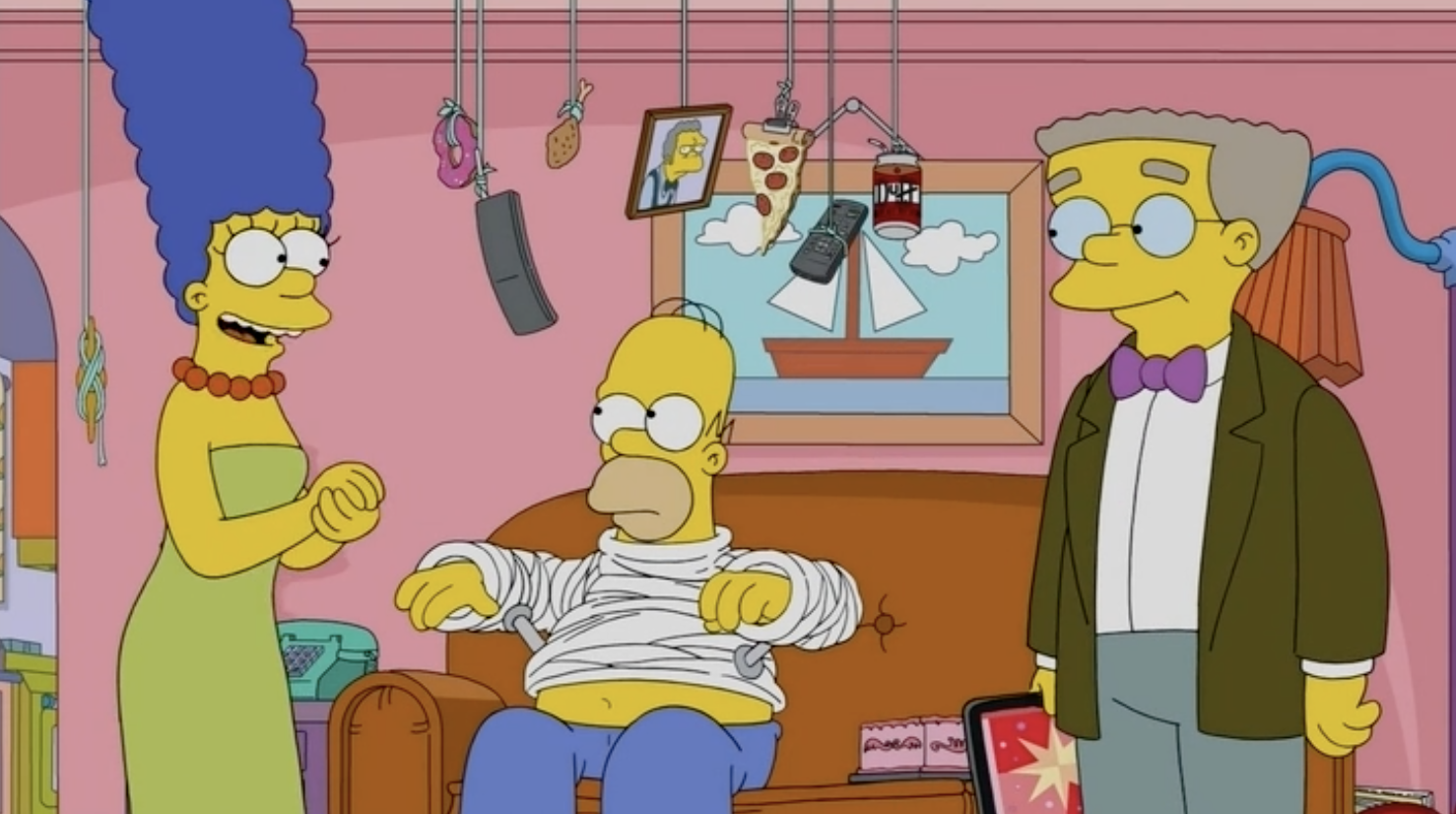
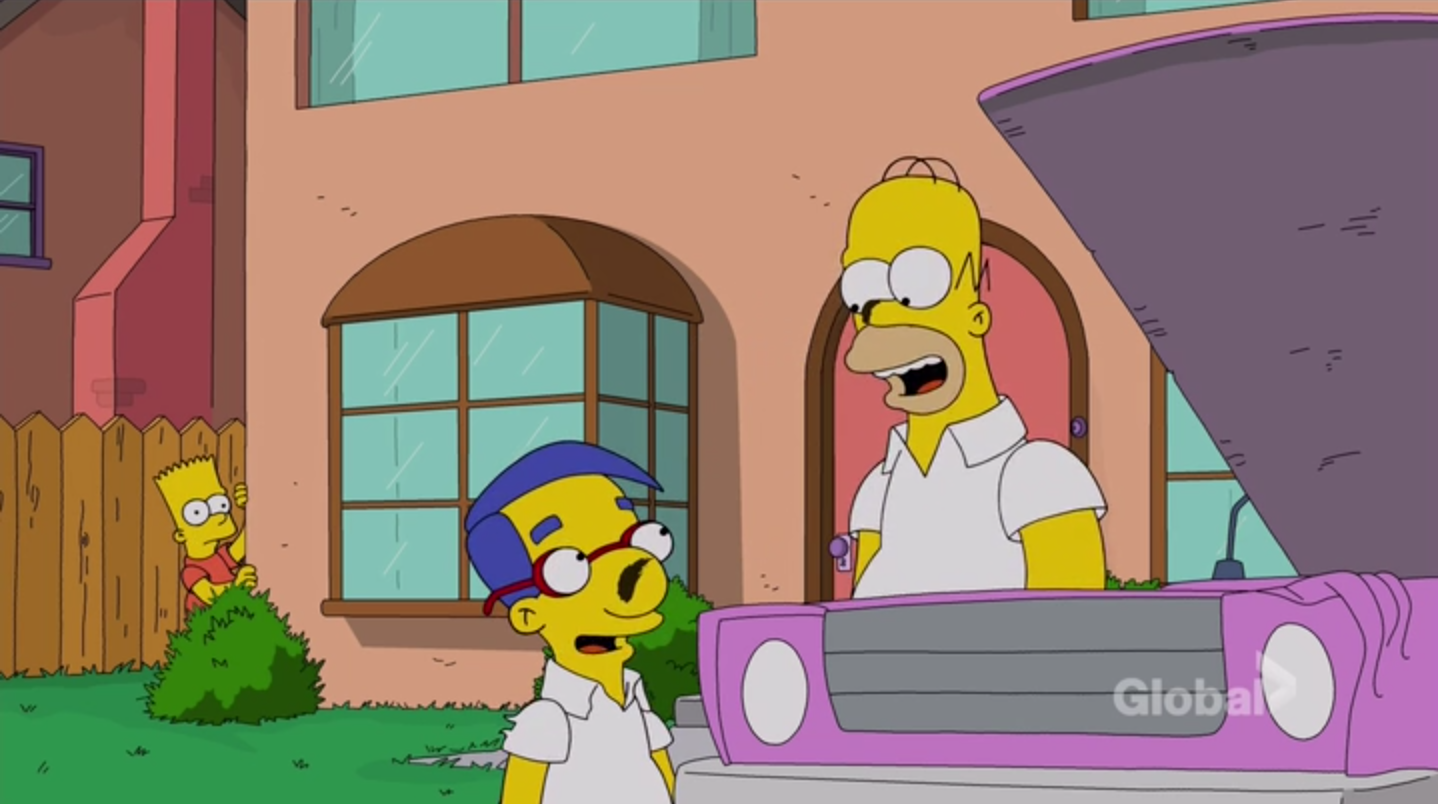
Mr. Burns befriends billionaire rapper Jay G, who teaches him the joys of recklessly overspending on extravagance. When Burns goes broke and Jay acquires all his assets, he devises his revenge with the help of Jay’s former band mates and his ex-wife.

The reaction: What’s another gimmick we can garner headlines with? An hour-long (forty minute) episode? Sure, let’s go with that. Unsurprisingly, this is a story that feels like it would have been just fine played out at normal length, artificially extended with redundant fluff and B-stories that go nowhere. It also features some of the most pathetically feeble Burns this show has ever seen. Things start off with him wanting to regain his youthful exuberance by throwing a party, which thanks to Smithers entrusting Homer to rewrite the guest list with living people, results in Burns’ summer house being filled with the usual Springfield suspects. Burns doesn’t seem to mind, and he throws a truly sad soiree, making the dancers wear foot cozies to a band of two people. The likes of Moe and Skinner ultimately chew him out for such a sorry display, and the night ends with Burns standing on his dock crying. And that’s not the first time he cries this episode. Burns is alerted to an actual happening party going on across the bay, so he and Homer investigate (from this point, Homer just inexplicably becomes Burns’ loyal right-hand man.) Said party is being held by rapper Jay G, who has Burns’ book on business to thank for his flagrant lifestyle. He teaches Burns the wonder of a platinum card with no spending limit, where we get a montage of the two going on a spending spree. They get flashy new outfits, Burns has his own posse… they stopped just short of giving him a gold grill. It’s episode summaries like these that make me wonder why I should bother writing an actual review. Do I need to tell you why this is out-of-character for Burns? But it turns out Jay G was purposefully trying to bankrupt Burns, and he takes everything from him, including the nuclear plant. The first half ends with Burns crumpling to a heap crying his eyes out. The very, very few times we saw Burns cry in the classic era were always very purposeful, and quite powerful. Now, it’s basically a joke for Homer to narrate over talking about how pitiful it is. Part two is Burns’ revenge scheme, where, after gaining insight into the rap game, he gathers together a team to write the “ultimate diss rap.” Yes, this is real. He records the likes of Snoop Dogg, Common, and other rappers in order to get Jay G back. I don’t quite see how this will reclaim his fortune, which should be the only thing Burns really cares about, but whatever. Jay G ends up paying off Burns’ artists and acquires his song, and in the end, it’s revealed the only reason he betrayed Burns was because he was following his book, where you must betray your master as the last step in getting ahead. Jay G is such a non-developed character that this revelation feels even more out of left field because we’ve had to wait over twenty minutes for it. It would still be a piece of garbage, but this episode would have definitely improved being normal length. But the show got its brief window of press for their one-hour episode extravaganza, and I guess that’s all that matters.

Three items of note:
– There are two separate disposable B-stories to pass the time, one in the first half, one in the second. During Homer and Burns’ misadventure, the Simpsons are stuck in the Hamptons for an indeterminate length of time, so we get to see what they’re up to. Story one features Lisa developing a crush on a snooty rich kid, and him trying to change for her. But that one sentence description is giving it too much credit. Scene one is him cutting in line, Lisa standing up to him, and him inviting her out because blah blah blah. Scene two is them on his boat, he abuses some whales, and Lisa breaks down. Scene three we see him as a changed activist, but Lisa defies his protest to get a chance to comb a pony. S’about it. Also the boy is Hank Azaria doing an adult voice, which struck me as very weird and creepy. By the second half the Simpsons have been in the Hamptons for so long, Marge opens her own crappy crafts store and starts to lose her mind, much like I am after watching so many of these episodes. These are the very definition of filler. They have zero connection to the main story, and they’re barely narratives themselves. Homer pops into Marge’s store twice and has no idea what’s going on and has no opinion of it, let alone the issue of how she’s affording it in the first place. Again, without this useless fluff, this could have easily been a tight twenty minute show. Well, relatively tight.
– Here’s a sizable mistake I’m surprised got through (well, not that surprised). Homer is in awe of Jay G’s beloved pet goose, and upon watching it eat, he says this: “He eats the same way I do: without swallowing!” I believe the word they were searching for was “chewing.” It eats without chewing. This line got through the table read, the voice-over record, and numerous test screenings, and I guess no one was paying enough attention to care (part of me doesn’t blame them.) On top of that, it’s effectively a repeat of the exchange from “Homer’s Enemy” where Lenny and Carl agree that Homer eats like a duck. So not only do they poorly recreate old jokes and bits, now they can’t even do it with the correct vocabulary.
– We get our cabal of guest stars in the second half, starting with Keegan-Michael Key as the latest extremely talented comedian to slum in through one of these shit scripts. He appears earlier on the Hampton streets as an unassuming candle vendor who exchanges words with Bart, then Homer helpfully butts in with narration (“So Bart met someone who I think comes back later. I forget why.”) Later, when he does reappear, the Homer narration returns (“Told yah this guy would come back! Told yah!“) We wouldn’t want audiences to strain their brains too hard about a complicated story point of a character reappearing later in the narrative without fully explaining it to them. Their brains might overheat! I shudder to think of what a modern “Who Shot Mr Burns?” would be like. Anyway, Key’s character is later joined by RZA, Snoop Dogg and Common (Homer has never sounded whiter reading out those names), who do their rap sections, then later stand in a row and say their one-off lines one after another. Taraji P. Henson also appears as Jay G’s ex-wife… sigh… Praline. Her character on Empire‘s name is Cookie. You get the joke? Empire is this huge critical and commercial success, and this is the extent they can parody it? It really is just so sad.

One good line/moment: It’s a pretty sorry state of affairs that even at forty minutes, you just get one giant goose egg (ha ha ha). I give points to Keegan-Michael Key for actually trying despite having no material, per usual. I always like listening to him, he’s a great performer.
607. Pork and Burns

Original airdate: January 8, 2017

The premise:
Homer gets Plopper the pig registered as a therapy animal. Meanwhile, Marge pushes a purge-happy lifestyle on the family, leaving Lisa so anxiety-ridden she gives up her saxophone.

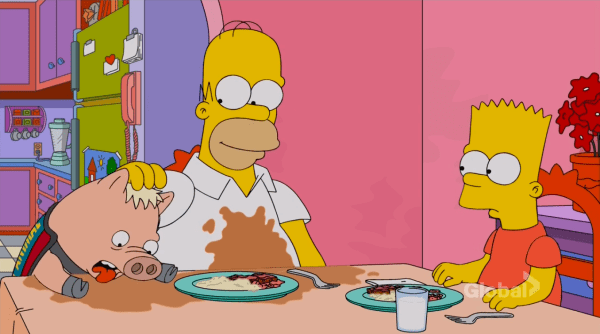
The reaction: It’s pretty obvious the only real cultural footprint The Simpsons Movie left behind was Spider-Pig, and in hindsight, I’m pretty surprised they didn’t try to ride the popularity of the character into the series in some way, aside from a brief cameo here and there. So, ten years post-movie, scraping the bottom of the idea barrel, we have our Spider-Pig episode. It turns out the piggy has had his own sty in the Simpsons backyard this whole time,  which would be pretty insulting if I didn’t care so little. Marge urges Homer to give away the pig, but he is resistant, going so far as to register him as a therapy animal. So he and Plopper are thick as thieves once again, which just begs the question: why did this take so long? It’s unclear how much time has passed since the events of the movie, but that doesn’t really matter. It’d be one thing if the joke was that Homer neglected this thing he liked and is now overcompensating because Marge pushed him to get rid of Plopper, but that’s not it at all. Homer loved Plopper in the movie, the pig was in the yard neglected for x amount of time, now he loves it again. No matter. Homer takes his beloved to a company picnic, where the hounds get loose and attack him. It’s a seemingly dramatic moment where the dogs really get their jaws into that poor pig, but once they flee, Plopper just looks slightly tired, and there’s a couple of weird rip marks on his back, looking more like torn paper than flesh. I’m not expecting to see a horrifically bloodied pig corpse, but what you’re showing me doesn’t make much sense. So for two times in three episodes, Homer is in prime position to sue Mr. Burns, but Burns counters to offer to heal the pig on his on-property medical center. Then Burns falls in love with the little porker, then Homer has to save him from Burns Manor, and Smithers lets him because he feels jealous. Yawn. Homer and Plopper are reunited, and I’m sure he’ll go right back to being completely absent for many years to come. I understand Plopper being used as desperate pandering to something from the show actually becoming popular, but ten years later? Who exactly is this for at this point?

Three items of note:
– The B-plot features Marge adopting the KonMari method of cleaning, going through each one of your possessions and determining if it gives you joy, and if not, throwing it out. Lisa takes this to an obsessive degree, completely clearing out her entire room save for her saxophone, but then she ends up second guessing whether she even enjoys that, turning her back on jazz altogether. You’d think that a crisis in faith like this would have demanded more screen time, but I’m sure that an entire episode of this would have been even more embarrassing. This feels like another passive aggressive Marge story, who seemingly didn’t bat an eye when Lisa cleared out her entire room and all her furniture, or do anything to rectify her daughter’s situation up until the very end. Bart does the heavy lifting, restoring Lisa’s love of music by playing her demo tape over the school PA. After that, we see Lisa playing air saxophone, with Marge standing in her doorway, asking, “Now what’s wrong?” She says this with a very forceful nature, like she’s fed up with her daughter’s complaining. Her daughter who threw away all her possessions and has been living in a completely empty room with no bed for at least a couple of days. She also had a panic attack in the middle of the episode, so I indirectly hold Marge responsible for that as well. In the end, it turns out that Marge never threw anything away and kept everything in a storage locker, including Lisa’s sax. Does that include all of Lisa’s furniture as well? What am I supposed to make of this? Why has Marge been kind of a bitch over the last few seasons?
– There’s a joke near the beginning that really confuses me. Bart thinks back to a prank he pulled on Skinner. After removing all of his car door handles, Bart pumps Squishee drink into his car after he gets in it, causing it to flood. As the car almost fills all the way up, Skinner laments, “Why did I wear Mother’s blouse today?” What’s the joke here? I honestly don’t know. Was he walking around in a blouse with his legs exposed, so the Squishee covering his bare legs make it even colder and more uncomfortable? That’s the closest I can get. Any other explanations are welcome. But don’t strain yourself over it.
– Homer has a Family Guy-esque cutaway fantasy when Marge mentions the Mayo Clinic, featuring mayonnaise jars as doctors. Yup. Mayo Clinic. Mayonnaise. This show has won hundreds of awards for its writing, and not only did this joke make it to air, I guess they were so tickled by it, they give it thirty more seconds at the end for the vestigial fourth act. Anything to kill time, I guess.

One good line/moment: BLANK.

606. The Nightmare After Krustmas


Original airdate: December 11, 2016

The premise:
Krusty renounces his faith to better reconnect with his Christian daughter, which is a huge win for Reverend Lovejoy, who was on the prowl for more converts during the holidays.

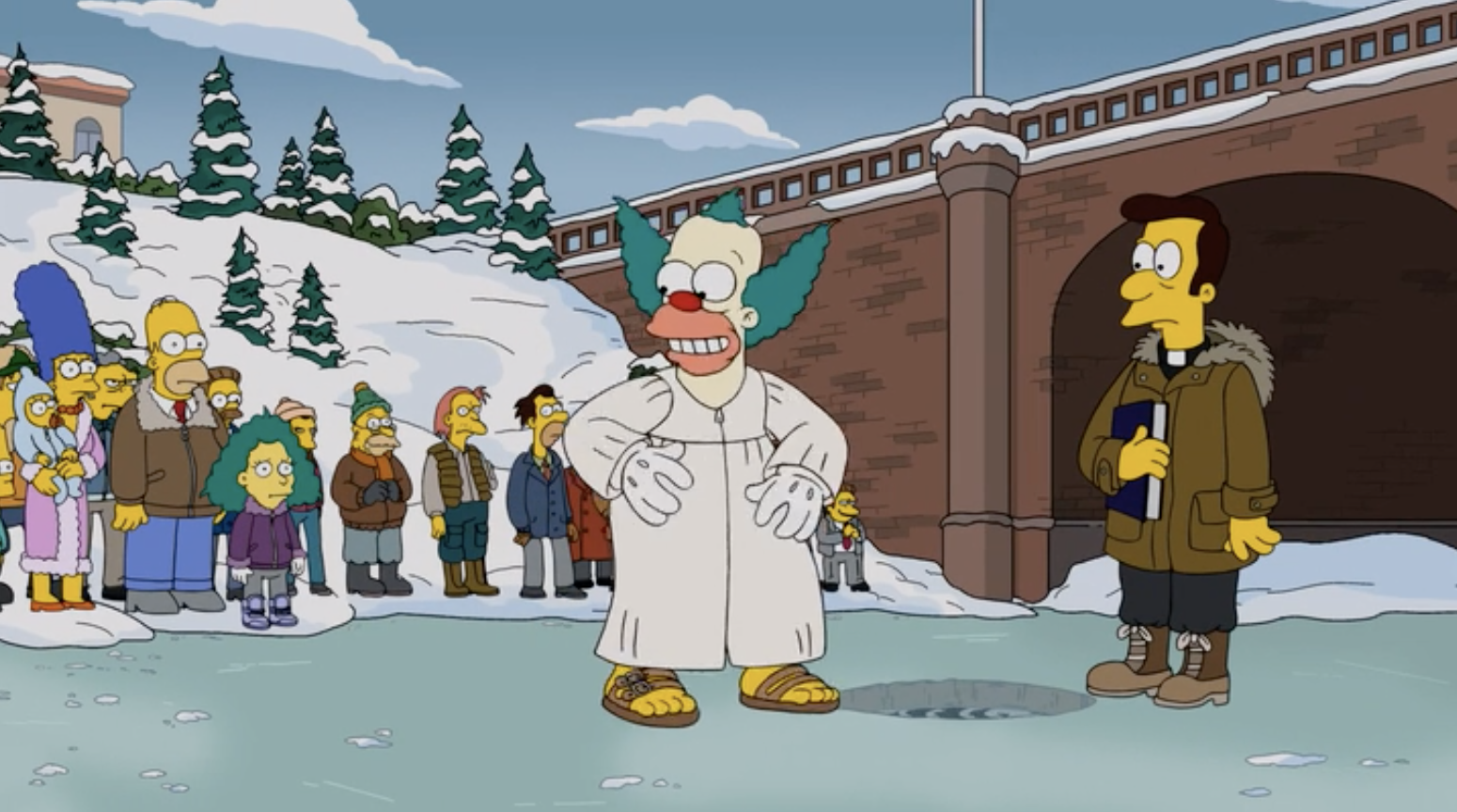
The reaction: This series began with a Christmas special, which directly took shots at famous holiday specials like Rudolph and Charlie Brown, while still providing a satisfying, sentimental (and fully earned) ending of its own. The only other Xmas special in the classic era was “Marge Be Not Proud,” a riff on “very special episodes” that plays a bit too straight, but is buoyed by amazing, unforgettable jokes and gags. From that point, it felt like we got a Christmas episode every year or two, seemingly an easy way to fill another slot on the schedule, and just like the rest of the series, they’re just become like any other show in terms of disregarding irony and subversion and playing stories straight to their inevitable sappy conclusions. And even that they can’t do fully coherently. So Krusty’s daughter Sophie returns (this time recast as Orange is the New Black‘s Natasha Lyonne), and he’s shocked to learn she’s a devout Christian. Following a hospital visit, Marge invites the two to their house for Christmas dinner, only for Krusty to use it to impromptu film a hollow, insincere holiday special in their home. This all happens incredibly fast and feels pretty out of left field. It seemed Krusty genuinely wanted to spend time with his daughter, and it’s not like this was his way of trying to connect with her. He’s just in full on show biz hack mode, but that’s not even the joke of it. Moving on, Krusty crosses paths with Lovejoy at Moe’s, who’s looking to add a few more sheep to his flock, so he decides to convert. From this point, Krusty and Sophie have no more dialogue together. She watches Krusty sermonize in church, she watches his TV show and then performs, but nowhere do these two actually talk about what’s happening or what they’re feeling. The finale featuring Krusty almost drowning under ice after rushing to be baptized in the dead of winter ultimately means nothing. And we don’t even get a concrete resolution. We get a musical Christmas outro where we see Krusty sitting with Sophie in the back of an “orthodox ambulance” as the Jewish EMTs put a yarmulke back on him. So I guess he’s Jewish again? What does Sophie think? Does it even matter? These episodes aren’t just safe and by the numbers, it’s like they have entire sections ripped out, so we’re missing character motivation, proper endings… but who needs these stories to actually mean something when you’re trying to bang out a script and go home early? Happy holidays, everyone!

Three items of note:
– I certainly wouldn’t call “Insane Clown Poppy” a classic (though it’s pure gold compared to this slop), but I remember the Krusty-Sophie dynamic being kind of sweet. Sophie wasn’t a super developed character, so I can’t complain about this reappearance feeling “off,” but she’s more a utility to this story than anything resembling a real person. But what was the important thing about her? The driving force of her debut episode all about her? Her violin. Here, she plays the French horn, with no mention of a violin, or anything from the last episode. I know it was sixteen years ago, but at least a throwaway nod to continuity would show that the writers at least give some kind of a shit.
– The B-story features Lovejoy being cornered by concerned members of the church and the Bing Crosby Parson (hate that guy) about raising membership. His story crossing with Krusty’s makes sense, I suppose, but I don’t get the accelerated ticking clock that the Parson has, goading Lovejoy to speed up his conversion, even if it means baptizing Krusty in the frozen river. Why? It’s just an artificial creation to set the stage for the final conflict.
– Jackie Mason voices Rabbi Krustofski as an Olaf hybrid in Krusty’s near-death experience (Krusty helpfully points out the “hacky parody of Frozen,” in case it weren’t clear enough). As we’ve seen with Glenn Close, even killing a guest character won’t stop them from dragging them back again and again. The ending also involves Jewish God debating with regular God (?) about whether Krusty’s baptism counted, so I guess the writers couldn’t figure out what the ending meant either. Then we get Krusty and Sophie in a sleigh ride singing a jaunty carol, passing by a guest star who appeared earlier who I had no idea who he was. Earlier he appeared with his gigantic art piece “The Strandbeest,” but I had no idea what any of it was. Theo Jansen is the artist’s name. Normally they have these guest stars introduce themselves by full name and list their credits, this felt like the exact opposite.

One good line/moment: As in “The Town,” this episode actually sports some decent animation in certain scenes with Krusty, first when he’s in his hospital bed, and later when he’s sulking at Moe’s. As with before, even though it’s a bit jarring in comparison with the normally stiff style of this show now, it was still enjoyable to see some actual acting employed, and in better effect than “The Town” too. Also, the C-plot featuring Maggie being terrified by an Elf on the Shelf knock-off was alright. My fiancee hates that little nightmare, so Maggie’s revenge in ripping it to shreds got to me.

605. The Last Traction Hero

Original airdate: December 4, 2016

The premise:
A tumble down Burns’ trap door leaves Homer in a body cast, and in prime position to sue. Smithers makes frequent visits to the Simpson house to convince him otherwise, and he ends up forming an emotional bond with Marge.

The reaction: This episode features the triumphant resurgence of inner monologue exposition. How would we know what the characters are feeling without them telling us word-for-word? Homer is the latest victim of Mr. Burns’ trap door, but it’s currently under construction, so he gets terribly injured falling face first into a cement mixer. This is another instance of taking a cartoony element of the show and twisting it to be “real.” They try to make a joke about it with Burns’ lawyer telling him the old trap door was perfectly legal because it was grandfathered into the property or something, but it still feels silly. You telling me all those poor schmoes who took the plummet before landed on soft pillows? With Homer mostly immobile, Burns sends Smithers to his house repeatedly to convince him to sign away his rights to sue. Eventually, he and Marge get to talking, and they vent about their complicated romantic relationships. So it turns out this was a Homer-Marge episode; before this, we saw that Marge was looking forward to spending more time with Homer, with her idea of fun being using Homer’s cast to help roll up electrical cords, and setting up a grid system to assist Homer in helping them put together a boring puzzle. Homer wasn’t being rude or abrasive or condescending, he just seemed disinterested in these activities, which I guess cut Marge pretty deep. It could have been incredibly easy to push Homer into an uncaring direction (marriage episodes from seasons 15-18 did it all the time), but I guess they just didn’t care. So, in talking over a couple days, Marge and Smithers form a bond… but then it turns out it’s a romantic one? Marge’s mind tells us so (“Oh my God! I want to kiss him!”) When Smithers leaves Marge hot and bothered, she leaps onto Homer and starts making out with him, but when she slips Smithers’ name, Homer’s mind takes over (“Wait a sec, Marge is getting her emotional needs filled by another man, and now she needs me for nothing but sex!”) Our happy ending involves Homer dropping the suit so Burns won’t keep Smithers from talking to Marge anymore, which really feels like not a solution at all. They probably would have won the suit and gotten a pretty penny, money to put into college funds for the kids, but I guess it was worth it if Marge has someone to expel her grievances to. This feels like that episode which had that “happy ending” of Homer not busting Marge for going to therapy. What happened to that? In the old days, we’d have Homer be such an insufferable ass that I never understood why Marge would stay with him. But too often lately, we see Marge can be pretty petty and passive aggressive herself. Everyone on this show is slightly unlikable, and that’s a big problem.

Three items of note:
– There’s a vacuous B-plot involving Lisa becoming bus monitor and the power going to her head. She videos the bullies beating up Milhouse with her phone, and eventually surmises that the way to keep order is to keep the like-minded students sitting next to each other with her carefully crafted chart. What insight! The nerds sit next to the nerds, and the bullies sit next to the bullies? Incredible! The only issue is that we see where the kids were sitting before the incident and after, and it’s basically the exact same. The only difference was Milhouse inexplicably sitting next to Nelson, which I guess he was cool with before the other bullies showed up. The scene of the bus fight and Lisa filming it echoed actual incidents that were filmed with kids really getting the shit beat out of them, and to use that as the impetus for this stupid nonsense B-story that ultimately says nothing feels pretty wrong. Also, when Lisa goes full authoritarian, she has a fantasy of her being Big Brother (er, Sister) to her bus drones and Bart throwing a mallet into her giant screen a la that Apple “Think Different” commercial from the 1980s. What an old reference. It was better when Futurama lampooned it over fifteen years ago (“Hey, we were watching that!”)
– The opening features Homer parking in Burns’ spot when he’s out for the day, and by that logic, he figures he can just take over Burns’ whole life. Makes perfect sense to me. We see that Burns has a button in his office that triggers a full recreation of the Enchanted Tiki Room to play, and I’m not sure what the joke is supposed to be. LOL random humor? Also, we see Burns is at a reserve with other billionaires to do some recreational hunting, specifically quails. Considering the tired references this show pulls, I’m shocked they didn’t do a Dick Cheney joke with him accidentally shooting Rich Texan in the face or something.
– There’s a weird joke in the show that I both don’t understand, and also serves to further undermine the emotional conflict. Marge’s puzzle is “Foggy Day in Berlin,” which for some reason triggers a black and white fantasy of a German woman opening her overcoat to Homer, beckoning him to “complete the puzzle” (actual pieces are missing from her body.) Homer instinctively recoils, “But I’m a married man!” Then she makes some joke involving a German spank bank and the fantasy turns into a zeppelin that pilots into Homer’s ear (don’t ask.) Out of the dream sequence Homer says, “Marge, I don’t think we should do this puzzle!” This is a stupid tangential joke, yes, but it shows that even in his fantasies, Homer would never dream of being unfaithful to Marge. So that makes Marge bitching about Homer and wanting to lock lips with Smithers seem even more unjustifiable. It’s not just poorly set up, they create scenes that directly go against what they’re going for.

One good line/moment: BLANK.

604. Dad Behavior

Original airdate: November 20, 2016

The premise:
Homer uses an app to outsource his fatherly responsibilities, leading Bart to bond with NFL quarterback Matt Leinart. Jealous, Homer bonds with Milhouse. Jealous again, Bart bonds with Kirk. Meanwhile, Abe knocks someone up and prepares for fatherhood, again.

The reaction: Our latest episode to be horribly remade is “Brother From The Same Planet,” where Homer and Bart gain new son/father figures. Homer discovers a Postmates-type app that allows him to hire people to do the jobs he would rather avoid, which ends up including hanging out with his son. Inexplicably, Bart is paired with Matt Leinart, a famous football player who delivers lines and I don’t know if there are inside jokes I’m supposed to think are funny. When Homer sadly sees the two of them throwing the ball in the yard, we cut to him hiring a surly kid to do the same, and my mind immediately went to Tom and Pepi. We even get a scene of Bart being suspicious of where Homer’s going like a jilted lover, a role reversal from “Planet.” Only now, the absurdity is gone. Boundary-pushing jokes like Homer channeling Richard Burton or Bart equating him faking excitement on the swings to a woman faking an orgasm are replaced with Homer and Milhouse playing with car oil, and a bunch of vacuous dialogue explaining how characters are feeling. Homer watches Bart and Leinart and is sad and says he wants that. Bart watches Homer and Milhouse and is sad and says he wants that. It doesn’t get any deeper or more involved than that. Even though Bart bought him from the app, he’s discouraged to learn that Leinart is only being nice because he’s being paid to, so he just disappears, and Bart wanders into Kirk’s garage and starts hanging out with him. There’s no explanation for why these characters like spending time with one another, what one provides the other emotionally like in “Planet.” Again, this show is just “stuff happens for twenty minutes.” In the end, the Simpsons and Van Houtens make up because the episode is over! This season is just a fucking disaster. Every time it seems like the show hits bottom, it just keeps managing to burrow deeper. Dig up, stupid! Dig up!

Three items of note:
– We begin with a rather bizarre variation to our opening credits. Events break formation when Bart launches out of the school, lands on top of Barney covered in leaves, but then he gets up and angrily breaks Bart’s skateboard in half. The other Simpsons fare even poorer: Homer gets the carbon rod lodged in his throat and he collapses, Lisa bangs her head against the door frame leaving the music room and is knocked out cold, and Maggie ends up behind the wheel, driving the car into a river, sinking it, as Marge’s limp corpse surfaces. In the end, Bart sadly walks into the living room, wondering where everyone is, and arranges four family portraits of his fallen family members to sit on the couch with him. What is the tone here? Is this supposed to be funny, or sad, or what? This show certainly doesn’t have the chops to do dark humor anymore, if that’s what they were aiming for. If I wanted an opening where the family gets horribly killed, I’ll just watch “Treehouse of Horror IX” again.
– If any further proof was needed that this show no longer cares about its characters or maintaining any semblance of realism, Abe getting a woman pregnant is relegated to a scant B-plot. It’s revealed at the start of act two: Homer goes to visit his father to talk about Bart. It seemed like this show was going to be examining bad fathers, Abe to Homer begets Homer and Bart. But then Abe just throws out a humdinger (“I got a real problem here! I’m gonna be a father again! My girlfriend’s pregnant!”) Apparently through a senior dating app, Abe met a woman, fucked her and impregnated her within the span of six months. Following this, this story is only worth two more scenes. Abe complains to Marge that he can’t be a father given how much he screwed up on Homer, then seeing his son and Milhouse (he thinks it’s Bart) fishing, he resolves that maybe he didn’t do such a bad job. In the third and final scene, he goes to the woman’s house, and she reveals the kid is actually Jasper’s, through a hilarious ultrasound of the baby with a giant beard. This woman has no name, by the way. But why should she? Nobody seems to give a shit about this situation. The only two lines Marge says during her scene set up jokes for Abe, and then later, Marge talks to her husband about why he was hanging out with a boy that’s not his own son, instead of his geriatric father about to have another kid. Although reading that back, both scenarios are pretty alarming. But if the characters in the story don’t care about what’s happening, then why in the hell should I?
– Act two opens with Kirk orchestrating some kind of prank for Milhouse to film for America’s Funniest Home Videos (is that still a thing?), which of course goes horribly wrong, ending with Luann running him over with her car. From there, we go to Homer visiting his dad, then back to Bart playing monopoly with Leinart. I really wasn’t sure what that orphaned Van Houten scene was doing there, as it didn’t seem to connect with anything. But four minutes later, we finally get Homer and Milhouse bonding and I guess that’s what it was supposed to set up. But there’s no real logical lead-in to this. Milhouse didn’t seem all that discouraged by Kirk’s shenanigans, and there’s no real reason for Homer to take a shining to the kid. As usual, they just didn’t even bother.

One good line/moment: When Homer discovers the joys of ChoreMonkey, we get a quick montage of his army of helpers filling in for him set to a cover of Steely Dan’s “Dirty Work” sung by Homer. Points because I love that song, and it actually makes sense in context.