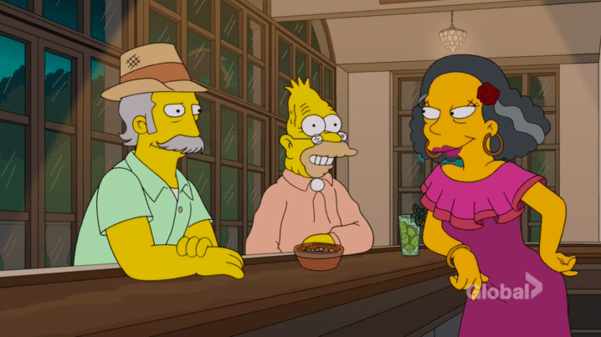
603. Havana Wild Weekend

Original airdate: November 13, 2016

The premise:
The Simpsons take Abe to Cuba in seek of better medical care. He ends up thriving in his new environment, and opens up a night club with an old Air Force buddy.

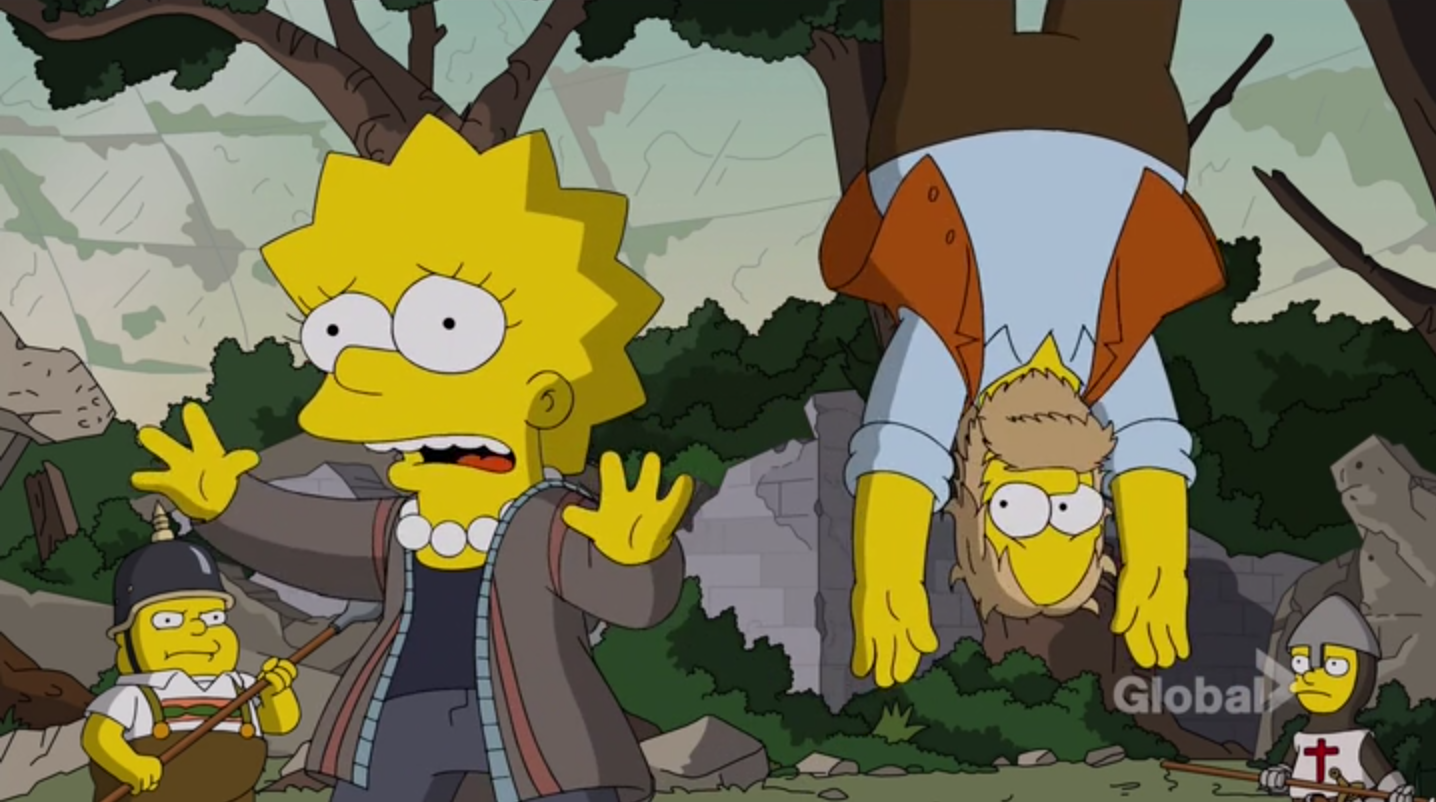
The reaction: For as much over explanation and excess exposition this show spews on a weekly basis, there are also many points where important details are barely discussed at all. Take our first act where the Simpsons are alerted when they find out the urine stain on the rug actually came from Abe. He appears tired and weak, sort of, through the rest of the act, and that’s about the extent of his condition. Doctors keep saying, “There’s nothing I can do,” without really talking about what’s wrong with Abe or why they can’t do anything. At the VA hospital, a helpful stranger walks up and just starts talking about finding health care in Cuba, so it’s off to Cuba then! There, a local doctor tells Abe there’s nothing he can do like everyone else. Can this be elaborated on a little more? But whatever, this plot “resolves” when Abe spies a classic 50s car and is twinged with nostalgia. Its owner offers to drive him around, and then he feels as good as new. The driver gives a long-winded explanation for this (“All our American cars were built before 1960, and studies show that exposure to objects from your youth can help you feel young again! A professor, Ellen Langer, did a study where seniors, exposed to culture from the 50s, became more vigorous and engaged!”) I had to write all that out just to show yes, that’s an actual, very real, very long piece of dialogue. It even cites a fucking medical study! This show is literally incapable of telling any story without painfully explaining everything that’s happening. Where are the jokes? We’re halfway through the episode by now, is this the point of the episode? Abe reveling in the past? Didn’t we just have this with the subplot last season of him hallucinating old memories thanks to new pills? From there, he randomly meets an old Air Force buddy who convinces him to open a night club out of an old plane, and has an affair with a hot waitress. Then a bunch of stupid shit happens that’s inconsequential. Are we supposed to care about Homer leaving his father behind? That this new woman might break Abe’s heart? None of that matters. There’s no build, no purpose, it’s just a bunch of stuff that happens played in sequence that robs you of twenty minutes. Why am I still watching this? Am I out of my freaking mind?

Three items of note:
– It’s pretty incredible when the show retreads old jokes, because it presents the most clear-cut examples of how far things have fallen. The scenario: Homer arrives in Cuba and must declare his purpose of visit. “The Trouble with Trillions” featured this in the form of a checklist with three boxes: Business/Pleasure, Smuggle Cigars, Assassinate Castro, of which Homer checks all three. This scene takes eight seconds. Clean, succinct, and no dwelling. Get in, get out. This episode nearly twenty years later features the same set-up, but the customs agent reads a now inflated eight reasons aloud to Homer as he responds to each one. Meanwhile, a bunch of shady-looking characters walk very slowly past her guard in the background. This whole bit takes thirty seconds, with ten more seconds added on with Lisa piping up with her “journalist” credentials to get them in. There’s plenty of ways I could cross-examine the differences between these two approaches, but the most glaring is the lack of confidence. The show in its prime was so dense, not willing to waste any time when they could be plugging in more jokes. The show now is perfectly content with extending a sequence as long as possible to drag things out, pad out as much as possible to get to that sweet, sweet running time.
– Again, “Trillions” in a mere minute or two gave us lots of great jokes in Cuba, from the adorable child serving donkey meat, street boxing whilst chomping on huge cigars, and the Che Guevara Duff billboard. Here, our Cuban adventure begins with Ricky Ricardo and Fred Mertz randomly appearing on the ship, who then appear randomly throughout the episode. I Love Lucy is a contemporary reference, right? Homer also watches Castro speeches on TV, which kills more time. Did Cuban television rebroadcast those after he was out of power? I dunno. He died a few weeks after this aired, so that’s interesting, I guess. Maybe.
– The ending involves the waitress actually being a CIA agent, who takes to the cockpit of the plane/nightclub to fly it back to America. The plane is filled with fugitives wanted by the United States, but they all just showed up by happenstance. Abe’s Air Force buddy wasn’t looking to open a safe haven, or attract notorious clientele, they just sort of showed up and he introduced them to Abe. Calling this a deus ex machina is an insult to the term. It’s made even worse that there was an attempted build-up, sort of, in that she knew Abe’s name before she met him, which connected to later when Homer goes to the US Embassy and it’s revealed that all AARP cards are monitored and tracked. So that was their big set-up and pay off? Do the writers think they did a great job with this? Is this their version of a slam dunk? How fucking inept are these hack frauds? Boy, I’m getting punchy.

One good line/moment:

602. There Will Be Buds

Original airdate: November 6, 2016

The premise:
Homer is roped into helping Kirk Van Houten coach kiddie lacrosse, and gets increasingly annoyed by his clingy friendship.

The reaction: This show has grown and changed so much over the years (all for the worse, of course, as exhaustively covered here), but the worst sin of all is something this episode seems to exemplify. From the outset, the primary goal of the series was to take the piss out of the most popular television at the time: the sitcoms of the 1980s. To twist all of the hollow, vacuous conventions of these insipid time wasters, subverting audience expectation in a magnificent display of creative storytelling. But as time marched on, and the TV landscape changed, The Simpsons ended up changing with it. As we’ve seen, this show has many a time embraced many different sitcom conventions it used to make fun of. Episodes are peppered with attempted bait-and-switch gags or the occasional “edgy” joke, but stories and the characterization fueling them have now become incredibly transparent and simplistic, with easily illuminated plot turns and conclusions (if any). This episode feels like the ultimate example. With a little bit of space added for a laugh track, this script could easily be turned into a live action CBS “comedy.” Here we have Homer being paired with insufferable dweeb Kirk, who introduces the concept of lacrosse to Springfield. Everyone, including the kids, are totally on board with this. Bart and Lisa are super psyched about this new sport, and look up to their beloved “Coach K” through the whole episode. Meanwhile, Homer isn’t so taken with Kirk’s penchant for rice sandwiches or Big Bad Voodoo Daddy, and it doesn’t take long before his secret resentment gets out. So Kirk goes missing, but it’s the championship game! The kids need their coach, and time is running out! The kids and the townspeople chant “Save Coach K!” as sappy music plays, all completely irony free. The “joke” on top of this is that Kirk is at a strip club, so I guess that’s the show thinking they’re still being subversive (more on that later). Homer makes amends with Kirk and the kids win the game, and wow, everything about the third act feels completely anti-Simpsons. Bart and Lisa act like over excitable teevee children, Homer gives an inspirational speech to Kirk played completely straight, and they make their triumphant return to the field like something out of a TV sports movie for kids. A lot of the tent poles of this series have turned to mush, and these problems have been present for a while now, but for some reason, this episode really exemplifies the state of this show now. It’s an overused quote, but it kind of fits: you either die the hero, or you live long enough to become the villain. The Simpsons is just another safe, predictable, nondescript sitcom, not much different than the ones the show was born in retaliation of. And if you ask me, that’s pretty fucking depressing.

Three items of note:
– Whenever the show introduces a “new” idea, it always ends up feeling like an advertisement for it. Kirk spends a good minute playing up lacrosse and talking about how it’s played. Is it that radical a concept? My high school had a lacrosse team, it’s not like it’s a brand new sport. And it’s not even that the joke is Springfielders are a bunch of dense hicks. They’re won over almost immediately, but unlike previous iterations of mob mentality, there’s no real reason for them to be. Why do all of these people, many of whom are childless, give a shit about little league sports? It reminded me of that awful “Boys of Bummer” episode where the whole town was out for blood when Bart bungled a game, but at least there, I could tell there was an attempt (and failure) of satire. Here, it’s just played straight. No jokes, no additional layers, no irony. It’s just a normal story. How sad.
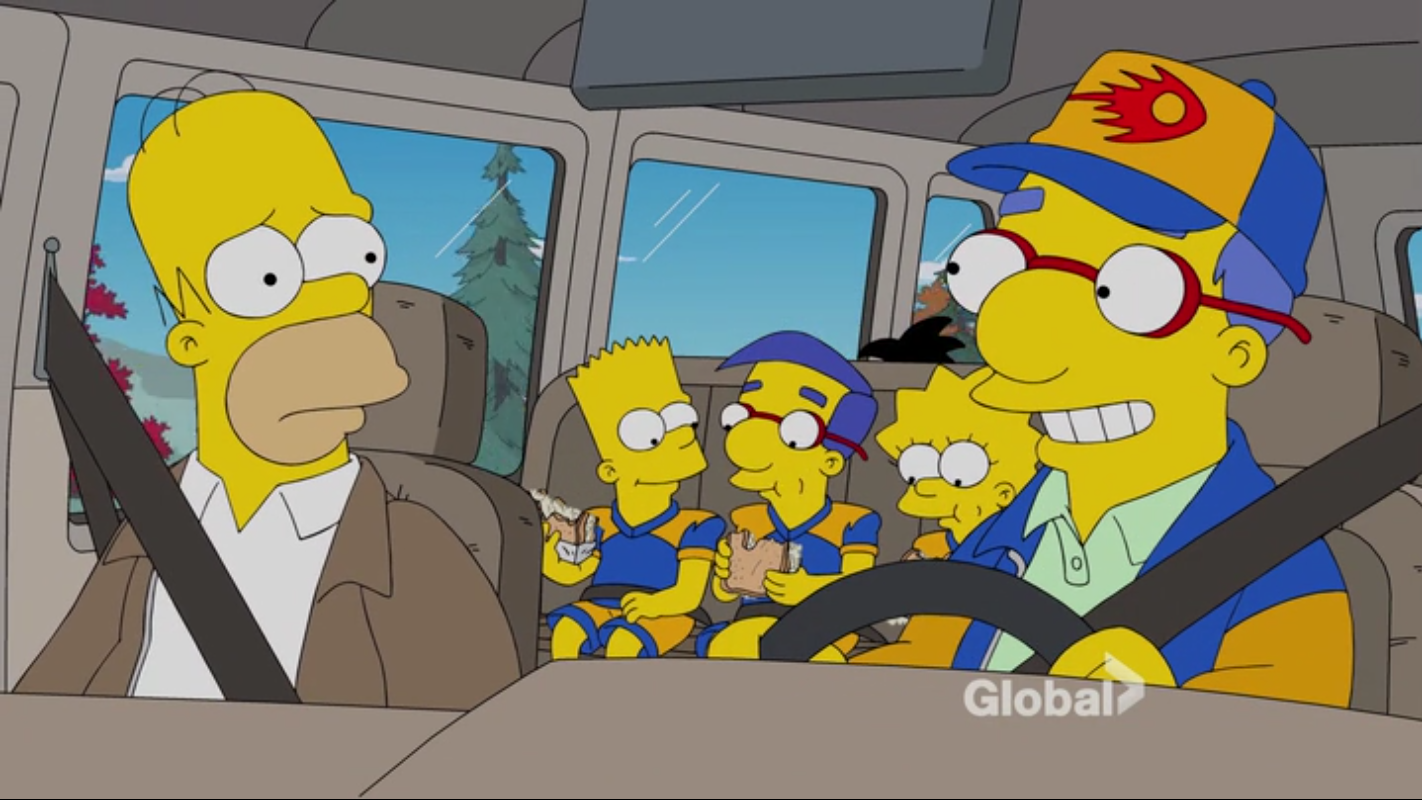
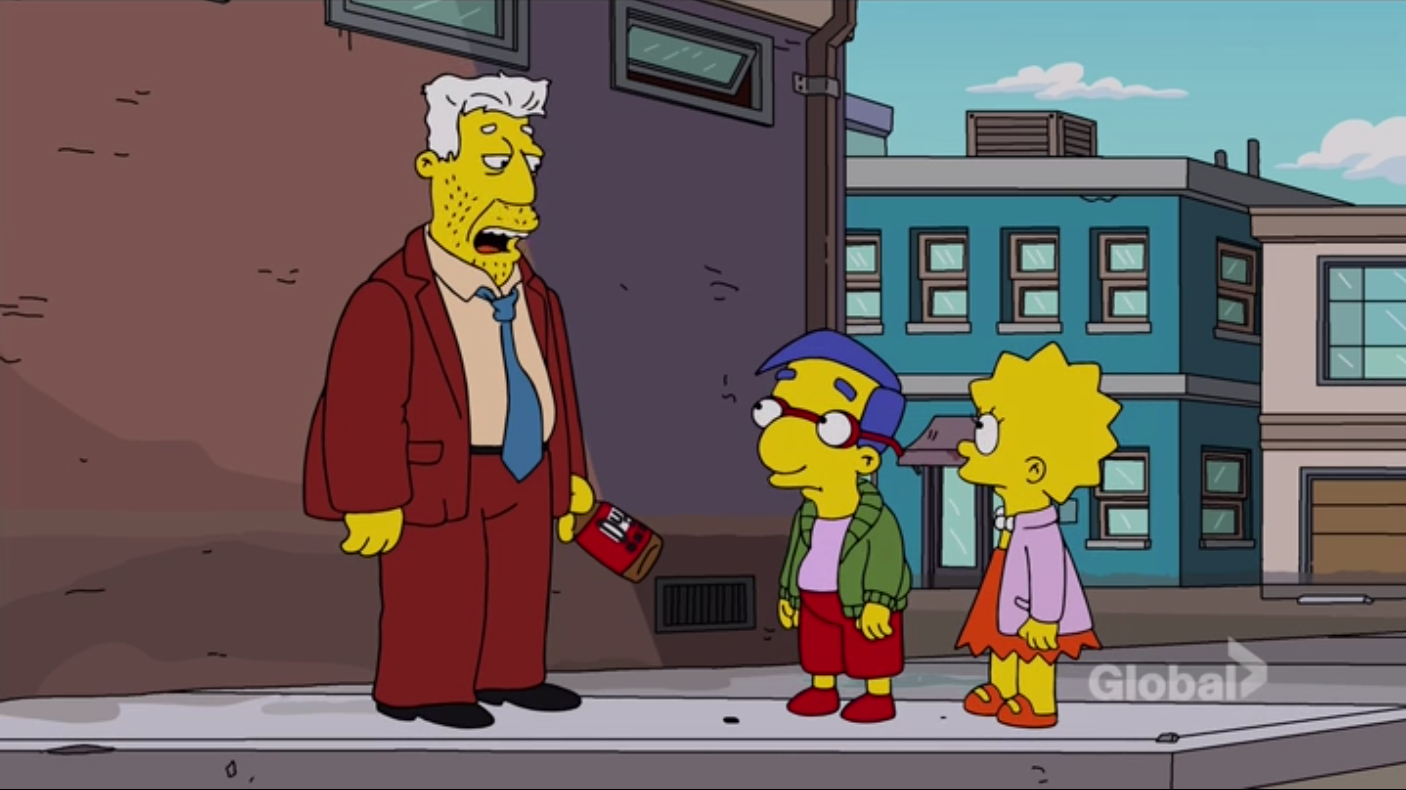
– I guess this episode is supposed to examine Kirk’s character a little more, and what I’ve learned is that he’s a bit of creep. Driving the minivan of kids, Kirk offers Homer a vape pen, and then asks him what’s the weirdest place he’s ever fucked Marge, with their kids well in earshot. Then later he invites him to come with him to a strip club. So this kind of muddies the waters of the story: Homer’s gripe is that Kirk is a big lamewad, but then there’s this skeevier stuff where Homer is clearly uncomfortable with Kirk’s behavior. Then we get to the very end, after this build-up of Kirk being into strippers, but it turns out he just pays to just talk to the dancers. So if the point is that he just needed someone to talk to, and that someone he thought was Homer, why would he be pushing him to come with him, and why wouldn’t he just say why? Also, what’s the story with him and Luann? The writers spent almost ten seasons loving writing material for pathetic loser single Kirk, and even now that they reunited him with Luann, it’s like they just can’t stop. He can’t have a conversation with his wife so he pays to talk to strippers? That’s pretty fucking pathetic and gross.
– This show was written by Matt Selman, who has acted as show runner on occasion for a handful of years now. I’m not entirely sure what the deal is with his standing, but I guess they just have him supervise one episode a season? Going on seventeen years, Al Jean’s been show runner longer than the entirety of all the other show runners, and you can really feel that stagnation. Why not have Selman supervise over a third of the season? I don’t get why it’s just like one or two. I can’t seem to look up anything about this in my very, very brief attempt at research, but it doesn’t really matter. I feel like I’ve seen some folks at No Homers praise the Selman shows, but while they might have a slightly different feel to it, it’s all the same pile of shit at this point. Along with this dumpster fire, Selman’s penned such classics as “The Food Wife,” “Husbands and Knives,” and everybody’s favorite, “That 90’s Show,” so you can draw your own allegiances.

One good line/moment: I hated this episode. Really hated it. I feel like retiring this section. Initially it was like a sign of good faith that deep within the shit, there was some good in each episode, no matter how small or fleeting. And that may be true in some cases, but really, what does it matter? A choice smirk or brief chuckle is meaningless in the face of twenty minutes of putrid junk. If I get a surprise laugh or enjoyment out of something that really catches me off guard, I’ll put it here, but if not, I’m just leaving it blank.

601. Trust But Clarify

Original airdate: October 23, 2016

The premise:
Lisa discovers Krusty’s latest line of snack chips contain harmful toxins, and the only person who will hear her out is a recently fired Kent Brockman desperate for a scoop. Meanwhile, Homer buys a new suit in the hope of getting a promotion.

The reaction: Episodes nowadays barely have one story to hang on, so it’s weird to see an attempt to do three at once, and unsurprisingly none of them seem to really go anywhere. Our first scene features Krusty hawking his latest snack treats and Bart eating them up, literally. Scene two shows Homer being jealous of his co-worker Tibor’s promotion (actually seeing him makes the joke of his character far less funny.) Scene three is Kent Brockman on a talk show taking credit for heroics done in a combat zone in Iraq that he just made up. At this point, I wasn’t quite sure what was going on, and as the episode continued, we just flip-flop around between these three stories. Each scene feels like a completely different episode, and there just isn’t enough time to make any individual story feel worthwhile. The most superfluous of the three is Homer’s ambition trip. He buys a suit, wears it to work, acts cool and confidant toward Burns, only to have it fail miserably. And that’s it. Meanwhile, Brockman looking for work and Lisa looking for someone to hear her out about the questionable Krusty kandy are completely disconnected up until the end, and it really just feels like waiting out the clock until we get to the predictable conclusion. Kent Brockman and his struggles to deal with new media could have been interesting, and despite it being the most focused story, it still feels very scant and condensed, like it was composed of scraps left over from “You Kent Always Get What You Want,” and his mini-plot line from “Four Regettings and a Funeral.” He even fields an offer from FOX News, a joke they already did in that episode. That’s not much to really say about this one, not a whole lot really happens in it. Mmmyep.

Three items of note:
– Harry Shearer is the credited writer here, which is a little odd, given the big hoopla from the previous year with him announcing he was leaving the show. That was a very interesting period, as Al Jean made it clear they were open to recasting, and I felt like new voices for Burns, Smithers and the rest would potentially be the last straw for those few diehard fans left. But I don’t even think that would be enough to get FOX to pull the plug. Maybe an option to write was part of Shearer’s new contract, though I imagine he had that allowance before. So I don’t know what the story is. But, of course, I’m sure whatever he wrote was ripped to shreds and pieced back together with cheap bubblegum like every other episode, so it doesn’t really matter at all.
– More empty satire comes in the form of The Late Late Late Show with Jimmy Jimmy, the talk show that Brockman goes on where his lies eventually get exposed. They both do a comedy bit, a self-described “pointless Internet sensation,” and then they just do a talk show segment where he asks Kent questions. So the jokes are that lots of late night hosts are named Jimmy, and that they’re kind of superfluous? There’s so much more you can mine from that territory, especially with the comedy black hole that is Jimmy Fallon, but as usual, they don’t even try. Also, curiously, the episode ends with Jimmy ruffling Brockman’s hair in similar fashion to Fallon and Donald Trump, which only happened a month before this aired. That feels even more aggravating to me, especially watching it in hindsight. That cutesy normalization of a dangerous, power-hungry narcissist, boiled down to an empty reference. Hey, I recognize that thing! Ugh.
– Bart and Lisa break into Krusty’s food manufacturing plant, only to surprised by a facility devoted to organic, clean growing. But when Bart hits a button labeled “Hit When Inspector’s Gone,” the scene before them is revealed to be just a curtain, opening to reveal the actual factory, which is as poor as you would expect. Jokes like these feel especially cheap, and there have been plenty of them over the last fifteen years or so. The show had never been firmly tied down to reality, and we’ve seen plenty of crazy “cartoony” jokes in the classic years, but never at the loss of the believability of the characters. When this gag happens, all I can think of is that, Bart, and especially Lisa, seriously couldn’t tell they were looking at a painting on a curtain? From that point, I equate their intelligence level to Wile E. Coyote. This show is now littered with moments like this of characters falling for things, believing stuff for no reason, going along with things apropos of nothing, all which make them feel less like real people and more like malleable cartoon characters who will think and do what we tell them.

One good line/moment: I watched this episode almost a week ago, and I don’t feel like scanning through each scene to find one line that I slightly smirked at for this section. I hope you understand.

600. Treehouse of Horror XXVII

Original airdate: October 16, 2016

The premise:
“Dry Hard” is a Hunger Games “parody.” “BFF R.I.P.” features Lisa’s imaginary friend killing people out of jealousy. “Moefinger” is a Kingsman “parody.”

The reaction: Treehouse of Horrors nowadays are usually just condensed would-be parodies of non-horror movies, but now we’re at the point where they’re a hodgepodge of multiple movies at once. The first segment features Lisa as Katniss in a Hunger Games-style Springfield fighting for natural resources from the all-controlling tyrant Burns. This show already did a parody of this franchise back in the LEGO episode by mocking the love triangle, and they do it again here too, and it’s just as limp (“My name is Pita, like the healthy bread!” “My name is also Peta, like the animal rights organization!”) When Lisa convinces everyone to just go after Burns and reek hell, then it becomes Mad Max: Fury Road with everyone in their souped up vehicles and people tied to those waving staffs. References! The third segment puts Bart in Moe’s secret service society, a la Kingsman. I guess if they consider Mr & Mrs. Smith appropriate Halloween material, why not this? The first half consists of Moe expositing endlessly to Bart about who they are, what they do, what their mission is… yawn. Then Homer turns out to be the villain, who looks like Blofeld from James Bond, and Bart engages in a big action set piece with him killing a bunch of people. I guess they’re trying to riff on the big action sequence in the church from the movie, but does “parody” mean you take an amazing scene and make a worse, less engaging version of it? The second story actually had some potential in its idea: people closest to Lisa getting killed and her being under suspicion for the murders. But any tension or intrigue is ruined by overexplanation per usual (“Oh, no, she’ll kill Mom! What do I do?”) These specials were once so imaginative, a once-a-year respite from the limitations of the normal series to try something different. Now, they’re filled with the same debilitating problems as every other episode. But this isn’t new. None of this is.

Three items of note:
– The opening features the Simpsons facing down their various main antagonists: Sideshow Bob, Kang (or Kodos), the ghost of Frank Grimes, and the crazy leprechaun for some reason (how random, they haven’t used him in almost a decade.) I’ve talked before about how lame and cartoony it feels for the Simpson family to have arch rivals, but I guess this is what counts as fan service these days, milking another laugh out of Homer not remembering who ol’ Grimey is. Maggie instantly kills the three live characters because that’s her schtick, and Grimes watches in horror as the screen fills with all 600 episodes playing at once (“In hell, they make you watch all of them in a row!”) The latter two-thirds, yes. Then we get a second intro, our couch gag, “Planet of the Couches,” which I think the show has done already. Ah, whatever.
– The first segment features authoritarian Burns hoarding all the water for himself, and during his broadcast to his lowly subjects, he continually wastes it in a multitude of ways, culminating in him doing an extended tribute to Flashdance with him dousing water on himself leaning back on a chair. I liked it better when Willie did it. I feel like this is going to be a very shitty season for Burns.
– The episode ends with a rearrangement of “Goldfinger” called “600,” as the show flaunts its latest meaningless milestone (remember when they used to make fun of those?) It ends with a scroll of shows that were “so very bad” over their lifetime on FOX, ending with The Critic and Futurama just to get people’s dander up. Al Jean’s credit warns, “You’re Next, Gunsmoke.The Simpsons is currently the longest-running primetime series, but it needs to get past show #635 to have the most actual episodes, which they will hit come season 30. My thought for the last few years is that’s when they would finally stop. 30’s a nice round number, and they’d have finally beaten that last record. But, really, why stop now? FOX seemingly doesn’t see the need to quit at this point, so I honestly don’t know. As grim as it may be, part of me feels the only thing that would halt the show now is the death of one of the core six cast members. I mean, how much worse can this series sink? Once I think it hits bottom, it keeps plumbing those depths. Well… I guess we’ll find out, won’t we?

One good line/moment: The second segment actually had a few alright lines (“The only invisible killer I believe in is God,”) and Lisa’s imaginary friend suffocating Milhouse with his plastic baggie was actually kind of disturbing, which happens very infrequently in Halloween shows of late.

599. The Town

Original airdate: October 9, 2016

The premise:
In the midst of a heated Springfield-Boston football rivalry, Bart’s Beantown allegiance infuriates Homer, prompting him to plan a family vacation to Boston to convince his son the town sucks.

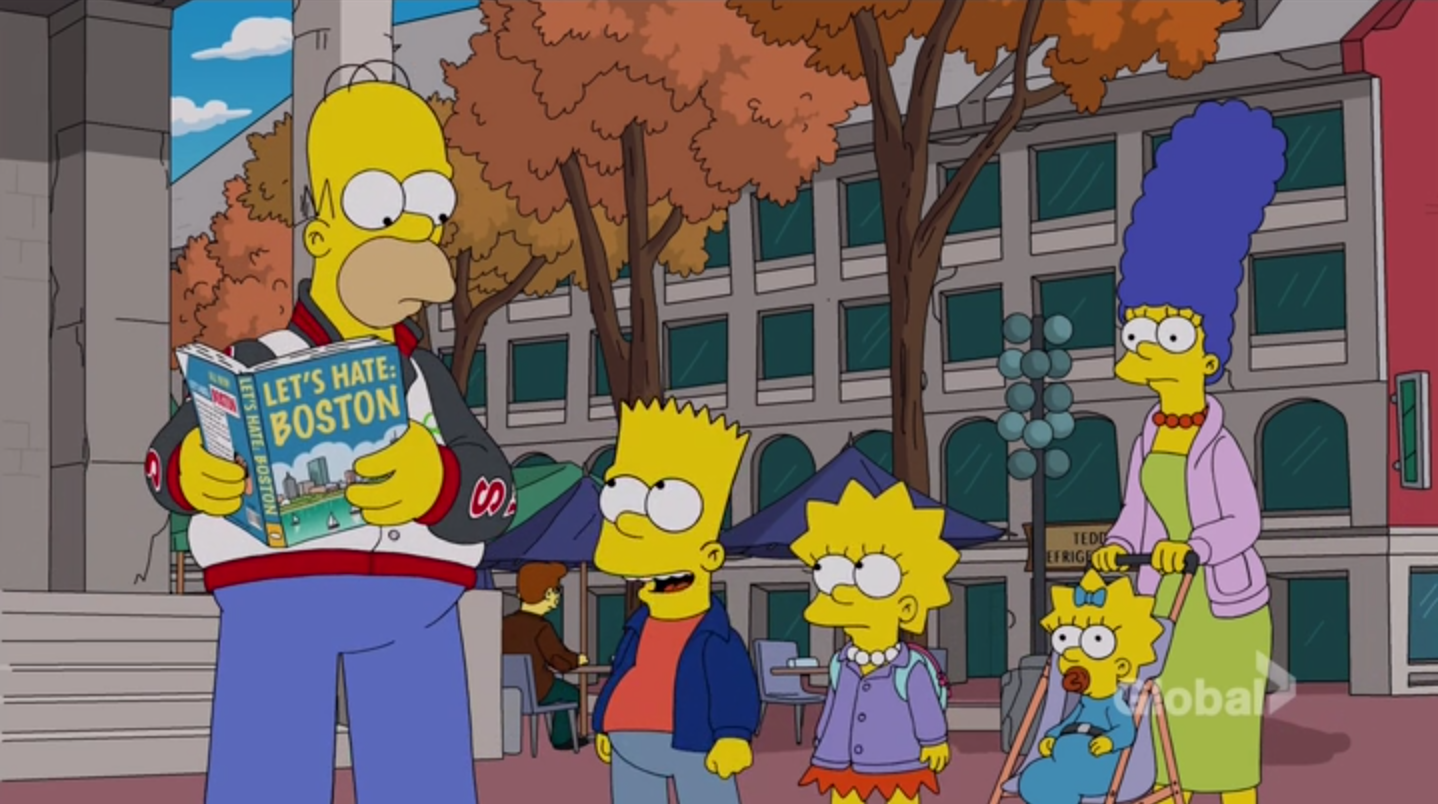
The reaction: Vacation episodes normally have some kind of larger character story going on alongside the sights and sounds of dropping the Simpsons into new surroundings. As time went on and the family jumped from continent to continent, the stories became looser and looser as the aim became to just make a bunch of jokes and references to other places. This episode feels like the ultimate example, a Bostonian love letter that I hope the people of that good city enjoyed, because I barely understood any of it. I’ve never been to Boston, and there are just so many one-off characters and locations and lines of dialogue that I really don’t know what to make of, because I can’t tell if they’re Boston references, or just the usual breed of inane nonsense this show normally trots out. When Boston beats Springfield in football, Homer is shocked to find Bart wearing a Boston hat. Unable to sway his allegiance, Homer arranges a trip to fuel his hate fire. This episode feels so inside baseball, like I said, there’s a lot of this I can’t tell if they’re supposed to be jokes or not, and that’s not really a good sign. They sure got their mileage of funny accents though, as it seems like everyone they meet has the strongest Boston accent and they’re taking full advantage of it with the dialogue (“pahk my cah in the yahd” type stuff.) So Homer hates Boston just like New York City, except with a flimsier rationale, but all it takes is him to play candlepin bowling and he’s completely won over. Lisa is won over by their arts scene, Marge by their local healthcare, Bart is a fan from moment one… man, Boston is just so great, they decide to move there! Between the loving recreation of all the landmarks and the Simpsons talking about how great everything is, this feels more like something Boston can use for their tourism campaign than actual satire. Bart quickly learns Boston is not the criminal slum he hoped it would be from his favorite movie The Departed (???), so he wants out. He incites Homer’s rage at a parade, goading him to putting on a Boston hat, but he snaps instead. But why is Homer so mad? His hatred of NYC was irrational, but it was also very consistent, hilariously so up until the end. If his emotions can turn on a dime after learning candlepin bowling lets you bowl thrice instead of twice, then who cares? As I say again and again, we’re at the point where characters can just change emotions at the drop of a hat, so the show has completely lost its ability to have any sort of tension or emotional investment. When Homer struggles to put the hat on, and when Boston-loving Lisa growls at Bart for putting him up to it, why am I supposed to care? What’s at stake? Why is this happening? Who cares?

Three items of note:
– Even though I couldn’t pick out a lot of the references, I could still recognize that they weren’t really jokes. Bart shows Lisa a clip of a crime movie set in Boston, where three guys prepare for their heist, but not before they all take a swig of their Fribble shakes. Fribbles are a staple of Friendly’s, a diner/ice cream shop chain based in the Northeast, and having grown up in New Jersey, I recognized that. But that’s just it. The “joke” is literally, here a thing you know. So much of this episode felt like let’s just cram in as many identifiable Northeastern U.S. things as possible. It’s pushed to the limit at the end where we get a bunch of shots of a crowd at a parade as we see a bunch of pop culture figures hailing from Boston. Conan O’Brien, the cast of Cheers, Steven Tyler, Michael Dukakis (who I only recognize because he’s wearing a tank costume), Mark Wahlberg and Ted the teddy bear… there’s also someone who’s a ghost? There’s at least twenty others I can’t recognize, is this supposed to be like freeze frame fun? Count the references! We couldn’t think of any jokes, but we could look up “celebrities from Boston” on Google!
– Speaking of references, Homer’s love of Boston is cemented with him taking a roll at every bowling alley in town, in a montage set to Bob Dylan’s “The Man in Me.” You know, the song used at the beginning of The Big Lebowski, which also played as people bowled? Again, I ask, what am I supposed to laugh at here? That they’re using the same song in the same context? Comic genius!
– Bart’s love of Boston stems from him wanting to be a “Southie,” whatever that is, and wanting to join the Irish mob. He tries to get in detention at his new school to find a gang to run with and pull off jobs… it all felt very strange. And it’s not like they’re playing off his naivete with anything, or making any kind of point, other than Boston in this reality is sanitized and cultured. Seeing Bart be so eager to get into a life of crime felt kind of uncomfortable for me. We’ve seen dream bubbles of him being a drifter or breaking the law, but to dwell on it this much to make this ten-year-old’s main motivation to join a gang… something about that feels unseemly.

One good line/moment: There were a couple sections of this episode that sported some more fluid animation than we’ve seen in a long time, most of which being Homer getting angry at Bart, and later at the end as he twists with rage and tears the hat in two. I would say I liked it, but it was almost jarring seeing this greater animation after years of bland nothingness, and only for certain scenes. Plus the acting was all flimsily motivated, but that’s the script’s fault, not the animators.