682. Warrin’ Priests (Part Two)

Original airdate: May 3, 2020

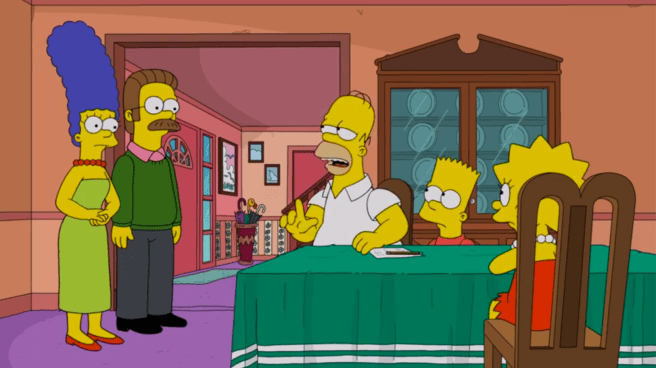
The premise: Having uncovered Bode’s most terrible secret, Lovejoy returns to Springfield to expose their newly beloved reverend, inflaming the town’s ire and shaking Lisa’s newfound renewed faith.

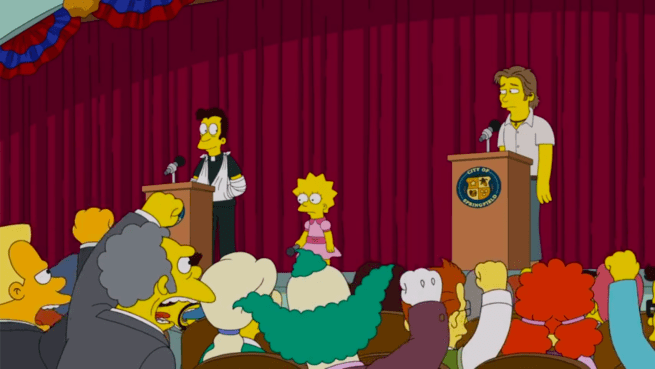
The reaction: So here we have part two, and I still have no idea why they made this a two-parter. After a brief recap, the entirety of act one is all just repeating information we already know: Bode is a hit with the people of Springfield, Lisa admires him as a wise man of faith, and Lovejoy discovers Bode’s secret in Michigan. While he rushes back home to reveal the truth, we get some time-filling fluff with Bode vs. Ned Flanders, which doesn’t culminate in anything. They scratch the surface of what Ned’s gripes are, but he and Bode never have much of a back-and-forth that amounts to anything interesting. Instead, their showdown in church is interrupted by a musical number from Lisa about how much she loves Bode, more fluff to pad the runtime out. Finally, at minute fifteen of the episode, Lovejoy returns for the big reveal: as part of a sermon as a young pastor, Bode burned a Bible. The congregation immediately turns on him, resulting in a “trial” between him and Lovejoy, where he doesn’t even attempt to try and give an explanation, nor does the crowd demand to hear one. Also, that was the big reveal? Why would the townspeople, who at the start of part one were running the fuck out of church since they hated it so much, care so deeply now about burning a Bible? I guess what the intention was is that Bode reinvigorated the townspeople’s faith, and this represents the ultimate betrayal of the religious tenants he stood for? I guess? But their reaction is less disillusionment and betrayal, and more just standard Springfield angry mob procedure (Moe yells out, “We’ve mobbed for less, people!”) Post-trial, Lisa meets with Bode where he finally explains himself: by burning the Bible, he was trying to illustrate how people put too much stock in the literal word and symbolic nature of the Good Book and not the actual message. Lisa rebuffs that symbolism like that is way too deep for her fellow moronic citizens. And so, Bode just leaves town and the episode is over. No resolution for Lovejoy, no final statement about any of the spiritual themes or meanings behind this two episode opus, just absolutely nothing. What a completely flaccid outing. As mentioned for part one, for all of the sermonizing Pete Holmes does in both of these episodes, I honestly don’t know what the point of all of this was. The concept of instilling Springfield with a practical, malleable version of faith could be an interesting one, but that idea goes completely unexplored and goes nowhere, over the course of two episodes. Both parts of “Who Shot Mr. Burns?” are chock full of set-ups and pay-offs, great character stuff, the building and unraveling of a mystery, and laughs, laughs and more laughs. “The Great Phatsby” buffered its two parts with two B-stories to kill time. But “Warrin’ Priests” is just the A-story, and it’s a pretty shocking display of how little they manage to fill the time with. A wholly unremarkable outing.

Three items of note:
– The couch gag this week was some bizarre home-movie style thing where the Simpsons are eating outside with some horses? I eventually surmised this must be a parody of a series I wasn’t familiar with, but “thankfully” the show just flat-out told me that, showing a Kent Brockman report with the on-screen title “SHOW PARODIES OTHER SHOW.” Afterward, I figured out this was their tribute to the opening title of HBO’s Succession, and once again I’ll say for the ten millionth time that a) recreating a thing doesn’t count as a parody if there’s not a lick of satire to be found, and b) a good parody should still play to the people who don’t specifically know the source material. Having never seen the show, I have no fucking idea what this was supposed to be. Any readers out there big Succession fans? If so, please let me know how loud you laughed at the opening of this episode.
– Marge warns Lisa not to get her hopes up too much over Bode, drawing her attention to the vision board of disappointment conveniently hanging in her kitchen. On it are photos of characters and moments from previous episodes: Mr. Bergstrom, Princess the pony, Bleeding Gums Murphy, Lisa teaching Mr. Burns about recycling, and Jesse Grass. All but one of these moments are from the show’s golden era, with the lone outlier being from season 12, an episode that aired almost twenty years ago. As usual, when this show does direct callbacks, it is always something from the show’s most respected years, and it’s always the clearest indicator of how completely disposable and forgettable the last twenty years of the show have been. Where’s Laney Fontaine, the Broadway star Lisa went on tour with? Or Chloe, Marge’s high school friend and roving reporter Lisa idolized? Lisa’s Wiccan friends? That homeless musician who was a drug addict? They’re not on that board because nobody gives a flying fuck about those episodes, and for good reason.
– Lovejoy’s trip to Michigan takes him to the doorstep of the megachurch Bode previously worked at, which only served to remind me of the wonderful HBO series The Righteous Gemstones, a very biting and truly brilliant satire on televangelist empires. Seeing the tepid jokes on display here on the subject (product placement in the stadium, the preacher being at the ready with a go bag of cash), it couldn’t be clearer how this thirty-one-year old show has been totally left in the dust by its sharper contemporaries.
– One bonus tidbit: balking at Bode’s Bible burning, Lisa comments, “Why couldn’t you have burned one of Bill O’Reilly’s books? There are so many!!” When I was a kid, my conservative father got me the best-selling book “The O’Reilly Factor For Kids,” and in a rare act of teenage rebellion, I burned it in a bonfire with some of my friends. What a little hellraiser I was. Also I am now looking at the five star Amazon ratings for the book and I’m getting sad so let me just close out this window…

681. Warrin’ Priests (Part One)

Original airdate: April 26, 2020

The premise: A new hip youth pastor, Bode, rolls into Springfield, quickly supplanting Reverend Lovejoy as the new town favorite man of God. Discouraged, Lovejoy travels to Bode’s hometown in Michigan to see what he can dig up about this mysterious stranger.

The reaction: Two-part episodes are certainly a rarity for this series. First we have the classic “Who Shot Mr. Burns?” saga, the brilliant mystery cliffhanger spoof. Over twenty years later, we got “The Great Phatsby,” a ridiculous affair involving Burns getting swindled by a famous rapper and his posse, or something stupid like that. Although that episode aired in one night within an hour time slot, whereas our latest two-parter “Warrin’ Priests” is running as two separate episodes. It’s difficult to discuss this one, having technically only seen half of it, so let’s table that discussion for now. This episode is also notable as it’s credited to comedian Pete Holmes, who I like fair enough. I’ve heard him as a guest star on a few podcasts I like (I have not listened to his own You Made It Weird show), and I enjoyed the first season of his HBO series Crashing, the semi-autographical series where he essentially plays a young version of himself, a good Christian boy who decides to become a stand-up comic. In this show, Holmes is also effectively playing himself as “Bode,” espousing what I assume are some form of his beliefs on God and religion. There are long stretches of the second half that are basically him sermonizing (in one case, a literal sermon), quickly winning the town over with his outlook on the world. However, for all his talking, his viewpoints appear to be incredibly simplistic: acceptance of everyone from all walks of life, and forgiveness for all, something like that. All the dialogue feels incredibly rambling and off-the-cuff, so that was my best summation. How this connects to the people of Springfield? No way specifically. Bode’s first big win comes from playing guitar and singing a new arrangement of “Amazing Grace,” nothing really that exciting, but apparently enough for the black choir leader to bizarrely praise, “This is the most exciting thing that ever happened in a white church!” Later, the people in the pews comment how they’re moved throughout the sermon and give Bode a three cheers at the end. But there’s no real specific connection between Bode and the people of Springfield, outside of him and Lisa bonding over meditation, which doesn’t really go anywhere. In terms of how Bode contrasts with Lovejoy, we see within the opening where the few patrons of church can’t bolt out of Lovejoy’s Sunday mass fast enough. The dark dismal church Lovejoy presides over is later bathed in holy light when Bode takes charge. It’s all very simplistic, without delving much into these two characters and how they differ ideologically. Lovejoy is immediately irked by Bode and is antagonistic toward him, but for no real reason. It’s not like they butt heads on approach or outlook, so I guess it’s just Lovejoy being protective of his home turf. In the first half, we see him choking and struggling to talk at points, later proving to be his undoing at the start of mass, where he is unable to speak at all, leading Bode to take over and everything goes downhill from there. But Lovejoy speaks just fine after mass, and it’s never brought up again. I thought maybe it would lead to some kind of crisis for Lovejoy that would motivate him to rekindle his love of his job and win back his flock, but perhaps this plot thread will be picked up in part 2? The cliffhanger involves Lovejoy traveling to Bode’s hometown in Michigan and finding a damning article about him. Oh no, what scandalous information has been uncovered about this character we literally just met, know barely anything about, and who has no real connection or hold over any other character? STAY TUNED, EVERYONE!

Three items of note:
– I recall an episode a while back where a new reverend supplanted Lovejoy in popularity (“Pulprit Friction,”) but I don’t remember much about it. The more easily apparent analogue to this episode is “In Marge We Trust,” where Marge quickly becomes the new church favorite. In that episode, we see how Marge actually listens to each person, lending a kind ear and giving honest advice, contrasted with Lovejoy, who has clearly checked out and can’t be bothered. We see them directly talk about these differences when we learn about Lovejoy’s past (“But you can’t let a few bad experiences sour you on helping people.” “Oh, sure I can!”) There are even scenes that feel like direct parallels; both episodes feature a scene outside of church where a crowd gathers around someone other than Lovejoy. But “Trust” really shows how Lovejoy being ostracized has affected him, pleading his case with the saints on the stained glass windows and sequestering himself to the basement with his train set (“If the passengers will look to their right, you will see a sad man.”) The episode gives us just enough backstory and additional characterization to this tertiary character to truly make us care about him. In “Warrin’ Priests,” Lovejoy is just bitter and petty through most of the episode, rude and condescending toward Bode, and it doesn’t look like that will change much in part 2.
– Lisa’s meditation session with Bode leads to a trippy out-of-body experience in an admittedly neat animated sequence. Slowly the black outlines for all the characters and backgrounds melt away, leaving Lisa a colored head floating in the vast emptiness of space. Her visage drifts and changes into different art styles, from a rough chalk drawing to a Picasso-esque design to a macaroni picture and so on. The scene is visually cool, but suffers from it not really amounting to anything character-wise, feeling more like time-filler than anything else. The scene is also kind of ruined with a fourth-wall-breaking joke partway through, where the different Lisas are interrupted with a “ANIMATION BUDGET EXCEEDED” title, which was odd considering the scene at that point was just the different still frame images floating in space, with no real elaborate animation occurring.
– Before the teaser for part 2 and the credits, this episode barely clocks in at twenty minutes. Again, it’s hard to make a determination having not seen the second part, but I’m already wondering why this story needed to be told over two separate episodes. Considering the premise of “Lovejoy is replaced by a more engaging spiritual figure” has been done on at least two other occasions, stories that were told in single episodes that also had B-plots, I don’t really see how the story in “Part One” couldn’t have been told in under ten minutes. I guess you’d have to trim down Holmes’ rambling speeches, but what a tragedy that would be, huh?

680. The Incredible Lightness of Being a Baby

Original airdate: April 19, 2020

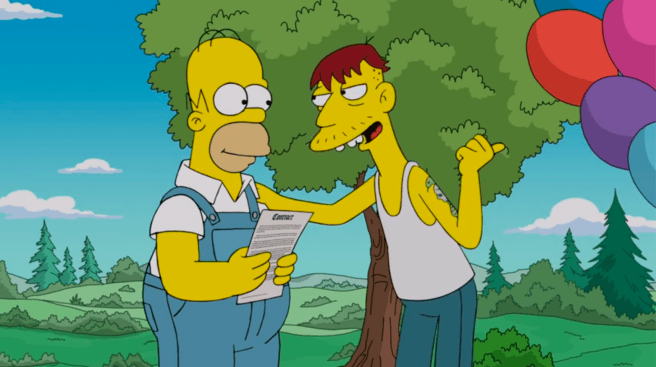
The premise: Mr. Burns forces Homer to go undercover to swindle Cletus out of his natural deposit of helium, but he finds it difficult to go through with it once he befriends the amiable hillbilly. Meanwhile, Marge arranges a play date for Maggie with her young love Hudson, but is quickly irritated by his trendy, overly safety-conscious mother.

The reaction: Well we’re back, with a whimper of an episode featuring two stories fighting for dominance, neither of which are particularly interesting. First, when Homer brings some of Cletus’ fancy roadside balloons to work, Mr. Burns starts gunning for his helium reserves, using Homer as his man on the inside, someone to pose as a seemingly innocent fellow yokel to gain Cletus’ trust. But, we see at first that Cletus offers the balloons to Homer to bring to work with him, so he must know that he’s not a fellow hillbilly. Is Homer pretending to be someone else or not? He’s putting on a Southern drawl and acting as such. But at this point in the series all these characters know each other, Homer and Cletus have had run-ins before… oh whatever. The two become fast friends and Homer ultimately comes clean with Cletus, who eventually strikes a fair deal with Burns after he and his family have him at gunpoint. Pretty dull stuff. The other plot involves Maggie and her little boyfriend Hudson, as previously seen in the theatrical (for a week, at least) short “Playdate with Destiny,” in the continuation of this relationship I’m sure everyone has been dying to see more of. Their cutesy antics were tiresome after a minute or so in the short, now we get to see more of them? Holding the plot up is Marge’s displeasure with the baby’s mother, a rich snob who insists on knowing Marge’s health records and sexual history, and baby proofs Maggie’s hair spikes. She ends up taking Maggie home, cutting off her relationship. She later gets into a conversation with the baby, trying to rationalize her decision, but it’s never like she’s just talking and trying to convince herself, she’s just literally trying to have a conversation with a one-year-old. It’s weird, and not intentionally so. At least I think. Eventually, Marge gets over herself and the two baby lovers reunite. Maggie carries Hudson across the threshold into their little backyard playhouse as “The Wedding March” plays, and I proceed to cringe myself into oblivion. In “Playdate” and now this episode, this relationship of theirs is just so incredibly saccharine, the kind of thing this show would mock in its prime. The fact that they made this episode in tandem with “Playdate,” playing this up as the “sequel” that fans would excited for, to see more of the romantic adventures of Maggie and Hudson, it goes back to my question of the show’s present day audience. Who is watching this show, and why? What is The Simpsons to them? I feel like I should have some sort of idea having watched all this crap, but I honestly and truly can’t give a straight answer to that.

Three items of note:
– At the beginning, we get another guest couch gag from animator Michal Socha, his third outing, this time presenting the Simpsons doing extreme sports. I’m not really sure why. He previously did that trippy sequence inside Homer’s mind all in red and black, which may be my favorite guest couch gag just from how cool the visuals are. After that, he did the IKEA-style “Build-Your-Own-Couch Gag,” which was okay, and now this, which looks kinda cool, but feels a bit empty and pointless. I dunno. I mean, as always, it’s more entertaining than the show itself, so I guess I shouldn’t complain.
– As its theatrical life was sadly cut short thanks to the nightmare world we now live in, “Playdate with Destiny” recently followed its companion Onward onto Disney+. Having gotten a free trial of it recently, I always see the promo for it on the top banner opening it up, and boy oh boy is it still really, really difficult for me to wrap my mind around The Simpsons being a Disney property. I’ve been thinking a lot about the brand identity of Disney+ and how it’s really just a hodge podge of different disparate media elements that don’t go together, but it’s not exclusively Simpsons-related and I don’t really feel like yammering on about it. There are some who fear that Disney wants to soften The Simpsons to make them more family friendly, but I really don’t think that’s the case. But I do think they want the show to be presented as such, and that’s seemingly why it’s on Disney+, on top of being a huge feather in the streaming service’s cap to entice viewers with a humongous amount of content. The header image on the Simpsons page on Disney+ is Bart, Lisa and Maggie dead center having a fun time on the swings. The description includes this lovely nugget: “Homer is not your typical family man. He does his best to lead his family, but often finds that they are leading him.” What in the hell does that mean? Does that sound like The Simpsons to you? The content is as you remember it (aside from the aspect ratio being fucked and no “Stark Raving Dad,” there aren’t any episode-specific cuts that I’m aware of), but the veneer of the show has been sanitized a bit. It would be sad if the show hadn’t been ruining itself for the past twenty years, but it’s still a bit tough to see anyway.
– The episode cuts to credits eighteen and a half minutes in, so to kill time, we have Homer and Cletus singing a “””funny””” parody version of Queen’s “My Best Friend,” having a rootin’, tootin’, daggum blast of a time. I feel like there’s been a previous episode or two of Homer and Cletus being friends and hanging out, but I don’t care enough to look back into specifics. It’s all just so boring, they’re chums because they’re lazy and drink a lot. Speaking of, Cletus really is one of those one-dimensional joke characters the show occasionally tries to do more with, and it always lands with a thud. Maybe you could do something more with this character successfully, but you’d need a strong story hook to take Cletus out of his element and really examine another side of him. Instead, it’s all the same fucking jokes we’ve been doing for decades. He talks funny, he eats roadkill, Brandine’s giving birth to more kids, he drinks his blinding moonshine… boy howdy, the mileage they get off these REALLY GREAT JOKES!!

679. Highway To Well

Original airdate: March 22, 2020

The premise: An unwitting Marge is hired at Drederick Tatum’s new weed dispensary, but her cool new job is threatened when Homer teams up with Otto and Moe to sell pot their own way: in the underground fashion of yesteryear.

The reaction: Hard to believe it’s been eighteen years since Homer was prescribed medical marijuana in a very controversial episode for its time. In terms of satirizing legal cannabis culture, this episode actually has some promising ideas, but as always, the execution doesn’t hit the mark, mostly from how Homer and Marge seem completely adrift in their own stories. We start with Marge dropping Maggie off at pre-emptive daycare, and not knowing what to do with herself, she just stands in a random line at a newly opened shop (“If all these people want to work here, maybe I want to work here!”) She takes a bizarre ethics assessment test, and then, by being the only person who notes the attendant’s name tag is upside down, she immediately gets hired and starts working, despite not actually knowing what the hell the store is. It reminded me of an episode way back when where Marge worked for an erotic bakery, fulfilling many, many orders before she finally discovered the truth. She’s supposed to be painfully naive, but the way it’s written, it just makes her look dumb and flaky. Later, Drederick Tatum reveals why they wanted to hire Marge: she serves as an honest, caring face that will put people at ease frequenting such an “edgy” establishment. This concept I do really like, since as a caring and emphatic figure of the community, Marge really is the ideal candidate, and seeing how smoking pot can help people with severe anxiety or stress could make her feel better, a new venue of mothering and helping as a replacement for Maggie. Another promising concept involves Otto, whose appearance in an episode like this was inevitable, who finds himself disillusioned by this brave new world of legal weed. He misses the good old days of buying some shitty skunk weed from a friend of an acquaintance of a friend in their run down apartment that smells like a wet grocery bag. And so, Moe and Homer make his dream a reality, setting up shop in the back of Moe’s to create a simulated experience of buying weed from some shady guy in his mom’s basement. This conceit could work twofold: enticing similar-minded folks like Otto who miss underground pot culture, that being a more appealing lifestyle than the actual act of smoking pot itself. Or it could end up becoming even more popular that Marge’s store, with hipsters embracing the more “authentic” nature of Homer and Moe’s shady outlet. But none of these things really happen. Marge’s allegiance to Well + Good only amounts to her being excited to be a part of something outside the home, which is the core idea behind basically all Marge-gets-a-job episodes. Meanwhile, I have no fucking idea why Homer is so invested on his end, to the degree that when Marge performs a sting operation to get him shut down to save her own job, Homer is upset and betrayed and I really don’t understand why. What personal investment does he have in the weed business? I don’t even know if he was being paid. The finale involves Homer outing Marge for never having smoked before, so she does, gets a bad high, and Homer helps calm her down, and that’s it. Any of the commentary about marijuana’s medicinal or helpful attributes is thrown out the window when Marge’s two co-workers are revealed to just be happy-go-lucky stoners (“What you need to understand is this: I’m high too!!” “I’m serenitied out of my gourd!”) By the time Homer accidentally blows up Tatum’s new cannabis resort and spa, I was at a loss in figuring out what the point of the episode was. What did Homer and Marge want, and what did they learn? I really couldn’t say.

Three items of note:
– Drederick Tatum plays a huge role in this episode, maybe his biggest solo episode appearance of the entire series. It was just kind of odd hearing him talk for so long. He also sports Mike Tyson’s facial tattoo for the first time (I think?), just in case you couldn’t tell this 30-year-old character is supposed to be a parody of the famous boxer. We then get great jokes like a magazine cover making fun of his speech impediment (“Bithneth Ith Booming”) Once more, the series finds itself woefully stuck in the past. After all those Hangover movies and Mike Tyson Mysteries on adult swim, isn’t the well on Mike Tyson jokes completely dried up at this point? Even now, we’re still expected to laugh at how funny he talks?
– Billy Porter and Chelsea Peretti join the long, long list of incredibly talented performers stuck slumming it through subpar material on this legacy show. Also making an incredibly brief cameo appearance is Kevin Smith. Homer claims he broke into Tatum’s exclusive gala event by claiming to be Smith’s father, and when he accidentally blows the place sky high, Smith runs in and cries, “Dad, what did you do?!” Kind of odd that an episode all about weed culture would only feature Smith for just one line. They couldn’t have given him another scene at the party or something? Kevin Smith is one of those creators whose work is a mixed bag, even terrible at times, but as a public figure, he’s just so authentic and so damn likable that I can’t be mad at him, even if Tusk made me physically vibrate I was so perplexed and aggravated by it. Smith talked a bit recently on his social media how excited and honored he was to be featured on the show, even shouting out the character designer who drew him (“I always dreamed of being on The Simpsons, but never imagined, if it happened, that I’d be rendered thinner than Homer!”) You gotta love the guy. Too bad he wasn’t in an episode twenty years earlier, or at the very least on Futurama as a head in a jar or something.
– The episode was so poorly plotted and aimless that Marge losing her job and Maggie being removed from daycare are relegated to a tag playing under the credits. Marge needing to find purpose in her life being a new empty nester could have been a really rich vein to tap through the entire episode, but it’s completely abandoned after the opening. Hell, maybe smoking pot could have helped Marge with her separation anxiety or something. She finds smoking helps calm her down, but has to hide her new habit from the rest of the family. There’s an idea. Although I don’t even know if you could even show a character smoking a joint even now on prime time television, which is probably why in the climax, Marge just takes a drop of CBD oil on her tongue.

678. Better Off Ned

Original airdate: March 15, 2020

The premise: Facing expulsion after a potentially disastrous prank, Bart is forced into a mentorship with Ned Flanders, only to find it incredibly beneficial. Jealous of his son’s new relationship to his most hated neighbor-eeno, Homer decides to become father figure to a despondent Nelson.

The reaction: I guess this is what happens when you smash together elements from previous episodes: a Simpson takes pity on poor little dirt urchin Nelson (“Slumbering With The Enemy”), Bart forms a connection with Ned Flanders (The Simpsons Movie), and Homer and Bart gain new father/son relationships (“Dad Behavior”). The biggest parallel in my mind is “Brother From The Same Planet,” with the exact same premise of Bart gaining a new father figure out of necessity, and Homer gaining a new surrogate son out of pure spite. Despite ostensibly being a Homer/Bart episode, Homer’s bad parenting doesn’t play a role in Bart’s inciting incident involving releasing a fake live grenade during a school assembly. Ned Flanders steps in to save Bart from getting rightfully expelled, promising he’ll get the boy on the straight and narrow. Or rather, he threatens Chalmers to unleash his “Prayer Chain” after he rightfully balks at using religious teachings to save a public school child. But whatever, there’s no sense complaining about ultra-fanatical religious jokes coloring Ned as unlikable when the show’s been doing this for almost twenty years now. Anyway, we first see Ned having Bart wash dishes, which Bart turns into a prank where he “cuts” his hand and squirts ketchup pretending it’s blood. In a serious tone, Ned threatens, “I can turn that into real blood, you little punk!” At this, I thought they were going to revive “Hurricane Neddy” and have this episode culminate in Ned having another mental breakdown trying to manage a hellion like Bart. But this moment is never recalled again, so I guess it was just a joke that Ned threatened to violently attack a ten-year-old. Anyway, a wilderness fishing trip (remember the movie?) instantly turns Bart into a good student and choir boy, just like that, I guess, so that now nine minutes in, our “plot” begins where Homer realizes Bart doesn’t need him, and eventually comes upon a crying Nelson at the dump and decides to mentor him. Again, I can’t help but recall when almost thirty years ago, Homer was the guardian to another sad, poor boy… what was his name? Pepsi? But here, of course, it’s all tell, not show (“Am I going to do it? Is it wrong to take advantage of one child’s feelings to make another child feel bad?”) Also, unlike “Brother,” where Homer took a genuine shining to little Pepi and tried to be a good surrogate dad, here, he seems to not give much of a shit about actually helping Nelson. Even though we previously saw Mrs. Muntz in the first act as the direct source of Nelson’s misery, showing up drunk at the school and passing out in his locker, she later appears to dress Homer down about getting Nelson’s hopes up about being a father figure who won’t abandon him, as so many have done before. Homer eventually tells Nelson the truth, Nelson swears revenge by getting Bart hurt at a prayer parade Ned has him in, and then Homer gets hurt instead and he and Bart have a bonding ride in the ambulance together, and awww ain’t that sweet who cares. Al Jean bizarrely has a story credit for this episode, which I can only assume was the result of him falling asleep with “Brother From The Same Planet” playing on Disney+ in the background and thinking he had a great idea for a new episode. Great work, Al.

Three items of note:
– I’ve spoken before about the nature of Bart’s pranks in recent years being a lot more cruel than in the classic era, where we’ve gone from Bart being a rambunctious little boy to just being kind of a little asshole. We just saw it two episodes ago where he forced the town to do his bidding out of fear of having a movie spoiled. We’ve seen him abuse Homer in numerous ways over the last five seasons or so. It just seems like there’s a big difference between painting the lines on the faculty parking lot too close together and fiddling with the water nozzles to mess with Homer’s shower, with recent “pranks” like destroying the SPRINGFIELD sign, psychologically torturing Homer, and here, bringing a weapon of war into school as a goof. And yeah, Chalmers was this close from expelling him, but comedy or no, in the year 2020, Bart would immediately be arrested for this shit. Considering this incident and Bart tricking Ned into thinking he cut his hand, the episode could have even been about Bart learning not to take things too far, or on how desensitized he’s become to violence, or something like that. But nothing. Those two scenes feel so off for Bart to me. Even his most notorious “last straw” pranks like him using a huge line of megaphones and unleashing town-wise destruction, or flooding the entire gymnasium, felt like kid-appropriate pranks performed with non-malicious intent.
– The Simpson women take two very different approaches in response to the conflict in this episode. Marge, as always, turns an active blind eye to her husband’s emotionally destructive behavior, running back into the house to tend to Maggie (“Where are you, my little excuse?”) But the bigger reaction comes from Lisa, in maybe one of the saddest moments in series history. Seeing Homer at the bar looking the other way as Nelson steals the coins from the jukebox, Lisa offers her father some cash (“Here’s forty dollars. That’s a lot of money to me. But I want you to get some therapy about what you’re doing.”) Just think about this. This is an eight-year-old girl offering her drunk father sitting at a bar her own money, pleading him to get professional help. This is an absolutely heartbreaking scenario. Fifteen seconds later, we get a joke about Duffman doing Shakespeare. Then we see Homer actually at therapy, the therapist says what he’s doing to those two boys is awful, and then we’re done with that whole concept. Just dreadful.
– When Bart and Ned have their day-to-night camping trip, I couldn’t help wondering where the hell Rod and Todd were. Remember those kids? One of them was incredibly distraught about his dead mother a couple months ago, until he suddenly wasn’t? They do appear mid-way through the episode helping Ned and Bart with the prayer pride parade, and then later in the tag, we see the conclusion where Homer has Ned be Nelson’s new sorta foster dad, and the Flanders and Muntz families come together for a nice family meal. The other bullies balk at Nelson giving up the “way of the bully,” to which he replies, “What can I say? People change.” He then reveals he has Milhouse on ice in the freezer (“Thaw! Thaw!”) Sometimes I feel I can barely comment on this shit. They try to have this completely tone deaf happy ending of Nelson finding a caring family, after spending twenty minutes making jokes about him being poor, then try to dangle some kind of characterization in maybe him reforming his ways, but of course he fucking won’t because this series is in cryostasis. This show just sucks so fucking bad, you guys.

One good line/moment: Can I just retire this section again? I think I’ve threatened to do that a few times, but I may finally do it for real-sies. If there’s something truly of notable quality in an episode, I’ll make a point of mentioning it, but otherwise, there doesn’t feel like any real point in doing this part anymore.