7. The Call of the Simpsons

(originally aired February 18, 1990)
Thus far we’ve seen season 1 maintain a pretty consistent tone of low-key, more emotionally-driven episodes, an animated sitcom that tweaks conventions but remains true to the characters. The show would evolve into much more than that, and this episode feels like the forebearer to the more crazier, out-there episodes. It’s such an odd man out in that respect, a wacky, jokey episode in the midst of these major character-driven stories we’ve had, but sadly, I think it’s the weakest of the bunch so far.

The beginning of the episode is fantastic, however; envious of Flanders’s newly purchased RV, Homer takes his family to get one of their own at Bob’s RV Round-Up, where they are hawked to by the eponymous Bob, voiced by Albert Brooks. Brooks has done many guest voices on the show, classic characters like affable super villain Hank Scorpio and bowling Lothario Jacques (more on him later). All of Brooks’s Simpsons characters seem to have some level of smarm, and Bob definitely has a lot of it, a sweet-talking shyster with a big hat and big ears who can talk anybody into a sale, whether they like it or not. Brooks obviously is doing a lot of ad-libbing here, and you can tell he was just having a lot of fun with the character. Every line of his is great: his claims of the ultimate RV having four deep fryers (one for each part of the chicken), buttering Homer up asking if he’s of Roman descent (“You’re like a God, sort of,”) and admonishing Homer’s wish to talk his potential purchase with his family (“If you have to talk it over with those humans over there, there’s something wrong with all of us.”) It’s such a fresh, flowing performance that you really feel disappointed when the family leaves the RV park and the episode has to continue onward.

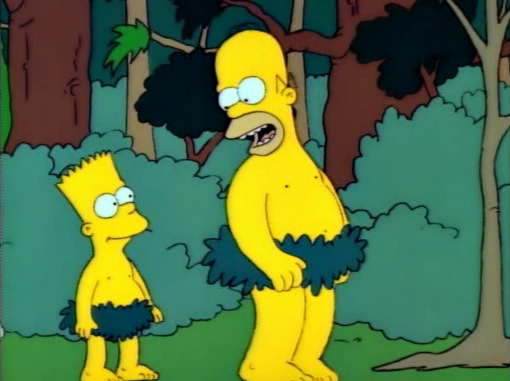
Homer ends up with an RV he can afford: a really shitty one. It isn’t long before he accidentally drives the camper off a cliff and the family must fend for themselves in the woods. Homer and Bart go out into the woods to look for help, but end up victim to various misfortunes: they lose their clothes in a waterfall, Homer is attacked by various animals, and finally ends up being mistaken for Bigfoot. Video footage of the mud-covered Homer causes a media frenzy. A lot of this material feels very silly, but not in a good way. There’s no sharpness to it, a lot of the gags feel like they’re out of bad Saturday morning cartoons. After the shrewdness of the first act with Bob, this feels very rote and childish. There are a few good jokes here and there (broadcast news of the “Bigfoot” sighting interrupted the live Presidential address), but it all just felt very empty. Even the ending with the great scientific minds debating whether Homer was man or beast felt a bit dumb. Even after doing full medical tests and examinations on his body, they can’t tell that he’s clearly a human being?

This show would certainly feature set pieces and plots much much more ridiculous than this one, but the most successful ones featured some kind of meaning to the madness, or at the very least a great set-up. Not only is it superior humor-wise, but the first act feels so disjointed from the rest. Homer’s rampant jealousy of Flanders at this point in the series was enough for him to go out camping? It feels so alien of Homer to do, even with this early version of him. So all and all, great first appearance by Albert Brooks, the lone savior of this episode.

Tidbits and Quotes
– As I said, every Bob line is great. Right off the bat when he spots the Simpson family as clueless rubes and remarks, “Thank you, God.” Also great is the scene when Homer’s credit check results in a loud siren going off (“Is that a good siren? Am I approved?” “You ever known a siren to be good? No, Mr. Simpson, it’s not. It’s a bad siren. That’s the computer in case I went blind telling me sell the vehicle to this fella and you’re out of business! That’s what the siren says.”)
– There’s also a couple of mini-subplots. Marge and Lisa bide their time by sweeping with make-shift wooden brooms, for some reason. A troupe of bears hold themselves in reverence of baby Maggie, which is cute, but doesn’t make much sense. I dunno, it never sat well with me.
– Bart asking Homer if they were going to hang themselves with the noose-like animal trap he set up seemed unusually dark. I laughed all the same, though.
– I’m a bit confused by the timeline of this episode: an entire crowd of Bigfoot spotters, vendors and gawkers sprouts up in the forest over how much time? A day or two? And in all that time, Homer and Bart are still lost, and the former hasn’t bothered to find a stream to wash the mud off himself? I know Homer’s a slob, but come on.
– Reporters flocking Marge with questions about her Bigfoot husband, resulting in the tabloid headlines is a good bit. Another subtle racy bit when a reporter asking Marge if marital relations with her husband to be “brutish,” Marge briefly smiles, then asks if the interview will be on TV.
6. Moaning Lisa

(originally aired February 11, 1990)
I feel like Lisa Simpson is one of the more under-appreciated characters in all of television. Within the show she certainly is, stuck as the misunderstood middle child of the Simpson clan. Amidst her dopey father, trouble-making brother, and her mother desperately holding the family together, Lisa’s incredible creative and intellectual gifts are mostly gone unnoticed. But outside the show, she is also the target of scorn. While later years have dabbled in making her a smug intellectual or political mouthpiece, Lisa was never really a fan favorite against the more popular Bart or Homer. But she plays a very important role in the series: she’s earnest, she works hard, but in the end, she can never quite catch a break. In many ways, she’s the most human character out of anyone on the show, and the episodes focused on her always tend to be the most emotional and down-to-earth, and this very first one is no exception.

The set-up is that Lisa feels sad. Though it’s not so much a sadness as a general malaise about her station in life; undermined for her creative outbursts at school and generally unacknowledged at home, she has basically ostracized herself from a world she believes holds no happiness for her. It’s an emotional arc that I can’t think of any other show tackling, and it never holds back. You really feel for Lisa and her unfortunate state of mind because we’ve all felt this sense of unhappiness sometime in our lives. While they are not the most attentive at times, her parents express concern. Homer, while not having the slightest idea of her daughter’s problems, does his best to hear her out and cheer her up, but to no avail. It’s a really sweet moment between the two, with Lisa acknowledging her father’s best intentions.

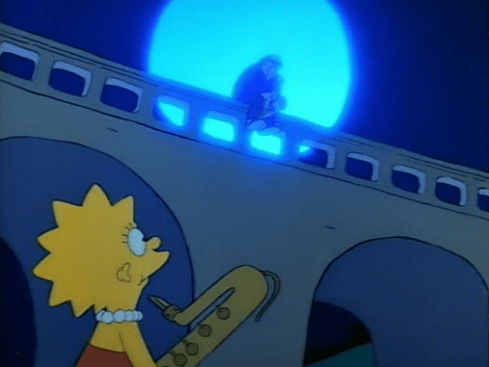
Lisa eventually finds some sort of refuge in a mysterious wandering jazz man named Bleeding Gums Murphy, resulting in an impromptu jam session late at night on the downtown bridge (I believe the same one Homer nearly jumped off of three episodes ago.) Murphy is a pretty infamous Simpsons character, though he’s only really been in two episodes (and the opening every week.) He’s helpful to Lisa, but also can be a little backhanded. (“You know, you play pretty well for someone with no real problems!”) Lisa earned recognition from a kindred spirit, and an outlet for her frustrations, but it is by no means a solution to her problem. There’s a happy ending here, but nothing permanent like out of a typical sitcom.

I guess the side plot should be mentioned, featuring Homer’s efforts to beat Bart at a boxing video game. I guess since the main story was so serious, this runner served as a comedic outlet and break from the drama. It’s got a lot of great funny bits in it, continuing with the season 1 tradition of Homer trying to impress his son and prove himself a man, but also features some early Homer overreaction, like his crazy dream sequence, and his equally crazy breakdown after Marge unplugs the television right before he finally bests his son. Seeing a grown man cry over a video game is probably the first truly pathetic act we’ve seen from Homer, but certainly not the last.

Marge, meanwhile, thinks back to her mother’s advice to her as a child, to bury your emotions and remain smiling to fit into the group. Her advice seems very true to her character, especially when you figure how much she puts up with from her family in the years to come. The scene where she vests Lisa with this advice is so great, it’s such poor advice, but Marge means it with such honesty, believing this will make her daughter happy. The end result of witnessing Lisa about to be take advantage of and undermined because of Marge’s words prompts her to completely backtrack, telling Lisa to just be herself and her family would be there to support her no matter what. It’s a wonderful turn, and a sweet ending.

Tidbits and Quotes
– In the opening titles every week, we’ve seen Mr. Largo throw Lisa out of class for her jazzy outbursts during class, but here, we finally see him in the show itself, where he’s basically what we expected. His very name gives it away, ‘largo’ being a musical term for a slow and broad tempo, completely uncreative and unambitious. When Lisa describes her music as reflecting those hardworking Americans who go unnoticed and unappreciated, Largo responds, “Well, that’s all fine and good, but none of those unpleasant people are going to be at the recital next week.”
– The boxing game “Super Slugfest” is a great Simpsons-esque parody of video games, with its old-school graphics and Punch-Out style meshed with over-the-top graphic violence, like a final blow decapitation, and the winner dancing on the loser’s grave in the ring, complete with triumphant low-bit music.
– Lisa, an eight-year-old girl, walks out late at night and receives advice from an elderly stranger. All of this should point to this being super sketchy, but it doesn’t really feel that way at all. Well… maybe a little, but Murphy seems sincere enough. Mostly.
– We get the first appearance of a Simpsons staple: someone waking up, sitting up in bed screaming. Also a really big, long Homer scream. And funny.
– “You know Marge, getting old is a terrible thing. I think the saddest day of my life was when I realized I could beat my Dad at most things, and Bart experienced that at the age of four.”
– I’ve always loved Murphy’s explanation of his name, in that he never goes to the dentist (“I suppose I should go to one, but I’ve got enough pain in my life as it is.”)
– One last bit, I love how Lisa plays a baritone saxophone, one that’s almost as big as she is. It’s a perfect visual metaphor on how she’s a big fish in a small pond, a girl who hold greater aspirations than others around her. It’s also just a funny gag when you see her really playing and struggling to physically keep up with her emotional music.

5. Bart the General

(originally aired February 4, 1990)
This episode is a writer-director dream team: David Silverman in his third outing, and the prolific and mysterious John Swartzwelder in his very first episode, the man who’s written more Simpsons episodes than any other writer, many of them topping fans (myself included) lists of greatest episodes ever. And this episode’s a great one, full of really down-to-earth material, relatable emotions and experiences, combined with bizarre dream sequences and an over-the-top finale. It’s probably my favorite one so far, as it’s such a real story, but still manages to integrate so many funny and weird elements into it, but that’s really the genius of Mr. Swartzwelder, as we’ll see in many episodes to come.

We begin this episode as Bart, in his efforts to defend his sister’s honor on the school yard, inadvertently ruffles the feathers of big bully Nelson Muntz. While he plays a rotating role between ally and menace nowadays, Nelson is a real threat here at the start, with a great gruff performance by Nancy Cartwright. Stuck with a scheduled showdown after school, Bart passes the time by panicking through two fantastic dream sequences. The first is visually ridiculous, of Bart facing down a gigantic Nelson, who is completely unaffected by any knifes or gunfire Bart fires at him. The sequence is so well thought out, dream-Bart getting increasingly more manic to mirror his fear while Nelson slowly lumbers (and laughs) along, not even fazed by the attacks. The second scene is verbally ridiculous, Bart imagining his funeral, and those paying respect. Each one is hilarious in their own right; Skinner concluding that “homework really was a waste of your time,” Otto marveling at the fantastic job in reconstructing Bart’s face, and an amazing display, both in the animation and Dan Castellaneta’s performance, in Homer’s way waaay over-compensatory mourning of his son, after he’d previously expressed his delight of getting off work. Nelson is last, who simply socks Bart’s body in the gut. Not many shows can make punching a corpse funny like this show can.

Bart seeks advice for his bully problem: Marge urges Bart go to the principal on the matter, but Homer intervenes, stressing he would be breaking the code of the schoolyard (“Don’t tattle, always make fun of those different from you.  Never say anything, unless you’re sure everyone feels exactly the same way you do.”) Such a wonderful commentary on conformist parenting. After this advice gets him nowhere, Bart goes to his grandfather for help. In our introductory scene for Abe Simpson, we see him writing a letter to an anonymous advertising agency expressing his disgust at the depiction of old people in the media. This one scene completely encapsulates Abe’s character: nostalgic, forever crotchety, and full of piss and vinegar. He points Bart in the direction of a friend of his: the one-armed nutjob owner of a military antique shop, Herman. He helps them devise the perfect attack plan to take down Nelson.

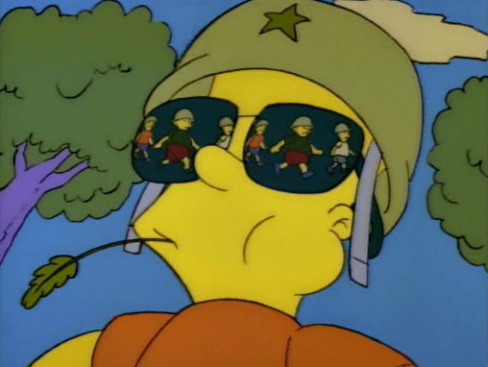
A seemingly simple story with Bart dealing with a school bully turns into one of the series’s first forays into pop culture parody. The third act pays tribute to a number of war films, like Patton and Full Metal Jacket. There are even more specific allusions to other famous wars, and even the friggin’ Nuremberg trials when Nelson’s cronies claim they were “just following orders.” The show ends with a treaty being written up, putting Bart and Nelson at a truce, with such great clauses as “Nelson recognizes Bart’s right to exist” and “Although Nelson shall have no official power, he shall remain a figurehead of menace in the neighborhood.” All this and the final end tag, a PBS-mocking segment with Bart attesting that there are no good wars, with the exceptions of the American Revolution, World War II, and the Star Wars trilogy, and that you can learn more at your local library. I appreciate this season for what it is, but this is the first episode I can truly gush about.

Tidbits and Quotes
– We get to know Lisa’s character a bit more here at the beginning. She’s a smart girl, but knows how to have fun, particularly at her brother’s expense. Their back-and-forth on the bus is a fantastic scene, further illustrating their personalities and relationship.
– Nelson’s two little crony characters are so odd to me. They are crucial to the story here, but I really don’t think they’ve ever been seen since, as they were pretty much replaced by the other bully characters. Poor guys. They didn’t even have names.
– “You made me bleed my own blood!” Such a great line, and great delivery too.
– There’s some great drawings of Bart’s mangled contorting face when he’s getting punched by Nelson.
– Abe’s letter is so great, it deserves to be quoted: “Dear Advertisers, I am disgusted with the way old people are depicted on television. We are not all vibrant, fun-loving sex maniacs. Many of us are bitter, resentful individuals who remember the good old days when entertainment was bland and inoffensive. The following is a list of words I never want to hear on television again. Number one: Bra. Number two: Horny. Number three: Family Jewels.”
– An amazing subtle animated bit: Bart arriving at the treehouse beaten, coughs up his hat (for the second time in the show), then just hangs it up on the wall and begins talking to the others. It just flows and isn’t addressed at all, it’s just there, and I love it for that reason.
– Another great Abe line: “I thought I was too old. I thought my time had passed. I thought I’d never hear the screams of pain, or see the look of terror in a man’s eyes. Thank heaven for children!”

4. There’s No Disgrace Like Home

(originally aired January 28, 1990)
As I’ve already mentioned, season 1 feels like a big experiment on figuring out what this show would end up being, and as such, some things feel sort of off watching them after so many years. The personalities of the Simpson family are so universally known, even by those who don’t even watch the show, that it’s pretty jarring seeing them act any different. This episode features many bizarre out-of-character moments, but I can’t say it doesn’t fit in with what we’ve seen already. At the start, this show was a bit more subtle and, dare I say, serious in its portrayal of middle class society and family life, and as such, it’s not as laugh-out-loud hysterical as the show would become. Here, we have Homer frustrated with his imperfect family and his efforts to better themselves, a conceit that sounds like the complete opposite of the Homer we know today. But there are plenty true-to-character moments sprinkled about, and given his desires to have a perfect Kodak Christmas in the first episode, it’s not a far leap for him to want to mold the stereotypical perfect family either.

We start with Homer demanding his family be on their best behavior at the company picnic, hoping he can score some brownie points from his boss, or at the very least not piss him off. At the event, Bart and Lisa are unrestrained brats, Marge ends up drunk off her ass, and Homer is in complete envy of a disgustingly polite and cordial family, wishing it was his own. Now, all of this already sounds like it’s from a completely different show, but as I’ve said, the premise fits within the overarching conceit of the season, this slightly off family and their interactions and reactions to society and social norms. Marge and the kids eat like slobs and are comfortable with this, assuming all families act like them, but Homer remains stringent that there is still hope for the Simpsons.

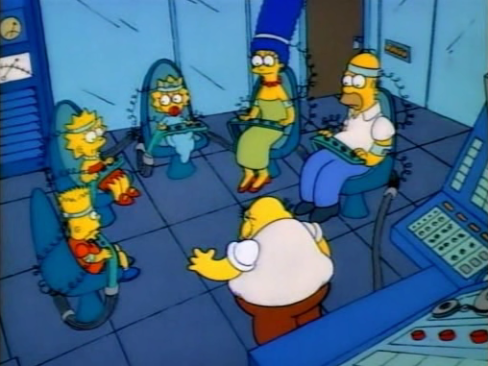
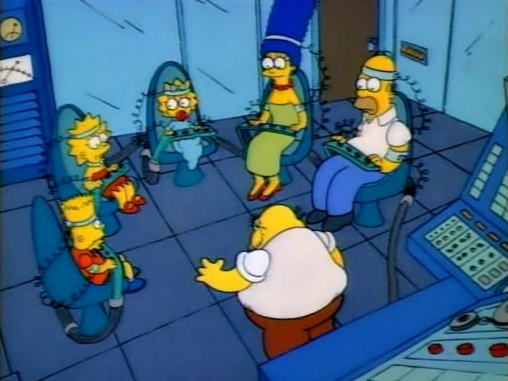
Like many of his problems, Homer finds the answer on TV at Moe’s: a commercial for questionable therapist Dr. Marvin Monroe. In one last grossly alien moment, Homer of all people pawns the family television to gather up the money to pay for therapy. During the session, the good doctor surmises that there is a great seething aggression within the family towards each other and they need to let it all out. They start out with whacking each other with foam mallets, which ends when Bart finds them to be more effective without the padding, right into Dr. Monroe’s shin. The doctor then pushes with more severe therapy: electroshock treatment, in a chaotic finale where each Simpson repeatedly shocks and gets shocked by one another, so much so that they cause power outages across Springfield. Even through this, the family remains thick as thieves, and when Homer catches Monroe on his money-back guarantee, getting back their $500, they are ecstatic. The Simpson family may get at each other’s throats, but at the end of the day, they’re still a family, regardless of its questionable foundations.

For all the out of whack things in this episode, there are also plenty of bits that still ring true today: Mr. Burns’ sprawling estate, the incompetence of the Springfield police force, and Homer’s undying belief in the words of TV. The episode ends with the family going off to buy a brand new television with their newly attained money. As they rush to the couch every week in the opening, TV is their great unifier as a family, it makes them who they are. There’s also a great subtle gag toward the end in Dr. Monroe’s waiting room, we see a bunch of waiting clients, including the suspiciously happy family from the picnic, all donning scowls. Perhaps it’s not the Simpsons aren’t the isolated screw-ups they may think they are.

Tidbits and Quotes
– “My boss is going to be at this picnic so I want you to show your father some love and/or respect!”
– As out-of-character as it may be, it feels very Homer to chase after his out-of-control kids like a wild man screaming, “Be normal! BE NORMAL!!”
– A very peculiar bit with the mother with the Southern twang talking to the other women about which child she loves more (“Usually I use their grades as a tiebreaker. They both got straight ‘A’s this term, so what’s a mother to do?”) There’s also a great follow-up by a tipsy Marge (“I sense a true greatness in my family, it’s a greatness that others can’t see. But it’s there, and if it’s not true greatness we have, we’re at least average.”)
– A very true early Burns quote yelling at the band, “Musicians, cease that infernal tootling!” Also the first mention of releasing the hounds.
– We get the first of many times of Homer breaking down into hysterics while saying grace (“Our kids are uncontrollable hellions! Pardon my French… but they act like savages! Did you see them at the picnic? Oh, of course you did… You’re everywhere, You’re omnivorous.”)
– Another testament to this season’s subtle humor is the stuff with the cops in the bar. Moe offers the two pretzels, to which Eddie declines (“No thanks, we’re on duty. Couple of beers would be nice though.”) Then later, when Homer tries to justify their dog’s attraction to them, claiming he has “wieners in his pocket,” Eddie responds, “Figures.” Like that’s a normal thing someone would have. Brilliant.
– Within the insane moment where Homer pawns the TV comes a great line when Marge suggests she pawn her wedding ring instead (“I appreciate that, honey, but we need $150 here!”)
– More bizarre background stuff: the walls of Dr. Monroe’s waiting room look like they’re made of waffle cone. Also the baffling cured alternate Simpsons, complete with the Homer substitute inviting his family out for frosty chocolate milkshakes.

3. Homer’s Odyssey

(originally aired January 21, 1990)
I don’t know how many characters can stoop to such shocking lows and still manage to bounce back, remaining likeable the whole way through, but if there is but one, it’s Homer Simpson. This episode has a lot of unusually dour content, stuff you don’t really expect or see coming, but manages to maintain the brisk feeling of the other episodes. We start with some lighter kid stuff with Mrs. Krabappel’s class on a field trip to the power plant. They are given a tour by an unusually tan Mr. Smithers, which begins with an old film on nuclear power, hosted by impish mascot Smilin’ Joe Fission. It’s a brilliant knock on the old 50s film strips, which I’m a huge fan of. The trip then bears witness to a sizable blunder: Homer knocks his transport cart into a radioactive pipe, and is promptly fired for his negligence.

Homer takes his mistake to heart, delving into a bit of depression. He maintains some will in his job hunt, but is discouraged further when he is denied at every turn. We get early hints of his later well-known alcoholism, as he finds he cannot afford another drink at Moe’s, and sinks so low that he smashes Bart’s piggy bank to scrounge up some cash. Realizing how deep of a hole he’s in, he resolves to commit suicide. This whole middle portion is so heavy, but it’s peppered with light bits of humor that feel really in-character of Homer. He writes his suicide note on “Dumb Things I Gotta Do Today” stationary, and unwittingly writes, “I can only leave you with the words my father gave me: stand tall, have courage, and never give up.” I don’t know how much I buy Homer’s death wish; it seems a bit uncharacteristic, but I have to give it up to the writers for having brass balls. An animated family sitcom where the father attempts suicide in episode three? That’s unprecedented.

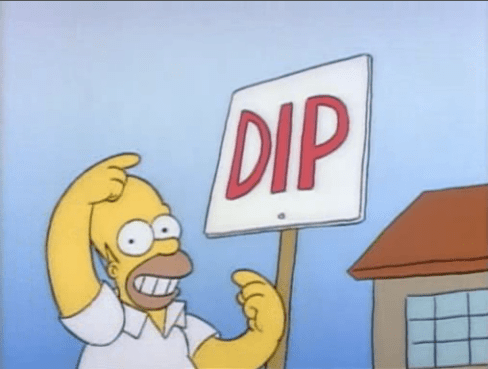
Homer, of course, lives, just in time to save his family from being hit by a truck. Acknowledging there should have been a stop sign at the intersection, he becomes a neighborhood watchdog, rallying an army of supporters in his crusade for safety. I never quite see how exactly this mollifies Homer’s predicament: his concern was of not being a provider for his family, and this new role of town hero can’t be getting him any money. But it does give him vigor and a newly gained sense of purpose, leading up to him crusading against his former employers at the nuclear plant. The rally is noticed by the head honcho, C. Montgomery Burns, who negotiates with Homer, offering him a position as safety inspector, to which he semi-reluctantly accepts.

The animation feels a bit rougher in this episode, but I still find its crudeness adds to some of the charm of these early shows. There are a lot of crowd scenes in the third act; the final one at the plant features a lot of tweaked out character designs. The Simpson family barely look human at this point, but next to some of these peculiar creatures in the background, they feel a lot more real. There’s also the weirdly bright backgrounds, particularly in the Simpson home, lots of washed out oranges and pinks that feel kind of crummy. Also present are the bizarre framed portraits on the wall, one featuring a screaming Homer, and another set of two framed pictures: one of Marge, and one above it of her beehive hair. These are ever present through the season, relics of these early classic years.

Despite the questionable actions he makes in this show, and many more to come, there’s just something about Homer that’s instantly forgivable. Through all his dimwitted decisions and pathetic pratfalls, he’s just a struggling every man trying to do what’s best for himself and his family. When grappling with the possibility of betraying his followers to work for the man, Homer’s mind goes to, among other things, thinking about how he can’t leave Marge burdened to support the family. As he put it, perhaps we all need to dig deep down to find the little Homer Simpson in us all.

Tidbits and Quotes
– A lot of characters have their first appearances in this show: Otto Mann, Sherri & Terri, Blinky the three-eyed fish, and Mr. Burns and Smithers (they appeared briefly in the Christmas show, but are truly introduced here.) Speaking of Smithers, most fans are aware of the coloring mistake of making him tan, but I’m more confused as how the almost Albino Sherri & Terri have a very dark-skinned father who works at the plant.
– “I defy anyone to tell the difference between these donuts and those baked today.” A great Homer line, speaking both his blind gluttony, and the plant’s cost cutting measures.
– Another first: Bart’s prank calls. Lisa laughing along with his brother’s hi-jinks is always heartening to see.
– A one-two punch of TV parodies: first, Homer is apparently watching LoafTime, the cable network for the unemployed (“We’ll be right back with more tips of how to win the lottery.”) Then, the fantastic Duff commercial: “Unemployed? Out of work? Sober? You sat around the house all day, but now it’s Duff time! Duff: the beer that makes the days fly by!” It’s such a brilliant back-handed slogan; Homer is easily taken by it, but I can just imagine a drunker, more depressed Homer still lying on the couch weeks later.
– ANOTHER first: Bart’s tag artist alter ego ‘El Barto.’ I can’t remember a lot of future episodes that really dealt with this; I think it was more picked up in the comic books and other Simpsons media.
– Homer’s introduction at the plant rally as a man whose very name is synonymous with safety is very odd to hear, considering how insanely reckless his character would later become. I also like his first words to the crowd (“Thank you. Unlike most of you, I am not a nut.”) The rest of Homer’s speech is great too (“Your lives are in the hands of men no smarter than you or I, many of them incompetent boobs. I know this because I worked alongside them, gone bowling with them, watched them pass me over for promotions time and again. And I say… This stinks!”)