12. Krusty Gets Busted

(originally aired April 29, 1990)
On tonight’s episode, we get our first major look at one of the greatest major secondary characters in the Simpsons pantheon: Krusty the Klown. A goofy, buffoonish harlequin, Krusty is at heart a true entertainer, by whatever over-the-top or potentially dangerous or humiliating means necessary. Later seasons will shine light on his angry and sleazy off-stage antics, but for now, Krusty and his empire is a perfect microcosm of children’s television: a madhouse of bright colors and loud shenanigans, and more show-related merchandise than you can shake a stick at (at the time, this series was cranking out its fair share of useless products as well.) In this episode, we get a look at Bart’s undying hero worship, Homer’s struggles to keep in his son’s good graces, and an epic war in kiddie TV.

We begin with a look at Krusty’s show, a chaotic affair of showboating, the audience blindly screaming catchphrases (“What would do if I went off the air?” “We’d kill ourselves!”), and senseless violence directed towards Krusty’s long-suffering second banana, Sideshow Bob. Between these antics and the first “official” Itchy & Scratchy cartoon, it’s completely devoid of any redeeming or educational content, just the way we like it. That night, however, Homer bears witness to the clown robbing the Kwik-E-Mart, and he is promptly arrested and stands trial. There’s some neat stuff within these sections sticking with the season 1 theme of Homer’s desire to not embarrass his son, but nevertheless, he must testify against his son’s TV idol in court, much to his chagrin.

With Krusty incarcerated, his show is handed off to Sideshow Bob, voiced by the blessedly voiced Kelsey Grammar. Having been mute save for his slide whistle in his first two appearances, he reveals himself to be a learned and brilliant thespian, and proceeds to change the format of the show to “learn about nutrition, self-esteem, etiquette, and all the mindly arts.” Bob creates a show the polar opposite of Krusty’s, a mindful and refined program where he reads “The Man in the Iron Mask” and ends each show by singing Cole Porter songs. Meanwhile, Bart remains loyal to Krusty, believing he was framed, and enlists Lisa to help him find evidence. During a taping of Bob’s show, which now takes the form of a kiddie version of a daytime talk show, Bart uncovers the truth: Bob is the culprit, given away by his grotesquely large feet. Years of torture and undermining from his former boss has chipped away at him, leading him to frame him for armed robbery. Watching this again knowing of Bob’s greater intelligence in later seasons, I feel this was a very weak plan coming from him. I mean, really, even Chief Wiggum should have been able to see the connection with the feet.

There’s so much stuff I missed talking about, like the town-wide vilification of the beloved clown in form of a public bonfire of all things Krusty, and the wonderful news biography of the entertainer’s life, from his humble beginnings as a street mime in Tupelo, Mississippi (just like Elvis) to his famed on-air heart attack whilst hocking Krusty Brand Pork Products. There’s just so much going on in this episode, but it all works fantastically, a wonderful introduction to a wonderful character. Comedy, thy name is Krusty.

Tidbits and Quotes
– Krusty uses the phrase, “I didn’t do it!” which would become Bart’s accidental catchphrase on the clown’s show in a much later episode. Just interesting to hear it this early.
– Great meta, semi-self deprecating line from Lisa on why Itchy & Scratchy is lost to her mother (“If cartoons were meant for adults, they would put them on prime time.”)
– Bob managing to perfectly disguise himself as Krusty still confuses me. Body padding would give him the build, but how could he have managed his mountainous tufts of hair down? He’d have to have them cut, but that would only arouse suspicion. Whatever. After the robbery, Apu has a great line to a hiding Homer (“You can emerge now from my chips. The opportunity to prove yourself a hero is long gone.”)
– The police line-up sequence is so wonderful, with an unusually competent Wiggum ordering, “Send in the clowns!” and Homer’s uncontrollably chuckling at the jesters before him (“If the crime is making me laugh, they’re all guilty!”)
– “Earlier this evening, the Springfield SWAT team apprehended the TV clown, who appears on a rival station, opposite our own Emmy-award winning Hobo Hank.” Now I really want to see Hobo Hank’s show. Must be pretty good if it won an Emmy.
– The animation of Krusty’s heart attack is absolutely amazing, so raw and horrifyingly drawn, but still hilarious through the whole thing. His weakened, guttural “Dying… I’m dying…” under the maddening cheers from his audience makes it.
– Krusty without his clown makeup is such a strange sight. I may be wrong, but I think this is the only time we see him like this, outside of his Rory B. Bellow disguise in “Bart the Fink.” Nowadays, even walking around in public, he’s got that get-up on, and nobody thinks twice about it. He’s just Krusty.
– Not quite sure why Marge calls Krusty an “insane criminal genius” just for robbing a convenience store. Partially-educated jailbird Snake seems to do it on a regular basis.
– Great bit with Lovejoy addressing the crowd before the bonfire (“Good people, I’m so happy you’re all here tonight. But please, just a few words of caution. Now, we are going to set this pile of evil ablaze, but because these are children’s toys, the fire will spread quickly, so please stand back and try not to inhale the toxic fumes.”)
– “Krusty wore big, floppy shoes, but he’s got little feet, like all good-hearted people. But Sideshow Bob really filled those shoes with these ugly feet!” He uncovered the truth, but I still don’t get Bart’s point. All people with large feet are evil?
– Homer has a great line toward the end apologizing to Krusty (“I’m man enough to admit I was wrong, and I’m sorry I fingered you in court. I sincerely hope that the horrible stories I heard about what goes on in prison are exaggerated.”)
11. The Crepes of Wrath

(originally aired April 15, 1990)
The series has slowly been evolving from a show about an upper-lower-middle class family, to a show about the offbeat town of Springfield. This episode features our first look outside the city limits, and the United States as well. The Simpsons would make many family outings overseas in the future to mock, deride and parody other foreign lands, but in this first international outing, only one Simpson makes the trip. This is an episode that has some interesting ideas, but ultimately felt quite sour to me.

We start in familiar territory: Bart causing the school toilets to explode with a cherry bomb, one occupied at the time by Agnes, Principal Skinner’s mother (in an odd first appearance where she is quite kindly, compared to the overly critical hag she is now). This latest incident results in Skinner approaching Homer and Marge about allowing Bart into a foreign exchange program to get the boy out of their hair for a bit. With that, Bart is sent off to France, and the Simpsons welcome a seemingly sweet Albanian named Adil. This side story has a lot of great stuff in it, with some great culture clash satire, such as when Homer breaks up an argument between Lisa and Adil (“Maybe Lisa’s right about America being the land of opportunity, and maybe Adil’s got a point about the machinery of capitalism being oiled with the blood of the workers.”) Homer getting played by Adil to retrieve confidential nuclear power blueprints and photographs for his native land is an interesting, slightly dark storyline, but Homer’s naivety throughout the entire episode, even up toward the boy’s arrest, gives it humor.

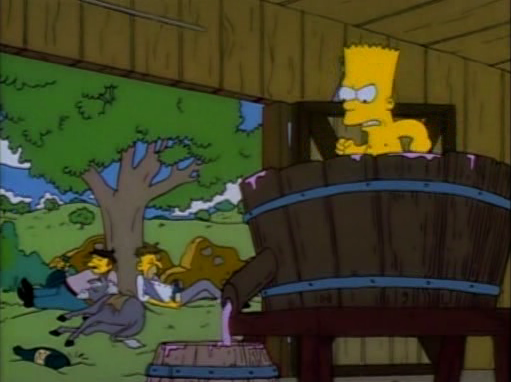
The main story, however, isn’t much fun. Bart finds that he has been placed in the care of two scummy, self-serving farmers in the French countryside, who essentially use Bart as their slave, working the fields in place of their beloved mule. They steal his belongings, make him sleep on the floor, and have him test out potentially life-threatening wine laced with anti-freeze. First off, this storyline bothers me from a logical level: what kind of foreign exchange program is this that these two scoundrels can get away with being in charge of a ten-year-old? They just blindly send Bart off to their care, and it’s just assumed it’s fine? But beyond that, it’s just kind of sad to see Bart basically being tortured through most of the show. There are a few good lines here and there, but it’s kind of a bummer seeing a kid used and abused like this, especially when it reminds you of real-life stories of this kind of horrendous activity going on.

Bart is saved when he miraculously manages to wrangle the French language and alert a policeman to his caregivers and their criminal enterprise (he later comments, “So basically, I met one nice French person.”) Meanwhile, Adil ends up being used in a criminal exchange for an American boy placed in Albania. It’s an episode that feels like it could have been more poignant and pointed toward presenting other cultures and then tearing at them, but it gets too muddled down in the dourness of Bart’s unfortunate situation. There’s not much commentary on France other than they like wine. The B-story is a lot better, but it also feels a bit dark. I guess with four credited writers on this one, a little bit of mish-mashing was bound to happen.

Tidbits and Quotes
– The beginning of the episode is brilliant, with Homer falling down the stairs and unable to move because of his trick back. Santa’s Little Helper and Maggie falling asleep next to him, and the talking Krusty doll’s fading batteries are amazing, as is Homer’s weakened shudder when Marge and Lisa find him (“The boy… Bring me the boy.”)
– Skinner lays Bart’s situation on thick for Homer and Marge (“Mr. and Mrs. Simpson, we have transcended incorrigible. I don’t think suspension or expulsion will do the trick. I think it behooves us all to consider… deportation.”) It’s also clear how little of a shit he gives about the boy, he just wants him gone (“Bart doesn’t speak French.” “Oh, when he’s fully immersed in a foreign language, the average child can become fluent in weeks!” “Yeah, but what about Bart?” “I’m sure he’ll pick up enough to get by.”)
Homer’s send-off to his son is funny and sweet: (“Always remember that you’re representing your country. I guess what I’m saying is, don’t mess up France the way you messed up your room.”)
– Skinner’s assembly introduction to Adil is a brilliant commentary of American relations and how we view radically different cultures (“You might find his accent peculiar. Certain aspects of his culture may seem absurd, perhaps even offensive. But I urge you all to give little Adil the benefit of the doubt. This way, and only in this way, do we hope to better understand our backward neighbors throughout the world.”)
The only real funny bit in the France stuff is the two brothers’s plan in putting anti-freeze in their wine (“Too much can be poison, but the right amount gives wine just the right kick.”)
It always struck me as odd that when Bart, visibly poor and starving, tells the policeman all the horrible things Cesar and Uglion had done to him, the policeman only reacts in shock about the anti-freeze scheme. I guess that was supposed to be the joke, but it didn’t feel much like one to me.

10. Homer’s Night Out

(originally aired March 25, 1990)
This is two episodes in a row featuring trouble in paradise for Homer and Marge, but instead of a more grave storyline with actual potential adultery, we get a slightly goofier story involving a heavily circulated photo of Homer and a scantily-clad belly dancer. The tonal difference between the two should be obvious: Marge being tempted away by another man might actually make sense, but Homer has no reason whatsoever to betray his saint of a wife. But in episodes where infidelity is presented to him (“Colonel Homer,” “Last Temptation of Homer”), Homer is never a very active party to any untoward shenanigans. Despite his bumbling nature, he is a man truly devoted to his wife, and can’t imagine a life without her, so even though this is much lighter than “Life on the Fast Lane,” it’s still saddening to Homer get put in the doghouse.

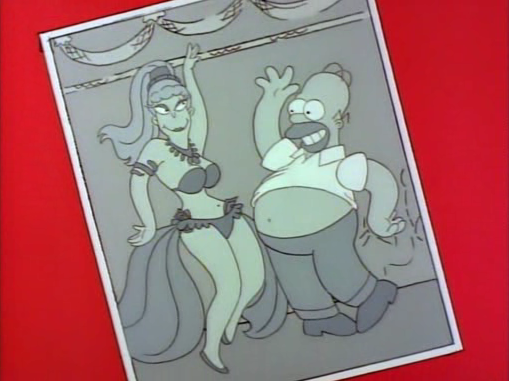
The episode starts out pretty slowly, with Bart sending away for a miniature spy camera in the mail. In the six-month gap between the delivery, we see two similar morning scenes of Homer and Marge in the bathroom. Homer being horrified at his weight (“239 pounds?! I’m a blimp!”) and then doing pathetic attempts at crunches is funny, but then seeing him do it again six months later with the same degree of outrage is even funnier (“239 pounds?! I’m a whale!”) We also find that Homer’s old assistant (now his supervisor after the six-month time jump) is having a bachelor party, which Homer insists is a classy affair (“A tea and crumpet kind of thing.”) The party inevitably turns blue, much to the chagrin of the groom and his father, thanks to Princess Kashmir, “Queen of the Mysterious East.” Also, said party is also taking place at the Rusty Barnacle, where Marge and the kids are out to dinner. Bart slips away from the table and happens to peek into the party, and with his camera, takes the immortal shot of his father with the exotic dancer.

What happens through the second act is a stretch to say the least, even by 1990 standards. The picture ends up making the rounds throughout the school, which I can buy, but then spreads throughout the entire town, xeroxes everywhere, reproducing this super scandalous photo. I figure it’s basically the real-life version of a viral photo, that’s more about the goofiness of this portly smiling fool with this beautiful dancer. It certainly isn’t for the photo’s sex appeal, as the episode sometimes alludes to. By the ending, when every single person who runs into Homer makes vague reference to the photo, it’s kind of going too far, though we get some great reactions though, like when a car of thirty-something ladies giggle and pose for Homer at a light (“Heh. Still got it!”) Marge inevitably discovers the photo, Bart is revealed as the one who took it, and Homer is kicked out of the house.

There are parts of the third act which mirror the serious tone of “Fast Lane,” like when Lisa whispers to Bart at the table, “I wonder when’s Dad coming home,” Marge notices, and then continue eating in silence. It feels so very real, and creates stakes for this marriage to need to come back together. To redeem himself, Homer takes Bart to nudie bars and burlesque houses all over town (hear me out) to track down Ms. Kashmir, to show his son that she is an actual human being, not just an object to be ogled. This ends in a grand finale at the Off-Ramp Inn, where Homer winds up in the middle of a lounge act hosted by a Dean Martin-esque singer, during a number, “I Could Love a Million Girls.” Realizing the night’s effects on his son, Homer makes a bold speech about women (“I have something to say to all the sons out there. To all the boys, to all the men, to all of us. It’s about women, and how they are not mere objects with curves that make us crazy. No, they are our wives, they are our daughters, our sisters, our grandmas, our aunts, our nieces and nephews. …well, not our nephews. They are our mothers. And you know something, folks? As ridiculous as this sounds, I would rather feel the sweet breath of my beautiful wife on the back of my neck as I sleep, than stuff dollar bills into some stranger’s G-string. Am I wrong, or am I right?”) It’s enough to win over Marge in the audience, and to win over me too.

Tidbits and Quotes
– Great scene with Bart vs. the mail lady. “Where’s my spy camera?! WHERE’S MY SPY CAMERA?!”
– I love Bart’s reaction to Marge’s announcement of going out to eat (“Only four of us? Who escaped?”)
– I don’t know how many bachelor parties have the father of the groom in tow. I guess the point was they were unaware of Princess Kashmir’s invite, and their displeasure of it all is most evident (“How do I tell you this, my boy: we’re in hell.”)
– First time Bart rearranges letters on a sign: “Cod Platter” to “Cold Pet Rat.” They would become much more elaborate in later years.
– One of the more archaic elements of this show is Bart developing his photos in a dark room. Not so much the case now, as kids can take digital photos on their phones with ease.
– As mildly insane as the phenomenon of the photo is, the most crazy element is Mr. Burns’s reaction, calling Homer to his office for advice on wooing the ladies. It’s a funny scene, but feels so unlike the misanthropic old man we know and love now.
– Homer goes to live with Barney, who lives in an absolute dump of an apartment (“If you get hungry in the middle of the night, there’s a beer in the fridge.”)
– Homer taking Bart to all the nightclubs looking for Kashmir is a great montage, with Bart continuously trying to peek over crowds and behind curtains to see the action (“Bart!! I said look at the floor!!”)

9. Life on the Fast Lane

(originally aired March 18, 1990)
This episode really, really surprised me. Season 1 has showcased the Simpson family in a more serious light than later on, treating their personal problems like feeling socially ostracized, depression and economic woes in a pensive manner. But this episode is well beyond what we’ve seen: the last half of it, apart from the slightly exaggerated nature of Jacques’ character, is extremely dramatic, a picture of a happy marriage quietly falling apart. It’s incredibly jarring and extremely effective. This show’s been on the air for over twenty years, and we’ve had so many Homer-Marge marital trouble episodes, we know nothing is going to happen to them. The fact that I felt real tension and doubt from this episode is a testament to how good it is. It may not be the funniest, but it’s definitely one of the most powerful Simpsons episodes ever.

We start innocently enough: Homer has forgotten Marge’s birthday, and with a mindlessly insensitive act presents her with a gift of a bowling ball, one drilled for his fingers and with his name on it. As an act of passive-aggressive retaliation, Marge decides to use the ball for herself. At the bowling alley, she has a run-in with Jacques, a breathy-voiced womanizer with a wavering French accent, voiced by Albert Brooks. Like Bob, Brooks seems to have a lot of improv in this, and he commands each scene he’s in, which works for his commanding character, with a quivering Marge overcome by his sense of presence. As I said, Jacques provides the episode’s main outlet of comedy. The number of great lines are endless: “Throw, damn you!” “My mind says stop, but my heart, and my hips, cry proceed,” “Your laughter is like music to me, but if you laugh at what I say next, I will die,” and of course, his immortal description of brunch: “It’s not quite breakfast, it’s not quite lunch, but it comes with a slice of cantaloupe at the end. You don’t get completely what you would at breakfast, but you get a good meal!”

As great a performance as Brooks gives, one cannot ignore the fantastic jobs Dan Castellaneta and Julie Kavner bring to the table. Kavner plays against Jacques with a undertone of worry, but still excitement about this potential affair, while Castellaneta really makes you feel for her dumb oaf of a husband. There’s an unbelievable scene that feels like it’s from some kind of psychodrama. With bizarre, maudlin non-Simpsons music, we see a despondent Homer take off his overshirt in his bedroom. He looks over sniffling at a picture of him and his wife, then notices something in the drawer. It’s the bowling glove Jacques had bought for her. With a confused, wavering tone to his voice, Homer reads the sewed inscription, “‘For Marge’?” It’s fucking unreal. The building tension is so dramatic, so unlike the lighter, more humorous show we’re more accustomed to. A later scene is just as amazing, when Homer walks in the kitchen to find Marge making him a sandwich. He goes up to reach for her hand, pauses, then grabs his lunchbox instead. In a so-true-to-Homer moment, his flattery of his wife is represented in complimenting her peanut-butter-and-jelly making technique, and the fact that such a silly piece of dialogue is so heart-breaking is a testament to how strong these characters are. Backtracking a bit, there’s a fantastic sequence of a daydream Marge has of her and Jacques in a dream dance parlor. It’s all done in grey tones with some cool reds and blues, with scattered imagery of bowling balls and pins. There’s also a Jacques’s collection of trophies, which as he claims, are not for bowling, but love-making. It’s one of the most visually arresting sequences in the show’s history.

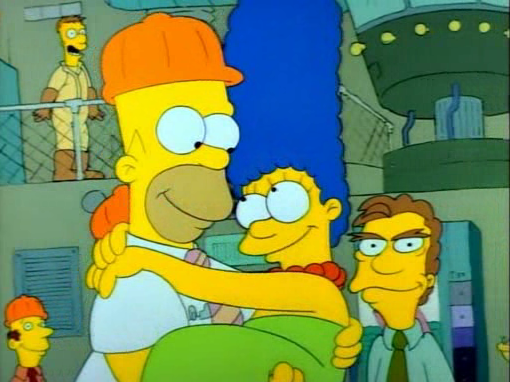
The ending is obvious, of course: rather than go to Jacques’s apartment, Marge surprises her husband at work, where Homer sweeps her off her feet, and makes a grand announcement to his co-workers (“I’m going to the back seat of my car, with the woman I love, and I won’t be back for ten minutes!”) Given how much has built up to this moment, it’s really an emotionally charged conclusion. It’s a truly earned happy ending, after one of the most devastatingly real and emotional episodes ever. It may not be very joke-heavy, but it’s definitely my favorite of the season thus far.

Tibdits and Quote
– I love Homer’s desperate search through the mall to find Marge a gift (“Too salty!” to the Jerky Hut, “Too exciting!” to Girdles ‘N’ Such Fancy Lingerie).
– The Singing Sirloin must do some good business. Four singers per table? That’s got to be some big payroll.
– Marge’s run-in with the bowling alley employee is great, with her indignation of being asked her shoe size and his continued pointing at policy signs (“Can’t bowl without a lane!”)
– Jacques’s character is comprised of so many things: the great design with his constantly squinted eyes, like he’s always looking out for women to seduce, the great voice by Mr. Brooks as I’ve mentioned, the way he’s animated, always moving in towards Marge, overpowering her of sorts, and the great music cue associated with him, like you’re seconds away from being completely seduced.
– Homer taking care of the kids in Marge’s absence gives the episode some needed laughs (“Does the time always drag like this?”) Also, Lisa’s descriptions of the eight stages kids go through during their parents’ marital squabbles, borrowed from a strip of Matt Groening’s Life in Hell.
– First appearance of Helen Lovejoy, who, for some reason, introduces herself as “the gossipy wife of the minister.” She’s animated with very quick movements, almost like a hummingbird flitting from place to place to nose into people’s business, a tic that wouldn’t carry on past this episode. Jacques has a great line when she leaves (“You have a lovely friend there. Let’s hope something runs over her.”)
– Jacques preparing for Marge’s arrival in his bathroom is a great scene, a man truly in love with himself. His parting line, “You’re really going to strike out tonight!” ends up being oh so true.

8. The Telltale Head

(originally aired February 25, 1990)
Over this season, we can see a lot of early hints of what this series would eventually become, in content, tone and scope. In this episode, we get a better impression of the actual town of Springfield. This is the first episode that really looks outside the Simpson family and features a few of the fellow Springfieldians we’ve met so far, and some we have just been introduced to. In this context, the episode starts out with a perfect representation of the town of Springfield as we will come to know it: a ravenous angry mob that chases Homer and Bart through town. The good people of Springfield are an impulsive lot, who can turn from calm to raging to relief with moderately little provocation.

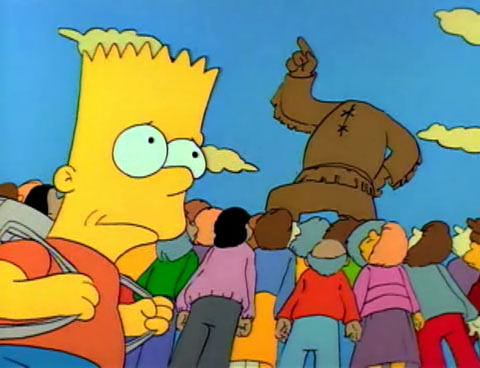
The mob in question is in response to the decapitation of the statue of town founder Jebediah Springfield, and our dear old Bart is responsible. The story is interestingly told as a flashback, leaving the viewer in the dark like the townspeople, and creating more of a sense of drama. The impetus of Bart’s misdeed is pretty simple: his attempt to impress some older bullies, Jimbo, Dolph and Kearney, in their first appearance. It’s pretty interesting hearing how parents and various morality groups in the early 90s perceived Bart as a bad influence, but his behavior in the first season barely even registers as devious. He’s mischievous at best, but he takes a neutral stance at his new friends’s shoplifting and defacement of property. Bart seeks his father’s advice, where Homer instills another classic misguided moral: “Being popular is the most important thing in the world.” Homer’s questionable advice sends Bart off to commit the deed: cutting through a bronze statue with an ordinary hacksaw. Don’t ask me how, it’s a cartoon, for God’s sake.

Bart and the bullies’s day about town gives Springfield a sense of scale, but the reactions of the townspeople after the statue defacement is really what gives Springfield character. We get a better sense of Moe’s bar, Abe’s retirement home, the Kwik-E-Mart and Apu, and the first look at the Krusty the Klown show (and a mute, off-model Sideshow Bob), all of whom are out for the blood of the hoodlum responsible for the heinous act. Even the bullies are offended, much to Bart’s shock. In keeping with the title’s namesake, Bart’s conscious and guilt is given voice by Jebediah’s head, Telltale Heart-style, eventually leading to his admission to his family, leading to the wraparound back to the beginning. Homer acknowledges he is partially to blame for his advice, and Bart is forgiven by the townspeople and returns the head to the neck from whence it came.

I glossed over most of the beginning, with the Simpsons attending Sunday mass; it’s not so important story-wise, but it sets up the role of religion in the Simpsons universe. The people of Springfield are mostly God-fearing and devout, albeit some with more reluctance than others. Everything is mocked on the show, religion included, but there is always a sense of positivity to the spirituality, like with Marge believing church to be good for the family. A character like Reverend Lovejoy (another first appearance) would be the subject of mockery and defilement on another show, but is treated as a real person, with a few quirks as we’d see down the road. There’s a lot of funny stuff in the beginning, with Homer listening to a football broadcast on a walkman during church and Bart’s ever-insistent questions to his Sunday school teacher. There’s a lot to love in this episode, a town-wide story with great character stuff, good jokes and an emotional core: a fore-bearer of things to come.

Tidbits and Quotes
I built the good Reverend up in my last paragraph, now I tear him down. Before his more respectful debut in the episode proper, I love how the beginning of the show shows him as part of the mob, torch in hand, with no qualms about hunting down and killing a young boy.
– The show’s first meta-joke: Bart claiming his story will take “about 23 minutes and 5 seconds.”
– I love the family’s Sunday best outfits, especially Lisa and Maggie’s bonnets and Marge’s pillbox hat high atop her hair. What era are we in?
– The sportscaster’s proclamation, “This could be the most remarkable comeback since Lazarus rose from the dead!” followed by Homer’s “Laza-who?” right as they pull in front of the church makes it doubly blasphemous.
– The Sunday school teacher’s exasperation at Bart’s questions is great, followed by a fantastic skewering line (“All these questions… Is a little blind faith too much to ask?”)
– Always loved this exchange between Jimbo and a hesitant Bart (“But sneaking into movies is practically stealing, man.” “It is stealing.” “Well, okay. I just wanted to make sure we aren’t deluding ourselves.)
– Dolph refers to their shoplifting as a “five-finger discount,” while they all have four fingers. Huh.
– I love the Candy Most Dandy shop owner, and I really don’t know why. He has such a sophisticated voice and is so irritated by the bullies, and seemingly by life in general, but meanwhile he owns a jolly-looking candy store. He may be my favorite Simpsons character with eight seconds of screen time.
– The bullies’s about-face in their sudden disapproval of the statue’s beheading seems kind of silly, but I love their response when Bart asks why they previously thought it would be a cool idea (“That was just cloud talk!”)
– The news report about the history of Jebediah Springfield is fantastic (“Jebediah Obadiah Zachariah Jedediah Springfield came west in 1838, along the way, he met a ferocious bear. Jebediah discards his axe and wrestles the bear and killed him with his bare hands.  That’s B-A-R-E hands. Though recently uncovered evidence that the bear, in fact, probably killed him.”) I love that glossing over of evidence that discredits his great accomplishment, as it’s an excellent illustration of how we tend to romanticize figures of the past, embellish their achievements, or just flat-out lie about them, not exactly for what they did, but what they stood for (see also: “Lisa the Iconoclast.”)