
I can’t remember when I first saw an episode of The Simpsons. I know for sure I started watching new episodes in season 10, but I can’t recall when I started regularly watching reruns before that. I consider myself within the second generation of Simpsons fans, as I was born right around when the series began, being a literal infant during the heyday of Bart-Mania, then discovering the show and becoming a fan at the tail end of the 1990s. But even though I missed that initial wave of popularity, I was still growing up in a world where The Simpsons‘s presence in every day life was inescapable, with Bart Simpson being as ubiquitous for a 90s kid as Batman or the Ninja Turtles. I also grew up with the show being considered somewhat taboo; it wasn’t out-and-out banned in my house, but I was strongly encouraged by my mother to not watch it at a young age, until she eventually relented when I got older. For whatever reason, this restriction did not extend to non-show-related material, so there’s part of me that feels like for a brief window of my childhood, I had more exposure to Simpsons books than I did with the show itself. I have a memory of having The Simpsons Rainy Day Fun Book at a pretty young age, which released in 1991, but I must have found the book somewhere around 1995 or 1996. Bart Simpson’s Guide to Life and The Simpsons Uncensored Family Album would soon join it in my library, as well as what would become my personal Bible, The Simpsons: A Complete Guide to Our Favorite Family.
It wasn’t much longer after that that I discovered the Simpsons comics. The first issue I bought when it was new was #37, which hit shelves in June 1998, but I distinctly remember the first comics-related thing I owned was The Simpsons Wingding, a trade paperback collection of issues #19-23 released in May 1997. Having missed the initial wave of Simpsons commercialism, I wasn’t able to experience first hand the early 90s toys, T-shirts, or video games due to lack of availability, but with the comics, I could easily pick up the reprinted volumes comprised with back issues at any book store, easily garnering a complete collection of the series up to the point I was picking up new issues. These were all put out by Bongo Comics, the company founded by Matt Groening, named after the one-eared rabbit character in his Life in Hell series. Bongo Comics had an incredibly impressive run, releasing titles from 1993 all the way up to 2018. Looking back at the issues I remember having, I stopped collecting the comic around mid-2006, so it’s wild for me to think that they kept plugging along for over a decade more.
Some readers in the past have asked if I was ever going to cover the Simpsons video games, but that always felt like well-trod ground that many people had covered, plus I felt less inclined to do it given my lack of exposure to pretty much all of the games pre-Road Rage (YouTuber honestom23 has been doing an unbelievably thorough job in his series ranking every Simpsons game, including all the different console versions of each game, as well as stuff like covering all the content from the recent Fortnite crossover. I highly recommend checking it out.) But the Simpsons comics feel a little less discussed, and for a brief, shining moment, I thought I might want to burn through a whole bunch of them and give my broad thoughts about the series, as I remembered it as a kid and looking back on it now. However, similar to past jolts of creative writing energy I’ve had for this blog in the past five years or so, my motivation dropped like a stone pretty early in actually reading the comics, in addition to being busy with other stuff that ate up my time. Never say never, but I don’t think I’m going to actually come back to cover this topic. However, I had already researched and written up my prelude article about Simpsons Illustrated, the magazine that predated Bongo Comics in the very early 90s. Rather than let it languish in my drafts, I figured I’d just post this as a one-off, since it is an interesting Simpsons curio, and something I think a lot of fans, myself included, had never really examined that closely.
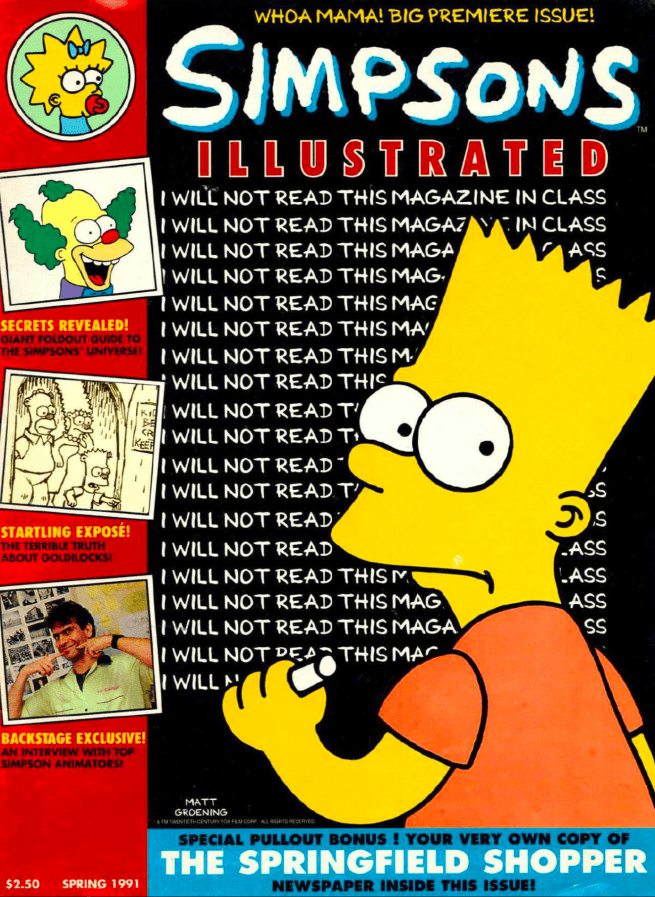
In the spring of 1991, halfway through The Simpsons‘s second season, the first issue of Simpsons Illustrated released. The magazine was released quarterly for a little over two years over the course of ten issues. It’s very much the direct forefather to Bongo Comics, being produced by Matt Groening, joined by artists Steve and Cindy Vance and Bill Morrison, all of whom would later found the comic company. I knew Illustrated existed, but I had never actually looked through an issue before, so I was curious to see what they were all about. They quickly reminded me of children’s publications I read as a kid, the likes of Nickelodeon Magazine and Disney Adventures. The issues are much, much slimmer than those magazines, most of which being around 40 pages, much less if you exclude the advertisements. In addition to normal kids ads for sugary cereals and candies, and promoting films like Home Alone 2 and Drop Dead Fred, there’s also a ton of Simpsons-related ads, pumping kids up to ask their parents for the new Simpsons video games, VHS tapes, books, novelty wristwatch, different themed food, a Simpsons Sing the Blues T-shirt, and the ever-impressive collectible plates (numbered by hand in 24 karat gold!) The magazine serves as a great window back to the early merchandising explosion of the show, where everybody everywhere wanted in on this new license to print money.
Like any magazine, there are your evergreen columns. “In the News” presents short news briefs featuring The Simpsons, ranging from the show crew’s frustration at being consistently shut out of the Emmys to the National Committee on Youth Suicide Prevention’s concern about the joke in “Bart the Lover” where the boy in the Zinc filmstrip tries to shoot himself being an imitable act for children (Matt Groening comments, “Does this encourage teenage suicide? If anything, it cheers up suicidal teens by giving them something to laugh at.”) There’s also many short blurbs about real people making the news who either have the surname Simpson or share a full name with one of the characters (which reminded me of a great story Groening told on an audio commentary of a scathing letter he received from a woman talking about how the show made her husband’s life a living hell as a nuclear safety inspector, which confused Groening until he saw it was signed by “Mrs. Homer Simpson.”)
“Junk Mail” is for fan mail and art, and it was incredibly sweet going through these letters, with so many people, from kids to adults, talking about how much they love the show and what it means to them. This section that only got larger as the issues went on, eventually becoming basically a quarter of the entire magazine, which I read as kind of lovely that they wanted to feature as much fan response as possible. Though one particular letter that jumped out to me was from a Mr. Matt Zimmer addressed to Russi Taylor, taking issue with Martin Prince using some “spicy” language in “Saturdays of Thunder” (“Deploy, damn you, deploy!”) Matt felt that Russi, who also voices Minnie Mouse and other characters in shows aimed at children, should have pushed back against the script using such language (“I realize you didn’t write the episode, but as a famous cartoon vocalist, you have enough clout to object to lines like that.”) I found this very laughable, but a few issues later, it became even better that they published a rebuttal letter from Wayne Allwine, Russi Taylor’s husband and the voice of Mickey Mouse (“Being my wife’s #1 fan, I feel I must take issue with the heart of your misguided epistle… I would remind you that we are human beings, NOT THE ANIMATED CHARACTERS WE PORTRAY!!”) I’m sure it didn’t feel great for that kid to have his ass ripped off by Mickey Mouse himself, but hey, he asked for it.
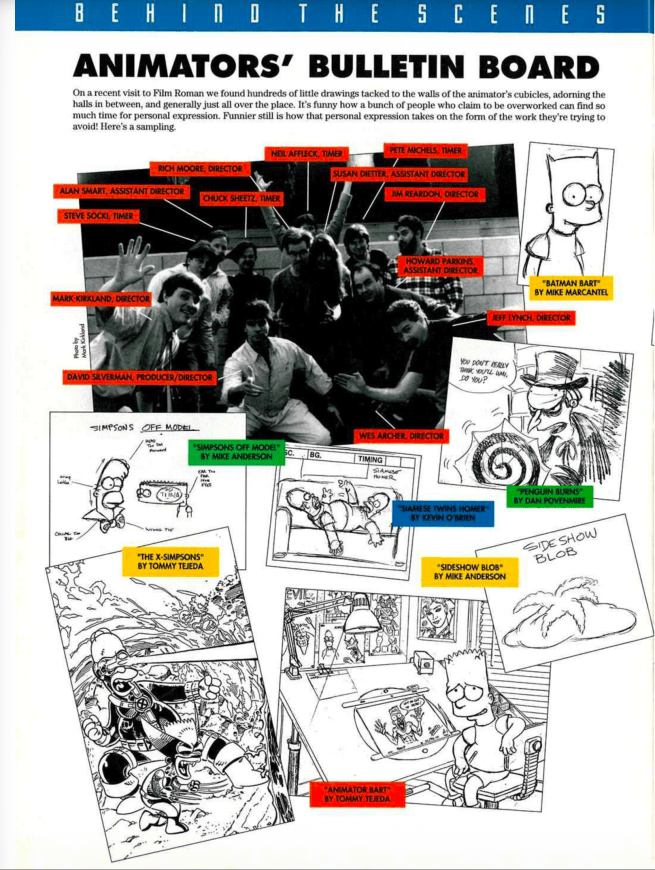 Each issue contains a behind-the-scenes interview with someone from the show, be it Nancy Cartwright, David Silverman, the full writer’s room, and in the final issue, the big man himself Matt Groening. As a grown-ass Simpsons fan, nothing in these features was new or revelatory information (with a few exceptions; I wasn’t aware that Nancy Cartwright threw out “Eat my shorts” during a table read), but this is probably the greatest value add for this magazine, especially if I put myself in the head of a young fan at the time. To get inside information about how my favorite show of all time was made, especially as a kid interested in animation, to hear from Silverman and Wes Archer in the very first issue about how they design characters and the different things that inspire the show would have been incredibly arresting to read. With these interview pieces plus each issue having a section in “In the News” talking about what’s to come for the new season, this felt like top secret information that you as a fan were being let in on. In an era where the actual people behind a show you loved were totally anonymous, this magazine really lets you in on the team responsible for the silly cartoon your parents just don’t get.
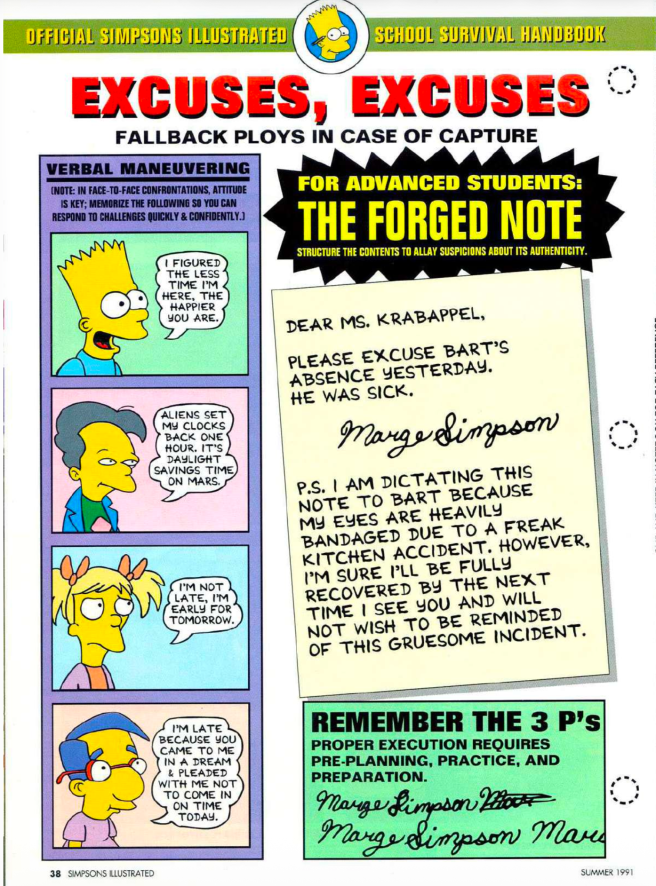 The rest of the magazine is filled with different kinds of content, ranging from a look at the Springfield Elementary School newspaper (Bart writes up an expose on the fiendish vandal El Barto), a historical write-up on the life of Jebediah Springfield (“Through his journeys, Jebediah became known as a friend to all Native Americans, except those few who had land he wanted,”) and double-page images showing you all the crap on the Simpson fridge or inside Mrs. Krabappel’s desk. It’s kind of a mix of two different categories: Simpsons-specific articles, diagrams and artwork, and Simpsons characters present some more general kid-targeted content, like interesting science or animal facts, or G-rated naughty limericks to annoy adults with. One issue features some mostly harmless pranks you can play on your friends, introduced by the Devil himself (as depicted in “Bart Gets Hit By a Car,”) and even funnier, the feature reappeared in the final issue for more prank ideas by popular demand (Satan tells the child reading, “I’ll see you soon!”) A re-occurring feature “The School Survival Handbook” has Bart dispense valuable advice on where to sit in class, how to get away with goofing off, and how to make your teacher’s life hell. So much of the format and spirit of these sections feels very Life in Hell, especially ID’ing different types of teachers and students you’ll encounter, which I think was definitely an idea used in Groening’s “School is Hell” mini-series. It reminds me how so much of season 1 of the show was emulating Groening’s comedic voice as well as his art style, so it would stand to reason that this magazine off-shoot would do the same, especially since Groening seemed to have some kind of hand in creating this content. The fake full-page ads for Marvin Monroe’s E-Z Analysis Hut (promoting a 24-hour therapy line for insomniacs) and Apu’s home study course for entrepreneurs (includes a free brochure, “How to Alter Dairy Product Expiration Dates for Fun and Profit”) are laid out exactly like they would be for fake businesses in a Life in Hell Sunday piece.
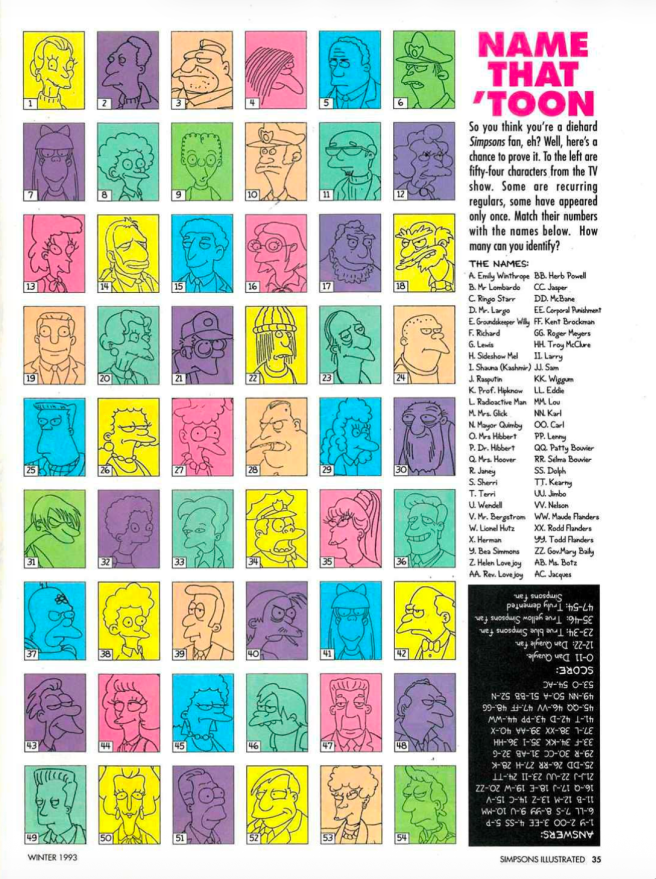 It’s also interesting to look back on Simpsons media during this period in how they expand the universe based on the limits the show had already established in just a few short seasons. Early show appearances like the Space Mutants, Bleeding Gums Murphy and Truckasaurus are given full-page highlights, the School Survival Guide makes use of Lewis, Richard, and other anonymous Springfield Elementary kids, and the characterization of Skinner and Krabappel as show “villains” to the young audience who identifies with Bart, rather than the more richly fleshed out characters they would later grow into. The above quiz is interesting to digest since there’s so many secondary characters the show is known for that just aren’t here, with Mrs. Botz, Emily Winthrop and even Ringo Starr padding out the head count alongside series evergreen characters like Kent Brockman or Chief Wiggum. But that’s what makes it fascinating to examine this period of Simpsons media, where they could only work off of and reference the 50-odd episodes that came before it. One feature is a Chief Wiggum case file to figure out who’s been defacing numerous safety signs all over town. Homer is amongst the suspects, but attests his own innocence by pointing out, “I’m the guy who put up all those signs in the first place!” It took me a moment to realize this is a reference to his brief stunt as a public safety crusader in “Homer’s Odyssey.” Also scattered amongst the articles and comics were some fun, non-canonical lore, such as Lisa mentioning that Marge’s father died in a freak roller coaster accident, and a Playdude profile on Krusty calling his never-seen (I think?) mother “Sofie,” which is a crazy coincidence given over a decade later, they would introduce his daughter also named “Sophie.”
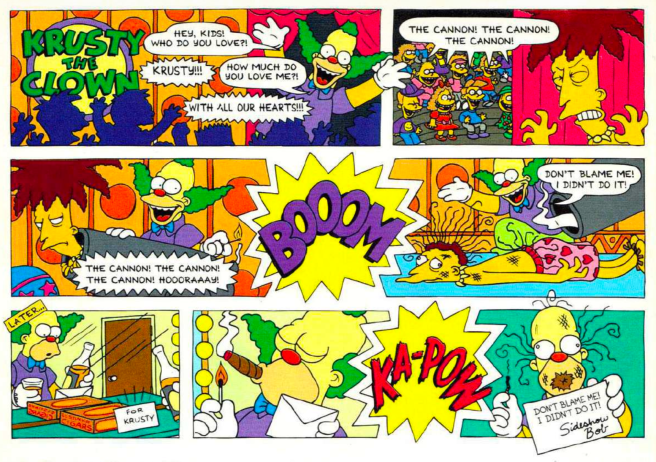 Each issue featured a Simpsons comic, starting with half-page, Sunday strip-style short pieces, eventually expanding to multi-page mini-stories (each issue also featured a strip of Craig Bartlett’s Arnold; nice of Matt Groening to give some print real estate to his brother-in-law.) The comics were obviously a huge draw for kids and Simpsons fans, with multiple letters in the fan mail sections demanding more comics and less of the other shit. It almost seemed like a foregone conclusion that a Simpsons comic book would become a reality. The fake ads and articles on the world of The Simpsons were definitely cute and clever, but it was obvious fans wanted to see more adventures featuring their favorite characters, in what would basically be all-new episodes in comic book form. I don’t know the specifics, but I imagine Matt Groening had always wanted to do a Simpsons comic, and maybe the opportunity for the magazine presented itself and he viewed it as a potential launchpad to eventually do the comics. The magazine was released by Welsh Publishing Group, who put out similarly targeted kids fan-zines for Barbie, DuckTales, and Teenage Mutant Ninja Turtles, so it may have seemed like a no-brainer to make the deal if Welsh expressed an interest. Through the success of Illustrated and the show itself, Groening must have gained the clout and the capital needed to make that leap to starting his own comic empire.
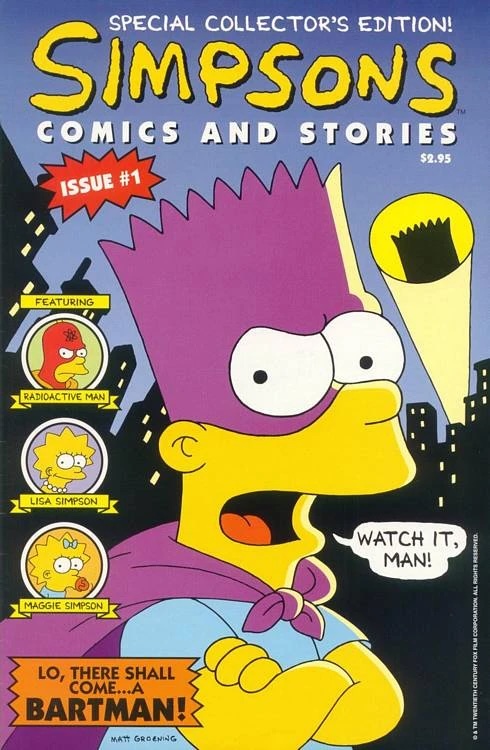 Before the end of Illustrated‘s run, they put out a special one-off issue titled Simpsons Comics and Stories, which, as the name would suggest, was an honest-to-goodness comic book with three short stories: Bart dons his Bartman superhero persona to save the legacy of his beloved Radioactive Man from being killed off, Chief Wiggum enacts a town-wide crackdown to expose the elusive vandal known as El Barto, and Maggie has a Baby’s Day Out-style silent adventure out in the big world. Steve and Cindy Vance and Bill Morrison were largely the team behind the writing and artwork, as would carry over to the early few years of Bongo Comics, so reading this is basically like reading Simpsons Comics #0. There’s more I could dig into with these first few comic stories, how they adapt the look and voice of the show, as well as examining the Bartman character, but that all sounds like stuff saved for next time. The great success and positive feedback of Comics and Stories must have been the deciding factor to going for broke, ditching the magazine and starting up Bongo. It is a bit odd though, since the final issue of Illustrated still has the usual subscription advertisement with the form to fill out and mail away for more issues, so I don’t know if it was a foregone conclusion that the magazine was for-sure ending at that moment, even though it came out just a few months before Bongo Comics released its first issues. But in any case, Illustrated was no more, a very admirable effort giving kids a peek through the peephole of how their favorite cartoon is made.


Nice post. Early Simpsons tie-in media fascinates me for a variety of reasons. One of them being, as you said, how it had to work off of the then-limited amount of material from the main source. (You’d think Princess Kashmir was a beloved mnain character from how prominent she was in early merchandise.) Or how that stuff really pushed Bart as the star of the franchise in a way the show never actually did much.
My country has recently started re-releasing the earliest Simpsons Comics in omnibus editions and I got the first one a while ago. I wouldn’t call them great overall (the attempts to transport the bait-and-switch humor and dialogue to the page are very hit-and-miss), but it’s interesting how they made use of the format to tell sorts of stories they couldn’t in the show (short stories, fantastical plots etc.). And of course it’s fairly fascinating to consider the early issues coming out at the time the show was at its peak (rather than being some franchise zombie extension). If you ever decide to go back to the idea of reviewing select issues I’d definitely be looking forward to it.
In the UK, they have kept the spirit of Simpsons Comics alive through themed compilations. Quality-wise they can be hit-or-miss (I gave up on them around 2009-2010) but they have their moments. My favourite story is probably “Hail To The Cat” because of how ridiculous and insane it is…
One interesting thing about the comics is how some of the issues explore the comics medium in general, with one notable one about the Obscenity Debate, and an anthology with stories told in the style of Manga or French/Belgian Bande Dessines. There are also plenty of parodies of Superhero stories – In addition to all the Bartman and Radioactive Man content, more obscure parodies included a story parodying Birds of Prey (The two most famous writers for Birds of Prey comics both wrote Simpsons Comics as well – Gail Simone at the start of her career, and Chuck Dixon when he was losing his prominence and about to drift into Right-Wing crankery…)
The funniest detail may be the child who complained about Martin Prince saying “damn,” only to be publicly corrected a few issues later by Mickey Mouse’s voice actor.
That is an unusually efficient form of media education. You write to a cartoon magazine, object to moral decline, and Mickey Mouse personally explains that actors are not their characters.
In retrospect, Simpsons Illustrated sounds less like merchandise than a small ecosystem around the show: fan mail, backstage access, fake ads, comics, parental anxiety and children demanding more Bart.
Which is probably why it worked. It didn’t just sell The Simpsons. It let fans live inside it for forty pages.🦌
Oh my god. If it’s real, that Mrs. Homer Simpson letter has to be one of the funniest things that’s happened in the real world, ever. Her husband probably later changed his name to Max Power.
Those Krusty merchandising jokes are more self-deprecating than I thought.