567. The Princess Guide

Original airdate: March 1, 2015

The premise:
While Mr. Burns makes a deal with a Nigerian king for his uranium, Homer is tasked with watching over the royal daughter. Wanting to experience America firsthand, the princess ends up forming an unusual kinship with a smitten Moe.

The reaction: As simplistic and transparent as this show has become, sometimes there comes an episode where I really am not sure what the point of it is. This one is about Moe finding love, except not really, because she’s not attracted to him, so he’s comforted that he found kindness in a platonic friend, I guess? Again, not really sure. We start off with Take Your Daughter To Work Day at the plant, featuring Lisa going to work with Homer, which only makes me desperately yearn for the sweetness of “Bart on the Road.” She’s effectively used as a prop so Burns can pick Homer to watch after the king’s daughter after scanning the monitors and seeing him hugging his daughter. So Burns has Homer watch the princess (I have forgotten her name, don’t think that matters much) at her hotel. She convinces him to take her out, so they go to Moe’s, where Moe proceeds to repeatedly say strange, awkward, but mostly innocent things, and the princess laughs and finds it all charming. But while Homer and Moe talk about stupid shit in the back room, the princess leaves, Homer goes off to find her and is conveniently arrested, then the princess returns, so I guess that was the best way they figured they could get rid of Homer for the time being. The princess hangs out, tolerating Moe, and then later in the evening, she falls asleep in the back room. Surely this woman wants to see more things than this gargoyle’s disgusting bar. Now we get sad pathetic lonely Moe as he goes to sleep on the bar and does a weird “Goodnight Moon” thing (“Goodnight beer, goodnight mice, goodnight princess who treats me nice.”) The princess had gotten up to leave, but then decides to stay upon hearing this. Ehhhhhh, let’s skip to the end. When all parties finally meet back up, Moe is shocked to learn the princess doesn’t have the hots for him, but just enjoyed his company, which he later seems to be fine with. And that’s it, I guess. Our happy ending is a flash forward to old future Moe, who reflects back on his one comforting memory of a woman actually being kind to him. Or feeling sorry for him, one or the other. Whatever.

Three items of note:
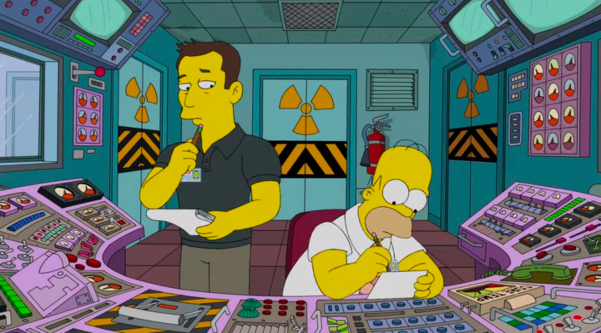
– In the first act, there was a pretty solid string of crazy Family Guy-esque cutaway gags one after another: one featuring a line-up of frozen Burns clones, showing Richard Branson is Burns’s neighbor, and then Smithers fantasizing about being in an island paradise with Burns. This last one turned out to be plot relevant, as Smithers goes along with having Homer watch the princess hoping he’ll fail and Burns will run away with him, with the Nigerian deal being critical to keep him from financial ruin after Elon Musk fucked him over, which is really, really weird to see this being a running reference, being mentioned here and in “My Fare Lady.” At the very end, we see a despondent Smithers walk out of Moe’s and come upon a couple of the escaped Burns clones and he feels happy again. Or something. Whatever.
– They had Jon Lovitz play a paparazzi guy who takes a photo of the princess kissing Moe on the forehead, and he has one line. Plus, it’s not even the same guy he voiced in “Homerazzi.” Did they just forget who that character was? Or is it just a big coincidence?
– The ending is just awful. Everyone is gathered around Burns’s office, including the Simpsons for no reason, as we painfully go through the plot beats with characters just openly saying what they feel and what they’re going to do, standard procedure at this point. I honestly can’t get over how terrible the writing on this show is sometimes (“I am not convinced.” “Because you want them to grow?” “Still not convinced.” “Because you can’t strangle a girl.” “That makes sense. Come here, daughter.”)

One good line/moment: Homer makes Lisa a replacement lunch out of a montage of increasingly elaborate trades in the plant cafeteria. It’s a bit dumb, but also kinda sweet seeing him do something nice for Lisa.
566. My Fare Lady

Original airdate: February 15, 2015

The premise:
After accidentally getting the bar completely wrecked, Homer, Lenny and Carl get Moe a job at the nuclear plant, but tensions rise when he is quickly promoted. Meanwhile, Marge becomes a driver for a ride sharing service, which ends up running her ragged.

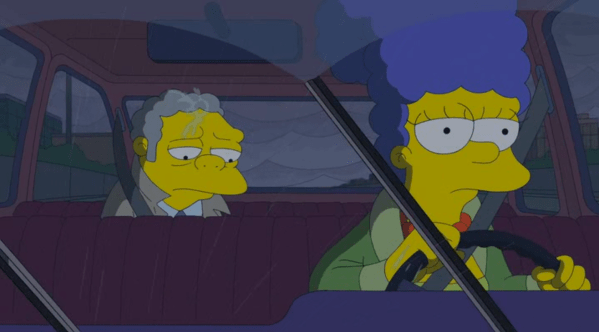
The reaction: Two bland tastes taste bland together… bleh. Marge is convinced to becoming a not-Lyft driver, considering she drives around doing chores all day. Nothing really comes of this plot whatsoever. She quickly finds herself exhausted from doing it, but it’s not even like they set up that she needs the money, or that she wants to do something different with her life. She randomly meets another driver, he asks if she wants to be one too, and she says yes. Meanwhile, Moe has the regular gang watch the bar when he goes to see some old Hollywood dame perform, who after looking it up I guess is an Elaine Stritch parody, and somehow he is about to score with her? Unfortunately, Homer and company’s ladies night scheme to drum up business for the bar fails when the women start a destructive bar brawl for some reason, trashing the place and ruining Moe’s shot at getting laid. This making sense so far? At this point, thanks to an extended opening and the Marge story, we’re halfway through the episode, so we quickly get Moe into the power plant, where as a janitor he manages to shoo away some safety inspectors, and Burns promotes him to supervisor. This is all condensed in the last few minutes, so I’m not exactly sure what Moe’s new job entails or why he would like it, but when his old customers shun him in the cafeteria, he just wants to go back to the bar. Marge picks him up for a ride, crossing the two plots, where we get some weird musical interlude where someone sings the dialogue and stage direction (I have no idea what this is supposed to be a reference to), and Marge and Moe decide to give up their new jobs. Or rather, Marge says that verbatim. Two “someone-gets-a-job” episodes for the price of one! What fun! Or lack thereof.

Three items of note:
– Even though an extended opening sequence killed almost two minutes (see below), we follow that up with even more padding, a recreation of The Jetsons opening theme. The pay-off of space Homer going to work under glass in a public display labeled “Why Humans Failed” is kind of cute, but everything else was just boring, just flatly recreating the original source material, tweaking a few small elements and putting in sign gags. Compare this to “Marge vs. The Monorail” and their Flintstones opening with Homer jumping into his car seat, breaking the window in the process, and his jubilant song about himself ending in totaling his car on a chestnut tree. Actually doing something creative with the material vs. just playing it straight and hoping people slap their fins together because it’s funny when one pop culture thing meets another pop culture thing!
– Once again, I have to bitch about the exposition shit. Carl has the idea to promote a ladies night at Moe’s and hangs a sign up. But, I guess in case you don’t know what a “ladies night” is, and I don’t see how any mentally capable adult wouldn’t, Lenny and Carl helpfully explain it thoroughly to you, the audience (“How does Moe make money if ladies drink free?” “That’s the beauty part. This place is about to be filled with guys buying beers hoping to meet ladies!” “Brilliant! And thanks for telling me what the beauty part of it was.”) It’s like I’m listening to a bar owners instructional tape.
– Surely they could have written some better jokes about ride sharing, there’s so much comedic potential to be had. Instead, once Marge starts driving, the Moe story takes almost all of the screen time. We see the cab drivers of the city are annoyed with Marge in particular for whatever reason, complete with awful, awful dialogue (“We used to get Uber amounts of work giving people Lyfts!” Yah get it?) We also have Christopher Lloyd, I guess playing his character from Taxi, but I’m too young to have any appreciation for that. For me, he’ll forever be Doc Brown. The two plots intersect at the end when the cab drivers corner Marge to beat the shit out of her, I suppose, and Moe scares them off with a shotgun. I guess that’s one way to connect the two.

One good line/moment: An entire guest opening title this time, a pixelated visual masterpiece animated by two fans. The timeline on this was pretty quick too; the video was posted February 1st, it took the Internet by storm, and just two weeks later, it actually got used by the show itself. That’s pretty fantastic, those two should be very proud of themselves. Not only is it incredibly inventive and uses fan service appropriately (nothing past season 10, of course), even using pixel art, the animation is more fluid and lively than what we see in the show itself. If you haven’t seen it (though I can’t imagine if you’re reading a blog like this that you haven’t), it’s well worth your time.

565. Walking Big & Tall

Original airdate: February 8, 2015

The premise:
Homer is empowered by a fat acceptance group to be proud of his size, much to Marge’s chagrin. In an unrelated opening act, Bart and Lisa write a new Springfield town anthem.

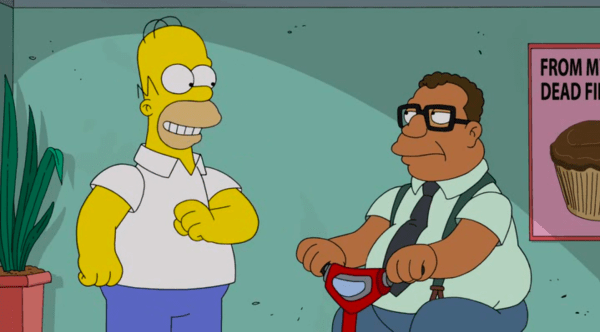
The reaction: I feel slightly redundant harping on the exposition laden dialogue at this point, but it’s got to be the show’s biggest fatal flaw at this point. When over half of your script is literally explaining what’s happening and what characters feel about the story repeatedly, what room is left for the actual story to happen? This episode is a pretty flagrant offender of this. Roughly nine minutes in, our story actually begins: Homer seeks out a weight loss group, but ends up attending a weight empowerment group instead, and is inspired by their charismatic scooter-bound leader to love himself for who he is. Hearing this, Marge, of course, is not pleased. Homer comes home and reiterates everything we already learned in the previous scene about the group. Later, when Marge attempts to bail Homer out of jail, they have the same conversation and espouse their same feelings on the matter. Then they do it again towards the end before the “climax,” if it can so be called. We’re left with a story about Homer feeling fat and proud of it, consisting of him just repeating that point over and over, but never actually seeing it. There’s one scene of him apologizing to the bathroom scale, but that’s really about it. Because of this, it doesn’t matter how many times we hear Homer repeat the same lines about “wide pride,” or talk about how awesome his new leader is, when we barely see or understand anything that’s being done, or know anything about this new character. It just ends up being a broken down mess of a story where everyone just talks in circles. On top of that, the subject of obesity in America is a rich one; scorn and ridicule of the overweight is a real issue, so the subject matter of this episode could really have meant something. I mean, I knew it wouldn’t, but in capable hands, it could. But it’s just a series of never-ending first draft, base level fat jokes. Rubbery sound effects when all the fatties are crammed in a jail cell. The leader slurps up his fries with a straw. When he dies (spoiler alert), the funeral director repeatedly walks in with more and more urns of his remains. There’s nothing more to these jokes than “laugh at the fatties! LAUGH AT THEM!” In the classic years, we saw plenty of gags at the expense of Homer’s weight, but there was always something more to them, more layers of humor on top, and they never felt scornful. But now, just like “jokes” aimed at gays or other religions, the social satire that this show was once known for now feels very petty and small.

Three items of note:
– The opening act is completely removed from the actual plot. It almost felt like a throwback to the 2000s when that was more common practice for the show. In a flashback, we see a young and strapping Mayor Hans Moleman present a town song, which is later revealed was a melody sold to many towns the nation over. I guess we’re supposed to be charmed to see him and the Old Jewish Man in their younger days, or smaller goofs like a younger Krusty in a Thriller jacket, but really, who cares? In the present, Lisa volunteers to write a new town song (after turning down Pharrell Williams in his three-second cameo), and she teams up with Bart to write it (following an awkward reminiscence to “Stark Raving Dad.”) The episode begins with the old anthem, and this orphaned plot ends with Bart, Lisa and the other kids performing the new one, and both are just terrible and unfunny. What was the last song this show did that was actually memorable? When “Weird Al” guest starred? They attempt to bring the plot back when Marge begs her children to write a song to sway Homer into getting healthy, but that just leads to them bickering and complaining about being one-hit wonders or something. It was a really awkward scene.
– I know I just harped on about the expository dialogue, but it really affects every aspect of these episodes. As pervasive as it is, sometimes certain moments annoy me more than others. Bart and Lisa’s new anthem gets a standing ovation, we see everyone is on their feet in thunderous applause… except Homer, who is firmly lodged in his seat. We saw before the performance he had to squeeze himself into the tight seat, and now we see him struggling to get up, so if you’re watching the screen and have one working brain cell, you understand what’s happening. But lo, here comes Marge to fucking explain it for you (“Homer, it’s a standing ovation! Get up! Our kids just did something amazing! Get up!”) I CAN SEE, MARGE. I CAN SEE.
– There’s a pretty egregious time eating scene of Homer at Moe’s reading off a list of insulting “fat” names he would no longer like to be called. It just goes on and on and on for forty long seconds. I’m sure that some of them might be halfway amusing, but a lot of them are not, and some not even really jokes (Wide Load, Fatso, Lard Ass, Pudgy Wudgy). Just got to pad this out to make air time, any way they can.

One good line/moment: Maggie and Abe feeding each other “Baby’s First Peaches” and “Senior’s Last Peaches” was a cute one-off joke.

564. The Musk Who Fell To Earth

Original airdate: January 25, 2015

The premise:
Elon Musk arrives in Springfield, and bizarrely inspired by Homer’s asinine non-sequiturs, he works towards making the town a more efficient place to live.

The reaction: It’s not a good sign when an episode starts giving you strong “Lisa Goes Gaga” vibes. The conceits of the two episodes are pretty similar: a mega guest star appears in Springfield out of nowhere, acts like a slightly exaggerated version of themselves, and effortlessly makes the town a better place. Just as we saw with Gaga’s inflated persona, the “joke” is that Musk is a quiet genius, he doesn’t emote, and just espouses his ideas and world views with no joke to them. They have a running gag that they do four times where they push in on his face as dramatic music plays as he’s thinking of an idea, which even that reminded me of the weird moments in “Gaga” of her getting psychic visions of people being unhappy. The plot here is that Musk finds himself attracted to Homer’s nonsensical statements, being able to turn them into ideas for inventions. That leads him to wanting to make the nuclear plant more efficient, but ends up putting it in the deep red under Burns’s nose, creating massive lay-offs. We had seen Springfield turn into an advanced utopia of sorts, but now it’s in disarray, and people hate Musk’s guts. But whenever we see Musk, he doesn’t seem affected at all, he’s just enthusiastically prattling off idea after idea to a bored Homer. When you put your guest star and focal point on a pedestal, making them infallible and ever-awesome, what kind of story can you get out of it?  We saw it with Gaga never having any sort of moment of clarity about her incessant pushing and forcing an eight-year-old to bottle up her feelings or that she peddles meaningless platitudes about self-esteem and affirmation, Lisa just forgave her for no reason and Gaga went out with a bang. Here, Musk similarly goes through no arc. Homer doesn’t want to be his friend anymore because none of his ideas work, I guess? And then Musk seems kind of sad when he leaves in his little rocket ship, missing his one true friend. There was a moment half-way into the show where Homer gives Musk a big hug, and he seems very uncertain about it, and after a few seconds, he warms up to it and hugs him back. In a show that actually cared about good writing, I thought it might be a character turn where Musk, once monotone and emotionless, learns how to emote, but he goes too far, and starts being incredibly clingy and annoying, and that’s what drives Homer away. But of course not. This show was once famous for presenting celebrities in subversive, interesting, and even sometimes, downright mean lights. Gone are the days of holding Tom Jones at gunpoint, blowing up Spinal Tap’s bus, or getting Buzz Aldrin to say “Second comes right after first!” and holding for an awkward pause. Now celebrities arrive to save the day, to be fawned after, and to do absolutely no wrong. I still think the Gaga episode is worse because of the complete and absolute bungling of Lisa’s story, but this one isn’t far behind.

Three items of note:
– When he lands in the Simpson back yard, Lisa is immediately at the ready to explain exactly who Elon Musk is, and there’s a running bit throughout of her always trying to suck up to him (“Maybe we’re the same, two lost ships in the intellectual sea, each of whom could inspire the other!”) Remember when Lisa was eight? There’s a scene with her and Musk in the back of the car, where Musk is writing down his dialogue on a notepad for some reason, and he rips each new page out over and over and over as Lisa talks over it with commentary. It’s so, so, so bad. At the end of that scene, we get the first instance of Musk being inspired by Homer’s gibberish, which is pretty self-explanatory, but of course, we need Lisa to explain what’s happening (“He’s taking your Homer-isms and turning them into his own great ideas! This is the most inspirational moment in my life!”) Please, shut up-ah your mouth, Lisa.
– We also get some limp Burns this episode, who lets Musk do whatever he pleases with plant operations until it’s too late. Smithers, for whatever reason, doesn’t trust him, and we see him fretting about it and confront Burns, and later the two make up, but really, it’s just empty time filler. And Burns releases the hounds indoors for whatever reason. He also attempts to use a trap door. I feel like those are the only few elements left of vindictive Burns. Before, they were hilarious exaggerated touches to his villainous, but grounded character. But now, with how neutered the character feels in most appearances, the jokes feel awkward and out of place.
– Speaking of which, Burns plans to have Musk killed in the third act, which also feels incredibly odd. Surely there are plenty of other options he could have come up with to dispose of Musk besides murder. And then when he arranges snipers to take him out, they’re all old, enfeebled, and promptly die upon taking their first shot (“Recoil was pretty bad.”) Burns is old and out-of-touch, but he’s pretty smart, there’s no reason he’d rely on these geezers to take care of business for him. Remember the hit man from “The Curse of the Flying Hellfish”? I sure do, and I really wish I was watching that right now.

One good line/moment: Nuthin’. Elon Musk sucks shit.

563. Bart’s New Friend

Original airdate: January 11, 2015

The premise:
Homer is hypnotized into believing he’s a ten-year-old, and Bart is delighted to find Homer is a much better best friend than a father.

The reaction: This episode got some minor buzz, as it was based on an old spec script Judd Apatow had written twenty years ago that I guess the crew found at the bottom of a dresser drawer or something and decided to actually use it. Apatow wrote it back in the show’s heyday, but I can’t imagine them doing a premise like this back then. But it’s almost impossible to judge; like all other episodes “written” by guest writers, this one went through the writer’s room machine to where it’s indecipherable from the rest of the slop. Homer is forced to actually do his job for once when the other sector 7G safety inspector retires, leaving him a work-obsessed mess. The family goes to a circus to calm his nerves, where a hypnotist turns him into a kid. From that point on, the work plot is over. You’d think it would be potentially funny, and a no-brainer story-wise, if you had Burns or Smithers interacting with Kid Homer, or Lenny and Carl try to bring him to Moe’s, and them being shocked that Homer doesn’t like beer, and so on. But nope, nothing. All we get is an off-hand remark from Lenny and Carl that the retired safety inspector came back as they are observing Bart and Homer from their backyard for absolutely no reason, because I guess they forgot about the first act’s plot and crammed that line in last minute. Kid Homer really doesn’t do much of anything in the episode, and after he comes home from the hospital, he interacts with almost no one except Bart. The thin premise is that Bart feels closer to his dad as a kid and doesn’t want him to go back. They attempt a sweet, serious moment of Homer saying goodbye to him before he’s turned back to normal, but it holds absolutely no weight whatsoever. We saw them playing in a montage, but that was sandwiched between two exposition-heavy sequences of Kid Homer talking about how he would never want to grow up like adult Homer, and Bart talking about how he doesn’t want him to change back, and then they repeat this two or three more times just so you remember it, per usual. It’s just another episode where they want you to care about something, but there’s so little we actually see of that thing, so we’re just told we should care instead. As usual, it’s tell, not show. Hmm. Well, given how interminably long Apatow’s last couple movies were, maybe this episode has more in common with his original script than I thought. Zing!

Three items of note:
– The couch gag felt pretty lazy and not well thought out. It’s Homer, Marge and Bart as the Three Bears coming home to find Lisa/Goldilocks has defiled their couches, done in a nondescript classic (sorta) animation style. The Bears are irate, Lisa screams, they get into a huge tussle… then we end on Marge, Bart and Lisa feasting on Homer’s ripped apart body. Huh? What happened here? Why would Marge and Bart be eating their husband/father? Homer getting hurt or maimed is just par for the course for couch gags at this point, they always do it regardless if it’s motivated or makes sense. All it did was make me think of the bit from “Treehouse of Horror XI” where Goldilocks is viciously mauled and killed off-screen, complete with ear-curdling screams and blood pooling under the door. Now that was wonderfully grim.
– There’s a scene here that’s pretty indicative of the tell, not show problem. The bullies go to beat up Bart, who retorts that Kid Homer will beat them up right back if they do. Then we get this (“That’s not your friend, it’s your screwed up Dad.” “Pretty sad, really.” “We’ll leave you alone.”) And then they leave of their own accord. It’s just these characters standing and explaining what we already know, and surely they must have seen Homer before they walked up to Bart and almost wedgie-ed him. Then we get this gem from Bart (“You did it, Homer! You saved me from the bullies! You’re the coolest kid I ever met!”) Homer didn’t do anything. He literally just stood there, motionless and silent. The scene is all about how great Kid Homer is to Bart, and he didn’t have to do a thing. Why have characters do any actions relevant to the story when characters can just say that they did them? It’s so much easier to just tell the audience what’s happening and what characters think about stuff than to, you know, actually show that stuff is happening.
– Bart takes Homer to Itchy & Scratchy Land to enjoy a little more time as a kid. It’s jarring how the theme park humor was so on point last episode, but now, everything’s back to normal. We get a Soarin’ “parody,” which goes on very long, and is just a bunch of limp gags going over areas of Springfield, in very awkward and flat 2D zooms. Unlike last episode, nothing about this is riffing on Soarin’, it’s just, “Hey, look, this is Soarin’!” It’s also a very unique ride to recreate, something that I think if you hadn’t been on it, you’d be a bit confused as to what it was.

One good line/moment: As a sucker for theme park gags, this one made me chuckle (“We’ve only been on two rides!” “You should’ve used Fastpass.” “Fastpass can’t solve everything!” “Spoken like a kid who’s never lived in a non-Fastpass world.”)