576. Cue Detective

Original airdate: October 4, 2015

The premise:
Homer’s amazing new smoker catches the attention of a celebrity chef, who challenges him on his show. But when the smoker ends up stolen, Bart and Lisa try to track down the culprit.

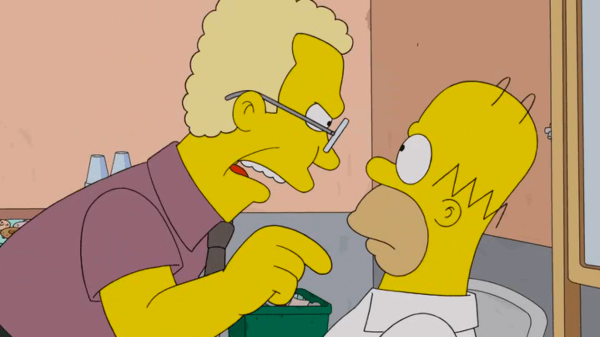
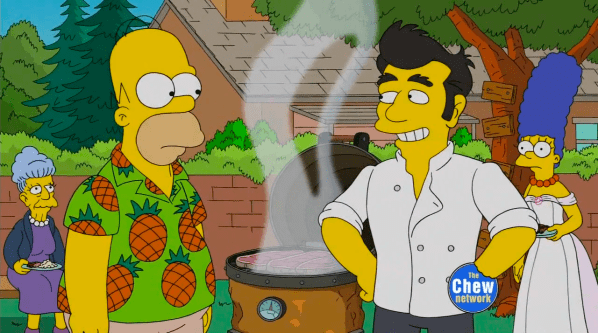
The reaction: Bart and Lisa teaming up to right a wrong was a staple of the show back in the day, enough that they eventually lampooned themselves with the ending of “The Day the Violence Died.” I can’t remember if that was the last time they pulled that premise, but here we are, twenty years later, and for whatever reason, they’re doing it again, but this time, much, much, much worse. We start with the Simpson family becoming town pariahs because of their stench, due to their deeply in disrepair washing machine. Rather than buy a new one, Homer blows a bunch of money on a barbecue smoker off some guy cooking on the side of the highway for some reason. Marge is momentarily upset, but soon the whole family, and later everyone in town, is won over by Homer’s new magical BBQ. Marge comments, “Look how popular we are! That smoker is the best thing that ever happened to us!” She says this while wearing her old wedding dress, as the family is dressed in various outfits through the whole episode. As this stupid plot continues to transpire, Marge becomes cheerleader to the rest of the family over this stupid smoker, which she seems to care more about than actually having clean clothes and a functioning washing machine. So, loudmouth celeb chef Scotty Boom shows up to their backyard to challenge Homer, then later the smoker is stolen. This kicks off Bart and Lisa’s sleuthing: they find a clue that leads them to the supermarket, then to Nelson, then to the dump, where everything plays out like a straight-forward mystery, instead of focusing on jokes like the show used to do. When we get to the competition, it’s revealed Scotty Boom cooked his meat using the smoker, disqualifying him. But the show’s not over yet, as things don’t add up. The final minutes are absolutely awful: Bart and Lisa chase down the shadowy figure they saw earlier, which is revealed to be Scotty Boom’s son. He immediately explains who he is, why he wanted to sabotage his dad, and how he did it. It’s just a gigantic info dump from this character we’ve just met. Then he and his dad immediately make up. Bart and Lisa mystery stories were never really like serious mysteries, they always served a greater story purpose. Trying to reunite Krusty with his father, saving Springfield from a tyrannical Sideshow Bob, finding out who took their dad’s stupid smoker. Which of these three doesn’t belong?

Three items of note:
– The episode begins with Skinner screening a movie for the kids, Doctor Doolittle. They show the actual live action film on the screen, we see several clips of it, and hear the kids making commentary for a good two minutes. What the hell is all this about? Where did this idea come from? It just felt so, so weird, and it just kept going and going. What’s the point? The movie is boring? Did one of the writers have a serious vendetta toward Doctor Doolittle? There was no opening titles, we went from the clouds straight to the first scene, so apparently this shit was deemed too good to leave on the cutting room floor.
– Homer spends all of act two lying on the floor depressed about the missing smoker, and by act three Bart and Lisa join him, having given up on their mystery solving. Marge must now carry this plot, so she competes against Scotty Boom in Homer’s place. Again, it’s incredibly strange seeing her completely tied into this premise given that we’ve completely dropped the washing machine plot thread. If anything, Homer’s impulsive, irrational purchase over a household necessity feels like a greater marital deal breaker for Marge than not buying narcolepsy medication from the last episode. But it just goes to show, stuff like this doesn’t matter anymore. The characters will act in whatever fashion the writers want them too, regardless of the scenario.
– They wait until over the credits to show Marge giving the smoker to Nelson in exchange for a new washing machine. What’s that about? Then we look into the future of the smoker at he and Shauna’s wedding, then a post apocalyptic future where their grown up kids are violently killed by a pack of warthogs. What the fuck is this shit?

One good line/moment: At the health food store, a clerk swaps out a “Nature’s Superfood” sign from pushing acai berries to goji berries.
575. Every Man’s Dream

Original airdate: September 27, 2015

The premise:
Homer’s recent bout with narcolepsy proves to be the last straw for Marge, causing them to legally separate. He then ends up dating a twenty-something pharmacist, voiced by cancerous polyp Lena Dunham.

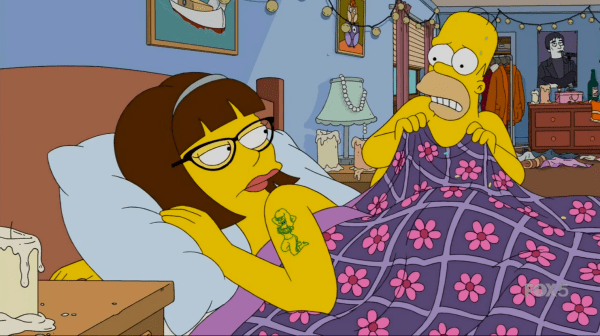
The reaction: At this point, I would really love to see a really serious episode where Homer and Marge get divorced. I mean, why not, at this point? I remember they drummed up news coverage for this premiere, crowing about how Homer and Marge were going to split up, for real, we swear, guys! Come on. It was almost embarrassing to see, like who’s falling for these cheap gimmicks anymore? So what causes this seemingly unbreakable couple to finally call it quits after twenty-six years? We see them in therapy after Homer didn’t get his medication for his narcolepsy because the line was too long. We don’t see how this medical condition is negatively affecting Marge, or anything else other than Homer’s normal annoying behavior. In perhaps the greatest example of characters just saying things to move the plot along, the therapist recommends that they separate, and Marge follows her words to the letter (“Kids, a professional felt the best way for your father and me to work on our relationship was to give up on it.”) Someone told her to do something, and she did it! And then repeated it! So Homer ends up going on a drug trip with a young attractive pharmacist named Candace, who for whatever stupid reason is interested in this old tub of lard. At this point, I have no idea where this episode is going and how it’s going to resolve itself by the end. But then Homer goes to dinner to meet Candace’s father, only to find out he’s invited the new woman in his life: Marge. As fucking dumb as all of this had been so far, I at least could see how this could pan out: father and daughter immediately begin arguing, and Marge would see what a hassle all of this is, and realize she’s content to go with what she knows, and that’s being with Homer. Quick and dirty, get out, episode over. But no, it turns out that everything we’ve seen over the last twelve minutes or so has just been a dream Homer had while passed out at the therapist. He resolves he’ll clean up his act, and over the coming month, he does. But it turns out all that was just a dream too. And then that itself was all a dream Marge had, and then that was all just a tattoo on the back of Dunham’s Girls character. Woof. This could have potentially been interesting if they had worked in earlier that Homer’s narcolepsy was causing him to lose time and become more and more disoriented, but there wasn’t even the slightest attempt to do anything like that here. They didn’t want to bother writing an ending, so they gave us this great big wank. It’s like a big slap in the face for anyone stupid enough to think Homer and Marge were really going to get separated, and a second slap for anyone foolish enough to still be watching this nonsense. I guess that includes me, doesn’t it? Sigh.

Three items of note:
– As all one-off characters are in the last decade-plus, Candace has no discernible personality, and this is especially damning considering this is the girl that’s making Homer forget about the love of his life (although it changes from scene to scene whether he’s still pining for Marge or he’s completely moved on.) Their relationship begins when she just says it does (“Are you asking me out? I mean, you’re not, but it looks like you’d be fun to hang with, and I’m pretty fascinating myself. I’m an author.”) But it really doesn’t matter. As evidenced by the cop out dreams-within-dreams ending, the writers had really no intention to make this a believable story that makes sense. As I mentioned at the start, it’s just a flashy gimmick episode where they managed to generate some minor press for the new season. The only woman that strayed Homer’s eye before was Mindy Simmons, a woman seemingly tailor-made for him that he cursed fate for placing before him. Would it have been too much to ask for Candace and Homer to bond over just one shared interest? Anything whatsoever? I guess so. We also get cameos from Dunham’s Girls co-stars, who all get a line each. They’re also joined by gay stereotype Julio, because he’s a catty gay guy who loves gossip and drama (those crazy gays, amirite?)
– The second act opens with a sad montage of Homer now living at the power plant, where we follow him at night looking forlorn and depressed, complete with somber music. Cut to the morning, where Homer happily hums walking out of the shower and is pleased as punch walking to his work console. Lenny and Carl comment on his sudden mood change, to which Homer responds, “Oh, you guys missed a very sad montage.” Again, more proof that the writers didn’t care about making any of this serious or meaningful at all.
– More bits of fan service with Candace’s tattoos and hallucinations in the drug trip montage: Smilin’ Joe Fission, Mr. Sparkle, Space Coyote, and the creepy clown bed make repeat appearances. From the modern era, we have Plopper, the Grumple and Fatov, that little Homer Olympic mascot. Which group sounds more fun to hang out with?

One good line/moment: The only explanation we’re given why Candace likes Homer is that he reminds her of a childhood snowman, which is one of many guesses that her friends throws at her. But Homer’s response to this is kind of cute (“Man, I would love to get back into snowman shape. Can’t even fit in my scarf anymore.”)

574. Mathlete’s Feat

Original airdate: May 17, 2015

The premise:
Lisa convinces Principal Skinner to turn the school into an analog Waldorf school, where students receive a practical, hands-on education. This new direction puts Groundskeeper Willie in higher regard, who is made captain of the mathletes team.

The reaction: I’m not familiar with this philosophy of Waldorf education, so as such, the episode spends about a third of its running time having characters explain what it is and talk about it over and over. After Springfield fails miserably at a mathlete competition, the college nerds from “Homer Goes to College,” now rich app developers and feeling bad for their alumni, agree to pay for Springfield Elementary to go fully digital. Also some of them are dressed like steampunks for some reason, and in one scene, their clothes change between shots. Overuse of devices causes a power surge, leaving the school in even worse shape then normal, and Lisa is inspired by Groundskeeper Willie’s special gardening tool to push the school to embrace a new proactive style of teaching. It’s all very arbitrary, and as usual nowadays, we’re halfway through the episode when this “plot” is kicking in. As I said, the show continues on as characters just reiterate the same thing over and over, that kids are learning by example instead of books. With the episode going nowhere fast, Lisa runs in to announce that Willie is now the coach of the math team. I’m not quite sure why she’s excited about this; Willie is none too bright, especially academically, so surely Lisa wouldn’t be psyched about him in charge. Especially when he randomly makes Bart the team captain for throwing an egg at Chalmers’s car at a perfect angle? Or something? At the competition at Waverly Hills Elementary, Bart is stunned that he actually has to do math. Why make him the captain if you’re going to do nothing with that story point? But look at me talking like there’s actually a structure to this. We end with Willie in a Harry Potter wizard hat and staff for no reason whatsoever and Bart solves the final question because of course he does and they win. What an exciting finale, huh? Each season that goes by, I just can’t believe the show can sink any lower, but here we are. It’s almost fascinating to see. It’s also very aggravating. Why did I continue this blog again?

Three items of note:
– We get a quick ChamSkin Productions title card at the end of Springfield Elementary’s video, a reference to the season 19 episode “Any Given Sundance.” I remember it also popping up in an episode a season or two ago. Is this fan service too? Does anyone have fond remembrances of the shitty sub-plot where Skinner and Chalmers tried to be indie movie phonies for no reason?
– Episodes feel like they’re written in disconnected pieces sometimes. We open with a marquee for the math tournament, with the joke “Good Seats Will Always Be Available.” Pretty alright line. But as we see at the beginning and at the end, there’s a pretty decent sized crowd in attendance, enough to do another joke with a whole hoard of people holding up letter cards to spell long words. And the tournaments are treated with such severity and seriousness as well, and I don’t fully understand why.
– These stupid “fourth act” tags are so disposable and unnecessary. I guess it’s not necessarily the show’s fault since it’s how FOX decided to restructure commercial breaks, but it’s so awkward. And because the episode was still short, we get a thirty-second bit of the family playing in a jug band, complete with a title card reading “The Simpsons Post Show Jug Band Fills The Time.” The one time an episode in the classic era ended up short, we got the wonderful time filler “Everybody Loves Ned Flanders,” a segment that was funny, actually parodied something, and had a catchy jingle to boot. This transparent, self-admittedly empty filler is just more proof of how little they seem to give a shit about making a good show.

One good line/moment: A new guest couch gag, wherein the Simpsons are horrifically killed by a renegade Rick and Morty. Rick sends his grandson to an alien photocopier to reproduce our favorite family while he fucks around the house in a drunken stupor. As much as it rings as yet another example of the show glomming onto what’s pop culturally relevant for attention, it’s still a fun segment (“You know how many characters there are on The Simpsons, Morty? There’s like a billion characters! They did an episode where George Bush was their neighbor!”)

573. Bull-E

Original airdate: May 10, 2015

The premise:
Marge’s meddling causes sweeping bully legislation to be passed and greatly enforced in Springfield. Homer is among those that must attend rehab, where he is forced to come to terms with why he continually abuses stupid Flanders.

The reaction: I wasn’t under the impression that Homer’s disdain toward his friendly neighbor-eeno was a big mystery, or something that even he didn’t realize himself, but I guess it looks like I was mistaken. Homer faces his feelings, but that’s really in the final third of the episode, so let’s backtrack. Bart is humiliated by the bullies at the school dance, which provokes Marge to propose anti-bullying laws at a town hall meeting. From that point, Chief Wiggum basically takes to arresting whoever he feels like who may or may not be transgressing these lenient laws (but of course if you couldn’t figure that out after watching him arrest four people, Lisa explains it for you, “The police are basically arresting anyone they want to!”) Like some modern episodes, there’s a hint of an idea here, of anti-bully crusaders becoming bullies themselves (South Park did a great episode about this, three years prior), but it’s barely addressed at all. We see Homer and a bunch of others are in rehab, with their session run by some guy voiced by Albert Brooks. His post-classic-era appearances in “The Heartbroke Kid” and the movie have actually been very enjoyable, but this is the first character (and his latest to date) that I didn’t find funny at all, just a lot of him rambling and monologuing in a sort-of German accent. He berates Homer into engaging in his inner feelings about Flanders, and he shocks himself when he realizes he’s been jealous this whole time. Again, I’m not really sure how this is a revelation. In “Dead Putting Society,” Homer  flat out admits he’s annoyed at his neighbor’s better life, and that was frigging twenty-five years ago. Later on, Flanders expresses his distaste of Homer’s behavior over the years, leaving him dumbfounded. So now, over two decades of abuse and torment, one of the show’s longest standing staples, and we have to resolve this conflict in under two minutes. Homer gets on his knees and begs his neighbor’s forgiveness, and when he waits on his lawn for days on end without moving, Flanders finally just gives in and forgives him. Brilliant. They didn’t even have to spew any more exposition, just have a character wait and say nothing, and the conflict will resolve itself!

Three items of note:
– Bart is nervous about going to the school dance, and is uneasy when a fifth grade girl with no name asks him to dance. We then get an extended bit involving the “Puberty Demon” who makes some obvious jokes. But as I’ve mentioned before, you can’t have Bart have direct relationships with girls and then turn around and show him as an ignorant naive little kid (many times within the same episode). Hell, didn’t we have him lusting over Milhouse’s cousin just last episode?
– I’m really surprised at how bad the Albert Brooks role was. I don’t think they even gave him a name. I’m also surprised that this deep into season 26, I can still be disappointed by something, or experience a first in terms of a fall from grace for this show, but here we are. Like I said, his post-classic roles have been engaging and fun for the most part, but here, I didn’t laugh once. I just didn’t get what his character was, ultimately.
– The final act skirts the edge of being actual commentary, where Homer is decreed a town hero for coming to terms with his assholery in one therapy session. He throws out the first pitch, gets a car in a parade, and people are lined up for his autograph. Is this like when we easily forgive celebrities for making amends for shit that they caused themselves? Or something like that? I’m not clear on what they’re doing, but then again, that’s normal for me watching this show nowadays.

One good line/moment: The fantasy sequence of a whiny Jesus being bullied under the eyes of a disappointed God was kind of amusing (“Forgive them, Father!” “I raised a wuss.”) Tossing Jesus’s halo up on the roof like a Frisbee was a nice touch.

572. Let’s Go Fly A Coot

Original airdate: May 3, 2015

The premise:
Abe is reunited with an old buddy from the Air Force, giving us another rambling story from his military past. Meanwhile, Bart develops a crush on Milhouse’s Dutch cousin, who gets him to take up e-cigarettes.

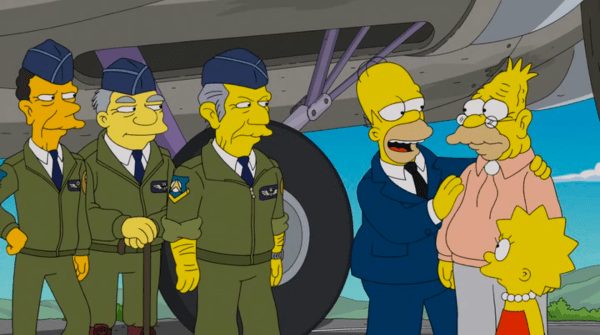
The reaction: Two more inane and aimless stories to throw on the pile. First, Abe’s old army buddies are disgusted at Homer’s treatment of his father, and they proceed to harass and harangue him into treating him better. They all go out to see not-The Expendables, then proceed to hold Homer at gunpoint at the veteran’s hall until he and his father have hugged for a sufficient period of time. Meanwhile, the only reason the B-plot exists is because an actress named Carice Van Houten in on Game of Thrones, and she’s named like Milhouse’s name, so that’s funny, right? It’s yet another Bart-falls-for-an-older-girl story like we’ve seen with Shauna or Mary Spuckler, but there’s not as much time devoted to it to feel as weird or uncomfortable as those examples. So the two plots “meet” when Bart runs into the kitchen announcing “they’re” sending Ms. Van Houten back to Holland (not quite sure who “they” is and why. Kirk and Luann? Her parents?) So Abe weaves a tale about him doing some stupid in the Air Force in a boring flashback, that I guess the point is about the power of grand stupid gestures to win people over (ending with a cameo by Mona, so we get yet another appearance from Glenn Close. Can we get any farther away from “Mother Simpson” at this point?) Of course this crush is meaningless; the girl was using Bart to get her new e-cigs, which he seems fine with, but then at the end, after the cliche race to the airport scene, we get a twist where Bart rejects her before she leaves, except it’s completely unmotivated. We also get a bunch of moments peppered throughout of Milhouse being disturbing and gross toward Bart (“Now you know what nuzzling me would be like!” “If it’s the blue hair and the schnozz you’re digging, I’ve got plenty more cousins!”) Another worthless use of twenty minutes.

Three items of note:
– The opening features an elaborate birthday party for Milhouse, where Homer, for whatever reason, exposits out loud that this new trend has gone too far for parental expectations, and makes it his mission over the ensuing montage to ruin children’s birthday parties the town over. Later, he’s accosted in his home by “Big Birthday,” led by a man in a suit who proceeds to scream at him for over a minute about some stupid shit, which ultimately leads in Homer cutting a deal that he’ll have to throw a lavish shindig for Rod Flanders. It’s at that party that Bart meets Milhouse’s cousin. But wouldn’t he have run into her at Milhouse’s party? These scripts are so piecemealed together, it really doesn’t even matter.
– Another joke that could have been amusing, but was driven into the ground into the center of the Earth: Homer and Abe see a movie preview set in a dystopian future, prompting Homer to comment, “Finally, a movie about a dystopian future!” Despite the fact he just repeated what the trailer voice-over just said, there’s material to be mined from the recent overabundance of grimdark-type movies. But then Homer begins to list off a bunch of movies within the last five years by name. For a long, long, long time. Thirty seconds of him just saying movie titles. It’s torturous. So, so, so fucking bad. After all this time, with so many of this atom bombs of anti-humor, I still wonder whether through all the stages of production if the writers think this shit is funny, or if they just don’t care. How much apathy towards your job can you possibly have?
– Near the end of the flashback, Abe hitches a ride with author Jack Kerouac, who for some reason, gives him a copy of his condensed manuscript of On the Road, and his original, “rambling, repetitive” version he’s written on a gigantic scroll, wanting Abe to destroy it, because who better to trust to dispose of a piece of writing you want no one else to ever read ever than a total stranger? The manuscript is immediately destroyed by a low flying plane’s engine, leaving only the scroll. Now, call me an uncultured swine, but I know absolutely nothing about On the Road. Wikipedia reveals the scroll is the real first draft, but I don’t see anything about people thinking it to be extremely verbose or cumbersome. Did one of the writers just recently read it, learn about its history, and decide to take a relatively obscure in-joke shot at Kerouac? It felt very strange, especially considering how most pop culture this show trots out today is an attempt to stay relevant. Or, at least a few years old relevant.

One good line/moment: An oddly dark moment where Homer knocks Krusty out with a sledgehammer to replace him at a kid’s birthday party. Cut to the curtain opening to Homer dressed as the clown, appearing dead with a noose around his neck, holding a sign reading “LAUGH AT THIS.” I wish after the kids screamed they would have just cut the scene, because Homer coming back to life to do a bad Krusty imitation kind of ruins the dark edge of it.