
 Original airdate: April 8, 2018
The premise: Bart seeks to wear down his father’s spirits to get whatever he wants using tactics from The Art of War. Meanwhile, Marge is disillusioned to find her favorite childhood book is a bit more culturally insensitive than she remembered.
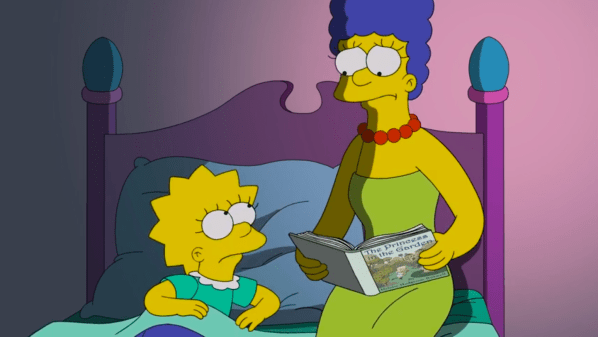
The reaction: I’m gonna be exclusively talking about the B-plot here, since there’s a lot to unpack and I really don’t have anything to comment on the Bart story. At an old bookstore, Marge finds “The Princess in the Garden,” and is excited to share this old favorite bedtime story to her daughter, but she’s less excited when actually reading it, finding it’s full to the brim of horribly offensive and degrading stereotypes. What’s a mother to do? This storyline is the show’s direct response to comedian Hari Kondabalu’s The Problem With Apu documentary, wherein he talks about his feelings about the Apu character as a harmful stereotypical portrayal, talking with the likes of Kal Penn, Aasfi Mandvi, Whoopi Goldberg and others about ethnic stereotypes in pop culture and how they affect those groups. I’d highly recommend it to anyone reading this blog, and it’s definitely worth seeing to inform your reaction to this storyline. Marge and Lisa act as the show’s mouthpieces for their views on the matter, and they are quite… tactless, to put it kindly.
Let’s break this plot down: upon revisiting this beloved story of her past, Marge is horrified to find it full of very insensitive and denigrative portrayals of different ethnic groups, things she never really picked up on when she was a child. This in itself is very rich material to mine from, how nostalgia can whitewash our view of the past and how we want to sweep problematic elements of the things we love under the rug so we don’t have to re-evaluate them. Marge’s solution is to stay up all night and Post-It note the fuck out of the book, recreating it (she comments, “It takes a lot of work to take the spirit and character out of a book, but now it’s as inoffensive as a Sunday in Cincinnati!”) Trying to make the book more palatable to a modern audience (Lisa), Marge rewrites the entire book, now about a “cisgendered girl” living in South America who rescues horses and fights for net neutrality. Her new protagonist is now effectively a flawless Mary Sue character, leaving Lisa to point out (“But since she’s already evolved, she doesn’t really have an emotional journey to complete, it kinda means there’s no point to the book.”) So let’s talk about this: the writers view the “Apu problem” as being the crest of a slippery slope, that removing the problematic elements of a narrative means robbing it of its soul and meaning. They also appear to be equating “ethnic stereotypes” with “character flaws,” in that a politically correct fantasy story involves no conflict or personal growth. This all feels like more of the writers’ tone-deaf portrayal of those accursed rabble-rousing SJWs, like that scintillating writing we saw in the Burns University episode. I understand that it’s supposed to be an exaggerated alternative, but it still feels pretty ridiculous.
Lisa is not receptive to this version of the story either, leaving a distressed Marge to ask, “What am I supposed to do?” “It’s hard to say,” Lisa replies, then directly turns to camera. “Something that started decades ago and was applauded and inoffensive, is now politically incorrect.” She then looks to her bedside table, which contains a framed photo of Apu. “What can you do?” “Some things will be dealt with at a later date,” Marge comments. “If at all,” Lisa adds, as they both look to camera. Forget the fact that it’s liberal mouthpiece Lisa crying about SJW PC culture, but this basically the show saying they never personally found Apu offensive, so that means he isn’t, and that the outrage about this character is a brand new invention, rather than only coming about due to underrepresented voices finally having a small portion of the media spotlight to talk about their long-held feelings. It’s less of the writers not understanding any of the points made in and around the documentary, and more of them saying they don’t particularly care that much, and we may or may not actually do something about this if we feel like it. What a stance.
I think this entire controversy is exemplary of a large issue, that The Simpsons as a show is completely anachronistic in our present day. The show was originally created as a response to bland, limp-wristed sitcoms of the 1980s, featuring a classic Americana 1950s-style nuclear family. Its rude and outlandish characters and biting social satire certainly stood out in a sea of “safe” shows like Full House or Home Improvement. But as time went on, as the show entered the 2000s, then the 2010s (and very soon, the 2020s), the television landscape changed. Culture itself is ever evolving. In addition to this off-kilter show becoming widely respected and accepted (counter-culture becoming culture), it had outlived the very shows it was lampooning in the first place. But rather than grow or change to counter this, or redirect focus and progress, the show retreated backwards, handicapping itself to its pre-established world and Flanderizing everyone in the cast with it. This is a show that hasn’t budged an inch in over a decade; while we see characters using smartphones and the occasional storyline about a current issue or trend, the characters, the setting, the comedy rhythms, the types of jokes, all completely stagnant and unwavering. It’s a show trapped in time, with no desire to change or attempt to reinvent itself, and you just can’t do that when you’re pushing your thirtieth season. Just look at the show’s complete inaction regarding a post-Mrs. Krabappel Springfield Elementary. Marcia Wallace’s final speaking role was in 2014, and Bart still has yet to receive a new fourth grade teacher. This is a bit of an extreme example, but rather than actually create a new character and explore different dynamics within a major setting of the show, the writers decided just not to bother. It’s easier just to not show a teacher in Bart’s class anymore, or if an adult it needed, throw Skinner and Chalmers in there to do their tired old schtick. Growth is hard, and this is a show that has proven time and time again that it just doesn’t want to bother trying new things, let along rethink old ones.
The character of Apu was created in an entirely different, much, much, much whiter pop culture climate. I mean, The Simpsons premiered a few years following the Short Circuit movies, where no movie producers or executives seemed to have an issue with a white actor donning brownface to play an Indian, while actual Indian actors were extremely hard to come by on mainstream television and film. I feel like Apu has more dimension and nuance to him that elevates him beyond a baseline Indian caricature, and there are plenty of jokes involving him in the classic seasons that are based in his unique character and not just being a rote stereotype. But, at the end of the day, he’s still a jolly servile Indian convenience store employee voiced by a white guy doing an exaggerated accent. The character is inarguably rooted in a seemingly innocent, but still present smidgen of racism. It also certainly didn’t help that over the years, like the rest of the cast, Apu became more of a one-dimensional stock character, and there were plenty of cringe-worthy gags where the only “joke” is him acting like a wacky foreigner, speaking in tongues, dancing a funny Indian dance, and so on and so forth.
The fact of the matter is Apu was always offensive. It certainly wasn’t offensive to the room of white guys who wrote the character, or Hank Azaria who rattled off the thick Indian accent to the guffaws of said writers, or to myself and throngs of other white fans who love the character. But to Hari Kondabalu and multitudes of other Indian-Americans, they don’t agree, and their viewpoints and rationales are valid, and worthy of listening to and understanding. There certainly wasn’t any malice or abusive intent in the creation of Apu, but in a modern context with more unheard voices at the public megaphone being able to speak their piece, he certainly is a character worthy of re-evaluation. Whether or not this storyline was just a stop gap acknowledgement before this gets “dealt with at a later date” as Marge claims, this episode really did feel like the show telling Kondabalu and company to go fuck themselves. His arguments, and the discussions that followed the documentary, all completely dismissed with the reductive rhetoric of saying people nowadays are too overly sensitive and PC. Since the episode aired, Al Jean has retweeted a few reactions from fans applauding their slam on political correctness. “Loved how you guys handled this non-issue,” one viewer complimented. “People just want to cry about everything nowadays b/c it makes them feel like they’re doing something. Don’t ever change!” Well, the show hasn’t changed in over fifteen years, why start now?
One good line/moment: Fuck it.
In closing, this brilliant tweet:



 Me Blog Write Good