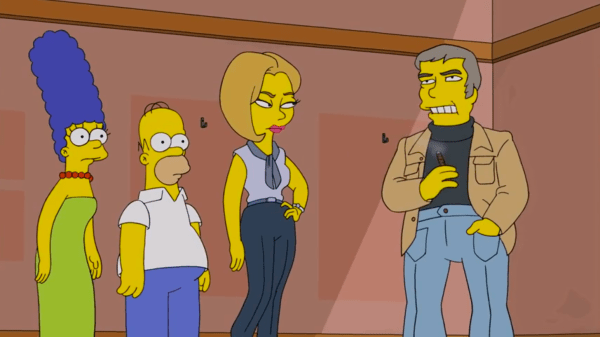
Original airdate: April 1, 2018
The premise: When his stardom plummets due to a recent scare of creepy clown sightings, Krusty takes to serious stage acting, but must deal with his crippling insecurities. Meanwhile, Marge urges Bart to seek help for his rambunctious ways and repent for his pranks.
The reaction: The Krusty the Klown Show is one of those series hallmarks that became more and more anachronistic the longer this show has shambled on. Inspired by Rusty Nails, the Portland-local clown Matt Groening watched as a kid in the 60s, Krusty as a character already felt like a throw-back since his inception in the 90s. It was odd that all the kids in town loved watching the hackneyed, kiddie antics of this cheesy clown on TV, but we still went along with it because the writing was so strong and the characters so earnest. But nobody likes clowns. Nobody. They scare children, they scare some adults, and nobody thinks they’re funny. The conceit of this episode was inspired by the It remake, as well as those creepy clown sightings that were nationwide a few years back, with Krusty’s career being ruined thanks to public perception over clowns (more on why this happens in a bit). Removing his make-up and going by his real name, he bags a role in a local play, but he must deal with his inner demons of self-doubt, represented by his face in the mirror telling him how much of a fuck-up he is. This happens two or three times where he runs out of the room screaming, and it just gets repetitive. Sideshow Mel is also in the play, someone who Krusty’s worked with for decades, you couldn’t have a scene where he confides in him or something? In the end, Krusty bashes himself in the head with a hammer on stage during an anxiety spiral, which the audience laughs at, and he does a little song and dance, then cut to after the show, he talks about how he’s famous again and everything’s alright. It’s one of this endings where it felt like they ran out of time so they just condensed the climax because you know everything’s going to revert to the status quo anyway, so who cares if it’s believable or makes sense?
There’s a lot more to unpack with the B-story. We open on Skinner supposedly retiring at a grand farewell ceremony, but it turns out it was all an elaborate ruse to prank Bart, dumping honey on him and covering him with seed. Cut to Bart sad in the bathtub as Marge is attempting to clean him up. Then later, the teachers and administrators carpool past Bart’s treehouse and the gym teacher chucks a dodgeball at his head. I get this is Bart getting his comeuppance, but it feels really weird to see the school staff going out of their way to bully and humiliate a young student. Bart gets his revenge by supergluing Krusty masks to everyone’s faces, but that leads to people randomly in clown make-up in the woods scaring people? The transition from this to actual creepy clowns showing up is really tenuous and I don’t understand it, so I won’t bother. Bart stands before a judge and is about to get a light “boys will by boys” sentence, but then Marge pipes up, wanting her son to actually suffer consequences for his actions. Fair enough, but why have the prank that broke the camel’s back be in retaliation to Skinner and the school staff pranking him first? Grown adults bullying a child, that Marge seemingly has no issue with? Bart sees a therapist, makes a run around town to apologize to all who he’s wronged, and throws a big apology party at the school, but he actually has a big tarp of water balloons at the ceiling ready to blow. But Marge telling Bart how proud she is for reforming himself causes him to rethink matters, but he’s too late to clear the room before the water balloons come crashing down. “Motherhood sucks!” a drenched Marge grouses as she leaves the room. And that’s the end of the plot! Marge has always been the endlessly suffering heart of the show, a never-ending well of love and acceptance for her children, and her reaching the end of her rope is such an extreme emotion for her, it could be the basis of a whole emotional arc (“Marge Be Not Proud” springs to mind.) Here, it’s just the ending. Boy, my son’s a fuck-up, I had such faith in him and he let me down. CUE CREDITS.
Three items of note:
– The couch gag features the family running into the Museum of Television, passing by displays honoring the longest running shows on TV and their episode count. They whizz past Gunsmoke at 635 episodes, and sit down on the couch next to it with their own series plaque of 636 episodes. Only Lisa does the math and says they’re four episodes early. Why didn’t they just make this for the 636th episode? I guess then we wouldn’t get this great miscounting joke and hear Homer say “D’oh.” So worth it. But yeah, we’re coming up on the big milestone: The Simpsons will soon be the longest-running primetime scripted television show ever in both years on the air and episode count. Congratulations, guys, you did it. I mean, a good two-thirds of the actual episodes are absolute garbage, but you did it nonetheless!
– Seeing the promo image for this episode with Krusty out of make-up, it just makes it clearer how much he looks like Homer, even more so later during the play when he has his hair slicked back and he looks balder, with the only distinguishing marks being the bags under his eyes. I remember way back when Matt Groening talking about the design choice, with Krusty being this TV icon that Bart worships, but he has no respect at all for his father, despite them looking almost identical. But I feel like this is the first time we’ve seen Krusty without all his makeup since “Krusty Gets Busted” (or as Rory B. Bellows in “Bart the Fink,”) so it’s something you have to address. So of course, they do it in the most ham-fisted way possible with Homer just lamp shading the fuck out of it (“He looks just like me! And Maggie looks just like Lisa! And Milhouse’s mother looks just like Milhouse’s father! Why is this universe so lazy?”) What a lazy stretch for a meta joke. We also already went through the Homer-Krusty similarity thing in “Homie the Clown” too, now that I think of it. Man, so many great old episodes.
– Llewelyn Sinclair makes his “triumphant” return, twenty-five years after “A Streetcar Named Marge.” I think he showed up one or two times in a cameo, but here he has an actual big role, serving as director for the Death of a Salesman knock-off Krusty’s in. Jon Lovitz certainly sounds twenty-five years older, his voice with less passion and energy despite mostly shouting all of his lines. Like all returning characters from the classic era, there’s nothing really funny or interesting going on. We learn so much about Sinclair in “Streetcar” with so little information, him proudly showing off his review of a grade-school play he did, berating but also bolstering his performers, a man who had so much passion for his cheap, nothing productions he was actively gunning for a fourth heart attack. What do we learn about him here? Nothing, really. He might be gay; he talks about maybe being “something more” with Krusty and kisses him on the lips before he goes on stage. Boy oh boy, gay people in the theater? What a trailblazing comedic trope!
One good line/moment: Nothing, really. I literally just watched it an hour ago and nothing is sticking out for me.