668. Marge the Lumberjill

Original airdate: November 10, 2019

The premise: Once again feeling the sting of her boring life, Marge falls into the world of competitive timber sports. She turns out to be a natural and is loving her new self, but Homer worries that her new trainer might be more interested in her than she thinks.

The reaction: Let’s tick the ol’ overused trope boxes: Marge wants some excitement in her life, a Simpson finds a new talent and is immediately a success, Homer is worried Marge might leave him… we’ve seen it all before, and done much better, but at least nothing here is stupid or out of left field. Noticing Marge is pretty skillful at chopping wood, Patty introduces her to Paula, who takes Marge under her wing to be a competitive lumberjack. Marge channels her pent-up frustration of being an overworked, under appreciated housewife for over thirty years out on the logs, which feels true to her character. She also is really hung up on not being called boring, which is overtly stated several times (“What could possibly be her motivation?” “I’m… not… boring!!”) This comes as a result of a school play Lisa wrote about the family, portraying Marge as incredibly lame and domesticated. Unfortunately, the Marge-Lisa connection dies soon after that. There’s been a couple episodes over the last twenty years about Lisa’s perception of her mother as just a boring housewife, and Marge attempting to make her daughter proud of her, and they’ve all been terrible, but it’s definitely a rich vein the show could mine that was touched on a couple times in the classic era, but could definitely be worth revisiting. Instead, we get Homer panicked that Marge is going to get turned gay and leave him. Oh boy. Paula is presented several times as being a bit too forward to Marge (repeatedly scooching closer to her sitting on a bench, effectively living like a married couple in Portland), but of course in the end it’s just a big misdirect, as she reveals to Homer she has a wife and child, something Marge didn’t think was relevant to bring up when Homer talked to her about his suspicions about Paula earlier, I suppose. The Homer-Marge stuff actually isn’t that bad, but still feels underwhelming in the end, and again, a dynamic we’ve seen done much better before. Outside of a few unique flourishes, the episode was mostly just pretty boring, which easily makes it the best of the season thus far.

Three items of note:
– Martin, Sherri and Terri make appearances early in the first act, now being voiced by Grey DeLisle, an incredibly talented voice actress who has appeared in tons and tons of stuff (probably #2 only to Tara Strong for biggest voice actress on television), most notably being Avatar: The Last Airbender, The Fairly OddParents and as Scooby-Doo‘s Daphne Blake for the last two decades. So, we recast Russi Taylor’s and Doris Grau’s characters, but Phil Hartman and Marcia Wallace’s get put in permanent retirement. I honestly don’t know what the right answer is when it comes to dealing with characters when their performers leave us. There really isn’t one. Do you write them out? Have them fade into the background in a new silent role? Or just recast? In her very brief first outing, DeLisle does a fairly solid job mimicking Taylor’s characters, so that’s good, I guess (oddly, her Martin sounds kind of like Charlene Yi to me.) I just feel more than anything members of the cast dropping off our mortal coil speaks more to the needless longevity of this series more than anything else.
– This episode’s handling of its LGBT material is pretty good, I suppose, given its not-so-stellar history during the 2000s (friggin’ “Three Gays of the Condo”…) Paula comes off a bit predatory, which of course is done out of service for the misdirect, but it feels less “gay person seeking to convert a straight” and more akin to Lurleen or Mindy coming onto Homer. Except those characters and their unfolding relationships with Homer were more involved and much better written. When Homer arrives in Portland to find his wife effectively in a domestically partnership with Paula, he’s shocked to see all of the gay in their house. A Janelle Monae poster! DVDs of Orange is the New BlackThe L Word and Tig Notaro’s stand-up special! A pennant from Bryn Mawr, an all girl’s college outside of Philadelphia! Look at all our gay references! Gay people love these gay things! Not quite offensive, only in that it’s lazy writing.
– The show can cross Portland off its big travelogue list, as we get a few bits of Homer and the kids checking out the city as they go to visit Marge. We get an extended scene of them driving past streets with the same names as beloved Springfield regulars (Quimby, Kearney, Dolph, Van Houten, Flanders), as hardcore fans will know were Matt Groening’s hometown inspirations to name those characters. But what’s the point of this scene? Knowing this information, I get the reference immediately, and then it just keeps going. There’s no real joke at the end of it (“Stupid Flanders street” barely counts as one). And if you don’t know that piece of trivia, I guess the scene would confuse you enough to go check it out online? And then once you read about it, you’ll just be laughing your ass off, I guess. I dunno.

One good line/moment: A few good moments throughout (Lisa wearing a replica of her own hair during her play was a great touch), but I thought Homer feebly trying to communicate how much Marge means to him throughout the back half of the episode actually worked pretty well, and was genuinely sweet, which is a rarity for these Homer-Marge marital strife stories (“I miss you when we’re separated in a revolving door! I miss you when I’m putting a sweater on over my head! I miss you when I close my eyes during a sneeze! I miss you when the clock springs ahead an hour! We’ll never get the time back!”)
667. Gorillas on the Mast

Original airdate: November 3, 2019

The premise: Homer is conned into buying a boat, and tries to sucker others into buying shares in it to offset his debt. Meanwhile, Lisa convinces Bart to help her free an orca whale from a water park, which inspires Bart to perform his own selfless act in freeing a gorilla from a zoo, with much more disastrous results.

The reaction: Boy, it’s been a while since I’ve seen an episode where so little happens. Homer is swindled by a smooth talking salesman into buying a boat, which takes incredibly little effort, and not in a purposefully funny way. They try to anchor (ha ha) his impulsive purchase on his memories as a kid asking Abe if they can get a boat, and he later shows off his fancy new purchase to his dad, but that doesn’t really amount to anything. Nor does his apprehension about telling Marge about his extravagant new purchase, since when he finally does fess up, she’s fine with it, so that led to no plot progression either. Finally, something happens: the boat’s motor starts to give out, and Homer is shocked to hear the repair costs, now feeling he has to share the boat with friends and have them make payments to pay it off. We never actually hear any of these amounts, what Homer paid for the boat or the cost of repairs. If the salesman had tricked Homer into paying an extremely paltry amount for the boat itself, knowing that it was a piece of shit that would quickly break down and carry a hefty fee to get it back to working order, that would make sense as a story. And I think that’s what they were trying to go for, except they didn’t actually write it that way. Homer buys a boat for X price, and now is saddled with a bill for Y price, and now there’s concern for some reason. He starts off sharing the boat with Lenny and Carl, which is fine, and then he ends up giving a share to all the usual Springfield suspects: Comic Book Guy, Sideshow Mel, Bumblebee Man, the Lovejoys, the Hibberts, Crazy Cat Lady, and so forth, who all get on the boat at once and sink it. Shouldn’t they have divvied up shifts for when they can use the boat? I have no idea. In the final scene at Moe’s, everyone is super pissed at Homer, but he placates them by saying how great it was they owned a boat for five minutes, and that turns the crowd around and they cheer for him. It makes absolutely no sense. I feel like my synopsis here is making the story sound more logical and coherent than it is. As it plays out in real-time, and divided between a B-plot, it really felt like nothing was happening. There was virtually no forward momentum, no stakes, no emotional investment, just… nothing.

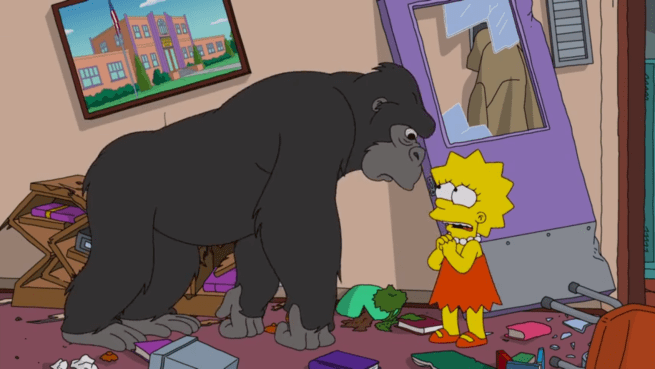
The B-plot (or maybe the A-plot, this one seems like it has more screen time) starts with Lisa planning to free a captive whale after being aghast by their awful treatment and living conditions during a visit to a local water park. It’s all incredibly on the nose (the opening shot has the family entering Alcatraz Water Park, “Subject of 5 Award-Winning Documentaries.” All of this is mostly in reference to the 2013 documentary Blackfish, and the ensuing efforts to address concerns of animal mistreatment at places like SeaWorld and to free the orca whales in captivity. It’s an issue that’s still ongoing, but it once again feels like the show missing the boat of a cultural moment by many years. SeaWorld still does have a handful of orca whales, but only because they claim they wouldn’t survive out in the wild. If the episode was actually about that, with the whale having no idea what to do once its cage was opened, or getting killed or seriously hurt immediately after being freed, that might have been interesting. But whatever. Bart is roped into helping out, and feels the strange twinge of satisfaction of a job well done, dubbed by Lisa as “altruism.” He follows up chasing after this feeling by freeing a gorilla from the zoo, who immediately goes on a rampage through town that we don’t see, and then Lisa calms him down somehow and that plot is over. Bart getting invested in a cause because it involves illegality like breaking and entering would have been an interesting enough plot for a whole episode. In fact, that element of it sounds like “Bart vs. Itchy & Scratchy,” which did a mostly adequate job selling that premise. Here, the idea has so little room to actually grow into anything, so it’s all pretty meaningless. Much like the rest of the episode.

Three items of note:
– Bart and Lisa also enlist Willie to sneak into the water park, as he mentions that he works there during the summer. It feels pretty random, and they don’t give him anything really to do other than make some kilt jokes and at the act break, he plays “air bagpipes,” which is just Dan Castellaneta making ear-grating noises for ten seconds. Ugh.
– Homer hounds Lenny and Carl to try to get them on board with his boat scheme. Cutting back and forth to them, we see them asleep in bunk beds with a portrait of Bert and Ernie on the wall. Later, we see them cruising on the boat with their girlfriends, both of whom look like the other in dresses. I’m sure I’ve mentioned this several times, but this joke of Lenny and Carl being gay for each other has been pushed to its limits at this point. Who were once just two working schmoes who acted as a sounding board for Homer to bounce ideas off of have now become this weird codependent couple who are obsessed with one another. You can evolve character roles and personalities as the years go on, hell, I encourage it, but these two have been stuck in this role for decades now and it’s not getting any funnier. Because it wasn’t funny in the first place.
– The gorilla is finally set free at Dr. Jane Goodall’s Pennsylvania reserve, where Lisa lays the praise on thick to Goodall, who is voicing herself. The character model is the exact same one used for Dr. Joan Bushwell from “Simpson Safari,” as her character was effectively just a rip-off of Goodall herself. I really don’t care about that, mostly because that episode was a piece of shit, but probably much more entertaining than this. Goodall isn’t a very good actor, but it’s not like I expected much from her, and I don’t think there were any jokes in her scene (stringing an eager Lisa along for a maybe sort of chance for a scholarship? I guess that’s a joke? Oh, who cares.)

One good line/moment: Ehhh, whatever. This season really blows so far.

666. Treehouse of Horror XXX

Original airdate: October 20, 2019

The premise: “Danger Things” is a Stranger Things “parody.” In “Heaven Swipes Right,” Homer dies unexpectedly, and is given the ability to swap into different bodies, trying to find the perfect one for his family. “When Hairy Met Slimy” is a Shape of Water “parody.”

The reaction: Another year, another Halloween special where I struggle to articulate the same damn criticisms without seeming like I’m repeating myself. Two segments here “spoof” contemporary media, the first one being especially confusing in that it references elements from all three seasons of the Netflix series, cramming so much into a mere six minutes that even as someone who’s watched the whole series, I couldn’t even tell what was happening. Treehouse of Horrors have been parodying horror fiction since the beginning, but a big reason it worked back then is that even within the framework of a reference to another work, they were still interested in telling their own stories. “Nightmare on Evergreen Terrace” casts Willie as Freddy Krueger, but retold his death and origin story in a very Simpsons way. “The Shinning” recreates a lot of memorable moments from the Kubrick classic, but also features new elements like Burns and Smithers kicking the whole plot into motion. I guarantee if they did a Shining segment now, it would feature Bart riding through the halls on a Big Wheel finding Sherri and Terri at the end of a hallway, because the name of the game now isn’t story, it’s references. The Christmas lights to communicate from the beyond, the water tank, the Upside Down itself, all the Stranger Things hallmarks are there, but ultimately meaningless with no story to hang onto, and must be absolutely baffling to anyone who hasn’t seen the show. Segment two was just kind of boring, and had no creepy elements to it whatsoever. Neither did segment three, which I guess they only did because Guillermo del Toro is such a big Simpsons fan. That’s the single biggest causality of these specials: they’re not scary anymore. Not that they were genuinely terrifying to begin with, but it was really impressive how this silly cartoon show managed to get pretty unsettling. Marge and the kids getting lobotomized as the Re-Ned-ucation Center. Martin letting out a horrifying death screech and collapsing in the middle of class. The family screaming in agony having their skin turned inside out. The gremlin holding up Ned Flanders’ severed head as he taunts Bart. In the last segment here, Kang bites off Smithers’ head, spits it at Burns to knock him out (complete with a coconut BONK sound effect) and they run away. It’s not so much scary as it seeming like they had no idea how to end the scene and just bailed. Treehouse of Horror segments of old were kind of tense, and they had a distinct atmosphere to them. But now, they’re just as meandering and pointless as any other episode.

Three items of note:
– We get a fairly long intro with an Omen parody of Maggie being a demon spawn. We open with Marge giving birth to a baby boy, but Homer doesn’t want another boy, so Hibbert just offers her demon Maggie instead? But regardless, the show already did an Exorcist spoof with Maggie two years ago, didn’t they? This is just the same thing over again. I guess it’s only here as the opening to tie into this being the 666th episode, but if that’s all it is, they could’ve made this a neat one minute long rather than three.
– In the Upside Down (or whatever hilarious name they decided to call it, I forget), we see a dead Uter prominently lying outside the town square wearing red glasses, clearly a stand-in for poor Barb from season 1 of Stranger Things. Odd choice, but there’s no Nancy analogue in the story, nor are there a whole lot of female characters from this show to choose from. Considering Russi Taylor just died, I was surprised they didn’t alter this at all, maybe just do a retake to remove just the Uter layer of the scene or something. I certainly wouldn’t cry insensitive, but it felt a little weird.
– Segment two ends with Homer finally landing on the perfect body to use: Moe. Marge seems perfectly fine with spending the rest of her days making love to the body of a creepy pervert who was unhealthily obsessed with her. Then Maggie shows up and Moe for some reason is now in her body, who tells Marge that he’s very thirsty. What better way to end your spooky Halloween special with your viewer imagining Moe in a child’s body sucking on Marge’s tits? It might be the most sickening thing ever done on the show. Jesus…

One good line/moment: I think there was one scene I mildly chuckled at, but I don’t remember what it was, so I don’t think it really counts if that’s the case.

665. The Fat Blue Line

Original airdate: October 13, 2019

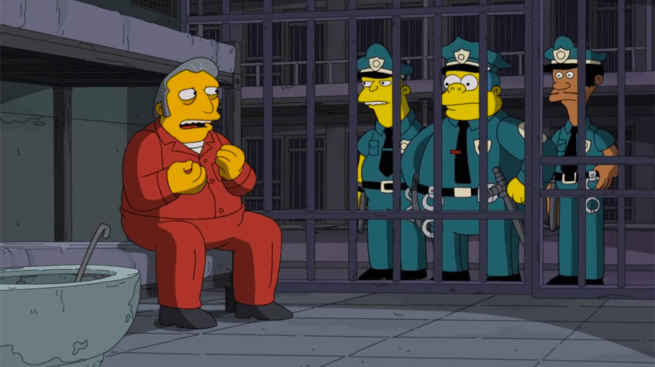
The premise: Fat Tony is arrested following a mass pick pocketing incident, a bust performed by an actually competent investigator from the attorney general’s office. Chief Wiggum is initially discouraged after having the case taken from him, but discovers through his own investigation that Fat Tony is actually innocent.

The reaction: I’ve previously talked about how one of this show’s most crippling handicaps is its dogged resistance toward any kind of evolution of its characters. In a fictional landscape of so many different personalities, locations and commonplace scenarios, it feels like they’ve all played out in relatively the same way for decades, and for a show that’s now in its thirty-first season, that’s a major problem. Take this episode featuring Fat Tony and the Springfield mafia. Born as loving tributes to classic mob films like The Godfather, and at the time to the recent cinematic success Goodfellas, they quickly became beloved characters, with a small handful of notable appearances in the classic era. Each appearance seemed to bring something new to the table: “Homie the Clown” showed their appreciation for Krusty’s buffoonery, spearheaded by self-professed Italian stereotype Don Vittorio. “The Twisted World of Marge Simpson” ended with them facing down the Yakuza. Even appearances as late as seasons 12 introduced memorable new members like Johnny Tightlips and Frankie the Squealer. But sadly, like the rest of the cast, Fat Tony would become a one-dimensional shadow of who he once was. He gets framed for stealing a bunch of wallets and is put in prison, and it turns out Johnny Tightlips was responsible, who places himself as the new mafia head. Does any of this matter? Do we get a better idea of Tightlips as a character, or any of the other mafia members? What do Legs and Louie think of this betrayal? None of this is explored. Instead we get a healthy helping of tired mafia and Italian jokes: Tony says goodbye to his wife and mistress before being incarcerated, makes toilet spaghetti in prison, and says a bunch of funny Italian words and expressions. One scene just ends with Tony and Louie just muttering nonsense to each other for like ten seconds. Running alongside this is Chief Wiggum feeling sad that he’s been replaced on the force, and eventually helping crack the case to save the day, a premise we’ve seen play out a whole lot better in “Homer vs. the Eighteenth Amendment.” Wiggum fell apart back then because being a cop was all he knew how to do, and without that, he’s completely listless. But here, he’s discouraged that people don’t respect him? Didn’t we just get this with Homer last week, to absolutely terrible results? But don’t worry, just like she does every now and again with Moe and others, Marge is there to believe in him, just because. The ending features her randomly appearing before Wiggum walking down a crosswalk with Maggie to deliver a drive-by “I believe in you, Chief!” It’s almost as if years of meaningless, unprompted encouragement from Marge that’s rung completely hollow has led to this moment. Remember the sweet moment in “Twisted World” where Fat Tony is first confronting Marge, but needs her help to actually turn her car off? Moments like those go a long way in humanizing these silly cartoons, and they stick out in my memory. But shit like this? I’ve nearly forgotten it all already.

Three items of note:
– Time for a quick guest star line-up. The episode opens with the Simpsons going to the local Italian street fair, the San Castellaneta Festival. I guess we’re supposed to laugh at that name. On stage, Mayor Quimby introduces Aquaman himself Jason Mamoa to kick off the festivities. Quimby mispronouncing his name and calling him “Superfish” felt reminiscent of his unflattering interaction with Leonard Nimoy in “Marge vs. the Monorail.” I honestly don’t mean to do direct comparisons to classic episodes like this, but sometimes they help illustrate points. A celebrity like Leonard Nimoy appearing at an event at a podunk nothing town in the 90s? Sounds plausible. But a big modern celebrity like Mamoa? Nah, dawg. Later, Bob Odenkirk shows up as Fat Tony’s lawyer, and I’ll be honest, I absolutely can’t believe the restraint on their part to not make him just a yellow Saul Goodman. Perhaps that’s thanks to his brother Bill Odenkirk writing the episode, but I was pleased that, as minimal a role as he had, Bob got to play a different kind of character. On the subject, El Camino, the Breaking Bad movie, just came out and it’s absolutely wonderful, if you haven’t watched it yet, why are you still reading this? And if you haven’t seen Breaking Bad, then go watch that first. Also, Better Call Saul, which I think is better than Breaking Bad. FIGHT ME.
– Wiggum’s big break in the case is uncovering a video online, “Tony D’Amico Age 23 Rare Interview,” a casual interview at a pool hall where Fat Tony flat out says the one crime he would never, ever commit is pick-pocketing. Who was filming this and why? Beats me. But watching the scene again reminds me, Fat Tony’s dead, remember? His role was assumed by his cousin Fit Tony, who was a fitness trainer prior to filling his dead cousin’s shoes. So this video shouldn’t matter at all, it’s the wrong Tony. But really, who gives a flying shit who it is, but then that’s the point, isn’t it? Crafting a story about the death of Fat Tony ultimately means nothing if you’re just going to replace him and pretend like none of it ever happened. In the same vein as Principal Skinner and Snowball II before him, it’s not cute or subversive when they do this, it’s just bad, cowardly writing.
– Toward the end when Fat Tony and Johnny Tightlips enter a stand-off, we get a reference of the infamous final scene in the series finale of The Sopranos, as the “tension” escalates as “Don’t Stop Believin'” plays. The Sopranos is one of the biggest shows of the last twenty years, and the ending was so culturally notable at the time that even myself, a person who never watched the series when it aired, recognized the reference immediately. But, as always, what is being added to this pop culture allusion? What is the joke here? We see Maggie parking her Fisher Price car (forget why she’s not with the rest of the family), but that’s basically it. I remember way back in season 13’s “Poppa’s Got a Brand New Badge,” they recreated the Sopranos opening with Fat Tony, at a time when the series was still going strong in its third season. If I recall, it’s a “parody” in the modern sense for this show in that it just shot-for-shot recreated something and considered that a good enough spoof. But here, we’re twelve years removed from the final episode of The Sopranos, and a parody like this feels so out of left field. Then again, I could equally complain about the couch gag, which is a recreation of a scene from last year’s Bohemian Rhapsody, which also feels like such an ancient reference now. I’ve talked before about how the advent of memes and the Internet have kind of ruined pop culture references for any show with an extended production, as they’ll always be late to the party after ten million people have done their own takes. And yes, that’s discouraging, but ultimately, it really shouldn’t matter how much time’s gone by. A pop culture reference can still be funny as long as there’s some kind of unique satirical take on the source material, and as usual with this show, there’s absolutely none to be found. The only “joke” is that the controversial cut to black that ending the legendary series is displayed here as Wiggum opening his mouth to camera about to suck a bullet out of Homer’s asscheek. Well done, guys.

One good line/moment: Eh, I got nothing for this one.

664. Go Big or Go Homer

Original airdate: October 6, 2019

The premise: Stuck supervising the new crop of power plant interns, Homer is introduced to Mike, an excitable elder millennial who considers him his idol. He begs Homer to be his mentor, which he happily accepts, feeling unappreciated at home and by the town at large.

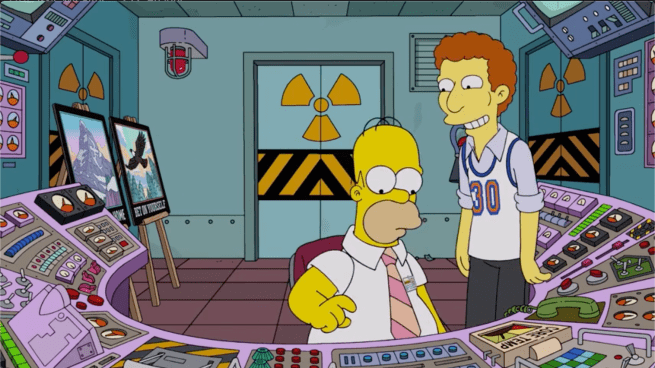
The reaction: Boy, the writers must have been laughing their tits off at this Mike guy. It feels like 70% of all the dialogue in this episode is just his motor mouth saying… jokes? I think? For an episode that focuses so heavily on this character, I am completely lost as to who he’s supposed to be and what I’m to get out of his “character progression,” whatever it even was. Mike is a 35-year-old voiced by the 49-year-old Michael Rapaport, who I’m not at all familiar with, so any kind of inside joke connecting Mike’s personality with his voice actor is completely lost on me. John from “Homer’s Phobia” was effectively a yellow John Waters, but his personality was wholly realized within the episode on its own. Anyway, Mike is one of a dozen new interns at the power plant, who immediately sticks up for Homer when he gets stymied by the others asking him actual questions about the plant. Mike looks up to Homer thanks to countless news stories about the plant’s numerous near-meltdowns over the years always featuring Homer at the epicenter of the crisis (despite Homer being a town pariah at this point, I guess none of these articles Mike presumably has obsessively read over and over again at this point implicate he was responsible for these disasters.) The first half of the episode is just him going on and on about what an honor it is for him to worship at Homer’s feet and how fucking amazing he is. But why? Mike is not a scientist or an engineer (“Why not follow my hero into the world’s greatest calling: nuclear whatever!”) He never asks Homer any questions about his job or any specific interest in what he does. It’s not even anything broad like he admires Homer’s “courage” for taking charge and averting all those meltdowns, like it’s just a general heroism he looks up to him for. It’s just… nothing. Absolutely nothing. Mike looks up to Homer because that’s what we wrote in the script. He wears a basketball jersey throughout and is obsessed with the sport, namedropping numerous players. Why isn’t one of them his hero? That doesn’t come into play in the story, so I guess it’s just another hilarious quirk from this great new character.

Meanwhile, Homer doesn’t look a gift horse in the mouth, thrilled that someone is giving him the respect he thinks he deserves. But Mike also has an incredible anger issue. Multiple times in the episode, when someone is rude to Homer, his face goes red and he goes off on an insult comic tirade against the ignorant swine who would dare defame his beloved mentor. One of his victims happens to be Bart, during a family dinner with Mike and his pregnant wife as invited guests. Despite witnessing Mike verbally abusing his son to the point of tears firsthand, Homer doesn’t say a damn word when Marge throws him out of the house, and never apologizes to her or Bart about it (“How many times do I have to say I’m sorry?” “Once would be nice!”) The conversation immediately pivots off of Marge attesting that this grown man that screamed at her young child is a dangerous lunatic, to Homer whining that she and the kids don’t respect him like Mike does. So, Mike actually appears to be mentally unstable, and it was getting more and more overt that I thought the episode would eventually have to deal with it. Instead, Homer decides to actually attempt to be a mentor, in his sole action of expressing interest in Mike’s dumb-ass idea: a business that sells pizza by the slice instead of entire pies. Mike gets a food truck thanks to a legitimate loan from the mob, leading to he and Homer to get chased to a junk yard by Fat Tony, who then lay down their arms because they like Mike’s dumb-ass idea and can also use it for money laundering and man, who gives a flying shit. In the end, Mike’s business with Fat Tony is a big success, Fat Tony makes Homer tear up when he calls him a great mentor, and shots over the credits show Mike thriving with his work and his family and living a wonderful life all thanks to Homer believing in him! Ohhhhhhh boy! He isn’t delusional or has serious anger issues to work on, he’s just a goofy character that we all love! Mike the adult intern! This one was a real head scratcher. Again, I honestly have no idea what they were going for with the Mike character, and as the episode is solely centered around him, that’s a serious problem. His insane actions and serious character flaws clash dramatically with the clean, safe happy ending we’re given, and none of the random pieces thrown at us fit together whatsoever. A very dumb, strange, dumb, dumb, dumb episode.

Three items of note:
– Homer begins his talk to the new plant interns blending a bunch of millennial stereotypes together, but thanks to this show’s floating timeline, the 38-year-old Homer would now have been born in 1981, making him a millennial! What a scary world we live in. When we get to the point the show is still airing and Homer is as old as I am, I think I’ll just instantly turn into a fossil.
– Mike blows up at Mr. Burns to stand up for Homer, and as thanks, he ends up getting shot in the face point blank with an old musket by Burns (filled with hundred-year-old pellets that lightly embed themselves in his face.) Certainly an unexpected ending to the scene, but one that is ultimately pointless, as there are no repercussions from this event, and Mike’s food truck is shown thriving in the power plant parking lot at the end, so everything’s all good!
– There really isn’t a whole lot of other specific stuff to comment on, since this episode is so absolutely heavily focused on this one-off character we will never see again (God willing). I guess members of the staff just really love Michael Rapaport, or are like good friends with him. Doing some quick Internet research, it appears he’s a pretty big sports guy, so I guess that explains Mike’s sports obsession. He’s also responsible for this, which I guarantee is ten thousand times funnier than anything in this abysmal episode.

One good line/moment: Mike giving Bart a vicious verbal beat down leaves the Simpson dining room speechless, except for Lisa, who is adorably laughing her ass off at her brother being made the fool for once. Yeardley Smith’s performance is just lovely, and it got a big genuine smile out of me for once, as it effectively added a joke to the truly horrific and shocking moment, using expert comedic timing I haven’t seen from this show in years. Ignoring the fact that the episode did absolutely fucking nothing to address or deal with Mike’s transgressions following this scene, it was an honestly great moment.