 (originally aired February 11, 1990)
I feel like Lisa Simpson is one of the more under-appreciated characters in all of television. Within the show she certainly is, stuck as the misunderstood middle child of the Simpson clan. Amidst her dopey father, trouble-making brother, and her mother desperately holding the family together, Lisa’s incredible creative and intellectual gifts are mostly gone unnoticed. But outside the show, she is also the target of scorn. While later years have dabbled in making her a smug intellectual or political mouthpiece, Lisa was never really a fan favorite against the more popular Bart or Homer. But she plays a very important role in the series: she’s earnest, she works hard, but in the end, she can never quite catch a break. In many ways, she’s the most human character out of anyone on the show, and the episodes focused on her always tend to be the most emotional and down-to-earth, and this very first one is no exception.
The set-up is that Lisa feels sad. Though it’s not so much a sadness as a general malaise about her station in life; undermined for her creative outbursts at school and generally unacknowledged at home, she has basically ostracized herself from a world she believes holds no happiness for her. It’s an emotional arc that I can’t think of any other show tackling, and it never holds back. You really feel for Lisa and her unfortunate state of mind because we’ve all felt this sense of unhappiness sometime in our lives. While they are not the most attentive at times, her parents express concern. Homer, while not having the slightest idea of her daughter’s problems, does his best to hear her out and cheer her up, but to no avail. It’s a really sweet moment between the two, with Lisa acknowledging her father’s best intentions.
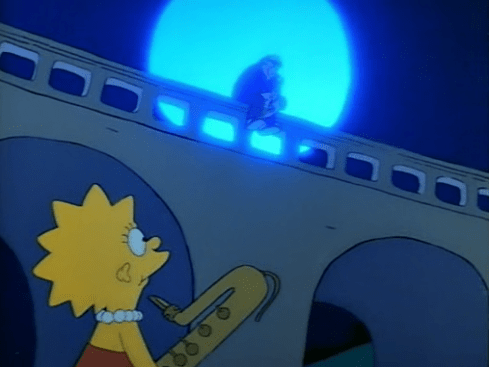
Lisa eventually finds some sort of refuge in a mysterious wandering jazz man named Bleeding Gums Murphy, resulting in an impromptu jam session late at night on the downtown bridge (I believe the same one Homer nearly jumped off of three episodes ago.) Murphy is a pretty infamous Simpsons character, though he’s only really been in two episodes (and the opening every week.) He’s helpful to Lisa, but also can be a little backhanded. (“You know, you play pretty well for someone with no real problems!”) Lisa earned recognition from a kindred spirit, and an outlet for her frustrations, but it is by no means a solution to her problem. There’s a happy ending here, but nothing permanent like out of a typical sitcom.
I guess the side plot should be mentioned, featuring Homer’s efforts to beat Bart at a boxing video game. I guess since the main story was so serious, this runner served as a comedic outlet and break from the drama. It’s got a lot of great funny bits in it, continuing with the season 1 tradition of Homer trying to impress his son and prove himself a man, but also features some early Homer overreaction, like his crazy dream sequence, and his equally crazy breakdown after Marge unplugs the television right before he finally bests his son. Seeing a grown man cry over a video game is probably the first truly pathetic act we’ve seen from Homer, but certainly not the last.
Marge, meanwhile, thinks back to her mother’s advice to her as a child, to bury your emotions and remain smiling to fit into the group. Her advice seems very true to her character, especially when you figure how much she puts up with from her family in the years to come. The scene where she vests Lisa with this advice is so great, it’s such poor advice, but Marge means it with such honesty, believing this will make her daughter happy. The end result of witnessing Lisa about to be take advantage of and undermined because of Marge’s words prompts her to completely backtrack, telling Lisa to just be herself and her family would be there to support her no matter what. It’s a wonderful turn, and a sweet ending.
Tidbits and Quotes
– In the opening titles every week, we’ve seen Mr. Largo throw Lisa out of class for her jazzy outbursts during class, but here, we finally see him in the show itself, where he’s basically what we expected. His very name gives it away, ‘largo’ being a musical term for a slow and broad tempo, completely uncreative and unambitious. When Lisa describes her music as reflecting those hardworking Americans who go unnoticed and unappreciated, Largo responds, “Well, that’s all fine and good, but none of those unpleasant people are going to be at the recital next week.”
– The boxing game “Super Slugfest” is a great Simpsons-esque parody of video games, with its old-school graphics and Punch-Out style meshed with over-the-top graphic violence, like a final blow decapitation, and the winner dancing on the loser’s grave in the ring, complete with triumphant low-bit music.
– Lisa, an eight-year-old girl, walks out late at night and receives advice from an elderly stranger. All of this should point to this being super sketchy, but it doesn’t really feel that way at all. Well… maybe a little, but Murphy seems sincere enough. Mostly.
– We get the first appearance of a Simpsons staple: someone waking up, sitting up in bed screaming. Also a really big, long Homer scream. And funny.
– “You know Marge, getting old is a terrible thing. I think the saddest day of my life was when I realized I could beat my Dad at most things, and Bart experienced that at the age of four.”
– I’ve always loved Murphy’s explanation of his name, in that he never goes to the dentist (“I suppose I should go to one, but I’ve got enough pain in my life as it is.”)
– One last bit, I love how Lisa plays a baritone saxophone, one that’s almost as big as she is. It’s a perfect visual metaphor on how she’s a big fish in a small pond, a girl who hold greater aspirations than others around her. It’s also just a funny gag when you see her really playing and struggling to physically keep up with her emotional music.