56. Black Widower

(originally aired April 8, 1992)
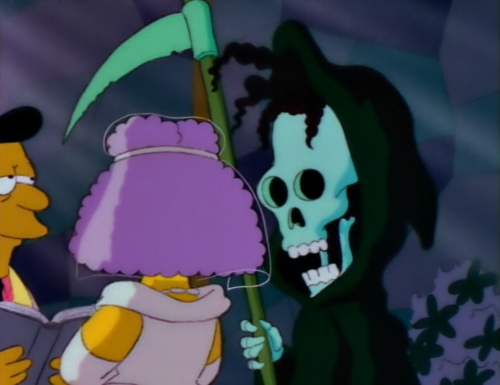
I look at Sideshow Bob episodes sort of like Treehouse of Horrors: they usually come around annually, and they’re always a treat (like TOHs, later seasons would screw them up too, but still). Bob is the closest thing the series has to a true villain, and this is really the episode that gave him that title, his return from prison to marry and murder Selma. But this is Bob we’re talking about, so he is completely convincing through the entirety of his scheme. It seems almost too easy for Bob to present himself a reformed model citizen (Lisa comments, “You’re living proof that our revolving door prison system works.”) Kelsey Grammar’s voice works wonders as he narrates his time in prison, and how he turned his life around upon Selma responding to his pen pal letter. Even Krusty seems willing to forgive Bob, in a tearful reunion reminiscent to Dean Martin and Jerry Lewis’s rekindling. Only Bart remains suspect that Bob’s motives are impure.

This episode is full of great moments, a fair share involving Bob’s growing annoyance and impatience awaiting the final culmination of his plan, and having to put up with Selma, a woman on the opposite end of his high-minded spectrum. The best scene is where he cannot contain his sheer contempt of MacGyver, much to Selma’s horror (Grammar’s read of “That was a well-plotted piece of non-claptrap that never made me want to retch” is wonderfully seeped with patronizing sarcasm). As much is done to make Selma particularly repulsive (excessive focus on her hairy legs here), there’s also a sweetness in showing her genuinely happy. The episode is also a unique mystery, in that we know who the killer is, we just don’t know how he’s going to do it. All the pieces fall into place, and Bart manages to figure them out before it’s too late. Super-director David Silverman does a phenomenal job here, with lots of dynamic shots, angles, shadow work; the slow-motion sequence of Selma lighting the match is dripping with tension. The episode balances these moments of humor and real drama perfectly.

I think Simpsons fans can all agree that Sideshow Bob is one of the greatest characters the show has ever known, and by extension, Kelsey Grammar is one of the best guest stars (really only rivaling Phil Hartman, in my mind). Bob has committed many heinous crimes in his time, including multiple attempted murders of our ten-year-old protagonist, but he remains one of the most affable characters in the entire series. Grammar’s smooth, intellectual performance, a voice I could listen to all day, plays a huge part in this, but there’s more to it than that. Bob favors high society, and believes in cultural and mental standards. Most of his criminal activity revolves around his attempts to better society: usurping Krusty’s show to make it more educational, running for public office, eradicating the brain rot of television. “Black Widower” is a peculiar exception, where Bob’s motives of marrying Selma aren’t exactly clear. He wants her money? To what end? I thought about this a while before I watched the episode, then I tried to put it into some perspective. This is Bob’s second outing, and previously, we didn’t see him in a criminal light until the end of the episode. This is the episode that made Bob an actual threat, a true original kind of villain. The plan may be extreme, but future greats like “Cape Feare” and “Sideshow Bob Roberts” wouldn’t work unless we establish Bob for who he is: the most highbrow attempted murderer the Simpsons universe has ever known.

Tidbits and Quotes
– I love when Bob tells Homer’s he’s forgetting the first two noble truths of the Buddha, Homer indignantly responds, “I am not!” Like he’s genuinely offended at the accusation.
– Great Cool Hand Luke reference with the chain gang, and Bob picking up a slew of discarded Krusty shake cups just adds to his seething rage.
– The Daytime Emmy segment is pure genius. First off, the category (Outstanding Performance by a Sidekick in a Children’s Show) is ridiculous. Then the nominees are even more ridiculous: Droopy Drawers, a sad-sack lanky clown who has a very hot date, Colonel Coward, a jittery panicked mess, Pepito the Biggest Cat in the Whole Wide World, Sideshow Bob (live from prison), and Suck-Up the vacuum, who could not attend, as he (it?) is shooting a movie in Spain. That’s like six jokes done just in six seconds reading off those nominees. Even better is Pepito holding his hands over his eyes in shame when he loses. Topped off with Krusty and Bob’s bantered, and the latter’s sedation by guards, and you got yourself a classic Simpsons scene.
– I always love the bit where Bob muses, “In our overcrowded cell, we became little more than beasts…” Cut to the cell in question: “Who used my chapstick?” “I did. Here you go.” Then, in the most disturbed, shuddered voice possible, “I don’t want it.”
– Bob playing violin for the rocking conjugal visit trailers is mildly disturbing, but a brilliant dirty joke.
– A Bob show wouldn’t be complete without having Grammar sing a song, this time karaoke with Selma to “Something Stupid,” which has a wonderful reprise that Bob croons after he believes he’s succeeded with his plot.
– Krusty’s Jerry Lewis-like telethon is a great sequence: the ridiculous relief cause of motion sickness, his response to Bob’s apology for putting him in prison (“Hey, if they ever open the books on this telethon, I’m right back in there!”), his insulting of Sideshow Mel (a visibly hurt Mel watching at home says, “All I can be is myself”), and the great silly animation of Krusty kicking Bob in the ass repeatedly in clownish fashion.
– Bob’s motives are hinted at in a few scenes, which are still funny enough to excuse. He asks Selma if they can afford the wedding (“I’ve already run through eight of the ten dollars they gave me when I left prison.”) Selma assures them they’re fine (“I got money. I bought stock in a mace company just before society crumbled.”)
– Bob’s hatred of MacGyver is the best thing in the show. After their “fight,” he still can’t bring himself to say one nice word about it (“I can’t do it! Even that car chase seemed tacked on!”)
– I love Lisa’s bitterness toward Maggie being made the flower girl over her (“if you want to go for cutesiness instead of competence, fine.”)
– This episode is filled with fantastic animation, by the way, particularly the telethon and Sideshow Bob assaulting the bellhop.
– In the third act, Bob gets progressively more sinister; upon gazing at the fireplace (“Ah, fire. Scourge of Prometheus, toaster of marshmallows… eradicator of deadwood…”) and the scene of covering murderous murmurings as foreign sweet nothings.
– I do like how Bart normally figures out Bob’s plans, showing he’s not a dumb kid, just one who’s not book smart. The sped-up sequence of him repeatedly trying to explain the plan to Homer is hilarious (“I explained it to Mom and we were on our way.”)
– I’m going so long here, there’s just so much great stuff… the Psycho reference at the end with the lightbulb, Selma wanting a separation after almost being murdered, Wiggum begging Bart to explain Bob’s plot, and the reason behind why the room exploded. I guess I’ll end with the immortal ravings of Bob as he’s being hauled off (“I’ll be back! You can’t keep the Democrats out of the White House forever. And when they get in, I’m back on the street! With all of my criminal buddies!”)
55. Colonel Homer

(originally aired March 26, 1992)
The origin story shown in “I Married Marge” has got me thinking a lot… Homer shackled himself to a job at the nuclear plant for the sake of his family, despite the fact that he is grossly unqualified and has no real interest in being a safety inspector. The only job he had much of an interest in was working at the putt-putt golf course, and that’s just because it was easy. He’s a man who never really found his calling, so knowing this, the dozens of episodes to follow involving Homer trying his hand at everything from bodyguard to grease salesman kind of make more sense. It doesn’t mean some of them don’t suck, but I just never thought about it from this angle. Anyway, this is pretty much the first (of many) “Homer gets a job” episodes; sure, there was “Dancin’ Homer,” but that made a conscious effort in explaining how Homer got time off from the plant. Here, he’s just knee-deep in a new profession, putting all his time into it. It’s a really heartfelt show, and a telling examination of Homer’s faithfulness.

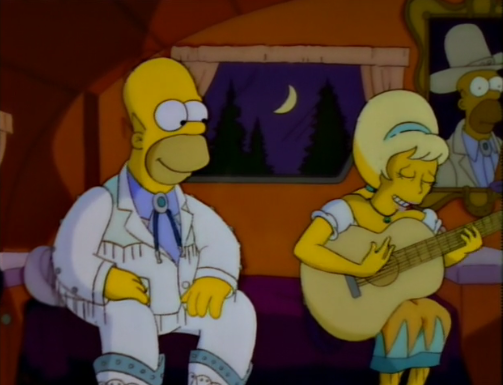
The episode starts with Homer being the most obnoxious ass possible at a movie theater, and Marge calling him out on it. Nobody likes being made a fool of in public, not even a fool as big as Homer, who takes a late night drive to cool down. At a seedy bar far from home (serving ass-backwards Fudd Beer), he first lays eyes on a beautiful waitress/songstress Lurleen Lumpkin, voiced by Beverly D’Angelo. Homer becomes entranced by her music, and the rest of the episode involves his assisting her rise to fame and Marge’s increasing displeasure of this new beautiful woman in her husband’s life. Most of the humor in this episode lies in Homer’s complete obliviousness. Every scene plays out along the lines of a husband who is contemplating, or actually just having, an affair with this woman, but the thought never even crosses Homer’s mind. For a man with endless faults, you can at least say Homer is an incredibly faithful husband who only have eyes for Marge. The first time he hears Lurleen’s song, “Your Wife Don’t Understand You (But I Do),” he is enraptured, but he’s never really comprehending the meaning of the song (similar to later with the overly blunt “Bunk With Me Tonight.”)

This show is also a journey through a slew of slightly discourteous Southern stereotypes, culminating in the amazing Hee Haw send-up “Yahoo,” featuring such hit players as Big Shirtless Ron, Butterball Jackson, and the Yahoo Recovering Alcoholic Jug Band. Lurleen herself is an interesting, if not also sad character; a woman with real musical talent, but stuck in an unlucky station in life. She garners real sympathy, even when she throws herself at a married man toward the end, you really feel bad for her predicament. The interactions between Homer and Marge are the strongest part of the show, as the two start drifting farther apart as Homer’s new career starts to take off. The ending featuring the two getting to bed as Lurleen’s surrender song plays is one of the greatest endings of the series, certainly of any Homer-Marge episode. While “Life in the Fast Lane” showed Marge’s believable reactions to a would-be suitor, this episode is a perfect polar opposite.

Tidbits and Quotes
– Homer’s comments during the movie occasionally ring through my head when I’m in a theater (“Who’s that guy? What’d that guy just say when I said ‘Who’s that guy?'”) I also love him ruining the ending, that the secret code was the nursery rhyme he told his daughter; it’s just such a great play on a twist in that kind of a lame action or thriller movie.
– We know right away the Beer ‘n’ Brawl is bad news. One guy shouts, “Hey you! Let’s fight!” The other guy responds, “Them’s fightin’ words!”
– There’s a small moment in this episode that may be my favorite part; Homer’s got Lurleen’s song in his head and he sings it aloud during bowling night. Lenny mocks him for him, but when Carl tells him he’s bowling a 280, Lenny proceeds to hold his own ball up close and sings to it. Something about the drawing and how he speaks very softly and carefully to the ball, I laughed really hard when he did that.
– We get the first instance of an emotionally insecure Moe, who is devastated to hear that Homer visited another bar.
– The best lines involve Homer’s blissful ignorance. He defends himself to Marge completely unabashed (“Marge, you make it sound so seamy. All I did was spend the afternoon in her trailer watching her try on some outfits.”)
– I love the Corpulent Cowboy, and the salesman who talks Homer into buying his iconic suit (“Now this is made from a space-age fabric specially designed for Elvis. Sweat actually cleans this suit!”)
– I couldn’t wedge this into the main review, but there’s something about the story that doesn’t quite compute. I don’t really know why Homer’s so gung ho about being this woman’s manager, to the point that he hands over his life savings to the recording studio guy. I think of it more like playing to the allegory of Homer having an affair, but the farthest thing from it. All of this pulls him away from his family, but something about Homer’s lifelong dream to be a manager to a music star alone doesn’t work with me.
– With the “Bagged Me a Homer” sequence, I can just imagine the writers desperately trying to come up with a whole bunch of mini jokes to fill the time of the song. I dunno, I’d rather they just focused on the song, they’re kind of distracting.
– The best line of the show is after Lurleen plays Homer “Bunk with Me Tonight.” The signals could not be more clear, but Homer is completely not getting it (“Woah, that’s hot. There isn’t a man alive who wouldn’t be turned on by that. ……..well, goodbye!”)
– To close, I love the quick bit we see of “Yahoo” with the two hicks (“Mah wife ran off with my best friend.” “You bitter?” “Yup. Bit him too. A-hyuck!”) Then a board from the fence lifts up and knocks him in the crotch. Laugh track. End segment. Brilliant. I also love the alternate scene that Matt Groening quotes on the commentary (“Zeke, why did you urinate in that turnip truck?” “‘Cause it’s headin’ for New York City!”) Man, I’d love to see a whole 22-minute “Yahoo” episode.

54. Dog of Death

(originally aired March 12, 1992)
Going into season 3, there were two episodes that immediately stuck out in my mind that exist on two opposite ends of the spectrum for this show. The first was “I Married Marge,” a wonderfully emotional episode that has a lot of heart and shines a light on how the constructs of the series and the Simpson family came to be. It has its fair share of laughs, but I love it for its story, of showing how Homer became the man he is today. Then there’s “Dog of Death.” It has a rather straight-forward plot involving money troubles issue for the family, and a kind of forced sweet ending, but man alive, if it isn’t the funniest episode I’ve watched yet, and one of the funniest of the entire series. Amidst this somewhat serious story of the operation of a beloved family pet and the financial woes it causes, there are so many incredible, insane jokes, and each one of them hits hard. You know when you watch an episode you love, and a scene begins, and you laugh in anticipation for the joke, and then at the joke itself? I was doing that almost the whole runtime. This is one freakin’ funny episode.

We start with a sharp satire of a frenzied money-obsessed culture in which lottery fever sweeps Springfield. The humor is spot-on from the start, with every copy of “The Lottery” being checked out of the library and Homer’s cocky assurance that he’s got the situation on lock by buying fifty tickets. When asked what he will do with his winnings, we go into the most insane dream sequence ever, possibly my favorite of the entire series. He imagines himself as a gold-plated giant, growing in size until he towers over the city, booming with his laughter, encrusted with jewels and diamonds. It’s absolutely crazy, and the stupidity is so layered: why would Homer want this, why would he think it’s a good idea, how does he think this could be bought, why is he growing bigger throughout his dream, and so on. It’s the quintessential crazy dream sequence, and I absolutely adore it. In the end, of course, he doesn’t win, but an enthusiastic on-air Kent Brockman does.

The Simpsons then find themselves in further financial hardship after an operation to fix Santa’s Little Helper’s twisted stomach. Their slightly lower standard of living and bitterness toward the family dog is slightly cruel on the surface, but all of the family’s budget cuts seem to specifically bite each person in the ass, with Marge missing out on her own lotto win, and Lisa, not having her “Encyclopedia Generica,” having to rely on a third-rate biography of Copernicus she found at the bus station (rather fortunate find if you ask me). The third act of Burns training a runaway Santa’s Little Helper as an attack dog has plenty of great Burns-isms, and the great Clockwork Orange parody of the montage of images to enrage a dog, from a tank demolishing a doghouse to Lyndon Johnson. The Simpson family’s anger toward the dog dissolves when he goes missing; even Homer gets emotional about his lonely leash and piddle spot on the rug. I’m sort of running out of stuff to put here… there isn’t much to analyze in terms of the meat of the episode, it’s more or less by-the-books Simpsons. Where it shines is its jokes, quotes and one-liners, so the section below will probably be quite bloated, but I’ll try to restrain myself. So yeah, funniest episode so far for sure.

Tidbits and Quotes
– Right off the bat, we have the great lottery commercial, which is just a complete unashamed unabashed lie (“The state lottery, where everybody wins!”) Followed by Barney inadvertently (and surprisingly to himself) creates the insane frenzy that grips the town.
– Homer’s over-excitement and sureness of his future win is great. His restrained and slow read to Marge is great (“I have a feeling… that we may win… the lottery!!”)
– This is the first episode to have the “throw the book in the fireplace” gag, which almost seems like a running joke, but it couldn’t have appeared that often. He throws “The Lottery” in the fire and later a book on canine surgery. Bill Cosby’s Fatherhood from “Saturdays of Thunder” is also shown smoldering away.
– Chief Wiggum remains devoted to the job while anticipating the lottery results (“No, you’ve got the wrong number, this is 91… 2.”)
– When Abe quips that he knew that they wouldn’t win, Homer goes into a rage (“Well, why didn’t you tell the rest of us? Why did you keep it a secret?!“) He tosses over the table he’s been keeping his tickets on, then angrily directs Bart (“If you were seventeen, we’d be rich! But nooooooooooo… You had to be ten!”)
– The animal hospital is great, with its tasteful disposal of lost patients, into a little trash bin with a basketball hoop over it.
– Even during a serious situation, I just love Homer and Marge’s differing ways of discussing potentially not doing the operation. Homer spins a magical tale about Doggie Heaven, then has to assert that there is a Doggie Hell (where Hitler and Nixon’s dogs live), but even Homer’s heart melts upon seeing eye-to-eye to the whimpering mutt (“Lousy manipulative dog.”)
–
Very great brief moment in the waiting room: they saved a man’s game cock, but he’ll never fight again (“That’s what you think. He’ll fight and he’ll win!”)
– I love how bitter Homer is commenting on a newly blinged-out Kent Brockman (“He’s got all the money in the world, but there’s one thing he can’t buy. ……..A dinosaur!”) Also the pay-off to the school getting proceeds from lottery tickets, which excites Skinner, but turns out to just be one eraser. To put it lightly, he ain’t happy.
–
I like all the photos of SLH either involving him being abused by Homer or the other way around. The winning photo for the flyers to put about town featured a petrified dog with disembodied hands entering from the left side of the frame.
– There’s some great Burns lines: seeing SLH at the kennel (“Why here’s a fellow. Wiry, fast, firm, proud buttocks. Reminds me of me.”), while training him (“If that were a real girl scout, I’d have been bothered by now!”) and his muffled “Release the hounds” whilst in his hyperbaric chamber.
– I love how Homer breaks down toward the end, yelling to the kids how there is no Doggie Heaven, and his smooth back pedal (“But… to put it another way…. there is.”)
– I love how much of a selfish indulgent asshole Brockman becomes, with a ridiculous spray-on tan, gold chains and gold house, complaining about all the homeless shelters and charities that want a piece of his money.
– There’s a great swipe at Snowball II towards the end, who is even more disregarded in the house than the dog. No one gives a shit about cats. And the great final disclaimer (“No dogs were harmed in the filming of this episode. A cat got sick and somebody shot a duck, but that’s it.”)

53. Separate Vocations

(originally aired February 27, 1992)
Bart on the side of law and Lisa a rebel? As Skinner bluntly points out, “Has the world gone topsy turvy?” Thanks to the results of the Career Aptitude Normalizing Test (or CANT), the two Simpson siblings are handed down future careers that boggle them: police officer for Bart and homemaker for Lisa. What follows is the two taking the news to heart and how it molds them into different personas, but in a way that feels believable and not just product of an arbitrary role-reversal episode. Bart takes in the allure of the power of “the man,” starting with a ride-along with cops Eddie and Lou, where he is allowed to handle a weapon and is nearly killed by a deranged Snake. While this would traumatize a normal kid, Bart is totally psyched, eventually taking his newfound sense of power to the schoolyard, and soon teams up with Principal Skinner to be his eyes and ears of the school. It’s an interesting and fun dynamic to see these two rivals on an even playing field for once, and Bart retains his cocky, mischievous attitude as he pushes the envelope of his duties.

Lisa, meanwhile, can think of no greater fate worse than the one of her mother, it seems. We once again get more sad looks at Marge, be it her dreams of being an astronaut as a child to seeing her keep a rictus grin on as her husband and son thoughtlessly gobble down her thoughtfully prepared breakfast. A visit to a music teacher further breaks Lisa’s spirits, as she learns she has given a poor pair of genes from her father in the form of stubby fingers. Lisa has always been a brooding type, sometimes seeming like an emotionally mature adult trapped in a child’s body, so it’s only natural that this level of discouragement would lead her to become a bitter nihilist. With her ambitions for the future crushed, she feels no need to be a model student and teacher’s pet, putting her in Marlon Brando in The Wild One territory (Skinner asks, “What’re you rebelling against?” Lisa, of course, responds, “Whaddaya got?”)

These two paths collide after Lisa steals all the teacher’s editions from the school, an act that nearly turns the school into chaos. Amidst this character study show is another great Simpsons look at public education: without answers in front of them, the teachers go into a frenzied panic, now being unable to appear smarter than young children. We also get a fair share of ridiculous cut-away gags, from Bart imagining himself as a drifter, and later as a witness testifying against a mobster in court, with his identity blotted out and voiced over by the great Steve Allen. As minor as a guest spot as this is, it’s still incredibly memorable (hearing Allen get out “Aye carumba!” is hysterical). We also get the first instance of something spontaneously bursting into flames for no reason, which would become almost a Simpsons staple. The show continues to get sillier, but never loses track of its emotional core, as in the sweet ending where Bart takes the fall to save Lisa’s future.

Tidbits and Quotes
– The beginning with the three children wondering what Krabappel’s surprise is very much like Homer’s co-workers imagining what his secret weapon is from the last episode. Now that I think of it, it’s the same as when the family members try to guess who Selma’s new suitor is in “Black Widower.” Must have been a trendy joke for this season.
– I do love the pathetically veiled questions on the CANT test (“If I could be any animal, I would be (a) a carpenter ant, (b) a nurse shark, or (c) a lawyer bird.” “I prefer the smell of (a) gasoline, (b) French fries, or (c) bank customers.”)
– Something about the ridiculousness of the test security and the Iowa testing center feels like an early joke-type for this show, showing ridiculous, over-the-top secret operations. I especially love the old man with the broom “troubleshooting” the machine.
– I’ve always liked Lisa’s plotting of her future (“I’ll be unappreciated in my own country, but my gutsy blues stylings will electrify the French. I’ll avoid the horrors of drug abuse, but I do plan to have several torrid love affairs, and I may or may not die young. I haven’t decided.”)
– Subtext is usually text on this show. The music instructor tries to break some news to Lisa (“I’ll be frank with you Lisa, and when I say frank, I mean, you know, devastating.”)
– Lou commenting how Mayor Quimby is “polling the electorate” may be the dirtiest joke ever done on the show. And I didn’t even catch it until I thought about it later, and I have an absolutely filthy mind.
–
The car chase is so well done, with the exploding milk truck as I mentioned before, but my favorite part is the inexplicable part where they drive through a bunch of empty boxes, like in all action movies. Lou comments, “Damn boxes!” I also love the bridge between the two acts, like it’s a cop drama (“Act II: Death Drives a Stick”).
– This also is the first instance Skinner mentions he fought in Vietnam. Initially a joke, this spawned many future jokes and flashbacks, broadening his character further.
– The third act montage sequence is fantastic, with some great music by Alf Clausen, showing how Bart has taken security in the school to an extreme, culminating in him selling out his own best friend Milhouse, who cries, “Sure, we have order, but at what price?!”
– I love the teachers going nuts when they’re answer key-less. One panicked man cries, “Does anyone know the multiplication tables?!” And of course, Miss Hoover trying to bring herself down from a panic attack (“Calm blue ocean, calm blue ocean, calm blue ocean…”)
– Another great ridiculous joke in enlisting the police to help: their hounds catch the scent of books in the library, so the police inexplicably send a battering ram into the door.
– I like the cockiness of Bart after he “confesses,” and his back and forth with Skinner, as he continually raises his number of detention days every time Bart talks back to him. Finally, he figures he’s had enough (“Maybe I’ll just shut my big mouth.”)

52. Homer at the Bat

(originally aired February 20, 1992)
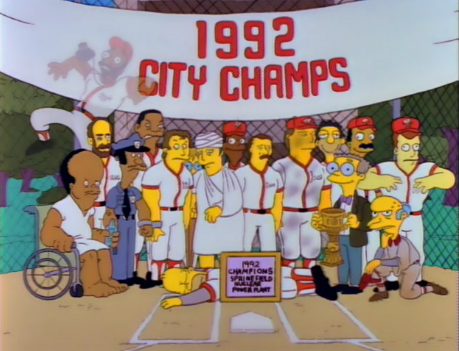
Well this certainly was a change of pace. After three episode in a row, and many more in seasons prior, we’d plumbed the emotional depths of the show, with stories focusing on real people and real conflict. And now we have this episode: a completely preposterous and bonkers storyline catering to nine, count’ em, nine special guest stars. This is easily the most ridiculous episode to date, and a real stepping stone for the show. It further expanded the universe to contain more potential for celebrities to lampoon themselves (and occasionally get screwed over by the writers), but still fit in with the established world and the story they reside in. Moreover, the series pushed its boundaries into wackier territory. Ken Griffy, Jr.’s “grotesquely swollen jaw” and Ozzie Smith literally falling into another dimension are jokes that feel insanely foreign to the subtler humor we’ve seen so far, but would pave the way for the joyful craziness we’d see in later seasons.

The episode begins a bit more grounded with Homer’s unusual enthusiasm over the company softball team, and his even more unusual skill for hitting homers, thanks to his crudely homemade “wonder bat.” I suppose even someone as grossly incompetent as Homer is allowed a few choice skills. Our plot kicks into gear in waiting for the final game against the Shelbyville power plant team; in attempts to win a million dollar bet, Mr. Burns decides to bring in a few ringers. Not one or two, but nine: Steve Sax, Jose Cancesco, Wade Boggs, Roger Clemens, and so on. This is not only incredible overkill in hiring an entire team of major leaguers, but the stakes of the game are entirely nil. When asked what he’ll do with his million, Burns half-heartedly comments, “I dunno. Throw it on the pile, I suppose.” The real matter here is a matter of pride, for Burns, and also for Homer, who becomes greatly discouraged losing his top rank on the team.

Now I don’t know a thing about baseball, so I can’t say anything in regards to how the guest stars were represented. Juggling nine guest stars is an incredible challenge, yet the show manages to create memorable moments and lines for pretty much all of them. I like how some of their ridiculous introductions mirror their ridiculous fates: Mike Scioscia yearns for a blue-collar job, so he finds himself enjoying his phony plant position, at least until he gets a horrible case of radiation poisoning. Perhaps the greatest running joke is the subtle rivalry between Homer and Darryl Strawberry, who is a big kiss-ass the entire episode. When he is switched out during the last inning for Homer, he’s understandably shocked (“But I hit nine home runs today!”) Despite the silliness and full plate of characters this episode had to manage, there still is a layer of sweetness to it in Homer’s final “triumph” at the end and the magnificent win for the team. This is really a cornerstone episode for the show, in its ability to just go nuts and reach as far out of the box as they could without wrecking the foundations of the series. Many, many episodes further down the line would break said foundation, but for now, we can revel in the sweet, sweet absurdity.

Tidbits and Quotes
– When Homer announces he’s got a secret weapon, the plant workers are all curious as to what it could be, from Charlie dreaming of a giant glove to Lenny (with an amazing grin on his face), who believes Homer has access to laser gun technology and can incinerate the other team. It’s classic Simpsons dream fodder, but perfectly lays the groundwork for the show in blending baseball and crazy, over-the-top jokes.
– The epic retelling of the origins of Wonderbat is filled with great Homer moments: his safety precautions in the thunderstorm, his shelving of his homemade football, and how he, for some reason, needs to hammer nails and use a acetylene torch to construct a wooden bat.
– The first game of the season is against the Springfield police force. The umpire sets the ground rules: “Okay, let’s go over the ground rules. You can’t leave first until you chug a beer. Any man scoring has to chug a beer. You have to chug a beer at the top of all odd-numbered innings. Oh, and the fourth inning is the beer inning.” Wiggum indignantly interrupts, “Hey, we know how to play softball.”
– I like Marge’s play-by-play narration as she’s filming the game with a camcorder (“And the man wants to hit the ball, too. And he does. And there he goes, off in that direction. And everyone is happy.”)
– The slow-motion replay of Homer’s winning hit is wonderful. Slow-motion is always difficult to do in animation, since it requires more drawings, but the grotesque jiggling of Homer’s flabby body is absolutely hysterical, complete with his slowed down grunts and aghast shock over actually getting a hit.
– The second, and last, I believe, appearance of Aristotle Amadopolis, this time briefly voiced by Dan Castellaneta. I wish he’d have appeared more often, or maybe I just think that because I want to hear more Jon Lovitz.
– Burns’s initial line-up is a great moment, populated by players who haven’t played the game, or even been alive, within the past century.
– Some classic Homer advice I think of time to time (“No matter how good you are at something, there’s always about a million people better than you.”) Bart completely understands (“Gotcha. Can’t win, don’t try.”)
– The different ways the players get indisposed of ranges from psychotic to even more psychotic. Eddie and Lou continue to be hard-ass cops in accusing Steve Sax of committing every crime ever taken place in New York, Jose Conseco apparently spends the entire night and following day rescuing items from a woman’s perpetually burning house, Wade Boggs is knocked unconscious by Barney over an argument over the best English prime minister (“LORD PALMERSTON!!”), and of course, Mattingly’s sideburns (“Don’t argue with me, just get rid of them!!”) I like the continual build that it seems like Homer will finally get to play, only to finally reveal that Strawberry is still present. Speaking of which, his one tear in response to Bart and Lisa’s taunts from the stands is the best moment in the episode.
– The show getting wackier also gets us closer to more big laughs. I’ve laughed my fair share at these past seasons, but sometimes the most insane shit gets the biggest laughs. The brief sequence of the fast-talking crazy peanut vendor hawking bags of nuts at the fans and into the parking lot had me in hysterics as soon as the scene started.
– Then, of course, there’s “Talkin’ Softball.” The song itself is fantastic, but showing it over the credits with a rough sepia tone filter of the show’s events is icing on the cake. It creates this bizarre instant nostalgia for events you just watched unfold a mere twenty minutes ago, but in a weird way, it just makes you like the episode even more. It sure worked for me.