106. Another Simpsons Clip Show

(originally aired September 25, 1994)
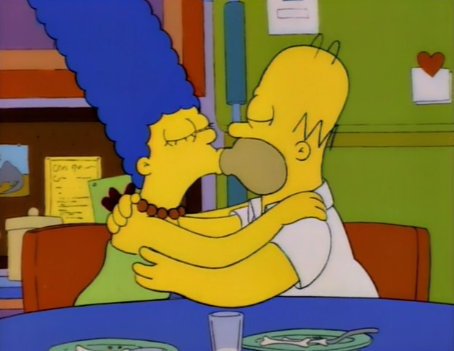
As the title suggests, it’s time for another clip show. The crew may have been harangued by the network into making these, but as we saw in “So It’s Come to This,” clip shows can be done somewhat effectively. I don’t know if they were just rushed with this, or completely exhausted from working on other episodes, but this one felt very vacuous. I’m sure FOX loved it because it was cheap to make, but it’s still pretty thin. Our wrap-around device is Marge talking to the kids about love, and they all proceed to share stories of past potential romances. Marge retells her almost affair in “Life on the Fast Lane,” Homer rebutts with his almost affair in “The Last Temptation of Homer,” Lisa recalls Ralph’s obsession with her in “I Love Lisa,” Bart briefly remembers his devastation at the hands of Laura Powers in “New Kid on the Block,” and Homer effectively wraps things up with remembering he and Marge’s first kiss in “The Way We Was.”

This clip show is odd in that big chunks of it are just abbreviated recaps of those past episodes, except when told in three or four minute intervals, they don’t give you the full emotional impact of the story. I guess with any clip show, half the humor comes from our recollection of these events from past episodes, but it kind of felt wrong re-appropriating the episodes like this. But beyond that, the whole topic of the show feels so wrong, in that Marge and Homer regale their children with stories of how they almost cheated on each other, even worse that Marge went first, and Homer followed her as an almost vindictive one-up. Some of the clip bits were funny, like Homer recalling kissing Flanders and Marge recalling Selma marrying Sideshow Bob, which she immediately back pedals from, but this whole episode just feels totally naught. Even a clip show requires some effort, and this one didn’t seem to get much of any. I’d say it’s the worst clip show, but I harbor a pretty deep loathing toward the much later “Gump Roast,” but we’ll cross that bridge when we get to it.

Tidbits and Quotes
– I remember when I’d watch this episode in syndication, the opening with Marge in bed is so unassuming, where you think it’s a regular episode, then we get to the first clip of Homer in the kiddie pool, and I’d always groan, “This episode again…” For some reason I remember it getting repeated a lot in reruns, but I may just be mis-remembering it.
– Great use of a clip with Homer throwing Marge’s book in the fire from “Dog of Death” with Marge commenting, “I knew we shouldn’t have put a fireplace in the bedroom.” There’s an idea of a clip show, where you try to construct a new episode using mostly old clips, but entirely new dialogue. It could’ve been a neat challenge.
– I like Lisa’s evaluation on the state of romance (“Romance is dead. It was acquired in a hostile takeover by Hallmark and Disney, homogenized, and sold off piece by piece.”)
– Though I really don’t like the context in which they found out, I still like Homer and Marge’s reactions to their respective stories of almost-infidelity. Homer, of course, is dumbfounded (“Marge, I want you to stop seeing the Jacques. You can let him down gently, but over the next couple of months I want you to break it off!”) and I like how Marge is seemingly satisfied that Mindy Simmons apparently hit the bottle pretty hard and lost her job.
– A minor thing that annoyed me was how characters “recalled” stuff in their stories that they were not witness to. Homer’s Mindy story contained the clip of Burns and his flying monkeys, then later his memory also had Marge and Artie’s altercations in his car. They could have cut those bits out, or had Marge recall the latter moment, but I guess they had no problem with it.
– Also, we retell “Lady Bouvier’s Lover,” an episode that at the time had aired only four months earlier? Why bother?

105. Lisa’s Rival

(originally aired September 11, 1994)
Here’s another episode with a fairly simple story and plays out in a very natural way. With not many friends and a hectic home life, all Lisa really has is her reputation at school for being the overachieving brain, a title she holds quite dear to her. Enter Alison Taylor, a girl one year younger then Lisa, but who is smarter, sharper and a better saxophone player. Despite her heightened intelligence and compassion, I like how Lisa has her own foibles. She and Allison could have formed a great friendship right away, but instead she becomes instantly threatened by this girl who has horned in on her territory, seemingly taking away everything that made her feel special. She develops a quiet loathing of this innocent girl; upon witnessing Allison get harassed by some bullying bitches, Lisa laments, “That used to be me in that mud puddle.”

To pad out our Lisa story is some crazy Homer antics, of course, where he ransacks the goods of a jackknifed sugar truck, hoping to sell it off for a profit. This is Homer at his most insane, which fluctuates from hilarious to reminiscent of the Jerkass Homer of later years. His logic regarding his right to take the sugar (“Read your town charter, boy. ‘If foodstuff should touch the ground, said foodstuff shall be turned over to the village idiot.’ Since I don’t see him around… start shoveling!”) and his bulletproof marketing strategy (considering the nails and broken glass within the product as “prizes”) is classic Homer thinking. But on the whole, the scheme just feels so poorly thought out, even for Homer. When Marge urges him to stop, we get another rambling monologue similar to his movie quoting in “Secrets of a Successful Marriage,” only saved in that this one’s a bit funnier and has spectacular animation by David Silverman. Maybe it would make more sense if more time were spent on it… or maybe not. Whatever.

Bart acts at the devil on Lisa’s shoulder to use underhanded tactics to slander Allison, until she eventually breaks and accepts his brother’s help. The ending with the diorama displays, and Lisa living out her own version of The Telltale Heart is very satisfying, and a suitable conclusion to the story. In the end, Lisa and Allison are friends, but since the latter is voiced by guest star Winona Ryder, we know we’ll never hear from her again. This episode is also greatly responsible for popularizing Ralph, as we get two landmark lines from him: “I bent my Wookie” and “My cat’s breath smells like cat food.” The ending of Lisa and Allison walking arms locked with Ralph is very sweet.

Tidbits and Quotes
– The opening sets up how Lisa’s life is her intelligence and her talent, showing the rest of the family a bit perturbed at her playing her sax in the house. Bart ends up botching his prank call to Skinner (“Well, as a matter of fact, my refrigerator wasn’t running. You’ve spared me quite a bit of spoilage: thank you, anonymous young man,”) and Homer destroys Marge’s camera hammering it with a drill (“I’m going to need a bigger drill.”) The best bit is Marge’s daydreams of her ridiculous romance novel, of her in the strong arms of a tanned, muscular fellow of questionable sexuality (Marge asks if the earring in his right ear means he’s a pirate. The man noncommittally responds, “Kinda.”) She’s jolted back to reality by her daughter’s music, giving a great Freudian slip (“Lisa, stop blowing my sex. I mean, stop blowing your sax, your sax!”) I also like the somewhat sad look into her domestic life, in that she admits to sacrificing a perfectly good camera for Homer to destroy in order to get some quiet time.
– Nice brief appearance by Hans Moleman, driver of the sugar truck,. Homer offers to guard his vehicle while he finds a pay phone (“If only this sugar were as sweet as you, sir.”) Once he’s gone, Homer wastes no time to start shoveling (“We’ve hit the jackpot here! White gold, Texas tea … sweetener!”)
– I love Lisa confronting her mother about why she was never moved up a grade, insinuating that she could have been a bit “nicer” to Principal Skinner. The read and timing of Marge’s response is fabulous (“Lisa! …I am nice.”) There’s so many possible reads for this… maybe it’s just my filthy, filthy mind, but I think “nicer” implies “favors.” As said from an eight-year-old girl. Makes perfect sense. Not really. Whatever, the scene’s still hilarious.
– The first act break is hysterical, with the double fake-out and Largo’s seeming self-awareness of it (“Alison got first chair, and believe me, this is not a dream!”)
– Great bit with Bart using a tape recorder to make note of future pranks, then his evil cackle. Then stop. Then record, and finishes off the cackle. I also forgot this episode had the FBI chasing Milhouse, which is one of the best things of the entire series. Milhouse’s “Oh no, not again!” implying this has happened to him multiple times, and then the call-back to him in The Fugitive jumping off the dam (“Aaaaaaaaah!! …my glasses!”)
– Lisa’s daydream assuring there’s no shame in being second best is great, with her in a band with other famous second bananas, who proceed to boo them immediately. Lisa awakes stating the obvious (“Why would they come to our concert just the boo us?”)
– I love the extremely patronizing nature of Allison’s father. When Lisa fails to play along with their complicated anagram game, he dumbs it down a shade and gives her a ball to bounce.
– Homer’s paranoia of sugar thieves surprisingly ends up being valid when he catches a proper British fellow stealing some for his tea (“I nicked it when you let your guard down for that split second, and I’d do it again.”) Also great is his spit take when the sugar pile melts in the rain.
– The dioramas are all great: Nelson’s literal take on The Grapes of Wrath (“Yes, very good wrath,”) Uter’s complete shame of his devouring of his rendition of Charlie and the Chocolate Factory (“I begged you to look at mine first… I begged you!”) And of course, there’s Ralph’s box full of unopened Star Wars action figures (“What’s a diorama?”) Skinner geeks out, and immediately announces him the winner.
– I like how the end really ramps things up to a ridiculous level. It’s pretty clear Allison didn’t make the fake diorama and seems very distraught and shocked at it, but Skinner doesn’t hold back in sternly scolding her about it. Then when the real diorama is revealed, Skinner is completely unmoved. Then we think Lisa may win, but he’s equally as unmoved by her display. Both projects are incredibly detailed and very proficient for frigging second graders, and he gives them such cold dismissals. For some reason, I find Asshole Skinner to be very amusing.

104. Bart of Darkness

(originally aired September 4, 1994)
Our fall premiere takes place in the dead of summer. It’s the second season premiere they’ve done so far set in summer (after “Kamp Krusty”), which must have made first-time watchers wax nostalgic over the recently bygone days. It’s a fairly simple story, but is executed splendidly and contains lots of great character stuff and plenty of jokes. When Bart and Lisa just can’t beat the heat, they pester their father into buying a pool, making the Simpson house a hotspot for the youth of the town to cool off. However, a fall from the treehouse leaves Bart in a leg cast, which turns him into an increasingly nutty hermit locked in his room. The episode gets its mileage out of pool jokes, from the store they buy it from (Pool Sharks, “Where the Buyer is Chum”), everyone’s horrified reactions when Homer actually adds in chlorine, and Homer and Marge’s adult swim, interrupted by a perverted Chief Wiggum.

There’s a neat running story with Lisa in the episode, who is put under the spell of faux friendship because of her pool. One could say it betrays her character a bit, but sometimes it’s neat to see her with a kid mentality, seeing this opportunity to lap up the sweet nectar of popularity and going for it. Particularly great is when her brain acknowledges the fleeting nature of her new stature, she scolds it and proceeds to talk in a dim, drawl-like fashion. Also playing to this story is Martin Prince, who is of somewhat equal mind of wanting to gain popularity. He steals Lisa’s thunder when word gets out that an even bigger push-over has gotten a pool, and they leave her stranded. However, Martin goes mad with his new power, over stuffing his pool and rupturing it, leaving him a lonely, broken boy without a bathing suit.

The allure of social status kept Lisa from comforting Bart, but with that gone, she takes a new vested interest in her brother. But things have taken a turn for the Rear Window when Bart appears to have witnessed Ned Flanders murdering his wife and burying her in the backyard. He sends Lisa next door to investigate, but Flanders returns home early brandishing an axe, leaving Lisa stuck in the house. Even though you know Ned is in no way a killer, there still is some believable suspense, and it’s all such a stupid magnificent mislead; his angry scowl and the way he brandishes the axe, all so he can place it back on the rack of the attic. In the end, Ned is proven innocent; his wife was just away at Bible camp,. As I said, there’s really not much to the story here, but this is one of those episodes that’s a lot of fun to watch unfold, with a lot of laughs and memorable moments.

Tidbits and Quotes
– All the heat wave gags at the beginning are great, ending with Homer’s ingenious plan to camp out in front of the fridge (“I got the idea when I noticed the refrigerator was cold.”) When the motor burns out, Homer goes to plan B (“Marge, can you set the oven to ‘cold’?”)
– Even though I had a pool at my house as a kid, I always wondered if the Pool-Mobile was real. Seems like such a cool idea. I love the animation of the water reacting to Otto hitting the brakes and splashing back into the driver’s seat (“Woah, I gotta replace that window.”) I also like how Martin is introduced early, as is his daring challenge regarding pantsing him (“Take your best shot! I’m wearing seventeen layers!”) Of course, a flurry of kids rip them all off (“I brought this on myself.”) Which of course gets called back at the end; Martin, believing he’s finally made it, only wears one pair, which after the pool explodes, Nelson promptly relieves him of it.
– I like Bart and Lisa’s negotiation tactics with Homer, calm and collected, followed by incessant repetition (a la “Brush with Greatness.”) Homer responds professionally as well (“Let us celebrate our new arrangement with the adding of chocolate to milk.”)
– Not often do I comment on sound effects, but there’s some excellent foley work of the slapping of wet feet in the Simpson kitchen. Real nice attention to detail.
– Great moment with Milhouse, who is quick to ditch his best friend in the middle of signing his cast (we see he’s unconsciously written “Milpool”).
– Stuck in his room, Bart tries to rationalize his position (“What fun can you have in a pool anyway that you can’t have in a bathtub with a garbage bag taped around your cast?”) We then get a fantastic sequence of kids in the pool having the most fun ever, reminiscent of the snow day in “Bart Gets An F.” They do a lavish synchronized swimming routine, ending with Homer in an inner tube floating into the circle of kids and spewing a beer fountain.
– I absolutely love Klassic Krusty, which again raises questions of what kind of an entertainer he really is, as he interviews AFL/CIO chairman George Meany (“Let me be blunt: is there a labor crisis in America today?”)
– The shadow design in Bart’s darkened room is so visually striking, very well done. There’s also great expression work on Bart’s slightly out of focus, twitchy face, especially the blank reaction shot when Lisa pussyfoots around expressing her excitement about being popular.
– Great animation with, upon hearing a woman scream, Bart reaching for the telescope box with his feet and hastily reconstructing it, then deconstructing it, then constructing it again.
– Bart is shocked in witnessing Ned talking to his sons (“He’s going to kill Rod and Todd too. That’s horrible! …in principle.”)
– Martin gazes upon his soon-to-be completed pool (“My plan has come to fruition. Soon I’ll be queen of summertime. Er, king. King!”) The two workmen exchange a puzzled glance.
– I love Bart’s performance reading his twisted play to Lisa, with his attempt to do cockney character voices.
– Great fake-out in the vein of “How To Cook For Forty Humans” when Lisa finds a wrapped container labeled “Human Head”! Actually it’s just “Schuman Farms Head of Lettuce.”
– Gotta love the Springfield Police Department Rescue-Phone (“You have selected regicide. If you know the name of the king or queen being murdered, press one.”)
– Absolutely perfect finale with Martin mournfully singing “Summer Wind,” which plays over the credits.

103. Secrets of a Successful Marriage

(originally aired May 19, 1994)
We haven’t seen a true-blue marriage crisis episode since season 2’s “War of the Simpsons,” which I’m fine with, since I always find them pretty hard to get invested in. As we would see in the many, many future episodes like this to come, most of them involve Homer being stupid and thoughtless to betray Marge and him having to make it up to her in the end. Homer is just barely in his wife’s good graces as it is, and when he screws it up further, he really needs to up the ante in his efforts to make Marge, and us watching, truly believe that he deserves to be taken back. “Homer’s Night Out” in season 1 is a perfect example, though that’s kind of a horse of a different color as Homer’s escapades were rather tame in that outing. Here, Homer’s dumbassery is truly ramped up, acting like a real “Jerkass” if you will. His actions really do go too far, and the payoff of his redemption isn’t nearly as satisfying as the writers may have hoped. In the end, I just don’t buy the two getting back together so quickly, and that’s kind of a fatal flaw.

The episode starts with Homer being hurt at the shocking revelation that he’s a bit slow, so he takes a trip to the adult learning annex. From there, he stumbles into the position as teacher of a class about marriage, which goes nowhere until he inadvertently brings up personal information about Marge. His gossipy class is riveted at these juicy tidbits, and Homer feels proud of himself for being able to captivate an audience. Now, we’ve seen Homer’s personality bounce around a bit this season, but his behavior always seems to make sense for the story. Episodes featuring a more obnoxious Homer like “Homer Goes to College” and “Boy Scoutz N The Hood” at least featured situations that made the way Homer acted make sense. Homer’s initial concern is that he’s none too bright, which then turns into a desire to be looked up to, so he breaks his promise to his wife and continues to reveal intimate details about her, then turns a family dinner into a humiliating class session. As an audience, we should never feel that negatively toward Homer, as his actions should always be innocently misguided, but when act two ends with him being thrown out of the house, he absolutely deserved it.

Act three involves Homer’s descent into madness, living in Bart’s treehouse a filth-ridden mess, pining for Marge to take him back. It’s a truly pathetic sight that seeks to set the groundwork for his great revelation at the finale. Lisa gives her father some advice, to remind Marge of the one thing he can give her that no other man can. In the end, Homer finally figures it out: he can give Marge complete and utter dependence. He needs her to put up with him because he loves her, and has learned that since he can’t even begin to survive on his own, he’ll never betray her again. I get it’s supposed to be half jokey, but something really rubs me the wrong way about this ending. Marge’s marriage/servitude to Homer is already an unspoken sad story throughout the series, but bringing it to the forefront like this, as a joke, doesn’t seem right. Outright saying Marge will put up with all of Homer’s shit because he loves her. I get the message here, and there could have been a way the scene could have really worked, but instead… it doesn’t. There’s some select scenes and jokes that work, but in the end, it’s a flat trouble-in-paradise episode with Homer being way too much of an ass. And this was almost a flawless season, too.

Tidbits and Quotes
– The opening with the card game is a pretty great set-up, perfectly illustrating how slow Homer really is. His dragging contemplation keeps him at Lenny’s well into the night, and when Lenny finds him, he starts his thinking all over again, and Lenny kicks him out. This episode looked pretty strong up until Homer got the teaching job… which really makes no sense. There could’ve been other ways this could have went, like Homer acquiring a new skill or taking an interest in education in a bizarre way. I dunno.
– The other classes at the annex are great: Moe’s gangsta rap self-defense class, which is so well-animated, Lenny’s class on tobacco spitting, who stare at him with such revery, and Hans Moleman’s class on eating an orange (“Just eat the damn orange!”)
– The best scene of the show is seeing Smithers’s past marriage, which starts as Cat on a Hot Tin Roof (with a great performance by Harry Shearer screaming “You leave Mr. Burns out of this!!”), then turns to A Streetcar Named Desire with Burns calling for Smithers. It’s a visually gorgeous black-and-white fantasy.
– I do like how petty and ravenous the class gets about Homer’s gossip. Homer bemoans the failure of his class (“I told Marge this wouldn’t work the other night in bed!”), a comment which Moe quickly twists (“So something wasn’t working in bed, huh?”)
– The scene where Marge first asks Homer to stop gossiping to his class is an example why this episode doesn’t work, where Homer randomly quotes a bunch of famous movie lines in a row. It’s a great performance, but has no business in this scene. You need to maintain that Homer is some kind of a human being reacting to the needs of his wife, but here he’s just completely out of his mind.
– Great line at the start of Homer’s first gossip-less class (“What is a wedding? Well, Webster’s Dictionary describes a wedding as, ‘The process of removing weeds from one’s garden.'”) The class immediately starts to leave. Another great line from Otto (“I can’t believe I paid $10,000 for this course! What the heck was that lab fee for?”)
– Speaking of “War of the Simpsons,” we get a similar bit from there of the Lovejoys convincing Marge should get a divorce. When asked if that’s a sin, Lovejoy sighs while holding a Bible (“Marge, everything is a sin. You ever sat down and read this thing? Technically, we’re not allowed to go to the bathroom.”)
–
Another scene I don’t care for is when Marge is driving and seems to be thinking of Homer’s voice saying he loves her, but it turns out to be Homer in the back seat. The joke completely back fires, and just reads as manipulative and creepy. I’d be even more pissed at him if I were Marge. But the episode’s only get three minutes left so we got to patch them up quick.
– Homer pep-talks his brain to think of something quick or they’ll lose Marge forever. Homer’s brain is on other matters (“Eat the pudding eat the pudding eat the pudding eat the pudding eat the pudding eat the pudding eat the pudding eat the pudding.”) Exactly eight times, mind you. A good friend of mine counted.
– I’m not positive, but this may be the first time Moe’s been shown to have a real shining toward Marge. I love the truly sleazy and manipulative way he tries to get himself into the house and openly admits to horning in on his best friend’s territory. Now, seedy behavior like this makes sense for Moe, but not Homer. I love the tension and dramatic angles when Homer walks in, wondering what’s going on, which sends Moe into panic mode, who smashes through a window and runs away.

Season 5 Final Thoughts
What a season. This show really has changed from its humble beginnings. With David Mirkin in the show runner seat, we’ve seen The Simpsons become a little more wacky. Did I say little? I meant a lot. The series has drifted from its grounded emotional state as was in season 3 and 4, and become more focused on over-the-top jokes and ridiculous bits. This would be catastrophic if not for two things: the stories and characters are continuously engaging, and the jokes are fucking funny. Season 5 is the funniest season by far so far, with more laugh out loud moments than I can even remember, and I just watched the damn episodes. In that season 3 was perfect in that it was full of heartfelt episodes that got you invested in the characters and their plights, season 5 is perfect in that it was consistently hilarious each and every episode. I greatly await this streak to continue in Mirkin’s second run in season 6.

The Best
This is the hardest list I’ve had to choose so far. I got my top five, but I have two amended runner-ups. It’s the best I can do.
“Homer Goes to College,” “Rosebud,” “Treehouse of Horror IV,” “The Last Temptation of Homer,” “Deep Space Homer” (Runner-ups: “Homer and Apu,” “Homer Loves Flanders”)

The Worst
“Secrets of a Successful Marriage.” And they were so close to a golden run.

102. Lady Bouvier’s Lover

(originally aired May 12, 1994)
Marge’s mother was first seen in “Bart vs. Thanksgiving,” a great joke on its own that she’s basically just an older version of Marge with gray hair and a voice so raspy it hurt to talk. Then she was briefly in “Selma’s Choice.” Now she’s the focus of this episode. After this, I can’t remember if we ever saw her again. Maybe in the background at a wedding or church function or something, but she was pretty much abandoned as a character. Why is that? Maybe for the same reason we see Grampa a whole lot more than Patty & Selma, your crazier, more joke-driven characters are easier to get mileage out of than ones who exhibit deeper emotion. Those characters also seem to always be women. But that’s a whole other can of worms; instead of bitch, I will choose to appreciate this episode for what it is: an interesting look at new relationships of those who have one foot in the grave already, seeking companionship for their final days. It’s got a sweet center to it, peppered with jokes, of course.

Jacqueline Bouvier and Abe Simpson kindle an interest in each other at Maggie’s first birthday party, swapping home remedies and waxing nostalgic about the old days. Abe is instantly smitten, Jackie a bit more reserved. I like the multiple dynamics here with their feelings on the relationship, along with Marge’s, who is happy for them but doesn’t want Abe to come on too strong, and Homer’s, who is a bit weirded out at the concept of his father and his mother-in-law dating. At a night out on the dance floor, Abe is cockblocked by Mr. Burns, who is equally smitten by the matron Bouvier, and hastily proposes to her. Jackie surmises that Burns can care for her financially, while Marge is incensed by her mother’s decision due to Burns’s monster-like qualities. Abe makes a dramatic scene at the wedding, and Jackie concludes that she doesn’t want to be with either of them. To Abe, that’s good enough.

There’s really a lot of neat things going on with this story, with Abe’s impulsive nature, the love giving him a bit more vigor and purpose in his old age, and Jackie’s seemingly old-timey passiveness about marrying whoever, or not marrying whoever. I feel like a lot more could have been made of this story, but there seemed to be a need to give it padding with a mini B-story, where Bart gets conned into buying a crappy animation cel (which at least comes to a sort of conclusion thanks to the main story). The main ideas and emotions come through pretty clearly, I was just hoping for a little bit more time with them. There’s also bits of humorous satire, such as Lisa commenting about how their family’s rituals have all come from commercial jingles, like how media has kind of homogenized our individual culture. I found this episode really interesting, with a lot of heart and its share of good jokes.

Tidbits and Quotes
– Classic joke where Homer asks Maggie to point out the monkey, and she points at him. Homer dismisses this until that baby properly points to a credenza when asked.
– We get the second appearance of Gerald, the one eyebrowed baby. I tell yah, that baby is up to no good.
– I love Dan Castellaneta’s incensed read as Abe responding to Jackie’s medical suggestion (“Balsam specific?! While we’re burning money, why don’t we give her a curative galvanic belt too!”) I like the follow-up of Bart mimicking their outdated banter, to which Abe and Jackie retort in unison, “Don’t make fun!”
– The whole first act feels very genuine, with the family sitting around talking about past memories after putting Maggie to bed. Then we get into the great Armor Hot Dogs song, which is half joke, half commercial, complete with Homer walking by at the end holding a “BUY ARMOR HOT DOGS” sign.
– Great quick line from the Crazy Old Man on the senior bus (“Hurry up, hurry! Each Matlock could be our last!”)
– Marge first suggests the idea to Homer of their parents getting together. Homer responds, “Old people don’t need companionship. They need to be isolated and studied so it can be determined what nutrients they have that might be extracted for our personal use.” Marge tells him to stop reading those Ross Perot pamphlets.
– Great bit with Abe getting the wrong woman out of the retirement home, and the perfect timing with Homer rolling up the window, and the woman’s disappointed moan.
–
The B-story with Bart buying the animation cel is good in its own right. It starts with a great home shopping parody, with Troy hosting a segment on the Impulse Buying Network with Roger Meyers, Jr., who’s touts his wares (“I’m proud to offer your viewers these hand-drawn Itchy and Scratchy animation cels. Each one is absolutely, positively, 100% guaranteed to increase in value.”) Then a quick announcer disclaims, “Not a guarantee.” We also get the return of Comic Book Guy when Bart tries to sell it, who is starting to slowly develop into the sarcastic grump we know and love (“No groaning in my store.”) I also love Homer’s impulsive reactions to Bart’s confession: blind anger when he hears Bart used his credit card, then excitement over getting the money (“Three hundred and fifty bucks! Now I can buy seventy transcripts of Nightline!”)
– Wonderful sequence of Homer expressing his fear over he and his wife’s parents getting together (“We’ll be brother and sister! And our kids… they’ll be horrible freaks with pink skin, no overbites, and five fingers on each hand!”) The depiction of Bart, Lisa and Maggie as blonde, blue-eyed Caucasians is intriguing and frightening. I’d love to see a segment of a show, or maybe a fan-animation of an existing sequence, with the characters in that style. It would be mighty freaky.
– Great scene of Homer teaching his father how to play it cool, with smooth jazz music and a color palette change to shades of blue. It’s a neat sequence, coming from nowhere, but still greatly appreciated.
– I like how Smithers is Marge’s parallel as the confidant upset about Burns and Jackie’s relationship; their simultaneous murmurs walking side by side at the wedding is great. Also great is Smithers’s seemingly off-the-cuff love note for Burns to write his new lady (“Darling one, read my words and hear my heart speak of a love soft and undying: a love that will be with you always.”) Burns asks how he came up with that, and a devastated Smithers revealed he wrote it in a card for Burns’s birthday. Also great is his attempt to make Burns look foolish in telling them that Homer and Marge are Fred and Wilma Flintstone.
– We get our second appearance from Luigi, doing basically the same bit as his first appearance (“Hey, Salvatore! Break out the cheap hooch for Mr. No-Tip and the dried-up-ah zombie he’s-ah captured!”)
– Great line from a despondent Abe (“Who needs her? Now I’ll have more time to read things I find on the ground. ‘La… tex… con… do’ …boy, I’d like to live in one of those!”)
– I love at the wedding, only one man is on the groom’s side, an old man with a German WWI helmet on. I want to know more about that guy’s relationship with Burns, his only friend in the world, apparently.
– Of course the ending song is amazing, a great parody of The Sound of Silence. Also great is how Abe sheepishly quiets his ranting after the Gracie Films lady shushes him.