
 (originally aired November 19, 1995)
We’ve learned a lot about the different events and characters of Simpsons past, but there’s one glaring omission: what happened to Homer’s mother? She’s been seen incredibly briefly in maybe two flashbacks, but where is she now? Well, here we learn the answer, in an episode that sheds a lot of light on Homer’s past, has plenty of big laughs, and one of the most emotional endings in all of television. When Homer fakes his own death to get out of work, most townspeople believe that he has actually passed. One such person is Mona Simpson, who shows back up in town to pay respects only to find her son is still alive. Homer is quick to welcome her back into her life, but Marge and Lisa are suspect of her mysterious absence. After some prodding, Mona comes clean about why she left home all those years ago: she was a radical activist protesting against germ warfare in the 60s. During a raid at Mr. Burns’s germ laboratory, she is the only one of her group to be identified and is labeled a criminal, forcing her to leave her family to protect them.
Mona, wonderfully performed by Glenn Close, and her back story seem to reveal a lot about our characters. First, she’s a very smart and mindful woman, quickly developing a rapport with Lisa (“You didn’t dumb it down! You said ‘rapport’!”), who is relieved to find a genetic origin to her intellectual gifts. Going along these lines, you realize how tragic Homer’s upbringing was. He was left to be raised by Abe, who as we’ve seen multiple times, is belligerent, demeaning, and an overall total ass. If Mona had been in Homer’s life growing up, he might have been a smarter, wiser person because of it. The man also has some deep seeded insecurities and damaging because of it, for obvious reasons (a particularly devastating moment when Homer, back to the camera, solemnly asks his wife, “Why did she leave me?”) It’s as relieving to us as it is to him for Mona to reveal her story, and for the two to have a heartfelt reconciliation.
The mother-son reunion is unfortunately cut short when Burns recognizes a disguised Mona and calls in the FBI after her. But thanks to an anonymous tip, Homer and his mother are forewarned and manage to escape. The tip came courtesy of Chief Wiggum; back when he worked security for Burns’s lab, the sabotaged explosion caused by the hippies inadvertently cured him of his asthma, allowing him to enter the police academy. This is fantastic because not only do you get your jokes from young Wiggum (“Listen to me breathe!”), but it also pays off in the plot in a believable way, as Wiggum was present during the investigation and was able to take advantage to help someone who helped him. Before she leaves her son once again, Mona tells him what Homer has probably wanted to hear since the day she left (“Remember, whatever happens, you have a mother, and she is truly proud of you.”) When she’s gone, all Homer can do is sit on his car trunk and gaze up at the stars, perhaps wondering if his mom is doing the same. It’s the most gorgeous single shot in the entire series, and perhaps the most emotional moment period. An absolutely beautiful episode in every respect.
Tidbits and Quotes
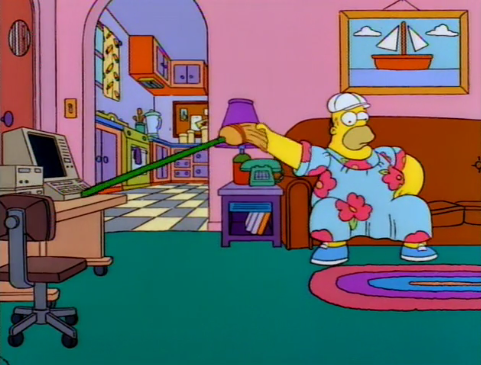
– We start on familiar territory, with power plant employees forced to clean up the highway. Burns hogs all the glory with a phony photo shoot, then heads off to his limo. Lenny bemoans his situation (“I can’t believe I’m spending half my Saturday picking up garbage. I mean, half these bottles aren’t even mine!”) That’s when Homer springs his prank, throwing a dummy version of him down a raging waterfall downstream, eventually getting sucked into a turbine. I love Lenny and Carl’s back-and-forth on how the dummy Homer gets in and out of peril, especially when Lenny posits some friendly beavers will help Homer, but instead they bite him and steal his pants. Also, great animation of the limp dummy Homer falling down rocks, floating pathetically down steam, then him just bobbing up and down until he shoots into the turbine.
– Great moment when Lovejoy and Flanders come to pay their respects to Marge. She of course has no idea what they’re talking about, claiming Homer’s out back in his hammock. But he’s not there (in a glorious shot with great color design). Ned and Maude humor Marge, and when Lisa happily skips by, Lovejoy slips Marge a card for a juvenile counselor.
– The last straw for Marge is when the electrician cuts their power, who seems very compassionate (“Your electricity’s in the name of Homer J. Simpson, deceased. The juice stays off until you get a job or a generator. Oh, and, uh, my deepest sympathies.”) In a great sequence in the dark with just moving eyeballs, Marge demands Homer straighten this situation out.
– I love how belligerent Homer is toward the town records bureaucrat, ranting about inaccurate and secret government files, when the man is more than happy to accommodate Homer’s requests.
– I always found it really shocking that Abe told Homer his mother died while they were at the movies. Like there’s no other delicate way he could have brought that up? Having a phobia of cemeteries, Homer never visited what he thought was his mother’s grave, only to find it’s Walt Whitman’s, which enrages him (“Leaves of Grass my ass!!”)
– I love the various Simpson reactions to Mother Simpson: Lisa’s calm surprise (“It’s like something out of Dickens…or Melrose Place,”) Marge’s nervousness (“I finally have a mother-in-law. No more living vicariously through my girlfriends!”) and Bart looking to make a quick buck for missed birthdays, Christmases and Kwanzaas. Homer is not amused (“I’ll Kwanzaa you!!”)
– Great moment when Lisa brings Bart downstairs to talk about their grandmother’s suspicious behavior, turning on the dryer to conceal their conversation. Bart can’t hear (“What?”) so Lisa turns off the dryer, but Bart still apparently can’t hear (“What?”)
– I love the scene where Marge has to lay the facts out for her husband that he shouldn’t get his hopes up about the woman who abandoned him for twenty-five years. Homer has two rebuttal points: it was twenty-seven years, and she must have had a good reason. Marge asks what that might be, and Homer’s damaged soul comes out (“I guess I was just a horrible son and no mother would want me.”) His upbringing is so, so devastating if you really think about it.
– L’il Homer is so adorable, as is his young mother, swatting away the electrocuting Operation game from him and singing him a bedtime song, the Fig Newton jingle.
– Every 60s story has the turning point for their characters, when they become opened up to a world of rebellion and freedom. Mona’s was Joe Namath’s wild unkempt sideburns. Abe, “stuck in his button-down plastic-fantastic Madison Avenue scene,” is not impressed (“Look at them sideburns! He looks like a girl. Now, Johnny Unitas, there’s a haircut you could set your watch to!”) I still use that expression, “that’s a [blank] you can set your watch to.”
– I love Dan Castellaneta’s frenzied hippie character right before they set off the bomb (“When this baby goes off, Burns’s lab is going to be history, man! Germ history! Oh man, I got the munchies.”)
– Only to make Mona even more sympathetic, she’s made a fugitive because she’s the only one of her group to go back to help a trampled Burns out of concern.
– Burns attempts to utilize the post office (“Yes, I’d like to send this letter to the Prussian consulate in Siam by aeromail. Am I too late for the 4:30 autogyro?”) but the squeaky voiced teller has trouble consulting his manual (“This book must be out of date: I don’t see ‘Prussia,’ ‘Siam,’ or ‘autogyro.'”)
– I love the aspects of Burns’s investigation: his outdated usage of phrenology, the cab driver and gravedigger’s back-and-forth “I saw/seen her! That is to say, I seen/saw her,” and Wiggum’s brilliant reading of Homer J. Simpson upside-down (“Put out an APB on a Uosdwis R. Dewoh. Uh, better start with Greektown.”) To top it off, he was actually talking into his wallet.
– I love Abe’s reaction to seeing his long-lost wife for the first time in decades (“Now here’s a piece of bad news!”) After a heated spat and chewing her out (“You were a rotten wife, and I’ll never ever forgive you!”), we get a brief beat, and then… “Can we have sex? Please?” When he’s instantly shot down, he cuts his losses (“Well, I tried! What’s for supper?”)
– Great quick joke with Bart, wearing a tye-dye shirt, acting like a hippie for his grandma, spouting 60s catchphrases, not even knowing what they really mean, or that some don’t fit the hippie lifestyle at all (“Peace man! Groovy! Bomb Vietnam! Four more years! Up with people!”)
– Hilarious moment when Homer proposes Mona move in with Abe, and the entire family has a heartily laugh, Abe included (“Oh, I’m a living joke.”) Unbeknownst to them, Burns and the FBI are outside. Burns intends the relish the moment, playing “Ride of the Valkyries,” which is cut short by ABBA. Smithers sheepishly admits he taped over it. When the house is rushed, Abe comes clean (“All right, I admit it: I am the Lindbergh baby. Waah! Waah! Goo goo. I miss my fly-fly dada.”) Joe Friday asks if he’s creating a distraction, or if he’s just senile. Abe responds, “A little from column A, and a little from column B!”
– We get two great jokes at the end amidst the emotional tour-de-force: the hippie driver (“Hurry up, man. This electric van only has twenty minutes of juice left!”) and a really sweet joke, where Mona assures Homer she’ll never forget him, that he’ll always be a part of her. She turns and hits her head on the door frame, exclaiming “D’oh!” She’s still a Simpson, after all.


 Me Blog Write Good