694. A Springfield Summer Christmas for Christmas

Original airdate: December 13, 2020

The premise: A “Heartmark” film producer is called to Springfield to assist in the filming of their new Christmas movie, where she instantly clashes with their small town ways, particularly with Skinner, but the two slowly start to fall for each other.

The reaction: So, I have to watch a lot of different shows and movies for my job, and one of our recurring clients is Hallmark. As such, I have seen a lot of Hallmark movies, including their never-ending supply of Christmas movies. One might think that doing a parody of a Hallmark movie is way too easy a target, but in all honesty, having seen them, it’s an impossible task. I don’t know if there’s a way you could parody them. They are so vacuous and paint-by-numbers, they’re basically already parodies of themselves. But despite that, this episode is basically trying to be one big Hallmark movie parody, but it basically ends up becoming just another Hallmark movie story, albeit with a meta twist. Big city, no-nonsense film producer Mary Tannenbaum (get it?), played by Ellie Kemper, is our focal character for most of the running time. To secure her promotion to head of the network, she must supervise the shoot of a new Christmas movie in Springfield. She’s dreading this, having a clear aversion to Christmas movies, something that predictably will be revealed as to why later in the episode. Mary is written like the one of two basic types of protagonists in Hallmark movies: the working woman from the big city who needs to learn to slow down and appreciate the simple things, preferably from a small town she’s stuck in and with a handsome country boy who can bring her down to Earth. In this episode, that role is filled by Skinner of all people, who butts heads with Mary instantly, as her filming is standing to interfere with Springfield’s annual Lettuce and Tomato festival. The story beats predictably go from here: the two agree to help each other out, grow more fond of each other, they have a brief falling out, Mary’s fiance gets into the picture, yadda yadda yadda… The entire town turns on Mary when her negative view on small towns is exposed, but she later admits a change of heart. After that, the whole town comes together to decorate the town square for their big shoot, including Skinner. It’s just like something out of a Hallmark movie! Because it is. Yes, there’s the meta aspect of them actually shooting a Hallmark movie, complete with the director talking about how pointless and disposable they are, and Mary has her share of self-conscious lines (“Christmas movies are the best movies, because everything always works out, no matter how contrived,”) but everything about the episode itself is playing out all the tropes of these movies completely straight. Like I said, it’s basically just like watching a terrible facsimile of a Hallmark movie, with no significant twist or subversion to it to make it interesting or entertaining. Parodying such a softball target in a unique or significant way is possible, even with the meta movie-within-a-movie angle, but per usual, the show chooses to go with the easiest, blandest route possible. What a shocker.

Three items of note:
– I know I already mentioned it at the start of the season, but man oh man does Julie Kavner sound bad. Her screaming at Homer to take Mary’s bags at the start made me incredibly sad. I have to assume that Kavner is in no pain while recording, and that the producers make sure their talent isn’t being pushed too hard, but this poor woman sounds like her voice is going to give out at any moment. They certainly aren’t going to recast Marge, but it’s getting to the point that it doesn’t even sound remotely like Marge anymore.
– Through the whole episode, we’ve been waiting for the explanation as to why Mary hates Christmas movies (both act one and two end with her grumbling, “It just had to be a Christmas movie…”) She finally spills the beans to Marge: her father was killed on set as an extra for Jingle All the Way. Yawn. Maybe this feels especially lame since I just watched Gremlins, where Phoebe Cates’ story about her dead father feels much more shocking and impactful. Also, if Mary’s father died while filming a movie, why on Earth would she want to be in the entertainment business? She calls it her dream job, but wouldn’t she want nothing to do with a company whose crown jewel are their Christmas movies? This aspect could have been highlighted as ironic, but instead, they do nothing with it. Again, what a shocker.
– So this episode is basically just a condensed Hallmark movie, but there are some details they get wrong. First, Hallmark movies are 100% sexless. Everything is building up to the completely chaste kiss at the very end, and leading up to that, there is absolutely nothing sensual or titillating at all, no intimacy, no discussion of attraction, nothing. The episode mentions this, with the director enforcing a closed-mouth kiss between the leads, but between Skinner and Mary, there’s a bizarre cheesecake shot where Skinner pours water on himself, revealing his muscular physique and Mary gets turned on a bit, and that would NEVER happen in a Hallmark production. Later, Mary mentions how she can’t wait to get back to the big city, her surgeon fiancé and her gay best friend. The gay best friend is a common trope of romantic comedies, but in Hallmark World, homosexuality does not exist. I think they might have broken the mold this year by having one gay minor character, but normally their movies feel completely lost in time (which I guess is part of their appeal). They actually use the black best friend trope a lot, which felt played out in most media by the end of the 90s. I wish I didn’t know so much about this shit, but if this show is gonna take on Hallmark, they should do it right. Maybe the reality of a grungy Springfield could have clashed with the saccharine, whitewashed world of a Hallmark story. Instead, all the Springfielders are cast in the small townie roles of the story, congenial faceless nobodies who all joke around at the local diner and obediently save the day at the end. Absolute yawn.

Season Six Revisited (Part Three)


13. And Maggie Makes Three

  • Seeing Homer and the kids watch “Knight Boat,” the Knight Rider parody, reminds me how this show really was on at the right time. So many classic movies and TV shows were television rerun mainstays, so this series could lampoon pretty much anything they wanted and it would still be somewhat in the public consciousness. Nowadays, new movies or shows that seem like cultural touchstones get forgotten about in a week because of how much shit there is. But regardless if you know what Knight Rider is (outside of the basic premise, I sure don’t), the parody is still funny. You get enough of the basics of what the show is that Lisa pointing out the absurdity of it is still understandable (“Every week, there’s a canal!”)
  • I love the beginning of Homer’s flashback story turning into an action movie where he saves the plant from terrorists. Considering this is now the fifth flashback episode, I like that they’re toying with the format, having fun with an unreliable narrator. This also comes into play at the start of the third act when Bart makes Homer’s head explode, and Marge forces Homer to restore himself to his actual weight.
  • “Oh, I should be resisting this, but I’m paralyzed with rage! And island rhythms!”
  • Homer literally burning his bridge at his old job now that he’s officially out of debt is absurdly hilarious, but it actually isn’t as absurd as a lot of his other crazy impulsive actions we’d later see. He’s budgeted for this in advance (but only for four family members), and him going to work his dream job at the bowling alley feels a lot like his carefree life working at the mini golf course. Homer is a man child who doesn’t aspire to much out of life, so it almost feels like him attempting to return to his old life now that his adult obligations are seemingly taken care of, but of course, fate intervenes. This is also the only instance where we see that Barney’s Bowl-O-Rama is actually named after Barney, a seemingly sweet gesture by his uncle Al, the owner (that sweetness seems to have soured as of late, considering he fires Barney and gives Homer his job.)
  • Bart running off to angrily punch the wall when Homer tells them they won’t buy any more fancy quilted toilet paper is one of those ridiculous random gags that always makes me laugh.
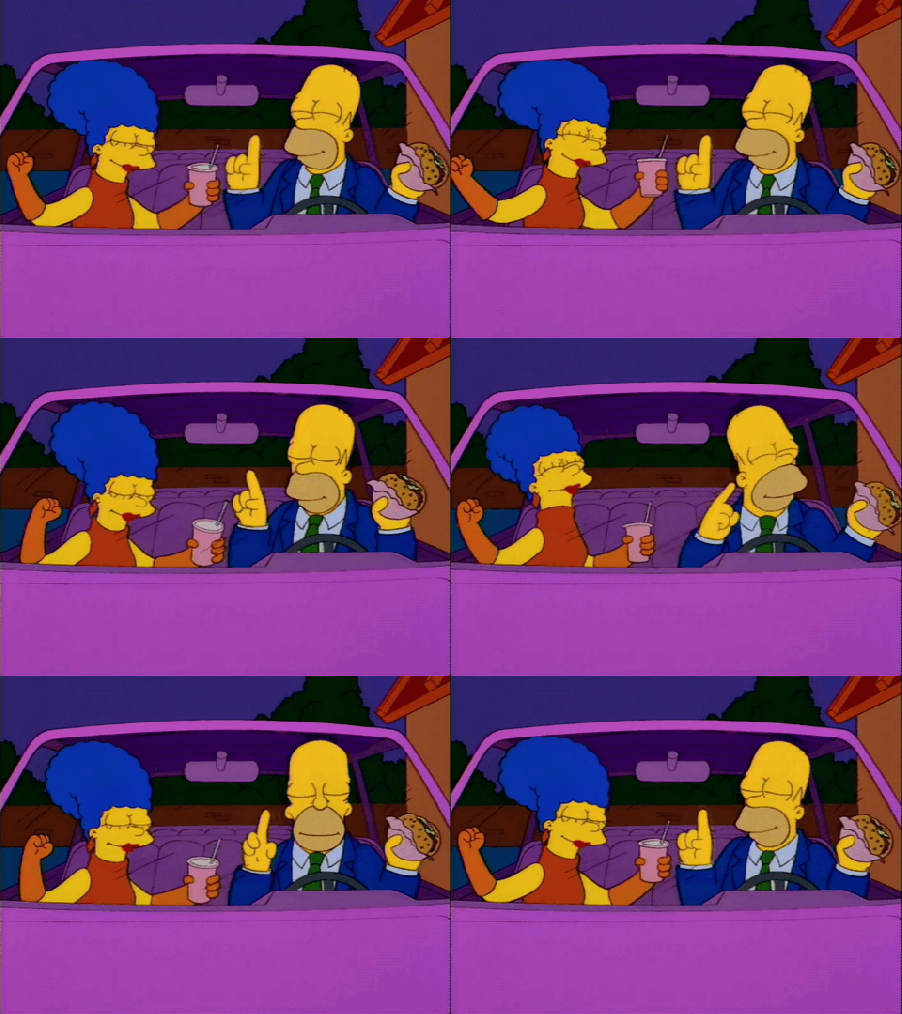
  • Homer and Marge going out for “dinner and dancing,” meaning grooving to the radio in their car at the drive thru, is probably my favorite Homer-Marge moment of the whole series. I love when we see that Marge is a woman of simple pleasures to a degree just like her husband, and that’s why the two fell for each other in the first place. It’s just so sweet.
  • The bowling pin gag where all pins are discarded into a giant pile out back after being used once, and gigantic logs are whittled down to create one new pin each is so wonderfully dumb. I also love Alf Clausen’s orchestration of the classic “Powerhouse” music.
  • Patty and Selma using the phone book to spread gossip is a perfect classic Simpsons gag. Even knowing the twist is coming, I still laugh every time (“Aaronson and Zykowski are the two biggest gossips in town. In an hour, everyone will know.”)
  • Homer’s complete ignorance of people congratulating him about Marge being pregnant is really perfectly executed. There’s been lots of moments in the history of this show where Homer is just way too stupid for a gag, but in this case, it’s contextually funny, almost like his subconscious is putting up blinders, like nothing is going to interrupt his new perfect life, no matter how on-the-nose the commentary gets (“Hey, Homer! Way to get Marge pregnant.” “This is getting very abstract, but thank you! I do enjoy working at the bowling alley!”
  • Ruth Powers being at the baby shower is one of those amusing timeline accidents, like when we see Santa’s Little Helper in “Homer’s Barbershop Quartet.” We also see Homer and Marge in the Simpson house when he finds out she’s pregnant with Bart, which they hadn’t bought yet, but for the sake of the joke, it really isn’t a big deal.
  • I don’t know how controversial this will be, but I’m not crazy about the ending. Homer’s misery washing away with just one look at his new baby girl, that I love, it’s a very sweet finale to the episode, with Homer finding joy in his adult life through his children. But the “Do It For Her” plaque always rings slightly hollow for me because of all the jokes made before and after this episode where Homer forgets Maggie even exists. Hell, there’s even a joke in this episode where he almost sits on her. The ending is kinda sweet, but it doesn’t hit as hard for me as Homer relating to Bart or Lisa or Marge. I wouldn’t even put it in a top 10 sweetest moments list. Homer sheepishly waving hello to the newly born Maggie and him gushing about her is a much more emotional moment to me than the last shot.
  • Simpsons Archive retro review: “First they did a great flashback episode about Homer and Marge meeting; then a very good one about Bart as an infant; then a fairly good one about Lisa as an infant; now a truly awful one about Maggie as an infant. I’m going to start a collection so the writers can BUY an original damn idea! GRADE: F.”

14. Bart’s Comet

  • Big Butt Skinner might be Bart’s finest prank, the perfect blend of ingenuity and immaturity. I love how much anguish it causes to Skinner over the course of the first act, when his plea for the kids to chuck rocks to pop it ends up getting his car pelted, being humiliated over the phone as the astronomers find it on their telescope (“No, there’s no need to do that. It’s already named after me,”) to the act break where he catches it but ends up letting it go in anguish after Bart accomplishes in one minute what he attempted for countless nights. Act one is probably the greatest depiction of the Bart/Skinner dynamic, with Bart as the rambunctious, savvy prankster, while Skinner tries his best to exert authority, but it never pans out the way he hopes.
  • The fighter pilot scene where they end up blowing each other’s planes up is an absolutely ludicrous commentary nowadays (“This is what happens when you cut money out of the military and put it into health care!”) Jesus Christ, can you even remember a time where you could call the defense budget underfunded, let alone in exchange for government health care? What a “horrible” thing to make fun of!
  • Skinner’s silent rage towards Principal Kahoutek as the ominous clouds blot out the moon is so fantastic, as is when his tone quickly shifts back to normal and the clouds quickly dissipate. Skinner is pretty brutal (“I got back at him, though. Him and that little boy of his.”) What exactly did he do? Once again, I like Skinner a lot more when he’s got some balls. Him getting angry at Chalmers and attacking him in “The Road to Cincinnati,” a scene stuck in an ultimately disappointing episode, was a very welcome display for Skinner.
  • I love the moment after Marge tells Bart she’s proud of him, he retorts with, “But then, you’ve always been proud of me,” causing Marge to pause and stammer out a yes. It’s great because it’s obvious that Bart is just messing with his mother like a kid would.
  • They’re pretty much one-scene wonders, but I still love the Super Friends, the biggest dorks ever to be animated. I like that Lisa is among their ranks, but her expression reads like she’s much more self-aware then they are. She’s barely got friends as it is, so she figures why not sit with her fellow mega-geeks. Also, Martin is conspicuously absent from the group. Given his standoffish attitude, I can imagine that he and the Super Friends have a silent rivalry going on. Martin versus the Super Friends is a new episode I’d love to see, although with a Grey DeLisle-voiced Martin, I’d be slightly less interested. Also the script would almost certainly be shit, so that too.
  • You kind of need to just go along with it for the purpose of the story, but Springfield has only one bridge out of town? What are they, on an island? It’s worth it for the scene where Arnie Pye is reporting on the cars flying off the destroyed bridge, effectively doing a mass suicide (“It’s a silent testament to the never-give-up and never-think-things-out spirit of our citizens!”)
  • The Congress vote on saving Springfield is a classic scene, where the bill ends up getting saddled with an additional rider: $30 million of taxpayer money to support the perverted arts (“All in favor of the amended Springfield-slash-pervert bill?”) The bill is killed unanimously, prompting Kent Brockman to give one of the greatest quotes of the whole series (“I’ve said it before and I’ll say it again: democracy simply doesn’t work.”)
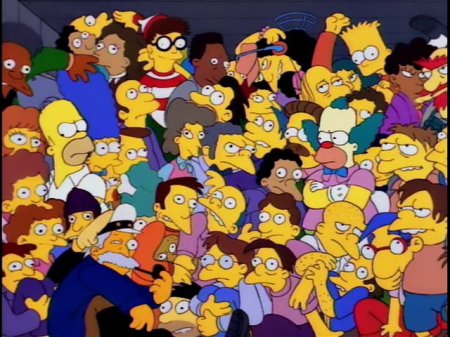
  • What a wonderful display of all of our lovable characters. They even stuck Waldo in there. I also love Nelson having Milhouse in a headlock.
  • Todd Flanders loading a shotgun intended for his father while crying is a wonderfully dark moment.
  • Homer teeters towards asshole territory by vehemently demanding Ned’s expulsion from the shelter, but he immediately makes up for it by leaving after him when his conscience gets the better of him. I like how that leads to Springfield solidarity in everybody following suit (“Hey, Homer, wait up, I wanna die too!”) The people of Springfield are selfish and moronic, but they do have a sense of town pride, with just a smidgen of familial unity, as the ending of this episode nicely displays.
  • Simpsons Archive retro review: “What the hell? I seem to remember when Simpsons episodes had plots which related to rather than hopelessly contorting real life. This continued in the recent trend of episodes being little more than jokes barely strung together by a thin, unbelievable plot.”

15. Homie the Clown

  • The opening of this episode is just fabulous, rapid-fire showing Krusty’s spend-happy lifestyle, completely ignoring any panicked statements from his accountant (”I don’t want to hear the endings of any sentences!”)
  • “Gambling is the finest thing a person can do, if he’s good at it!”
  • I love Homer’s excitement over new billboard day, especially considering how clear it is that he’s excited that they’re all food-related (scoffing at Krusty’s billboard, “Clown college? You can’t eat that!”) In the next scene we see he’s got all his new foodstuffs out on his work console, but the power of advertising proves to be incredibly intense as the clown college continues to worm into his brain.
  • Marge’s “I think I’ll have some wine” while the family stares at Homer sculpting his mashed potatoes always makes me laugh.
  • I like how the story of this episode is kind of a big in-joke reference to the long abandoned idea that Krusty was secretly Homer in disguise, the irony being that Bart reveres this famous TV clown, yet has no respect for his father. I assume this idea was abandoned around the same time as the intended reveal that Marge was a Life in Hell rabbit. I love that despite being in full costume, Homer is still easily identified by his single two hairs on top of his head instead of a small tuft of hair like Krusty’s, but nobody else seems to notice or care.
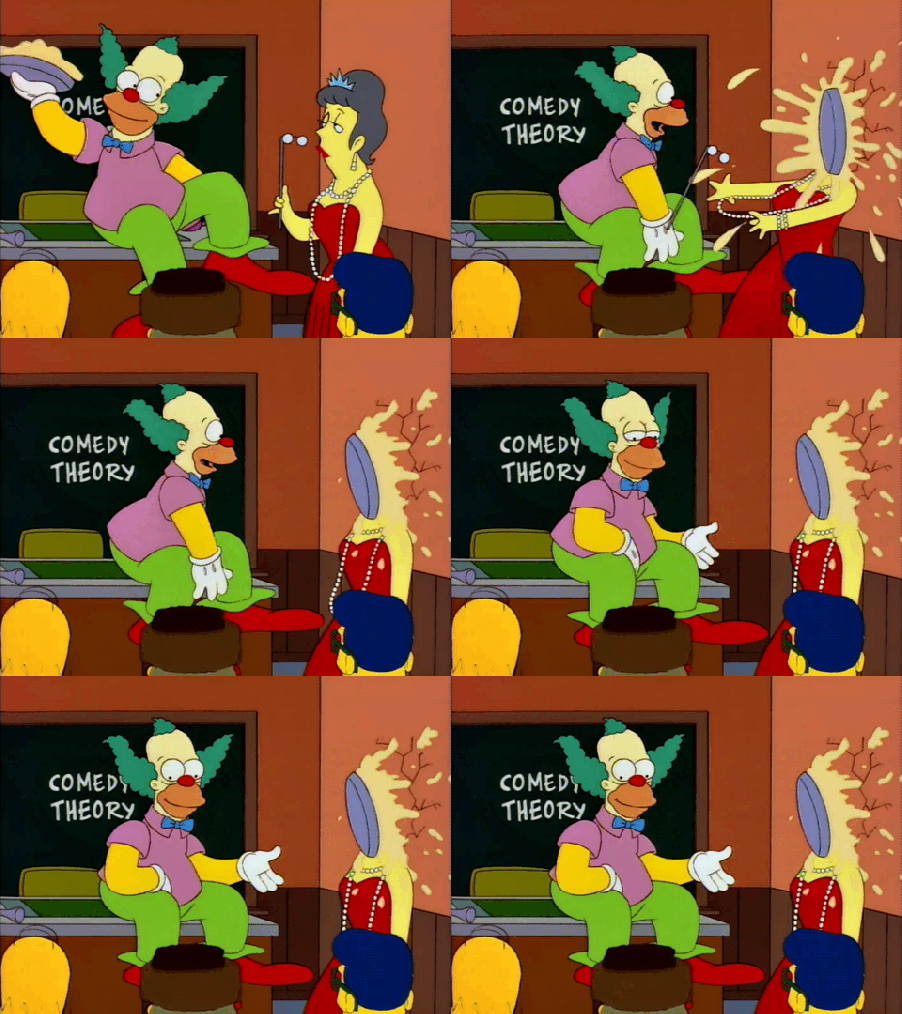
  • I love how brutal this pie-to-the-face looks, that the wealthy dowager’s head just imbeds itself into the wall. How is she not dead after this?
  • I like how most of act two is just Homer getting more and more degraded as a Krusty performer, to the point where he’s at a kid’s birthday party getting shit thrown at him as he weakly dances about. And the lowest of the low, he’s subjected to Kirk Van Houten bossing him around.
  • I really don’t know much of anything about Dick Cavett other than he had a talk show, but he’s got to be one of the most brutal celebrity appearances (“I’d just like to say, I know Woody Allen,” followed by the most tepid applause.) I miss the days when celebrities came on the show to get the rug ripped out from under them, not get their asses kissed (“Your churlish attitude reminds me of a time I was having dinner with Groucho…” “Look, you’re going to be having dinner with Groucho tonight if you don’t beat it!”)
  • Krusty betting against the Harlem Globetrotters is so funny. Watching a high stakes bet over a basketball game also reminded me of Uncut Gems, which is also a positive.
  • I’m sure there’s Rule 34 of post-plastic surgery busty Krusty, and no, I don’t want to see any links confirming that.
  • More wonderful cartoon brutality in Ned getting shot twice by Legs. The combination of the bullet impact, Ned’s yell and the speed of the animation of him falling to the floor just makes it feel really intense.
  • I like that Homer is quick to throw Barney under the bus to save his skin, after admitting his own identity to the mob didn’t work. Also, Barney is apparently kind of a big sleaze himself, taking pictures of Legs’ sister. I guess I can buy that.
  • What a great character Don Vittorio is. A self-professed Italian stereotype, yes, but Dan Castellaneta’s performance is so earnest, he makes even a character arriving this late into the third act feel incredibly notable. He even got his own action figure, for Pete’s sake! I love how tickled he is by Krusty’s antics, and conversely, how offended he is when Homer/Krusty botches his act (“The fact that you did not do the trick well is the biggest insult of all!”)
  • It’s a simple shot, but I love the POV of Homer failing to do the loop.
  • It’s pretty sweet that after Homer messes up Krusty by covering his eyes riding the trike, he redeems himself, and his clowning education, by swallowing the tricycle at the end and ringing the bell. It’s so stupid, but it feels like a triumphant moment for him.
  • Simpsons Archive retro review: “Another Swartzwelder disappointment. Fat Tony’s return seemed so promising, but the plot was contrived. Homer becomes a clown? Come off it. I guess fresh ideas are hard to come up with after a while. Grade: D.”

16. Bart vs. Australia

  • Everybody learned about the Coriolis effect from this episode, right? And then at one point tried to test it out themselves? This show really taught me a lot of things.
  • The first act is the perfect representation of showing Lisa as smart, but not smug. She just knows a lot because she’s intelligent, and definitely feels some sense of superiority over Bart in particular, but never in a smarmy way. She stops short of mentioning the equator on the globe, in favor of “this line,” in both a helpful and condescending way. Then she messes with her brother about the far-off land of Rand McNally (“They wear hats on their feet and hamburgers eat people!”)
  • The gag of an elderly Hitler still being alive feels like one of the most bizarre jokes ever done on this show.
  • Homer’s brain reasoning with himself about something he may or may not have forgotten definitely rings truer to me having a terrible memory married to a woman who remembers everything (“Quiet, it might be you! I can’t remember.” “Naw, I’m going to ask Marge.” “No, no! Why embarrass us both? Just write a check and I’ll release some more endorphins.”)
  • Hank Azaria as Bruno, Tobias’ father, is one of those incredibly loud and boisterous voices that is just so high volume, you can hear the sound bouncing off the recording studio. It’s fantastic.
  • Evan Conover (Undersecretary for International Protocol: Brat and Punk Division) is hands-down Phil Hartman’s greatest one-off role. All of his characters are congenial-presenting shysters, so his voice is basically tailor made for a government official. 
  • The skeleton who attempted to dig his way out of his own coffin is a pretty dark visual gag.
  • I like how Bart releases his bullfrog at the airport as a means to not spread any more mischief (“I don’t want to get into any more trouble down here. I’ll pick you up on the way home.”) The frog of course escapes into the wild immediately, providing an amusing through-line of the bullfrogs multiplying rapidly, wreaking havoc on the continent.
  • The toilet at the US Embassy may be one of the greatest jokes of the entire series, at least conceptually. A shining example of useless government spending and American’s sense of superiority, all for a toilet to flush the “correct American way,” something most people won’t even realize.
  • Given the enormous statue at the Cultural Center, I guess Snake must have some Australian ancestors.
  • Have I mentioned Dankmus recently? Anyway, C-O-B-E is another bangin’ track.
  • One of the biggest laughs I’ve gotten during this whole rewatch is after Marge gives her impassioned speech on the phone with the Aussies (“I think we can all agree, there’s no substitute for the discipline of a loving parent.”) She confidently hands the phone back to Conover, who continues (“…so we’re in agreement. She won’t be allowed near the phone again.”) So fucking funny. One of the best jokes just spitting in the face of narrative tropes.
  • This really ends up being a great character study of Bart by the end, of this mischievous, unflappable kid who clearly can see the absurdity of the whole situation, so his own recourse is to mock it mercilessly and moon an entire country. That climax really is one of the show’s greatest individual moments.
  • Simpsons Archive retro review: “Ouch, that was the single worst Simpsons I’ve ever seen. It was hard to figure out what the hell it was trying to say, I mean if I want to here about caning or ecosystems I’ll read Newsweek.”

17. Homer vs. Patty and Selma

  • Gotta love Homer’s wallet full of singed bills. I also love his annoyed face when Barney guesses his investment is in pumpkins, so much so I made it my profile picture.
  • I’m sure Marge has a difficult enough time trying to save face about Homer in front of her sisters, and I love that Homer, in his pettiness, is no help at all. When Marge tries to explain to Patty and Selma that her husband is a very complicated man, he immediately hangs his head out the bedroom window, smashes a plate on his head, and yells, “Wrong!” Just great.
  • I love Homer’s dream about the mysterious invention that could make him rich, if he only knew what it was (“Why would you need to see it? You’re the genius that invented the… product in question.”) It looks like some kind of metal ball with weird little gizmos sticking out of it. What could it be?
  • Who could forget dear Rat Boy?
  • We get an incredibly rare moment with Bart’s seldom-seen chums Lewis and Richard fighting for slots at P.E. Sign-Up Day (“This gets uglier every year! Any sign of Bart and Milhouse?” “No, and if they don’t get here soon, it’ll be T.S. for them!”)
  • Homer’s frozen grin after Patty & Selma show up is so damn funny. He’s just stewing in his own juices in that armchair.
  • Susan Sarandon as the ballet teacher is another underrated guest character. Maybe not as unsung as a Brad Goodman, but she’s got some good lines (“So many of your heroes wear tights. Batman, for example, and… Magellan.”)
  • “You can’t spell ‘obsequious’ without ‘I.O.U.” “I’ll have to trust you on that.” Yet another word I learned from this show, although I don’t know if I’ve ever actually used it.
  • “Is this projection accurate?” is probably in my top three favorite Marge lines. The way that she delivers such a specifically worded question as earnestly if she had just said, “Is this true?” is just so funny to me.
  • Seeing Bart become incredibly proficient at ballet so quickly reminded me of modern episodes where in no time flat he becomes an expert drummer, cartoon director, and so forth. But the difference here is that the point of the subplot isn’t him becoming an amazing dancer, it’s his apprehension and fear about being a boy who likes dance. The subplot ends in true Simpsons fashion where the bullies are won over by the mysterious masked boy’s performance, prompting Bart feels brave enough to reveal himself, but he is chased out of the school anyway. Nelson’s “As long as he’s hurt” always makes me laugh, and I sometimes forget the additional scene with Lisa, which is cut in syndication, but that’s just as great a moment.
  • In terms of classic era guest appearances, Mel Brooks skews the closest in terms of just being there to be fawned over, but the show smartly channels that reverence coming out of Homer’s mouth, showering Brooks with dubious compliments (“I love that movie, Young Frankenstein. Scared the hell out of me!”) and goading him into re-enacting his famous comedy routines, except getting them wrong or performing them awkwardly. Chief Wiggum showing up compounds this, only annoying Brooks further.
  • I like that the ending kind of sneaks up on you, where Marge talks about how difficult the strife between her husband and her sisters is on her, leading Homer to make a great sacrifice: actually doing something nice for Patty & Selma. Marge finally having an example to show what a caring man Homer is and Patty and Selma sincerely apologizing is a very sweet conclusion.
  • Simpsons Archive retro review: “I had a dumbfounded Krusty-like expression on my face after this episode was over. I’m not advocating a homogenized goulash of writers where no one has a distinctive identity, but I would like to see the consistent level of intelligence and humor that was present the last two seasons.”

18. A Star is Burns

  • Regarding this episode’s controversial production, where Matt Groening removed his on-screen credit out of protest, I wonder if there was ever any bad blood between him, Al Jean and Mike Reiss. I assume Groening went back home to his solid gold mansion and rested on his giant pile of money and got over it fairly quickly. Anyway, I remember asking my mom who Jay Sherman was when I was a kid, thinking he was yet another celebrity playing himself. It wasn’t until later when I saw reruns of The Critic airing late at night on Comedy Central that I realized that he was from a whole other show. I actually rewatched The Critic recently, and it mostly holds up. It definitely feels like an extension of season 3 and 4 Simpsons in terms of its isolated cutaway jokes, but almost to its detriment at times. There’s a lot of great gags in the series, but sometimes at the expense of the audience really caring about the story or the characters. It’s tough to care about Jay when every other scene he’s doing a jokey celebrity impression or is dropped into a movie reference. There’s not a ton of room for actual character work. The second season definitely tried to remedy this, rendering Jay more relatable and crafting better stories that feel a bit more grounded, but as the season only had nine episodes and a clip show, the series died before it could really improve itself any further. It’s still definitely worth a watch, but it felt a little more rickety than I remembered it.
  • Krusty as FDR always makes me laugh. Him absent-mindedly getting up out of the wheelchair is a big faux pas, but him still covered in clown makeup wasn’t an issue?
  • “The easiest way to be popular is to leech off the popularity of others.” An ethos that modern Simpsons has put into practice many a time…
  • Todd’s screaming down the river bend getting cut off by the trees in the foreground is one of those stupid jokes that I really, really love.
  • “Bart Simpson, meet Jay Sherman, the Critic!” You could argue about the artistic integrity of a crossover made to help promote another show, but this episode really doesn’t feel any less like an episode of The Simpsons to me. Jay Sherman is like a celebrity guest star (hence my confusion as a child) and the town holding a local film festival doesn’t sound too alien of a premise for this show. Also, the two series share so much DNA in regards to their sense of humor. Homer and Jay’s stomachs growling at each other feels kind of like a Critic gag, but it doesn’t feel out of place on this show at all.
  • “I’m afraid we have a bad image, sir. Market research shows people see you as something of an ogre.” “I ought to club them and eat their bones!”
  • I love Homer’s prized belching contest trophy is just a big wide-open mouth on a stand. Great design.
  • “Man Getting Hit By Football” and Homer laughing at it is one of those early wav files I remember downloading on the computer. I think I had it as my PC start-up sound for a while, even though it was like a minute long.
  • I like that despite being rejected by Burns, Bumblebee Man still gets a prominent role in his movie, presumably as Senor Spielbergo’s special request.
  • “How can you vote for Burns’ movie?” “Let’s just say it moved me…TO A BIGGER HOUSE! Oops, I said the quiet part loud and the loud part quiet..”
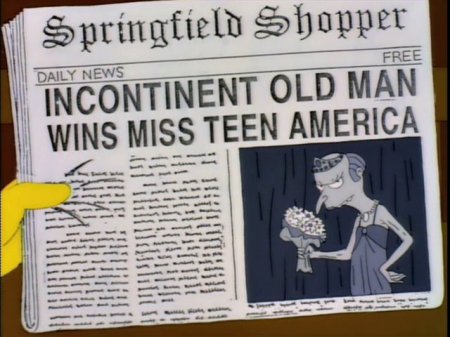
  • Another great newspaper headline.
  • Why exactly was an Itchy & Scratchy cartoon produced by a major studio eligible for an amateaur film festival? Who cares?
  • The story of how Hans Moleman’s short film was optioned by Hollywood, produced and went on to win an Academy Award definitely feels like a movie in and of itself. It could be the follow-up to Mank!
  • Simpsons Archive retro review: “Let’s face it: sooner or later, with the Simpsons so popular, the show will be destroyed by the very system and facet of society that it has made its reputation criticizing. This shameless, blatant promotion of ‘The Critic’ could well be the narrow end of the wedge for that.”

693. Sorry Not Sorry

Original airdate: December 6, 2020

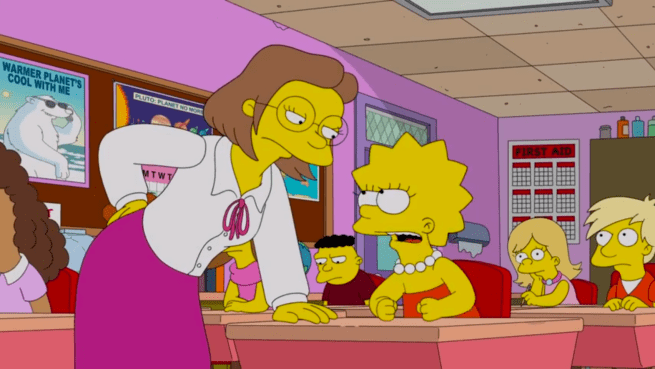
The premise: When Miss Hoover gives Lisa a B-minus on her report, Lisa calls her a hack, landing her in detention. Miss Hoover proceeds to continue giving her detention unless she apologizes, but Lisa won’t budge.

The reaction: Of all the side characters I’d be interested in seeing a whole episode about, Miss Hoover would probably be towards the bottom of my list. Unlike Mrs. Krabappel, Miss Hoover functions perfectly as the perfect foil to Lisa. What cruel misfortune that a gifted and impassioned young student would get stuck with a teacher who couldn’t care less about her job. Could a Miss Hoover episode be interesting? Sure, I guess so. But unlike “The Road to Cincinnati,” this isn’t even that, it’s another boring as hell Lisa storyline. Lisa creates an elaborate model for her report, dreaming that it’ll be the lynch pin that gets her into Yale, but she is aghast that Miss Hoover gives the entire class B-minuses across the board because it’s easier. She also has a back injury so she’s laid up on a mat in the classroom, a detail that doesn’t really matter at all to the episode. Enraged, Lisa lays into her (“I come here every day eager to learn, and you just put me down!”) This presents an issue to me, as Miss Hoover has always been consistently shown as incredibly apathetic toward all of her students, but this episode paints her as weirdly antagonistic, goading Lisa into her apology lest she get more detention and her Yale dreams go up in smoke. She’s an adult woman who presumably knows how silly it is that a second grader thinks any of her individual grades matter to any colleges, so maybe she’s just messing with her? But anyway, the idea could be that getting called a hack cuts deep into Miss Hoover and this is her lashing out, but like I said, this episode isn’t about Miss Hoover or her story. The best we get is when Lisa follows her home to her shitty apartment where she lies on the floor with her cat who hates her (“I’m so alone,” she narrates, in case you didn’t pick up on that.) Real exciting stuff. Lisa believes she shouldn’t have to apologize, but after seeing how awful Miss Hoover’s life is, she decides to make amends by spending her Yale piggy bank money on a down payment for a vibrating chair for Miss Hoover’s bad back. Upon getting the chair, Hoover still doesn’t accept Lisa’s apology, still upset about the “hack” comment. But why does she give a shit? Miss Hoover is a non-character, and we’ve learned nothing about her this episode, so why is she still holding this over Lisa? Just to be a cruel bitch? I guess so. But everything’s cool when she finds the massage function on the chair and ups Lisa’s grade to a B-plus. Nothing was learned, nothing was felt, what an absolutely pointless exercise.

Three items of note:
– This episode was written by Nell Scovell, who has written for a bunch of different series, but most notably wrote the season 2 episode “One Fish, Two Fish, Blowfish, Blue Fish.” Surely this must be the longest break in TV history, thirty years between scripts. Wikipedia also reports she’s a strong advocate for gender equality in the TV workplace, writing of her experiences of the toxic environment at Late Night with David Letterman. I guess this explains the bit in this episode where Lisa goes on a rant about how women are expected to say sorry all the time “because men make us feel like we have to apologize for existing,” a point that feels weird in context since she’s refusing to apologize to Miss Hoover, a woman. Anyway, as usual, this episode by-and-large feels no different than anything else this season, which just makes me wonder if there’s anything that can shake up this series at all at this point. Bringing back the classic writers yields nothing different, be it David X. Cohen recently with “Podcast News,” or the great Jeff Martin, returning to write absolutely awful episodes like “Moho House” and “I’m Just a Girl Who Can’t Say D’oh.” I thought bringing in young blood would give the series a shot in the arm, but as we saw with “Undercover Burns” and “Three Dreams Deferred,” that didn’t seem to do the trick either. I say it over and over, but I just don’t know what happens in that writer’s room when they’re ripping these scripts apart that just sucks the life out of them
– Lisa’s super awesome presentation is on Gladys West, a mathematician whose work on satellite models of the Earth were incorporated into the development of GPS systems. She creates a little model Earth with satellites, then she hits a button that activates a recorded rap about Gladys West set to the theme of “Wild Wild West.” It’s Kevin Michael Richardson singing, but who recorded this song in-universe? Is this a real song? Or did Lisa get a random adult musician to perform a song she wrote? And the class is dancing and going apeshit about it for some reason. What is this? Lisa is normally the one who values studying and hard academic work over flashy gimmicks. It would make more sense if she got upset at her thoroughly researched and informed oral report got her a lower grade, not some dumb rap song. Same with her thinking this project will actually matter to the Yale admissions board. Does she think they’re gonna be movin’ and groovin’ to her cool rap song? I just don’t get it.
– The episode is told in media res by Lisa sitting on the roof as she’s joined by the rest of the  family in the end. In a tag at the end of the episode, Homer’s lying on the roof a la Snoopy on his doghouse, where he dreams of being a World War I flying ace, just like Snoopy used to do in the comics and TV specials. I’ll admit, it was kind of cute seeing the dream sequence where Homer is sitting on a doghouse-sized Simpson house. But do people still get this reference? I don’t know how many people 20 and under have seen the Peanuts specials, and I’m sure a lot have, but if you didn’t know the reference, I don’t know what the hell you’d make of this. Then the sequence ends with him crash landing near two British soldier, referencing a major scene from 1917. As usual, too late with a movie that’s exited public consciousness, even more so with this fucking year. Jesus, I saw that movie in January, this year, it feels like an eternity ago. But none of that is the show’s fault, to be fair.

Season Six Revisited (Part Two)


7. Bart’s Girlfriend

  • “That’s not fair, Nelson. They didn’t have the Killmatic 3000 back then!” “Records from that era are spotty at best!”
  • Bart’s “Soul Man”/”Troll Man” song is so great. Every now and again, it pops into my head and I love it.
  • “Yarrr, I hate the sea and everything in it.” Between this and his pathetic raft in “Boy Scoutz N The Hood,” I love how the Sea Captain is not only a complete fraud, but a self-hating one as well. It’s also yet another example of the show pushing their elements to their limits. How much more could you do with that character? I remember an episode within the last two years that had a first act devoted to the Sea Captain’s life and an adventure out at sea and it just felt so pointless. Thirty years later and you’re going to try to make him a real character?
  • I actually laughed out loud at “Sunday School, Est. 1 A.D.” written on the classroom door. I don’t think I ever noticed that before.
  • Maggie Roswell voices the Sunday school teacher here with a really great performance, you can hear her struggle to try and be open-minded about Bart as to not sound like a hypocrite to her class. Tress MacNeille voiced her in “Homer vs. Lisa and the 8th Commandment,” and probably in however many other subsequent appearances she’s had over the next twenty-five years. I feel like I bag on MacNeille a lot, and I don’t mean to, because she’s incredibly talented. She would just end up being very overused on this show when we get to the Al Jean era and she would voice almost every single woman character. She’s fantastic in more unique, over-the-top characters (Agnes Skinner, Brandine, Futurama’s Mom), but I think Maggie Roswell can do understated and subtle a lot better and funnier.
  • This is the first of two times Bart has been tempted by the protruding behind of a teacher, the second being in “Team Homer.” It’s the same set-up twice, but with two different jokes (“Must… fight… Satan! Make it… up to him… later!”)
  • It’s odd that Skinner performs his incredibly elaborate sting operation to catch Bart on a Sunday, giving him three months detention for a prank after school hours. But who cares, it’s worth it to hear Willie erupt at him for being an unwitting pawn (“YAH USED ME, SKINNER!! YAH UUUUSSSSEEEDDD ME!!”)
  • Bart and Jessica’s rebel montage is set to “Miserlou,” music at the time just made famous by Pulp Fiction. It’s funny how a few episodes ago in “Itchy & Scratchy Land,” they made the soon-to-be-outdated John Travolta joke, and now they directly paid homage to his comeback movie. It had just come out a month before this episode aired, so this probably was a last minute addition to use that music in post.
  • Homer talking about Bart missing his old glasses is one of those bits that makes absolutely no sense, but is so damn funny anyway.
  • “Stop him! He’s heading for the window!” makes me laugh every time.
  • I love how Lisa is at Bart’s side to help him through the whole episode, from the beginning when Jessica first rejects him, to the end where she takes it upon herself to expose her. It’s very sweet how despite how he annoys her constantly, she’s still very supportive and protective of her big brother.
  • Great absurdist touch how they use a metal jack to lift Jessica’s mattress.
  • The ending bit between Lovejoy and Jessica is so fantastic as it tells us so much in so little time about the family dynamic of the Lovejoys. Timothy tells his congregation his daughter was at boarding school, but it’s logically revealed she was expelled, but Tim just plugs his ears and will not have it, turning a blind eye to his problems. But is Jessica’s somber admission of her crimes being a desperate cry for attention just a sweet lie to avoid greater punishment, or does she really mean it? Or both? It’s neat to speculate about, but considering she’ll never be seen from again, don’t worry too much about it.
  • Simpsons Archive retro review: “Ouch. Not funny. Hardly smiled. Why, oh why…? Not even Willy’s bare behind saved the show. There was no bite to this episode, it was lacking the usual wit. Meryl Streep, eh? They should have done something interesting with her, not this predictable stuff.”

8. Lisa on Ice

  • I love the small bits of acting at the very beginning of the family watching TV. Homer is wagging his beer can in front of Maggie, while Bart and Lisa do homework in front of the set. The latter is setting up the joke where Bart tosses his book report in the fire, but the former is just a sweet little extra that I always love to see.
  • Lisa’s prank with the “fake” snowball is a great moment, as is Jimbo’s backfired taunt (“Nice PJs, Simpson! Did your Mommy buy ‘em for you?” “Of course she did, who else would have?” “…alright, Simpson, you win this round.”)
  • Skinner’s Academic Alert system reminds me how impossible it is to hide grades from your parents in our digital age when most schools have all grades up immediately for helicopter parents to glom onto. My wife is a teacher and there are certain parents who get on her ass immediately about grades way before their kid would have told them about it. I feel bad for kids now.
  • “If you lose, I’ll kill you!” Great call-and-response action between Homer and Bart here.
  • I love how Apu has absolutely no problem hocking a puck at a defenseless eight-year-old girl not once, but twice (“Let’s try a hard one to make sure it wasn’t a fluke!”)
  • The montage of Bart attempting to be a good student is fantastic. It’s one of those great jokes in this series where it’s openly making fun of shitty sitcom storytelling, then pulls the rug out from under its characters. Bart tries to fill Lisa’s shoes, fails miserably, then gets beat up for his troubles (“This is for wasting teacher’s valuable time!”) I also like how we see Lisa protecting Bart from the bullies, which could have easily just been its own isolated scene, but that the two lead directly into each other makes the story feel stronger.
  • Every Marge bit in this episode is great, she’s completely out of her element in an episode about sports. I can relate (“By blocking the net, I really think you helped your team!” “How about we play the basketball?  I’m no Harvey Globetrotter…”) And, of course, you gotta watch out for her Shaq attack.
  • Homer is definitely extra jerky this episode, but it’s for a story-specific reason. Just as he imagined he was living in a rowdy college movie in “Homer Goes to College,” here Homer is embodying all the shithead fathers who live vicariously through their kids’ little league sports (just as Lisa bitterly describes to her gym teacher). His riling up of Bart and Lisa against each other never feels like it goes too far, and all of that pent up passion purposefully builds up to the end, where even Marge gets poisoned by it (“He tripped my boy! I demand vengeance!!”), which makes Bart and Lisa’s mutual concession of the game even more satisfying.
  • There’s some great painful sound design in this episode, between Milhouse’s teeth getting knocked out to Homer banging his head on the range hood over the stove.
  • The bit of Bart knocking the ketchup across the table and Lisa catching it is a wonderful quick bit of animation. I love that in exaggeratedly fast motions from Marge or Lisa, their pearls stretch and squash with them.
  • Moe’s random appearance is definitely a highlight. It has nothing to do with the episode at all, but it still works in adding in more conflict leading up to the final game. And for every single instance in newer episodes where Marge acts nicely to Moe and is more than happy to help lift him up, I always refer back to this line (“You caught me at a real bad time, Moe. I hope you understand I’m too tense to pretend I like you.”) It just makes more sense for her to be quietly angry at the man who runs the seedy bar that keeps her husband away from her and their children every night than for him to be a close family friend.
  • The “Kill Bart”/”Kill, Bart” chanting is a tremendous joke.
  • The ending with Bart and Lisa’s flashbacks is just beautiful, an absolutely perfect example of the show utilizing sentiment without feeling too treacly. It’s one of those great sequences like Homer’s proposal in “I Married Marge” where I’m laughing while tearing up simultaneously, where Marge is touched by her children’s actions, while Homer is crying for a different reason (“They’re both losers! Losers!!”)
  • Simpsons Archive retro review: “Grrrr! Who was responsible for last night’s monstrosity? He should be forced to apologize on the air, and then be fired from the show, sterilized, and sent to live like an animal in the sewers below Los Angeles for the rest of his life.”

9. Homer Badman

  • Lucky Charms is a really terrible cereal. The grain pieces taste bad, and don’t really work to balance out the sweet marshmallow. Throw the whole box away, Bart.
  • I love how energetically Bart and Lisa help out in the great candy scheme, quickly backing down from asking Homer to go to the convention after understanding that Marge going means more candy for all (“For the greater good,”) to helping sew all the giant pockets into Marge’s enormous trench coat.
  • It really bothers me that you can see Frink’s pupils through his coke bottle glasses in the sour candy scene.
  • That’s a pretty damning expression. No wonder Ashley freaked out.
  • I love the bit where Marge tells the kids they can donate the extra candy to charity, and a sick Bart and Lisa feebly grasp the sugar pile and continue to eat sweets for breakfast. It feels like the perfect contrast to the hundred jokes in later seasons where Homer would wail and scream at the very concept of something being given to charity. Here, it’s little kids being selfish over a childish thing, rather than Homer being a heartless dick.
  • “Two! Four! Six! Eight! Homer’s crime was very great!” [pause] “‘Great’ meaning ‘large’ or ‘immense,’ we use it in the pejorative sense!”
  • It’s really fantastic that from the very start, Marge believes Homer’s story, so we don’t have to deal with any stupid bullshit like her actually thinking Homer groped a teenager. I also love the scene later when they’re in bed and Marge has to break it to Homer that she can’t help him out of the situation. It’s a very sweet, genuine scene, where Homer pleads with his wife to help his dumb ass, but his dependency comes from a more earnest place than it felt in “Secrets to a Successful Marriage.”
  • One of the protestors is Marge’s high school friend from “The Way We Was,” but appearing the exact same age she was in 1974. They must have just recycled the character sheet without realizing it.
  • The Rock Bottom interview is so damn good. The constantly changing clock after each of Homer’s cut up words is great, but it’s even better that we saw his uncut interview and it’s less than a minute of him talking and the clock not moving, so it makes no sense either way. I also love that they shot the reverse angle of Godfrey Jones outdoors, that  they didn’t even bother shooting it in the same studio to make it look consistent. They could barely give a shit to make it look the least bit credible.
  • “Simpson scandal update: Homer sleeps nude in an oxygen tent which he believes gives him sexual powers.” “Hey, that’s a half-truth!”
  • The theme of this episode of people being emotionally manipulated by sensationalist media, even affecting the thoughts of their own family, definitely rings truer than ever in 2020. This episode’s specific story about a man being railroaded by a woman slandering them on sexual harassment feels like it’s probably been held up by some folks as a means to mock any woman who comes forward with a story, but I don’t want to go down that rabbit hole any further. In-universe, it’s great that Homer doesn’t begrudge his kids for believing TV over him. He’s just as conflicted as they are (“Maybe TV is right. TV’s always right…”)
  • “The courts might not work any more, but as long as everybody is videotaping everyone else, justice will be done.” Jeez, speaking of bits that feel more relevant now… In an age where everyone can film stuff on their phones, we’re definitely exposed to more horrific stuff going on, but we’re in an even greater hellscape than The Simpsons could have ever predicted, where there’s people in our society who can see actual video evidence of crime and corruption, and still not believe what they’re seeing is true.
  • The Rock Bottom corrections are a freeze-frame bonanza. Some highlights include “Our viewers are not pathetic sexless food tubes,” “Licking an electrical outlet will not turn you into a Mighty Morphin Power Ranger,” and “Godfrey Jones’ wife is cheating on him.”
  • The twist at the end of Willie getting put in the media crosshairs and Homer going along with it is fantastic (“Marge, my friend, I haven’t learned a thing.”) He may have missed the moral completely, but at least he and TV are back together.
  • Simpsons Archive retro review: “C-plus – a good episode, with a few laughs, but the story just dragged along, and the “Willy with his video tape” ending just made the show stop cold as if it had slammed into the side of the house. I’ll agree with one thing: the nerds on the Internet are not geeks…”

10. Grampa vs. Sexual Inadequacy

  • First off, this is probably the best episode title ever. I don’t remember how old I was when I first saw this episode, but I remember reading the title as a kid in the Simpsons complete guide and not understanding it whatsoever.
  • I love how by the end of a sexless year, Marge is so pent up she hurriedly shoos a terrified Bart off in the middle of the night.
  • Al Gore’s “celebration” is a fantastic scene. Ah, the days when your most scathing critique of a high-ranking politician was that they were too boring. Wasn’t that quaint?
  • I love how pissed Homer and Marge look when they’re at the end of their patience with the Paul Harvey tape. It’s also great that Marge is the one to toss the cassette out the window, then Homer backs the car up over it. Teamwork!
  • Hilarious work by Dan Castellaneta for Abe’s elongated “seeeeeeeexxxxxxxxxx!”
  • The Stock Footage Festival joke is pretty silly. It’s bizarre that the kids would go to such a thing, but for the purposes of the joke, the Festival sign is hanging on the wall in the dark theater.
  • “You look like a man who needs help satisfying his wife!” “I guess people have some sort of moral objection to our sex drug.” Most comedies would kill for two slam-dunk jokes like this in a single episode, while this show doles them out in ten seconds.
  • I love Milhouse’s stupid little head nodding, completely none-the-wiser of what his parents are up to.
  • Speaking of, I love the “B-plot” of the kids trying to figure out what’s wrong with their parents. It’s not even really a plot since it goes nowhere, but it’s a cute couple of scenes that thankfully doesn’t rely on the kids’ misinformation about sex, just child-like silliness (beware the reverse vampires!)
  • Young Homer doing his Kennedy impression is pretty damn adorable. And of course, it’s the perfect lead-in for another great awful parenting moment from Abe (“This is the greatest country in the world. We’ve got a whole system set up to prevent people like you from ever becoming president! Quit your daydreaming, melonhead!”)
  • As we wait for the Homer/Abe reconciliation in the third act, Homer attempting to overcompensate on being a good father to make up for his own lackluster childhood is logical to the story, and very funny. I love at one point we see him with Maggie strapped to his chest, but he’s eating a bag of potato chips and all the crumbs are falling all over her. Bart and Lisa are less than enthused by all this extra attention (“Dad, it’s just that too much of your love can really be… scary.” “Someday you’ll thank me for all this scary love.”)
  • Though not as big an emotional wallop as “Lisa on Ice,” I like how this ending feels incredibly genuine. Homer finding the picture of his father dressed as Santa doesn’t absolve all of Abe’s sins, but it does show that he did care for his son. Meanwhile, Abe is truly sorry he hurt Homer. The two accidentally burning down the family house is representative how they both share some of the blame and need to apologize to each other, which Abe sincerely, though begrudgingly, does in his own way (“I’m not sorry I had you, son. I was always proud… that you weren’t a short man.”)
  • Simpsons Archive retro review: “Although I’ve supported the show this season while other people have trashed it, I’m afraid that tonight’s episode sucked. Grandpa, who is usually the highlight of the show, got on my nerves tonight. His stupid lines got boring, and the plot was not too well thought out.”

11. Fear of Flying

  • The Mt. Lushmore caricatures are really fantastic, drawn by David Silverman in the style of famed caricaturist Al Hirschfeld. You don’t get a great look at them in this episode, but seeing them reminded me that the drawings appear in the Moe’s Tavern section of “The Simpsons Guide to Springfield,” probably the best tie-in book the show ever put out. It was like a fake travelogue with a little write-up on every single attraction, shop, restaurant, and other miscellaneous tourist highlights if you were to visit Springfield, USA. The fact that you could fill an entire book talking about fictional locations is a true testament to how fleshed out the world of the series is. It’s a really unique book that I’d highly recommend you check out if you can find it in a used book store for fifty cents or something.
  • The Little Black Box is such a brilliant name for a pilot’s bar. I also like that Homer’s wacky accident was completely a result of being thrust into it against his wishes in an absurdist fashion (“I keep telling you I’m not a pilot!” “And I keep telling you you flyboys crack me up!”) There are plenty of examples in later seasons of Homer doing dumb shit on his own and inexplicably getting rewarded for it.
  • The build of Marge’s increasingly fraying psyche is pretty engaging. She just gets more and more unhinged over time and you really wonder what the root of it all is.
  • Homer’s paranoia about therapy is played out very well. Despite his aggressive stance on not wanting to get “blamed,” it comes off more like his insecurities of being bad for Marge, and worrying that the jig is finally up and she’ll rightfully leave him. His nervous backpedaling asking Marge about her session is a great moment (“Don’t tell her I raised my voice! Happy family, happy family…”)
  • Marge’s father has always remained a big question mark in the lore of this series. There was clearly less interest or desire to explore the Bouvier family on the part of the writers, so sadly, this episode remains the only episode that ever highlighted him in a real significant way. Given her very traditionalist upbringing in regards to societal roles for men and women, Marge seeing her father figure in a “feminine” occupation definitely seems like it would be jarring for her as a child. Part of me wishes we got more information about the fallout of the inciting incident. Almost thirty years later, and I still want to learn more about the Bouviers.
  • The ending is very rushed, but purposefully so (“That’s okay, you don’t have to make her into some kind of superwoman. She can get on a plane, that’s plenty!”) Again, I want to know more about Marge’s family, but instead we get the silly joke montage of her past traumatic incidents involving planes, although I love Ann Bancroft’s read as she brushes it all off (“Yes, yes, it’s all a rich tapestry.”)
  • Simpsons Archive retro review: “It sucked for one simple reason. Homer is funny. Bart is funny. Willy the Groundskeeper is funny. Principal Skinner is funny. The Flanders family is funny. C. Montgomery Burns is the living avatar of ‘funny.’  Even Lisa has her moments of being funny. Marge, however, is not and never can be funny.”

12. Homer the Great

  • The power plant parking lot extending to the Simpson backyard has got to be the biggest geography cheat in the show’s history, but it’s so damn funny, I don’t even care. The point is Homer is having a tough morning, and how he barely acknowledges Bart and Marge at the window, nor the ridiculousness of his insane commute being for nothing, makes the cheat completely worth it.
  • Homer’s paint can plan to track Lenny and Carl is actually pretty clever, maybe even too clever for him to come up with (“Now all I have to do is follow the yellow drip road…”)
  • The scene at the dinner table where Abe keeps trying to say he’s a Stonecutter is pretty unique. Rather than just play the scene straight with Abe bringing up the information, or the family just ignoring him and having that be the joke, they add on top of it with Bart commenting on it (“Dad, remember those self-hypnosis courses we took to help us ignore Grampa? Maybe we should be listening to him now.”) And of course we get Homer giddily saying he’s a chicken and Marge being completely exhausted by it.
  • “And by the sacred parchment, I swear that if I reveal the secrets of the Stonecutters, may my stomach become bloated and my head be plucked of all but three hairs.” “I think he should have to take a different oath!”
  • I wonder how extensive the Stonecutter secret tunnel is. It’s not like it only leads directly to the power plant, it’s got to be a whole series of routes to different locations around Springfield. I also love how it was included in The Simpsons: Hit & Run video game.
  • I saw this episode a lot in syndication, so I always forget about the cut scene of the Stonecutter’s version of what happened at the Declaration of Independence. The idea of a secret society’s bastardized history is funny, but I can’t say that I missed seeing it from all those reruns.
  • The Stonecutters song is just wonderful, especially having heard it and sung it for years at the Stonecutters LA live trivia events.
  • Similar to the last episode with Homer damaging the plane not being purposeful, I love that Homer using the sacred parchment as a bib was originally a precautionary measure of not wanting to make a slob out of himself and disrespect his fellow members. Of course, he’s an oblivious moron, but it’s funnier if his intentions are good and he acts dumbly because of it, not just him being a selfish, destructive dick.
  • I love the start of act three where Homer, in full Chosen One garb, walks to the stage absolutely giddy, giggling to himself. All he wanted this episode was to feel a sense of belonging, and now he’s gotten more than he ever could have imagined.
  • It’s a little unclear why the other Stonecutters treat Homer with such absolute reverence, letting him win at cards and bowing before his presence, even outside of the Great Hall. The whole point of the Stonecutters is to just be a rowdy, boorish men’s club, a place to get drunk and play ping pong. All the mysticism and prophecy stuff is just nonsense set dressing. Now all these guys have to cater to Homer’s every whim, which doesn’t make it seem very fun. But it’s fine as a stepping stone to Homer making them actually do good and charitable things for the community, which they get really pissed about, which makes for a great third act conflict.
  • “He’s gone mad with power. Like that Albert Schweitzer guy.” I never understood this joke. Finally, based on the footnotes on the Simpsons Archive capsule, I think it’s that Moe actually meant to say Adolf Hitler? That definitely seems to make sense. But when I watched it, it just made me think, who’s Albert Schweitzer?
  • This ending is another sneak attack sentimental ending. Homer realizing his sense of belonging in the family Simpson is genuinely sweet, and again, it’s fucking funny at the same time, with Marge’s talk about two special rings, prompting Bart and Lisa to loudly blow on their cereal box whistle rings.
  • Simpsons Archive retro review: “This is the first time I’ve ever been disappointed by a episode with ‘Homer’ in its title. First, the plot was simply too UNbelievable. Second, many of its gags just didn’t work: They were either predictable, stale, cheesy, or just plain embarrassing. Grade: C.”

692. The Road to Cincinnati

Original airdate: November 29, 2020

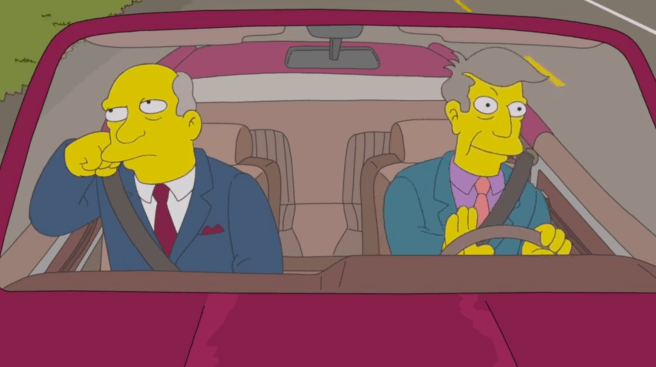
The premise: Superintendent Chalmers is scheduled to speak at an administrator’s conference in Cincinnati and is dispirited when he ends up having to take Skinner with him. Their road trip proves to be calamitous, but the two end up growing fonder of each other along the way.

The reaction: One of my biggest wants over the past fifteen or so years for this show is for them to explore their enormous roster of secondary characters. I think we’ve had enough Homer and Lisa episodes for one lifetime, why not give us some variety and feature Ned Flanders, or Mayor Quimby, or in this case, Skinner and the Superintendent? Just like Comic Book Guy going to Comic-Con, a story with Skinner and Chalmers being stuck together feels like a promising idea, one I was genuinely curious as to how they would execute it. While it definitely felt novel to have an episode that barely featured the Simpsons at all, I was ultimately disappointed as to how bland and unambitious the episode ended up being. If you’ve seen any road trip comedy featuring two mismatched protagonists, you can basically predict the story beats here: the two bicker, meet up with odd characters and get into wacky shenanigans, one or two token acts bring them closer, a secret is revealed leading to a falling out, then a tearful reconciliation and everything is a-OK by the end. That’s not to say a traditional story can’t be engaging or fun to watch, but there’s not enough unique here that really kept my attention. Skinner resolves to have more backbone and be proactive in getting on Chalmers’ good side, and his kindness and quick thinking gets the two out of a few jams, which helps to make Chalmers grow more fond of him. Unfortunately it doesn’t seem like we learn a lot about these two during their trip. We see Chalmers freaking out about air travel, getting them kicked off the plane, but that never really develops into anything. Skinner finally standing up for himself to Chalmers was a little cathartic, but feels a little empty since there’s no real stakes for him in the episode. He tags along with Chalmers not for a promotion or a pay raise, he just wants to be his friend, I guess. This show has actually had some success in the past few years in showcasing new and different shades of our familiar characters (Mr. Largo and his partner’s domestic life, Krusty’s dream of filming an “unfilmable” adaptation of a sci-fi story), it’s just a bummer that this episode entirely focused on the secondary cast feels so rote and formulaic. 

Three items of note:
– In an episode where the Simpsons barely appear, it was interesting seeing how the rest of the cast were given some rare token roles. Dan Castellaneta plays the Missouri sheriff, though he typically plays a lot of non-Homer roles per episode. Yeardley Smith gets a lot of lines as one of the improv Shakespeare performers Skinner and Chalmers pick up. And, something I didn’t notice before the credits revealed it, Julie Kavner performed the turkey on the airplane that freaks Chalmers out, and pretty well, I might add. She also gets a decent sized bit as Marge in the tag of the episode, so don’t worry, all of our regular performers definitely earned their large paychecks for this episode.
– Attached to the episode description I read somewhere, it mentioned that there would be a steamed hams reference, which instantly made me cringe. I feel like the genesis of this episode was inspired by the explosion of the Steamed Hams meme, so I was preparing for the worst, most on-the-nose callback ever. However, the reference ended up simply being a Steamed Hams restaurant they drive by, a blink-and-you’ll-miss-it background sign. I was pleasantly surprised by the restraint.
– If it’s one thing this show is unable to do anymore, it’s balancing genuine sentimentality with a snarky twist, something that really made this series shine in its heyday. Now, happy endings are played 100% straight, and even if they’re somewhat earned, they feel like they belong in a completely different show. Here, Skinner races back to Cincinnati to get Chalmers his cue cards for his speech while Chalmers riffs on stage about how lame Skinner is, before slowly realizing he actually cares for him (“God help me, I respect Seymour Skinner! In fact, I like him!”) The two have a tearful hug and Chalmers gives his speech uninterrupted. It literally feels like something out of a bad movie, with no attempt at adding anything new on top of it. Maybe Chalmers’ speech goes terribly? The two get kicked out? Some other crazy thing happens? You can still have your sweet moment and have it land meaningfully, but there’s got to be more to it.