Season Seven Revisited (Part Two)


7. King-Size Homer

  • What a beautiful pan. Who cares that it makes no sense spatial-wise that all these rooms are directly next to each other? I love it. Also great is Burns’ absolute befuddlement at Homer just appearing in his office, with great, understated reads by Harry Shearer (“Can I help you?”)
  • I like that Homer’s starting weight is 239 pounds, the weight he got down to by the end of “Brush With Greatness.” In fact, I now consider this episode to be a direct sequel to that show, where after Homer’s personal triumph of losing weight, he gleefully chooses to gain it all back and then some.
  • “Assal horizontology” is a term I wish I had more cause to actually use in real life. Also, I’ve searched up and down Los Angeles for Hollywood Upstairs Medical College, but sadly, I cannot find it.
  • I love Ned’s guest appearance in Homer’s work-from-home fantasy as a haggard victim of the rat race (“A crazy guy shot a bunch of people, and the subway ran over my hat!”)
  • I really like the first act twist. As would be expected, Homer is almost at his goal weight, and a hail Mary Play-Dough donut from Maggie pushes him over… but his gut was on the towel rack, revealing he was actually heavy enough already. Even better is the towel rack gag was set up earlier, so it doubles as a great callback too.
  • Another great newspaper headline. I also love that drawing of Burns for some reason.
  • I used the “To start, press any key” audio bite as the Windows start-up sound on my PC when I was younger. Boy, was I clever!
  • Morbidly obese Bart and his washin’ rag would go on to launch a thousand shitposts. I love that it’s yet another dark future for Bart that he, for some reason, thinks is awesome, like him being a drifter or get horrifically mutated by an experimental cola.
  • I love Marge’s presence throughout the first two acts and how she eventually creeps her way into Homer’s story. During Homer’s rapid weight gain, she timidly brings it up, but is quickly dismissed by Homer. This drives her into the background, hoping this crazy episode will fade out on its own like it usually does (“Normally your father’s crackpot schemes fizzle out as soon as he finds something good on TV. But this season…”) Later, when Lisa confronts her mother to do something, Marge is hesitant, not wanting to hurt Homer’s feelings, in one of the greatest crazy lines in the whole series (“Your father can be surprisingly sensitive. Remember when I giggled at his Sherlock Holmes hat? He sulked for a week and then closed his detective agency.”) When she finally does get Homer’s ear, she’s understandably upset and things do get a little sad, where she not only admits that she fears for her husband’s health, but also finds herself less physically attracted to him. It’s genuinely affecting.
  • I absolutely love the bit where Homer cockily brags to Marge about “tripling his productivity,” using the mocking moniker “Miss Doesn’t-Find-Me-Attractive-Sexually-Anymore,” his pettiness completely blinding him to what an awful label that is to both her and himself.
  • Homer being bored working from home, distracted by the dog, the mail, anything to pull him away from the computer, definitely reads differently after ten on-and-off months of me working from home.
  • Homer’s incredibly fast ranting at passing motorists, and then the ice cream truck driver, feels reminiscent of the raving homeless man from “Bart Sells His Soul.” Dan Castellaneta is really great at talking fast, it seems.
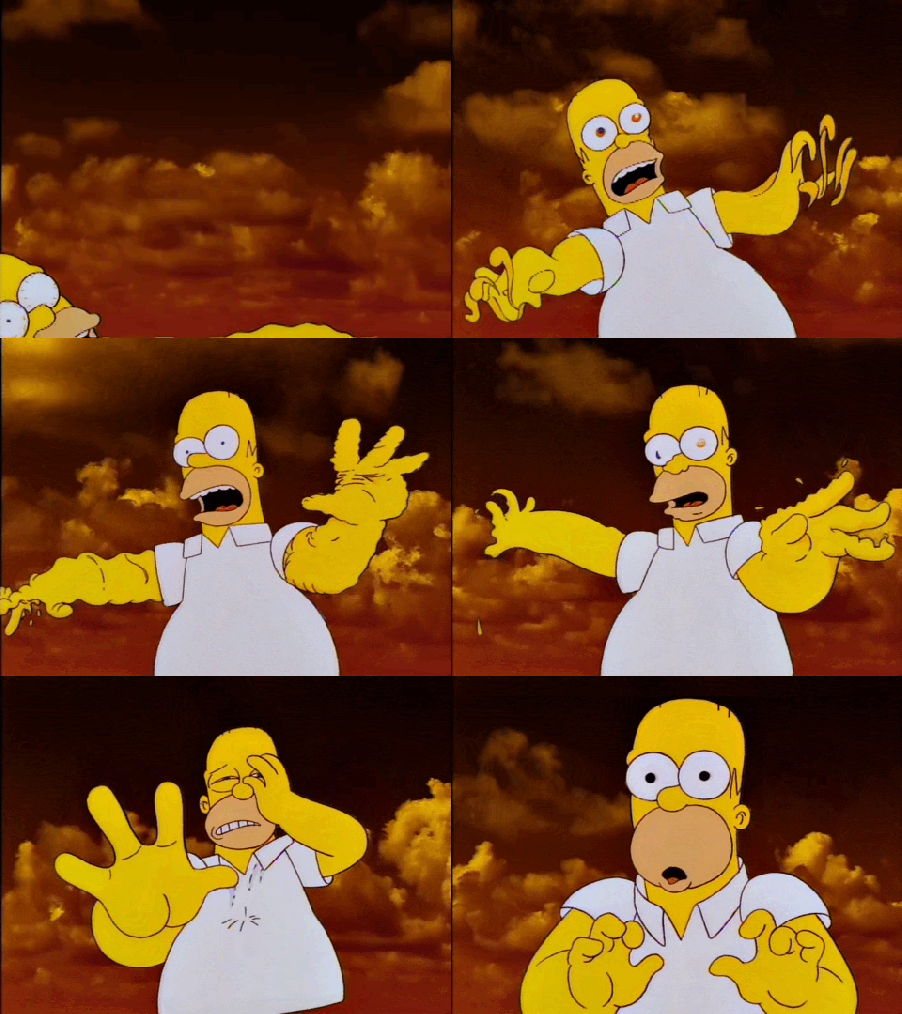
  • The rising action of Homer making his way to the manual shut-off switch plays as very dramatic, but it still feels like it has real weight. By the end, there’s not much in the way of jokes as Homer climbs and tries to balance on the ladder as the tension ramps up, but it still works after Homer vowed at the end of act two to actually give a damn about his job, and now he has to put up or shut up on his promise.
  • You might wonder why Homer didn’t just get more liposuction to make him into a slim man, but I absolutely buy that Burns would only pay to have him returned to his “normal” size.
  • Simpsons Archive retro review: “This was an OK episode, not very outstanding by OFF’s usual high standards. Did they really make fun of FDR’s disability? It was better social commentary on the way people are granted disability freely, IMHO. The animation of the fat Homer was not all that pleasant to look at. C-.”

8. Mother Simpson

  • I love the bit where without thinking, Lenny picks a bird’s nest with eggs out of a tree and tosses it in the garbage.
  • Great drawing of “Homer” getting stuck in the turbine, up for barely a second before he disappears inside.
  • We get a rare moment of Marge actually expressing anger at her sisters over their treatment of Homer when they present her with his tombstone (“Get out of here, you ghouls!”) It’s not shown often, but Marge isn’t an idiot. She must be hurt by her sisters’ treatment of her husband, as briefly seen in “Homer vs. Patty & Selma.”
  • The animation of Homer and Marge left in the dark after the power is cut is fantastic. With just the eyeball animation, everything still feels very expressive.
  • I’ve mentioned it before, but Homer’s upbringing really was pretty awful, all in the hands of how absolutely cruel and uncaring Abe was. Him telling Homer that Mona died when they were at the movies is so terrible, and in the blink of an eye, li’l Homer’s life changed forever, doomed to be raised by a man providing him nothing but insults and discouragement. When Marge asks him what “good reason” Mona had to leave him, Homer solemnly responds, “I guess I was just a horrible son and no mother would want me…” That might be the most devastating line in the whole series. Homer really has some deep scars from his childhood, and for good reason.
  • I always found it odd that Marge addresses Mona as “Mother Simpson” when they all confront her. I guess they never firmly established her name is really “Mona,” as that was just one of her many other aliases that Lisa discovers. But to me, when I hear it, I just think, “Hey, that’s the title of the episode!” I also like how when Mona talks about her radicalization in the 60s, Marge asks, “So where did your newfound sense of irresponsibility take you?” Of course that’s how she would frame any form of protest. It definitely feels in line with her awkwardness towards bra burning in “The Way We Was.”
  • I definitely say “Now there’s a [blank] you can set your watch to!” in an approving way just like Abe from time to time.
  • I really like that they show Wiggum as campus police in the flashback. Considering he’s probably a young college student and Homer’s a kid, that would make modern day Wiggum in his late forties, which feels right. It’s definitely a lot more interesting than future flashback episodes where we see every citizen of Springfield is exactly the same damn age so they can make Springfield Babies-type jokes.
  • I get that the point of Mona going back to help Burns is to show how she’s incredibly kindhearted, she would even lend a hand to her enemy, but come on, that’s an incredibly rookie move for an anarchist. Which she was, so that checks out too.
  • The back-and-forth between Abe and Mona is just wonderful, just incredibly passionate performances by Castellaneta and Glenn Close. 
  • It’s great that we see Wiggum quietly in the background for most of the investigation in act three, which explains how he was able to tip off Homer before the cavalry arrived, retroactively explaining why he wasn’t quick to volunteer any information himself to the feds. Very well done.
  • The ending is still a killer, just absolutely tragic and beautiful at the same time. When I last watched this episode, my mother had just passed a few months prior, and now nearly ten years later, it still hits just as hard. I feel you, Homer.
  • Simpsons Archive retro review: “C-plus – I just stared at the screen for 22 minutes in sort of the same way that Homer stared at the sky at the end. On top of that, the ‘Lisa is just like Grandma’ bit was stressed a little too much.”

9. Sideshow Bob’s Last Gleaming

  • This is my favorite Sideshow Bob episode in that it really perfectly illustrates the character. A pompous thespian through and through, Bob’s true nemesis is idiotic lowbrow culture, personified by the “chattering cyclops” that is television. It stings even greater considering he was once an active participant in such moronic programming (“My foolish capering destroyed more young minds then syphilis and pinball combined!”) The final straw comes from overhearing a dumb FOX sitcom with a familiar guest star: accomplished stage actress Vanessa Redgrave. Bob is practically in mourning hearing a respected performer reduced to appearing on TV’s “bottomless chum bucket.”
  • “I renew my objection to this pointless endeavor, informally now and by affidavit later… time permitting.”
  • Lisa’s excitement about seeing the first female stealth bomber pilot is a fantastic joke (“During the Gulf War she destroyed seventy mosques, and her name is Lisa too!”) It’s funny on its own how Lisa is childishly enraptured by this trailblazing woman who she shares a name with, conveniently overlooking her horrific actions, but it’s also a tremendous slam on the celebration of a non-cis white men breaking into notable or high rank positions overshadowing any of their actual terrible actions (see: most of the Obama administration.) Of course, this is also a joke that would never, ever be done with modern-day Lisa.
  • I love how Bob’s scheme unfolds, creating an inconvenience for the colonel solely to hear his voice and speaking patterns, allowing him to mimic him to access a restricted area of the base. Like his showboating to the schoolkids in “Sideshow Bob Roberts,” Bob once again puts his performing abilities to work, affecting the voice of a dimwitted Southern recruit to egg the colonel on, then Kelsey Grammer does his best R. Lee Ermey impression as he chokes his way through one of his distasteful exclamations (“Get moving or I’ll tear you up like a Kleenex at a… snot party!”)
  • Speaking of Ermey, he’s great in this episode. He’s doing the schtick you expect him to, but any character whose dialogue includes “I’m going to come in there and corpse you up!” is aces in my book. I also like the scene later in the bunker where his Garfield-related expression is met with awkward silence, and he sheepishly says, “Sorry, my wife thought that was gangbusters.”
  • I love the animation of the fighter jets hovering in front of the Tyranno-Vision (great name) to watch Bob.
  • “American Breast Enthusiast” has got to be the classiest porno magazine ever.
  • It makes absolutely no sense, but I love how Bob is able to shoo away the helium, allowing him to speak in his normal tone.
  • Another great childlike moment from Lisa where she escapes the air force base and excitedly tells her mother about all the exciting things that happened. Modern-era Lisa would seriously urge to push on to capture Bob with some kind of pithy remark or something stupid.
  • Fantastic animation of Bart’s book bag getting instantly run over and nonsensically set on fire.
  • This episode kind of feels like a spiritual sequel to “Krusty Gets Busted,” as they’re both about Bob’s utter disdain toward mindless pop culture, perfectly represented by Krusty’s loud and moronic antics. It’s appropriate that Krusty has the last TV show standing, the man who made Bob suffer for so many years, thwarting him once again. Enough is enough for Bob, in his last ditch effort vowing to kill the awful clown. Of course, this builds to a hilarious anti-climax as the Wright Brothers plane pathetically bumps into the broadcast cabin, foiling Bob almost immediately.
  • Simpsons Archive retro review: “‘That was a well-plotted piece of non-claptrap that never made me want to retch.’ ‘Sideshow Bob Roberts’ aside, I never like Sideshow Bob episodes. They’re appealing, but just not funny. This one had too many FOX swipes and not much plot development, and the conclusion was rather hasty. My Grade: D+.”

10. The Simpsons 138th Episode Spectacular

  • This is definitely the best clip show, both in watchability and the creativity of the concept. Not only is most of the content material never seen before on TV, there’s the brilliance usage of Troy McClure as host, filling his fourth wall-breaking role perfectly. He would reprise such a role one season later in “Spin-off Showcase,” but sadly, never again.
  • I love the characterization of Matt Groening as a reactionary right-wing crank, angrily shooting at trespassers in his office and injecting conservative Easter eggs into the show (NRA4EVER!)
  • It’s kind of crazy that after all these decades, there’s never been an official release of the Tracy Ullman Simpsons shorts. I’ve seen all of them a long time ago, but the bulk of them were low-quality TV rips of The Tracy Ullman Show reruns on Comedy Central. It’ll most likely never happen now; a complete shorts collection would have made more sense as a limited DVD release than a feature on Disney+ at this point. Also, they’e more a bizarre cultural artifact rather than something I’d watch for legitimate entertainment. You see a few of them and you basically get the idea.
  • The second act is the only section featuring actual show clips. It does its best to package them in a unique way with Troy reading viewer mail, but I still end up skipping through them. It’s a clip show. It is what it is.
  • I always laugh at Phil Hartman’s gravely serious read of “You’ve got some attitude, mister.”
  • I like the faded color and scratchy film effect put onto the deleted scenes, like they were locked in a vault for decades and unearthed. As for the clips themselves, robotic Richard Simmons from “Burns’ Heir” is the one most people probably remember, but all the clips from “Treehouse of Horror IV” are just great, and I wish they didn’t get cut (especially the set-up and payoff of Lionel Hutz’s free pizza guarantee.) It’s also kind of funny that we get a cut scene from “Mother Simpson,” an episode that had just aired two weeks prior.
  • It’s so great how purposefully bad the fake “Who Shot Mr. Burns?” ending is. Smithers’ elongated groan at getting a 5% pay cut for shooting his boss is so damn funny.
  • “Who knows what adventures they’ll have between now and the time the show becomes unprofitable?” HASN’T HAPPENED YET, APPARENTLY.
  • Simpsons Archive retro review: “Please. Not another clip show! This one was better than the others, in that the writers made it pretty obvious that they (and Troy McClure) hate doing this sort of thing. The Robotic Richards Simmons clip is the ONLY thing that saves this from the garbage dump. Overall, a D-.”

11. Marge Be Not Proud

  • The Bonestorm commercial is just glorious, with the savage reindeer inches away from goring the poor children to Santa bazooka-ing the game cartridge into the game console, almost shattering it.
  • This may be the most genuine Marge quote ever (“If loving my kids is lame, then I guess I’m just a big lame.”)
  • I don’t know why, but I love that Comic Book Guy halts Bart’s reaching hand for the cash register with a Sharpie. He could have just said “ah ah ah” and stopped Bart, but the little extra action makes the scene feel more alive.
  • Milhouse screaming for his mom to eject Bart from the house (twice) is a great character moment. As we saw with “Bart Sells His Soul,” the moments where Milhouse can actually get one over on Bart are few and far between, but when an opportunity presents itself, he’ll easily take it.
  • Don Brodka is such a hilarious character, ironically because he’s completely humorless (“Don’t smart off to me, smart guy.”) The gag where he calls the Simpson home and leaves a message, despite it seeming like he was actually talking to someone, is absolutely spectacular. Even better considering, I think I remember from the commentary, Bill Oakley and/or Josh Weinstein talking about how they vainly tried to explain the concept of the joke to guest voice Lawrence Tierney and he just didn’t understand it, but the way it turned out, you’d never realize that.
  • Troy McClure’s shoplifting video might be in his top 5 best videos: the fact that the production is openly a legal requirement for McClure (“I’m here today to give you the skinny on shoplifting, thereby completing my plea bargain with the good people at Foot Locker of Beverly Hills,) and the very origins of the very first thief (“Oh, Shakazaramesh, will you ever learn?”)
  • I absolutely love that in Bart’s vision of Brodka, he says “cat-feesh” instead of “capiche,” which is a great callback to Bart’s earlier not understanding him saying “capiche.” So of course, his memory would screw it up. It’s a really neat subtle detail.
  • Another great touch I never really noticed before is when the family arrives at the Try-N-Save. Bart worriedly inquires if it’ll be a quick in-and-out trip (“So we’re just going to do this photo and get out, right? Badda-bing, badda-boom?”) The rest of the family talks about all the stuff they want to do in the store, and Marge caps it off, “We’re going to have a great day! Badda-bing, badda-boom, right, Bart?” Marge clearly doesn’t understand “badda-bing, badda-boom” normally punctuates something done quickly, but she uses it anyway as a means of wanting to play off of Bart. Between this and her giggling at Bart’s hug earlier, it all does well to build her up for her eventual disappointment when Bart’s thievery is exposed at the end of act two.
  • It’s a quick moment, but I like how annoyed Lisa is at the photographer messing with her hat before the shoot.
  • I love the bathroom scene with Bart and Lisa, where Lisa explains how Marge processes things differently and this latest escapade has clearly cut her deep. But when Bart asks her to clarify further, Lisa gives a childlike shrug. In later seasons, Lisa would just flatout explain to Bart (and the audience) what Marge is feeling and how he should make it up to her exactly. Here, she’s just a kid who doesn’t have all the answers, and that’s wonderful.
  • I gotta say, that giant marshmallow that absorbed all the hot cocoa looks absolutely delicious. I’m with Abe, I want a slice.
  • This episode is decried by Dead Homer Society as the “one bad episode” in the classic era, for leaning heavily into “after school special” territory, playing the morality aspect and Bart’s redemption mostly straight through the whole thing. I understand the criticism, and also, having seen a decade-plus worth of new episodes since I’ve watched this one, I get how this sort of serves as a harbinger of things to come. Especially in the last six or seven years, we’ve seen episodes that play emotional moments 100% straight, with very little subversion or uniqueness laid on top of them. The third act of “Proud” is sort of like that, but I think what separates it from the bullshit that airs nowadays is, aside from having more actual jokes, the characters still behave like real people, and the conflict is rooted in something that feels incredibly relatable: deeply disappointing a parent and how much it can screw you up as a kid. That genuine emotional core holds strong, and makes the ending where Marge and Bart reunite pay off beautifully. 
  • Lee Carvallo’s Putting Challenge. That’s it.
  • Simpsons Archive retro review: “No characterization, forced continuity, and worst of all – forced emotion. In other words – one of the biggest pieces of tripe to come out of the Gracie Films offices since ‘Radioactive Man.’”

12. Team Homer

  • “They’re really socking it to that Spiro Agnew guy! He must work there or something.”
  • When Moe inquires where Lenny, Carl and Barney are, Homer answers that they’re spending time with their mistresses? What?
  • I love how stupidly simple the riot caused by Bart’s shirt begins (“His shirt makes a good point!” “I’m with the shirt: homework rots!”) And of course the desk bursts into flames when the kids knock it over. I’m always a fan when something just randomly sets on fire. Also absolutely wonderful is Chalmers’ incredibly slow evaluation, just milking the time before the crowd of kids inevitably rushes by to ruin everything (“I am going to give this school a perfect ten! I’ll just write the zero first… now, a vertical line to indicate the one…”)
  • In hands-down the funniest Vietnam joke from Skinner, he explains he spent three years in a POW camp eating nothing but a thin stew, but upon returning to America, his true anguish came as a result of not being able to create the dish (“I came close to madness trying to find it here in the States, but they just can’t get the spices right…”) It’s such a genius bait-and-switch.
  • This feels like the first major instance of fleshing out Apu and Moe. It’s weird since they’ve both had their own episodes, but seeing them and Homer bouncing off each other in a normal setting like a bowling alley allows new characteristics to shine through, like Moe’s crippling insecurity (“Buenos noches, senorita!” “What’d he say? Was that about me?”)
  • Martin (proudly) and Lisa (begrudgingly) model the school uniforms, and I like how you can kind of infer that they roped the two smartest kids in the school (or maybe they’re in student council or something) to have to do this little fashion show. Also great are the two different types of giant boxes carted into the auditorium: Mr. Boy and Mr. Boy for Girls.
  • Homer’s “suckiest bunch of sucks who ever sucked” speech is great, but I also love Lisa’s annoyed “We are not wieners!” after he hangs up.
  • I only know what colorfast clothing means from this episode, I’ve never heard it used in any other context. I could barely understand what Chalmers was screaming about for the first couple times I watched it. He excitedly follows Skinner to find Agnes in the park (“This I gotta see!”) although I’m not sure what the spectacle would be. Agnes screaming and collapsing into a heap because her dress turned tye-dye, I guess?
  • Surely somebody has made that lobster harmonica at this point, right? If so, I want one.
  • Simpsons Archive retro review: “This was a middle-of-the-road so-so episode. They’ve done worse, but they’ve also done better. Some good laughs, some really good meta-humor involving the competing teams. The school uniform subplot didn’t really go anywhere. A perfectly average C.”

Season Seven Revisited (Part One)


1. Who Shot Mr. Burns? (Part Two)

  • The opening misdirect of Smithers’ dream is another great example of the show making cultural references that work without knowing specifically what they are. Hell, “Who Shot Mr. Burns” itself was directly inspired by Dallas’s “Who Shot J.R.,” and now the beginning of this episode where Smithers finds Burns alive and well in the shower is a reference to an infamous season premiere of Dallas where they brought back Patrick Duffy’s character after killing him off, effectively erasing the entire previous season where he was dead as just a dream. Speaking of which, considering how “Part One” ended, it’s easy to interpret that Mr. Burns might actually be dead, with some online and print speculation from fans at the time before “Part Two” talking about the identity of Burns’ “killer” rather than the “shooter.” But whether you know about Dallas or not, it’s still funny how quickly the opening descends into fantasy madness (Speedway Squad! In Color!) before revealing it’s actually a dream, and it’s kind of cool how they dance around the question of whether Burns is actually dead or not for a few minutes before finally revealing he is in fact alive.
  • I don’t think the rickets gag works. Lack of sunlight apparently gave Homer a bad case of rickets, but it’s been just one day since Burns activated the sun blocker. Also, am I dumb for not automatically knowing rickets is caused from a lack of vitamin D? It’s a bit too much to put together for a joke where Homer walks funny.
  • I guess this episode shows why we don’t see much of Dave Shutton: he’s an awful reporter, even compared to Kent Brockman (“Dave Shutton, Springfield Daily Shopper. Who are you? Where are you going?” “Oh, do your research, Shutton!”)
  • Smithers is obviously the most likely suspect, and I like how the first act works as quick as it can without feeling rushed to cross him off the list. It’s great how the episode itself remarks on this too with Marge and Lisa (“I guess it’s never the most likely suspect.” “Actually, Mom, in 95% of cases, it is.”)
  • Lisa’s given titles on her suspect list are a great touch. It’s odd hearing Moe being called a “nightclub owner,” but Barney as “liquor connoisseur” is just perfect.
  • Tito Puente’s “Senor Burns” still really slaps, as the kids say. And the MVP of this episode is unquestionably the guy at the condom machine.
  • All the other characters’ alibis are fantastic, from Skinner’s awkward bathroom encounter with Chalmers, Willie’s Basic Instinct nod and Space Invaders obsession (“That was a pretty addictive video game.” “Video game?”) and, of course, Moe’s polygraph test, which is the subject of, you guessed it, another amazing Dankmus remix.
  • Just like the Dallas opening, Wiggum’s Twin Peaks dream still works without knowing the source material. Twin Peaks is a show I’ve been meaning to watch forever, and even though the dream scene is incredibly specific to the series, I still think it plays if you see it as just a weird, cryptic dream Wiggum is having, which makes it funnier when Lisa ultimately breaks and tells him the information point blank when Wiggum fails to pick up the clues.
  • Gotta love the DNA guy who’s easily bribed by a carton of cigarettes.
  • Even though Homer obviously wouldn’t be our shooter, I like how there’s still credible evidence that must be unraveled. Sure, someone could have planted the gun in the Simpson car, but how did the fingerprints get there? It’s enough to keep the audience thinking until the final reveal. Going along with that, I love how Homer continues to get more erratic to the point he threatens Burns and points Wiggum’s revolver point blank at his head in impulsive rage. Again, he’s not our man, but I love how dramatic the ending gets.
  • Finally it’s revealed that it was Maggie all along, the perfect fuck-you ending that still doesn’t feel like an insult whatsoever, especially since Burns’ desire to take candy from a baby was set up in “Part One.” That the whole thing was just a complete accident “caused” by an infant is a great ending, but as one commenter previously mentioned, it did set the stage for a whole lot of future jokes involving Maggie being an expert marksman or weirdly violent (like breaking a bottle to threaten Mr. Teeny in the movie), completely missing the point of the joke.
  • During my rewatch, I’ve been using the Simpsons Archive to help copy-paste quotes. As a young fan, it was always one of my favorite sites, I’d look through all their different lists and guides for hours. The episode capsules were their crown jewels, especially in an era before the DVDs were released. A curious time capsule to look back at now is their reviews section, featuring fan reviews of the episodes as they aired, and it’s really intriguing to hear negative feedback for episodes most fans would consider bonafide classics. The archived reviews start at season 5, when the show was getting a bit wackier, and clearly there were some fans that were absolutely not having it. If you’re curious, pull up the capsule for your favorite episode that you consider a flawless peak for the series, and you’ll find two or three people who just fucking hated it when it aired. Y’know, I think I’ll feature one negative quote per episode for novelty purposes. I might even retroactively do it for seasons 5 and 6.
  • Simpsons Archive retro review: “That was the worst Simpsons ever. I would’ve rather seen an old repeat.  If you hadn’t figured it out before, you can figure it out within the first few minutes. I would’ve expected more from the talented Simpsons writers.”

2. Radioactive Man

  • The hats flying into the air gag really feels like it shouldn’t play, but I still laughed at it anyway. This episode actually has a lot of cartoony gags in it, like Homer running so fast it leaves a Homer-shaped dust cloud and Bart looking at the six corners of the treehouse before seeing Milhouse, an especially brilliant and mindfucky gag.
  • Comic Book Guy’s waddle over to the computer is such a funny piece of animation. This scene is a fascinating look at the dawn of Internet nerds circa 1995, back when they were stuck on landlines staring at gigantic monitors. I still don’t understand the joke where the last nerd shown is an incredibly tiny Prince. Is that really Prince, or just a nerd dressed like him? And yeah, Prince is short, but he’s not like a little person.
  • It’s so great how Quimby effortlessly goes from sucking up to the film production (“We’ll blow up our dams, destroy forests, anything! If there’s a species of animal that’s causing problems nosing around your camera, we’ll have it wiped out!”) to relentlessly bleeding them dry once they’ve set up shop. The whole town is on the same page about sucking Hollywood ass to drain as much money out of them as possible (as seen from the great signs around town, “Welcome Hollywood Money” and “We LOVE Phonies.”)
  • It’s very funny to me that Fall Out Boy, a hugely popular band still to this day, is named after one of the most obscure Simpsons characters ever. Not even a character, a fictional sidekick in Bart’s favorite comic book.
  • I love the moment where Nelson laughs at himself in the mirror after whiffing his audition, finally realizing how demoralizing his catchphrase is (“Ohhh, that hurt. No wonder no one came to my birthday party.”) It’s a brief and humorous moment of clarity that holds more weight than any of the countless future subplots featuring Nelson the poor little dirt urchin. Also, I previously talked about how the show was already mocking its own catchphrases and tropes by season 5, but “Haw haw!” still plays if they can find an applicable situation.
  • “George Burns was right: show business is a hideous bitch goddess.”
  • Bongo Comics published a dozen or so Radioactive Man comics over its lifespan, which is really interesting on several levels. First, the idea that you can read a fictional comic book from a fictional TV show in real life is novel in and of itself. There’s not a ton of Radioactive Man lore from the show, so the writers pretty much had to create their own superhero canon for the most part. Also, the comics spanned over Radioactive Man’s fictional run as a comic, so issue #1 “released” in 1952, while issue #1000 came out in the then-current day 1995. The rest of the comics are issues scattered between those years, and they would parody different comic book tropes within those decades. For instance, issue #679 “released” in 1984 featured a more gritty tone, clearly referencing the likes of Watchmen and The Dark Knight Returns. One of the final issues released was the comic book tie-in to the Radioactive Man movie, featuring the likenesses of Rainier Wolfcastle, Milhouse and Krusty in the roles in the film. It’s a really neat read, as you get to see how the isolated snippets we see in this episode were retrofitted into an actual narrative in the comic to make a complete story. I’d highly recommend seeking it out.
  • Even though this episode is mostly goofy, I like the throughline of Milhouse the tortured child actor. Pushed into the job by stage parents who cared only for their own potential windfall, he has absolutely no interest at the start, which turns into bitter, seething resentment by the end. Pamela Hayden kills it with Milhouse’s acid-tinged disdain for the “jiminy jilickers” scene.
  • “My eyes! The goggles do nothing!” is a bonafide classic scene, but what exactly was the outcome going to be had Milhouse been on set? Was a ten-year-old boy expected to swoop across the chasm and hoist Wolfcastle away before the acid hit? 
  • Slot car racers really feel like a thing of the past. I’m sure kids don’t play with them anymore, but do any nerdy adults? I never had any race tracks of my own, but friends of mine did when I was a kid. Spirographs, on the other hand, I was all over.
  • Like Tito Puente, Mickey Rooney randomly appears as characters shout his name aloud, but he’s so damn funny and it makes story-sense for him to be there, a former child star hired by Hollywood suits to talk sense into Milhouse. Then he tries to take his job, right before his next big break subbing for a little girl in a Jell-O commercial (“I could play that!”)
  • Having lived in Los Angeles for many years now, I have to say the ending depiction of Hollywood is 100% accurate.
  • Simpsons Archive retro review: “Yeesh. That was about as subtle as a LAPD interrogation. Only not as funny. Is it too early in the season to choose a ‘worst episode this year?’”

3. Home Sweet Home-Diddly-Dum-Doodily

  • Cute touch of Maggie karate chopping her toast before eating it. Also, I always thought Marge said that she “marbleized” the toast, but she was actually saying it was melba toast, which I never heard of until this moment.
  • Marge is in prime characterization in the first scene, the ultimate super mother holding the household together. She works her ass off for her family, but she loves to do it. It’s sweet that Homer goes out of his way to secure a gift for her in the form of a trip to the spa, but because this is the horrible world of The Simpsons, one half-day off for Marge leads to complete disaster. How the perfect storm is set up from the start with the old newspapers, Bart and Lisa’s troubles at school, the “Stupid Baby” prank, this entire first act is just perfect.
  • “Stupid babies need the most attention!” is a line I think of all the time.
  • Skinner is quick to call CPS on the Simpson house, but still uncaring enough to send Lisa home wearing garbage bags on her bare feet and Bart wearing an onion sack.
  • Great work from the audio department adding whistling noises to Lisa’s dialogue when she loses her tooth.
  • “Oh bitch bitch bitch!” is another line I think of all the time.
  • Of course the one episode of Itchy & Scratchy Rod and Todd see is the most traumatizing short of all time. A seemingly innocent “baby” Itchy stabs Scratchy twice with a broken baby bottle. I love how slowly he pulls the bottle out of Scratchy’s bright red wound makes it feel extra painful, and that he runs out with Scratchy’s TV, which really feels like pouring salt into the wound, making it feel even more scornful that he’s robbing him versus just the usual cartoon violence. As Scratchy weakly chokes out, “Why? My only son?” and dies, we roll credits, and Rod and Todd are scarred for life.
  • The emotional scenes in this episode are incredibly potent, with Homer and Marge despairingly walking by the kids’ empty bedrooms to Bart and Lisa fondly swapping memories of their parents. These are tender, heart wrenching moments, particularly the former, as the kids’ absence have left gigantic craters in Homer and Marge’s lives that they’ll do anything to get back.
  • Alongside the already emotional premise, I really like how the emotional stakes of this episode is the fate of Maggie’s soul. As Lisa helpfully explains, she hasn’t been a Simpson as long as she and Bart, as the impressionable young Maggie becomes more and more comfortable with her new adopted parents. It may be incredibly silly when Maggie does a Linda Blair-esque head turn after saying, “Daddily-doodily,” but seeing her lovingly reunited with Marge at the end, reaffirming her identity as a Simpson, still feels like a powerful moment.
  • We get not one but two great drug jokes with Marge: first when she and Homer return from the spa, the CPA officials overhear her incredibly unfortunate comment, “It’s like I’m on some wonderful drug.” Later, at the Family Skills graduation, Marge gets an erroneous fail on her drug test, which she confidently rebukes (“The only thing I’m high on is love. Love for my son and daughters. Yes, a little LSD is all I need.”) I feel like if I came up with that line in the writer’s room, I would be so damn proud of myself.
  • Only on this show could the third act ticking clock be to prevent a baptism, but it’s not played as cynical or ripping on religion at all. The happy ending of the Simpsons reuniting is played straight, and feels completely genuine without being saccharine. It seems so effortless how the show manages to toe that line.
  • Simpsons Archive retro review: “Does anyone else agree that there is something missing this season? It seems like the voices are a bit different and that the plot lines have a horrible Critic-esque quality. They just aren’t as good as the weekday reruns.”

4. Bart Sells His Soul

  • I definitely watched this episode before knowing about “In-a-Gadda-Da-Vida,” so I didn’t quite get Bart’s prank. He picked an extra long hymn and that’s his fault? Though to be fair, surely one member of the congregation had to recognize the song after ten minutes of singing before Lovejoy, right? (“Wait a minute, this sounds like rock and/or roll!”) But who cares, it’s great. They included it on one of the soundtrack CDs, but considering it’s just a reorchestration of another song, did Iron Butterfly get paid royalties for that?
  • Milhouse’s innocent question as to why organized religion would manipulate or obfuscate the truth (“What would they have to gain?”), followed by the immediate cut to Lovejoy’s loud money-counting machine is so damn good.
  • Bart’s cheeky “Any time, chuuuuuuuu-mp” always makes me laugh.
  • It’s always funny when we see Dr. Hibbert’s children, reminding you that he and his whole family are basically just references to The Cosby Show. I don’t know the last time they’ve been seen on the show, but they certainly are an out-of-time parody at this point. I’d say a Dr. Hibbert episode could be kind of interesting, but… you know. Also, I’d love to go eat at Professor P. J. Cornucopia’s Fantastic Foodmagorium and Great American Steakery.
  • I love that Bart’s turmoil through the entire episode is completely internal. He didn’t “lose” his soul, but his uncaring attitude to his sense of self led to this weird crisis within himself that he’s unable to make sense of. It’s sort of similar to the show’s early morality play episodes like “Homer vs. Lisa and the 8th Commandment.”
  • I really like how this episode features Milhouse finally getting one over on Bart. After being used and abused as a second banana for six seasons, he’s now in the position of power over a subdued Bart, and he knows it. I love this little bit of animation (and Pamela Hayden’s performance) of Milhouse’s smug “yeeeeessss” as Bart walks up to him. Milhouse coldly demands fifty bucks for Bart’s soul back, and cackles like the dork he is as he somberly leaves. So great.
  • The ending of the Uncle Moe’s commercial was cut in syndication, but I love how dumb it is. The uncreative simplicity of the extended jingle (“It’s good good good good, good good good!”) as Moe struggles in vain to keep a big grin to the camera, twitching wildly. Watching this silly subplot also reminded me of the Playmates Simpsons action figure line, and one of the dozen or so planned figures that was cancelled when the line ended was an Uncle Moe variant. That would’ve been a neat collectible, with a little Million Dollar Birthday Fries hat to put on his head. What a shame.
  • The scene where Marge naturally senses something is wrong with Bart is really, really sweet, further emphasizing that this is Bart’s mental struggle, so of course an obsessively loving mother like Marge would see something is wrong… but not quite know what (“It’s not fear of nuclear war… It’s not swim-test anxiety…”)
  • The little girl with the cold teef that causes Moe to lose it looks a lot like Samantha Stanky. I also love the ominous reprise of the Uncle Moe’s jingle right before everything goes to shit, it’s a really great music cue.
  • The street sweeper running down Bart is a fantastic double joke, where it looks like it just thoroughly cleaned Bart’s bike, but then it quickly falls apart. Then the street sweeper is apparently a madman who drives down the subway stairs and crashes.
  • Speaking of madmen, Dan Castellaneta gives a dynamite performance as the homeless man Wiggum attempts to placate (“Who’s been stealing your thoughts?”)
  • Gotta love those ALF pogs. Speaking of ALF, if you think my episodic reviews are humorous and thorough, I’ve got nothing on Philip Reed’s ALF project, a writing exercise where he exhaustively reviewed every episode of ALF, as well as bonus articles about the characters, other ALF media, and so forth. I remember watching ALF reruns when I was younger and liking the show, but looking back on it now, it really was quite terrible, and Philip digs into why in an exhaustive (and hilarious) amount of detail. I’d say even if you haven’t seen ALF, they’re still really engaging in how in depth he goes into explaining every part of every episode and why it’s shit. I’ve read the entire thing several times at this point, I’d highly recommend checking it out.
  • I love Bart’s desperation by the third act. The time lapse shot of him sleeping all night in front of the Android’s Dungeon is pretty sad, all leading to his final desperate moment of prayer, with an absolutely fantastic performance by Nancy Cartwright. It’s probably the most vulnerable we’ve seen Bart in the entire series.
  • Lisa buying Bart’s soul back for him feels like a thank you for Bart buying the Bleeding Gums record in “‘Round Springfield.” Funny how there’s two endings where a Simpson sibling saves the day by buying something from Comic Book Guy. 
  • Simpsons Archive retro review: “This was one of the stupidest episodes I’ve seen. It was corny and predictable and it had the humor of Erkle’s show. I don’t know what the hell is wrong with the writers of the show, but I think the good ones have been replaced with nephews and beer buddies of the show’s producers.”

5. Lisa the Vegetarian

  • The sound design in Storytown Village is really strong, from Mama Bear’s busted speaker to the axe cutting off Mother Goose’s head. That latter gag is executed absolutely perfectly, together with the timing, the animation of how swiftly the axe goes through the goose, and the sound effect.
  • The Simpsons returning home with their busted up back window is such a wonderful joke in how it’s not even highlighted. It’s a great coming back to earth after the sweet bit of Lisa bonding with the lamb, where right as the gruff voiced “Mother Goose” comes on the PA system (“The following cars have been broken into,”) we cut right to the Simpsons pulling up the driveway with a busted back window. Like, of course they were among the unlucky ones, why dwell on the joke any further?
  • Gotta love Lord Thistlewick Flanders. And hey, have I mentioned Dankmus recently?
  • The Independent Thought alarm is a perfect Springfield Elementary feature. I also love Willie’s vindication at Skinner’s order to remove all the colored chalk (“That colored chalk was forged by Lucifer himself!”)
  • The Itchy & Scratchy in this episode really is one of the strangest, where Itchy serves Scratchy his own bloated stomach on a plate at a fancy restaurant. Even when he repeatedly eats a piece and it flies back out of the hole in his meal, he’s completely none the wiser. It feels so gross, with Scratchy’s shaved pink belly and the sound effect of it flopping onto the plate. Of course, Scratchy only dies when he receives the exorbitant bill and his head explodes. Brilliant.
  • I’ve definitely thought “Yo, goober! Where’s the meat!” at least a few times waiting for my food at a restaurant. 
  • “A certain… agitator… for privacy’s sake, let’s call her Lisa S. No, that’s too obvious. Let’s say L. Simpson.”
  • “Meat and You: Partners in Freedom” has got to be the best filmstrip of the entire series. Every moment in it is classic: Troy forgetting the kid’s name, sliding a finger on the cow’s back and tasting it, the “kill floor,” the “science-tician” who gets cut off, the very memeable shot of the shark eating the gorilla, and of course, the very helpful diagram of the food chain.
  • The gas grill gag is great by itself, but made even better for knowledgeable fans who recall “Treehouse of Horror.” While Homer’s excessively doused grill caused a mini-mushroom cloud to erupt in that episode, here, he lights a match and the grill lights up like normal. Really great bait-and-switch.
  • Barney’s “Go back to Russia!” in response to Lisa’s gazpacho always makes me laugh.
  • Paul and Linda McCartney’s appearance skews very close to the impending deluge of guest stars who show up just to be fawned over, or worse to hawk their own images or wares, but their interplay with Apu ends up mostly saving it. I love that being an eight-year-old girl, Lisa’s initial reaction to seeing the vintage rock star is, ”I read about you in history class!”
  • I feel like some might complain about Lisa’s actions and behavior in the third act being too mean and spiteful, but that’s kind of the whole point. She’s really devoted to this new cause, but, as a child, she ends up getting too wrapped up in it and ostracizing herself from the family. Homer is equally as petulant, being a dimwitted man child. The ending when the two reunite is beautiful (I absolutely love their back-and-forth “you looking for me?” dialogue. Both know they have to apologize, but have to muster up the courage to do so) is so very, very sweet, topped off with Lisa getting a veggie-back ride.
  • Simpsons Archive retro review: “Kind of a disappointing episode. It seems like a WSB episode where every character is given a few token lines to say. Only Apu brought any sensibility to the show. And a message to the writers. Please do not devote entire episodes to your celebrity guests’ pet causes.”

6. Treehouse of Horror VI

  • Pimply Faced Teen shouting “You don’t scare us!” when Homer storms out is so funny.
  • Homer steals the Lard Lad donut entirely out of spite, but seems to be having a grand old time lying in the donut hole in his underwear drinking beer. Never mind how he got that thing in the house though.
  • “Panic is gripping Springfield as giant advertising mascots rampage through the city. Perhaps it’s part of some daring new ad campaign, but what new product could justify such carnage? A cleanser? A fat-free fudge cake that doesn’t let you down in the flavor department like so many others?”
  • The captain of the high school basketball team that Wiggum shoots dead is literally taller than the building he walks out of. He’s got to be over ten feet tall. Forget what Lou says, that kid is a monster.
  • Lard Lad’s giant angry face through the door frame is such a memorable image to me. I always think of Lard Lad’s as one of the most iconic stores of Springfield, but I think this is its first appearance. I just love Lard Lad, he’s such a great design. I wish they had like a little statuette of him, I’d love to have that on my desk. Though maybe one does exist, there’s endless amounts of Simpsons merchandise out there.
  • I love Harry Shearer’s performance by the head of the ad agency, with his warbling attempt to sing the anti-monster jingle (“Don’t watch the mo… don’t watch them… mon-steeeeeeerrrrrssss…”) 
  • “Children, I couldn’t help monitoring your conversation. There’s no mystery about Willie. Why, he simply disappeared. Now, let’s have no more curiosity about this bizarre cover-up.”
  • Truly disturbing performance by Russi Taylor doing Martin’s death screech before he falls to the floor getting killed by dream Willie. It’s so genuinely horrifying, but in classic show fashion, it’s immediately followed by Nelson’s “Haw-haw!” and the great scene of Martin’s twisted corpse being exposed to the class, and then rolled into the kindergarten.
  • I got Simpsons calendars for a few years when I was younger, and I remember more than one year had a thirteenth page for Smarch, which featured a bunch of fake holidays on the calendar. It was a really nice touch.
  • While “Nightmare on Evergreen Terrace” plays the Elm Street premise mostly straight, I like how Willie’s origin story is almost like the inverse of Freddy Krueger’s. While Freddy was a school groundskeeper who murdered and/or molested children that the parents burned alive to protect them, Willie senselessly dies due to ignorant and uncaring budget cuts made by the parents (“Recharge fire extinguishers? Now, this is a free service of the fire department…” “Nay!”) Also, there’s a shot of the parents toward the end of this scene that always stuck out to me. I know the kids’ desks are low to the floor, but jeez, look at those guys. The shot also makes poor Ned and Martin’s dad look as fat as Wiggum.
  • Willie’s “compost-mortem” line is some damn good writing. I also like how he takes a bunch of different (tartan patterned) forms before he sinks down into the sandbox. I don’t exactly know why he does it (the rocketship makes sense for him trying to get out, but the elephant and tank would serve more to weight him down), but I still think it’s cool.
  • I’m certain I mentioned this the first time around, but Homer³ always reminds me of Cyberworld 3D, an IMAX film from 2000 that acted like an anthology showcase of different early CG animation: shorts films, music videos, a sequence from Dreamworks’ Antz, and what I cared most about, the Homer³ segment. Getting to see the Simpsons in IMAX was a real treat for my young self. I really wish the film was available in some form so I could see it again, but given the different rights holders of the different segments, that’s never gonna happen.
  • Even though it’s very rudimentary, I think the 3D animation holds up in the sense that Homer has basically been transported into an early 3D demo reel, walking past primitive CG assets and first-pass water effects. He’s trapped inside the concept of 3D, so if this were some crazy, elaborate 3D environment, it would kind of sully that idea.
  • Can you believe there are actually people out there still excited for a Tron 3? Takes all kinds, man…
  • The meta aspect of Frink explaining the concept of three dimensions is so great. I love that the characters are all completely befuddled by the concept of the z-axis, which pairs nicely with the x/y/z directional sign 3D Homer walks up to.
  • Simpsons Archive retro review: “I thought this Simpsons episode sucked. I mean, did it suck or what? And Homer³ was just trying to camouflage the fact that…it sucked! And you know, what a way to cap an episode. Homer’s in the real world and goes into Erotic Cakes stores. So? What happens next. Credits…It sucked.”

695. The Dad-Feelings Limited

Original airdate: January 3, 2021

The premise: Comic Book Guy’s wife Kumiko gets baby fever, but he isn’t crazy on the idea of having kids. When the pressure gets to be too much for him, he retreats to his childhood home, forcing Homer and Marge to convince him to come back.

The reaction: Season 25’s “Married to the Blob” introduced Kumiko, the love of Comic Book Guy’s life, whom he married by the end of the episode. In the seven years since then, we’ve only seen her a small handful of times. Much like Selma’s daughter Ling or Ned Flanders becoming the new fourth grade teacher, this “big change” ended up barely being addressed in the years following, in this case, a new character to easily be discarded if need be (as we just saw this season in “Three Dreams Denied.”) Kumiko is a manga artist whose biggest turn-on is American sarcasm, but we basically know nothing else about her, so reading the synopsis to this episode was kind of laughable. How can I give a shit about whether CBG and Kumiko have a kid when I barely even understand them as a couple? That being said, I was willing to push all of that aside. If this episode wanted to retroactively develop Kumiko’s character and her relationship with CBG, I’m fine with that. But of course, that didn’t really happen. Kumiko is basically an otaku’s dream girl, as she and CBG spend their Sunday having tea service and attending a Miyazaki film marathon. This changes once she gets to hold Maggie for the first time, awakening her desire to have a child of her own. This change of heart doesn’t reveal any new info about Kumiko and her hopes for a family, never extending any further than her just being baby crazy, like all women get, amirite, guys?! CBG is blindsided by this, as they had bonded in their mutual disinterest in having children. This scene contains a nugget of actual character work, as CBG explains that his years of minding the comic book store have given him a natural disdain toward children, never imagining he could ever be a father. Marge (and begrudgingly, Homer) stick their noses in their affairs by trying to push CBG in the right direction, pawning Bart and Lisa on them during an outdoor film screening of a Back to the Future “parody.” Having never seen it before, Bart and Lisa are enchanted by the film, getting CBG incredibly emotional, watching this favorite film of his through new eyes, regaling the kids with trivia and factoids. Although over-explained through the dialogue, this feels like the perfect inspiration for why CBG would ever consider procreating, so kudos to the writers on that. When Bart and Lisa get frightened as their parents have seemingly gone missing (they’ve run off to have sex, obviously), Kumiko continues to try and get CBG to emotionally open up and comfort the kids, but it proves to be too much as he flees the scene. Despite Kumiko still not being a real character, things seemed to be going in a promising direction with seeing the couple actually acting and reacting back and forth with each other, but it was over far too soon.

Kumiko knows where CBG has run off to, but she demands Homer and Marge go after him, because God forbid she actually take agency in her own story, lest we actually learn something about her. CBG’s childhood home is an old, pretty lavish mansion, and from this point, we’re regaled with CBG’s origin story of his youth via a quirky, narrated flashback with picture book-esque visuals. These sections are clearly referencing the style of Wes Anderson, and even though I’ve only seen a couple of his movies, I still got what they were going for. CBG grew up in a house full of childless relatives, each with their own obsessive collections, too busy to pay attention to him. When his father missed his big baseball game, he retreated to the world of comic books. All of this is not very funny and pretty underdeveloped, and it all feels like it would hold a lot more weight if CBG had actually narrated his own story, or if it unfolded over time as CBG and his father talked about it. Instead, it feels like Tell, Not Show again, almost intentionally, as the book closes on the flashback and we see the title, “Great Expositions.” But what specifically about comics was CBG drawn to? The escape into fantasy? How there’s always a status quo in long-running comics, so there’s no permanent emotional pain? Also, it’s unclear what CBG’s relationship with his father is. His father lets him back into the house, no problem, but then CBG just goes to his room and it seems the two don’t even speak to each other. Ultimately it’s revealed that CBG’s father missed his son’s big game in order to buy a baseball signed by his favorite player, but ended up not going (“I was afraid if you lost, I wouldn’t know how to comfort you.”) I guess they’re showing how CBG got his stunted emotional growth from his father, but there’s way too much open-endedness to this story. What happened after the game? Did CBG and his dad just never speak again? His father says he expressed his affection with collectibles, so did he buy CBG his comics when he was younger? Their story is so underdeveloped I just don’t know what to make of this ending. Despite my initial grumblings, a story about CBG and Kumiko planning a family could work, and a few pivotal moments here do, but it’s mostly just severely undercooked and rushed to actually feel like a meaningful story.

Three items of note:
– Continuing this season’s recasting, Jenny Yokobori is the new voice of Kumiko, replacing Tress MacNeille. I actually enjoyed her performance, though it’s hard to directly compare to MacNeille, since the material here is more emotional and substantial than any of Kumiko’s other appearances, where MacNeille just did a generic Japanese girl voice. Hopefully they don’t rope Yokobori into voicing Cookie Kwan. Best to just let that horrible character stay dead.
– CBG, Kumiko and the Simpsons all attend the movie screening at Springfield Forever Cemetery, inspired by similar events hosted at Hollywood Forever Cemetery (yet another example of Springfield basically being Los Angeles, Jr. now.) There, they watch the classic sci-fi film “Forward to the Past.” Sigh. We see scenes of the movie featuring not-Marty and not-Doc and their time traveling steamboat. I honestly don’t get why they do these almost-but-not-really parodies. Am I supposed to think it’s funny that you took a famous movie and just changed some words around? Why couldn’t they have just been watching Back to the Future? Earlier, Kumiko cosplays as a character from Gremlins 2, which CBG mentions by name, so what the hell’s the difference? The fake movie scenes aren’t commenting on Back to the Future in a funny or interesting way, it just feels pointless.
– In our last scene, CBG returns home and tells Kumiko he’s a changed man. Kumiko is thrilled (“You are ready to make a baby!”), the two don their cosplay and share a romantic dance as the Faces song “Ooh La La” plays. Curtains close as the credits start to roll (this song was also used in the Wes Anderson film Rushmore, most likely why they used it here.) It’s all just so sickeningly sweet. This is another Matt Selman-produced episode, and all of his episodes seem to have these incredibly saccharine conclusions, emotional endings that are 100% played straight. They always feel like shit the show would have made fun of in its prime. During my Revisited series, rewatching seasons 6 and 7, there are plenty of examples of genuine, heartwarming moments, but they’re always surrounded by absurdity, or have some kind of undercutting joke or weird element to them that make them simultaneously funny. Here, I guess we’re supposed to laugh that CBG is in a beaver costume, but it’s just not enough. It’s just a schmaltzy final shot that feels absolutely unearned.

Family Guy’s “The Simpsons Guy”

Original airdate: September 28, 2014

I absolutely hated Family Guy when I was younger. Following its initial cancellation in 2002, the show gained new life on DVD and reruns on Adult Swim, leading to its network revival in 2005. I was in high school during that in-between stage when Family Guy DVDs were being traded around like wildfire, and having the reputation of loving cartoons and drawing my own comics, many people assumed that I must have loved Family Guy. I did not. I had seen a couple episodes of the show and didn’t care for its style of humor, but its rampant popularity and people’s assumptions that I liked it made that dislike turn even more sour (South Park‘s “Cartoon Wars” two-part episode definitely felt like a catharsis, featuring a similar dilemma with Cartman and his crusade to get Family Guy taken off the air). My biggest gripe was its reliance on pop culture cutaway jokes which usually felt nonsensical and without any sort of satirical element. One that’s always stuck out to me is a retelling of the ending of Back to the Future, where Doc wants to take Marty and Jennifer to the future to stop their daughter from marrying a black man. When Marty asks why that’s a big deal, Doc stammers awkwardly and backpedals. The only real joke to the scene is that Doc is inexplicably a racist, which isn’t really based on anything contextual from the movie, or within the episode itself. The show definitely leaned heavy into shock humor similar to South Park, but mostly as one-off gags, so it just came off more like the show just wanting to make racist, sexist and homophobic jokes for their own sake. I never understood the show’s crazy popularity, so I just held that hate in my heart through high school and never let go. Past that, I remember randomly watching a couple episodes in college, at that point my extreme feelings having subsided. I’m sure I’ve said I hate Family Guy and Seth MacFarlane a couple times on this blog, but I don’t feel that strongly anymore. I just don’t find what he does that funny. Simple as that.

Since Family Guy‘s return to the airwaves, Seth MacFarlane’s comedy stock exploded in the late 2000s/early 2010s. Two more successful animated series, a couple of live-action movies, and what seems to be his most precious baby, The Orville, a live-action series starring himself in the most expensive Star Trek cosplay production ever made. I don’t know how hands-on MacFarlane is with Family Guy anymore; the fact that he voices a lot of major characters makes me believe he must be more actively involved in some capacity than Matt Groening is with The Simpsons. But with the show now in its 19th season, Family Guy has become its own television institution just like the show that inspired it. In Disney’s acquisition of FOX, the two shows definitely seemed like they were being positioned as equally valuable assets. They’re pretty similar at this point, two wildly popular animated comedies with a huge catalog of episodes that the majority of fans seem to think have lost their luster. I don’t know what the equivalent rise and fall of Family Guy is versus The Simpsons in terms of when things went to shit. Some fans only like the original three season run, while others thought the revival had a few good years in it before the quality dipped. If any of you out there are Family Guy fans and want to give your thoughts on this, I’d be interested to hear it. But either way, by 2014, both Family Guy and The Simpsons were cultural relics whose older fans had mostly grown disinterested in their contemporary antics. Why not have them do a crossover?
When I first heard about the Simpsons/Family Guy crossover, it was a few years after I had abandoned watching The Simpsons, so I really didn’t care that they were about to co-mingle with “the enemy.” What integrity did the show have left to lose? But I had absolutely no interest in watching it, not even out of morbid curiosity. The only clip I saw online when it came out was the Homer and Peter car wash scene, and that was more than enough to keep me as far away from it as possible. More than a few people asked whether I would be covering “The Simpsons Guy” in my reviews, which I didn’t because it was a Family Guy episode (unlike the Futurama crossover, which I did cover, because it was a Simpsons episode. It’s a bit confusing). So in the spirit of the season, I thought why the hell not give the crossover a watch, just to see how they pulled it off, and also to reevaluate my feelings on the more modern version of Family Guy.
Before the Griffins and the Simpsons officially meet, the first five minutes of the episode is the “set-up” of how Peter and the gang to end up in Springfield in the first place. This section served to give me a little taste of what newer Family Guy has to offer. Peter gets hired as a newspaper cartoonist, and comes under fire due to his offensive punchlines, specifically toward women. His cartoons are crudely drawn, with smudges and fingerprints all over the page, with purposefully inflammatory subjects like bestiality (a man on a desert island asks a monkey if he’s free later) to the one that gets him in hot water about spousal abuse (a man slams his battered wife on the counter, complaining, “My dishwasher broke!”) The cartoons are so on-the-nose offensive that I couldn’t help but laugh, but it made me think about how the series as a whole seems to be like that. I guess this reflects Peter’s sense of humor being incredibly off-color, but it feels like that’s a lot of the rest of the characters’ attitudes as well. There’s an overall meanness to this show that doesn’t seem to be rooted in any sort of specific commentary, it’s just kind of crassness for crassness’ sake. In the context of this one episode I’m watching, I can sort of appreciate it, but it feels like it would grow incredibly thin after a while, and certainly after almost twenty years. Anyway, when an angry mob descends on the Griffin house, they decide to leave home for a while, only to have their car stolen at a gas station. Thankfully they happen to be nearby a large town, as the camera turns to reveal them standing before Springfield, USA (“What state?” “I can’t imagine we’re allowed to say.”)
It isn’t long before the Griffins run into Homer Simpson, where they meet up with the rest of the family at the Simpson house. While Homer helps Peter try to track down the stolen car, the other characters have their own little team-ups. Stewie practically imprints himself onto Bart, wearing his clothes in wanting to be as cool as he is. Seeing Stewie desperate for this ten-year-old’s approval is weirdly pretty sweet (“Y’know, I’m only wearing this diaper as a dare. It’s not like an every day thing…”) The scene where the two make prank calls to Moe is something I remember being talked about when this aired. People complained Stewie’s “Your sister’s being raped!” line was pushing it too far, but standing in contrast to Bart’s comparatively innocent prank, it works perfectly in depicting the comedic dichotomy of the two shows. Meanwhile, Lisa struggles to raise eternal punching bag Meg’s self esteem by trying to find something she’s good at. When Meg proves herself to be a better saxophone player, Lisa bitterly takes the instrument away, in a moment that definitely feels like modern-era Lisa (“It would be a shame to waste such great butcher’s arms on a musical instrument.”) But later, surprisingly, she redeems herself by presenting the sax to Meg as a farewell gift. Meg stammers and goes into a self-deprecating tangent, to which Lisa sincerely interrupts, “Shut up, Meg.” It’s another oddly genuine subplot, that like Stewie and Bart, blends the two show’s styles well, with the Simpsons reacting aghast at the Griffins’ more blue humor (Meg offhandedly mentions she usually beats up a cat when she feels depressed, causing Lisa to hastily shut the door on an eavesdropping Snowball II.) Chris and Brian are left to walk Santa’s Little Helper, with the Griffin dog aggravated at the Simpson mutt’s undignified behavior (responding to SLH’s barks, Brian is unable to communicate back, “I’m sorry, that’s a gutter language.”) Brian lets the dog loose, and he and Chris must chase him through town, running by and interacting with other Springfield residents and locations: Patty & Selma at the DMV, Dr. Nick at the hospital and finally Krusty at Krusty Burger. Considering the whole appeal of the episode is the Griffins visiting Springfield, this section was a logical excuse to check off a bunch of iconic characters and locations all at once. Lastly, Marge and Lois’ outing of going to a movie in the afternoon happens off-screen, presumably because both series don’t much interest in writing for women characters.
Homer and Peter’s efforts to find the missing car is definitely the weakest section, as they attempt to “think like a car” by gulping down gasoline, then proceeding to administer it rectally (followed by a cutaway gag of the videotape of their violation being sold at a sex shop). Next they hold a car wash for stolen vehicles, where they seductively clean cars in skimpy outfits to Def Leppard’s “Pour Some Sugar on Me.” It’s pretty gross, purposefully so, but it just goes on for so long that I don’t really get how anyone could find it funny. Things pick up when the Griffin car returns, having been stolen by a confused Hans Moleman, and Peter treats Homer to a drink in thanks, having brought his own Pawtucket Patriot Ale into Moe’s for him to try. Homer is shocked to find the beer is just Duff with a new label, accusing Peter of being a rip-off. The allegory is pretty obvious, but the dialogue is well aware of that and it’s pretty well done (“Duff is an icon!” “Yeah, but some folks prefer Pawtucket Pat. Don’t get me wrong, I used to love Duff when I was younger, but I haven’t even had it in like, thirteen years.”) This leads to a climactic court case where Peter is put on trial for grand theft. In a courtroom packed with Simpsons and Family Guy regulars, the Blue-Haired Lawyer helpfully narrates that the suit also calls into question other suspicious similarities between Springfield and Quahog, from the obvious (Mayor West and Quimby running off to smoke a J) to the tenuous, like Quagmire and Lenny (“You like sex?” “Ehh.” “I don’t think we’re very similar.”) The judge being Fred Flintstone, himself believing that neither party is very original, is a pretty good gag, and he rules in favor of Duff, leaving Peter and the many other employees of the Pawtucket Brewery out of work.
As the Griffins are about to leave, Peter snaps at Homer for costing him his job (“I think I speak for everybody when I say, I am over the Simpsons!”) This leads to an all-out brawl between the two, a seven-minute-long fight that has them tumble all over town, ending up falling into the power plant’s reactor, flying all the way up to Kang and Kodos’ spaceship, then sailing over Springfield Gorge (“We’re gonna make it!” “Trust me, we’re not”) before plummeting to the bottom. This is a variation of Peter’s ongoing battle with the Giant Chicken, a reoccurring Family Guy set piece that became longer and more elaborate each ensuing time. I guess the fact that it goes on for so long is supposed to be the joke? I was just incredibly bored by it more than anything. Plus the extent of the violence, how Homer and Peter get absolutely brutalized and seemingly are willing to murder each other definitely feels wrong to me. I know we’re playing by Family Guy rules here, but seeing Homer actually trying to kill somebody isn’t something I want to see (though we’ve seen it quite a few times in later Simpsons seasons, to “hilarious” effect.) The two make amends in the end (“I’m sorry we fought. I just wanted to make you laugh and cry. You see, I’m a Family Guy.” “I understand. I’m a The Simpsons.”) Back in Quahog for the final scene, we get a logical wrap-up from Lois as to why Pawtucket Brewery is in no trouble at all (“We lost, but how are they gonna enforce it? What, are they gonna come here? I think we know that’s never gonna happen!”) 
I’ll give this easy compliment: “The Simpsons Guy” is a much, much, much better crossover than “Simpsorama” was. Outside of Homer and Bender being drinking buddies, “Simpsorama” didn’t seem all that interested in pairing the two show’s characters together or having them react to each others’ worlds, favoring cheap cameos and Easter eggs over anything of substance. It felt like such a severely wasted opportunity. Meanwhile, “The Simpsons Guy” feels like as well done as a Simpsons/Family Guy crossover could possibly be. Well, modern Simpsons at least. This is definitely a Family Guy episode featuring the cast of the Simpsons. Visually, it’s odd to see Simpsons characters with the incredibly flat and stiff staging of a Family Guy episode; despite all of them being on-model throughout, so it definitely doesn’t feel like a Simpsons episode in that regard. Writing-wise, there’s not a lot of isolated sections with just Simpsons characters, but the few there are, they definitely felt like jokes that would be at home in season 26-era Simpsons, if not a little bit better (Krusty Burgers being made from dog meat, Dr. Nick waiting on “Doctor Dog” to start the operation.) But the episode as a whole, focusing on the characters bouncing off of each other, building up to the meta-commentary about Family Guy being a “rip-off,” was plotted well and executed pretty entertainingly. I even enjoyed some of the Family Guy-only moments. I feel if there’s anything from the series I genuinely like most, it’s the Stewie-Brian dynamic (“He’s like something out of Mark Twain!” “Whose real name was Samuel Clemens!” “…how does that further this conversation?”) I also liked a bunch of the meta jokes, like when Peter tries to allude to a cutaway gag but Homer just gets confused, then in the back half of the extended 44-minute episode, Peter snaps at Lois, then apologizes (“Sorry, Lois, I’m tired, we usually only do these things for half an hour.”) 
So yeah, outside of the more egregious elements like the car wash and the endless final fight, I was pretty surprised how much I enjoyed this episode. I guess you could complain that it leans more Family Guy than Simpsons in terms of its focus and humor style, but considering the current-day quality of The Simpsons, I don’t really view that as a problem. Honestly, I’m kind of stunned as to how much I liked this. And seriously, if you’re reading this and you’re a Family Guy fan, or ex-fan, or whatever, I’d love to hear your thoughts about the trajectory of the series, its rise and fall, how the show changed over time, and what it’s like now. The only thing I kind of know is that the show is incredibly meta and self-referential now, more-so than it ever was before, but I don’t know if that’s good or bad. Is there a mirror image of Me Blog Write Good out there of someone watching every episode of Family Guy, impotently yelling and screaming about how the new seasons are horrible? Boy, what a sight that would be, huh?

Season Six Revisited (Part Four)


19. Lisa’s Wedding

  • Pretty cute detail of Maggie giving the thumbs down to Ned and Smithers’ knight battle.
  • My wife has gotten into looming over the past year. I’m hoping at some point I walk in on her and she’s made a tapestry reading, “Hi Mike, I am weaving a loom.”
  • Last time I watched this episode, we were just one year beyond the fantastic far off future of 2010, and now we’re almost a decade past that point. Regardless, this is still easily the best depiction of the future the series has ever done, seamlessly combining plausible predictions (video phones, overcrowded schools with corporate sponsors, the death of the environment) and purposefully silly gags like the old-new planes and exploding robots.
  • It’s funny hearing that Lisa has taken up vegetarianism in the future, seemingly predicting “Lisa the Vegetarian” one season later.
  • The digital Big Ben flashing “12:00” is my favorite future joke in the entire episode, as it’s the perfect representation of a technologically advanced future that is still plagued by human error. It reminds me of the pilot of Futurama where we first see the futuristic splendor of New New York, featuring a floating billboard where the panels rotate, but one of the sections is broken and doesn’t rotate when the board switches. It’s such a great touch to signify that the future ain’t all it’s cracked up to be.
  • Hilarious performance by Yeardley Smith giving her awkward, unsure laugh at Hugh’s father’s pithy remark (“Should I laugh? Was that dry British wit, or subtle self-pity?”) Mr. Parkfield is pleased, delighted to hear such a “boisterous” American laugh.
  • Every other future episode after this depicts an older Bart who is basically acts like his ten-year-old self, which always feels very sad and uncreative to me. For me, I think the most plausible fates for Bart is either he gets his act together and thrives, as we see him in “Itchy & Scratchy: The Movie” as a Supreme Court Justice, or in this episode, where he’s a normal blue collar guy working construction and going to strip clubs. He’s still immature, but it feels more believable than him just being a man child in later episodes.
  • Nice touch as we pan by executives Lenny and Carl, they appear to be taking a meeting with the Germans from “Burns Verkaufen der Kraftwerk.”
  • Poor Milhouse, bald like his father at the age of 25. I also love seeing him as a teenager getting easily shot down by Lisa. Future future episodes would depict the two of them as married, which always felt wrong to me, but I can easily imagine Lisa go on a pity date with him to be nice, but turning him down before he gets his hopes up.
  • The gag with Maggie always getting cut off before speaking is pretty funny in this episode, which they would of course repeat in every single other future episode. But what is Maggie’s personality? That would actually be interesting to see. How does she get along with the rest of the family as a kid? Or a teenager? The show has done two episodes featuring Bart and Lisa’s adolescence, why not go three for three and characterize Maggie? I’m sure it’ll be terrible, but why not give it a shot?
  • Kent Brockman reporting for CNNBCBS (a division of ABC) is definitely the most eerily predictive joke in this episode.
  • Gotta love Marge and Lisa laughing about how Milhouse “doesn’t count” in regards to Lisa still wearing white. Poor, poor Milhouse.
  • I absolutely love Homer in the third act. He feebly tries to relate to Hugh’s parents (“You know what’s great about you English? Octopussy. Man, I must have seen that movie… twice!”) It’s silly, but he’s really trying. Later, he timidly explains to Lisa why he still has the cuff links (“I found them on the nightstand this morning and… well, I guess they weren’t his cup of tea. Don’t worry about it.”) You can see that he was actually hurt that Hugh left them behind, but he doesn’t want to cause a fuss because of Lisa. It’s kind of a sad moment, and it perfectly tees up Lisa’s ultimate defense of her family to Hugh.
  • “You know, I’ve attempted to enjoy your family on a personal level, on an ironic level, as a novelty, as camp, as kitsch, as a cautionary example… nothing works.”
  • Another sweet detail that when Lisa returns to the faire tent at the end, we see Wiggum leaning against it, taking a nap. Awww.
  • Simpsons Archive retro review: “Last night’s episode was among the most disappointing displays I’ve ever witnessed. Everyone’s already seen Back to the Future, guys. We don’t want the Simpsons version.”

20. Two Dozen and One Greyhounds

  • Santa’s Little Helper chasing Snowball II with a knife in his jaws is a pretty insane gag
  • Wonderful animation of SLH pulling the “precious cable TV cable” all through the neighborhood. Great touch as the mailboxes get knocked over as the cable hits into them.
  • I don’t know if I ever really put it together, but I love the touch that She’s the Fastest is the new #8 at the dog track, seemingly having filled Santa’s Little Helper’s old number.
  • The staging of SLH humping She’s the Fastest on the track is so damn funny. It’s completely unnatural, with him rising up in frame while still running and mounting at the same time, but who cares, it’s great.
  • The newborn puppies are so fucking adorable, with their half opened eyes and the little puppy whimpering noises.
  • Hilarious read by Dan Castellaneta’s “GET THAT CAT OUT OF THE WAY,” followed by the entire family staring daggers at the damn cat.
  • The sitcom scene is just fantastic, a perfect display of on-the-nose hacky writing of the very important dinner where nothing can go wrong, and everything goes wrong. And “See you in hell! …from Heaven” is a hall of fame line for Lovejoy.
  • “See My Vest” has got to be in the top 5 songs of the series, a peppy, upbeat, Disney-inspired showstopper that’s all about murdering two dozen puppies for their pelts. What’s not to love? Plus a cameo by human Mrs. Potts, informing Burns he should save two to kill to make matching clogs. Once again, this dog-killing episode is available to stream now on Disney+.
  • The door knob jostling and eventually turning all the way around is another of those ridiculous gags that I love just because of how impossible they are.
  • Bart’s plan of pulling the clothesline to get all of the dogs to stand on their hind legs prompts Burns to spout some purposefully on-the-nose dialogue (“This can’t be happening! They’re all standing. I can’t tell them apart!”) Normally I’d admonish the show for something like this, but the third act paints Mr. Burns as basically a cartoon villain, about to murder a bunch of puppies point blank with a gun, so I think dialogue like that almost plays into that angle. He then proceeds to try to murder all the puppies, then Bart and Lisa, but in the end, he just doesn’t have the heart for it.
  • The fake-out of Homer “hanging himself” at the end is absolutely my favorite bait-and-switch of the whole series. It’s so stupid, but that just makes it all the better. Homer bats the basement light bulb to make him feel better. Sure, why not?
  • Simpsons Archive retro review: “This episode had the potential to turn into something absolutely awful, and it did. Puppies? I’m supposed to laugh about puppies? I haven’t seen so much commercialized cuteness since the Care Bears. I think we were all rooting for Burns.”

21. The PTA Disbands

  • The gag with the cannon at Fort Springfield is so great. I love any joke where the thing you expect to happen doesn’t actually happen, which this show does a lot of. Pamela Hayden’s matter-of-fact read of the tour guide just totally sells it.
  • The Diz-nee takeover of the historical park is such a scathing gag (Sorry, But There’s Profit to be Had), making it all the more inappropriate given the show’s new owners.
  • It’s pretty wild seeing Uter get left behind and the camera cuts away just before he’s beaten mercilessly by a bunch of adults with the butts of their fake guns. Not only that, but Krabappel and Skinner don’t really seem to be that bothered by it (“Because of your penny-pinching, we’re coming back from a field trip with the fewest children yet.” “God bless the man who invented permission slips.”)
  • I like that in her going head to head with Skinner, Mrs. Krabappel does seem to actually give somewhat a shit about her responsibility as a teacher (“Our demands are very reasonable. By ignoring them, you’re selling out these children’s future!”) Unlike someone like Miss Hoover, it seems like there is a genuine core to Krabappel that wants to be an inspiring educator, but years at a hellhole like Springfield Elementary have worn her down to a nub, and Skinner repeatedly failing to meet her and her fellow co-workers halfway have finally gotten her to the breaking point.
  • The band playing “the forbidden music” might be the lamest syndication cut joke. It feels like such a long scene devoted to a joke that’s not even funny. The little girl stuck hanging from the gymnasium rings, a casualty of the teacher’s striking, the dramatic event ending our first act, really feels much more appropriate as an act break scene.
  • I like how Bart’s weekday shenanigans feel a bit more wild and reckless than his normal fare, fucking with people at a construction site and causing a pandemonium at the bank. It all signals how without any boundaries, he ends up pushing things a bit too far, like flying a kite at night (“Hello, mother dear…”)
  • Conversely, I love how Lisa falls apart because of her desperate need to be validated. It’s not so much the learning as the reinforcement that she’s doing a good job, which feels very believable for a young child to feel. Her desperate pleas to Marge to give her any sort of grade, prompting her to scribble an “A” on a piece of paper and hand it to her, is a great scene.
  • Dan Castellaneta’s ADR in the crowd during the PTA scene when Skinner and Krabappel shoot back and forth at each other is really funny. (“Taxes are bad!” “Children are important!” “The taxes! The finger thing means the taxes!”)
  • Bart’s “prank” of an enormous log embedding itself into the chalkboard, and presumably the new substitute’s head, is so wild. It’s one of the few times I actually created a shitpost of my own.
  • In another instance of the show mocking TV conventions, we have Skinner and Krabappel trapped in a small space to figure out their problems (“Me? Go to my office? Well, it’s highly irregular, but alright!”) They then proceed to bang on the door to be let out for hours and hours on end, and eventually when they do get to talking, we get our grand resolution: occupied jail cells in the classroom (“It’s all right, children, just ignore the murderer.”)
  • Simpsons Archive retro review: “Improbable, poorly scripted, and lacking in all respects. Lisa was completely out of character throughout — proof positive that Jennifer Crittenden must go. An utter disaster and total failure from start to finish. 5/10.”

22. ‘Round Springfield

  • I love how awkward the big TV set looks wedged between the counter and the cupboards as the family apparently hauled it into the kitchen to watch during breakfast.
  • “Who was George Washington Carver?” “Umm… the guy who chopped up George Washington?”
  • What the hell kind of prize is a jagged metal Krusty-O? It’s not a toy of any kind, and the fact that it’s literally a dangerous lookalike of the actual food product hidden in the bag of cereal itself rather than in the box makes it even more on-the-nose stupid… but in a good way.
  • Great performance by Marcia Wallace humming “Stars and Stripes Forever,” really milking it before she finally lets a clearly pained Bart go see the nurse. I also never noticed how this “foreshadows” the band concert later where they play the same song. I imagine this wasn’t intentional, but it’s kind of neat.
  • “Cheese-eating surrender monkeys” has its own goddamn Wikipedia phrase, as the joke was co-opted by overpaid columnists and blowhard reactionaries to admonish the French for being cowardly or some shit. I remember it came into resurgence leading up to the Iraq War when France decided to opt out of helping us. What a blunder, huh? Almost twenty years later and that occupation’s going just great!
  • I really wish we’d gotten at least one other major reappearance of Bleeding Gums Murphy. He was such a fascinating and engaging character out of the box, representing both a dour and optimistic future for Lisa the jazz musician. At least in this episode, we give him a decent amount of background, which is interesting to learn, while also feeling like a nice little send-off.
  • Great animation of Krusty’s pained overreaction to the (regular) Krusty-O. It feels a little reminiscent of his on-air heart attack from “Krusty Gets Busted.”
  • I guess there’s not really much point in knowing exactly why Bleeding Gums is in the hospital and what killed him, since it doesn’t really matter. I love how him giving Lisa his sax reads like him knowing he’s on his way out, and he might as well give his prized possession to someone who will use it and appreciate it.
  • I love the irrationally angry crowd at the school recital. They give the band not even five seconds before they start vehemently booing these eight-year-olds, including Abe, yelling at his own granddaughter (“This sucks!”)
  • Alf Clausen’s jazz motif after Bleeding Gums dies that plays throughout the rest of the episode is a really beautiful piece of music. It really just emphasizes and enhances Lisa’s emotional state.
  • I’ve always appreciated how the two plots come together at the end so effortlessly, where Bart uses his settlement money to buy Lisa Bleeding Gums’ record, with the very reasonable and believable explanation that she was the only one who believed him when he said he was hurt. Plus, he has his back-up plan with the newly issued Krusty-O’s, featuring flesh-eating bacteria in every box. What could go wrong!
  • And of course, obligatory shout-out to Yeardley Smith’s wonderful rendition of “Jazz Man.” Just great.
  • Simpsons Archive retro review: “I thought this episode was just plain awful, the only really funny part being the end cloud scene with James Earl Jones voiceovers. I was offended by the sappiness; I like cutting satirical humor. That’s why I watch The Simpsons and why I don’t watch dumb sappy sitcoms.”

23. The Springfield Connection

  • The Springfield Pops is a great opening set piece, with Homer’s bizarre indignation toward the “butchering” of the Star Wars score (“They’re butchering the classics! Could that bassoon have come in any more late?”)
  • Marge’s passion for law and order being sparked by Snake’s crooked card game definitely feels appropriate. She reprimands him like a moralistic housewife wanting clean streets for herself and her children in a perfect motherly scolding tone (“How dare you prey on the greedy and stupid like this!”)
  • Lisa getting Bart in an arm-lock in the kitchen is pretty adorable, both seeing her easily manhandling an emasculated Bart, and her enthusiasm over her mother’s exciting apprehension.
  • The sound effect of the shopping cart disappearing in the gigantic wheel of cheese is just… [chef’s kiss]
  • Each magazine cover in the “Death Sports” section is better than the last. I really want to read that glass eating article.
  • Wiggum’s “What-what-what-what, this better be about pizza!” makes me laugh every damn time.
  • Marge really is a badass during her training, especially on the shooting range. Her whole build-up through the first act is great. She’s a character with a lot of pent up frustration and energy, finally getting an outlet.
  • I love the Hill Street Blues motif played throughout the episode, and the end credits version where it’s blended with the usual Simpsons theme. I love that version, it’s probably in my top 3 favorites.
  • Trigger happy Marge pulling out her gun at the hair salon isn’t quite as “funny” watching it nowadays… Also, the joke where Lisa rightfully questions the police’s focus on mass incarceration to maintain the status quo of the privileged rather than systemic or societal changes to benefit all rings truer than it ever has. And McGruff the Crime Dog! Did I mention he had a music album?
  • The altercation between Homer and Marge at the end of act two is great, as Marge tries harder and harder to give Homer a way out, which then turns into embarrassment and an attempt to save face after Homer takes her hat. The emotions are played so well, thanks to a great performance by Julie Kavner.
  • Hans Moleman’s execution is definitely one of the show’s grimmer jokes. Lovejoy’s “From this point on, no talking” is hilarious, but even darker is the following scene of Homer and Marge in the bedroom, the lights flicker off for a second. RIP Hans.
  • Herman’s only had a handful of appearances over the years, which is why it’s always interesting whenever he comes back into view. Here, he’s perfect as the understated culprit, the liaison to a smuggling ring under everybody’s nose. If they wanted to write Herman now, he’d basically have to be an insane online QAnon supporter, which could either be hilarious, incredibly depressing, or both.
  • There’s a great piece of ADR toward the end that I don’t know if I ever noticed, where everyone’s out on the front lawn with the police, and in the background, Abe complains, “That’s my ambulance! I called for it four hours ago!”
  • Simpsons Archive retro review: “Tonight I did something I haven’t done in a long, long time. I actually turned off an episode of The Simpsons before it was over. It seems like the good episodes only come every other week these days. The portion that I saw: D-.”

24. Lemon of Troy

  • I love Bart’s fantasy of the future, a technological wonderland that can bring him back to life out of thin air, while simultaneously being absolutely fascinated by his simple yo-yo tricks (“What’s normal to him amazes us!”)
  • I feel like I’ve given Tress MacNeille a bit of a hard time on this blog, as she would be somewhat overused in later seasons, but she’s undeniably an incredible talent, appearing in this episode as Bart’s county line doppelgänger Shelby. Tress is excellent at voicing kid characters, and Shelby is just such a gutsy little shit, the perfect annoying foil for Bart.
  • “Hey, everybody! An old man’s talking!” is another line that makes me laugh every single time I hear it.
  • I love Milhouse’s slowly building rage at Shelbyville through the first two acts, threatening to kick their butts… at Nintendo, getting more and more incensed at their “thievery” of wearing your backpack with one strap or his famous catchphrase of “radical.” But of course, upon meeting another Milhouse, he melts like a pat of butter in the sun.
  • Marge’s phrasing of “a violence gang” is just wonderful.
  • Luann Van Houten reveals she was born in Shelbyville (a point that enrages Kirk), but it certainly seems like quite the coincidence given how Kirk and Luann most definitely look like they’re related…
  • The Nelson/Martin team-up (Team Discovery Channel) is so fun to watch. I love that Martin takes it upon himself to rough up the poor little kid peddling lemonade (“Okay, piglet, start squealing!” “This is Country Time lemonade mix! There’s never been anything close to a lemon in it, I swear!”) Then only when the kid’s bigger brother emerges does Martin unleash Nelson, who awkwardly knocks the kid out, but not before attempting to justify this bizarre pairing (“Aww jeez, I never hang out with him, normally.”) Episodes in later seasons would depict Nelson and Martin as equal chums to Bart, which always felt wrong, making me always think back to this episode.
  • This episode perfectly displays Springfield and Shelbyville as two towns filled with the same ignorant loudmouths engaging in a pointless rivalry (“Sounds like Springfield’s got a discipline problem.” “Maybe that’s why we beat them at football nearly half the time, huh?”) This becomes even more absurdist during the skateboard chase when we see all the bizarro mirror-image establishments like the Speed-E-Mart, Joe’s and femme Groundskeeper Willie. I think more than one later season episodes would depict Shelbyville as a more highbrow, enlightened town that looks down at the dirt urchins of Springfield, an extremely strange re-characterization.
  • It’s funny that Bart’s eureka moment of knowing Roman numerals is from Rocky movies, when my base knowledge of Roman numerals comes from Treehouse of Horror episodes.
  • It’s great that Homer’s Shelbyville double is basically Hank Azaria doing his take on the original Walter Matthau-inspired Homer voice (“Get out here, son! There’s a doin’s a-transpirin’!”) Also, fantastic animation of him attempting a smug face after taking a huge bite out of a lemon.
  • Simpsons Archive retro review: “Well, it was an okay episode. A little on the stupid side (at points, so stupid, it was funny). I better see some improvement to the show, or it will be history soon.”

25. Who Shot Mr. Burns? (Part One)

  • I’m not quite sure why Willie is digging Superdude a grave in the basement. Wouldn’t it be easier to just do it in the yard? He needs to strike oil in the school itself, that’s why.
  • The bit where Homer ignorantly returns Burns his own important envelope is fantastic. I love that he actually was trying to do a good job, which makes the scorn from Burns sting even more. The chip on Homer’s shoulder just gets more and more unbearable as the episode goes on. He’s just a poor miserable schmo working a job he hates for a mean old codger, and all he wants is to just be recognized by name, and he can’t even get that.
  • Great sign gag at the Executive Spa: Physical Fitness for Better Tyranny.
  • Some of Skinner and Chalmers’ back-and-forths in the first act definitely feel like forebears to “Steamed Hams,” particularly the Awful School is Awful Rich headline, which I always laugh at (“An unrelated article? Within the banner headline?”)
  • Tito Puente’s impromptu appearance is almost like how celebs would randomly show up in future seasons, but it still works because his arrival in Springfield is immediately (and humorously) explained, as Lisa basically tricked him into becoming her new teacher (“Lisa has told me all your students are as bright and dedicated to jazz as she is!”)
  • Skinner confronting a poorly disguised Burns is such a great scene. It’s so much fun seeing him actually with balls. His flat “Please don’t waste those” at Smithers shooting staples at him is so funny.
  • What the hell is a sour quince log? A quince is apparently some kind of fruit, but a sour fruit chocolate doesn’t sound very appealing to me. Burns was right to dispose of it. Poor Homer.
  • Burns’ master plan to block out the sun couldn’t be more perfect. A scheme that would be absolutely devastating for the town, representing Burns’ absolute dominance over them all. In addition, it’s the perfect move for an ultra-capitalist to concoct a way to charge people for what nature provides them for free. You think if big business could figure out a way to monetize sunlight, they wouldn’t be all over that shit?
  • This might be the greatest script ever written for the show in terms of its story. The potential suspect list just grows and grows as Burns’ oil drilling continues having new natural repercussions to the town. Smithers is shown as getting more and more worn down by Burns’ over-the-top villainy that even he can’t take it anymore. By act three, literally everyone in town is out for Burns’ blood, but he just revels in their hatred. He’s won, at least for now. It’s just an absolutely compelling ramp up for the entire episode.
  • God, what a beautiful camera move when Homer finally snaps and runs across Burns’ office.
  • Quimby’s plan to confront Burns is right out of the establishment Democrat’s playbook (“I have here a polite but firm letter to Mr. Burns’ underlings, who with some cajoling, will pass it along to him or at least give him the gist of it.”) His follow-up line is also fantastic (“Also it has been brought to my attention that a number of you are stroking guns. Therefore I will step aside and open up the floor.”)
  • Smithers shamefully admitting he spends his days drinking and watching Comedy Central is a joke that didn’t quite age well. I have no real memory of a Comedy Central pre-South Park and Daily Show, was it really so bad?
  • The only real clue about Burns’ true assailant is really brilliant; after Burns confidently asks, “You all talk big, but who here has the guts to stop me?,” we get a pan across all our characters, all of whom lose their nerve and look away. The only one who doesn’t? Maggie, who stares straight ahead.
  • I actually watched something I’d never seen before for this rewatch, the “Springfield’s Most Wanted” special that aired before Part Two in the fall of 1995. An obvious parody of America’s Most Wanted hosted by John Walsh, it goes over the case details of Burns’ shooting, identifying the most likely suspects, and getting thoughts and predictions from guests such as Dennis Franz and Chris Elliott. It’s a cute piece, definitely a product of its time, but feels basically like pointless fluff, considering it aired right before the season premiere. I was originally going to ponder why the special never got released on the season 6 DVD, but looking back, it actually was included as an extra. I poured over those DVD sets so many times, how in the hell did I skip over that feature for so many years?
  • Simpsons Archive retro review: “I really liked this episode. The sense of drama was skillfully created, and the jokes largely character-driven instead of merely surreal. A promise of improvement for the next season?”

And that does it for me for 2020!  The Revisited series will return in 2021 with season 7, as well as the triumphant return of season 32! Oh boy! Although keep your eyes peeled, there might be a special Christmas surprise coming just in time for the holidays…