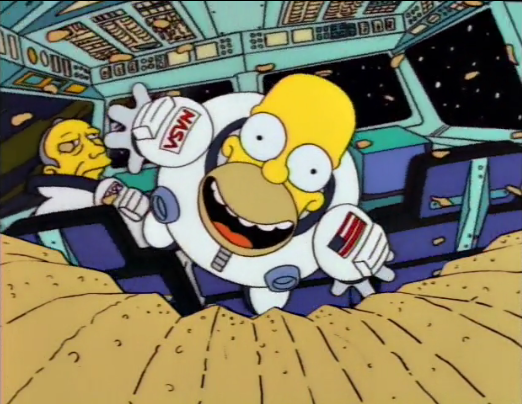
94. Homer and Apu

(originally aired February 10, 1994)
Oh, Apu Nahasapeemapetelion. Your origins so humble, and your destiny so great. Some could cry he was a stereotype, but it was more of the show pulling from real life (if you haven’t noticed, many convenience store clerks are Indian). As the seasons progressed, we’d catch more glimpses of him in his price gouging, yet kind-spirited nature. But this is the episode that really cemented him as a respectable secondary character. His tenure living with the Simpsons made him a family friend and ally, and we learned more about Apu, his expertise, his faith and his dreams, all of which involve his beloved Kwik-E-Mart in some fashion. Between this, a hoard of solid jokes and a show-stopping musical number, this is one of the great ones.

In his efforts to conserve stock, Apu places expired food in the bargain bin, but no one’s thick enough to fall for such an obvious deception… except Homer… twice. Attempting to get even, Homer teams up with Kent Brockman to do an expose piece on the Kwik-E-Mart, which he bungles, but not before getting some damning evidence. We don’t dislike Apu for his actions because here he exists as a mouthpiece for the stingiest, cost-cutting methods of his company (a point he makes later when he comes under fire by Kwik-E-Mart heads, attesting he was only following company procedure. A representative responds by noting, it’s also company procedure to blame any problems on a scapegoat or sacrificial lamb. Apu, not fully getting the situation, replies, “And if I can obtain for you these animals?”) Relieved of his post, Apu realizes his wrong-doings and vows to make it up to Homer and his family. He becomes a helpful house guest: cooking ethnic meals, assisting Marge with efficient shopping tips, and overall improving the family’s way of life. It appears Apu has turned the corner to a new life, indicated by his song “Who Needs the Kwik-E-Mart?” But, like many characters on this show, he secretly yearns for the status quo, and would like nothing more than to return there.

Filling Apu’s position is guest star James Woods, who takes the job as research for a movie role (maybe). He’s one of the best celebrity voices ever on the show, with his wavering method of speech, and the times he gets really fierce (harassing Jimbo in going through a line reading, arguing with his agent on the phone.) He gives a really mellow, yet spirited performance, and he’s hilarious. Meanwhile, Homer accompanies Apu to India to trek to the world’s first convenience store to beg for his job back. Homer, of course, screws things up, and we’re back in America in about a minute and a half. While it may seem like a stupid sidebar, it’s a classic Simpsons moment nonetheless, with the elderly and wise Kwik-E-Mart CEO slurping on a Squishee as zen-like as he possibly can. After taking a bullet for Mr. Woods, Apu manages to restore his employment in the end, and all is well in the world. It’s an episode that seamlessly blends the low-key main story with ridiculous side bits involving celebrities and spur-of-the-moment trips across the world. It also, in one episode, gave new life to a side character, making him someone we truly care about and want to see more of.

Tidbits and Quotes
– The first scene sets the stage perfectly, illustrating the Kwik-E-Mart’s inflated prices. A 29-cent stamp? $1.85. Two bucks of gas? $4.20. Penny candy? Surprisingly expensive. A disgruntled customer attempts to wreck some merchandise on his way out, allowing Apu to deliver a classic line: “Silly customer! You cannot hurt a Twinkie!”
– Homer is as thick as ever here: even while experiencing terrible indigestion, he continues to eat the rancid ham. Afterwards, he confronts Apu, who counters his anger with five pounds of frozen shrimp. Homer astutely notices the shrimp isn’t frozen and it smells funny. Apu ups it to ten pounds. Homer is sold. Cut to an ambulance. Brilliant.
– The barking dog on “Bite Back with Kent Brockman” may be one of my favorite gags in the entire series. I forgot all about it when it popped up, I love it. It’s one of those gags that goes on for so long, and just gets funnier and funnier. I only wish the barking had been even more ridiculously long. It’s made even better by the final bit with the dog barking a message from the Church of Latter-Day Saints.
– The camera hat is a wonderful Simpsons accessory, so inconspicuous. The POV shot from the camera wobbling and slowly entering the Kwik-E-Mart as Apu stares blankly is a great bit of direction. Homer tries to be casual (“Don’t be alarmed, Apu. Just go about your daily routine like I’m not wearing the hat,”) but when Apu notices the buzzing sound and posits that Homer may have a “bee in his bonnet,” Homer freaks out, smashes the hat and runs away. However, it manages to catch incriminating footage of Apu selling the most filth-ridden hot dog in the universe, and ridiculously enough narrating it to the camera (“Now this is just between me and you… smashed hat.”) Homer, of course, buys the hot dog.
– Great bit of the babbling brook Apu believes to be like mocking laughter turning out to be two bums under the bridge having a good time (“Who needs money when we got feathers?”)
– I love the stupid fake-out between act one and act two of Apu appearing to want to viciously strangle Homer, but revealing it to be the signal of apology in his customs. He later comments on how misleading it might appear (“You know, now that I think about it, it may be a little confusing. Many have died needlessly.”) When Apu offers to help Homer for karmic realignment, Homer surprisingly replies that karma can only be dosed out by the cosmos and slams the door. Apu muses, “He’s got me there.”
– In exchange for a Chipwich, Homer agrees to let Apu stay, which leads to a number of great scenes: Apu utilizing store display techniques to push products at home (“Hey, corn! Haven’t had that in a while!”) and the trip to MonstroMart, a wonderful parody of big box warehouse stores (“That’s a great price for twelve pounds of nutmeg!”) Apu wisely advises Marge against the express line, of which a rambling Grampa is at the head of, in exchange for the longest (“All pathetic single men. Only cash, no chitchat.”)
– The musical number is fantastic, with Apu twice knocking over Grampa, and the awkward end where the family just stands there and sits down on the couch (“Everything really wrapped up nicely. Hmm. Much quicker than usual.”) I also love Homer’s anger toward Apu’s mood change (“He lied to us through song! I hate when people do that!”)
– Woods has a great monologue on the phone with his agent, a bit of it sounds ad-libbed but it’s really funny (“How can it be the same movie if they’ve changed my character from a convenience store clerk to a jittery eskimo firefighter? …Uh huh… uh huh… mm hmm… well, actually, that’s a pretty good explanation.”)
– Really sweet moment when Apu finally returns to the Kwik-E-Mart, pumped up to face his demons, but he quickly melts upon seeing the familiar sights of his beloved store (“Ah, my old Squishee machine. And my scum bucket with fly. And a hot check list.”)
– Classic bit of tape with Apu’s 96-hour shift, so delusional toward the end he believed to be a hummingbird. And classic ending where the bullet that hit Apu actually ricocheted off another bullet lodged in his chest from a previous robbery, saving him from death.

93. Bart Gets Famous

(originally aired February 3, 1994)
Being meta is a tricky thing to pull off. Creating a plot of an episode, or even a single joke that is self-referential can come off as being too overt or out of place, or even a little smug. It has to work within your universe, and here, it perfectly does. The Krusty the Clown Show is already a hotspot for jokes about the inner workings of television and its many personalities, and Bart accidentally becoming the new flavor of the month with a quirky catchphrase is a wonderful parody of the initial fame of The Simpsons itself, with Bart Simpson T-shirts aplenty. It’s a great episode that not only pokes fun at the gratuitous content, but also the fickleness of the viewership. It’s a perfect feedback circle… of crap.

We start off with an exciting school field trip to the box factory, one of the show’s greatest set pieces. The idea of it is boring enough, but the mostly empty factory, limply moving conveyor belts and the deadpan tour guide sells it even more, making something so mind-crushingly boring as hilarious as possible. Bart manages to escape to the neighboring TV studio, where he stumbles into a job as Krusty’s assistant. We see Krusty at his more asshole-ish here. Firstly, he doesn’t even recognize Bart, despite the kid having saved him from prison and reuniting him with his father, and then he basically uses and abuses him through most of the second act with various insane odd jobs. Bart isn’t even safe during school hours (“I need to get your fingerprints on a candlestick. Meet me in the conservatory, chop-chop. Don’t worry, everything’s gonna be aaaall right.”) He’s your typical Hollywood blowhard taking advantage of the little folk, even if they are a precocious ten-year-old fan. Bart is asked to fill in a bit part on the show, which turns catastrophic. Covering his bases with an instinctual “I didn’t do it,” he inadvertently invents a catchphrase that would take the country by storm.

Krusty does all he can to milk this cow until it’s good and dry: charging money to witness the boy, record deals, and sketch after sketch of the same damn joke over and over again. What gets most interesting in the third act is Bart getting exhausted of his fame, hoping people can look beyond him being a one-line wonder. I would think this is like both writers hoping people will see The Simpsons beyond its easy-to-market gimmicks and catchphrases plastered on merchandise, or writers going onto other projects and not wanting to be pigeonholed for just doing The Simpsons. Either way, Bart manages to shake off his frustrations and give the people what they want… only to find out his schtick is old hat. Krusty sums it up best (“That’s show business for you: one day you’re the most important guy that ever lived, the next day you’re some schmoe working in a box factory.”) It’s an interesting, entertaining show about being a flash-in-the-pan, the rise and fall of a one-hit wonder, and the vacuous nature of catchphrases. In kind, the episode ends with our beloved cast spouting each and every one of them.

Tidbits and Quotes
– Great opening bit with Homer reading his horoscope (“‘Today will be a day like every other day.’ D’oh! It just gets worse and worse!”) I feel like later, Homer would develop this cocky air about himself, but here, he is true Homer: blissfully ignorant at times, but aware that his station in life sucks.
– I love how brutal Lisa’s fantasy is, where her greatest dream involves inadvertently killing her brother (“Impaled by my Nobel Peace Prize. How ironic.”) Later, Bart attempts to escape into fantasy, but with a television-ruined mind, he can’t come up with anything original.
– We get a bit more insight into Bumblebee Man, who seems to be a consummate professional who doesn’t want to insult his audience with tired old gags. So instead of getting bit in the ass by a lobster, they use a giant mouse trap (“I love it!”)
– Great over-the-top line reading on Homer, finding Bart’s lucky red hat on top of a box (“He’s a box! My boy’s a box! Damn you!! A box!!“) Also, a great addendum at the start of the second act when he comes running in to the house with the box (“I have some horrible, bone-chilling news!!”) only to be pulled back when Bart walks in the room.
– More ineffectual reporting: Kent Brockman adjusts the news to suit his fancy (“Tragic news tonight: 120 dead in a tidal wave in Kuala Lala… Kuala Lum… France!”)
– I like Bart’s innocent response to Krusty tossing him his towel (nice Mean Joe Green reference): “Wow, a big clown hanky!”
– Homer is at his most brain-dead when Bart talks about working for Krusty, first in his rant against helping poor people (which the family pauses after, then chooses to ignore), then Homer injecting his story about being a terrible street musician. After the fantasy, he gives his son his blessing to get an electric guitar, which is not what they were talking about at all. The bit is saved by Homer using his reassurance voice (“Gig, son. When you’re a musician, a job is called a ‘gig.'”)
– I don’t see why people would wait in line for Bart to sign photos of Krusty, while the clown himself is sitting a fair distance from the table smoking. I love his coldness towards an eager little girl fan.
– Another great Dan Castellaneta performance as Sideshow Mel, simultaneously screaming at Bart and vomiting all from behind the bathroom door.
– Krusty gets all the best lines in this show, with not bothering to remember whether his sidekick is dead or just sick, to the slow build-up to him telling Bart is finished, pausing to open the stage door, just in time to reveal all of the swarming fans. He immediately changes his tune (“He’s mine! I own him and all his subsidiary rights!”)
– Great appearance by Conan O’Brien, of course former writer on the show, and at the time recent graduate to late night television. He delivers one of the best lines of the entire series (“Sit perfectly still. Only I may dance.”)
– Phenomenal back-and-forth between Bart and Marge about repetitiveness in television (“I shouldn’t let this bother me. I’m in television now. It’s my job to be repetitive. My job. My job. Repetitiveness is my job. I am going to go out there tonight and give the best performance of my life.” “The best performance of your life?” “The best performance of my life!”)
– I love the crowd’s disappointed nature over Bart’s improv as they leave in disgust (“That’s what passes for entertainment these days, woozle wozzle?”) and the show-ending announcement right after (“Ladies and gentlemen, the Klown Show has been put on hiatus for retooling.”)

92. Homer the Vigilante

(originally aired January 6, 1994)
All through this season we’ve seen Homer take a drastic turn from his previous sadsack demeanor into something of a raving lunatic. The bumbling, but earnest and well-meaning father seems to have been replaced by a selfish, obnoxious, self-satisfying jackass. However, one must always look at the context. When you have characters as rich as this show, one can wax and wane their personalities to fit the story, allowing certain aspects of them to shine and take the helm. With “Homer Goes to College,” we saw his flagrant desire to emulate pop culture lead him into becoming a loudmouth party animal. “Boy Scoutz N the Hood” illuminated Homer’s penchant for childish teasing and torment, which admittedly was a bit less effective. In “Homer the Vigilante,” Homer is a petulant, power-hungry lout who functions purely on impulse. The idea of a neighborhood watch taking things too far is present, but the proper motivations for Homer’s actions don’t seem to sink that deep into his thick noggin, leading some of his behavior to be… kinda dickish.

The crisis starts after a wave of break-ins courtesy of the Springfield Cat Burglar. When local law enforcement seems to be ineffective (as usual,) a neighborhood watch program is started, with Homer volunteering to lead it. Before this point, we have a bunch of great jokes involving the town protecting themselves, like Frink’s mobile robot house and a paranoid Apu shooting down customers from the parking lot (“Thank you for coming! I’ll see you in Hell!”) Homer is elected to lead the watch group thanks to an already whooped-up crowd, but you’d think his actions would cause some dissonance in the organization. Some, like Moe, may just go along with harassing everyday Joes, but Apu? Principal Skinner? They may be Homer’s old Be Sharps buddies, but they’re much more level-headed and respectful. And what about Flanders? He pretty much disappears after the reigns of the watch group are taken from him. I think an internal clashing of the group would have made more sense, and given Homer more of a reason to fight.

There’s also a soft-spoken theme where Grampa’s help is continuously denied, as the masses seem to agree old people are useless… at least until he discovers the identity of the cat burglar: his retirement home neighbor Molloy, smoothly voiced by Sam Neill. It’s first brought up after the rage of enthusiasm after Homer is elected and people get behind him, and then it all kind of stops to introduce this plot angle that we know will culminate in the end. I dunno, it didn’t work for me. But this whole episode could have been garbage and still would have been saved by the It’s a Mad, Mad, Mad, Mad World ending. It fits perfectly with the blind mob mentality of the town that they would be fooled like that, creating a frenzy of people looking for a big T, only to ultimately be bamboozled as Molloy used this opportunity to escape for prison. This episode’s got some problems, but it works for the most part, and has enough classic, funny parts to keep it going.

Tidbits and Quotes
– The opening robbery sequence is full of jokes: Molloy going for his lock pick, then realizing Homer’s left his keys in the door, subduing Santa’s Little Helper and Homer with sausage links, replacing Bart’s portable TV with a book “Coping with Loss,” and removing Marge’s pearls, revealing deep imprints on her neck (she later reveals she has hundreds of them, all family heirlooms.) Bart also had his stamp collection stolen, a fact the family openly mocks him for, as well as Nelson, who literally phones in his “Ha-ha!”
– Frink’s moving house is one of those great “Why?” jokes. Upon danger, the house sprouts robot legs to run to safety; the model version runs, then falls and bursts into flames. Little wooden people fall out of the door, also ablaze. Frink tries to cover himself (“The real humans won’t… burns so quickly.”) Why did he even put people in the model? Then in the next scene, we see the house actually does exist as a full-size model runs away, and bursts into flames too. After seeing the prototype, why would anyone buy it?
– Lisa blowing the jug and Homer having a hoedown is a classic scene, as is the second time around when Homer is deep in thought (which is a hilarious drawing.)
– Nice spin (ha ha) on the spinning newspaper gag (“Is Nothing Safe?”) to have the cat burglar steal that too.
– I love the timing of this scene: Homer runs through the code names (“we’ve got the secret vigilante handshake. Now we need code names. I’ll be Cue-Ball, Skinner can be Eight-Ball, Barney will be Twelve-Ball, and Moe, you can be Cue-Ball.”) Short beat. Moe replies, “You’re an idiot.”
– A pretty dated MC Hammer reference, but I still really like the Rapmaster 2000 bit with all the kids dancing behind Homer.
– More great timing: on Smartline, Homer responds to criticism against him and his organization (“Kent, I’d be lying if I said my men weren’t committing crimes.”) Beat. Kent replies, “Touche.” Then there’s a phone call (“Well it looks like we have our first caller… and I mean ever, because this is not a call-in show.”)
– Another great newspaper the day after the burglary (“Zirconia Ztolen!”) with a drunken Homer as the sub-headline.
– Abe’s got a few good moments in the third act gloating about how he solved the mystery (“So you see, old people aren’t so useless after all. Malloy’s old, and he outsmarted the lot of you. And I’m even older and I outsmarted him!”) He laughs, and Moe tells him to shut up. Abe meekly responds, “I’ve had my moment.”
– Molloy proves to be so charming that mob mentality almost urges to let him go. Oddly enough, Wiggum is nonplussed (“Gee, I really hate to spoil this little love-in, but Mr. Malloy broke the law. And when you break the law, you gotta go to jail.”) Enter Quimby (“Uh, that reminds me, er, here’s your monthly kickback.”) Wiggum is not amused (“You just… you couldn’t have picked a worse time.”)
– I love all the different “big Ts”: the Big T Building, Big T Burgers and Fries, the Tea Factory, and the Big T Theater (featuring Ice T and Booker T). We have some cameos from Mad World actors, the most highlighted being Phil Silvers drowning in his car, with Bart subbing as the kid in the film that told him the stream was shallow enough to drive through.
– Great final line from Wiggum: “No, dig up, stupid!” And the Mad World end title music is among my favorite variations on the end theme.

91. $pringfield (or, How I Learned to Stop Worrying and Love Legalized Gambling)

(originally aired December 16, 1993)
This is one of those episodes where not much seems to happen plot-wise. I read that fans were crowing back in this day that the recent seasons suffered from focusing on gags and humorous set pieces replacing a solid through story, but I say if you have a fair premise and a lot of great jokes, how can you really complain? Faced with an economic crisis, Springfield agrees to legalize gambling and open a casino, where Marge proceeds to get addicted to gambling. That’s pretty much the main story, with little peppered elements by Homer, Bart and Mr. Burns. Our episode opens with some focus in showing us a prosperous 1940s Springfield dissolve into the crummy, dilapidated 90s. A tasteful gag involving Homer putting on glasses he found in the toilet actually fits with the theme: Burns is forced to make layoffs, but hesitates when he spies a bespeckled Homer (“Better keep the egghead. He just might come in handy.”) Even with a thin plot, at least all the jokes are derived from a consistent source.

Burns’s new casino on the waterfront is a rousing success, captivating young and old alike. Homer is hired from within to be a blackjack dealer, whose feeble understanding of the game makes his a popular table. It’s here we get the first appearance of the Rich Texan, a character who is mostly associated with the later seasons, but here, he’s quite funny out of the box (“Homer, I want you to have my lucky hat. I wore it the day Kennedy was shot, and it always brings me good luck.”) Bart is tossed out for being underage and, inspired by the hecklings of the teenage management, he opens his own casino in his treehouse. We get some good gags out of it, and a very special musical guest Robert Goulet, singing the very same naughty “Jingle Bells” tune that introduced Bart way back in 1989. Most interesting here is Mr. Burns, a man who craves money and power, who appears to have found the perfect business (“People swarm in, empty their pockets, and scuttle off!”) As such he becomes a paranoid wreck, adopting Howard Hughes-style germophobia and Kleenex-box shoes.

The primary story is Marge becoming a compulsive gambler, addicted to slot machines. The Simpson household falls to ruins without her, leading Homer to finally confront his wife about her problem. It’s interesting to see straightened arrow Marge to have a vice, but it doesn’t really build to much, that and the stuff with Homer fending the house by himself is kind of reminiscent of “Marge in Chains” or “Homer Alone.” But, again, jokes save all: Homer’s insane overreaction about the Boogeyman (“Bart, I don’t want to alarm you, but there may be a boogeyman or boogeymen in this house!”) and his make-shift meal consisting of cloves, Tom Collins mix and pie crust (the sound effect of him taking a bite is wonderful, then the pause and Homer uttering, “Let’s go see Mom.”) It’s nice they left the show open-ended, like Marge wasn’t going to cure her addiction that quickly, but all-in-all, I kind of wish they did more with the plot. It could have been a bit more emotionally charged. But that aside, this is a really funny show. A real keeper.

Tidbits and Quotes
– I love the painfully awkward pause at the doorway between Henry Kissinger and Burns and Smithers, where there’s nothing really left to say, so Burns just closes the door on him and the story continues.
– Great bit at the unemployment office with Barney, admitting he hasn’t held a job in six years. Kent Brockman asks what kind of training he has, to which Barney shamefully replies, “Five years of modern dance, six years of tap.”
– Just to make sure everything’s square with God, Flanders asks Lovejoy what he thinks about legalized gambling. The good Reverend responds, “Once something has been approved by the government, it’s no longer immoral.”
– Oh God, I love the endless Burns laughing sequence. I’m sure it’s like the Sideshow Bob rake scene where some people don’t think it’s funny because it runs so long, but to me, it just gets funnier and funnier, especially when he’s laughing in church, and then later when he ponders at what exactly he was laughing about, then remembers and laughs again, making you think it may start all over again.
– The pitchmen for the casino design are all hilarious. For some reason, I love the timing with the Englishman’s pitch: the grizzled old waitress comes into frame (“Freshen your drink, gov’nor?”) followed immediately by a Burns closeup of him grimly saying, “GET OUT.”
– Some would say the Gunter and Ernst getting brutally mauled by their tiger is not so funny now considering it pretty much happened with Siegfried and Roy, but for a sick fuck like me, it’s even funnier. This show is prophetic, mark my words.
– Great, in-character line from Marge upon finding a quarter on the floor at the casino (“I wonder if they have a lost and found.”)
– I wonder how Bart was able to afford a giant sign with light bulb framing for his casino. Or how he affixed it to the side of his wooden treehouse all by himself. Now that’s dedication.
– All the Burns scenes are hilarious: his vision of Smithers’s germ ridden face (“Freemasons run the country!”), his spectacular model of the Spruce Goose (“Model?”) and the amazing call-back to it when it seems Burns has regained sanity and is reopening the plant (“I said hop in.”)
– Lisa’s Florida costume is fantastic, as is Homer’s impassioned speech to Lisa when it’s finished (“The only monster here is the gambling monster that has enslaved your mother! I call him Gamblor, and it’s time to snatch your mother from his neon claws!”) And of course, a classic Ralph line at the pageant (“I’m Idaho!” “Yes, of course you are.”)
– Madman Homer running amok at the casino is hysterical, throwing people’s craps and hanging up their phone calls. He’s so crazed he rips the slot machine Marge is using right out of the wall and can’t even speak clearly (Marge first asks him to slow down, then to think before he says each word.) Homer finally gets it out, “You broke a promise to your child,” accompanied by a great music cue and camera whip-around. It’s a pretty impacting moment.

90. The Last Temptation of Homer

(originally aired December 9, 1993)
Going waaaay back to season 1’s “Life on the Fast Lane,” we saw Marge contemplating an affair, which doesn’t seem too out of the ordinary considering the dumb ape she’s married to. However, the flip side of this would be unthinkable: Homer is the luckiest guy in the world that he’s got Marge, and moreover, he knows it. The man’s shortcomings could fill a novel, but the one thing he’s not is unfaithful. That’s what makes this episode so interesting: Homer finds himself impulsively attracted to another woman, and he has no idea how to deal with it. It’s like fate put all the pieces together to screw with him and make him want to be with this other woman. It’s a great throwback to early Homer where life seems to be conspiring against him in every way.

The femme fatale in question is Mindy Simmons, new power plant hire thanks to the Department of Labor forcing Mr. Burns to have at least one woman on staff. Upon first sight, Homer is completely bowled over by how attractive she is, and promptly bolts out of the room, not sure of what just happened. As the show progresses, he gets more and more paranoid about his situation. He learns that Mindy shares the same love of junk food and slacking off at work, which only makes things worse. He attempts to take solace in his beloved family, only to be further perturbed by a very sick wife and the oddball antics from his children. Not even an out-of-body experience can give him relief: his guardian angel, taking the guise of Colonel Klink from Hogan’s Heroes, pulls an It’s a Wonderful Life to show Homer a world where he marries Mindy instead of Marge, only to find Homer is fabulously wealthy, and Marge is the President. Klink quickly gives up, leaving Homer even lower than he was before. Sure, this was presumably all in his mind, but even his wildest fantasies prove to betray him.

Homer’s continuing losing battle reaches a head when he and Mindy are sent off to Capitol City to represent the plant at a big energy convention, and are later gifted to a romantic dinner for two. Then, the last straw: Homer’s fortune cookie reads, “You will find happiness with a new love.” Even sweets have turned on him, and Homer concludes that he can’t fight fate. In one of the sweetest, most genuine scenes in the entire series, Homer breaks down with Mindy about their situation, where she tells him to look in his heart and go from there. It’s a spectacular performance by Dan Castellaneta, as well as guest star Michelle Pfeiffer, and  it looks amazing with the moonlight and shadows in the hotel room. In the end, Homer sticks with Marge, of course, and everything turns out alright. It’s a very intriguing episode regarding Homer, a real human-like portrayal after all the wacky stuff he’s been up to this season. But that’s one of the great things about the show, you never know what shade of character is going to be illuminated each week.

Tidbits and Quotes
– There’s also the B-story with Bart being prescribed glasses, special shoes, scalp salve amongst other treatments and becomes the ultimate social outcast. It’s got a few funny bits, but ultimately is just time filler since the A-story is so much more interesting. I do like the ending where the bullies are shocked to find Bart back to normal… then proceed to beat him up anyway.
– I love Martin’s anger and frustration over not being picked on, as Bart struggles to read a blurry chalkboard (“It’s ‘photosynthesis’!! Damn your feeble brain!”)
– More plant safety: the emergency exit doors are just painted on the walls. When Charlie goes to complain, Burns shoots him off in a tube, that apparently seems to lead all the way to India. Preposterous, yes, but still funny. With him gone, the plant needs a new dangerous emissions supervisor. Burns first goes with foreigner Zutroy until the Department of Labor flags him as an illegal alien (“That’s preposterous! Zutroy here is as American as apple pie!”)
– Homer finishes off his work day (“Another day, another box of stolen pens.”) He tosses them in his backseat with a whole bunch, some of which have been leaking copious amounts of ink on the seat.
– Classic bit with Homer coming up with a fake name to disguise his own story: Joey Jo-Jo Shabadoo. Moe comments, “That’s the worst name I ever heard,” causing another man at the bar to run out crying. Barney calls out, “Hey! Joey Jo-Jo!”
– Homer is befuddled to find Mindy seems to share all of his interests (“Foul temptress. I’ll bet she thinks Ziggy’s gotten too preachy too!”)
– Homer in the elevator with Mindy is a fantastic sequence, starting with both of their inadvertent Freudian slips. Homer attempts to think unsexy thoughts, starting with Patty and Selma shaving their legs, then Barney dancing in a bikini humming the I Dream of Jeannie theme. But he quickly morphs into Mindy and his plan is foiled. Homer decides to abort mission, hit the emergency stop and get off, where he slides down one of the cooling towers. This already makes no sense, but they seem to have been going down in the elevator. Down from what point? Whatever, I still laughed.
– TV betrays Homer too, with each channel featuring programming about adultery. He stops at a commercial with women in workout clothes and the slogan “Just Do It.” He screams and runs out before the end, where it turns out it’s for the NRA (the other one, the National Ringworm Association.)
– Very quick Lionel Hutz appearance, annoyed to find Homer in the knocked over telephone booth (“Hey, you, get out of my office!”)
– I love Stuart the duck, animal worker at the plant, and that later on, when Burns is surveying the antagonism amongst employees on the security monitors, the last is Stuart pecking at an unconscious co-worker.
– Great one-off character with the cheeky bellhop and his inappropriate noises regarding Homer’s king-size bed. Homer is not amused (“Stop that! I love my wife and family. All I’m gonna use this bed for is sleeping, eating, and maybe building a little fort. That’s it!”)
– The sexual tension between Homer and Mindy grows ever thicker. Mindy comments that a mere wall keeps the two from sleeping in the same bed at the hotel. Homer feebly responds, “Walls are a necessity in today’s society.” Later, Mindy seductively suggests the two do something that could get them in a lot of trouble… order room service. Burns becomes aware of this and sends his flying monkeys to stop them a la Wizard of Oz, but alas, the creatures fall out the office window into traffic. After a beat, Burns tells Smithers, “Continue the research.”
– Great bit at the convention with passer-bys chiding the nuclear power booth and Mindy and Homer shooting back insults (Homer yells, “Go to hell!” while throwing a brick.)
– Hilarious quick line from Mindy after finishing her meal at Madame Chao’s (“What a perfect evening. It sure was nice of them to make us cheeseburgers.”) Also, fate screws Homer again, as he was one cookie away from them cracking open the “Stick With Your Wife” barrel.
– That last scene with Mindy is amazing, as I’ve said, even from the start: Homer invites Mindy in, she sheepishly says, “Okay.” Homer then parrots what she said in a kidding fashion, like mocking her because he’s so fed up and defeated with the situation, feeling he has no choice but to sleep with her.