144. Lisa the Iconoclast

(originally aired February 18, 1996)
Lisa episodes always tend to be more understated. Not as bombastic as episodes starring Homer and Bart, but more introspective, or about a broader topic. In this show Lisa inadvertently uncovers a horrible truth regarding the town’s beloved founder Jebediah Springfield, that he was actually a murderous pirate who had nothing but contempt towards the town. This occurs during preparation for the town’s bicentennial celebration, and if one thing unites the typically ornery and volitale citizens of Springfield, it’s their mutual love and respect for their town founder. Among those excited is Homer, who manages to horn his way into the position of town crier, who he admittedly is quite good at (Bart comments, “You’re a big fat loudmouth and you can walk when you have to.”) A particularly sweet component of this episode is that Homer believes in Lisa’s story (remarking she’s usually right about everything), and vehemently assists and vouches for her in her quest to expose the truth.

Lisa finds herself butting heads with the curator of the Springfield Historical Society (where she found Jebediah’s confession stuffed in his old fife) Hollis Hurlbut, voiced by Donald Sutherland, giving a wonderfully subtle performance. Hurtbut assures Lisa the note is a forgery, even with her logical evidence to back it up. Any attempts Lisa makes to spread the truth are met with great scorn. From the school to Moe’s Tavern, no one will bear to hear anything derogatory about Jebediah Springfield. Lisa’s pursuits can only be calmed upon exhuming the founder’s corpse to see if he bears a silver tongue (his actual one apparently was bitten off during a grog house fight). When no tongue is found on the skeletal remains, Lisa is discouraged, but soon unravels the mystery, finding that Hurlbut is attempting to cover up the truth, unable to admit he had spent years devoting his life to a fraud. Unable to cope, he swiped the silver tongue off the body quickly, hoping the controversy would fade. But in the end, Lisa finds she just can’t rain on the town’s parade and keeps the facts to herself.

Like many Lisa episodes, this one doesn’t go for the huge laughs, but more focused on the content and feelings of the characters that keep it going. Jebediah Springfield’s true past is reminiscent of many other famous historical figures whose pasts may not be as clean-cut as we are led to believe. However, the ending is spot on: regardless if the man was the real deal, the legend certainly is. It brought out the best of the entire town, and that makes the myth just as real as anything. As I said, I love that Homer teams up with Lisa in this, and also that both end up in dour positions as a result: Lisa seemingly being proven wrong, and Homer being stripped of his town crier position as a result of making a fuss. The best moment of the episode is when Lisa apologizes to her father, who accepts, and Homer attempts to feign a smile until he deflates into a mope. He wants to keep his spirits up for his daughter, but can’t quite bring himself to it. But of course things are a-OK at the end, as father and daughter lead the parade in grandiose fashion, a sweet end to an interesting show.

Tidbits and Quotes
The beginning film strip of young Jebediah Springfield (played by a young Troy McClure) is very shoddily made, with stage hands and boom mics in shots, and a poorly disguised stunt double for McClure when he’s taming the buffalo.
– ‘Embiggen’ and ‘cromulent’ have both entered my personal lexicon. They may even be real words at this point. The former certainly sounds like one. Embiggen (verb): To make bigger.
– I believe this is our first mention of Kearney being an especially old fourth grader, who, since he can recall Watergate, must be at least twenty-five years old. Later episodes would reveal he has a young son, Kearney, Jr.
– I love the uselessness of the essay contest, that the top eighteen essays will be put on file at the library, to rot away unread.
– I really love Jebediah’s actual name Hans Sprungfeld. It’s very silly.
– Wonderful awkwardness between Lisa and Hollis after she discovered the confession. The “You have arthritis?” line was apparently an ad-lib from Sutherland, and Lisa’s quieted “No…” is adorable.
– I love the title of Lisa’s essay, “Jebediah Springfield: Super Fraud.” She certainly doesn’t sugar coat, I can give her that.
– Nice quick bit with Comic Book Guy at the copy store, paranoid Homer will rip off his unpublished screenplay. Homer is just waiting for Lisa, but makes a mental note: “Steal his idea.”
– Brilliant bit when Quimby warns Lisa about the corporations sponsoring their bicentennial. Lisa rebuts that they’re sponsoring a murderous pirate, to which one man responds indignantly, “A pirate? Well, that’s hardly the image we want for Long John Silver’s!” The animation of their quick exit is pretty funny too.
– I would think Jebediah’s skeleton, not to mention his clothes, would be mostly deteriorated after all this time, but I guess it’s worth it to have Wiggum desecrate a corpse for a little ventriloquism act.
– I love the pathetic sight of Homer shaking an alarm clock when his town crier bell is taken, almost similar to him singing the blimp song with a pickle in “Lisa the Beauty Queen.”
– The flashback of Hans fighting George Washington is pretty epic, and pretty stupid. But even that is handled with care, and lays in a subtle clue about the end. We see Hans smash against the portrait and knock it to the ground, which must have damaged it slightly, at least enough to Hans to catch part of it on his boot and rip it, which he later used to write his confession on. Lisa completes the puzzle, and exposes Hurlbut, who stupidly has displayed the stolen silver tongue out in the open in one of the dioramas.
– Hilarious bit where Quimby has hired a sniper to take out an eight-year-old girl, who still fires a shot after Lisa doesn’t expose the truth as she walks away.

143. Bart the Fink

(originally aired February 11, 1996)
There was a time when Krusty actually had artistic integrity. He was a clown of the people, one who lived to entertain. He has some of that vigor of the past deep within him somewhere, but his enthusiasm has been replaced by his status as a celebrity, his high accolade and millions of dollars made from shoddy merchandise. He’s become so far removed from his humble roots that if you take away the fame, you’ve broken the man completely. And that’s precisely what happens in this episode, as Bart inadvertently gets Krusty cited for massive amounts of tax evasion. His show (and his trademarked name) are stripped away completely, as are all of his subsidiary assets and his estate. He gets increasingly despondent about his situation, eventually culminating in him driving his plane into a mountain side, where he is declared dead.

This episode is an absolute vocal tour de force from Dan Castellaneta, giving his all as Krusty, loudly bemoaning his predicament and bitching about having to be a normal human being (“I was a big cheese. A huge cheese! And now look at me! I got to ride the bus like a schnook. I got to live in an apartment like an idiot! I have to wait in line with a bunch of nobodies to buy groceries from a failure!”) A key scene depicts Krusty’s show under IRS scrutiny, now dubbed the “Herschel Krustofsky’s Clown-Related Entertainment Show,” with Krusty in sweats forced to perform with no sets or props. Is his attempted enthusiasm his natural showmanship, or just his desire to stay on the air as a celebrity? I dunno, maybe it’s a little of both. Meanwhile Bart has to cope with ruining the life of, and then by association causing the death of, his beloved hero. As a result, he seems to see Krusty everywhere, until he realizes all of his sightings had some kind of connection… maybe Krusty isn’t dead after all.

As in many classic episodes, Bart and Lisa join forces to put this mystery together; it turns out Krusty is alive, now reborn as Rory B. Bellows, man of the sea. Krusty seems to have had a change of heart, no longer desiring a life of notoriety and riches, but a simple life of quiet solitude. I feel like I can buy this, that at his lowest point, Krusty concluded that he can begin life anew in an entirely different direction. But we’ve only got two minutes of show left so we have to get the Klown back into Krusty. Bart manages to convince him by reminding him how he’s more respected than all the country’s educators, and Krusty declares he’s not going to let them hog all the respect. I feel like the joke would have worked better if Krusty hadn’t already had a monologue about it earlier (“Everywhere I go I see teachers driving Ferraris, research scientists drinking champagne. I tried to drink a Coke on the bus, and they took away my pass!”) But regardless, the status quo is restored, a fair enough end to an episode with great performances and plenty of laughs to go around.

Tidbits and Quotes
– To receive an inheritance from their deceased great aunt Hortace, the Simpsons must stay one night in a haunted house. But unlike “Homer Loves Flanders,” the joke here is that the stay is actually quite lovely (Lisa comments, “Their tap water tasted better than ours.”) In the end, each Simpson only gets a hundred dollars each, with the rest going to Ann Landers.
– Another great Springfield business: the Tacomat, now with a special: 100 tacos for $100. Comic Book Guy makes out with a wheelbarrow full, all set for a Doctor Who marathon.
– I love the running gag about the various stupid bank promotions, first with “You’ll Go Ape Over Our Car Loans” (“A professional in an ape mask is still a professional,”) the reindeer antlers, and then later in New York, “Our Interest Rates Are Through The Roof!” with a man wearing a giant house.
– It’s kind of odd that Jimbo harasses Bart for only a one dollar check.
– Great laugh from Milhouse when he exposes his autographed stomach to some grossed-out girls. It’s so delightfully nerdy.
– One of the greatest scenes in the entire series is with the Cayman Islands representative. His character design is great, and the timing of his scene is just perfect (“I’m sorry, but I cannot divulge information about that customer’s secret illegal account. …oh, crap. I shouldn’t have said he was a customer. Oh, crap. I shouldn’t have said it was a secret. Oh, crap! I certainly shouldn’t have said it was illegal. …it’s too hot today.”)
– Great bit with Kent’s tiff with an off-screen producer on his pronunciation of ‘evasion’ as ‘avoision.’
– I love how uncontrollably devastated Krusty is meeting with the IRS. When told they’re going to garnish his salary, he thinks they said ‘celery,’ but he wasn’t actually joking, he’s just overtly (and loudly) distraught.
– IRS Burger is an example of a set-piece with ten jokes in one scene. The idea that the IRS wouldn’t just repossess the Krusty Burger building, but open their own restaurant is stupid enough, then we have Homer ordering various joke items (“I’ll have four tax burgers, one IRS-wich, withhold the lettuce, four dependent-sized sodas, and a FICA-ccino.”) Then Pimply Faced Teen gives him a form to fill out, which Homer intently does, asking Marge what her gambling debts were for the year (to which she loudly replies, “Seven hundred dollars!”)
– I love Krusty’s plane, the “I’m-on-a-rolla-Gay,” and Krusty’s sentimental memories of it (“I used to fly to Vegas in it with Dean Martin. One time we were flyin’ in it, and the moon hit his eye like a big pizza pie! We wrote a song about it! But it ended up infringing on one he recorded years before.”) I like the subversion that you think it’s going to be the origin of that song, but actually isn’t, making it even more stupid and hilarious.
– I love how mean Krusty is toward Bart, who is nothing but apologetic to him. He even considers punching a ten-year-old in the face when he asks him to, but not even he at his lowest point can go through with such a horrible thing.
– We see Chalmers and Agnes Skinner on a date this episode, and Skinner’s wishes for a distraction from the awkwardness are answered as Krusty’s plane whizzes by (“That’ll do nicely.”)
– Great read by Chief Wiggum proceeding to the crash site (“Folks, show’s over, nothing to see here… oh my God, a horrible plane crash!! Hey everybody, get a load of this flaming wreckage! Come on, crowd around, don’t be shy, crowd around!”)
– John Swartzwelder is among those at Krusty’s funeral, who for some reason has a Kermit the Frog puppet.
– Troy McClure is the perfect host for Krusty’s funeral (past ones he’s helmed include “Andre the Giant: We Hardly Knew Ye” and “Shemp Howard: Today We Mourn a Stooge.” It’s a bit random why he’s there, but I liked Bob Newhart as a guest, and his stumbling attempt at giving a speech about a man he knew nothing about. Then Troy concludes the funeral (“We’ll be sitting shivah at the friar’s club at 7 and again at 10. You must be over 18 for the 10 o’ clock. It gets a little blue.”)
– I love Homer’s attempt to console his son (“Don’t let Krusty’s death get you down, boy. People die all the time, just like that. Why, you could wake up dead tomorrow.”) He stares at Bart for a few seconds… then quickly bids him good night.
– Bart blows up a Krusty balloon asking Captain McAllister if he’s seen him. The Captain mistakes the distorted face as Handsome Pete, a midget accordionist who dances for nickels with a face just like Krusty’s, but more manic looking, perhaps the most insane idea for a Simpsons character. But we also get the great line from the Captain, “Not a quarter! Yarr, he’ll be dancin’ for hours!”
– We get a semi-satisfying conclusion to Krusty’s money problems where he reveals the life of his other persona is insured for a lot of cash… then his boat explodes.

142. Scenes From The Class Struggle In Springfield

(originally aired February 4, 1996)
I feel a lot of regular fans of the show are not too thrilled about Marge episodes, but I think there’s great potential in delving into her character. I’ve addressed this many times, so pardon any redundancies. Any hopes and dreams Marge had for herself were basically extinguished upon getting knocked up, making her a doting housewife. She’s the kind of person who never wants to raise a fuss or do anything out of the ordinary, unless it’s a happenstance impulse, like when she became a cop. There have also been many times she’s dreamed of being more affluent; she looks upon the high life of the well off with awe, thinking they are truly the better people, a life she cannot attain. But when presented that opportunity, she goes for it, ending up getting sucked into this other life that turns her into something she’s not. It’s not the jokiest of episodes, episodes focused on Marge and Lisa never are, but it certainly raises some interesting character stuff, and has a lot of classic moments.

On a trip to the outlet mall to get a new TV, Marge uncovers a ridiculously marked down Chanel suit. Her overly modest personality is illustrated immediately in her hesitance to buy it (“It wouldn’t be right to buy something just for me. If it were a suit we all could wear, maybe…”) She eventually does, but is discouraged that she has no special place really to wear it but going to the Kwik-E-Mart to run errands. There she encounters a former classmate Evelyn, a high society girl who never really acknowledged Marge, but only does so now by her fancy, expensive suit. She invites her to the Springfield Country Club, Marge’s ticket to a seemingly better life. From the start we see how the rest of the family has no real interest in this strange new place. Lisa is vocal about the highfalutin nature of it all (until she spots some riding horses), and Bart and Homer are mainly bored or bewildered by it. Marge meanwhile runs with a new crowd of incredibly pompous women with equally pompous names (all ridiculous alternate pronunciations of normal names, like Eliza-beth and Rau-berta), but despite their gilded, self-centered ways, Marge is enraptured, believing this is how the “good” people are.

There’s a small subplot later in the show where Burns challenges Homer to a game of golf, which gets some earned laughs, but is mainly there to pad out the story. Responding to snide commentary from Sue-sin, Marge manages to alter her dress a few times to make it appear different, but an incident with the sewing machine completely destroys it. At her height of her desperation, she ends up going to Chanel and blowing through the family’s savings on a brand new dress. At this point, she’s getting especially curt with the family, particularly Lisa. Her continued dwellings in the high class world has made her near antagonistic toward her seemingly imperfect family. This continues to build as she forbids Homer from driving their crappy car to the valet, and before entering the club, demands they all must behave (“No vulgarity, no mischief, no politics. Just be good!”) But she then manages to see what she’s become and what she stands to lose, realizing how much she loves her family just the way they are. It’s a great episode with a nice lesson, and we learned a bit about Marge, the show’s most underrated character.

Tidbits and Quotes
– I love Bart and Lisa’s suggestions where to get a new TV: the former at Sharper Image (“They’ve got a TV shaped like a ’50s diner!”) and the latter at the Nature Company (“They’ve got a TV assembled by Hopi Indians!”) Marge asserts that they can’t afford to go to a store with a philosophy.
The salesman gives a great pitch to Homer on the ‘Carnivale,’ a TV that looks exactly the same as their old one (“It features two-pronged wall plug, pre-molded hand grip well, durable outer casing to prevent fall-apart…”) Homer is swayed immediately (“Sold. You wrap it up, I’ll start bringing in the pennies!”)
Cletus has a great one-two punch this episode: picking out the Classy Lassy shirt for Brandine, then later popping in when he hears the outlet mall will be receiving slightly burned Sears activewear later in the day (“What time and how burnt?”)
– Marge’s debate on buying the suit is filled with small great moments, maintaining that she does treat herself (“I treated myself to a Sanka not three days ago.”) Lisa explains she doesn’t have to rationalize everything, and Marge ends up buying it… then rationalizing it’ll be good for the economy. And the design of the suit is real good too, Marge looks great in it. I also like how when Marge looks at the tag, and later drives to the actual store, the ‘Chanel’ name is always conspicuously blocked.
– We’ve got the gas station right in front of the Kwik-E-Mart, which we only see if the plot or a joke requires it. The only other time I can think of was “Sweet Seymour Skinner’s Baadassss Song,” but there may have been others. My readers seem to be more knowledgeable than I, so maybe they’ll know.
– Lisa is displeased about the country club from the start (“Do I have to go? That country club is a hotbed of exclusionist snobs and status-seeking social climbers.”) Marge doesn’t approve of Lisa using the word “hotbed.”
– Great animation of Krusty flailing to get out of the way of Homer’s car. He appears throughout the show constantly getting hurt (great animation of him falling to the ground after getting hit by a golf club), then after a final injury, he bemoans, “I knew my kind wasn’t welcome here.” Whether he’s talking about clowns or Jews, I’m not sure. Perhaps both.
– Marge is really out of sorts with these high society women, talking about how all of their food is fancy and mail order. She attempts to jump in with her own related commentary (“I get food in the mail, but in a different way. Every month, Good Housekeeping arrives in my mailbox bursting with recipes. Sometimes the most satisfying meal is the one you cook yourself.”) One of the other women responds with a story of how rather than waking their maid, she and her husband dared to microwave their own soup. It was a spectacular mess, but they had the maid clean it up.
– I love how Kent Brockman’s bratty daughter looks exactly like him, white hair and all (“I didn’t ask for a bologna sandwich! I wanted an abalone sandwich!”)
– Guest star Tom Kite is slightly unnecessary, but he’s made worth it when he reveals that Homer stole his clubs (“Stay the hell out of my locker! You can keep the shoes!”) and then later when he’s coaching Krusty, who then gets knocked unconscious by a lost club, he darts his eyes and runs off.
– That Sue-sin’s a real bitch, with her snide commentary about Marge’s suit. Evelyn attempts to mollify Marge’s concerns (“Don’t worry, Marge. Susan’s idea of wit is nothing more than an incisive observation humorously phrased and delivered with impeccable timing.”) Later at the gala event welcoming the Simpson family, Susan explains, “I hope she didn’t take my attempt to destroy her too seriously.”
– The golf subplot has a lot of great bits: Homer teeing off in the men’s room, hitting one in the handicap stall as his finale, Burns’s imitation of Richard Nixon (“Oh, I can’t go to prison, Monty. They’ll eat me alive!”), the greatest use of Homer’s “Mmmm…” for “open faced club sandwich,” and Burns’s slow realization that he actually isn’t a golf champ. The plot also even ties in with the main story, as Homer has to swallow his pride and keep Burns’s secret to assure Marge will get in the club.
– God, I love the second act break. After mangling the suit beyond repair, Marge laments, “At times like this, I guess all you can do is laugh.” Then five seconds of silence before the fade to black. Amazing.
– We get a horrid look at Patty and Selma’s closet. Their scandalous purple number is much too tight on Marge, and I can’t even imagine (nor do I want to) what it looks like on Selma.
– I love each of the family’s mentionings of what they’re going to do at the club, each completely true to their character: Homer aims to amuse with the anecdote that got him bleeped on the radio, Bart looks to be up to some trickery posing as an Italian count, and Lisa plans to ask if people know their servants’s last names (or in the case of their butlers, their first.) Marge immediately reprimands all of them, even Maggie, and we get beautiful performances by the subdued family (Homer’s is particularly heartbreaking: “I just won’t say anything, okay, honey?”)
– Marge says she can return the dress, but they’ll just have $3300 credit at Chanel. Homer asks, “They have beer and gum, right?”
– The very ending is sweet, with the family back where they belong and are most comfortable: the Krusty Burger. Pimply Faced Teen sees it otherwise (“Man, you’re crazy. This place is a dump!”)

141. Two Bad Neighbors

(originally aired January 14, 1996)
Last time I gave Team Homer” some minor criticism for being too silly, so now I’m gonna look like a big ol’ hypocrite by saying how much I like this one, one of the craziest episodes of the entire series. In this show, the large mansion across the street from the Simpsons which has always been there and always will be has been sold… to George H.W. Bush. The real George Bush (voiced by Harry Shearer, that is.) It doesn’t get more absurd than that, but dammit the show makes it work. His explanation of coming to Springfield is believable, wanting to get away from politics by moving to the town with the lowest voter turnout. His presence is much to the awe of most of the town, and George builds a small kinship with Ned Flanders, who shares his penchant for good Christian living and kooky catchphrases (“Fine and dandy like sour candy!”) But nothing could prepare our ex-President for a brush with our favorite little hellion Bart Simpson.

Bart becomes a pestering irritant to Bush with his constant questioning and lack of traditional respect for elders. So the episode pretty much becomes “Dennis the Menace” with these two, as well as Barbara Bush as the kindly forgiving Mrs. Wilson. Sure, Bart isn’t typically this bratty or spastic, but it’s not incredibly out of the realm of his character, and moreover I just love the idea of this parallel. In the show’s early days, the real H.W. Bush made an offhand comment in one of his speeches that America should be more like the Waltons and less like the Simpsons. This 100% was something one of his speechwriters came up with as a good sound bite, but it gives this episode some context, making Bush actual enemies with Bart and Homer. In no way does this feel like vindictive or petty on behalf of the writers though, since the tone is always goofy and Bush is never portrayed as a truly bad guy, just out of touch with the current generation, as evidenced with that real-life quote.

When Bart’s antics accidentally lead to the destruction of Bush’s newly completed memoirs, he is given a light spanking, something that infuriates an already agitated Homer, who had been jealous of Mr. Bush the moment he stole his thunder at the swap meet. The third act becomes a ridiculous prank war between the Simpsons and George Bush, ending in an all-out brawl in the sewers. It’s so, so very absurd, childish and stupid… but damn it all if it isn’t so much fun to watch. By the time Mikhail Gorbachev shows up with a house warming gift at the end, I’m beyond the point of questioning what’s happening. There’s no sort of political angle here, or any harsh criticism about Bush at all; it’s still a story about our characters: Homer’s rampant jealousy, and the generational rift between Bart and his elders. I’m sure when this aired, it must have completely polarized the fans, some thinking that a literal former president showing up in Springfield was just too much to swallow. But I absolutely love it. It was one of my favorites as a kid, and it’s even better now being more familiar with H.W. Bush. As dumb as it is, it appeals to multiple sensibilities, like the show does at its best.

Tidbits and Quotes
– I’ve always loved the beginning TV bit (“The Grand Nationals of Sand Castle Building… Preview!”) which has a bait and switch with promises of bikini girls and daredevil surfing… exciting things the beach would normally have, but all of which has been cleared for painstaking sand preparation.
– I don’t remember ever firmly establishing where Apu lived… he lives in an apartment later on with Manjula, and we saw him with Princess Kashmir at the Fiesta Terrace, but that might have been her place. So I guess he moved after this. Lots of people show up to the rummage sale, but I assume they don’t all live on the same block.
– Great artful covering up of the “Ayatollah Assahola” T-shirt to get past censors, and Homer displaying more specific knowledge of how such a dated shirt could still be relevant today (“It works on any Ayatollah: Ayatollah Nakhbadeh, Ayatollah Zahedi… even as we speak, Ayatollah Razmada and his cadre of fanatics are consolidating their power!”) Also, great explanation of the ‘Disco Stu’ jacket, that he ran out of space to write ‘Stud.’ And that of course leads to the introduction of one of the greatest tertiary characters: Disco Stu (“Disco Stu… doesn’t advertise.”)
– I love Mrs. Glick’s firm enforcement of her item’s prices, and their very specific uses (“Just candy, Ned! Ninety dollars!”)
– God, I love Skinner’s dissertation of the tie rack, first complaining about the loud motor, then of the inability to reach ties in the back if it’s taken out. He then surmises since he only owns one tie, he’ll pass… but then he comes back and buys it. And then later when Homer puts the motor up for sale, he takes that too. So dumb.
– Homer’s bombastic karaoke is lovably bad, with Wiggum accompanying on keyboard.
– I love Rod and Todd’s harrowing warnings to George Bush about Bart, with Ned quieting them down (“Now Todd, don’t scare the president.”) Then Bart comes by on his skateboard and dramatic music plays.
– I really like Bush’s glee at the U.S. News cover article, featuring Clinton as Public Enemy #1 (“Roasting the new guy…”) Again, not painting him as vindictive, he’s just glad to see his replacement is catching some flack just as he did for four years.
– I love all the scenes with George and Bart. So many great quotes, like when Bart screws with his card shuffler (“Those cards are from Air Force One, and they only give you so many packs!”) and then when he accuses the boy’s hands are filled with mud and cookies, and then Bart reveals clean hands, he mutters under his breath, “Probably stole a napkin…”
– George at the drive-thru line is hysterical, his confused reading of “Krusty Burger” is fantastic, and his insistence that cheeseburgers are more of a Wednesday thing. Homer, behind him in line, incessantly honks at him until a secret service member disables his horn (“Hey! My taxes pay for that horn!”) Even better is that Homer willingly popped the hood when the agent asked so he could do it.
– Great bit where Homer has to consult a book that says Bush was President, then begrudgingly concludes, “Well, his story checks out.” He then sadly asks if his wife would love him more if he was President, to which Marge responds that as long as he keeps the car full of gas, she’s happy. Homer is relieved, then nervously looks back at the car in the driveway.
– I love the ending of Bush’s memoirs (“And since I’d achieved all my goals as President in one term, there was no need for a second. The end,”) and the fact that he considers them good, not great. The animation of the motor going nuts and wrecking everything in the garage is fantastic, especially the exterior shot where you see it all in silhouette, then the final part where a light bulb drops and causes it to reactivate and shred up all the memoirs. And great minor joke where we see one bit of paper fly by reading (“V.P. Quayle Disappointment.”)
– Great brief moment with Abe, not knowing what all the fuss is about that Bart got spanked (“When I was a pup, we got spanked by Presidents till the cows came home. Grover Cleveland spanked me on two nonconsecutive occasions!”) Marge replies that she just doesn’t believe in that punishment, to which Abe retorts, “And that’s why your no-good kids are running wild!” He accusingly points to Lisa, who is quietly reading.
– It’s so very childish, but excellently executed prank with cardboard cut-outs of Bush’s sons at the door, but only serving as a ruse to slap a rainbow wig on George’s head. The writers claimed they didn’t even know who “George Bush, Jr.” was at the time, but we’d learn alllll about him soon enough. I love the reveal of Bush at the Elk’s club with his sheared technicolor hair (“Now, are there any questions? …keeping in mind I already explained about my hair.”)
– This episode contains my favorite line reading of the entire series. George is pushed to the limit and is driving donuts on the Simpsons lawn. Marge naively questions that maybe he’s lost. We’ve panned across the front window until we see Homer at the edge of the window, who has an amazing stern expression on his face. “He’s not lost.” I can’t even describe it. It’s so severe and knowing, I laugh every goddamn time. That and, “It’s time to hit him where he lives!” “His house?” “Bingo.”
– The great Bush lines keep coming after he gets out of his car (“Can’t decide if this will be considered feisty, or crazy”) and then when he spies Homer and Bart through the sewer grate (“If he thinks George Bush’ll stay out of the sewer, he doesn’t know George Bush.”)
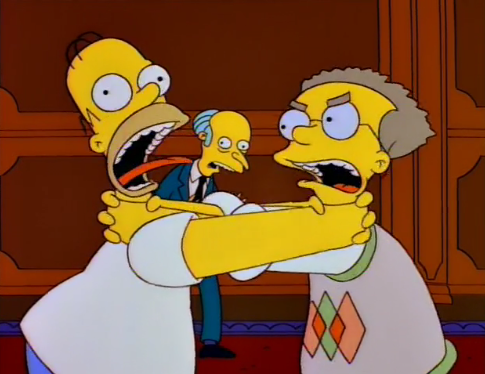
– I love Bush threatening while choking Homer, “I’ll ruin you like a Japanese banquet!” referring to the famous incident when an ill Bush vomited on the Japanese Prime Minister at a state banquet.
– Hank Azaria as Gorbachev always makes me laugh (“I just dropped by with present for warming of house. Instead, find you grappling with local oaf!”)
– The ending is great too, with Gerald Ford moving in and Homer finding his true equal, with both of them tripping on the walk to the house and uttering “D’oh!” in unison. Can’t think of a better final moment than that.

140. Team Homer

(originally aired January 6, 1996)
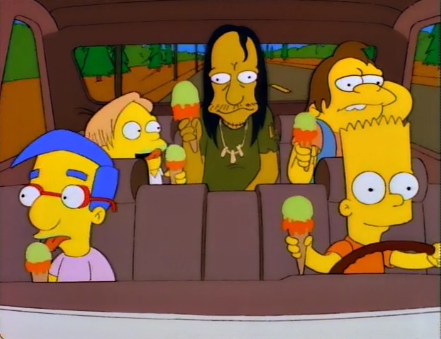
This season has been filled with a lot of emotional episodes that take deeper looks at our characters and their relationships in new, interesting ways. “Team Homer,” on the other hand, feels like a throwback to the sillier, more outlandish episodes of season 5 (surprise surprise, David Mirkin is the executive producer here). We have two stories running side by side, premises that feel a little scant, but have enough laughs and interesting stuff in them to keep going. The main story reintroduces Homer’s love of bowling; in order to play during league night, he wrangles Apu, Moe and Otto together, thus introducing the world to the Pin Pals. They eventually start building a camaraderie, and work their way up through the ranks during tournament play. However, to procure the $500 team registration fee, Homer had to get a loan from Mr. Burns. High on ether at the time of the request, now the sinister old man demands an explanation… until he has a change of heart and decides he’d actually like to join the team.

I don’t know how much I buy Burns’s chummy turn here, especially given how incredibly sudden it is. He exhibits the social awkwardness of a sheltered rich person, but without much contempt for his fellow man. I think back to “Burns Verkaufen Der Kraftwerk,” where Burns gleefully went “slumming” at Moe’s, but still clearly talked down to these penniless layabouts known as the middle class. Here he’s just an old softie, bowling consistent gutter balls, much to the rest of the team’s chagrin. The pathetic sight of him rolling the ball and his excitement regarding it (“Look at that! All the way to the end with only one push!”) keeps the show entertaining, but something just didn’t sit right about Burns’s behavior here. His snap back to his selfish ways at the end is equally as unusual; it’s all meant for the sake of humor, as Burns explains (“Teamwork will only take you so far. Then, the truly evolved person makes that extra grab for personal glory. Now, I must discard my teammates, much like the boxer must shed roll after roll of sweaty, useless, disgusting flab before he can win the title!”) But on the whole, it just didn’t feel like Burns.

Strangely the B-story works a bit better for me. When Bart causes a riot at school with his MAD magazine shirt “Down with Homework,” the students are forced to wear uniforms, turning them into conformist zombies. Everything about the plot rings so true, from the children’s quick descent into anarchy after Bart reveals the shirt, and the faculty’s complete contempt for anything resembling an individualistic thought. The kids become empty shells of who they once were, forgetting their most basic instincts and catchphrases (“Ha… ho?”) In the end, rain turns the non-color fasted uniforms tye-dye, and the kids go on a rampage once more. Both of these stories are pretty thin, and it’s fine that they don’t really intersect at all. While I have issues with Burns in the main story, I still laughed a fair amount at some of the bowling antics and the different teams, and the school uniform story has a lot of great Skinner and Chalmers stuff. So I can’t complain that halfway through an absolutely spectacular season, I find an episode that’s merely pretty hilarious and memorable. That’s fair enough to me.

Tidbits and Quotes
– Lunchlady Doris has her final speaking role here, due to the unfortunate passing of Doris Grau. At least it’s a great appearance (as always), revealing she’s the mother of one of the seemingly endless squeaky voiced teens working low-paying jobs all over Springfield.
– Moe has a great monologue after being denied right to bowl (“You go through life, you try to be nice to people, you struggle to resist the urge to punch in the face, and for what? For some pimply little puke to treat like dirt unless you’re on a team. Well, I’m better than dirt! …well, most kinds of dirt. I mean, not that fancy store-bought dirt. That stuff’s loaded with nutrients. I can’t compete with that stuff.”)
– The plotting of the bowling story is pretty solid as is, beginning and ending with Otto playing the crane game, along with it being integral to the climax. And what is his ultimate prize? A lobster harmonica. Of the many Simpsons products I want to be real, that’s in the top 5.
– The Skinner/Chalmers stuff is so rich. Hank Azaria is hysterical as Chalmers is very slowly about to give the school a perfect 10 score (“I’ll just write the zero first… now, a vertical line to indicate the one…”) Then of course he’s trampled by a herd of out-of-control kids. This leads to an equally hilarious bit with another Vietnam story from Skinner: a distraction by MAD Magazine caused his platoon to be captured, and he recalls his days in a POW camp surviving on just a thin stew. His personal torment comes not from that, but his inability to recreate the stew here in the States.
– The early Burns stuff is great, with his hallucinations of Homer as the Pillsbury Dough Boy (“I owe my robust physique to your tubes of triple-bleached goo!”) and supposed murder of Hans Moleman, who he believes to be the Lucky Charms leprechaun and tries to extract his gold with a power drill. Also funny later is when he expresses shock over his bowling payment, then finds it was for his boweling (“Remember that month you didn’t do it?” “Yes… that was unpleasant for all concerned.”) And then he expresses shock over the actual bowling payment.
– All the different teams are great, from the Stereotypes, consisting of Luigi, Willie, Cletus and Captain McAllister (Apu muses, “They begged me to join their team! Begged me!”) and the Homewreckers, consisting of Lurleen Lumpkin, Princess Kashmir, Mindy Simmons and Jacques. Considering Homer’s relationship with those ladies, I suppose that game must have been slightly awkward. Also fabulous is the police force team, with Wiggum, Eddie, Lou and Snake. Wiggum uncuffs Snake to go bowl, who then proceeds to run off.
– Bart complains to his mother the new uniforms suck. Marge wonders where he could have picked up such language. Pan over to Homer on the phone (“Yeah, Moe, that team sure did suck last night. They just plain sucked! I’ve seen teams suck before, but they were the suckiest bunch of sucks that ever sucked.”) Marge scolds him, so Homer hangs up (“I gotta go, my damn wiener kids are listening.”)
– There’s a lot of great Moe lines in this, from his reaction to Bumblebee Man’s taunt “Buenos noches, senoritas!” (“What’d he say? Was that about me?”) to his displeasure at Burns (“Call this an unfair generalization if you must, but old people are no good at everything.”)
– Great exuberant reading of Milhouse’s “I’m freaking out!!” and final joke of the story of Skinner realizing his mother’s dress will react similarly, running off, with Chalmers following, commenting, “Now this I gotta see.” Wasn’t there a future episode showing Chalmers had an interest in Skinner’s mother? I don’t remember. Plus it was a post-classic era episode, so who cares.
– I love Homer’s stolen Oscar from, of all people, Don Ameche, and the timing and staging of the joke where he attempts to flush it multiple times off screen, followed by a pathetic “Maaaaarge, someone broke the toilet!”
– Great bit with Moe attempting to hobble Burns with a crowbar but he actually ends up fixing his gimp knee (“That precision assault popped it back into place. Thank you, masked stranger!”)