154. Treehouse of Horror VII

(originally aired October 27, 1996)
This season had a bit of a late start, so we’re opening with the Halloween episode,, a custom that would be all too recurring in later seasons. But at least this one aired before Halloween. Anyway, on with the review: first up, “The Thing and I.” The Simpson children hear strange noises in the attic at night, but their parents remain elusive as to what’s going on. There’s a great eerie aura set early on, with Bart in his bed at night hearing creaks and grunts, and a dark shadow dashing from view in the vent, which is actually quite spooky. Also great is later on when they inspect the attic, and Bart whips the flashlight over to a wall only to see chains rattling; clearly a creature has gone loose. Said creature is revealed to be Bart’s identical brother Hugo. Separated at birth, Hugo was deemed to be the “evil” twin, and has been locked away in the attic on a diet exclusively of fish heads. The family and Dr. Hibbert go off to search for him, but Hugo never left the house, leaving Bart for him to fulfill his fantasy of conjoining them once more. Nancy Cartwright is really great as Hugo, a deeper register Bart with a twinge of madness to it. The end reveal that Bart was the evil twin all along is mildly clever, but made funny at the slow, laborious way it was revealed (capped off by Bart’s “Oh, don’t look so shocked”) and the horrible outcome for Bart having to switch places with his brother. It’s a wonderfully twisted end for a really odd segment.

“The Genesis Tub” suffers from being the middle segment as much as Lisa suffers for being the middle sibling. Lisa is all set with her science project involving a tooth slowly dissolving in soda, but a spark of static electricity ends up breeding new life, one that grows at a fantastic speed, passing even ours within a mere night. She is most impressed with her creation, but through brotherly horseplay, Bart nearly destroys their entire world. In a fantastic piece of animation, tiny war planes retaliate by attacking Bart in his bed. The sequence of the planes zooming up to his head from the foot of the bed is just fantastic. Following this, Lisa is beamed down into the petri dish, learning that the people believe that she is God and that Bart is the Devil. They are shocked to hear that they are actually related, and have a number of questions to ask of their Almighty Creator. It’s really this last part that’s the most interesting, thinking about the world from their perspective and dogging Lisa with questions she doesn’t hold the answers to. But this also begs the question, why did they shrink her down in the first place, especially considering they couldn’t change her back? I guess they did emerge from soda water and are like two days old, so they can’t be too bright. It’s a neat little story, only suffering from being sandwiched between two dynamite ones.

“Citizen Kang” is one of my favorite Halloween shorts. It’s creepy, it’s funny, and touches on the most terrifying subject of all: politics. Homer is abducted by our favorite Rigilians Kang and Kodos, but their “take me to your leader” plan is complicated when Homer informs them of the upcoming election. The aliens proceed to abduct President Bill Clinton and Republican nominee Bob Dole and take their places on Earth, morphing into exact duplicates. As the two imposter candidates do their rallies, Homer is left looking like a madman in his efforts to expose the extraterrestrials. Every single line from Kang/Dole and Kodos/Clinton is absolutely hysterical for oh so many reasons: the vocal disconnects, their complete lack of knowledge of human history or behavior, and other characters responses to them, all of which remain oblivious to any foul play (“I am Clin-Ton. As overlord, all will kneel trembling before me and obey my brutal commands. End communication.” Watching at home, Marge scoffs, “That’s Slick Willie for you, always with the smooth talk.”) Also, being about the 1996 election doesn’t date this story in the least. There are some allusions specific to Clinton and Dole, but the focus on the campaign trail and the rigamarole and talking points with it remain timeless. At the eve of the election, Homer finally unmasks the imposters, but Kang and Kodos present that the American people have to vote for one of them under the two party system. And indeed they do. The best line of the show, one of the best lines of the series, is in response to an outraged man in the crowd yells, “I believe I’ll vote for a third party candidate!” And Kang responds, “Go ahead, throw your vote away!” Brilliant. America would rather be enslaved by aliens than vote for a third party. Bad news for Ross Perot. I can’t be bothered ranking these, but this segment has got to be in the top five. All in all, another great Halloween trilogy. I should enjoy these while they last.

Tidbits and Quotes
– The opening bit is kept short and sweet: Homer is lighting a candle, ends up lighting himself on fire, he runs around screaming. Good enough.
– I love how cavalier Homer is bringing the bucket of fish heads to the attic, and his little diddy he sings along with it. The direction is so great too, where we see from the entrance of the attic the kids peeking upward and hear the ravenous sounds of the heads being devoured.
– The kids forming a human ladder to open the attic door is a cute moment within a creepy show. The attic is full of references to past episodes, as it usually is, along with stacks and stacks of Homer’s unsold autobiography, “Homer, I Hardly Knew Me.”
– I absolutely love how Dr. Hibbert appears in the house so startlingly, and how when Marge screams in shock, Hibbert mimics in kind. So bizarre. Hibbert’s got a lot of great lines and moments here, responding to Lisa’s claims of “Siamese twins” not being PC (“And hillbillies prefer to be called ‘sons of the soil.’ But it ain’t gonna happen,”) calling Hugo “too crazy for boy’s town, too much of a boy for crazy town,” and how he subdues the boy by swaying him with a fake mirror… then socking him in the face. The timing on that bit is great, where we see it’s a false mirror with Hibbert’s face staring through… then him punching directly to camera, knocking Hugo out cold.
– Great moment flashing back to Bart and Hugo’s birth. One boy starts gnawing repeatedly on the other, and Marge instinctively holds her arms over her bosom and comments, “I think I’ll bottle feed that one.” I also love the stupid mislead of Hibbert slicing down a paper cutter after narrating he’d have to separate the boys, then of course revealing he’s cutting up waivers for Homer and Marge to sign.
– I love Lisa’s cheerful commentary regarding her science project (“Science has already proven the dangers of smoking, alcohol and Chinese food, but I can still ruin soft drinks for everyone!”)
– Easy, but great joke that following Lisa’s shock that she’s created life, she’s quickly distracted when Marge calls that there’s waffles for breakfast. They end up being just square pancakes due to the waffle iron being in “the shop” (Lisa grumbles, “The waffle iron’s been in the shop forever…”)
– For no discernible reason, the tiny world seems to have duplicate versions of Frink and the three college nerds. (“Unshrink you? Well, that would require some sort of a re-bigulator, which is a concept so ridiculous is makes me want to laugh out loud and chortle, and… uh… but not at you, O holiest of gods, with the wrathfulness and the vengeance and the blood rain and the hey-hey-hey-it-hurts-me…”)
– The ending of Bart passing off the project as his own is great, as is Willie throwing the other science fair projects in the trash, and the final reveal that all this hassle was over a paltry gift certificate.
– Upon being abducted, Homer seems all too willing to accept an anal probe. Kang and Kodos are disgusted (“Stop! We have reached the limits of what rectal probing can teach us.”)
– To ensure that no one will believe Homer, the aliens spray him with booze (I love the dramatic angle of Kang/Dole saying, “Rum!”) Sure enough, when Homer tells the family the next morning, Bart is very unconvinced by his father’s absurd story (“Sure you were, rummy.”) I also love that even in retelling his fantastic tale, Homer feels the need to lie in commenting he had caught a large fish before the abduction.
– Classic classic scene with Kang/Dole: “Abortions for all.” Crowd boos. “Very well, no abortions for anyone.” Crowd boos again. “Hmm… Abortions for some, miniature American flags for others.” Crowd cheers.
– I love Kang/Dole and Kodos/Clinton walking hand and hand, and the awkward read of the aide telling them how odd it looks. Kang/Dole responds, “We are merely exchanging long protein strings. If you can think of a simpler way, I’d like to hear it.” And the two continue walking with big grins. So hilarious.
– Phil Hartman does a fine Clinton, as he did on Saturday Night Live, and Harry Shearer is equally great as Bob Dole. I like their back-and-forth on the alien ship of how they’ll put aside the partisan politics for the greater good of the country, just in time for Homer to accidentally shoot them out into space. The animation of them flailing about briefly before dying and floating off is fantastic.
– I love the staging of the ship crashing into the Capitol, then panning down hearing Homer run down the steps and outside to finally expose Kang and Kodos.
– We end with a classic line, that has become somewhat of a meme during election time, from Homer following the enslavement of Earth: “Don’t blame me, I voted for Kodos.” Like it would have been any different. Brilliant.

153. Summer of 4 Ft. 2

(originally aired May 19, 1996)
Immediately following our star-studded rocktacular finale is a more low-key companion episode, and as most meditative episodes are, it’s about Lisa. We start with the ending of another school year, where Lisa makes the shocking discovery that being hall monitor and head of the yearbook committee hasn’t done much to make her popular, finding she hasn’t a friend in the world. A brief sidebar, I always wonder about the character of Janey in these situations. She’s occassionally shown as Lisa’s friend, but other times appears disinterested in her. My opinion, she’s a fickle bitch in sheep’s clothing. Same with all the other girls at her slumber party in “Flaming Moe’s,” or any other time we see girls with Lisa. None of them really “get” Lisa, thus her loneliness. This somber realization sets in right as the Simpson family are heading off to Ned Flanders’s beach house for the summer. Deciding a different approach is needed to solve her dilemma, Lisa concludes she must create a new identity for herself, leaving town with an empty suitcase.

The family (plus Milhouse) arrives at sunny Little Pwagmattasquarmesettport, another Simpsons name that’s absolutely brilliant for reasons I can’t accurately explain. Lisa’s first step is to get a new outfit: a tie dye number with backwards cap and tinted sunglasses. I love how it’s basically a getup from the eyes of someone approximating what a cool kid would wear, it almost works. She runs across some kids under the pier, laid back beach townies who aren’t the sharpest, but are overall nice people. A lot of the episode’s charm comes from Lisa’s nervousness in not just keeping up the charade of her alternate persona (“Like, y’know, whatever…”), but also just being in social situations. Particularly great is her first encounter, where she’s gathered up the will to walk over to the kids, then is spooked by a wayward seagull. She is eventually welcomed into the group, and builds a particular bond with the sole girl, Erin, performed with a genuine relaxed nature by Christina Ricci.

There’s a few other things going on around the Lisa story to generate more laughs. Homer embarks on a mission to procure some illegal fireworks, which of course results in an amusing catastrophe. Even more fantastic is Milhouse, who seems to only be there out of obligation that Marge told Bart that he should bring someone. He ends up becoming the ultimate third wheel; his presence is not really desired by anyone, he’s just tolerated for being there. Meanwhile, Bart is discouraged that Lisa’s friends aren’t as easily swayed by his antics as the kids back in Springfield. As petty vengeance, she uses the school yearbook to expose Lisa’s nerdy self to the townies, devastating her. The Milhouse stuff works particularly well in the third act when Bart and Lisa are at vindictive odds toward each other, and Milhouse, completely out of the loop, is stuck in the middle, taking the brunt of their childish attacks. All is well in the end as the kids accept Lisa for the person she is, in the form of desecrating Homer’s car with sea shells, so Lisa can have a piece of the beach with her on her return home. It’s a very satisfying end to a swell show.

Tidbits and Quotes
– Great acting, vocally and animation, on Milhouse imitating the different types of sprinklers.
– Nice sign outside the Yearbook Office (“Immortalizing Your Awkward Phase,”) and wonderful bit when Lisa uses a box cutter to retrieve the new books, unknowingly holding up one with a humungous tear right on the cover. Noticing it, she tosses it aside and holds up a fresh one. The name “Retrospecticus” is also brilliant; I’m sure Lisa spent a while coming up with an intellectual name that no one will pay any mind to.
– Great comeback to Nelson’s classic “Who died and made you boss?” to which Lisa responds, “Mr. Estes, the publications adviser.” No one comments any further on this as Nelson takes charge and just passes out all the books to the crowd. Those books looked pretty expensive. Not only am I surprised the school could afford them, but I’m sure they wouldn’t want them to be handled by eight-year-olds and end up given away.
– Nice freeze frame moment of Lisa’s superlatives, including record holder for most hand raises in a semester (763), and tidiest locker (unopposed).
– Wonderful scene of Flanders talking to Homer over the fence about his “rhubarb of a pickle of a jam.” It’s a double whammy of jokes, as the uninterested pose of Homer with his one arm on the fence is hilarious, as is Flanders recounting he’s been called for jury duty and the basics of the case, all of which flows so realistically like he’s actually recalling the information. Homer gives him the hand motion to get to the point and Ned asks if he wants to use his beach house. Homer agrees, only if he can also look at his septic tank.
– Fantastic bit when Lisa muses about her loneliness, gesturing to her books (“These are my only friends. Grownup nerds like Gore Vidal, and even he’s kissed more boys than I ever will.”) Marge, none the wiser, responds, “Girls, Lisa. Boys kiss girls.”
– I love the silliness that Lisa packed a microscope to bring to the beach. And great callback at the end when in the yearbook, one of the kids wrote to bring her microscope next time.
– I like all the post-it notes around the beach house. Even Marge is annoyed by the overkill; she finds an empty ice tray in the freezer, each slot with a note, “Fill Me.” She incredulously asks, “With what, Ned?” She flips the note over to reveal another continuing, “With Water.” Also great is Homer taking the “Put Food In Me” off the fridge and onto his gut.
– Great timing of Homer and his “improvised swimsuit,” wearing a welcome mat over his crotch. He walks outside, says hello to a person, then we see the reflection of red and blue sirens. I suppose he said hello to a cop right outside the door.
– Hilarious bit of Homer gleefully driving the car in low tide.
– I love the family playing Mystery Date, it seems appropriate the Flanders family would have a lame board game lying around for fun. Especially great is Homer’s slow giddy realization that the dud looks strikingly similar to Milhouse (“Hey! He looks just like you, Poindexter!”)
– Homer’s casual read to the Apu substitute at the convenience store is such a great performance (“Let me have some of those porno magazines… large box of condoms… a couple of those panty shields, and-some-illegal-fireworks, and one of those disposable enemas. Ehhh… make it two.”) Not suspicious at all. Also great is Marge’s bewilderment unpacking the items (“I don’t know what you have planned tonight, but count me out.”) The clerk also has a gem of a line, presenting Homer with the M-320 (“Celebrate the independence of your nation by blowing up a small part of it.”)
– Nice bit when Lisa and the kids are hanging out at the house. Erin mentions that her mother would be intrusive in offering Rice Krispie squares and Tang. Marge, coming in with a tray of just that, hears this and does a quick 180 back in the kitchen.
– Homer’s firework fiasco is a pretty spectacular sequence, culminating in the dishwasher erupting in a sea of black gunk. And great followup as we see Marge in the background mopping it all up in the next scene. There’s a lot of pitiful Marge stuff in this episode, from her talking about how she always dreamed her daughter would be her best friend, and the start of the third act as a smiling, but internally devastated Marge looks at the sunrise through the window whilst blindly scrubbing at all the destroyed dishes in the sink.
– I like how Lisa is utilizing all of Bart’s old catchphrases, as if she figured they would work for her audience. Bart is indignant of protecting his expressions, but Marge is less receptive (“Oh, you haven’t said that in four years. Let Lisa have it.”)
– One of the yearbook photos features Lisa at a grammar rodeo, a great callback to “Bart on the Road.”
– Wonderful acting moment as Lisa snaps at Bart at the breakfast table, then snaps back when Marge re-enters the room. And great reveal with the cereal box to see that Milhouse was at the table the whole time. That leads great to the carnival scene where he is caught in the middle of their fight. I especially like the end when Lisa’s bumper car goes out of the ring and lightly taps a tree… dropping a bird’s nest on her head.
Great read by Homer, undercutting the sentimental climax: “Sweet merciful crap! My car!!” Leading right to the fallout, seeing the sea-adorned car is being harangued by seagulls. Bart is redeemed by having the kids sign Lisa’s yearbook, and Milhouse giddily points out his own signature, “See you in the car!” My friend signed that in my yearbook one year, right in the corner and everything.

Season 7 Final Thoughts
In terms of my favorite season so far, it was a tie between 3 and 5, with 3 championing in more emotional and grounded stories that examine our characters, and 5 succeeding in cramming as many ridiculous and crazy gags and laughs into each show as possible. Season 7 is the happy marriage between these two elements, with each episode managing to find new successful ways of having its cake and eating it too. The show excels in its ability to blend the truly emotional with the hilarious, and this season does it in spades. Like season 3, a lot of the shows feel very grounded and realistic in spending time with our characters combatting with life and each other. When the kids are taken into protective services, or Homer’s mother must leave him again, these moments are played very straight, but peppered with jokes that don’t distract, but sweeten things. And even at its silliness, like “Two Bad Neighbors,” the show still feels real to me, and that’s the highest compliment you can really give any fiction. We still have one more classic season left, but I’m pretty confident season 7 has a lock for favorite season. It’s stupendous.

The Best
“Bart Sells His Soul,” “Sideshow Bob’s Last Gleaming,” “A Fish Called Selma,” “Twenty-Two Short Films About Springfield,” “The Curse of the Flying Hellfish”

The Worst
No worst. Best season is perfect season.

152. Homerpalooza

(originally aired May 19, 1996)
Serving as the “official” finale for the season, I’m sure this episode was highly advertised for its high-caliber guest stars, including Cypress Hill, Peter Frampton and the Smashing Pumpkins. Gimmicky? Back in these days, major guest appearances mostly served as set dressing for a larger story, in this case, Homer’s attempts to relive his carefree youth amongst a new generation. Previous episodes have shed some light on Homer’s arrested development, on how knocking up Marge forced him to make the leap from boy to man much quicker than he’d hoped. As such, he still considers himself a fun-loving party animal, even if he doesn’t party anymore, and also his idea of partying consisted of singing Bee Gees with Barney at his father’s house. He’s shocked to discover not only does he have no idea or interest in new alternative rock, but his kids think that he’s lame. To counter this, he gets them tickets to the hip music concert Hullabalooza.

For Homer, Hullabalooza is a strange new world, full of heavily disaffected teens who don’t want some old man cramping their nonconformist style. But fortunately for him, he finds a different avenue to make the scene, thanks to his seemingly iron clad stomach. A malfunctioning cannon shoots a compacted inflatable into his gut, and the crowd is shocked to find it didn’t affect him at all. With that, Homer is welcomed into the freak show, traveling town after town getting a cannonball right in the stomach. It’s an interesting way to get Homer to fit in, not really giving him a specific talent but highlighting his very high tolerance for pain, which we’ve seen plenty before, and we’ll see plenty onward. It isn’t long before all the stunts start taking his toll. Tests show that his stomach is near demolished, and one more cannonball could kill him. Of course his next stunt is on home turf in Springfield, and seeing his family in the crowd, he dodges the shot at the last second, knowing that they’re too important to him to take the risk.

Digs at the then-current music scene act as lovely set dressing, between the highly commercialized music festival to the hilarious animation of the diehard fans slowly swaying to the beat, looking absolutely uninterested, because that’s how the cool kids act. When he has the will, Homer is a man full of energy, but these are just not his people. The scene where he dares to address one of them and the crowd turns on him in rapid succession is so well timed, with accusations piling on and the tension building up until they throw him out. The guest stars all have their moments, some better than others. Particularly great is Peter Frampton, who always seems to be irate about something, and Cypress Hill, who have a great scene whispering to each other wondering if they ordered a classical orchestra whilst under the influence. There’s also some neat direction in showing Homer’s stunts, coming up with different ways to show Homer getting shot at over and over again. In the end, no lesson has really been learned on what it means to be cool, as when you’re an adult, there’s just no pleasing the younger generation. That’s just the way it is.

Tidbits and Quotes
– A fantastic opening sequence where a daydreaming Otto drives the bus into the junkyard, right into a car crusher. He and the kids must quickly get out the back before the bus is completely demolished and spit out in a greatly condensed version of itself. Smash cut to Marge reading a letter at home (“Dear parents. Due to yesterday’s unscheduled field trip to the auto wrecking yard, the school bus will be out of commission for two weeks. By reading this letter out loud, you have waived any legal responsability on our part in perpetuity throughout the universe.”)
– I love Grand Funk Railroad, so I’m on Homer’s side with this one. I love his rock music history lessons (“Grand Funk Railroad paved the way for Jefferson Airplane, which cleared the way for Jefferson Starship. The stage was now set for the Alan Parsons project, which I believe was some sort of hovercraft.”)
– The music store is one of the best store names of the show’s history: Suicide Notes (formerly Good Vibrations). Not only are they great puns, but they exemplify the difference in tone in generations of music, clearly and succinctly. So brilliant.
– The music store clerk is befuddled at Homer’s mention of Apple computers, which at the time was not really a widely recognized name… yet.
– Great flashback of Homer looking on at some cool kids in their tricked out van, dubbed the second-base mobile. Why not third, why shoot so low? The following sequence is so fantastic with the strobe effect of Homer getting closer and closer to the van, in the same standing position, and then clearly realizing he’s not wanted, and cut to him back far away again.
– The best line of the show goes to Grampa, responding to teenage Homer’s claims that he’s not “with it” (“I used to be with it, but then they changed what ‘it’ was. Now, what I’m with isn’t ‘it’, and what’s ‘it’ seems weird and scary to me.”)
– Nice quick and telling line from Marge when Homer complains about how weird the record store seemed to him (“Record stores have always seemed crazy to me, but it doesn’t upset me. Music is none of my business.”)
– I don’t know how good it is for business to hold a big music festival on a weekday, but I suppose its clientele appear to be teenagers skipping school, dropouts and the unemployed. And we tie up the driving to school story with a great fake-out, deliciously milked by Homer (“I must be getting forgetful in my old age. Open the glove compartment and fetch me my brain medicine.”)
– Nice homage to R. Crumb as Homer struts his stuff, trying to connect with the young peoples.
– I like how we gloss over the big plot point of Homer leaving his family for an extended period to go on tour in a freak show with one scene: Marge is dissatisfied, telling Homer he doesn’t have to do something just because the opportunity presented itself. Homer responds politely, “You know, Marge, in some ways, you and I are very different people.”
– I love how meek Homer is addressing the crowd at his first performance. Latter day Homer would be bombastic and loud, but here he has a bit more humility. He builds up his courage in ensuing performances, as he grows more and more comfortable with himself, like a real person would.
– Nice bit where Homer signs a cannonball for a kid, gives it back to him, and the weight immediately pulls him down to the ground
– Nice exchange between Homer and Billy Corgan of the Smashing Pumpkins (“My kids think you’re the greatest. And thanks to your gloomy music, they’ve finally stopped dreaming of a future I can’t possibly provide.” “Well, we try to make a difference.”)
– Cypress Hill takes a cue from Nelson, taunting “Haw-haw!” at Bart when Marge briefly recounts when he ripped his pants at the Christmas play.
– I would like to hear the full version of “Insane in the Membrane” with orchestral accompaniment. I love the serious expression of the one violinist too.

151. Much Apu About Nothing

(originally aired May 5, 1996)
A short two episodes after “22 Short Films About Springfield” showed us the potential of our supporting cast, we have an episode further examining our favorite jovial price-gouging convenience store clerk. Who doesn’t love Apu? Starting as basically a quick (and easy) observational gag that Indians run a lot of quick stop joints, he evolved into a very rounded character, a man embodying service with a smile and immense pride of his work. Not only do we learn a lot about Apu in this episode, it’s coupled with some political satire regarding anti-immigration legislation. I believe this was a hot button issue in California at the time, and wouldn’t you know it, all the jokes and jabs are just as relevant today, if not more so. When this show would tackle issues, it seems like they only went after things that they knew would never go away, so episodes could remain relevant. They were mindful like that back then.

The episode begins with an uproar in Springfield after a curious bear wanders through a residential area, resulting in Mayor Quimby implementing a bear task force. Then the citizens are upset over being taxed for said force, leaving Quimby’s hands tied. He then realizes he can just pass the buck onto another issue: it’s those damn illegal aliens fault! He proposes a proposition to deport all illegals, which the town quickly gets on board for. I’m sure there’s probably many viewpoints on this, and there could be stuff I’m forgetting, but I consider this the first first act that’s irrelevant to the main plot. Now this would become common practice in later years, with stories that are much more ridiculous than this, but you could easily divorce it from the rest of the episode and it would still make sense. That being said, at least the first act sets up the idea of a quick-to-act, easy-to-please collective mindset, that they can’t put it together that they can’t have it both ways regarding protection from bears and being taxed for it. That being said, of course they go with Quimby’s dumb proposition. The connection is a bit tenuous, but nowhere near as thinly as first acts would become.

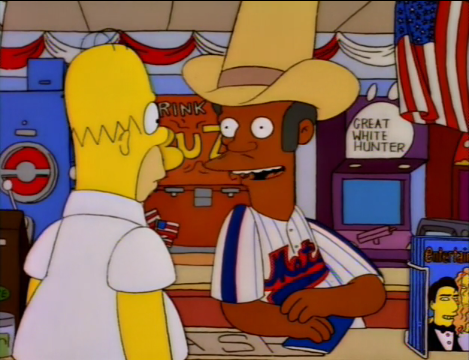
The Simpsons learn that Apu is an illegal immigrant, and they all try to help him pass his citizenship test. In-between, we have a great segment where Apu purchases a fake ID and documents from Fat Tony, and heeds the mobster’s advice to “act American.” Adorned with a cowboy hat and ridiculous accent, Apu tells Homer that he’s just like him (“What do you say we take a relaxed attitude towards work and watch the baseball game?”) It’s a great performance by Hank Azaria, which only gets better when Apu finally breaks down and expresses his sorrow about betraying his heritage, how he wants to stay in this land he loves, but as himself. It’s a wrenching scene that feels so genuine, so much that it manages to permeate Homer’s thick skull, inspiring him to go against Prop 24. Later when Apu passes his test, Homer gives an impassioned speech about how immigrants are the backbone of the country and to vote no, and the crowd goes out in droves… to vote yes. He’s dumbfounded (“When are people going to learn? Democracy doesn’t work!”) Sure, it’s a repeat joke from Kent Brockman, but it works just as well the second time.

Tidbits and Quotes
– I love how insanely panicked Ned is at seeing the bear on the street, who is really doing nothing. Maude can’t unlock the door because she’s panicked too, leaving Ned to smash through the window.
– The bear part is pretty silly, with Homer climbing a wire we’ve never seen before or since to get to his car, but falls. There’s a great shot of a pathetic terrified Homer looking up at the bear, and I also love that when Wiggum shoots the tranquilizer dart, Barney has walked out of nowhere to be the target of it. Of course, he breaks it open and drinks the sweet contents inside… then collapses.
– Homer really is in shining dumb form in the first act (“I’m sick of these constant bear attacks. It’s like a frickin’ country bear jambaroo around here!”)
– I wasn’t a fan of Moe claiming the bear was “smarter than the average” and “swiped [his] pic-a-nic basket,” but it all turned around when we see Quimby whip out a picnic basket when the mob leaves. Why would he take that? Even when this show cranks a dud joke, they can turn it around to be funny.
– Lisa trying to debunk her father’s faulty reasoning is such a classic scene. She proposes a random rock could keep tigers away: it doesn’t seem to be doing anything, but there’s no tigers around. Putting some brief thought in, Homer offers to buy the rock. Lisa decides to just give up and accept her father’s money.
– Homer is incensed by the five dollar Bear Patrol tax (“Let the bears pay the bear tax. I pay the Homer tax.”) Lisa points out that it’s home-owner tax.
– Last episode we saw a more serious Grampa flashback. Now we’re back to silly. It starts out well enough when he talks about living back in the old country… he forgets which one. Then it ends with his whole family living in the Statue of Liberty (“We had to move out once we filled the entire head with garbage.”)
– I love how irrational and outraged Moe is in this show, just like an average American. I particularly love his main gripe (“You know what really aggravazes me? It’s them immigants. They wants all the benefits of living in Springfield, but they ain’t even bother to learn themselves the language.”)
– Apu’s life story is as informative as it is entertaining, starting from his graduation from CalTech (Calcutta Technical Institute), the top of his class of seven million (pretty damn good). As he leaves for America, we see his proud parents, and also his child bride Manjula, who we will see again in a few seasons. He goes to Springfield Heights Institute of Technology (this show rewards you for paying attention. They’d use the same joke in the movie Accepted, and run it deep into the ground), and we see a younger Professor Frink (“I predict that within one hundred years, computers will be twice as powerful, ten thousand times larger, and so expensive that only the five richest kings in Europe will own them.”) Apu explains he took his job at the Kwik-E-Mart to pay off his student loans, and continued to work after his student visa expired. Marge is accepting of this (“What you’re saying is so understandable. And really, your only crime was violating U.S. law.”)
Apu is most grateful for Fat Tony’s help, to which the mobster responds, “Can the courtesy. You’re an American now.”
– I love Apu’s fake American voice, and his verbal gaffs (talking about the NY Mets, but pronouncing it “nye Mets.”) I also love the breaking line for him, as he speaks he gets increasingly more frustrated and goes off (“Who needs the infinate compassion of Ganesha when i have Tom Cruise and Nicole Kidman staring back at me from Entertainment Weekly with their dead eyes!!“)
– The first plan to get Apu citizenship is to get him married, so Homer immediately turns to Selma. She isn’t receptive (“My name’s already Selma Bouvier Terwilliger Hutz McClure. God knows it’s long enough without Nahassapeema-whatever. From now on, I’m only marrying for love… and possibly once more for money.”)
– Great “Where is Springfield?” moment where Lisa points where they are on the map just for Bart to pop his head into frame, blocking it. Though from the angle, Lisa’s too short for the map so perhaps she’s pointing in the south. Or maybe it’s just a gag and there’s no answer.
– Great payoff for all the hatred Moe dished this episode, only to find out that he is taking the citizenship test too, with a fake mustache.
– Apu seems pretty learned about American history as is. For his final question on the oral exam, he starts to explain in detail the causes of the Civil War, but is just told to “just say slavery.” I love his joke about asking where the welfare office is right after being accepted. The proctor is stunned but Apu assures him he was just playing around.

150. Raging Abe Simpson and his Grumbling Grandson in “The Curse of the Flying Hellfish”

(originally aired April 28, 1996)
Grampa is one of the show’s more interesting characters. His senile outbursts are his main gimmick, which, like with much of the cast, would usurp his entire character in later years, but his life story is very rich, with fascinating tidbits that may or may not be completely true. He’s a man very much the product of his era: an agile young man sent off to war, who then came back home to settle down with a family. We’ve seen a younger Abe before, full of vigor in his constant berating and denigrating of his only son. Here we see him at full physical form, leading a rough-tough battalion in the Ardennes during the war. We gain a newfound respect for him, as does Bart, who at first is embarrassed by his grandfather’s constant outbursts, but then starts to believe his war stories aren’t complete nonsense. This is a pretty crazy ambitious episode, and some of the stuff is maybe too fantastical for the normally grounded series, but it’s incredibly entertaining and one of my favorites.

We start by re-establishing that everyone thinks Grampa is a delusional old coot, especially Bart. But he soon learns of his grandfather’s wartime past, of how he entered a pact with his fellow soldiers in the Hellfish battalion regarding a treasure trove of paintings stolen by the Nazis. The last surviving member will gain access to these priceless items, and the only two left are Abe and Mr. Burns. Burns, being the greedy old miser that he is, wants to speed up the process, hiring an assassin to try to kill Abe. The attempted murders are pretty damn absurd, but they kind of keep the episode balanced from getting too dark. The flashbacks during Grampa’s story are fantastic. We get to see Abe at his most active and courageous, and that even back then, Burns was just as selfish and with as great a sense of entitlement as ever. We also see that familiar ancestors like Wiggum and Barney’s fathers were part of the platoon, which is a bit silly, but it makes sense given that Springfield is the typical American town that most townsfolk would have enlisted. We’ve seen Abe’s wartime experiences in a few flashbacks, mostly as gags (him posing as a cabaret singer comes to mind), but it’s great to see it here played in a serious light. A particularly nice moment is the air of respect he gives when he addresses the gravestones of his men, which feels so genuine, even if it is capped off with a joke (“I want you to know that when I die, you’re all welcome to visit me in rich men’s heaven.”)

Bart manages to swipe Burns’s Hellfish key, and together with Grampa’s, trigger the Hellfish grave marker to shine a light on the location of the treasure… out at sea. They manage to retrieve the sunken crate, but are ambushed by Burns, who buys time escaping by kicking Bart into the empty crate to sink to a watery grave. Now, this is hands down the most evil, unforgivable thing Burns has ever done, and it would seem to be going too far, but for some reason it doesn’t feel that way. You’re wrapped up in the story, and we get to see Grampa be heroic in saving his grandson, and then regaining his past physical feisty nature in getting onto Burns’s boat and taking him down. It’s a proud moment for him, and we’re glad to see it. The resolution is pitch perfect, with the U.S. government arriving to retrieve the paintings, and to avoid unwanted tension overseas, they return the items to their closest living inheritor: some snooty Eurotrash douchebag (hilariously performed by Hank Azaria). It’s a real adventurous episode overall. Later seasons would be known for having big action sequences and ramping up some crazier elements, which are present in this episode, but the difference is this one earned its finale. The plot is very interesting and works with our characters, and we even get a nice bonding moment between Bart and Grampa at the very end, which is then wonderfully undercut by the best line in the show: “Hey, fun boys! Get a room!”

Tidbits and Quotes
– We get a look at some of the other kids’s grandparents: Grandpa Van Houten has an RV and a new wife, and Grandpa Muntz, a judge, is proud to announce he’s just sentenced his forty-seventh man to death, a factoid Nelson is quite proud of.
– I love everything about Grampa addressing Bart’s class. Where the other men just stood in front of the blackboard, Abe makes himself comfortable, demanding attention as he takes a load off, putting his legs up on the desk as he tells his rambling story (“My story begins in nineteen-dickety-two. We had to say “dickety” ’cause that Kaiser had stolen our word “twenty”. I chased that rascal to get it back, but gave up after dickety-six miles…”) Martin scoffs, “‘Dickety’? Highly dubious!” Abe quickly retorts (“What’re you cackling at, fatty? Too much pie, that’s your problem!”)
– Abe’s mail gives us some good gags (“Consider burial… at Sea World!”) He’s none too thrilled (“This junk was hardly worth getting up for. Maybe if I go back to sleep for a few days, some good mail will build up.”)
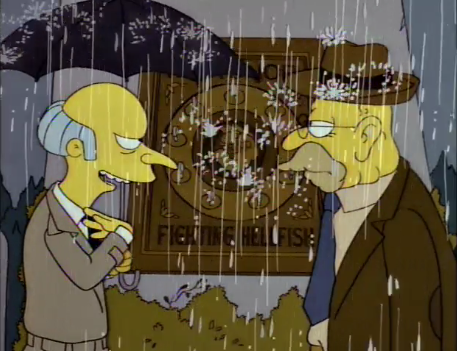
I love the atmosphere at the funeral in the rain. The music is very foreboding as Burns and Abe, the only two in attendance, give each other knowing stares while holding their respective keys. Reverend Lovejoy gives a lifeless eulogy of Asa Phelps’s life in the background, which is pretty funny if you actually listen to it (“Asa Phelps spent his entire life in Springfield, except for four years of service in World War II and one high school day-trip. He worked at the United Strut and Bracing Works as a molder’s boy, until he was replaced by a Molder-Matic, and died.”)
– The Hellfish symbol and the grave marker are fabulous designs. They really give the episode a historical, mysterious feel to it.
– Nice swipe at Marion Barry as Burns calls the assassin, identifying himself as M.B., to which the assassin asks “Barry” if it’s time for another shipment. Barry was mayor of the District of Columbia, infamous for falling victim to a sting operation in 1990 where he did coke. And then afterwards was re-elected. Funny world we live in.
– I like how the assassin’s plans just get worse and worse, from the Simpson family disguises (I love Smithers’s Bart disguise. Like, why would they think this would work? “I’ll be in the car, dudes”) and then later of him just going for broke and shooting up the retirement home. Unfortunately for him, the nurses are packing heat themselves (“Our residents [shot] are trying [shot] to nap!! [shot]”)
– A small moment I love when Grampa is on the Simpson couch recalling the assassination attempts. Thinking her grandfather is out of it, Lisa suggests she moisten the washcloth on his forehead. Grampa shoots up, irate (“It’s plenty moist!”) I love that line.
– I love the explanation of why Burns was just a private. Abe explains that he was busted for obstructing a probe from J. Edgar Hoover, and they got stuck with him in the battalion.
– A very exciting moment when Abe saves Burns from a grenade blast quickly gets turned into a wild dirty joke (“They took a photo of my keister for Stars and Stripes! …at least they told me it was for Stars and Stripes.”) So, yeah, some dirty men’s erotic magazine used a photo of Abe’s ass. Or something to that effect.
– Ox, the stereotypical dim tough guy, is great for when we see him, the only man who can explain what a tontine is in unusually eloquent terms. Abe also explains he was the first to die, getting a hernia carrying the crate of paintings out of the castle.
– I like Bart’s urgings to go with Burns to get the treasure (“I won’t eat much and I don’t know the difference between right and wrong!”) and Burns’s response (“Oh, you’re a good boy, but the child labor people have been watching me like a hawk.”) This was all an elaborate ruse of course so Bart could get the keys.
– Nice back-and-forth to start the final act as Bart and Grampa walk through the cemetery (“Hey, Grampa, do you think that dead bodies get up and walk around at night?” “If they’re anything like me, they have to get up twice.”)
– Bart needs to dive down into the water to retrieve the crate. Grampa sets up a signal system: tug the rope sixty-three times if he’s out of air, and sixty-four if he’s found the treasure. Why so many times? So dumb, but so great. Dan Castellaneta gives a great performance when the rope tugs sixty-three times and Abe bemoans his grandson’s death, but when the rope tugs one more time, he becomes joyful without skipping a beat.
– As over-the-top as it is, I do love the climax. It’s a real exciting and satisfying conclusion with these two old men returning to their past selves: heroic Abe and underhanded Burns.