159. A Milhouse Divided

(originally aired December 1, 1996)
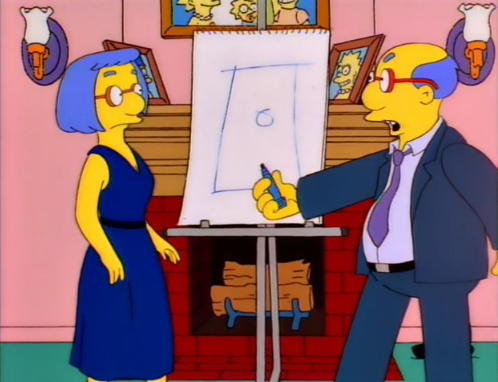
In case you haven’t figured it out from the other 158 reviews, this series is pretty amazing, and it always seems to come up with new ways to emphasize that fact. This episode’s first act culminates with an aggravated back-and-forth conversation between two characters we really don’t know anything about, but thanks to great solid writing, we completely understand these people, their personalities and their motives. The set-up is Marge’s desire for social interaction through having a dinner party, inviting the Lovejoys, the Flanderses, the Hibberts and the Van Houtens. Groundwork is laid throughout the evening with the latter couple getting increasingly at each others throats before getting cut off by Marge, moving onto another activity to sweep the unpleasantness under the rug. But a game of Pictionary becomes the Van Houtens undoing, as Kirk and Luann have it out. Hank Azaria and Maggie Roswell give dynamite performances, both hilarious and absolutely dramatically believable. That’s why this scene is so insane, it really feels like a heated argument, and you can feel the incredible awkwardness of the other couples witnessing a marriage fall apart at the seams, especially from Marge, who is running out of ways to divert attention away from this elephant in the room. It’s one of the best scenes of the entire series, since the show has managed to create something from nothing in the most engaging way possible.

Kirk and Luann break up and begin to form their own separate lives. While Luann is more than pleased with being single, quickly hooking up with an American Gladiator, Kirk’s life isn’t going so hot. He gets fired from the cracker factory thanks to his divorce (“Crackers are a family food. Happy families. Maybe single people eat crackers, we don’t know. Frankly, we don’t want to know. It’s a market we can do without,”) he lives in a seedy apartment complex, and his car gets stolen by a cheap floozy. We do feel bad for Kirk, but he is really a pathetic character by nature. He muses about how he should have seen the signs that this would all happen, which new pal Homer believes will never transpire with him and Marge. Meanwhile, groundwork has also been set through the episode of Marge constantly being disappointed and fed up with Homer, so when the telltale signs finally permeate Homer’s skull, he freaks out, believing divorce may be coming his way any time soon. So he does the most rational thing he can think of: get divorced himself and throw a lavish second wedding.

I think there’s plenty of unmined gold to be had from the Kirk and Luann story, examining their new lives more and potential awkward run-ins with each other. Also barely even touched upon is its effect on Milhouse, who we only really examine for one scene. That could have been a whole story in itself. On paper, it might seem like a rich story sadly diverted to be yet another Homer-Marge marital woes episode, but it really doesn’t feel that way. First off, as mentioned, the stage is set through the episode of Marge’s quiet displeasure over her husband, and second, Homer’s troubles set in from his (over)reaction to the main story. It also ties in with the Van Houtens plot anyway, as Kirk figures that if a big romantic gesture works for Homer and Marge, it could work for him too. With as much gumption as he can muster, he belts his love ballad “Can I Borrow A Feelin’?” to his former wife, asking him to marry him again. She says no. This ain’t TV, Kirk, not every story has a happy ending. Pouring salt on the wound, Luann’s new boyfriend escorts him outside and shuts the door. Kirk vows he’ll be back… prob-probably. I was really surprised just how much I loved this episode. It’s surprisingly tense and dramatic at the start, but keeps the laughs and energy up even with the third act plot shift, still maintaining the themes and brings the main story back for a satisfying ending. And we fleshed out two tertiary characters to boot. What more could you want?

Tidbits and Quotes
– Marge wishes for more conversational engagement at home, but the family continues to eat dinner glued to the TV. Homer moans that the plates aren’t see-through as he attempts to lick it clear whilst still staring at the screen, Bart’s down to his skivvies at 5pm, and even Lisa can barely put together sentences, too absorbed with the idiot box.
– Another great store name, “Stoner’s Pot Palace,” of which Otto walks out quite disappointed with the false advertising. Easy joke, but effective.
– I like whenever Marge gets into something, she puts her all into it, like when she puts another glaze on the already blindingly bright ham. And of course seconds before the party starts, Homer is still in his underwear in the living room playing with slot car racers (“Just gotta put my shoes on!” “The only thing I asked you to do for this party was put on clothes, and you didn’t do it!”)
– It really is disconcerting that Kirk and Luann look exactly the same. I wouldn’t want them to address it on the show, since it’d be way too creepy, but there must be some kind of weird intentional or unintentional inbreeding going on there. Like imagine being sexually attracted to basically yourself as the opposite sex. Or the same sex. No judgement.
– I fucking love the uneasiness of the first act, it’s done so well (“Marge, I know I haven’t eaten that well since the army.” “Or that noisily…”) I love Hank Azaria’s low “Alright, that’s it…” getting ready to start some shit before Marge cuts him off.
– The Pictionary scene is absolutely stellar. I love the frequent cuts back to Marge, nervously wringing her napkin, then later when Luann mentions how Kirk’s incompetence cratered his cracker company to tie with Table Time and Allied Biscuit, to which Marge discreetly tosses a plate of Allied Biscuit crackers back in the box and tucks it under the couch. Luann goes on (“I love having to borrow money from my sister. I love having to steal clothes from the church donation box.”) Such devastation in her voice too. Cut to Lovejoy (“Oh sweet Jesus…”) It’s even better since he had alluded to the ransacked clothes earlier. So many minor bits that are amazing: Gudger College, Luann’s unseen perfect representation of ‘dignity,’ Lisa coming in singing “You’re A Grand Old Flag,” and Kirk’s horrible drawing skills.
– First appearance of Kearney’s kid (“I sleep in a drawer!”) In “Much Apu About Nothing,” we see Kearney used a pitiful fake ID to try and buy beer, so he must be no older than 20, and his son looks pretty young… and now I’ve just pictured Kearney having sex. Brilliant.
– Great reference to the audience when Luann tells Marge to forget everything she used to know about her, to which Marge honestly responds that she doesn’t really know anything about her.
– Kirk shows off his new digs to Homer (“You get your own bed. I sleep in a racing car, do you?” “I sleep in a big bed with my wife.”) I love the sound effects of the establishing shots too, lots of sirens and gunshots.
– The bit we do see of Milhouse does work perfectly, with Luann fawning over her perfect son who is currently destroying the house.
– After breaking a chair on Luann’s gladiator boyfriend, Bart tries to do the same with his father… to much different results. This is a Homer-gets-hurt scene that really works, as it has a motivation and works in the scene. Plus it’s so unexpected, for us and Homer, who is contently taking a bath when he gets slammed so hard by the chair that it breaks to pieces. Dan Castellaneta’s scream is hysterical (“What the hell is wrong with you?!” “Jeez, sorry. It’s a pretty standard stunt, Homer.”)
– As Homer laments how crummy his marriage began, we get a clip from “I Married Marge,” which is also paired with new footage of Marge, who appears less than thrilled at her marriage at Shotgun Pete’s. Most of what we’ve seen of their past, the two are fairly happy, but as has been implied, there’s an underlying sadness to Marge. Homer tries to smooth things with a cake, “To A Whale of a Wife,” I assume a reference to Carvel’s Fudgy the Whale.
– Homer tries to smooth things over with Marge, but fails in every way. He also stops in to give her an impromptu hair cut at the Perm Bank (another amazing store name.)
– I love how happy Homer is to tell his wife that they have to get married again since he already got them a divorce (“I didn’t want a hokey second wedding like those ones on TV. This one is for real!”)
– Homer’s vows are amazing, of course, hilariously read by Lovejoy (“Do you, Marge, take Homer, in richness and in poorness… poorness is underlined… in impotence and in potence, in quiet solitude or blasting across the alkali flats in a jet-powered, monkey- navigated… and it goes on like this.”)
– The smooth jazz end credits theme may be my favorite variant, tied with the “Mad Mad Mad Mad World” version. It’s just so mellow and cool.

158. Bart After Dark

(originally aired November 24, 1996)
This is an episode with a pretty out there plot, but it succeeds based on the pitch perfect characterizations. It shows this series can tackle just about any story as long as we stay mindful of our beloved characters. Things start off naturally enough as Lisa gets adamant about a new cause: cleaning up a sizable oil spill devastating a distant beach. We see celebrities like Rainier Wolfcastle and his buxom companion mugging for the camera in their staged publicity stunt, but we also see that a righteous Lisa isn’t much different. True, she probably cares a lot more for the cause than those Hollywood phonies, but we also see how flighty she is with her environmental activism (justified in that she’s just a child), and devastated when she arrives and sees she won’t get to clean the cute little animals. After much cajoling, Marge agrees to take Lisa to the beach, leaving Homer and Bart to their own devices. Suffice to say, the house quickly becomes a wreck. Marge had kept the boys just on the edge of civilized, and it’s great to see how low they can go, be it Bart gargling with soda or Homer answering the door wearing a grocery bag (with groceries in it.)

The main story kicks in when Bart’s horseplay leads to the destruction of a rooftop gargoyle on a house belonging to a witch (at least according to child folklore.) Homeowner Belle arrives at the Simpson house expecting Bart to be punished, and Homer, not wanting Marge to find out about this down the line, demands Bart do chores for the woman to pay off his debt. But neither of them know Belle’s actual business: the house is actually a gentleman’s club called the Maison Derriere, where Bart performs a litany of tasks from being doorman to subbing in for the unusually short opening act. It’s a pretty risqué episode, but this kind of subject matter has never stopped the series before. A particularly great scene involves Homer’s discovery of where he sent his son to work, consisting of Belle apologizing for any miscommunication whilst he is dumbstruck by a nude Princess Kashmir on stage. I like Bart’s childish naughtiness in volunteering to sort through a trunk of bras, and later seeing the slightly perverted side of Springfield’s citizens, including Principal Skinner, who brings Bart’s work to the attention of the Lovejoys and the Flanderses. The second act break is one of my favorite of the series, where Homer gets incredibly adamant in defense of his decision, then immediately deflates when he sees Marge standing there (“Now, Marge, you’re gonna hear a lot of crazy talk about Bart working in a burlesque house…”)

Reminiscent of “Itchy & Scratchy & Marge,” Marge leads a moral crusade against this previously underground establishment, effectively guilt tripping the town into siding with her upon showing damning photographs of various citizens attending the burlesque house, including Mayor Quimby (“That could be any mayor!”) The town is in true angry mob form as they storm the Maison, smashing and setting fire to the area. How best to resolve this situation? Through song, of course. “We Put the Spring in Springfield” is one of the show’s hallmark numbers, incredibly catchy, entertaining, and full of overt euphemisms (those ladies sure put the “boing” in Springfield, alright…) It also culminates into a great self aware moment about these kinds of ridiculous songs, where Marge comes in late with a bulldozer and is shocked to find that a song has completely changed everybody’s minds, and that they can’t re-sing it since it was so spur of the moment. Marge attempts to come up with her own song on the spot, but accidentally rams her bulldozer into the house. One of my favorite lines from the whole series is from Lovejoy, “Thanks a lot, Marge. That was our only burlesque house.” This man of God who three minutes ago was totally against the place is now devastated to see it gone. But that’s the power of the spontaneous song. A hilarious and showstopping episode if I ever saw one.

Tidbits and Quotes
– After a quick V-Chip joke, we get a really crazy, kind of dark Itchy & Scratchy, with the set up of a talk show with Scratchy as the abused victim on stage. Itchy breaks a bottle, comes out from backstage to full applause, Scratchy gets down and begs for his life and Itchy lunges the bottle at him before the show is cut off by a news announcement. How horrifying…..ly funny.
– Of all the beaches the tanker could have crashed in, of course it was Baby Seal Beach. Also great seeing a drunken Captain McAlister offering Dave Shutton a hundred bucks to take the blame for the accident on camera.
– Great animation and performance by Yeardley Smith of Lisa play-acting for her mother on how much she loves that peach tree.
– The time fade of Bart and Homer doing garbage angels to seeing them passed out on a floor is so funny and disturbing at the same time. One day has passed since Marge left and they’re literally stewing in their own filth.
– I don’t know if I buy Martin wanting to hang out with Ralph, but we do get the great Burns line when he sees the two running away from the toy plane (“I don’t like being outdoors, Smithers. For one thing, there are too many fat children.”)
– Wonderful performance by Tress MacNeille as Belle in this episode. I feel later seasons would overuse her as every single woman and child voice, but she’s had plenty of memorable performances throughout the series. Belle has a particular affectation and rhythm I haven’t heard from any of her other many, many characters.
– Classic bit where Homer drops Bart off at Belle’s saying he needs to take responsibility for his actions, then accidentally pulls up on the curb, knocking over the mailbox. He immediately screams and quickly drives off.
– My favorite scene is definitely when Grampa walks in the door, turns to put his hat on the rack, turns back to see Bart, turns back to get his hat, and then out the door. All while whistling. He then peeks his head in and asks, “Is your name ‘Bart’?” Bart only has to nod. Grampa demands if his father knows he’s working there. Bart says it was Homer’s idea. Grampa is convinced, walking back in asking for a whiskey sour.
– I love Bart on stage telling the absentee comic’s lame jokes, but the crowd laughs uproariously at them because I assume they’re all drunk.
– Homer takes a moment to observe the many pictures on the Maison Derriere’s wall (“President Eisenhower celebrates 40th wedding anniversary. Not pictured: Mrs. Eisenhower.”)
– I love how Skinner tries to cover his tracks when he realizes that Bart is the doorman at the burlesque house, and then later when the Lovejoys and Flanderses show up at Homer’s door. Helen Lovejoy tells them Skinner found out about Bart, who then pops up from below, almost like he was hiding in shame, to defend himself (“That’s true, but I was only in there to get directions on how to get away from there.”)
– The scene where Marge demands Belle get out of town is fantastic, where Belle is really just toying with Marge, who is incredibly adamant toward her cause (“Sleazy entertainment and raunchy jokes will never be as popular as sobriety and self-denial.”)
– The town hall meeting is full of great stuff, like the townspeople angrily defending the structural stability of the house in question, and the various calls of shock at the slideshow of people leaving the Maison Derriere. When no one comments on Barney’s picture, Moe steps up out of obligation, and Burns is surprised to see Smithers up there (“My parents insisted I give it a try, sir.”)
– The song is obviously fantastic, I’m sure you know that if you’re reading this. Probably goes in third after the Planet of the Apes musical and “You Can Always Depend on the Kindness of Strangers.” I also like the ending with Marge’s lame ventriloquism act, and Homer’s boisterous “Take it off!” leading to Bart kicking him out.

157. Burns, Baby Burns

(originally aired November 17, 1996)
There’s been plenty of guest stars come in to play different characters. There’s also plenty of guests stars who have played themselves. Then there’s the rare occasion where it’s one and the same. Here we have Rodney Dangerfield voicing Mr. Burns’s long lost bastard child Larry, who essentially is the same character that we know from the many movies he’s been in. It seems so odd and out of place, but it’s mollified by two points: one, I love Rodney Dangerfield, and two, the character actually works for the purposes of the story. Who could be more opposite and act as a greater foil to the joyless, no-nonsense Burns than Dangerfield? Given this opportunity, the writers managed to cram this show with a ton of Rodney-style one-liners, which may not entirely fit with the comedic rhythm of the series, but dammit do I still love that guy that I didn’t mind (one in particular I use quite often, “If it gets any livelier, a funeral’s gonna break out.”) I also love his character design, a sore of bizarre mish-mash of the actual comedian with Burns-like features. He even exhibits the same extended preying arms walk at one point.

I really enjoyed basically everything in the first two acts. Having previously picked him up as a hitchhiker, Homer builds a kinship with Larry due to their mutual laziness, which makes sense. Meanwhile, Burns desperately attempts to integrate his son into high society at a fancy gala, which is a scene that basically feels ripped from one of Rodney’s movies. I can actually picture it; he’s at the finger sandwich station, but he scoops the bread out of each piece and makes this elaborate super sandwich, much to the crowd’s shock. If anyone can remember the movie, feel free to post. Again, I don’t mind this content shift because I was still amused and it worked within the story. Burns can’t even pawn his son off to Yale without a rather sizable donation (“Yale could use an international airport, Mr. Burns.”) Burns’s annoyance continually builds until he outright disowns his son, leaving Larry with no one to rely on but tag along Homer, who comes up with a brilliant scheme: a phony kidnapping.

Now the last act is a bit strange. The fake kidnapping didn’t seem too inspired, but I did find myself going along with for the most part, as it wasn’t that out of left field and there were plenty of great gags thrown in. It’s the very ending that doesn’t entirely sit with me. Larry admits that they faked the kidnapping, leading Homer to come to his defense, giving some rigamarole schmaltzy speech about how much he values the love of his children or something. Nothing really built to this epiphany on Homer’s end, so it didn’t really make much sense coming from him with no set-up. This leads to Burns and Larry’s not-so-reconciliation, which is at least better than them making up when we know we’ll never see Larry again (and I do like the dumb revelation that he has a wife and kids, “Oh, that reminds me. They’re probably wondering where I went! I told ’em I’m going for coffee, that was a week ago!”) And then we have the dancing party ending, aping 80s movie conventions, many from movies Rodney’s been in like Caddyshack. While I at least appreciate that they pointed out how dumb it was, it just didn’t sit right. After all the Rodney-isms and silly third act twist, I feel like it needed something of a grounded ending that sort of made sense, but instead they just went for broke in all out craziness. But on the whole, I enjoyed it. I feel if you don’t like Rodney Dangerfield, you’d hate this one, but luckily for me, that’s not the case. If that is the case for you, then I don’t want to know you.

Tidbits and Quotes
– I love Flanders’s spiel at the cider mill, proudly flashing his annual pass (of which he’s the first, and possibly only, member). He instills Homer with great wisdom regarding the difference between juice and cider (“If it’s clear and yella’, you’ve got juice there, fella! If it’s tangy and brown, you’re in cider town!”) Homer’s brain can’t take much more, literally abandoning the rest of his body, leaving his mortal self to nod a few times, then collapse in a heap. The animation of him falling is hysterical, he just sort of crumples to the floor. Compare this with that shitty pulled frames cycle of people falling down that Family Guy does all the time. What garbage. But I don’t want to open this Pandora’s Box…
– I like Marge’s apple souvenir hat atop her hair, and the little running gag of her mispronouncing words and Lisa correcting her, much to her chagrin (“It doesn’t take a nucular scientist to pronounce foilage.”)
– Great animation when the train screeches to a halt, thrusting Burns and Smithers forward and all the pool balls spill into one pocket.
– I like all of Larry’s horrible tchotchkes, like the googly eyed walnut and rocks, and the stretched out Pepsi bottle (“If this stuff is too nice for ya, I’ve got some crap!”)
– Homer’s initial reaction to Larry on the side of the road with a “Springfield” sign is hilarious (“Can’t they get a pole for that sign?”) Also great is his bickering with Marge whether they should pick him up, culminating in Homer declaring they are picking him up. At that point they’d already pulled into the driveway at home, so he backs out and drives the other way.
– I like the rhythm of the bit of Grampa sitting on the pie. It’s a wholly contained joke with Marge almost narrating it, “Don’t sit on the pie,” “Are you sitting on the pie?” And Grampa’s “I suuuuure hope so…” is hilarious.
– Nice winking nod to Rodney’s constant riffing, as he rattles off a few one-liners walking up Burns’s estate (“Hey, who am I talking to?”)
– The history of Larry’s conception is truly a great one: at his 25th Yale reunion, Burns ran across his unrequited love, and managed to see past her slight wrinkles and gray hair… to her 21-year-old daughter. Their arousal was heightened by seeing Gone With the Wind and Clark Gable’s reckless use of the word “damn,” then they snuck into the Peabody museum, and expressed their love physically, “as was the style at the time.” Larry is impressed (“Well, how do ya like that? I have been in a museum!”)
– Cheap joke with Burns’s “play room” actually hosting a play, but I love the one actor’s intensity in an unknown production (“You can’t just eat the orange and throw the peel away! A man’s not a piece of fruit!”)
– I like all of the Rodney-isms, but my favorite is probably his reaction to the rather homely, recently outed debutante (“Woah! Put her back in! She’s not done yet!”)
– We get a joke where Moe talks about what happened to the last guy foolish enough to charge a beer to Mr. Burns… who of course is Barney. Pan over to show him covered in garbage, saying it was worth it. I’d comment how silly it was that he still would be covered in filth from what we assume is a past event… but it’s Barney, so it still works.
– I think it’s sweet when the Simpson kids make their own Rodney-style jabs at their mom, but it’s all in good fun. Marge’s slight annoyance is overtaken by a shyness as she thanks their applause.
– I like Burns on the phone with Homer using a disguised voice, who is trying to get Burns to admit he misses Larry, but to no avail (“Do you miss your son?” “Yes, I am missing one son! Return it immediately!”)
– Homer and Larry are on the run from the cops. They first try and hide out at the old abandoned warehouse, only to find it’s up and running (“D’oh! Stupid economic recovery!”) Then they go to a costume shop, and we later see two men dressed as an organ grinder and monkey leaving the store. The shopkeep then goes to the bathroom and tells Homer and Larry they need to beat it. The two then find the perfect empty hiding place: a movie theater playing “Too Many Grandmas,” starring Olympia Dukakis and Bo Dereck. Based on the brief bit we hear, I want to see that movie (“Drive faster, Grandma! Grandma’s gaining on us!”) The two are basically safe until they make the mistake of heckling Hans Moleman. I love the timing of him slowly walking up the aisle with Homer and Larry laughing, cut to the cops surrounding the building.
– God, I love the simulation of Homer getting shot to death. Why would they waste money on doing that? And producing it so quickly? Jokes like these don’t make much sense, but that’s why I love them (“A bloody end for Homer Simpson… is just one of several possible outcomes according to our computer simulation.”)
– I like the end where Larry asks if his father can accept him for who he is and pops a cocky smirk, followed by Burns’s uneasy noises under building music. It’s not an easy decision, and he eventually goes against it (“Oh, I can’t do it, it’s just not me!”)

156. The Homer They Fall

(originally aired November 10, 1996)
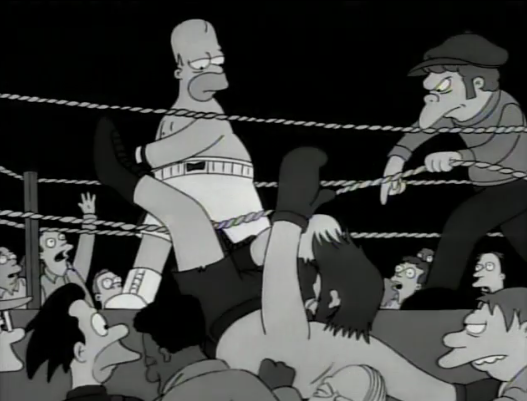
In unusually close proximity to “Homerpalooza,” we have another episode hinged around Homer’s incredible tolerance for pain. After witnessing him stand his ground in a bar fight (literally just stand there dumbly), Moe cooks up a scheme to make the dumb oaf champion of the underground boxing circuit. The strategy? Have Homer take as much abuse as his opponent can dish, then lightly tip them over when he exhausts himself. It’s an absurd, but amusing concept, with Dr. Hibbert revealing that Homer is literally too thick in the head to register any pain he suffers. As Homer’s popularity builds, Moe has a run-in with Lucius Sweet, his former boxing rep and blatant rip-off character (“He’s exactly as rich and as famous as Don King, and he looks just like him, too!”) Sweet now represents heavyweight Drederick Tatum, and he needs someone he can fight that can sustain three rounds (“The fans are weary of fights that are over before they have an opportunity to even get drunk.”) Moe now must choose between being a somebody in the world of boxing again, and seriously endangering the life of one of his best customers, and possibly his friend.

One of the biggest issues regarding the show’s tumbling lapse in quality is characterization, most particularly Homer. I was surprised to find in this particular episode how much he had been warped. Dragging Marge into the gadget store with her saying he’s hurting her arm, and him replying, “No I’m not!” is such a small gag at the beginning of the show, but is incredibly telling about a dark direction the writers would take with his character. Later, upon seeing Bart return home brutally beaten, what is his advice? To squeal on the bullies to everyone he can find. What? Whatever happened to the Code of the Schoolyard? The show is peppered with odd moments like this of Homer being far too stupid or careless, but for some reason it doesn’t feel too egregious because of the plot. Lucius tempts Moe with a future glory in exchange for writing a death sentence for his talent, leading to the next scene where Moe tells a blissfully ignorant Homer he’s fighting Tatum. Now, a blue collar slob like Homer has got to know who Tatum is, but he’s none the wiser. However, it sort of works in the context of this episode that this big dumb loyal idiot is playing at Moe’s lack of a conscience.

This episode is really focused on Moe, a thorny area of his past and his potential chance to relive it. I love all of that stuff, including Lucius Sweet, a great performance by Paul Winfield (understandable, given he played Don King in a TV movie a year prior.) I would have loved to have seen this episode focus almost exclusively on Moe, though. As I mentioned previous regarding “Twenty-Two Short Films,” this could have been the perfect opportunity to expand on that concept. If Moe was our star, Homer’s exaggerated stupidity could have totally worked, as he would exist to make Moe feel guilty about himself and his actions. But instead, it’s sort of split between the two of them, and we get much less interesting moments of Marge concerned about her husband and beckoning Moe stop the fight. Then Moe rescues Homer from the ring as the Fan Man. Sure, why not? Not quite sure how he was able to lift up and carry a grossly overweight Homer, but whatever. Despite my grumblings, I thought this one was alright. The plot was mostly sound, it had its fair share of good gags, and I love any chance we get to see more Moe. I want mo’ Moe.

Tidbits and Quotes
– I don’t really care for the opening scene with the limited Bonanza reunion, but I do love the one Indian’s horrible attempt to curry the audience’s favor (“You know, on the series, we were always trying to kill the Cartwrights. But it looks like Father Time took care of that for us, right? Am I right, folks?”)
– Fantastic scene where Comic Book Guy meets his match with the Charles Bronson-voiced clerk (“A fat, sarcastic Star Trek fan. You must be a devil with the ladies.”) CBG is instantly deflated, and ends up selling his intended return to Bart for four bucks (“I must hurry back to my comic book store, where I dispense the insults rather than absorb them.”)
– The Ultimate Belt stuff has nothing really to do with the main story, but I do love its usage in Bart’s escapade with the bullies, fooling them with a dishonest turn signal, the incredibly loud alert button, and the Emergency Use Only button, which launches a parachuted message for a concerned patron to call the police.
– Hibbert gets a good scene, explaining Homer’s unique medical condition in his ability to take a beating (“Why, I could wallop you all day with this surgical two-by-four without ever knocking you down. But I have other appointments.”)
– There’s a lot of good Moe lines here and there, like calling Boxcar Bob as a hungry young fighter, literally fighting for a sandwich, and his signature boxing gloves with barbed wire wrapped around them, which he calls “the stinger.”
– I like Lenny’s line during the match, “Man, that tramp’s got the energy of a hobo,” as we see the fighter periodically looking back to check that his bindle is okay.
– I like the black and white montage, where Homer’s racking up the big bucks, which translates to him being able to afford slightly nicer car washes.
– Lucius Sweet is probably the best thing about this episode, an unabashed and unashamed parody, using words like “verticality” and “strategizing,” which I use too from time to time. He brings the laughs, but also works just as well in his foreboding warning to Moe about how he can either take this shot or stay a nobody forever.
– Drederick Tatum returns, with Hank Azaria doing a great Mike Tyson riff, with a fair share of great lines too (“Believe me, my God, if I could turn back the clock on my mother’s stair-pushing, I would certainly… reconsider it.”)
– Great ad for the fight, playing up the “rivalry” between Drederick and Homer. Even the title of the show is “Tatum vs. Simpson: Payback,” despite them never having met before. Also great are the T-shirts for sale, with Tatum’s fist coming right out at Homer’s dumb clueless face.
– Michael Buffer appears as ring announcer, giving his (literally) trademarked line, “Let’s get ready to rumble!” He also introduces the crowd of Springfield’s elite, including Kent Brockman, who is greatly chastised and booed (“This just in, go to hell!”)
There really is a general flatness about a lot of the final act. It’s not too much fun watching Homer getting the shit beat out of him, and we know something’s going to happen to stop the fight. All we can do is wait. I do like Dr. Nick as the fight doctor though (“Kill him! Kill him!”)
– Sweet bit at the end where a beaten up Homer sadly comments that he forgot where they parked, and Marge consoles him (“That’s all right. We’ll just wait till everyone else leaves.”)
– I don’t know what to make of the end with Moe as an aerial worldwide humanitarian. If someone wants to make heads or tails of that, be my guest.

155. You Only Move Twice

(originally aired November 3, 1996)
Let’s start off by saying this episode is definitely in my top 5, and is on many fans top lists as well. A quick run through first: Homer gets a new job at Globex Corporation, meaning the family must move up state to the luxurious estate of Cypress Creek. The first act break of all our favorite Springfieldians saying goodbye to the leaving family is a great sequence. It’s almost as if this is starting a brand new spin-off, and they’re bidding farewell to the audience. As a senior member of the power plant, Homer is assigned as supervisor for a team working on God knows what, and he seems to be doing pretty well for himself. The rest of the family, not so much: with a house that literally tends to itself, Marge is left with nothing to do but drink wine, Bart is bumped down to the remedial class to learn about the letter ‘A,’ and Lisa finds she’s allergic to just about everything in the town. As in many flashback shows, this episode is ultimately about Homer having to sacrifice his happiness for the greater good. He’s quite pleased with his new respectable position, but deep down he knows his family must come first.

In many cases, it’s difficult to really pin down exactly why an episode is your favorite, but here, a key element is very clear. Two words: Albert Brooks. He’s played many classic characters on the series before this, but this episode showcases his greatest role of all: affable super villain Hank Scorpio. He’s one of the best characters the show’s ever seen, with every one of his lines memorable, hilarious and all building of who he is and his relationship with Homer and his employees. At the start, he shows up at the Simpsons new doorstep with a cordial, giving nature, at first just giving a stark contrast to Homer’s former greedy miserly employer. On his first day, we see him really pump Homer up, get him to trust him and motivate him. He’s like this awesome showman, and a great boss, what’s not to like? Then we find out he’s a super villain bent on world domination. But y’know what, I’d still work for him. Although at times it appears that he’s just pandering to his employees needs disingenuously, it really does seem he’s sincere. To get people to go along with his schemes, he needs to be kindly and accommodating. My favorite scene is the very end where in the midst of a militaristic attack on his operations, Hank takes the time to hear out Homer’s problems, and insists he do what’s best for his family. I don’t think it’s false modesty, Hank is really a swell guy, who just happens to be a criminal mastermind. His character also had so much potential. Despite the outlandish ending of him allegedly “conquering” the east coast, they could have found some way to bring him back somehow. But if they did it on the show now, I’m sure they’d just fuck it up, so I hope they don’t.

As Hank puts it, it’s the little things that make up life, and there are loads of little details in this show that just make it so perfect. Upon returning home, Homer rips the ‘Abandoned’ sign off the door and opens the door, watching his family walk in and smiling. It could have just been a simple stage direction for them to just walk back in their house, but it just further emphasizes how much Homer loves his family and knows he made the right decision. They encounter Otto sitting on a blanket drinking a beer squatting in their house, who, upon seeing the Simpsons, must wake up his girlfriend and leave. Very funny, but even better that it was set up earlier when he was a prospective buyer (“Windows? I don’t know if I can afford this place.”) From this, we can put together that Otto came by later and saw it was labeled ‘Abandoned,’ and figured he could just live there. This is all pulled from a mere ten seconds, and the full twenty two minutes is filled with more great material, I catch new things every time I watch this one. There were a few animated nuances on Hank that I caught, and for some reason I never quite registered Bart’s sighting of a baseball made out of Secretariat. No joke falls flat, every scene is memorable, Hank Scorpio’s one of the greatest characters ever… this one’s basically flawless.

Tidbits and Quotes
– Before they go after Homer, Globex tries to sway Smithers into their web, with temptations of an impressive salary and health benefit for him and his life partner. Little do they know Smithers is already working for his life partner. The line, “What’s wrong with this country? Can’t a man walk down the street without being offered a job?” is even funnier/more devastating considering the job climate today.
– If ever there was a line that completely exemplified a character, it’s this one from Marge: “I’ve dug myself into a happy little rut here and I’m not about to hoist myself out of it.” And we’re only two minutes in.
– The Cypress Creek promotional video is as great as you’d think, especially of course the bum fading into a mailbox. And even a stupid joke like that gets a callback later, when Marge comments to Hank Scorpio that the town is so nice, she expects to get the bum’s rush. Hank replies, “We don’t have bums in our town, Marge, but if we did, they wouldn’t rush, they’d be allowed to go at their own pace.”
– I love the cavalier attitude Marge has about the house falling apart; first we see the chimney collapse outside the window behind her, then later Bart breaks through the ceiling from upstairs, and Marge casually pokes him back up with a broom while still talking to Homer.
– We get a one scene wonder for Apu showing up at the Simpson open house (“Hello. I am not interested in buying your house, but I would like to use your rest room, flip through your magazines, rearrange your carefully shelved items and handle your food products in an unsanitary manner. Ha! Now you know how it feels!”)
– I’ve always remembered, and loved, the Simpsons new address: 15201 Maple Systems Road. It’s such a perfect name, fusing nature with corporate efficiency.
– Brooks is on fire off the bat as Scorpio, with his Popeye-papayian run and throwing his moccasins away and screaming at them (“Ever see a guy say goodbye to a shoe?” “Heh heh. Once.”) There’s just something about his voice that’s so engaging, Brooks is a dynamite performer.
– I love the bit where Hank illustrates there are no walls in his building after asking Homer to hang up his coat. And he didn’t even give it to him at all! Homer is shocked and notices Hank with a big grin on his face and his coat on backwards. This is why I think he’s an earnest character, he’s doing his best to win over a new employee. Yeah, because he wants him to work for him to help with his evil schemes… but in a good way.
– The great Hank lines come hard and fast (“These gentlemen here will be your eyes and your ears, and should the need arise, they’ll fill in for any other part of your body.”) I also love when he picks up the phone and botches Homer’s trust fall, his quick, “Oh my God, the guy’s on the floor!”
– The details, the details! Homer’s new workstation has a poster reading, “There’s No ‘Me’ In ‘Team.'” …yeah, there is.
– Cypress Creek Elementary is so advanced, it has its own website. Which at the time made sense.
– I love the dramatic music cue when Marge takes a sip of wine, and her later musing of it (“I’ve been so bored since we moved here, I found myself drinking a glass of wine every day. I know doctors say you should drink a glass and a half but I just can’t drink that much.”)
– Classic, much quoted line from a kid in the remedial class (“I moved here from Canada, and they think I’m slow, eh?”) I also love the end of the scene where a kid pats Bart on the back, which gets increasingly harder into a slap. It’s just so bizarre.
– Hank’s hammock discussion is absolutely brilliant, as is the concept that a ‘hammock district’ would ever exist. The scene is also a great example of how Hank is almost working overtime to bowl Homer over, but Homer’s just so thick he does not register anything he’s saying (“There’s a little place called Mary Ann’s Hammocks. The nice thing about that place is Mary Ann gets in the hammock with you. Ha ha, I’m just kiddin’!” “Oh.”) He also of course does not notice any wrongdoing, even when Hank gives a threatening proclaimation to the UN and blows up the 59th Street Bridge in Manhattan while Homer’s in the room with him.
– Why did Hank have sugar in his pockets? And where was he keeping the cream? Probably best not to think about it…
– Another great callback where we see Lisa happy in the forest befriending a li’l chipmunk, who later betrays her by blowing a dandelion in her face to aggravate her allergies more.
– The James Bond scene is perfect. Firstly it’s James Bont to avoid legal concerns; he’s clearly a completely different character now. Then Hank’s line, “I don’t expect anything from you except to die and be a very cheap funeral.” See, even his mortal enemy he respects enough to give a funeral for, he is an awesome guy. Then Homer blindly tackles Bont, and Hank is quite pleased (“When you get home tonight, there’s going to be another story on your house!”) Then guards proceed to shoot Bont to death. In the next scene, Homer comments to his family at the dinner table about how he tackled a loafer at work. So goddamn funny…
– I mentioned the last Hank scene, but his final moment is just great (“Homer, on your way out, if you wanna kill somebody, it would help a lot.”) He then leaps out into the field, using a flamethrower on some foot soldiers. Then later we see he’s conquered the east coast and has given Homer the Denver Broncos. What a guy. There’s also the Bond-esque “Scorpio!” song at the end, which is such a perfect parody, and well performed (“And on Fridays the lunchroom serves hot dogs and burgers and beer! He loves German beeeeeeeeeeeer!”) I fucking love Hank Scorpio. Watching this show, I remembered that he was originally supposed to be the antagonist for the movie, which could have been amazing, but they scrapped that idea, and created a new character for Brooks to play. But I’ve got ten more seasons to get through before we can touch on that.