
 Overall, I’m a fan of the Comedy Central era of the show, but I admit, it ain’t perfect. Hell, the series as a whole isn’t perfect. I consider myself a relatively objective viewer; if I’m watching something I loved as a kid, or something I’ve seen a billion times, I feel like I can see through my rose-tinted nostalgia glasses to see if something isn’t quite working. And rewatching the series, I did notice a handful of things that bugged me, or stuff that didn’t quite hold up so well. I love Futurama dearly, but it definitely has its fair share of dud jokes and uninspired writing. As such, I thought I would highlight an episode I dislike, probably my least favorite episode of the entire series, and dig into some things I don’t quite care for about the show. I feel like a primary criticism I could make on the whole is the show can feel overly written at times, with characters reciting dialogue that doesn’t feel natural or is transparently structured to be a joke line. Sometimes those kind of unnatural-sounding conversations work, sometimes they don’t. For as smart as so much of the writing on this show can be, it’s almost surprising when a joke falls completely flat, or they present material that feels incredibly trite and outdated. Case-in-point, the treatment of men and women on the show sometimes seems very antiquated. Episodes like “Why Must I Be a Crustacean in Love?” and “Bend Her” portray women as vapid, nagging harpies, and the emotion-suppressing men who put up with them so they can have sex (“Tell her about your feelings in an open and honest way.” “Yeah. Either that, or be a man.”) I’m willing to brush stuff like this off given “men act like this, but women act like this” comedy was still par for the course in most network shows of the late 90s/early 2000s, but I was very surprised to see it still pop up several times in the Comedy Central seasons. The biggest offender of all this outdated, uncreative material is “Neutopia,” a greatest hits collection of the best gender politics jokes written in 1954. I’m honestly shocked every time I watch it that such an intensely intelligent show could have spit out something so aggressively lazy and unfunny.
 I feel like it doesn’t help that in Futurama‘s entire lifespan, they’ve had very few female writers. Not to say that you need a woman to write good female characters, but maybe it would help a little bit? In the show’s original FOX run, only one episode was credited to a solo female writer, Kristin Gore, daughter of three-time guest voice & former Vice President Al Gore. She wrote “Leela’s Homeworld,” and was a staff writer for seasons 3 and 4. The revival Comedy Central years would see Maiya Williams, wife of long-time Futurama writer Patric Verrone, write two episodes. Like pre-2020 Simpsons, the staff seemed to have trouble finding women writers to hire who they weren’t married to. The Simpsons also had a sausage fest of a writer’s room for its golden years, but at least they had writers who were interested in crafting real stories for Marge, Lisa, Patty & Selma, even Mrs. Krabappel, really fleshing out their limited female cast. Futurama‘s female character roster is even smaller, basically just Leela and Amy (there’s also Mom, but she functions perfectly fine as an occasional antagonist, with just enough of a backstory.) Leela and Amy got their fair share of characterization, and work well as polar opposite characters (the no-nonsense action girl and the carefree party girl), but a lot of their relationship with each other basically boils down to Amy making catty remarks at Leela and her getting annoyed, your garden variety cat fight bullshit. Season 7’s “The Butterjunk Effect” (another lousy episode) calls itself out on it solely to double down (“Girl friends always talk trash to each other.” “It’s when women are polite to each other that you know there’s a problem.”) This is dialogue from an episode of television in 2011! “Neutopia” is all of these poor impulses supercharged in one episode, shockingly written by J. Stewart Burns, the man that got the show its first Emmy with “Roswell That Ends Well.”
The episode kicks off with Planet Express on the verge of bankruptcy, with the crew needing to figure out a plan to save the company. Leela and Amy’s suggestions go ignored by the men, who instead propose making a pin-up calendar, noting that their contracts stipulate “all female employees must pose nude if requested” (pretty gross!) When that fails to sell, the Professor suggests working as a commercial airline, stealing an idea Leela had said earlier, where Leela, Amy, and LaBarbara are forced to be stewardesses as Fry and Hermes “pilot.” In the first act, the dynamics of this episode are clear: the men do not have a high opinion of the women. There were jokes demeaning women in past episodes from the Professor and Bender, but I could accept those since the former is a doddering, out-of-touch old man, and the latter is an impulsive loudmouth who says offensive things all the time. Here, all the male characters are united in their mutual hatred of women and how incompetent they think they are. Even beyond the eye-rolling nature of these types of jokes, it just gets really tired, even before we get to the end of act one. The men are stupid and ignore the women, we get it. Somewhat interesting is how they have to pad the character count on the male/female groups we’re stuck with for the episode, in this series with a very limited supporting cast. We get some familiar faces like Sal and Hattie, but also curiously Victor the car salesman, Dr. Cahill from the Head Museum, and strangest of all, the young woman the Professor dated in “Three Hundred Big Boys.” Couldn’t they have just had Linda the newscaster on the plane?
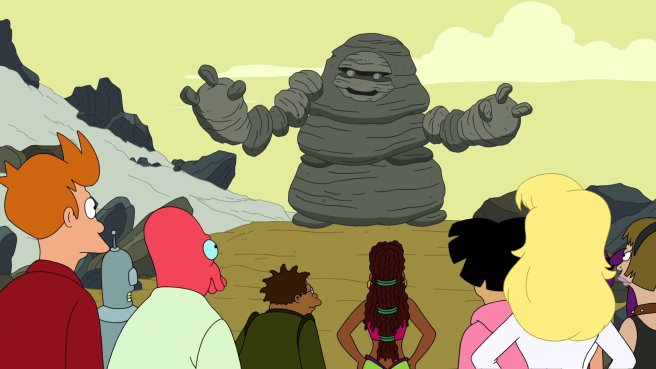 Things get worse (for the characters and the episode) when the Planet Express ship/plane crash-lands on an alien planet. A towering rock creature, awakened by the men and women bickering, is perplexed by the concept of gender, and desiring to determine the superior group, it sends the two teams off to accomplish a task before the planet’s liquid mercury rises to dangerous levels. Then we just get a parade of the moldiest, just incredibly lazy “men and women” jokes imaginable. Men like fart jokes and never ask for directions. The women go nuts for a mirage of a clearance sale, and are quick to answer trivia questions about Desperate Housewives and the amount of calories in low-fat yogurt. Now, I have no doubt the writing staff of this show is incredibly smart (J. Stewart Burns has a Master’s degree!), so I have to believe that the intention here was to exaggerate these stereotypes so much that that becomes the joke. I feel like for jokes that are supposed to be “wrong” or borderline offensive, you can occasionally get away with them as one-off shock jokes, but this is literally the entire episode, and there just doesn’t seem like there’s anything else going on to latch onto. It’s also especially depressing given that the future typically presented in this show seemed to at least be somewhat progressive with social issues (nudity being de-stigmatized, no eyes batted at weird interspecies relationships with aliens, etc.) So seeing a world where men are bitching about women running their mouth too much in the year 3011 is kind of a bummer.
Act three is where the title actually comes into play, as the rock creature, in an effort to “fix” everyone’s issues, eliminates their genitals, and I assume their hormones as well. As a result, they’re able to repair their ship in record time and act in a very congenial, passive manner towards each other (“I enjoy humor when no one gets hurt!” “Your companionship is inoffensive!”) I guess the idea is that humanity could function as a chaste, utopian society, but without the burning passion of sexual tension and release, what’s the point? Which, yes, I guess there’s a nugget of truth to that idea, but it’s not developed enough since we’re in the third act and we’re kind of speeding towards the end. Maybe if these were all couples like Hermes and LaBarbara, it would make more sense, but instead, Sal makes a joke about how he can work more efficiently since he’s not sexually harassing women in the job, and I fail to see why this is supposed to be portrayed negatively. The rock creature eventually returns our cast’s genders, but gets them reversed, but before it can change them back, it’s killed by Zapp Brannigan (“I got your distress call and came as quickly as I wanted to!”) As the gender-swapped crew returns to Earth, we get some more home-run jokes about the sexes (“I need my sleep! I’ve got to get up five times a night to play Xbox!”) The final “comeuppance” for the male characters is in order to save the day, they must pose for a pin-up calendar in their female forms, which doesn’t make the contractual obligation any less gross. And speaking of gross, I hope you think seeing Hermes and the Professor’s flopping tits is hysterical, because we get a whole sequence of that. It’s no different than the intentionally disgusting Homer/Peter car wash scene from the Simpsons/Family Guy crossover.
 We wrap things up with the Professor chiming in with what I assume is the message of the episode (“Ah, marriage. It combines the contentedness of being neutered, with the occasional sex of being not.”) Were these writers just pissy that they weren’t getting laid enough? But again, it’s the most tired, overused writing trope of the bitchy wife who never lets you fuck her, this is the kind of stuff that this show really should be above. An entire episode about a sexless alien society, how it functions, and how the crew reacts to it could have been an interesting Futurama episode, but perhaps not given how this train wreck turned out. I guess we’ll see how this Hulu reboot pans out, but I do wish we get some more play out of the show’s female characters. There really aren’t that many Leela or Amy-focused episodes, there’s definitely more that can be dug up about them. Or even an all-Mom episode. They could bring back Dr. Zoidberg’s girlfriend Marianne and give her something to do, maybe send the two of them on a little mini-adventure. But whatever happens, I hope that in this latest reboot, we’ve left this kind of old-fashioned men/women schtick behind for good.
 Me Blog Write Good
Episodes like Neutopia are perhaps the greatest argument possible for gender equity in writing, or in any field really. Their shtick is so cliche and hacky that no matter how you feel about feminism and women’s rights, you can’t help but roll your eyes at what the primarily-male writers came up with.
That’s especially true since Neutopia couldn’t exist in a vacuum. If Futurama had more developed female characters they could probably come up with better character interactions, in this episode and others, than lol sexism!
Even as a man I’ve always found these stereotype jokes to be extremely lazy. Humor comes from novelty and surprise. A character behaving just like stereotypes predict them to? It’s the opposite of that.
I remember when I watched all of Futurama in high school, this was the only episode I remember outright despising. Glad to see I’m not the only one.
“I guess the idea is that they could function as a chaste, utopian society, but without the burning passion of sexual tension and release, what’s the point?”
I’m not familiar with this episode (from the sounds of it, I haven’t missed much), but I guess that makes it potentially aphobic on top of everything else. (Mind you, I don’t find that quite so eyebrow-raising for 2011.)
Yeah, I’ll admit this was always a bit of a sticking point with Futurama for me. The sexual politics of The Simpsons sometimes felt like they were mired in the mid-20th century too, but they were seldom as gleefully on the nose about it. Did the writing staff feel that we as a society had come through all gender-based assumption and this would now be seen as ironic?
I believe it’s more “old men yelling at clouds” content.
For all the commentary on the staff being generally liberal, there do exist ingrained prejudices based on systemic upbringing, and sexuality is one of those things. It’s explains why the shows, despite being positive (usually) towards homosexuals, were very negative towards transgenders and people trying to seek non-standard sexual identities. They weren’t familiar with it, so those people are clearly freaks. After all, a whole episode was made where Bender had a sex change just so he could cheat at the Olympics (ironically a very, very common argument people make about why transgenders can’t compete in sports of any kind), and later it was all about how life was so much more fun as a woman because you’re a piece of meat for men.
My other big problem with this episode was how, despite the show being set in the future, “Futurama” as a series rarely took advantage of their status as a science fiction series and had fun with it. It often felt like they were a hokey sitcom with the backdrop that “it’s the far future”. Like… they converted the Planet Express ship into a crappy PanAm plane that you probably would’ve seen in a Honeymooners episode just so they could do stupid 1960s stewardess jokes.
As someone who often defends the Comedy Central era, it was like this; when the highs were high, they were great, but the lows were fucking low.
I had a great time rewatching Futurama recently but I was struck by how the female characters are often treated as props in the romantic subplots, kind of like manic pixie dream girls in that they are written to like people purely because the plot demands it.
Firstly you have Amy who, despite being a main or secondary character, completely takes a back seat in the Kif romance episodes as the whole story is about *his* efforts to get the girl.
I think Leela fared a bit better in the original 4 series, but in Bender’s Big Score she’s so thinly written as she falls for Lars in about 5 seconds simply because the writers said so. There’s nothing about him that suggests they’re a good fit, but the writers thought that if they have a few scenes of them doing romantic things while some visual gags play out it would be enough. Eventually she falls for Fry simply because he likes her and he pursues her a lot. It definitely falls in with the kind of audience this show thinks it skews towards, i.e lonely, alienated young men who long for a completely affable fantasy girlfriend. Kind of disappointing when you look at how (relatively) fleshed out the Simpson women are.
The most dated episode of the show is easily “Amazon Women in the Mood”, not just because of the sexist jokes (even at the time they were getting away with it a layer of irony) but the “snoo snoo” sequence in the third act. It really shows you how different things were back then, that men being violently raped to death was considered funny.
Fry, Zapp and Kif are repeatedly raped by amazons and no one bats an eye. But Homer gets assaulted by a panda and everyone loses their minds!
Still says a lot about society when female on male sexual assault is still considered comedy or at least, emasculating for the man. Though in Homer’s case, it was less “Homer is being raped, that’s horrible” and more “Why would the writers have Homer being raped, that’s not what you’d have in the older episodes”… thereby missing the point.
Invincible’s next season is coming real soon, and people who have not read the comics are so not ready.
>in Bender’s Big Score she’s so thinly written as she falls for Lars in about 5 seconds simply because the writers said so. There’s nothing about him that suggests they’re a good fit
Brah… He’s Fry.
Yes, Fry, the person who is as dumb as a rock and gives Leela no reason to love him other than the fact he likes her. Not that it matters as he acts absolutely nothing like Fry. Again, there’s nothing to suggest Leela should fall in love with him, aside from the fact the plot says so. It’s obvious watching the film that she has zero autonomy – her dialogue is so unnatural.
You’re absolutely right. So when he actually gave her reasons to like him, like developing and growing as a person (devils hands, the parasite, maturing into Lars) she liked him back. What’s the issue you’re finding here?
The only issue I find is the one Mike! has pointed out — Fry would always prove himself to Leela, only for her to stop liking him again in the next episode.
Hey Mike, sorry for the off-topic question, but do you know what happened to Dead Homer Society? It’s odd that it hasn’t been updated in years.
I don’t have any information, sadly. I don’t know what happened with Charlie or DHS.
Assuming Charlie didn’t die (which I truly hope is the case), I suspect he just got sick of modern Simpsons and stopped giving a shit. The last few posts on the site are pretty much all quotes of the day, suggesting that he didn’t have much to add about the state of the series in the present.