
 One might expect Futurama would be a true-blue science-fiction show, with the cast getting into wild space adventures and weird, mind-bending sci-fi plots all the time. But it’s really not. Sure, we visit strange planets and one of the lead characters is a wise-cracking robot, but Futurama quickly established itself as a sort-of workplace comedy that mostly mined its future setting for comedic purposes. Unlike a show like Rick & Morty, which tackles a new genre trope each week and lets the shit fly, Futurama sits in a middle ground where it’s more character-driven, but still sets up outlandish situations to throw their cast in and see how they react. Now that all the characters have been greater fleshed out after season 1, they’re starting to become more adaptable to any crazy situation. A mass robot uprising, a sunken city, a murderous mechanical Santa Claus… part of the fun with the show now is just waiting to see how Bender or Professor Farnsworth reacts to any given scenario. “War is the H-Word” has always been one of my favorite episodes because it feels like the show really firing on all cylinders, turning a fairly simplistic comic premise of characters going through boot camp and into battle and really making it memorable, with fantastic gags and great character work, all wrapped in an exciting space age package.
The entire impetus for the episode is wonderfully stupid, as Fry and Bender sign up for the armed forces solely to get a five-cent military discount on gum, and they are almost immediately called to serve when war is declared mere seconds after they enlist. The Fry/Bender relationship has grown at this point where the two of them, while they differ in key ways, sometimes are just a pair of impulsive goofballs, with Leela acting as the straight man to their shenanigans (“I want to enlist. My friends always die unless I’m there to save them.”) The three go through their own little journeys in the episode, but what makes this one really shine is it being a great showcase for some of the most notable of the supporting cast, starting with Zapp Brannigan, a classic character who basically arrived fully formed in the fourth episode of the show. Audacious, overly confident, and a complete buffoon, Zapp is at his best when he’s tasked with leadership, giving ridiculous speeches to his men (“Soon you’ll all be fighting for your planet. Many of you will be dying for your planet. Some of you will be forced through a fine mesh screen for your planet. They will be the luckiest of all.”) But despite all his talk, he’s a coward at heart, purely a symbolic figurehead, as shown by him posing on horseback on a floating platform adjacent to the actual battlefield. Kif Kroker is also in tow, the long-suffering, ever-sighing second-in-command to Zapp, but we’ve seen him enough times now that we can subvert his expected personality. When Zapp demotes Fry to the most humiliating title imaginable, being Kif’s assistant, Kif becomes a strict, ridiculous authoritarian (“Mix these mixed nuts! I see two almonds touching!!”) And of course, we get more screen time with Richard Nixon’s head, as introduced early in season 2 as the newly elected President of Earth. In what feels like Matt Groening getting his ultimate revenge on a politician that pissed him off as an angry young man of the 70s, Nixon had become a reliably funny side character, in no small part thanks to Billy West’s outrageous performance.
 It’s funny going back to this show set a thousand years in the future and seeing things that feel like true relics in time. For an episode that aired a year before 9/11, it definitely feels written in an antsy, complacent America just itching to get involved in another overseas conflict. As such, Earth’s army is heading off to a planet inhabited by a species they have no information about, nor even know who they look like, but if they’re foreigners, that’s good enough for us to make the first strike. The “enemy” turns out to be a race of sentient balls, proving quite the formidable foes to our heroes. And of course it gives the episode free license to make all of the testicle jokes it wants. Sure, it’s juvenile, but it’s also funny as hell (“These balls are making me testy!”) There’s a minor through-line of Fry having to redeem himself after his cowardice on the battlefield, eventually saving the day in the very end, but Leela gets the flashiest of the side stories. She finds herself unable to enlist, as Zapp explains the army’s recent “men-only” policy (“After a series of deadly blunders caused by distracting low-cut fatigues and lots of harmless pinching, the army decided women weren’t fit for service. Not while I’m in charge.”) So, she dons an androgynous disguise, posing as up-and-coming recruit Lee Lemon, seemingly inspired by Disney’s then-recently-released Mulan (when makes me feel incredibly old.) Not only do we get Katey Sagal giving a fun performance as Leela adopting a more “manly” tone, we also see Zapp honed in on “him” for reasons he can’t explain. It’s like he has a built-in Leela magnet, and his attraction to Lee Lemon is something he simply cannot control. Or bi Zapp confirmed? Or both? (“That young man fills me with hope. And some other emotions that are weird and deeply confusing.”)
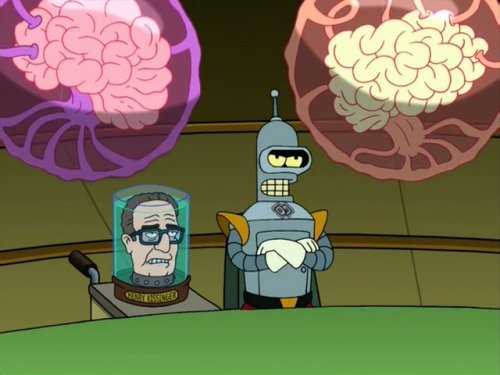 The episode culminates in Fry and Leela discovering Earth’s secret winning strategy: sending Bender (and Henry Kissinger’s head) off to negotiate with the leading Brain Balls (“They’ve got a lot of brains, and they’ve got a lot of… chutzpah.”) But unbeknownst to anyone, Bender has a bomb secretly implanted in his chassis, triggered to go off when he says his most commonly spoken word, which, to the surprise of no one, is “ass.” Barely two seasons in and this show is already making fun of Bender’s catchphrases, and of course, they tease out Bender explicitly not saying the word for as long as possible (“I’m gonna shove this treaty right up their… wait a minute, where do you shove things up a ball?”) It plays out so well, leading to the very ending where the bomb is reprogrammed to detonate on Bender’s least said word, which intrigues the robot further (“Is it ‘please’? Oh, I know! ‘Thanks!'”) Everyone gets in their fair share of great moments in this one. Dr. Zoidberg inexplicably shows up as an army doctor, while feebly working on his comedy material, foreshadowing his dreams of being a comedian. Even our regular cast mates who don’t tag along for the plot get in good lines before they leave, like Farnsworth advising Fry to eat the hearts of those he kills to gain their “rich, tasty courage,” and Hermes telling Fry and Bender not to worry about their jobs while they’re gone… by firing them on the spot (whilst holding back tears.) It’s just an overall really solid outing for the show, an episode that’s kind of always been my baseline great example of what the series can do once it really got moving.
Starting in January of 2000, Futurama would get bumped to a 7pm slot on Sundays, with FOX’s newest show, Malcolm in the Middle premiering at 8:30. Malcolm quickly became a critical and ratings hit, and it would remain in the coveted post-Simpsons time slot for the next two seasons. I ended up missing a decent amount of seasons 2 and 3 of Futurama because I kept forgetting it had moved. After a promising beginning for the series, it only took seventeen episodes before it would become thrust into primetime obscurity, in a deadly time slot that may as well have been its tomb. It’s unclear as to what the “truth” is regarding why FOX was so quick to give up supporting Futurama. Matt Groening and other producers claim the network really didn’t like the show from the beginning, which I can imagine was true of a few of the head executives, and sometimes that’s enough to doom your show, but again, we don’t really know a lot of specifics. FOX would continue to pick the show up for two more years, so they must have seen some value in it. But even at this early juncture, with the show barely a year old, the writing was already on the wall for its ultimate cancellation.

 Me Blog Write Good
The M*A*S*H stuff always makes me cackle. The idea of “iHawk” bot having a literal switch between irreverent and maudlin is inspired.
“In what feels like Matt Groening getting his ultimate revenge on a politician that pissed him off as a young and angry Gen Xer…”
He was born in 1954 wasn’t he? So a baby boomer rather than a Gen Xer.
Sorry for being Professor Brainiac here. 😉
Whoops, year-wise, I was thinking of Nixon’s actual term versus when Matt was actually born. You truly are a Genius at Work!
Regarding why FOX moved Futurama’s timeslot around, I’m guessing they felt the show needed to reach The Simpsons’ level of success to be worth having around.
We know that a decade earlier Jim Brooks was able to negotiate complete creative control for The Simpsons writers, and that it was much tougher for Matt Groening to obtain similar freedoms for the Futurama crew. Presumably to FOX executives, this arrangement made Futurama feel like a less stable investment (or one that made executives uncomfortable with their lack of control) and it had to perform extremely well to earn its keep. I think FOX slept easier regarding The Simpsons’ creative freedom because it had proven itself as a massive cultural phenomenon that continued to make money. Futurama never reached The Simpsons’ stratospheric commercial heights.
So I think FOX viewed Futurama as a show struggling to justify its uniquely privileged existence in terms of ratings, even if by normal standards the ratings were good. And when a show struggles, networks move it to different timeslots to see if it finds more of an audience there. Once it was clear that wouldn’t happen? Futurama gets quietly canceled.
I think this was the first episode I watched. I was a kid, and I was amazed at how more risque it was than The Simpsons. Besides them being called “balls”, those aliens *were* actually meant to resemble testicles, right?
This’ll be the last compare & contrast I do – I’m cutting this idea short, for real this time. Mainly because I didn’t find myself doing much actual comparison the other times, what with the new episodes being so bad, but also because rewatching Futurama has made me realize I don’t feel much of anything towards it.
Even most of the FOX era doesn’t do much for me. I get what most of its jokes and plot beats are going for, but they don’t make me laugh or feel anything. I really just like the concept and potential of this series, but the execution is … well, it’s OK, it’s not bad, it just doesn’t land for me. That’s why I wanted to do this comparison – I don’t feel an insanely huge difference between any era of Futurama. Even the Hulu run doesn’t feel THAT different from the FOX one. It just atrophied a bit between FOX and Comedy Central, then atrophied a bit again.
So take War is the H-Word. It doesn’t all work for me, but the episode attempts a lot of jokes, so I understand Mike’s review of it here when he calls it hilarious. New episodes attempt fewer jokes. This week’s episode, The Temp, is actually pretty good by Hulu Futurama standards. It feels like a modern Simpsons episode where the plot takes priority over comedy, but most plot beats aren’t super interesting either. It has a genuinely intriguing hook where a random guy takes Fry’s place, and nobody but the audience can tell something’s off. But there’s no intrigue or tension after the start because then acts 2 and 3 just flash back and spend 10 straight minutes explaining everything. And it’s basically exactly what you’d expect. It’s a random guy the crew wronged once who wants revenge and hypnotized them. Cool. But that took up 10 minutes. Cut back to the FOX era, to War is the H-Word, and an entire armed conflict took place in that time.
So Hulu episodes take two forms. Either the writers are desperate for ideas and approve really bad ones, or they stretch out half-decent ones to get the most mileage out of them. But even then, I feel like they’re making bad decisions. There was no reason for The Temp to spend 10 minutes explaining things.
Wouldn’t it be more interesting to spend acts 2 and 3 in the present, building tension as we try to figure out who this Fry impostor might be? Spending more time with the audience intrigued? The emotional appeal of watching a mystery is not knowing what’s going on and trying to figure it out. So why not drag out THAT part of the story, if you’ve got to drag something out? Why drag out the boring part wher you find out what happens? That’s the sort of competence I can appreciate about the FOX era, at least. They spent their time where it made the most sense.
If you’re a big fan of what Futurama does, more power to you. You’ve at least got 72 smartly made episodes to enjoy.