
 (originally aired May 2, 1991)
Character traits and compulsions that seem commonplace nowadays seemed to have more gravity back in these early days. In a later episode, Homer getting drunk at a party would work as an amusing flashback, but here, it’s treated much more seriously, as the catalyst to this Marge-Homer marriage trouble episode is Marge’s mortification over Homer getting wasted during their house party. His drunken antics are also varied, going from loud rants to chewing out strangers to lustfully staring down Madame Flanders’s neckline. Particularly jarring is his brief interaction with Bart; it’s an uncomfortable moment where he tries to get his son to “perform” for his buddies. It’s definitely a bit unsettling, but that’s what we need to get at. This is just far too much for Marge, as she puts it, “you didn’t just cross that line, you threw up on it!”
As a result, Homer is stuck having to go to a weekend marriage retreat hosted by Reverend Lovejoy. His attitude then turns when he finds out it’s being held lake-side so he can get in some fishing, and he’s enticed further upon hearing rumors of the famed giant elusive catfish General Sherman that dwells there. Meanwhile, Abe is left in charge of the kids, who quickly proceed to take complete advantage of him, letting them buy gallons and gallons of ice cream, drink coffee and smoke cigars. It’s a B-story I don’t much care for. Lisa does protest a bit and feel some remorse, but it doesn’t make much sense that she would go along with any of Bart’s schemes to this capacity. The ending bit with Abe tricking the kids into straightening up their act is a nice finale, but besides that, it’s mostly filler. Though we do get the first appearance of Snake, and our first “Haw haw!” out of Nelson.
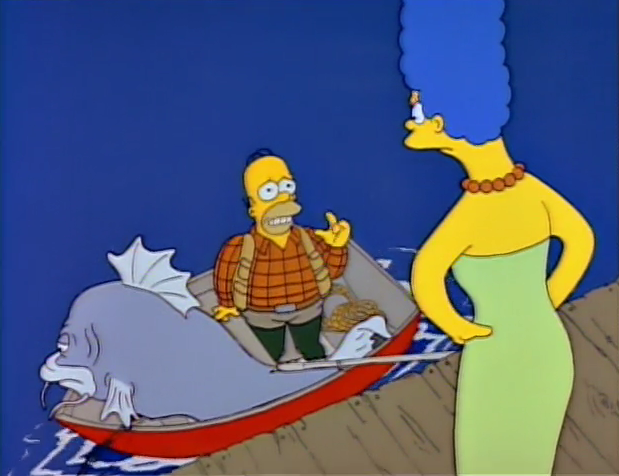
The rest of the episode almost suffers from the fantastic first act; Marge and Homer at the retreat isn’t quite as interesting. By completely ridiculous happenstance, Homer winds up in a boat desperately trying to reel in the General, and when Marge catches him, he angrily tosses it back, showing his true devotion to his wife. It works, I guess, but his gallant gesture doesn’t seem to equal his general assholery at the party. This is another one of those episodes that gets buried amidst more stronger, classic shows, and while sometimes they may be hidden gems, this one’s just alright to me.
Tidbits and Quotes
– Odd that Ned of all people gets the ball rolling on Homer’s inebriation by serving him up drinks. A far cry from two years later when he’s still devastated by a raspberry schnapps he had ten years prior.
– Dr. Hibbert’s very dry manner of speaking is a source of great comedy: first in his commentary about how with all its chemicals, a gag ice cube is much more dangerous than a cube with an actual fly in it, then later upon leaving, he suggests that Marge turn a passed out Homer on his stomach, if she wanted him to live through the night.
– Homer’s recollection of the night before is spectacular, a wonderfully designed sequence with a great New Yorker cartoon-style featuring a dapper Homer as head of an Algonquin group type gathering. The rapid pan across the group morphing into their normal selves is spell-binding, it’s a really great piece of animation.
– One thing this episode has going for it is there’s a lot of great acting in it, from the subtle movements of drunk Homer to the not-so-happy couple during their fight at the retreat. There’s also a smaller bit when Homer is forced to explain his bawdy behavior to his son. Bart just sits there with a flat smile on his face. It’s like he’s humoring his dad, he’s well aware what being drunk means. When his father says he’s hoped he hasn’t lost any respect, Bart responds, “Dad, I have as much respect for you as I ever did or ever will.” Slick.
– I don’t know why, but I love the first couple at the retreat. “Queen of the harpies!” has stuck in my mind for years.
– I like how Homer talks aloud about his foolproof plan to catch and eat General Sherman before the morning, and he barely gets one foot out the door before Marge wakes up and catches him.
– We get a great line from the Reverend, who knows a lost cause when he sees one (“Marge, as a trained marriage counselor, this is the first instance where I’ve ever told one partner that they were 100% right. It’s all his fault. I’m willing to put that on a certificate you can frame.”)
 Me Blog Write Good
Did you catch that the British-sounding couple at the retreat was a reference to “Who’s Afraid of Virginia Woolf”? I’ll admit I didn’t for years, then I saw the film featuring Elizabeth Taylor and Richard Burton.
I just loved hearing Dan Castellaneta doing his best Michael Caine, while Julie Kavner got to just use her natural voice for once.
Never seen that movie, so I never got the reference. It is still a funny scene regardless. This episode is okay. There are some really solid jokes, but I’m not sure how I feel about it as a whole. I guess it makes more sense for Marge to get mad at Homer for getting drunk and making an ass of himself compared to just getting mad at him for dancing with a woman, but still. I like it, but it would end up being in the 150-200 rankings.
“It’s a B-story I don’t much care for. Lisa does protest a bit and feel remorse, but it doesn’t make much sense that she would go along with any of Bart’s schemes to this capacity. ”
Really? Besides the first act, this episode is basically saved by the B-Story. Simple but effective, I could watch an entire episode of that. The characters personalities of the first 3 seasons are my favorite in the whole series, because they were more realistic and darker yet so funny and particular: and this B-story has it: Bart being a total uncontrollable pain in the a*s (smoking cigars, destroying the house, I love it!), and Lisa being more sensitive (the remorse when things get too far) but still being a kid, and as such being subjected to her older brother personality, and still liking the freedom they had without their parents (it makes A LOT of sense, Mike).
Plus, the ending is perfect. It is such a simple “story”, but it has everything a darker and funnier family sit-com must have.
This episode is alright, but not the most memorable. There’s some good bits (Marge should turn Homer over if she wants him to live, among others), but it’s still pretty okay overall.
Again, this episode falls under the good but not great category. The subplot with Grampa and the kids is actually great but the main plot with Homer and Marge was somewhat underwhelming.
A key thing about this episode’s climax that could easily slip by, I think, is that it’s not important that Marge be won over… It’s Homer who has been struggling with his difficulty in caring about what Marge cares about. He loves HER, but he doesn’t get why he shouldn’t be able to do whatever he wants all the time. Because he’s a child. His mantra “gotta be a good husband, gotta be a good husband” is like a child who fears a spanking but has no idea how to control his behavior in the moment, and tries to talk himself into it somehow.
Throwing the fish back was him winning HIMSELF over, realizing that, even at his most impulsive, his primary impulse is to please his wife.
And I gotta say, Homer’s drunken attempt at getting Bart to do something cute felt very familiar. That’s just part of being a kid, I think.
Maybe if you’re the kid of a parent who’s an alcoholic, it’s very familiar.
Speaking of which, Homer does need to win over his wife, in the sense that he needs to show he takes his alcoholism more seriously. Which he almost never does, much to the series’s detriment.