
 (originally aired November 1, 1990)
The series shows some growing up this episode both in size and scope: we go from one boy’s concern on passing a test to an entire gubernatorial race from start to finish in just a few episodes. We continue to see the show’s evolution in its greater showcasing of the world of Springfield, and a more extended look at our favorite heartless billionaire C. Montgomery Burns. This episode is a real tour de force, working as a character examination, a riff on smarmy political tactics and the media feeding into it, and some parody worked in with pieces of Burns echoing Charles Foster Kane. Even with all this, we still work in the Simpson family, who provide running commentary from the common man’s perspective, and inevitably become the undoing of the greedy, wealthy ruling class.
This episode feels so current, but has classic, old-timey elements to it: the media circus we see in the third act is as accurate now twenty years later, but we begin with a 1930s reporter coming to town looking for a hot scoop. Against the hokey Americana scene of Bart and Lisa fishing at the ol’ swimmin’ hole, it looks perfectly at home, and absolutely reeks of the touch of writer John Swartzwelder (just look at his comedy novellas for more of this kind of stuff). The reporter hits the jackpot in the form of a three-eyed fish (its second appearance, now dubbed Blinky; the creature would sort of become the show’s unofficial mascot), which clearly has been contaminated by run-off from the nuclear plant. After a great sequence of inspectors examining the egregious safety violations, they demand Burns bring the plant up to code with a $56 million price tag, or they’ll shut it down. We see Burns at his most vulnerable (and a tad inebriated) after this, as does Homer, who has managed to sleep in at work past closing time. The two share an odd emotional moment as Burns explains the dilemma, and Homer inadvertently gets the plot rolling by off-offhandedly mentioning that if Burns were governor, he could do whatever he pleased.
And so the Burns campaign begins. Everything about it is so spot-on in so many ways. His team seems to be broken into two halves: one to elevate his public image from despicable monster to respectable human being, and the other to make his opponent, the incumbent Mary Bailey, do the reverse. The episode mocks the ham-fisted, pandering nature of political promotion by managing to spin a widely hated man like Mr. Burns into a Samaritan. We start with a PSA hosted by Burns explaining the phenomenon that is Blinky. It starts with the classic gag of Burns badmouthing the public, unaware that the feed is going out live. On a shitty show, this would be the climax of the third act, and Burns’ sshameful undoing, but here, we just gloss right over it. As long as Burns makes a convincing-ish argument, the short-attention-span-adled public will forget all about it. And what an argument, complete with an actor portraying Charles Darwin giving his expert opinion on Blinky’s rapidly accelerated, but completely natural evolution. Ending with a catchy jingle (“Only a moron wouldn’t cast his vote for Monty Burns!”), the public is instantly swayed. Brilliant.
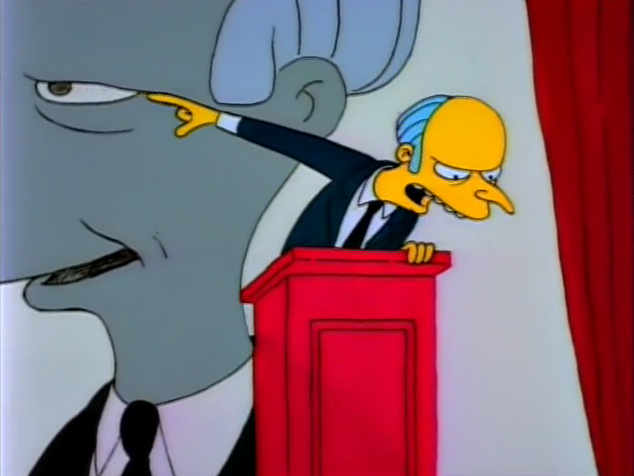
I love how Burns not only is clearly tortured that he must act open and approachable, but he has nothing but absolute contempt for the common man. His actions are purely self-serving, and he’ll put up with whatever he has to to get what he wants, but throughout the entire episode, he treats the normal actions and behaviors of regular people like they’re aliens from another planet. There’s also the overt parallels to Citizen Kane, in Burns’s rise to power, in the characters themselves, bold, powerful men who are dwarfed by their crippling loneliness, and obvious references to the film, such as Burns’s campaign speech before a giant photo of himself, and his breakdown at the very end. For many people like myself, The Simpsons was our introduction to classic films like this, The Godfather, It’s a Wonderful Life, and many others; I remember watching them exclusively to see the origination of the parodies (and who’d have known that they’re actually pretty good films?) But the references are actually worked into the characters and the situations; the joke works because Burns works as a Charles Foster Kane type. It’s the correct way to do a parody, rather than expect the joke to be the reference itself, like another FOX animated show that I will not speak the name of here.
Burns’s campaign would have gone off without a hitch had it not been for those meddling Simpsons. Homer is in full, unwavering support of his boss for obvious reasons, but Marge remains steady in her opinion of Burns being pure evil. In one final pandering publicity stunt, Burns has dinner at the Simpson house the night before the election, an event full of cameras, cue cards and a total lack of anything genuine in nature. But Marge puts an end to that last bit: inspired by a off-hand comment Homer made about how she can express herself through the house she keeps and the food she cooks, dinner comes in the form of a three-eyed fish, and Burns finds he can’t swallow his own hypocrisy, spitting out his first bite, ruining the election (odd how two absent-minded comments Homer makes both start and complete the plot). Burns throws as big a tantrum as he can, weakly managing to topple a few things at the Simpson home, promises to destroy Homer’s dreams and takes his leave. Marge reassures her husband with a sweet ending (“When a man’s biggest dreams include seconds on dessert, occasional snuggling and sleeping in til noon on weekends, no one man can destroy them.”) While the aim of this show reaches so high with the Burns stuff, it never loses sight of the emotional core, the Simpson family, who are given equal attention and merit in the episode without feeling shoehorned in. It’s a shining example of showcasing a minor character while allowing the main characters their own time to shine as well. This is the first episode I would label as perfect, the definition of classic Simpsons
Tidbits and Quotes
– I love Lisa’s response to Dave Shutton’s inquiry about she and Bart’s fishing (“My brother’s using worms, but I, who feel the tranquility far outweighs the actual catching of fish, am using nothing.”)
– The plant inspection is a forebearer to the goofier the show would become later (“Gum used to seal crack in cooling tower… plutonium rod used as paperweight…”)
– Burns’s arrogant and ruthless behavior is revealed early on, when he is completely aghast that the inspector isn’t taking his bribe. He doesn’t know much about the common man, but they’ll shut up if enough dough is thrown their way, but not this time.
– This is the first episode that the question of what state Springfield is in really starts to present itself. The state flag really nails this pointless debate right away: stripes, a star, and the slogan, “Not Just Another State.”
– I love Dan Castellaneta’s performance as “Charles Darwin.” I can’t even place that accent, I guess it’s sort of English… I guess?
– The foreshadowing is so subtle here, where Burns claims that Blinky is “a miracle of nature, with a taste that can’t be beat!”
– Abe has a great comment following Burns’s PSA (“That Burns is just what this state needs: Young blood!”)
– I don’t think Smithers says a word in this episode; he’s basically replaced by Burns’s campaign manager. But I love seeing him in the background, standing and smiling wearing pro-Burns paraphernalia.
– Burns is so pandering in his political jargon, all he ever rants about is how he’s going to show those bureaucrats what for and he’ll lower taxes. He doesn’t care about any of that, he just chose an issue he thinks the public will respond to, and, as established earlier, the only thing he knows is that he can mollify others by promising them more money. It’s purely contemptuous of these lower life forms, aka the non-wealthy (“The voters now see you as imperial and god-like. But there’s a down-side to it. The latest polls indicate you’re in danger of losing touch with the common man.” “Oh, dear! Heaven forbid!”)
– I love the absolutely synthetic nature of the question Lisa is forced to read (“Mr. Burns: your campaign seems to have the momentum of a runaway freight train. Why are you so popular?”) and the great deadpan read Yeardley Smith gives it.
– A fantastic, daring joke of Bart saying grace (“Dear God: We paid for all this stuff ourselves, so thanks for nothing.”) I also love Mr. Burns’s save (“Only an innocent child could get away with such blasphemy. God bless them all!”)
– There’s so much bizarre animation associated with Burns eating the fish, be it his disturbed, disgusted look chewing and spitting, the cameramen and political team looking shocked (the dropped jaw guy is an all-timer drawing), and the great slow-mo bit where the media circus has their fill of the spitted up fish and leaves (“Ruined before it hit the ground.”)
– “Ironic, isn’t it, Smithers? This anonymous clan of slack-jawed troglodytes has cost me the election, and yet if I were to have them killed, I would be the one to go to jail. That’s democracy for you.” “You are noble and poetic in defeat, sir.” …huh, I guess Smithers had lines in this episode after all. My mistake.
 Me Blog Write Good
“Heaven forfend”, much funnier.
[QUOTE]It’s the correct way to do a parody, rather than expect the joke to be the reference itself, like another FOX animated show that I will not speak the name of here.[/QUOTE]
That can apply to either Family Guy or the later episodes of The Simpsons (what most people online call “Zombie Simpsons” because it’s bereft of all light, life, brains, and personality and now shambles across our television every Sunday night), because both shows have been accused of this.
“It’s the correct way to do a parody, rather than expect the joke to be the reference itself, like another FOX animated show that I will not speak the name of here.”
You mean Zombie Simpsons?
It starts with the classic gag of Burns badmouthing the public unaware that the camera is going live. On a shitty show, this would be the climax of the third act, and Burns’ shameful undoing, but here, we just gloss over it.
One word: Gabbo
It’s kind of scary how this episode is from 27 years ago, but it feels like the mockery of the election we just had. Everything Burns does is exactly like what Trump did. WTF?
This is one of my favorite episodes. It’s amazing that it was made in 1990 yet is still relevant today. Even ignoring that, the story is very meaty with topics without ever feeling unfocused or disjointed, and Mr. Burns is characterized excellently here, with a bunch of subtle nuances as noted in the review. There’s great gags dispensed throughout, as well. A solid episode overall.
Another amazing episode with Mr. Burns trying to run for governor. Quite honestly, this episode goes for the satire of out of touch billionaires trying to relate to the average American and the media trying to make profit out of political fear on both sides and it’s done in the most direct and funny way possible.
I remember not being the biggest fan of the episode but now I love this episode.
What I find really interesting is that the cost of getting the plant up to code seems to be not merely an annoyance for Burns, but ruin. Whether he’s exaggerating that or not, it does kind of play to the understandable difficulties a lot of large enterprises have with government overregulation, while others like Burns, who actually are criminally negligent, apparently could not run a profit if they weren’t. Like maybe some research needs to go into that, and how to make it more profitable to do good than bad. Because that’s something you can rely on, and by gum, we had that working for a while there.
Of course, this show has never shown the slightest understanding of nuclear power, or how clean, safe, and idiot-proof it is (any more than it understands religion after the first few seasons). That’s not the point, it’s a cartoonish exaggeration, complete with glowing green goo everywhere. But it’s still basically limitless free energy, Burns should be able to write a blank check to a fleet of maintenance workers. Later, as the show becomes more goofy, that is the premise they stick with: Burns can absolutely afford to bring it up to code, and chooses not to because he’s such a skinflint.