
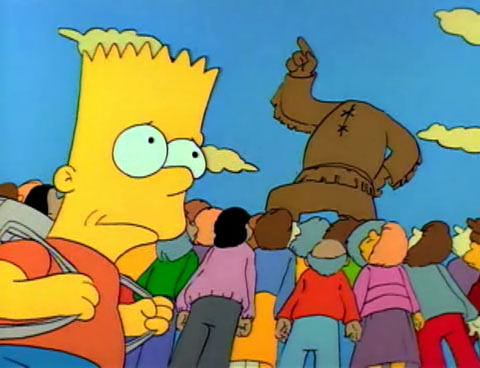
 (originally aired February 25, 1990)
Over this season, we can see a lot of early hints of what this series would eventually become, in content, tone and scope. In this episode, we get a better impression of the actual town of Springfield. This is the first episode that really looks outside the Simpson family and features a few of the fellow Springfieldians we’ve met so far, and some we have just been introduced to. In this context, the episode starts out with a perfect representation of the town of Springfield as we will come to know it: a ravenous angry mob that chases Homer and Bart through town. The good people of Springfield are an impulsive lot, who can turn from calm to raging to relief with moderately little provocation.
The mob in question is in response to the decapitation of the statue of town founder Jebediah Springfield, and our dear old Bart is responsible. The story is interestingly told as a flashback, leaving the viewer in the dark like the townspeople, and creating more of a sense of drama. The impetus of Bart’s misdeed is pretty simple: his attempt to impress some older bullies, Jimbo, Dolph and Kearney, in their first appearance. It’s pretty interesting hearing how parents and various morality groups in the early 90s perceived Bart as a bad influence, but his behavior in the first season barely even registers as devious. He’s mischievous at best, but he takes a neutral stance at his new friends’s shoplifting and defacement of property. Bart seeks his father’s advice, where Homer instills another classic misguided moral: “Being popular is the most important thing in the world.” Homer’s questionable advice sends Bart off to commit the deed: cutting through a bronze statue with an ordinary hacksaw. Don’t ask me how, it’s a cartoon, for God’s sake.
Bart and the bullies’s day about town gives Springfield a sense of scale, but the reactions of the townspeople after the statue defacement is really what gives Springfield character. We get a better sense of Moe’s bar, Abe’s retirement home, the Kwik-E-Mart and Apu, and the first look at the Krusty the Klown show (and a mute, off-model Sideshow Bob), all of whom are out for the blood of the hoodlum responsible for the heinous act. Even the bullies are offended, much to Bart’s shock. In keeping with the title’s namesake, Bart’s conscious and guilt is given voice by Jebediah’s head, Telltale Heart-style, eventually leading to his admission to his family, leading to the wraparound back to the beginning. Homer acknowledges he is partially to blame for his advice, and Bart is forgiven by the townspeople and returns the head to the neck from whence it came.
I glossed over most of the beginning, with the Simpsons attending Sunday mass; it’s not so important story-wise, but it sets up the role of religion in the Simpsons universe. The people of Springfield are mostly God-fearing and devout, albeit some with more reluctance than others. Everything is mocked on the show, religion included, but there is always a sense of positivity to the spirituality, like with Marge believing church to be good for the family. A character like Reverend Lovejoy (another first appearance) would be the subject of mockery and defilement on another show, but is treated as a real person, with a few quirks as we’d see down the road. There’s a lot of funny stuff in the beginning, with Homer listening to a football broadcast on a walkman during church and Bart’s ever-insistent questions to his Sunday school teacher. There’s a lot to love in this episode, a town-wide story with great character stuff, good jokes and an emotional core: a fore-bearer of things to come.
Tidbits and Quotes
– I built the good Reverend up in my last paragraph, now I tear him down. Before his more respectful debut in the episode proper, I love how the beginning of the show shows him as part of the mob, torch in hand, with no qualms about hunting down and killing a young boy.
– The show’s first meta-joke: Bart claiming his story will take “about 23 minutes and 5 seconds.”
– I love the family’s Sunday best outfits, especially Lisa and Maggie’s bonnets and Marge’s pillbox hat high atop her hair. What era are we in?
– The sportscaster’s proclamation, “This could be the most remarkable comeback since Lazarus rose from the dead!” followed by Homer’s “Laza-who?” right as they pull in front of the church makes it doubly blasphemous.
– The Sunday school teacher’s exasperation at Bart’s questions is great, followed by a fantastic skewering line (“All these questions… Is a little blind faith too much to ask?”)
– Always loved this exchange between Jimbo and a hesitant Bart (“But sneaking into movies is practically stealing, man.” “It is stealing.” “Well, okay. I just wanted to make sure we aren’t deluding ourselves.)
– Dolph refers to their shoplifting as a “five-finger discount,” while they all have four fingers. Huh.
– I love the Candy Most Dandy shop owner, and I really don’t know why. He has such a sophisticated voice and is so irritated by the bullies, and seemingly by life in general, but meanwhile he owns a jolly-looking candy store. He may be my favorite Simpsons character with eight seconds of screen time.
– The bullies’s about-face in their sudden disapproval of the statue’s beheading seems kind of silly, but I love their response when Bart asks why they previously thought it would be a cool idea (“That was just cloud talk!”)
– The news report about the history of Jebediah Springfield is fantastic (“Jebediah Obadiah Zachariah Jedediah Springfield came west in 1838, along the way, he met a ferocious bear. Jebediah discards his axe and wrestles the bear and killed him with his bare hands. That’s B-A-R-E hands. Though recently uncovered evidence that the bear, in fact, probably killed him.”) I love that glossing over of evidence that discredits his great accomplishment, as it’s an excellent illustration of how we tend to romanticize figures of the past, embellish their achievements, or just flat-out lie about them, not exactly for what they did, but what they stood for (see also: “Lisa the Iconoclast.”)
 Me Blog Write Good
A sign that I almost missed:
Space Mutants 4: The trilogy continues.
The FOX version of this has a part during Bart’s speech where Bart tells the crowd that they lost their sense of town pride and citizenship and that’s what turns them around. The versions on DVD and on FXX don’t have this. Why was it cut? Because FOX asked Groening to shoehorn that “town pride” speech near the end because the episode didn’t have a moral to it.
Now, call me crazy, but I think it did have a moral to it — several, in fact. “Don’t give in to peer pressure,” “Take personal responsibility for your actions,” but they were so subtle that the pinhead producers didn’t see it.
One of the funniest bits from the first season is Homer listening to the Walkman during church and Lovejoy’s mouth somehow syncing with the radio. I also love Homer’s lame coverup to his outburst. “IT’S GOOD! IT’S GOOD!… Uh… to see you all…”
This may be my favorite episode from Season 1. I just love how the story is told as a flashback and as you said, it really develops the citizens of Springfield. The animation during the night scenes is also really nice.
The Sunday school teacher getting frustrated from all of the questions is hilarious as is the bit with the walkman in churrch. Although, I did not realize ear buds existed in 1990.
Cloud talk is also a great line.
Canais, I don’t remember there ever being any dialog about town pride. Although, outside of catching the episode maybe once on TV, I always watched it from the VHS tapes or DVDs, so that could be why.
Watching this episode for the first time after having seen many of the episode post 1996… damn Sideshow Bob looks different. Chief Wiggum sounds competent, and there’s something about Mr. Burns’ voice, too.
One of the best season 1 episodes. I really like the story, and the teens get a nice introduction. I like the “you’re stealing” joke, the church set piece at the beginning with the “blind faith” line… there’s just a lot to love about this one.
This is easily a great episode. Bart, Jimbo, Kearney and Dolph work off each other very well in my opinion. This episode has a relatable story with Bart wanting to be cool so he steals the head statue of Jebadiah Springfield (the town’s founder). This episode also shows despite Bart’s rebellious attitude, he still has a heart and a conscience. While I wouldn’t say this episode is the best of its kind. I still really like this episode.