467. MoneyBart

2201Original airdate: October 10, 2010

The premise:
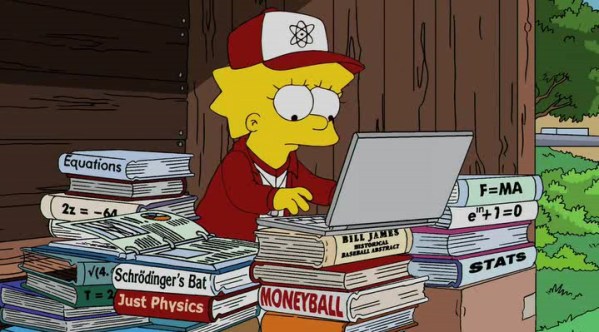
Attempting to bolster her extracurricular resume, Lisa becomes the manager of Bart’s little league team, despite knowing nothing about baseball. However, when she latches onto the statistics and probabilities linked to the sport, she leads the team in an incredible winning streak.

The reaction: Wow, three Lisa episodes in a row? We start with a recent Yale graduate returning to Springfield Elementary to admonish Lisa, an eight-year-old child, for not having more extracurricular activities. It’s the same thing as Declan Desmond in that astronomy episode. It skirts close to a point about more and more pressure being put on children and their parents to load up earlier and earlier to impress colleges, but it barely comes close to that point. The episode is all about Lisa delving into the science behind the game, utilizing probability to determine the outcome of plays, which is an incredibly interesting concept, but as usual with this show, it isn’t really delved into, it’s just briefly explained, and then we jump into a montage of the team winning every game as Lisa cracks open book after book. A rift is created when Lisa becomes a hardass stickler to her system and kicks Bart off the team for disobeying her play, despite him hitting a home run. In a pitch during the final game, Lisa pleads Bart to return, who disobeys her orders again as Bart attempt to run all the bases, and ends up losing the game. But the crowd was swept up in the excitement of the moment, swaying Lisa as well. It’s all so… boring. Everything about the ending is so stretched and laboriously spelled out, I guess because there’s barely any material here to begin with. The last two episodes featured Lisa stories that felt extremely rushed because of the presence of a B-story, but here with only one plot taking sole focus, the story still feels so thin.

Three items of note:
– There are very few things I’m aware of about all these episodes I’m about to endure, with the only stuff I remember is anything that was highlighted in the entertainment news. In this case, it’s the couch gag conceived by Banksy, where we see the hellish working mines where nondescript Asian children are painting Simpsons cells and making Simpsons merchandise. It’s pretty dull and boring, which would be okay if it actually was communicating a point that the show itself hadn’t already done twenty years ago. Remember Kent Brockman reporting on the production of the Itchy & Scratchy movie? Yeah, me too. Hell, The Critic already made this exact joke twenty years ago too, and it was quicker, more scathing, and funnier.
– In the middle of the episode during Bart and Lisa’s feud, we find Homer and Marge picking sides in their argument. They’ve barely been present in the episode, and I thought this would develop to something, but it really doesn’t. We also get a bizarre bit where we cut back and forth between the two glaring at each other down the dining room table: Marge mad, Homer mad, Marge mad, Homer asleep, Marge mad, Homer mad. Like, we don’t see him wake up or anything, she doesn’t get more angry at him passing out at her. It felt like weird padding.
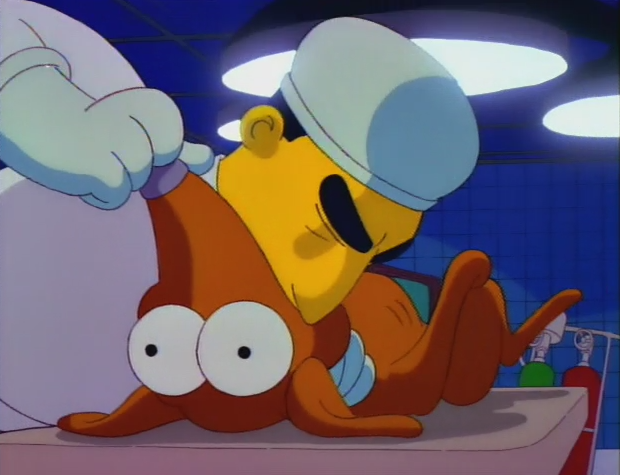
– This episode is full of watered down bits from previous episodes. Lisa’s initial indigence about not being accepted as the new coach because she’s a girl rings of her attempt to join the football team in “Bart Star.” In that episode, her character was on the precipice of the indignant liberal mouthpiece she would eventually become, but it’s clear her intention was to shake up the “system” rather than play the game, but when she finds that not only is coach Ned Flanders is open to her joining, but she’s not the only girl player, she sheepishly leaves. Here, Lisa’s smugness is only deflated when she realizes the names of past baseball managers she thought were female were actually men, a belabored joke that takes two times too long to tell. We also get Bart and Lisa doing the coach signaling thing, which is nowhere near as hilarious or memorable as Burns from “Homer at the Bat.” Speaking of, we get the return of Mike Scioscia as a guest, creating a great example of the stark difference in how the show treats celebrities. Nineteen years prior, Scioscia’s undying work ethic got him laid in a hospital bed with radiation poisoning. Here, he gives Bart a pep talk on a roller coaster while showing off his World Series rings. Which sounds funnier to you?

One good line/moment: Any time we’re on the baseball field, the announcer is always Harry Shearer doing his Vin Scully voice, and while of course the quality of writing has gone down, there are still a few good lines in there from him (“Bart Simpson on deck, his bat’s just hungering for a Homer, like Chronos for his children. Speaking of ‘Homer,’ Bart’s father’s name is, you guessed it, not on my fact’s sheet.”)

466. Loan-A Lisa

2201Original airdate: October 3, 2010

The premise:
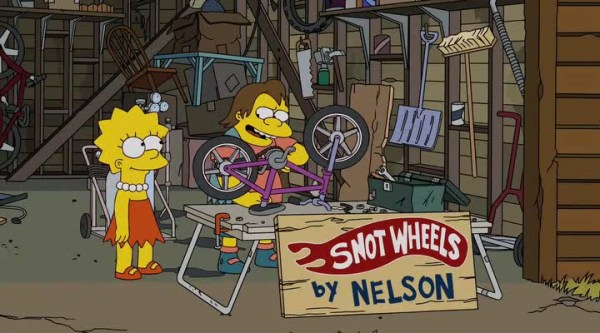
Lisa decides to anonymously invest in Nelson’s business of modding bicycles, but becomes horrified when he decides to drop out of school once business starts to take off. Meanwhile, Homer discovers a way to temporarily live the high life by purchasing extravagant items and returning them for full credit a few days later.

The reaction: This was a pretty dry and lifeless one. It’s especially hard to care when your A-story kicks in literally half-way through the episode. Or rather, there was one plot for the first half, then it became the B-plot in favor of the Lisa story. When Lisa starts looking up micro-finance and how to invest in a business, I certainly thought the episode was going to take a much larger turn, which at least might have been a little interesting. Instead, the episode is about Lisa giving Nelson $50 to start a business. Which from that paltry cash, he completely pimps out his garage and is able to pay employees $11/hr. How much work could he have possibly done? Lisa initially donates anonymously, but she eventually breaks and tells him, mostly because she is so satisfied with herself and wants to hear praise directly from him. So when she’s shocked to find out Nelson is dropping out of school and that’s the thrust of the story, it’s hard to care because she had been so smug before, and also, who cares? Her attempts to sway Nelson backfire, and ultimately he’s done in when he finds out he hasn’t been using water soluble epoxy on the bikes. So, just buy different epoxy and you’re all good? I guess ultimately the message is that he would have known that if he had gone to school, but he’s gonna get a shitty education anyway at Springfield Elementary, so what’s the point? The episode just felt like a cobbling together of elements from past shows (the Lisa-Nelson relationship, Abe giving out his inheritance, Marge’s awkwardness with high-class) strung together with a limp plot.

Three items of note:
– The Itchy & Scratchy at the start is a “parody” of Up, which of course means it’s a recreation of the opening montage of the film using exact shots and the exact same music, with the only differing thing in it being Itchy gunning down Mr. and Mrs. Scratchy at the end. Like all of the show’s references to the animation studio, it just feels like them holding up a giant “WE LOVE YOU PIXAR” sign. Looking up at the clouds, Scratchy points out images of Buzz Lightyear, Mike Wazowski and WALL-E. These aren’t jokes. I guess the audience is supposed to smile and clap their hands because they recognize those characters? The worst part is is that they could have actually done something actually clever with the material. The Up opening scene contains some genuinely heartbreaking moments that could have been deliberately and humorously sabotaged by over-the-top violence. Maybe you play the whole thing straight up until the end, when an elderly Scratchy having just buried his wife returns home only to be abruptly killed by a manic Itchy, who laughs and scurries from the room.
– I don’t really have much to comment about the A-plot, then B-plot. It starts as a “Scenes of the Class Struggle in Springfield” retread, then becomes Homer just buying expensive shit and getting caught. Well, he kind of gets caught, but then there’s no resolution to the story. At the start of the story, Marge feels cornered into buying an expensive purse by snobbish brow beaters Helen Lovejoy, Bernice Hibbert, and… Julio. I gotta say, I thought his character was slightly amusing at first, but now I cringe whenever he shows up. It’s basically just Hank Azaria doing his character from The Birdcage, except Julio has no character or purpose within a story, he’s just a flat gay stereotype, a literal card-carrying one as shown here, as he presents Marge with a dual calling card of “Sassy Gay Friend” and “Scheming Gay Enemy.” We’ve come a long way since “Homer’s Phobia,” baby.
– Unlike the classic years where celebrities who appeared on the show were subject to a fair share of good-natured ridicule, nowadays it’s like a promotional platform for them to look awesome. Nowhere is this better exemplified than the inexplicable appearance of Facebook creator Mark Zuckerberg. There’s plenty of rich material you can get out of privacy concerns or how social media has affected real-life relationships and the weird exacerbated social conditioning of it all, but the show is interested in none of that, and the only joke is that Zuckerberg speaks in Facebook statuses. What a riot! Like the Pixar segment at the start, it really feels like the show isn’t interested about making jokes about things, but would rather use their massive audience to advertise stuff they think is cool.

One good line/moment: Nobel Peace Prize winner Muhammad Yunus is another disposable guest appearance, and while he didn’t really have a lot to work with, you can tell he had a lot of fun recording his lines. His fading “Goodbyyyyyeeee” when he left the computer screen was just adorable.

465. Elementary School Musical

(When I rebooted the blog a few years ago to continue barreling through the rest of the seemingly endless run of the show, I barely got through a season. I considered it all to be a moot point; to me, the show had reached a plateau of quality where all the points I could complain about seemed to be covered, and bitching and whining about it even more seemed pretty fruitless and repetitive. But every now and again since then, I found myself drawn to wanting to cover the last seven or so years, like a moth to a yellow flame. So yeah, I’m gonna try it again. And yeah, I’m sure I’ll cover well trodden over ground and remake a lot of the same points. And I can’t even guarantee I’m not going to throw my hands up and stop mid-way through again. But the urge is striking my fancy at the moment so let’s see how long this crazy train can stay a-rollin’.)

2201Original airdate: September 26, 2010

The premise:
Lisa spends a week at an arts camp and has her creative spirits lifted, only to come crashing down once she has to return to a harsh reality. Meanwhile, Krusty drags Homer and Bart to Europe to accept a Nobel Peace Prize, only to find the award was only a ruse to put the clown on trial for his multitude of overseas crimes.

The reaction: “How I Spent My Strummer Vacation” comes to mind as a direct comparison to this, and the fact that this episode has an even more inept story than one of the worst episodes ever, that’s pretty astounding. Firstly, we spend the first few minutes with the Krusty story before Lisa is dropped off at camp with no real set-up whatsoever. The only bit we get is her complaining about being the overlooked middle child, which is not so much sympathetic as it is whiny and self-righteous. So here’s your problem: Lisa spends the back half of the episode missing the artistic freedom she had at the camp, when we barely saw any of it. After she gets dropped off, we get our opening number with the cast of Glee (FOX synergy at work!), and then we meet our guest stars, Bret McKenzie and Jemaine Clement, who, like Simon Cowell, Stephen Colbert, and others in the past, are basically just playing their TV personas, despite being billed as new characters. After that, we get two scenes that are basically poor attempts to do Flight of the Conchord-style banter, and Bret and Jemaine at the campfire, singing a song about art that says and means nothing, but inspires Lisa anyway for some reason. Homer’s dream of being a rock star made no sense, but at least we spent an entire act at the camp and got a sense of what it was. Lisa is disillusioned by her drab normal life, so she goes to “Sprooklyn,” the Springfield arts district, only to be shocked that Bret and Jemaine are actually depressing starving artists. Her childlike hopes dashed and her supposed idols exposed as frauds, she pleads with her mom to take her home, but then tells Bret and Jemaine that she’ll “try again when I’m older,” which I don’t quite understand. Try to strike it out as a broke artist when she’s older? What? It’s like they ran out of time and just had to end the episode. It’s yet another instance where the writers try to have their cake and eat it, where Lisa has the intellect and cultural knowledge of a forty-year-old, but is also a painfully naive child who buys into Bret and Jemaine’s indistinct empty pleasantries hook, line and sinker.

Three items of note:
– Way, way back, I bitched about the new HD opening titles, but seeing them again after all these years, it continues to really bother me. I guess you can consider the “slower” pace of the original titles outdated, but I think that’s better than them shoehorning jokes into every little moment, like Lenny and Carl doing a pratfall behind Homer at the plant or Otto eating the nuclear carbon rod for whatever reason. Stuff like that you may smirk at, at best, the first time you see them, but having to see it each and every week, you get sick of it real quick. We also get two new changing elements to the opening titles, something that flies by the clouds at the very start, and a sign gag right before we enter Springfield Elementary. Ironically for a show that at this point feels like it’s in a joke drought, the opening titles is like an exercise for how much we can cram into a minute so the audience won’t get bored. Also, the chalkboard gag, “When I Slept In Class, It Was Not To Help Leo DiCaprio,” it took me a good while to realize it was an Inception reference. Glad that joke held up.
– There are three campers who are voiced by Glee cast members, whose names I can’t be bothered to look up. Their opening number is so, so bland and sterile, lyrically and visually. The song is a “parody” of “Good Vibrations” by The Beach Boys with Lisa doing the chorus as “Art, art, art and education.” When you can’t think of jokes and need to fill time, I guess repetition is your next best bet. It’s just so boring, and ultimately leads to nothing, since act two features the campers doing nothing artistic at all other than dancing to Bret and Jemaine singing. Again, “Strummer Vacation” was a piece of trash, but at least I have an idea what the rock-and-roll fantasy camp was, with scenes of all the rock stars talking about writing songs, creating an image and averting the paparazzi. I haven’t the faintest clue what “Expressions: A Performing Arts Camp” is supposed to be. The best we get is a camera slideshow from Lisa at week’s end as a joke-filled recap of shit we never saw, including guest appearances from Andrew Lloyd Weber and Elaine Stritch and a performance of Angels in America, where the joke is basically someone just redrew the poster for the HBO miniseries and added Lisa to it.
– There’s not much to really say about the B-plot. Krusty brings Homer along for “being the easiest laugh I know,” and Bart tags along just because. Despite his many, many crimes, the judge decrees Krusty will be exonerated if one can cite one contribution he made to Western society. Bart saves the day by presenting a clip from 1990 of Krusty being a primadonna and refusing to play a gig in South Africa, and that three days later, Nelson Mandela was released from prison. That makes sense, right? They don’t even bother making a joke about it being illogical. Bart barely finishes his dialogue before the judge turns around and clears Krusty of all charges. I had to rewind because it went so fast and I could barely figure out what was happening.

One good line/moment: I actually smirked at a couple of gags, but my favorite moment was an unintentional laugh. One of the campers is a kid in a wheelchair, I guess as a reference to Glee, and in the wide shot toward the end of the opening song, you just see him alone in the corner spinning in a circle. It’s kinda sad, but I laughed at it all the same.

Ten Defining Episodes

I feel the avalanche of latter-era episodes has kind of tainted the spirit of this blog a bit, and my return to continue and cover season 21 certainly didn’t help. Sure, those episodes deserve to get taken down every peg possible, but through it all, we can’t forget the amazingness that is the show in its prime, The Simpsons, as it is, the greatest comedy to have ever air on TV. And so, in what may be this blog’s final post (maybe), I’ve decided to do… a list. Yeah, real original. Now, I didn’t want to do a top 10 best, and certainly not a top 10 worst. This is a little different. It may shock you to hear this, but there are some people out there who have never watched the show before. It’s true, I’ve met them. Now surely everyone has heard of the show, and can identify a few of the main characters, or at least the Simpson family. Also, I think everyone has at least seen a small bit of at least one episode in their lifetime of channel surfing. But in terms of sitting back and seriously watching an episode? We take that luxury for granted, but some people aren’t so fortune. So how does one introduce another to The Simpsons? Can you even imagine it? Where do you start? What episodes would you show that can fully illustrate the show’s utter genius? Well, that’s what this list is: the ten episodes that represent the greatness of The Simpsons.
imarriedmarge1. I Married Marge (season 3, episode 12)
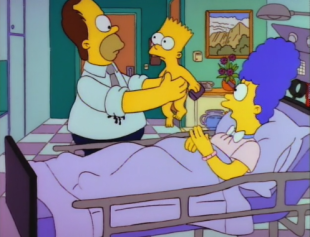
This episode serves almost like a prologue to the Simpson family, and the bumps and sacrifices taken in order to create the semi-stable household that it is in our series proper. As their younger selves we can profile Homer and Marge perfectly, the former a loving husband who tries to do right despite his crippling idiocy and short attention span, and his lovely wife, who is sweet, gentle, and who he’d do anything for. This is also one of the sweetest episodes of the series, with multiple moments that pack an emotional whollop, but also we’re shown that the funny never stops, and more importantly, doesn’t interfere with the tone of a scene. We can be touched by Marge reading Homer’s simple, yet truly heartwarming proposal, and laugh as we see his butt crack in her face as he continues to fish around the seat for it. Now needing to support a pregnant wife, Homer’s arrested development is shaken as he strong arms his way into a grown-up job, thrust into responsible adulthood, which explains his sometimes childish outlook. This episode sets up a lot, and given that everyone at least has a cursory knowledge of the series, it’s not alienating as a prologue, and is my ideal starting point.
dogofdeath2. Dog of Death (season 3, episode 19)
This is my idea of a “normal” episode, as we watch the family as they manage through a true-to-life situation, in this case what to do when their dog falls ill and his operation comes with a high price tag. After the emotion-heavy introduction, this episode easily shows off the series’s strongest asset: humor. In my opinion, this is one of the funniest episodes ever, with so many absolutely hysterical bits. All the lottery hysteria at the beginning feels very real, but then you also have crazy shit like the frenzy the town gets whipped up in, and the King Homer dream, perhaps the best dream sequence of the whole series. Doggie heaven, Burns training Santa’s Little Helper to be a killer, Brockman becoming a smug asshole after winning the lottery, the laughs keep coming hard and fast. But the foundation of a solid, relatable story is still there, and while we feel good when Bart and his dog are reunited, we then laugh at Homer scoffing at the idea of petting the cat (“What’s the point?”)
dogofdeath3. Three Men and a Comic Book (season 2, episode 21)
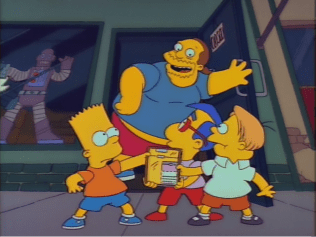
At this point, I figure we’d examine each Simpson on their own adventure, and their role in the show. First up is Bart. To me, the best Bart episodes are when he’s just a precocious, devious youngster, be it struggling in school, playing pranks, or engaging in idol worship with his TV hero Krusty the Clown. In this episode, a limited edition comic book is like the holy grail to our favorite spiky haired ten-year-old… but unfortunately he’s got to work for it. This episode also shows how the tone of a show can turn on a dime, but still feel like a cohesive story. We open with the big comic book expo set piece, rich with satire, then we have Bart working under Mrs. Glick, then by act three it turns into a Treasure of the Sierra Madre parody with heightened action and drama. But even through all that, the plot still flows and nothing seems like it’s coming out of left field. It’s like a twenty-two minute roller coaster, and it’s one hell of a good ride.

streetcarnamedmarge4. A Streetcar Named Marge (season 4, episode 2)
Now it’s Marge’s time to shine, in an episode that also further examines her relationship with her husband. From the start we see Homer is forgetful and inattentive to Marge’s new creative and social venture, but never do we feel his rude behavior comes from any sort of malice. In one of the most telling lines in show history, when Marge asks him why he never told her he never had any interest in her hobbies in the past, he responds, “You know I’d never say anything to hurt your feelings.” That sums it up right there; Homer may occasionally say hurtful things, but he never knows what he’s saying is hurtful. Meanwhile, Marge proves to be a powerhouse performer in “A Streetcar Named Desire,” channeling her anger at her husband, and also showing off her own talents, which gives her some sense of identity outside of the house. Also critical is the music; one of the great pillars of this show is its amazing songs, and this episode, turning the ultimately somber Tennessee Williams play into a rousing, show-stopping musical, is the king of them all. The upbeat “You Can Always Depend on the Kindness of Strangers” may be the most brilliant thing this show has ever done ever. And remember, a stranger’s just a friend you haven’t met. You haaaaven’t meeeeet… Streetcar!

lisassubstitute5. Lisa’s Substitute (season 2, episode 19)
I see this one a lot on people’s top episodes lists, and while I don’t know if I’d put it amongst my absolute favorites, in terms of illustrating Lisa’s character, it’s the perfect representation. She’s the eternal big fish in a small pond, trapped in a town full of idiots and a family that may support her, but will never truly be able to reach her on an intellectual or emotional level. Since by nature of her character, she must remain somewhat miserable in the status quo, so most Lisa episodes involve her finding happiness and it being taken from her, in this case the enter and exit of the brilliant and sensitive substitute teacher Mr. Bergstrom. He’s everything Lisa could ever want in a teacher, nay, a human being, and their emotional connection only makes it tougher to see them part ways. Also running through the episode is depicting Homer’s disconnect with her daughter; if anyone in the family has less of a chance reaching her, it’s him. But we once again see the critical element of Homer in that he loves his family, in an ending where he attempts to make amends, and succeeds, in his own simple-minded way.

homerstriplebypass6. Homer’s Triple Bypass (season 4, episode 11)
Last up is the big man himself, in a hysterical episode involving a father of three suffering a heart attack and needing to undergo a serious operation. A big part of Homer is his incredible gluttony, and here we see it finally come around to bite him in the ass. This episode is a crowning example of the show dealing with truly devastating subject matter, but remaining consistantly funny with absolutely no clash in tone. We go right from Lisa hugging her father and sobbing when he announces his operation, to Homer saying how Abe Lincoln sold poisoned milk to school children within three seconds, and you can still laugh. We get our fill of great moments, with the always hilarious Dr. Nick, Homer’s childish glee over his adjustable hospital bed, and visits from Moe, Barney and Krusty (“This ain’t make-up!”), but we also can truly appreciate the tender moments of Homer’s nighttime prayer, and his maybe final words to his children, which again is peppered with great moments of humor with Bart telling him what to say (“And Lisa, I guess this is the time to tell you… that I’m adopted and I don’t like you. …Bart!!“)
brushwithgreatness7. Brush with Greatness (season 2, episode 18)
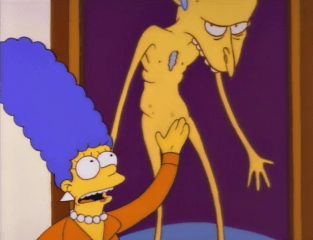
Another Marge episode, kind of in the same vein of “Streetcar” in displaying her talents apart from her normal housewife identity. It’s a bit more prominent in this one, showcasing her artistic talents, a trait that’s continued through a few token episodes. There’s a lot more great stuff here though, like the Mt. Splashmore opener and Homer attempting to lose weight. But more importantly, this episode illuminates one of the greatest members of our supporting cast, C. Montgomery Burns. He’s at his most fiendish here, but we also see a more vulnerable side to him (I love his earnest “Can you make me beautiful?” to Marge). As despicable as he is, he’s still human, as explained in the final reveal of Marge’s painting, one of the show’s best examples of blending outrageous humor with a genuine meaning. This series certainly wouldn’t be the same without its secondary characters, and the finale to this show almost acts as a thesis statement on Mr. Burns.
youonlymovetwice8. You Only Move Twice (season 8, episode 2)
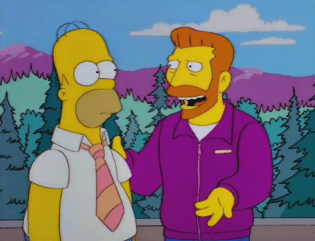
In terms of its emotional core, this episode kind of complements “I Married Marge” and the other flashback episodes, in showing that in the thick of it, Homer will always choose his family over himself. He finds himself in a cushy job, a great house and a boss that seemingly respects him, but he finds he can’t be truly happy if his family isn’t. But on top of all that is mountains and mountains of humor, with Hank Scorpio at the top of them all. Albert Brooks has voiced many memorable characters over the series, but Scorpio tops them all, the elaboration on the great premise of what if a James Bond villain were the world’s greatest boss? Every line of his is hysterical, thanks to the sharp writing and Brooks’s own ad-libs. This episode is to highlight the show’s ability to create one-off characters that truly stand the test of time, and Scorpio definitely is at the front of the line.

bartvsaustralia9. Bart vs. Australia (season 6, episode 16)
This is a series that skewers every facet of American life and culture, but that’s not even enough. Nowhere on Earth is safe from ridicule. There seemed to be a lot more travel episodes in later seasons, all of which were mostly toothless, and at worse lightly culturally offensive, but this episode rules because it tackles a foreign country and foreign policy simultaneously. The United State and Australia end up both coming off like idiots, attempting to calm an international incident accidentally caused by a ten-year-old. We get Phil Hartman playing his best one-off role as the American ambassador (“Then it’s agreed: during the bargaining session, we each get two candy apples… all right, one candy and one caramel,”) the legendary game of Knifey Spoony, and Bart mooning the highest ranking Australian officials, only to be escorted out by helicopter in a shot in a reference to the famous photo of Americans retreating from Vietnam. What more could you want out of an episode?
homesweet10. Home Sweet Homediddly-Dum-Doodily (season 7, episode 3)
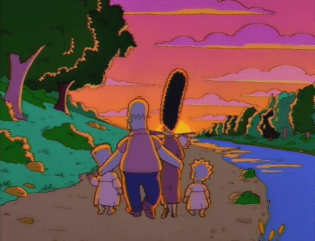
At its core, The Simpsons is about… well, the Simpsons, this family whose members never seem to find real acceptance or happiness out in the world, but remain a strong unit in themselves. Sure, they bicker and squabble, but deep down Homer and Marge love their kids, and vice versa. Nowhere is this better displayed than this episode, where parents and children are separated thanks to an avalanche of misunderstandings. Playing amongst the humorous bits of bizarre life at the Flanders house and the dimwits at the proper parenting course, we get amazing scenes of Homer and Marge sadly walking past their children’s empty rooms, and Bart and Lisa in bed reminiscing about fond memories with their parents. For better or for worse, they all belong together. The shot at the end is a perfect encapsulation of this, a beautiful shot of Marge cradling her baby (“Maggie, you’re a Simpson again.”) Followed by Maggie removing her pacifier and belching. As crude and dysfunctional as they may be, the Simpsons are happy just as they are.

Whelp, I guess that’s it. For real this time, I can conclude I have no interest in anything from season 22 on. I’d like to thank everyone who took the time to read and comment throughout my journey. Hopefully you enjoyed my exuberance and my suffering, and I hope I’ve inspired some of you to go back and revisit great moments from this truly tremendous series. Smell you later!

So, what have we learned?, or Thank God it’s over (again)

simpversaryIn January 2010, I watched the 20th anniversary special that Morgan Spurlock made. I had made the decision the previous fall to finally stop watching the series, so seeing this special was kind of bittersweet to me, celebrating 20 years and the future of a show that I had just decided to give up on. The special was not so much about the show itself, but the global phenomenon it spawned, and how it affected all of us as people, a society… hell, the entire world. We got to see the Simpsons-inspired donuts of Portland, Oregon, a pretty damn good Homer impersonator at San Diego Comic Con, a British fan with over 30,000 pieces of Simpsons stuff over every inch of his cramped house, blowhard Bill Donahue continue to make a public fool of himself, Dr. Ruth discussing Homer and Marge’s sex life, and Conan O’Brien hypothesizing a wonderfully grim end to the series that I almost wish would actually happen (“Marge is going to take a good long look at Homer, and say, he’s so stupid, and he’s screwed us over so many times. It’ll be humorless, it won’t be funny, it’ll just be her looking at Homer, and saying, you are such a stupid son-of-a-bitch, you’re endangering my children, you’ve destroyed the town six hundred thousand times, you’re a threat to mankind. I’m leaving you forever.”) The show’s “alleged” decline in quality is touched upon very briefly, with two writers dismissing any and all criticism, but hey, the special is neither the time nor place to bring that up. After I watched it the first time, I kind of enjoyed it, but I certainly remained steadfast with my decision to abandon the show. And watching it again, I pretty much feel the same way.

So here’s the million dollar question: what caused one of the greatest, if not the greatest, television show ever to slowly but surely become one of the worst? Well, if you ask that off the bat, you haven’t been paying attention to this blog at all. There’s so many answers and contributing factors to this inquiry, but there’s one point I want to elaborate on as what will probably be my final statement. Episodic TV comedies are really hard to keep going. What I’ve noticed is very, very few of them get past five seasons and remain as good as ever, so the fact that we got eight untarnished seasons of The Simpsons is miraculous. But over time, things happen. Situations get crazier, characters more exaggerated, the show starts becoming ridiculous, and starts losing its humanity. But there’s no reason a show with such a strong foundation as The Simpsons couldn’t still be great today. With so many characters and locations established in the great, wide world of Springfield, the stories that could be told are endless. But the show, for whatever reason, seemed to stop trying. I think with a long-running comedy, you need to shake things up and try new things, explore new places and different avenues for your characters to go down. But this show seemed to do the opposite; rather than have the cast grow, they retracted, becoming more one-note props than actual people. If I continue elaborating, I’ll just be repeating points I’ve made through this whole blog, but I feel like the biggest disservice of the show is its degradation of its characters, and the town as a whole. What once seemed so full of life was now just going through the motions, spit out the catchphrases, do the same old schtick, cash your paychecks and move on to next Sunday.

Many fans cry about how the last decade or so of the show will tarnish the legacy of the series. The Simpsons  will certainly be remembered for running long past its luster, and every article written on it will surely include some sort of asterisk to this point, but just take a look at the special. Every clip, every reference, everyone interviewed, everything that is shown or mentioned comes from the classic era. It’s a special celebrating twenty years, yet 95% of all the material shown comes from the first half. The fact of the matter is that the latter episodes are just incredibly unmemorable, and this anniversary special just further emphasizes it. Frank Grimes, Mr. Plow, the Land of Chocolate, Whacking Day, the Babysitter Bandit, all of these classic moments, and many, many more will be remembered and cherished forever. But what’s a noteworthy moment from the last decade that you can honestly say will stay with you? Even episodes that pissed you off will eventually fade away, and in time, only those sweet, sweet golden years will remain. The systematic tarnishing of The Simpsons used to bother me, but now it really doesn’t matter anymore, even after having just suffered through hundreds of sub-par episodes. We can remember and honor the show in whatever way we choose, and nothing they do now or into the future can taint my fond memories of our favorite yellow family.

So there’s the retrospective. Wednesday, one last post. Probably.