

Original airdate: January 15, 2012
The premise: In an attempt to gain some actual friends, Lisa creates an online social network called SpringFace, but as its popularity spreads and ends up addicting the entire town, serious problems begin to arise.
The reaction: Wherein the writers really loved The Social Network and decided just to do that story. Mark Zuckerberg was on the show last season, so we once again have another Star Wars/Cosmic Wars scenario. But whatever, Facebook doesn’t exist, except for the times when it does. We get a framing device of Lisa on trial for her actions causing devastation to the whole town, I guess mirroring the deposition in the actual film. Surely this will all make sense when we get to the end. Except of course it doesn’t. It isn’t until the nine minute mark that the story actually kicks in. Lisa is on Springfield Elementary’s online chat room or something, and, not knowing what to say, types in simple questions like “Do you like ice cream?” of which she immediately gets four responses. Desperate for friends, Lisa uses this social meeting site as inspiration to create… another social meeting site? After the act break, we see her and the other Super Friends in the computer lab creating the website. So, does she not consider them her friends? Or does she just want non-nerd friends? They could have even made a joke about that if they had, you know, put some thought into this. So SpringFace launches and Lisa is stunned that even adults are using it. The episode then turns into a social commentary of everyone staring at their phones and not interacting with each other, which is a really softball satirical target, but even this the show manages to bungle. We barely see what people are so engrossed with on their phones, which could have created amusing juxtaposition to what they’re actually doing, or could be doing, in real life. It never extends farther than just seeing people staring at their smartphones, which ultimately leads to calamity of people texting while driving causing car wrecks, and in no time at all, the town is in ruins, somehow. It’s not clear why there’s this widespread of a disaster, and why Lisa shutting down SpringFace will fix anything. People still have smartphones they can use to text and use the Internet, what difference will this make? Trying to satirize a popular film and a social media obsessed culture, this show spectacularly fails at both.
Three items of note:
– This episode was extremely short, so not only do we get lots of padding within the actual show, but also at the start and end. First is the lengthy couch gag starring David Letterman. Remember the old couch gag where he just turns around in his chair and that was it? A short but sweet simple tribute. Here, I guess it’s an extended parody of the actual Late Show opening? I don’t even remember it, and it just drags on and on. Like I mentioned earlier, the SpringFace plot doesn’t start until nine minutes in, and that wraps up at eighteen minutes, so the actual plot of the episode is just nine minutes long. After some final joke title cards, we get a bizarre ending bit involving Patty and Selma competing against the Winklevoss twins (voiced by Armie Hammer, who played them in the film) rowing at the Olympics. I guess they figured, we want to take that part of the movie, and Patty and Selma are twins, so that will make it Simpsons-y. Then before the very end, they stop rowing and start making out with each other, because the only thing funnier than two dudes kissing is if they’re related. Incest is hilarious! But no, we’re still not done! We get a self-acknowledged “Show’s Too Short” story; Dan Castellaneta as Vincent Price narrates a prank from Bart that goes wrong, done in an gothic cross-hatching visual style. Despite the oddity of its existence in the first place, it’s easily the best thing in the entire episode. It’s just really surprising to me that considering how much needless padding that’s in nearly every episode at this point, they couldn’t squeeze in just a few minutes more.
– In recent years, the show has definitely slipped away from Springfield being America’s Crud Bucket to being suspicious similar to southern California. This episode’s opening set piece involves the Simpsons visiting the fancy new outdoor mall. The architecture and layout of some of the buildings, the trolly car, the expensive condos, the specific stores (American Girl), it’s literally the Grove in Los Angeles. Halfway through the set piece, Marge whips out a bunch of gift cards she has, even though these are supposed to be more high-end stores, so who knows how she got these? But nowadays, the family doesn’t seem to be struggling, they’re having a grand old time at the mall, with the scene ending with Homer buying the latest Apple laptop. They’re doing just fine financially, except when an episode dictates they need to be poor, and then they’re poor. Flexible reality!
– The ending really makes no damn sense. In the framing device, Lisa laments that SpringFace was being used in ways she hadn’t intended. First we see her spying on Bart, Milhouse and the bullies playing an ultra violent video game, having somehow used SpringFace to trade weapons from their accounts. What? How? Either this video game was made exclusively for SpringFace, like a Facebook game, or the company apparently struck a deal with CEO Lisa to share content through the social media site. Either way, violent video games wasn’t a problem Lisa created, and shutting the site down won’t solve it. And what’s the problem anyway? Rather than beating them senseless, the bullies are willfully playing this game with Bart and Milhouse and having a great time. That’s a positive from my perspective. Then we see Homer driving and texting, with Marge riding shotgun, also texting. Marge looks worried as she stares at her husband, but doesn’t say a word until he’s done saying his full joke. There’s even a weird second pause after he stops talking before she says, “Watch the road!” They could have made it a point that the allure of smartphones is so strong that even the always responsible Marge has gotten completely addicted, but instead here, it makes no sense that it takes her forever to tell her husband to put down the goddamn phone. So it results in a giant car pile-up, and then we see the entire town is like one big car wreck up in flames. So, video games and texting are the demons SpringFace created, two things that can be done on smartphones without a social media app. But whatever, Lisa shuts down the site, and everyone throws away their devices. Why? Did they do nothing on their phones but SpringFace? Parts of this episode feel like they were written by old men who don’t understand this new technology, but the writing staff must all use smartphones and get why this makes no sense, right? Or maybe they just don’t care. That may be it.
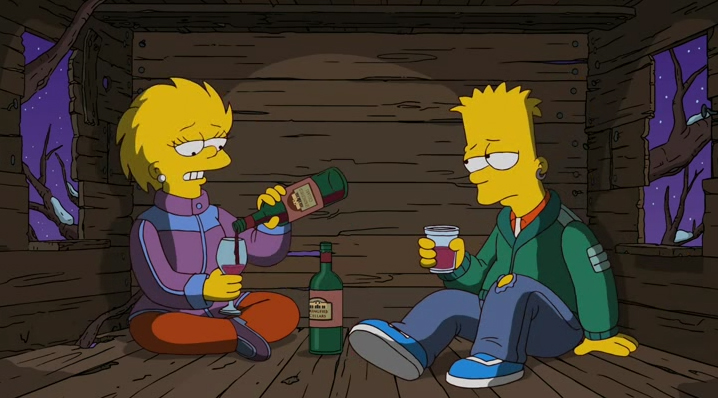
One good line/moment: The ending bit, the “Show’s Too Short” story. It’s nothing spectacular, but the different visual style and Castellaneta’s Vincent Price made it enjoyable, at least until the very ending where we see Skinner reading the story.


 Me Blog Write Good