527. Whiskey Business


Original airdate: May 5, 2013

The premise:
A fresh new suit gives Moe a new lease on life after his latest botched suicide attempt, and things are looking up when a pair of venture capitalists express interest in his homemade whiskey. Meanwhile, Abe gets injured while babysitting Bart, leading the boy to take care of him in the basement. Also meanwhile, Lisa is disgusted to find Bleeding Gums Murphy’s image being used as a performing hologram.

The reaction: Did they just cram three unfinished outlines together into one script? It felt like I was watching story scraps for the two “subplots.” The fun begins with Moe planning to end it all, hoisting himself into a noose. The show has been getting plenty of yucks out of Moe attempting to kill himself for years now, but this is the first time they’ve really tried to treat it seriously. They try to have their cake and eat it by including a bunch of jokes during it, but it just doesn’t work at all. They have “Suicide is Painless” as the hold music for the suicide hotline, which feels like a terrible version of that type of joke from the classic years (playing “Crazy” on hold with the mental asylum). I just don’t like clinically depressed Moe; the few times it’s been effective is when they manage to balance his sleaze with his vulnerabilities (“Moe Baby Blues”), but it’s just plain boring seeing him just sad, or then later, just happy. Once he gets a fancy new suit and renovates the bar, our “story” finally begins, thirteen minutes in. Some young hotshots come in and Moe serves them his homemade liquor which we’ve never heard of, and they want to turn Moe’s into a brand they can sell as an IPO. At this point, this plot is being intercut between the other two stories, so it’s kind of hard to keep focus. Moe’s suit is destroyed in an impossibly stupid fashion, and the end involves him showing up in his drab wear at the New York Stock Exchange, which ultimately tanks his stock price. It felt like “Simpson and Delilah” where Homer loses his hair, but despite Karl’s brilliant ideas, no one will listen to the ramblings of a bald man. In this instance, though, there’s a simpler solution: just buy new clothes. Plus, there was no indication that those two suits were won over by Moe’s winning personality, it was his whiskey they loved. So who cares? Just throw anything halfway presentable on and be done with it. The ending features a fake-out where Moe doesn’t kill himself in the end; he looks wistfully at the noose in his back office, calling, “Not today, old friend. But the holidays are just around the corner.” So this is our feel good ending? Moe’s safe for now, but what if he kills himself on Christmas? Stay tuned to find out in another hilarious suicidal episode!

Three items of note:
– As mentioned, the two subplots are very scarce. While Homer and Marge are away trying to cheer up Moe, Abe is in charge of the kids. Seeing the old man’s senility in action, Marge tells Bart that he’s actually in charge of his grandfather. Bart builds a crazy ass water slide in the span of an afternoon, and Abe injures himself on it in an over-the-top fashion. This leaves Abe on a cot in the basement as Bart tends to his injuries. In the end, it’s revealed he was only faking his injuries because he wanted to spend time with Bart. Marge I guess never questioned why Abe was missing when she returned home, and she ate up Bart’s bullshit excuse why she hasn’t been able to reach his phone for days (“He told me he was gonna nap for most of the week.” “Oh, good! He needs his sleep!”) And that’s it. She also never went in the basement ever, despite that being where the washer and dryer are. Very straight-forward, saccharine and boring. The other “plot” is much different: Lisa is at the Jazz Hole seeing her musical heroes, and is stunned to see a Bleeding Gums hologram performing, as well as being used as ad-space. Before I move on, a mute Janey also stands with Lisa, wearing a cool jacket. I guess they figured it would be weird that Lisa was there all by herself? Janey was always like her default best friend, but they don’t share a lot of the same interests, especially jazz. I don’t even remember the last time she spoke. But it’s another example of characters just being used as props. The second and last scene of this plot involves Lisa writing an angry letter to Murphy’s record label, only for Sonny Rollins to appear in her living room telling her to stop. It’s revealed that he is also a hologram, the van outside projects some other offensive holograms of Princess Diana and Gandhi, and then that’s the end. The whole topic of exploiting celebrities after they’ve passed and “reanimating” them is kind of fascinating, but this plot is so short that they can’t wring anything out of the concept beyond the most basic joke of having Gandhi breakdance. And it’s a shame to see them bring back such an iconic character as Bleeding Gums Murphy for a disposable C-story.
– Marge arrives at Moe’s furious that Homer has yet again been wasting hours of his life there, but then cools off when she finds out about Moe’s situation. Then it’s like she becomes his life coach, proposing the road trip, dressing up in a nice pants suit for some reason, and spends the episode speaking in cliches or exposition or both (“This trip is about turning your life around!” “Every time you wear it, you’ll know how much we love you!” “Look over there, Moe!”) When Moe comes to the door in his torn apart suit, Marge regales him with the story of Dumbo, and then proceeds to explain the whole plot, relating the magic feather and his suit to both being placebos. Why was this necessary? They literally spend over thirty seconds talking about and recapping the story. But moreover, there’s no reason Marge should be bending over backwards this much for Moe. I’ve mentioned this before, but Marge should hate him, the man whose business her husband wastes away in every night away from her and their children. The great line from “Lisa on Ice” says it all (“I hope you understand I’m too tense to pretend I like you.”) And it’s not even that her heart was softened after learning of Moe’s suicide attempt; as we saw from the bar rag episode, among others, Marge now considers Moe a close personal family friend. Makes no sense to me.
– I’ve been noticing a lot of reused plot threads and jokes in recent episodes. Along with “Delilah,” Moe’s devastation of his destroyed suit reminded me of “Scenes from the Class Struggle in Springfield.” And individual jokes repeat too: messing with the hot and cold water was done in “Tennis the Menace,” and Moe talking to the crowd while his stock tanks was like an unclever version of a gag from Futurama‘s “Future Stock.”

One good line/moment: Another good sign gag, this time at the Jazz Hole (Closed-Caption Scat Translation Available).
526. Pulpit Friction


Original airdate: April 28, 2013

The premise:
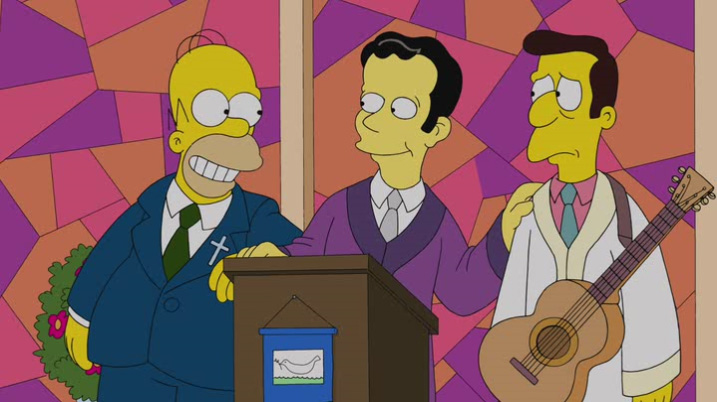
A new associate minister is instated at the church, who quickly supplants Reverend Lovejoy in popularity. Him appointing Homer to be a deacon becomes too much for Bart and Flanders, who team up to get rid of this new character.

The reaction: At a few points, I thought this was turning into a sorry rehash of “In Marge We Trust,” but even that would be too focused of an endeavor. As we’ve recently seen, this show can’t handle stories with the most prominent secondary characters like Flanders or Mr. Burns, so a third-string player like Timothy Lovejoy has no shot whatsoever. But despite the set-up, the episode isn’t really about him at all. The Bing Crosby Parson appears with a new reverend in tow, Elijah Hooper, who immediately wins the Springfield congregation over with meaningless pop culture references relating the word of God to Meet the Parents and Die Hard. Unlike the earnest nature of Marge as the Listen Lady, Hooper seems like a hollow fraud; he comes off as kindly and good-natured, but he never communicates any real ideas. He makes Homer his deacon for partly his own purposes: convert the least religious man in town to prove his methods and beliefs work. Ned is outraged at Homer’s promotion to the church, and Bart feels alienated from his father after he doesn’t want to moon the (G)Oogle street cam van with him. Homer and Bart being partners in crime rather than father and son is something we haven’t seen in a while, and it was a trend I was glad to see gone. But we’re supposed to feel bad for Bart feeling distant from his father in this one quick scene? And it’s not like Homer is treating his new position with seriousness and respect: we see him get out a speeding ticket, and em-blaze his name on the church marquee. Bart and Ned go to find Lovejoy, who is now selling hot tubs and believes he’s found his calling. It’s not clear why he’s there, or why he likes it, but none of that matters. Bart pulls a stupid prank to discredit Hooper, and then Lovejoy reappears to save the day, because it’s the ending and he has to come back. There’s no reasoning, no purpose, just stuff happening for twenty minutes. But that’s basically every episode now.

Three items of note:
– I don’t think I’ve ever seen the couch gag play into the actual beginning of the episode before. The Simpsons parachute down onto the couch and end up busting it (a couch gag we’ve already seen around season 7 or 8-ish), and then we open the episode with the family mourning their broken couch and needing to buy a new one (“Brother, Can You Spare Two Dimes?”, anyone?). The couch gag ended with a couch spring bursting through Homer’s gut, I would have been amused if the episode started with a giant bandage over his midsection.
– Also to pad time is a thin B-plot featuring Marge losing her wedding dress, and her shock and horror hearing Lisa say she doesn’t plan on getting married. This comes up about halfway through the episode, and no real plot had kicked in yet, so I wasn’t sure if this was going to turn into anything. Later on, we discover that Lisa has found the dress, currently being used by a newlywed couple at the courthouse. Marge is happy with this, and Lisa says she maybe might get married someday perhaps. And that’s it. Riveting. Marge ends up coming off unlikable in another instance of her insistent pushing of her hang-ups and beliefs on her children, and Lisa comes off unlikable in full hardcore liberal mode, positing a possible future of her getting married to a Chinese dissident for their green card.
– The ending is so dumb. Bart and Milhouse scheme that if they infest the town will bullfrogs, Biblical plague style, they can expose Reverend Hooper as a fake. They use dead bedbugs (carried over from the opening of the episode, in another shocking instance of continuity) to lure hundreds and hundreds of frogs into town. It’s a crazy amount of frogs, a veritable infestation, and for whatever reason, the town looks to their reverend to help them? It’s all just so silly. Lovejoy magically appears and saves the day because his by-the-book sermon is so boring, all of the frogs fall asleep. Hilarious!

One good line/moment: The Bingo Riots memorial plaque was a cute gag (“God pulled all their numbers that day.”)

525. What Animated Women Want


Original airdate: April 14, 2013

The premise:
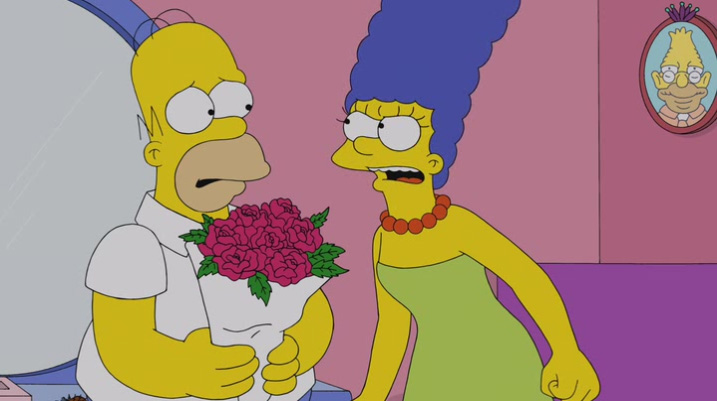
Homer once again finds himself in the doghouse, and has to figure out how to win Marge back for the thousandth time. Meanwhile, Milhouse decides to give treating girls like crap a shot, and is surprised to find it actually works on Lisa.

The reaction: We open with Tress MacNeille narrating on how women think is a mystery to men, because darnit, men and women are just so different! It’s a battle of the sexes episode, with reductive material that feels like it was ripped from a 1950s film strip. Homer and Marge go out for a romantic lunch at a new sushi restaurant, and they seem to be enjoying themselves. Later into the meal, Marge starts into an asinine anecdote as Homer stuffs his face, which she then sternly chastises him for. “Words hurt, you know…” he sadly responds. And then that’s it. It takes only a mildly callous act from Homer for Marge to fly off the handle and be annoyed and disappointed by him for the entire episode. They try to frame it like it was Marge’s breaking point, but for that, you would have needed to have some actual build-up. There’s not really much of a clear direction from this point on; Homer attempts to make it up to Marge in a number of ways, but they’re just not enough for her. His final act involves converting the garage into some kind of sex dungeon (how this is supposed to help mend fences, I haven’t a clue), and we end with Marge concluding that she still loves him because he’ll never stop trying. I remember Homer-Marge episodes from the 2000s were especially infuriating and sad because they would involve Homer being a raging uncaring asshole, and Marge taking him back for no real logical reason. This episode was much different than that; it went with the bottle that The Simpsons Movie cracked open of Marge looking back over their relationship and why she puts up with all of Homer’s nonsense, and enough is enough, so really, nothing a sincere Homer can do will be sufficient enough to placate that line of thinking. Instead, she just goes back with Homer because the episode is over. Really, these two should have gotten a divorce years ago.

Three items of note:
– It’s time for another pop culture MASH note, this time with a special intro inspired by Breaking Bad. We see Marge baking blue cupcakes, in a montage reminiscent to the cooking sequences in the show, set to “Crystal Blue Persuasion.” They’re taken to the bake sale and sold, all while Homer watches with binoculars with a Heisenberg hat on. So, what’s the joke? Why is Homer acting so suspicious and weird? Is it supposed to be like Marge is selling his product on his turf? I’m straining to try and see this as a parody of the show, but it just isn’t. It’s just “HEY WE LOVE BREAKING BAD JUST LIKE YOU!” Complete with live action footage from the actual show of Walt and Jesse watching TV to close out the intro. Guess you gotta do something to kill time between cooks.
– The B-plot is so freaking weird. Milhouse is inspired by Marlon Brando in A Streetcar Named Desire and decides to act like an uncaring, abusive jerk to Lisa for a change. Why the fourth grade class is watching this mature film in class, or why the kids all seem to be paying very close attention to such an old movie, or why Mrs. Krabappel puts her cigarette out in Bart’s ear, is besides the point. Turns out, Lisa eats it up. How do we know this? Because she says so (“If you’ll excuse me, I have to go think of you in a different light.”) Milhouse is trying to act cool with a Bazooka Joe jacket on, and Lisa is just falling over herself over it. It’s the kind of shit the show would make fun of, but here, it’s working! I guess that episode a season or so ago cemented that Lisa actually likes Milhouse deep down, so I guess I should expect more garbage like this further down the road. The plot kind of just peters out with Milhouse sort of abandoning his new persona, and Lisa still thinking he’s sweet. Or something. It’s just so fucking dumb.
– Wanda Sykes guest stars as the school therapist (I guess J. Loren Pryor is out of a job), in a really unfunny sequence with Milhouse. Seems like his bad boy act works on grown women too; he throws a momentary hissy fit and slides everything off her desk in one full swoop, and she seems to be incredibly impressed by it. Between her and that condo woman who was going to jump his bones when he was pretending to be Kirk, I guess all the ladies be loving Milhouse now. George Takei also returns to play Akira, twenty-two years after he originated the role. He only gets like two or three lines, which is really strange because we also have a different character of the head chef who has a much larger role, played by Maurice LaMarche. Why didn’t they just have this be Akira’s new restaurant or something and give him and Takei the meatier role?

One good line/moment: Bad writing aside, Homer actually trying to make an effort and win Marge back felt very nice to see, standing in contrast with the petulant screaming man baby he normally did in these types of episodes.

524. Dark Knight Court


Original airdate: March 17, 2013

The premise:
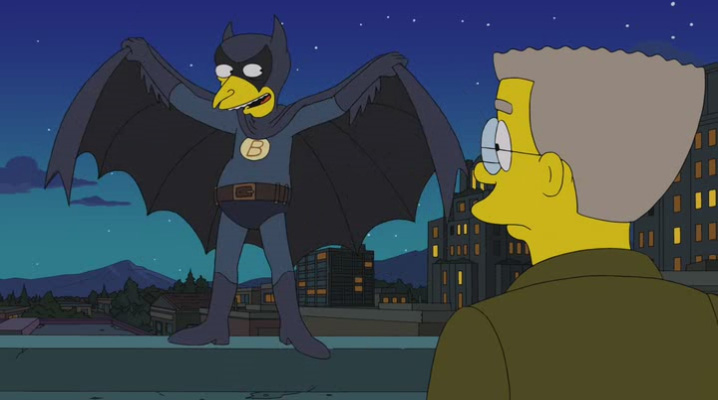
Inspired by a renewed childhood love of comic books, Mr. Burns adopts the superhero persona Fruit Bat Man. Meanwhile, an Easter festival debacle is blamed on Bart, leading to a mock trial with Lisa at his defense.

The reaction: Back in the day when I was still regularly watching the show, I remember reading about the upcoming episode “Simple Simpson,” featuring Homer as the superhero Pie Man, and thinking it was the dumbest thing ever. It actually turned out to be not that bad, but it’s a stroke of pure genius compared to this. Senile bucktoothed old mummy with bony girl arms Burns as a superhero? And him wanting to thwart crime and stand up for the little guy? He and Smithers randomly end up inside the Android’s Dungeon, he remembers reading comics as a kid, and he connects with a Batman-type character as a fellow billionaire misanthropic recluse, then he decides to be Fruit Bat Man! Smithers placates his beloved’s mania by paying people off and creating elaborately planned scenarios where Burns can swoop in, save the day, and be the beloved hero. When Smithers finally reveals he was actually orchestrating all of his heroic deeds, Burns is crestfallen. This isn’t like him helping him cheat at golf, this comes off as incredibly sad and pathetic. Burns may have his moments of naivety, but he’s a very ruthless, formidable character. There’s so many times in recent years where the easiest thing seems to just make him into a big joke, but it robs the character of his vital essence. But most of the episode is devoted to the trial plot, where Lisa defends Bart for some prank he didn’t do. It’s pretty damn boring. There was a Bob’s Burgers episode this season featuring a kids trial that had a pretty similar set-up, but that had characters that still have some soul and vitality to them. The ending features the two plots coming together (two episodes in a row, I’m shocked) where Lisa for some reason entrusts Burns in exposing the truth to prove her brother innocent, which he does. And then that’s it. And then they do an Avengers parody, but with all the old characters and they’re called the Dependables! Get it? Remember when this show had clever writing?

Three items of note:
– Janet Reno seems like such a bizarre booking as the judge of the trial. How many of the young people watching the show were even alive when she was a relevant political figure? Turns out Abe knows her from arguing in front of the Supreme Court (literally outside the building) when she was Attorney General back in 1998. From that, I guess they became pen pals for some reason. Also, the scene gave me “That 90’s Show” flashbacks of the show’s floating timeline wallpapering over the classic years. Abe (and Jasper and Crazy Old Man) look twenty years younger, but of course back in season 9, they were as old and cantankerous as ever.
– We have a montage featuring Burns thwarting “crimes” and the people Smithers has payed off to play along: Homer, Lenny and Carl (plant workers), Krusty, Sideshow Mel and Mr. Teeny (maybe they owe Burns money?), and the Crazy Cat Lady (a mentally ill person). Then we get to Burns’s house party, featuring dozens of people who Smithers happily hands out stacks of cash to. There’s also two hot young socialites who take Burns back to the hot tub. I sure hope they were paid the most handsomely of all. Again, the middle portion of this episode is Burns as a sad, pathetic old man who has no grasp on reality, a portrayal that feels so anti-Burns to me.
– I think this is the first instance of Lunchlady Doris being referred to as Lunchlady Dora. I think it wasn’t until a year or so later when her name was actually in print in an episode that fans bitched on Twitter, and one of the writers confirmed the name change was out of respect to Doris Grau. I still don’t get it. If was out of “respect,” why not keep her retired like they had for over a decade? Or create a new lunchlady character? If this is the excuse they’re using, then why not bring back beloved characters Roy McClure and Lenny Hutz, and have Hank Azaria voice them? Was Doris Grau any less of a respected performer to them as Phil Hartman?

One good line/moment: Witnesses are called to question Bart’s character, the greatest of which being Moe, who tearfully gets through his experience of being traumatized for years over Bart’s prank calls. It’s an amusing conceit, although as usual for this show, any humorous idea gets drawn out for twice as long, and then they bring it back again for a callback in the final scene. Good enough.

523. Black Eyed, Please


Original airdate: March 10, 2013

The premise:
Ned finally reaches his breaking point with Homer’s boorish behavior and punches him in the face, leaving him wrought with guilt on how to make things right. Meanwhile, the new 2nd grade substitute Ms. Cantwell has an inexplicable hatred of Lisa, and Lisa is determined to find out why.

The reaction: Two more underwhelming stories to toss on the pile. What ultimately sends Ned off the deep end is Homer getting chummy (and getting high with) Ned’s parents. It seems like such a weird callback from fifteen years ago. With Ned’s deep-seated anger re-emerging, this felt like a spiritual sequel to “Hurricane Neddy,” an episode that I was conflicted on regarding Ned’s characterization. There’s not much of a build-up to Ned punching Homer, nor any real discussion about it being provoked from years of Homer’s abuse or anything. Instead, Homer lords it over Ned, claiming if he doesn’t fight back, he’s the better man. Then we get a scene where the town reacts to Ned as a monster and Homer a hero a la the third act of “Homer Loves Flanders,” except it isn’t earned at all. As for the B-plot, it’s just awful, probably the worst “story” we’ve seen in a long time. Lisa gets a new substitute, a woman who from the very start hates her. Just flat-out hates her. Vindictively. Yes, Lisa does come off as a suck-up at the start, but by the second half of the episode, she’s visibly traumatized by this woman. So the whole runtime it’s a huge mystery: what is this woman’s deal? I knew the payoff would be stupid and disappointing, but I wasn’t expecting how half-hearted it would come off. But if I can give the episode credit, it actually wove the two stories together: Homer decides to call it square with Ned only if his new wife Edna can help Lisa get rid of Ms. Cantwell (bonus points for actually showing Ned and Edna together as well). So Bart is transferred into her class, raises hell, and Ms. Cantwell takes off in her car. It takes Lisa clinging to her windshield to finally get a straight answer out of her: she hates Lisa because she’s pretty. That’s it. That’s the conclusion. There’s no build-up to this, nothing in her behavior that this clears up, nothing. I guess she’s just an emotionally disturbed woman who had a horrible childhood, and now decides to get her rocks off emotionally abusing an eight-year-old girl. I was expecting to be unsatisfied, but this was incredibly unsatisfying. And they got Tina Fey to voice her, what a gargantuan waste of a huge talent for such an awful character.

Three items of note:
– We get another couch gag from Bill Plympton, a black-and-white graphite piece of the Simpsons as film noir characters about to get into a skirmish. It’s kinda neat, but not as great as his last couch gag with Homer and the couch.
– Rather than explore the source of Ned’s rage more or talk about Homer and Ned’s long-standing relationship, we get a nightmare of Ned’s personal hell, full of guys in non-Jesus beards, spicy mustard, and a giant Richard Dawkins Satan. When Ned wakes up, he consults the Bible for advice, where we get Marvin Gaye playing as he scans through naughty passages talking about semen on the ground and whoremongers. Did a ten-year-old write this part of the script?
– Speaking of ten-year-old humor, here’s an awful joke. Homer has reservations about punching Ned, but he is insistent (“Come on, Homer, I’m insisting on a fisting!”) The camera pans out to reveal Smithers beside them (“What’s this about a fisting?”) You see, because Smithes is a gay man, and that means he enjoys the sexual act of fisting with another man! That’s what gay guys do, right? It’s funny because HE’S GAY!!! I was wondering why exactly this scene was happening at the plant, we see Ned with a little visitor’s badge on, and my sad, sad guess is that they came up with that Smithers joke, and decided to make the scene take place at the plant. Siiiiiiiggh.

One good line/moment:
– The bullies are astonished to learn Lisa’s teacher is a bully, as they didn’t consider that as a career option. Dolph is psyched (“Boo-yah! I’m gonna buy me a Hyndai Elantra!”) It’s only funny to me because I have that car. As well as a third of all the cars I see around Los Angeles.