557. Opposites A-Frack

Original airdate: November 2, 2014

The premise:
Discovering Mr. Burns’s kinda secret fracking operation, Lisa calls in a liberal assemblywoman to put an end to it, but she and Burns end up in a secret torrid love affair.

The reaction: I don’t typically like doing direct compare and contrasts just because of how unfair they are, but it’s hard in instances like this or “Super Franchise Me” when they’re so obvious. Burns’s actions here and those in “Who Shot Mr. Burns? Part One” with his oil drill feel so completely separated from each other. Lisa discovers a flimsily disguised warehouse literally right down the block from her house that I guess she never noticed was there, and she and Bart just walk inside, and in case you can’t figure out what’s going on with your eyeballs, she helpfully explains it to you (“This whole building is just a facade for a drilling operation!”) Then Burns appears and just starts explaining his whole plan to this eight-year-old girl. Later on, he needs to buy the mineral rights from the landowners to continue fracking, and he enlists Homer to help sell the idea to all the local dullards. Why would he do this, and why would he trust Homer to do a complete and thorough job? Also, Burns keeps talking about the land below Evergreen Terrace, but Homer seems to talk to all the residents of Springfield. The worst of all is right when the fracking is about to resume and Burns has gotten exactly what he wanted, he stops everything when he magically surmises there’s one signature missing in his giant stack. I can’t think of a more un-Burns thing to do. Can you imagine classic Burns doing shit like this? Compare this to “Who Shot Mr. Burns,” where not only did Burns tap the oil well before Springfield Elementary could, he did so with utter glee and contempt for the lowly wretched citizens he holds in sheer contempt. Burns is absolutely ruthless, and he doesn’t care who he has to bribe or screw over to get what he wants. This episode stars neutered Burns, who has been around for over a decade, a withered, flimsy husk of a man who occasionally appears to have some teeth, like when he barrels down the door of the assemblywoman early on, but it’s all a facade. The love story I don’t even know what to say about it. Burns consults Homer about his affair, and takes away that he must harden his heart to keep the relationship casual. What the fuck am I writing? If I wrote the basic framework of this story, would it sound anything like Burns? Also, I don’t even know if I can lay this plot out in a coherent manner that makes sense, because it barely did watching the finished product. What a pile of trash.

Three items of note:
– The opening features Patty and Selma staying at the house, and when they promise not to smoke, Homer tries to catch them by installing smoke detectors all over the house. It even conveniently starts raining so they can’t go outside to smoke. But, thankfully, the basement door has magically transformed into a new bathroom, and for whatever reason, Homer didn’t install smoke detectors in there. Maybe he didn’t realize he had a new room in his house either. This serves as our lead-in to the main story when the water from the sink catches on fire and Patty and Selma cause a huge explosion. Homer throws the two out on their asses, and they’re never referred to again. I guess Marge could give a shit about her two visibly injured sisters, but lo, they are mere plot utilities here.
– Through the second half of the episode, after Homer works for Burns to get the fracking approved, Marge is in direct opposition, her signature being the one Burns needlessly points out is missing. To everything Homer throws at her to get her to relent her position, she just repeats, “Our water was on fire.” Over and over. By the very ending, by the sixth time she says it, Homer has a grand realization (that he explains aloud, of course), so I guess this was supposed to be a build-up to a joke, that Homer finally understands, even though it’s the same thing she’s been saying the whole episode, or something? This happens sometimes where I can’t tell if the show is doing a joke or not because the writing is so terrible.
– Burns and Homer get pally at his manor and talk relationships when a wrecking ball crashes through, courtesy of the assemblywoman who wants to get even for being dumped, and is taking over his land. Man, this fucking episode… it’s especially terrible, worse than normal. I can’t even recap this shit because it’s so nonsensical and too laborious to explain. The best worst moment is toward the end when Burns resumes fracking, we see the earth being fractured and Evergreen Terrace starts rumbling. We get a few small jokes in the Simpson backyard, and the scene culminates in this exchange between Marge and Lisa (“Is one of the side effects of fracking earthquakes?” “Yes.”) Again, just in case you weren’t following what’s going on, let’s just tell you straight out. Between this and earlier when Lisa pulls up a Netflix documentary to explain to the audience what fracking is, it’s almost like a goddamn PSA.

One good line/moment: Nothing. This one was particularly godawful.

556. Treehouse of Horror XXV

Original airdate: October 19, 2014

The premise:
In “School in Hell,” Bart and Lisa are transported to a school of the damned, where Bart greatly excels. “A Clockwork Yellow” is a Clockwork Orange “parody.” In “The Others,” the Simpsons are surprised to find themselves haunted by their Tracey Ullman-era predecessors.

The reaction: Another season, another subpar Halloween special. Though to be fair, “School” is actually the strongest segment I’ve seen in a while. It’s got some promising ideas, like the hell school being more supportive and nurturing to Bart than Springfield Elementary, and there’s something wonderfully disturbing about the idea of the ending, where Homer willfully lets Bart horrifically maim him for his graduation. But despite the promise, a lot of it goes unfulfilled, with our usual collection of expository dialogue and surface-level jokes. “Clockwork” I’m pretty much in the dark about, having not seen A Clockwork Orange. But of course, parodies on this show used to stand on their own; fellow Kubrick homage “The Shinning” worked just fine when I saw it as a young lad. I know the basics of the plot of Clockwork, but nothing here really stands out as doing anything beyond just recreating bits from the movie. By the end, it seems like the writers lost interest and just started cramming in references to other Kubrick films, then ending with the director himself throwing a red pen in the air, it hitting him in the head, and him staring at the camera for a few seconds before cutting to black. “The Others” is the most unfortunate, as the Simpsons meeting their crudely drawn and primitively behaved doppelgangers is a potentially neat idea. But, there’s absolutely no story; ghost Marge takes a shining to Homer, then Marge kills herself to get back at him, then the kids kill themselves, and it turns into a Homer-Marge schmaltz ending… and Marvin Monroe is there too. What an absolute waste. Wouldn’t it have been neat for the old Simpsons to want to take back their house and try to kill the family or something? Why were they haunting them to begin with? Upon their first appearance, Lisa claims that their time has passed, ghost-Bart belches, and she retorts, “That was unmotivated!” The series in its heyday could have excellently compared and contrasted the show from its roots, but nowadays, it’s a joke in and of itself. Character motivation, and other elements of good writing, have been hard to come by in this last decade of episodes.

Three items of note:
– Nothing’s better than a reference that you have to laboriously explain. In the hell segment, Bart pulls Hot Stuff out of a portal, an old Harvey Comics character from the creator of Richie Rich. As soon as he showed up, I was surprised, since he’s a pretty obscure character. But then he immediately talks about how lame his comic was, pulls out an issue and explains how bad it is. If you need to spend this much time explaining who this character is and why the joke is funny, wouldn’t it be better to just toss it and think of something else? I guess not.
– They use the famous Clockwork eye clamps to make a jab at how awful FOX is. How edgy. Not only have there been dozens of better digs at the network in the past, there have been plenty in classic Halloween specials alone. Plus, with stuff like Brooklyn Nine-Nine, The Last Man on Earth, and Empire, there’s plenty on this network that are leaps and bounds above anything this show is churning out nowadays. Speaking of, there was another terrible FOX joke in the last episode too. So, so bad.
– The very ending is pretty cringe-worthy, when a parade of other Simpson families from other dimensions show up, in the style of Adventure Time, South Park, Archer, and others, including… [shudder]… the Minions. This show has inserted references to popular current shows and movies for the sake of just being references before, but this feels like the ultimate example, the most transparent instance of them trying to generate some light Internet buzz. Look, here’s a clip of Simpsons Minions! Homer as the Ice King! These are things that people like now! We can be like that too! Why isn’t anyone paying attention to us?

One good line/moment: Like I said, the hell segment has some good stuff in it. The designs of the creatures and the school are pretty neat, and there were some good jokes sprinkled throughout, like the hell chalkboard gag (Eternal Torment Is The Only Just Punishment for the Unbaptized) and the portal back from Hell being in Burns’s office.

555. Super Franchise Me

Original airdate: October 12, 2014

The premise:
In need of some extra income, Marge is talked into opening her own sandwich franchise, but soon finds she needs to employ the entire family to help tend to the restaurant to keep it afloat.

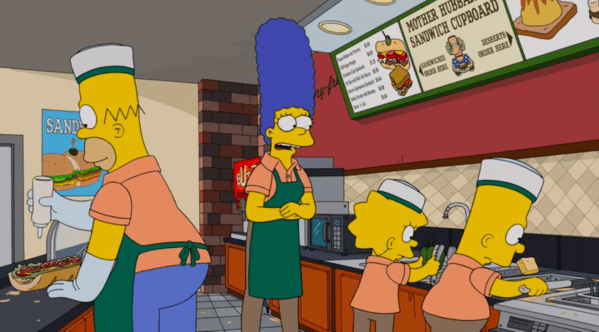
The reaction: Ah, the latest classic episode to be horribly rehashed, “The Twisted World of Marge Simpson,” where Marge starts up her own culinary business to hilarious results. Well, I guess just “results” in this case. We start with her making a bunch of sandwiches, Bart and Lisa take them to school to share with the other kids, then we’re at the playground where Marge is accosted by a sandwich shop franchiser to convince her to join her chain. Why are these two at the school? Where did this woman come from? Maybe they could have made her the parent of a kid who can’t stop talking about how much they love Marge’s food, but why try to write in any connective narrative tissue when you can just keep the plot barreling forward? So Marge is now the boss of her own newly built Mother Hubbard’s Sandwich Shop, and she’s thrilled to have a domain to call her own. However, she immediately frets about the business floundering, and can’t find any employees better than Gil or… [shudder] Shauna, both of whom she fires. Soon, she ends up employing Homer and the kids to work the restaurant. Now, a couple things here. First, I guess we quickly dropped the angle of Marge cooing about the restaurant being all hers since now it’s a family affair. Second, the point of her wanting to go into business in the first place was to build up the family’s savings, but now I guess she’s perfectly fine with her husband skipping work to help her out, and force her children to work as well. Are they missing school? I guess so. More conflict arises when a second Mother Hubbard’s opens across the street, run by Cletus and his family, and steals all of Marge’s customers. We see an ad on TV about their signature roadkill hillbilly eats, so why wouldn’t it be the toast of the town? Why the hell would anyone eat there? And through all of this, there’s virtually no satire or commentary on franchise chains; there’s plenty to joke about corporations screwing their own franchise locations, or turning a blind eye to child labor laws, stuff like that, but they don’t even bother. Instead, the family pulls off a lamebrain scheme to the big boss to get out of their contract and return Marge’s initial investment, and it works like a charm. And nothing of value was lost! Or gained!

Three items of note:
– The plot kicks off when Ned takes back his giant freezer from Homer, who had been keeping a bunch of meat in it. To not let it go to waste, Marge ends up making a gigantic laundry basket full of sandwiches. So, where are all those going to be stored? Thankfully, Ned returns after that to return the freezer for no reason (“I felt a little guilty for taking back what belonged to me.”) I don’t think I’ve ever seen an instance where within the first act they retconned their own impetus for the plot beginning in the first place. Pretty wild stuff.
– There’s a helluva lot of time killing in this episode. We get two montages, the first of which is Homer pacing and waiting for Marge to make her sandwiches, where literally nothing happens for thirty seconds. We also have an end tag featuring caveman Homer slowly chasing a giant sloth, resulting in the first sandwich, because that’s an idea, I guess. But the more egregious padding to me is a joke from Homer, where he mentions how a free-refill policy on drinks resulted in him bankrupting a Pizza Hut. Alright, got it. But then we get a thought bubble and we see the scene where that’s happening, with Homer at the drink dispenser and a manager behind him looking worried. Fifteen seconds of that. We already got the joke, but we gotta rack up those precious seconds to get it to air time somehow.
– God, I hate Shauna. She keeps coming back again and again and I just don’t understand it. Everyone in the cast is awful now, but she’s got to be one of the worst. Why Marge didn’t just hire the Pimply Faced Teen instead? But then, he randomly appears when she goes to fire Shauna, and then he quits in solidarity with her, thinking he’s got a chance to score with her. Oh, poor, sweet Pimply Faced Teen. You deserve so much better than that poorly written trollop.

One good line/moment: A good visual gag of the giant Mayo truck pulling up to the store, and the workers having the squeeze the tanker like it’s a bottle to pump the mayo out.

554. The Wreck of the Relationship

Original airdate: October 5, 2014

The premise:
Homer and Bart are forced into a conflict-resolution cruise to mend their strained relationship. Meanwhile, Marge takes over her husband’s fantasy football league, striving to win in order to put an end to trash talk.

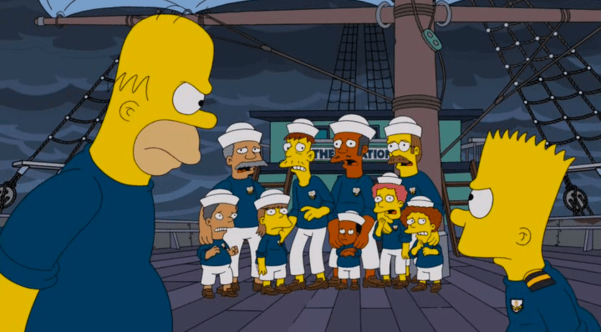
The reaction: Alright, a father-son episode! Surely this won’t be a repetitive, nonsensical affair bereft of characters acting like human beings. Homer is upset that Bart disobeys him, with the two getting into a stalemate regarding Bart eating a piece of broccoli at dinner. I like seeing these two so childishly obstinate about something so small, but they just drag it on and on and on. Fed up by this nonsense, Marge surmises there’s only one course of action left: she has her husband and son kidnapped in the middle of the night (why? Your guess is as good as mine) and hauled off onto a conflict resolution cruise called the Relation Ship. From that point, we got a montage, Bart grows an affinity to the sailor’s life, all the way up to being christened superior office, much to Homer’s chagrin. It really feels like we’re going nowhere fast, because, as usual, every scene is just the characters explaining what’s happening and what they’re feeling (“You’re my son and you will hate what I hate!” “I like being a sailor,” “He can’t order me around. I’m his father!” “He’s your superior officer, so he can and will order you around.”) For our big dumb ending, a storm comes out of nowhere, and Homer and Bart butt heads on how they should proceed (Homer is really adamant about dropping the anchor, for whatever reason.) Bart then presents a broccoli and eats it as a sign of peace with his father, which really surprised me that they actually tried to tie this nonsense back to the beginning, but it doesn’t really amount to much. What is the point? Everything felt completely empty to me, not that that’s anything new, though.

Three items of note:
– The B-plot is just as inert. Marge takes over Homer’s fantasy football team, and spends the first half of her story gasping repeatedly every time someone emails her some trash talk. Then she vows to beat the men at their own game, and then, over a montage with a sports announcer, she does. And that’s it. It’s just shameless filler, complete with a tiny sprinkling of fan service with Marge wearing Tom Landry’s hat from “You Only Move Twice” atop her beehive.
– The other families on the boat don’t fucking matter, they’re just set decoration. We’ve got Ned, Rod and Todd, Cletus and one of his kids (these two groups are the only ones with lines), Apu and one of the octuplet, Lewis and his dad, and… Arnie Pye and his teenage son? Boy, they must have been really desperate. Nameless extras are seemingly verboten in this series now. Seeing this line-up gave me flashbacks to “How I Spent My Strummer Vacation” with the crowd of familiar faces who paid a pretty penny to be a rock star, regardless of it makes sense for these characters to be there. How much strife could Apu possibly have with just one of his eight children, who is still a toddler? How could Cletus afford to be on such a cruise? Wouldn’t Chief Wiggum and Ralph be a more logical space-filler than Arnie Pye and his offspring we’ll never, ever see again?
– Nick Offerman plays the captain in an absolute waste of his talents. Giving him a character with a personality or some jokes I guess was too difficult. Also, he’s put out of commission in the last act after being tempted by some rum, where he desperately monologues just like Lionel Hutz back in the day, taken by the siren song of the brownest of the brown… what’s that? You want me to drink you? But I’m in the middle of a trial! …yeah, much more well done back then.

One good line/moment:
– I did like some of the sections of the broccoli stand-off. I found myself enjoying Dan Castellaneta and Nancy Cartwright’s interplay through most of it, especially when they were taunting each other to forfeit.

553. Clown in the Dumps

Original airdate: September 28, 2014

The premise:
Rabbi Krustofski kicks the bucket, and in addition to a comedy roast cutting him especially deep, Krusty has a crisis of conscious of what he should do with his life.

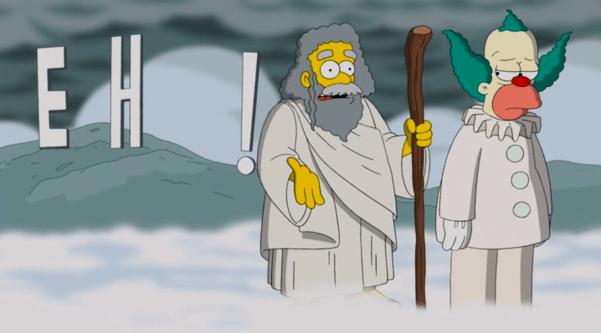
The reaction: Looks like it’s about time for Krusty to quit showbiz again. What’s this, the eighth time now? This episode is basically tenuously connected scraps of Krusty stuff we’ve seen before, most obviously “The Last Temptation of Krust” with him feeling alienated from modern-day comedians. Jeff Ross and Sarah Silverman are on the roster for Krusty’s comedy roast, and Krusty gets his widdle feelings hwut. But it’s not even like he goes through any kind of change where he’s game at first, and the jokes get too real and eat away at him. Instead, despite being a seasoned industry veteran, he seems bummed out the entire time, not understanding what a roast even is (“Nobody warned me this roast would treat me the same way as every roast I’ve seen and laughed at!”) What garbage writing. In “Krust,” we clearly saw that Krusty was a comic trapped in the past, whose old material didn’t connect with modern comedy sensibilities. Here, Krusty is sad just because. Bart appears later to go talk to his father to cheer him up for some reason, and when Krusty visits the rabbi at the temple, he ends up dying in mid-sentence. I guess like Mona Simpson dying with her eyes open, it was just regular old age, like God just came down and took ‘im. Krusty is haunted by his father’s interrupted last word of “Eh…” on whether he thought he was funny, and ultimately quits his show because of it. He spends the rest of the episode being sad and explaining why he’s sad over and over. How do we wrap this nonsense up? Bart takes Krusty to the temple of his father’s rabbi, which he just happens to know, I guess, and finds that he is using Krusty’s old jokes in his sermon, ergo, he did think Krusty was funny. Sure, that works for an ending, why not? Rabbi Krustofski was one of the show’s legacy characters who made one or two legendary appearances in the show’s prime, and then later was trotted out multiple times for fan service purposes. We’ve heard Jackie Mason’s increasingly weakening voice several times over (him straining to sing the poorly written Jewish Heaven song at the end was kind of sad to hear), but as we just saw with Glenn Close, not even killing the character will keep them from dragging them back for more. And really, what else have we learned about the good rabbi in these other appearances? Absolutely nothing.

Three items of note:
– This season premiere had a bit of buzz going into it that I recall, as the writers were incessantly teasing the “death of a recurring character who is voiced by an actor who won an Emmy for the character.” Al Jean and company were quoted a bunch, beating around the bush about how it could possibly be anyone, but I wasn’t buying that shit. I saw through this publicity nonsense fifteen years ago with Maude Flanders, and that’s when I still tolerated the show. Maude may have been a tertiary character, but at least she had a bunch of episodes under her belt, plus her direct connection to Ned, one of the main secondary characters. From the info they teased, and the fact that it was a Krusty episode, I thought it might be Rabbi Krustofski, and thought, wow, if this is who they’re killing off, that makes this gimmick even more hollow and meaningless. And that’s what they did. But I get it, at this point, every year or two, they’ve got to do something of note to get some minor press. They did the LEGO episode, and then every other season, they can acknowledge a milestone, like the recent 600th episode. It’s just a “Hey! We still exist!” where everyone pretends to still like the show, and then right afterwards goes back to avoiding it like the plague.
– The B-plot was very, very scarce, and felt very strange tonally. Krusty’s speech at his dad’s funeral about how death can come before you know it gets Lisa worried about his own father’s poor health and seemingly fast-approaching demise, and she, of course, narrates everything she’s feeling (“Dad, I’m worried about your health. I don’t want to lose you!”) Later on, we get a scene of Lisa overseeing Marge struggling to keep a breathing mask on Homer’s face as she sleeps, an overly long sequence that feels more depressing than slap-sticky fun. It makes me feel sad for all involved; compare this to Lisa’s similar worry in “Bart’s Friend Falls in Love,” instead of a light, absurdist touch with quick flinging jokes like the Good Morning Burger or a dream involving lowering Homer’s carcass into his burial plot with a crane, we get this depressing scene of a woman desperately trying to tend to her sick husband who’s gasping for air. This plot ends with Lisa wrapping Homer in bubble wrap to protect him (again, it’s really sad to see a little girl this paranoid in worry about her father dying), and then her precautions being vindicated when Otto crashes the school bus through the backyard and into Homer, and the bubble wrap buffering the blow. And then that’s it, I guess. What a waste of time. At least it was short.
– Minutes before the end of the episode, Krusty awakens from a drunken coma, having just had a vision of his father telling him to help people and do good unto others. Then we see him open up a new animal shelter. A reporter chimes in with an expertly written question (“Krusty, have you fulfilled the promise you made to your father in the dream you never told anyone about?”) It’s the equivalent of making a joke about how a joke they just did isn’t funny. Krusty responds, “Somehow, a brief act of uncharacteristic generosity solved nothing.” This is intolerable. It’s like the writers are incapable of pushing a plot forward without characters explicitly say exactly what is happening. Again, I might as well be listening to an audio book.

One good line/moment: Another guest couch gag, this time done by surreal independent animator Don Hertzfeldt, probably best known for the Rejected short films, which I remember being quoted ad nausea at my high school back in the day. The couch gag bears resemblance to that film, as we get a glimpse of the future incarnation of the series, where the Simpsons have been reduced to black-and-white, grotesque, barely coherent, catchphrase-spewing creatures. It runs a little long, but at least it was something different. Can’t they just let Don Hertzfedlt or Michel Socha or Bill Plympton make a whole episode?