664. Go Big or Go Homer

Original airdate: October 6, 2019

The premise: Stuck supervising the new crop of power plant interns, Homer is introduced to Mike, an excitable elder millennial who considers him his idol. He begs Homer to be his mentor, which he happily accepts, feeling unappreciated at home and by the town at large.

The reaction: Boy, the writers must have been laughing their tits off at this Mike guy. It feels like 70% of all the dialogue in this episode is just his motor mouth saying… jokes? I think? For an episode that focuses so heavily on this character, I am completely lost as to who he’s supposed to be and what I’m to get out of his “character progression,” whatever it even was. Mike is a 35-year-old voiced by the 49-year-old Michael Rapaport, who I’m not at all familiar with, so any kind of inside joke connecting Mike’s personality with his voice actor is completely lost on me. John from “Homer’s Phobia” was effectively a yellow John Waters, but his personality was wholly realized within the episode on its own. Anyway, Mike is one of a dozen new interns at the power plant, who immediately sticks up for Homer when he gets stymied by the others asking him actual questions about the plant. Mike looks up to Homer thanks to countless news stories about the plant’s numerous near-meltdowns over the years always featuring Homer at the epicenter of the crisis (despite Homer being a town pariah at this point, I guess none of these articles Mike presumably has obsessively read over and over again at this point implicate he was responsible for these disasters.) The first half of the episode is just him going on and on about what an honor it is for him to worship at Homer’s feet and how fucking amazing he is. But why? Mike is not a scientist or an engineer (“Why not follow my hero into the world’s greatest calling: nuclear whatever!”) He never asks Homer any questions about his job or any specific interest in what he does. It’s not even anything broad like he admires Homer’s “courage” for taking charge and averting all those meltdowns, like it’s just a general heroism he looks up to him for. It’s just… nothing. Absolutely nothing. Mike looks up to Homer because that’s what we wrote in the script. He wears a basketball jersey throughout and is obsessed with the sport, namedropping numerous players. Why isn’t one of them his hero? That doesn’t come into play in the story, so I guess it’s just another hilarious quirk from this great new character.

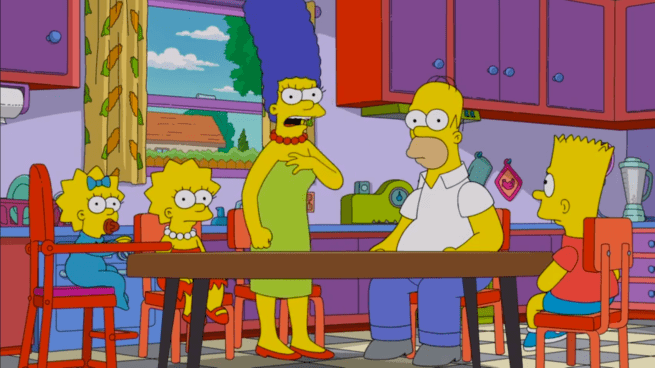
Meanwhile, Homer doesn’t look a gift horse in the mouth, thrilled that someone is giving him the respect he thinks he deserves. But Mike also has an incredible anger issue. Multiple times in the episode, when someone is rude to Homer, his face goes red and he goes off on an insult comic tirade against the ignorant swine who would dare defame his beloved mentor. One of his victims happens to be Bart, during a family dinner with Mike and his pregnant wife as invited guests. Despite witnessing Mike verbally abusing his son to the point of tears firsthand, Homer doesn’t say a damn word when Marge throws him out of the house, and never apologizes to her or Bart about it (“How many times do I have to say I’m sorry?” “Once would be nice!”) The conversation immediately pivots off of Marge attesting that this grown man that screamed at her young child is a dangerous lunatic, to Homer whining that she and the kids don’t respect him like Mike does. So, Mike actually appears to be mentally unstable, and it was getting more and more overt that I thought the episode would eventually have to deal with it. Instead, Homer decides to actually attempt to be a mentor, in his sole action of expressing interest in Mike’s dumb-ass idea: a business that sells pizza by the slice instead of entire pies. Mike gets a food truck thanks to a legitimate loan from the mob, leading to he and Homer to get chased to a junk yard by Fat Tony, who then lay down their arms because they like Mike’s dumb-ass idea and can also use it for money laundering and man, who gives a flying shit. In the end, Mike’s business with Fat Tony is a big success, Fat Tony makes Homer tear up when he calls him a great mentor, and shots over the credits show Mike thriving with his work and his family and living a wonderful life all thanks to Homer believing in him! Ohhhhhhh boy! He isn’t delusional or has serious anger issues to work on, he’s just a goofy character that we all love! Mike the adult intern! This one was a real head scratcher. Again, I honestly have no idea what they were going for with the Mike character, and as the episode is solely centered around him, that’s a serious problem. His insane actions and serious character flaws clash dramatically with the clean, safe happy ending we’re given, and none of the random pieces thrown at us fit together whatsoever. A very dumb, strange, dumb, dumb, dumb episode.

Three items of note:
– Homer begins his talk to the new plant interns blending a bunch of millennial stereotypes together, but thanks to this show’s floating timeline, the 38-year-old Homer would now have been born in 1981, making him a millennial! What a scary world we live in. When we get to the point the show is still airing and Homer is as old as I am, I think I’ll just instantly turn into a fossil.
– Mike blows up at Mr. Burns to stand up for Homer, and as thanks, he ends up getting shot in the face point blank with an old musket by Burns (filled with hundred-year-old pellets that lightly embed themselves in his face.) Certainly an unexpected ending to the scene, but one that is ultimately pointless, as there are no repercussions from this event, and Mike’s food truck is shown thriving in the power plant parking lot at the end, so everything’s all good!
– There really isn’t a whole lot of other specific stuff to comment on, since this episode is so absolutely heavily focused on this one-off character we will never see again (God willing). I guess members of the staff just really love Michael Rapaport, or are like good friends with him. Doing some quick Internet research, it appears he’s a pretty big sports guy, so I guess that explains Mike’s sports obsession. He’s also responsible for this, which I guarantee is ten thousand times funnier than anything in this abysmal episode.

One good line/moment: Mike giving Bart a vicious verbal beat down leaves the Simpson dining room speechless, except for Lisa, who is adorably laughing her ass off at her brother being made the fool for once. Yeardley Smith’s performance is just lovely, and it got a big genuine smile out of me for once, as it effectively added a joke to the truly horrific and shocking moment, using expert comedic timing I haven’t seen from this show in years. Ignoring the fact that the episode did absolutely fucking nothing to address or deal with Mike’s transgressions following this scene, it was an honestly great moment.
663. The Winter Of Our Monetized Content

Original airdate: September 29, 2019

The premise: When an outlandish fight between Homer and Bart goes viral online, a social marketing-savvy hipster seeks to make them into profitable Internet celebrities. Meanwhile, Lisa fights back against the school’s new privatized detention system.

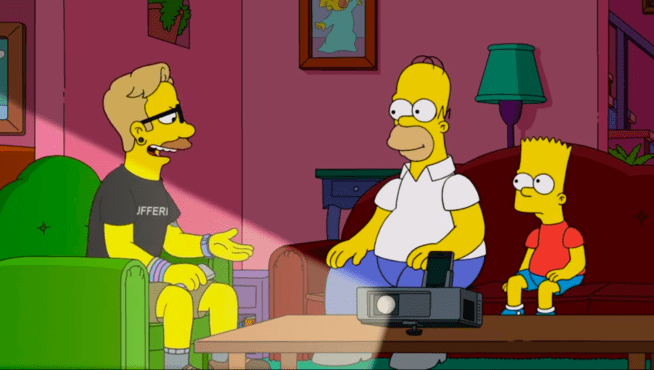
The reaction: Aaaaaaaand we’re back, and boy, what a low impact dud of a premiere. Not having watched this show in four months, coming back to it, it’s really surprising how thin the storytelling is. In our A-story, Warburton Parker (voiced by John Mulaney) appears to basically narrate most of the episode, talking about how he can monetize Homer and Bart’s father-son fights online, after their original live video was watched and laughed at by everybody in the whole damn world (example #659 of a Simpson becoming an instant success and worldwide phenomenon overnight). So Homer and Bart are totally onboard with doing these fights… but why? For money? Warburton gives them a $5000 check at one point, but we’re never told how much cash they’re getting and what they’re doing with it. So is it for the fame? They pay it some lip service to this point, and we see Homer and Bart are both recognized by their peers, but they don’t seem to regard it all that much either. But amidst their videotaped brawls, the two find that they enjoy each other’s company, which ultimately gets them in trouble when Comic Book Guy leaks a video of them hugging. But these two incredibly brief bonding scenes barely even feel like they’re related to the story. This is an episode where in my head I’m already coming up with three or four different angles this plot could take to actually work as a story, but instead, it feels like an incredibly thin outline that they just wrote scenes around and shoved through production. Like where was Marge during all this? She could have been involved, chastising Homer and Bart for promoting violence and sewing discord in the family. Or maybe Homer and Bart’s renewed relationship would make their fighting seem less “authentic,” and Parker could start making up lies to fire them up and get them at each other’s throats even more. That would have made him more of, like, a character, instead of some rando who just walked into the Simpson backyard and wedged himself into their lives for fifteen minutes. Instead, there’s no emotional element at all, Homer and Bart just waft through the story until the very end, when they decide that it’s stupid and they don’t want to fight anymore, and that’s the end. Boy, I can’t wait for twenty-or-so more episodes of gold like this!!

Three items of note:
– I don’t really have much to say about the B-plot. Lindsey Naegle comes in to run detention, having the kids make children’s license plates. The idea of privatizing detention and hand-waving child labor is potentially interesting, but of course the show does basically nothing with the idea. The resolution makes absolutely no sense: when the kids strike, Chalmers has the brilliant idea to replace them with the teachers, a group who “will do anything for money as long as it doesn’t involve kids.” So we see the faculty happily making license plates, and that’s the end of the story line (Ned Flanders is not present in the group, as it still seems the writing staff keeps forgetting they made him the new fourth grade teacher.) But Naegle stressed she wanted “free” labor, and Chalmers says the teachers are getting paid for this. And if this is being done during school hours, who’s watching the kids? Fuck me for wanting this story to make sense and have some kind of coherent conclusion, right?
– The animation during Homer and Bart’s first fight stood out to me. It’s definitely more fluid than the standard fare for this show, which we’ve seen a bit more of since the production switched from Film Roman to Rough Draft (Rough Draft has worked with the show from the beginning, so I don’t know if they took over production in full, or are working with another American studio. I can’t seem to find a conclusive answer.) Anyway, it’s a welcome change to get scenes that have a bit more life in them, but watching this specific scene, while containing more drawings to make the movement more fluid, it all felt kind of floaty, mainly because there were no sharp, distinct poses to really ground the action. The show in its hey-day was a champion at really, really funny and expressive poses, but in the more rigid structure the show is created in now, we really don’t get much of that at all anymore.
– When Parker tells Homer and Bart they’ve gone viral, they excitedly do the flossing dance, accompanied by text reading “DON’T SUE US, BACKPACK KID.” I believe last season they had a bit of Bart flossing, but honestly, at this point, this joke feels very, very tired. I think I talked about before how in this instantaneous meme-ing age, trying to do topical pop culture references on a TV show schedule is a complete fool’s errand, since everyone instantly makes fun of things as they happen immediately on social media. Parker also makes a joke about Homer and Bart getting more views than the Murphy Brown reboot, which is one hell of an obscure reference. Speaking of references, the B-plot kicks off when Lisa is sent to detention, and we get a “Making a Misbehaver” opening title sequence, which mimics the opening to Netflix’s Making a Murderer. I have not seen it, so to me, this sequence means absolutely nothing to me. For the hundredth time, recreating something from pop culture exactly does not count as a joke. I remember It’s Always Sunny in Philadelphia did an entire episode based off of Murderer, but it mocked the conventions of a documentary-style show and created a new narrative that fit and made sense within the world and its characters. Having never seen Murderer, the episode still worked for me because it fit into the show’s world and made jokes with and around the parody. Here, the “parody” means nothing to me, and to someone who has seen the show, I guess they just smile and nod because they get the reference?

One good line/moment: Nothing I can really recall. This one was a real snoozer. It’s gonna be a loooooong season.

662. Crystal Blue-Haired Persuasion

Original airdate: May 12, 2019

The premise: Desperate to find health coverage for the kids, Marge’s last resort is crystal healing from some weirdo new age store. When the crystals seemingly work wonders on Bart’s ADD, Marge takes a greater interest in the newly defunct business, opening her own new age healing store out of the garage.

The reaction: Marge starts a new business, taking on new age medicine, Bart feels bad for lying to his mother… all of this ground we’ve trodden over before, making for a real thud of a season finale. Our plot goes into motion with Mr. Burns eliminating children’s health plans from his employee benefits, and Marge needing to find an affordable alternative to Bart’s Focusyn ADD medication. I guess they worked out the kinks of that drug over twenty years. I get that it’s implied that Bart is a rambunctious scamp that needs to be drugged to contain himself, but the fact that we never see such a thing makes any contrast the show seeks to create not as effective. Out of options, Marge wanders into a new age healing store, where she’s informed of the magical power of crystals. Wearing one around his neck, Bart comes home with an A paper, winning Marge over on this kooky new treatment. Eventually, she comes upon the healing store’s inventory when the owner joins a cult (Marge seems relatively nonplussed by this), and eventually opens up her own shop to sell to her eager-to-buy friends. When she eventually expands her marketplace to the likes of fairy traps, moon potion and brain powder, it’s unclear exactly how much of this Marge believes to not be a big fake scam. She had a moment of internal conflict when she initially picks up the business, questioning how much these products actually do work, but after that, she’s just selling this shit happily with no real qualms about it. Meanwhile, Lisa discovers Bart’s been using the crystal to help him cheat on his tests by convoluted means, and eventually forces him to tell Marge the truth. At the same time, angry customers come at her wanting refunds, revealing the crap never worked after all (at this point, weeks must have gone by. What took them so long?) Then Marge closes up shop and that’s it. The last episode featured her wanting some excitement in her life starting a business, and I commented that it would have been better if we actually saw some of that instead of her just telling us. I guess I got my wish. Marge was proud of what she accomplished, but rather than show any actual reflection about it, or any kind of satisfying wrap-up to whatever the hell we just watched, instead our final scene features Homer in a leotard working out to a women’s exercise tape. Sigh. This is the second episode written by new writer Megan Amram. After seeing “Bart vs. Itchy & Scratchy,” I wrote that I was interested in seeing what her next episode would be. Well, there it was. Fuck me for trying to find a hope spot, I guess. Her first script felt like it had a little personal identity to it, but this one is just like all the rest, written and rewritten and rewritten in the writer’s room until it’s just like a bowl of flavorless mush.

Four items of note:
– Two thirds into the episode, Marge is confronted by Piper (Jenny Slate, another great comedian wasted), owner and proprietor of a new age kiosk at the Shelbyville Mall, pissed that Marge’s store is cutting into her business. So are Shelbyvillians driving to the neighboring town to get their holistic bullcrap? The only clientele we’ve seen thus far are familiar faces (Cookie Kwan, Sarah Wiggum, Helen Lovejoy, etc), so whatever. Heated up by her newfound success in business, Marge decides to take Piper head on by opening her own kisok across from hers. In Shelbyville. Why didn’t they just make this at the Springfield Mall? And haven’t there been a handful of episodes from the past fifteen years re-framing Shelbyville as an affluent, well-to-do city who regularly mock their hick neighbors? Oh, who cares. Right as Marge is reigning supreme over Piper, Bart admits his lie, and then the likes of Luann and Nelson’s mom show up to complain that her shit don’t work (driving all the way to Shelbyville to complain, I guess. Did they carpool?) Blegh.
– Ned walks next door with one of Bart’s A papers to compliment Marge on the success of her “pagan hogwash.” For a moment, I was wondering why the hell he would know about Bart’s grades, but then I remembered that one year ago, they officially made him the new fourth grade teacher. We even get a small scene with him at the school later before Lisa exposes Bart’s cheating plan. Now, I’m a freak who still watches this show and obsesses over details way too much, and even I forgot that Ned was the new teacher. They haven’t mentioned or shown it once for this entire season. The school has always been primary set piece for this series, and a new teacher for Bart is a mighty big role, let alone it being a major secondary character we’ve known since the show’s beginning. This is a tremendous change in the dynamics of this show, and it hasn’t been explored at all. How does Ned differ from Mrs. Krabappel, his dead wife? How does he feel about filling her shoes? What is his dynamic with Bart, Nelson, or the other students? How does he get along with Skinner or Willie or Miss Hoover, his new co-workers? These are all very rich questions a writer would hypothetically be interested in exploring. But why the fuck bother? We’ll just keep writing the same shit, and only mention Ned as the teacher if we absolutely have to. What kind of mentality is that?
– Bart initially balks at Lisa demanding he tell Marge the truth. She rebuffs, “You don’t realize how bad this is, do you? You betrayed the one person who still believes in you.” Just when I thought they were going to actually have a nice Bart-Lisa moment where he reflects and processes what he’s done, we go into a silly, upbeat montage set to The Intruders’ “I’ll Always Love My Mama” featuring Homer tossing Bart into a lion’s den and Marge fending them off, and Marge helping Bart write his chalkboard punishment. Following that, Bart is aghast (“Oh my God! She’s shown me nothing but love! How do I make this guilt go away?”) Terrible. I think back to the great writing from episodes like “Marge Be Not Proud” where Bart and Lisa talk about how Marge’s anger and disappointment is manifesting in a different way (“Her heart won’t just wipe clean like this bathroom countertop. It absorbs everything that touches it, like this bathroom rug.”) And then when Bart asks how he can fix it, Lisa shrugs, because she’s an eight year old kid. What beautiful, realistic, and funny writing. It’s a true rarity when characters on this show actually talk or react in a fashion that feels like they’re believable people, rather than just joke-spewing automatons jittering about for twenty minutes until they run out of juice.
– So this show had already mined material out of new age hippy stores almost twenty years ago, with some of the only good material from “Make Room for Lisa” (“Namaste.” “And an ooga-booga to you too!”) But more of this episode reminded me of one of South Park‘s best earlier episodes “Cherokee Hair Tampons,” where the gullible morons of South Park are tricked into buying the expensive wares of holistic medicine by “native” Americans in a shop run by “Miss Information.” A sick Kyle needs a kidney transplant, and this new age bullshit makes his parents feel like they’re actually doing something, but it’s really just making him worse. When Stan asserts that a doctor at the hospital told him that Kyle needs an operation or he’ll die, Miss Information retorts, “Well, of course the doctor told you that, because he wants to make money!” Then she turns to charge Kyle’s mother hundreds of dollars for some more crap. It’s a pretty great episode that actually has something to say about this topic, as well as telling a personal story with the main characters (the only person in town with Kyle’s blood type is Cartman, and he isn’t going to give up his kidney quietly.) None of this, of course, is present in this whimper of an episode.

One good line/moment: There were a handful of lightly chuckle-worthy moments. I did enjoy that Marge’s makeshift store was called “MURMUR.”

And so ends the momentous 30th season. Thankfully it seems like season 28 is still the absolute low point of the series thus far, with the two years that followed seem like the attempted scraping and clawing out of the deep, dark hole they’ve been plummeting down since the year 2000. It’s hard to really rank these seasons in how little I enjoy any of this shit anymore, but I give season 30 a bit more credit over season 29 for containing a couple of interesting ideas and concepts that unfortunately were completely squandered (“Krusty the Clown,” “The Clown Stays in the Picture”) and for “Bart vs. Itchy & Scratchy,” an episode that wasn’t perfect, but I could at least feel like there was a ghost of a new, authentic voice behind it. As this season wraps up, The Simpsons is now officially a Disney property. They’ll be exclusively streaming on Disney+, airing on Freeform, and our favorite family’s faces will likely be plastered all over many a Disney corporate event. The show is still signed on for two more seasons, and at this point, I really don’t see any end in sight any time soon. What else will Disney attempt to squeeze from this withered husk of a series? How long can the show possibly go? Tune in this fall for the soul-shriveling continuation of Me Blog Write Good! As usual, thanks so much for reading. I’m glad you guys enjoy reading this thing, and as long as this show refuses to die, then neither will this goddamn stupid blog. Bring it on, season 31.

661. Woo-hoo Dunnit?

Original airdate: May 5, 2019

The premise: Someone has stolen Lisa’s stowed away college money, and on a very special Dateline: Springfield, the mystery becomes unraveled as to who committed the dirty deed.

The reaction: Format-bending episodes like these is a chance to delve into new, interesting territory you couldn’t get away with in the show proper. The last example of this, “22 For 30,” I recall being pretty decent, crafting a kiddie basketball scandal story that felt believable and was mostly engaging. Here… not so much. The big mystery here is that Lisa’s college fund, $650 stowed away in a cleanser can under the sink, has gone missing, and our Dateline narrator runs down the suspects and starts whittling them down to find out who done it. It didn’t take me long to start getting tired. Honestly, who gives a shit who stole the money? The episode is hyper-exaggerated on purpose, that this incredibly detail-oriented investigation is in the service of such a petty crime, but that kind of gag premise can only go on so long before it starts to wear thin. On top of all that, it becomes clear before halfway through the episode that Marge is the one that stole the money. As the Dateline narrator starts to accuse each Simpson, we cut to Marge getting increasingly more indignant about them being scrutinized, until eventually she tosses the production crew out of the house. Yeah, no shit she’s guilty. In a very belabored scene, we discover she used the money to invest in a new product, little stick-on coasters that attach to your cups (I think Karl Pilkington is entitled to some royalties for this idea.) She tearfully admits to Homer that she just wanted some excitement out of her life, and Homer, ready and raring to gloat to the kids that for once he didn’t fuck something up, feels bad and covers for her. They laid track for this reveal through the episode in discussing Marge’s gambling past, and her insistence that the family use coasters on the nice table, but again, who really cares? Marge apparently bought a thousand of the little coasters, but that’s as much information as we’re given. Why did she buy so many? How did she try to sell them? Did she even try at all? Maybe she could have recouped her investment. But we never find out any of this. Marge wanting to get more out of life is a plot motivation the show’s been using since the beginning, none of this is anything noteworthy, apparently so given how throwaway this ending seems. Episodes like these seem particularly egregious in how absolutely disposable they are. This is a series with a rotating cast of at least sixty major secondary characters you can mine new stories out of, but instead, we get an episode about who stole from the Simpson money jar? How unremarkable.

Three items of note:
– We discover Bart had stolen the money (then later returned it in full) to invest in his business of selling slime on the schoolyard. The bullies were in charge of production, and boy oh boy we get another loving Breaking Bad reference with the kids producing the slime in music video format just like the meth cooking sequences from the series. They don hazmat suits, the mixing/processing devices are similar, the slime initially is blue despite the final product being green (maybe they mixed the yellow in afterwards), we see the bullies taking a break to watch TV… am I supposed to be laughing yet? I’ve repeated this more times than I can count, but this doesn’t count as a parody. There’s no subversion, no commentary, no purposeful re-adaptation of the original source material. It’s just them doing their own version of a Breaking Bad cook scene, because they love the show. And at this point, the show’s been off the air for six years. How huge is their Breaking Bad boner after all this time?
– It took me a while to figure out why the table looks so strange in the above shot as we see it in a couple scenes. It looks extra short because we have rarely ever in thirty years seeing the Simpson kitchen seen the table without its blue tablecloth. But also it looks like it’s placed right up against the counter instead of in the relative center of the kitchen. The framing just seems very weird. But why is the tablecloth inexplicably removed? Because they needed to have Marge get angry about rings on the table to set up the coaster reveal at the end. It couldn’t have been more obviously telegraphed from barely four minutes into the episode, hence my boredom waiting for the big reveal to finally rear its dreary head.
– Will Forte as King Toot makes a reappearance, scat singing a Dave Brubeck song for fifteen seconds. I love me some Will Forte, but man, what a waste of such a huge comedic talent. But what else is new…

One good line/moment: Ahhhhhhhh whatever.

660. D’oh Canada

Original airdate: April 28, 2019

The premise: After accidentally plunging down Niagara Falls, Lisa is granted sanction into Canada, and finds herself not wanting to leave such a seemingly perfect country.

The reaction: The Simpsons take on Canada! Again! Moments after Lisa washes up on Canadian soil, she’s greeted by a modest mountie who says “eh” a lot, and is later given an IV drip of maple syrup. It’s like ticking the over-exhausted Canadian trope boxes. When Lisa goes on an angry diatribe over all the current American affairs that plague her eight-year-old mind, the mountie deems that since she feels unsafe in her own country, she’s now a Canadian refugee, and then “deports” her parents after protesting. It all feels very dumb, but it doesn’t matter. Lisa is enthralled living in a nation that prioritizes the environment, education, and actually cares for its citizens (“I’ve never been happier!” she explains to the audience, helpfully.) Eventually, Marge eventually sneaks her way across the border to get her daughter back. Of course, there’s no real emotional element to this at all. Lisa seems to not care at all about being away from her family, as she adamantly demands to stay in Canada when Marge shows up. She lives with foster parents who I guess were assigned to her, but of course we don’t know anything else beyond that. Meanwhile, Marge is pissed when she comes to get Lisa (“Listen you little traitor, I’m your mother, and you live where I live! You’re coming home with me!”) Remember when Marge used to be nice to her children? Anyway, it turns out the two of them are stuck there since America is very anti-immigrant at the moment, but Lisa has a last minute change of heart about the good ol’ US of A because the episode is almost over. When she’s originally about to leave Canada, her new teacher helpfully walks by to let her know that there’s a lot of shitty things about Canada too. It’s a fairly pedestrian theme the show could have utilized, how the grass always seems greener across the border or whatever, but of course they doesn’t even bother. The episode ends with the Simpsons running across a frozen river that’s cracking apart, but that doesn’t really matter as Homer’s able to cram in a joke about the Detroit Lions, and they get back into America and that’s it. Boy oh boy did I not miss this show.

Three items of note:
– On their trip up north, the Simpsons take a little trip through Upstate New York, where Homer sings a ballad to the wretched wasteland with revised lyrics to “New York, New York.” It’s basically a minute and a half long piece of filler in an episode that already felt super short (there’s an extended reused couch gag from years ago, and another thirty-second song later by Canadian Ralph.) It’s full of references to Oriskany, Mohawk Valley Community College and the old Kodak factory, which I guess people will understand and think is funny? I don’t get it, are a bunch of writers from upstate New York and were just laughing their tits off writing this? It’s just more of acknowledging reference humor than actual jokes. If the Simpsons drove through Central Jersey and sang a song about all the different landmarks and tropes of the area, I’d be perplexed more than anything, even though I would get the references. And beyond that, of course, the song is completely meaningless. “Capital City” meant something. “New Orleans” from “Oh, Streetcar!” meant something. This song means nothing, except to get mentioned in a couple of local New York papers. Any press is good press, I guess.
– I’m pretty sure this is the first time the series proper has breached any sort of discussion about President Trump. In her rage against America, Lisa repeatedly tries to hurl obscenities about our very smart big boy President, only to be shushed by Marge. Later in her new classroom, she introduces herself (“As an American, I’d like to apologize for something our President said about your wonderfully progressive Prime Minister.”) She is then ushered to another room where she’s able to Skype with Justin Trudeau (voiced by some guy), who proceeds to prove he’s not “weak” by lifting himself up on his desk and shimmying around. Jesus. It truly feels like a shitty SNL sketch where whoever playing Trudeau rips his shirt off and he’s ripped, and he’s like “Does THIS look weak to you, Mr. Trump?!” And the audience goes wild. Holy fuck, how embarrassing. The scene ends with Lisa alluding to the SNC-Lavalin scandal, causing Trudeau to get the fuck out. I guess this is their way of being impartial, but it felt like too little, too late after such a sorry display.
– Marge doesn’t give a flying fuck about her daughter’s unhappiness or disillusionment about America. When Lisa once again affirms she’s going to stay in Canada, Marge, with a big smirk on her face, tells her to look out across the lake at the United States and think of only the good. Lisa does, and she imagines America’s all-stars: Abraham Lincoln flying on Dumbo (SWEET, SWEET DISNEY SYNERGY!!), Aretha Franklin, Judy Blume (voicing herself) and Louis Armstrong, who sways Lisa with just one line of dialogue (“Get your ass back over there!”) It’d be funny if it were intentionally awful, but I know it’s not. Speaking of Dumbo, I thought maybe I’d talk about the absolutely stupefying piece of synergy released a month ago during the promotion of Disney+, announcing the series would be available exclusively through the new streaming service. I still don’t fully know how to express how I feel about it. It so desperately wants to seem like it’s biting the hand that feeds like they used to, referencing to Disney as their “new corporate overlords” (SEE! They referenced that line that’s a meme!!) and showing Rupert Murdoch’s portrait in a trash can (never mind the Murdochs are now majority shareholders in Disney), but it’s all so fucking phony. The Simpsons went from being counter-culture in the 90s, to just being culture in the 2000s, and now they’re blank-faced corporate assets to be used however their new lords and masters at Disney will see fit. To paraphrase Troy McClure, who knows how much more soulless and creatively bereft The Simpsons will become between now and the time the show becomes unprofitable?

One good line/moment: I got nothin’ here. This was a pretty bad one.