709. Treehouse of Horror XXXII


Original airdate: October 10, 2021

The premise: “This Side of Parasite” is a Parasite “parody.” In “Nightmare on Elm Tree,” Bart’s treehouse comes to life and gathers an army of trees to wage war against their human oppressors. “Dead Ringer” is a “parody” of The Ring, except with TikTok instead of a videotape. Yes, you read that right.

The reaction: Here we are at another Halloween special, where I struggle in vain to try and come up with something new to say about them. No real scares or tension, unremarkable tone, parodies that don’t actually parody anything…  I’ve said all this stuff before. The first segment just retells the plot of Parasite up until the very end where they attempt to build atop the rich social commentary of the film by having all the “parasites” hiding under the house fight and kill themselves. I really didn’t get it. It reminded me of the Stranger Things segment where they tried to condense so much source material plotting down to a few minutes that it loses all meaning as a story. I can’t imagine this would make much sense to anyone who hasn’t seen Parasite (if you haven’t, feel free to chime in. And then go watch Parasite, it’s fantastic), and to those who have seen it, it’s just a series of scenes you recognize from that movie you saw. The third segment is not as slavish to the source material, but it’s equally as dull with Lisa uncovering the mystery of the ghost girl killing all her classmates, with the “twist” being that when the girl comes to get her, Lisa bests her by smothering her with her friendship, resulting in the ghost girl banishing herself because everybody hates Lisa. Really uninspired stuff. Along that vein, the second segment felt incredibly bare bones. While I like the impulse of writing a story about an actual treehouse of horror, it’s basically nothing but the trees going on a rampage, and then they kill all the humans. It reminded me of “Night of the Dolphin,” but without the Snorky character, so there’s no story other than a bunch of pop culture jokes to fill time (Little Shop of Horrors! The Wizard of Oz! A Tree Rollins cameo!) Modern Treehouse of Horrors are normally pretty forgettable, but this one felt like the weakest I’ve seen in a while, without much of anything I could even charitably call out as a highlight.

Three items of note:
– This year’s special was advertised as having five stories instead of three. The opening is a riff on Disney with Bambi (Bart) fearing his mother (Marge) has been shot and killed just like the original film, but a Homer buck ends up goring the hunter (Mr. Burns) to death. I’d hesitate to call this a parody. I honestly don’t even know what to call it. Between segments two and three is a brief visual poem read by not-Vincent Price, “The Telltale Bart,” depicted in a twisted storybook style of Bart getting up to all sorts of mischief. This segment is actually an expansion of a bit from a season 18 episode “Yokel Chords,” where Bart terrifies his classmates with the legend of “Dark Stanley,” where we see his nightmarish tale come to life in the same sort of Edward Gorey-inspired art style. However, watching that clip again, the art direction is pretty striking and unique, and by itself, it’s a pretty fun and inspired sequence. “The Telltale Bart,” on the other hand, has the Gorey-style designs, but none of the interesting visual direction. It’s just animated straight ahead like it were a normal section of the episode, only in a different style. It also abruptly ends with Maggie killing the Vincent Price storyteller for the story taking too long, which was just random. In the end, it ultimately came off as kind of boring, especially given how they executed a similarly stylized sequence so much better thirteen years earlier.
– It’s so strange how we get “parodies” of Parasite and The Ring in the same episode; the former being an example of the writers desperately trying to take on current pop culture, but being far too late to the party (although of no fault of theirs, the pandemic has kind of wiped all pre-2020 pop culture from any kind of relevancy anyway), and the latter just feels like such an uninspired pull, given Ringu is almost twenty years old. But the bulk of the original Treehouse of Horrors were based upon older movies or Twilight Zone segments, so what made them so different? Well, on top of the show being produced in the 90s when those other works felt more timeless in an age when there were only so many media outlets, those episodes actually crafted real stories with these characters, and many times with some kind of unique twist or hook that was unique to the Simpsons universe. Homer goes mad in the “Shinning” house because of no beer or TV. The Talking Tina doll from The Twilight Zone is re-imagined as a Talking Krusty. I never saw the source material of any of these segments  until much later, but these stories made sense to me, made logical sense, and most importantly, were incredibly funny, completely on their own. Meanwhile, the Parasite segment featured no real Simpsons spin on the film whatsoever, and like I said before, must not make a whole lot of sense to someone who hadn’t seen the movie.
– Yes, it’s true, the Ring segment features all your favorite Springfield Elementary students saying the word “TikTok.” It’s as awkward as it sounds., I guess it’s no different than Dolph writing on his Apple Newton way back in the day? But at least that had a joke to go with it. Whatever. Grey DeLisle gets in a few more lines as Sherri and Terri, and I think she’s starting to sound a bit better. It’s not perfect, but it felt close enough that it didn’t sound jarringly off as it did a bit in her first couple of appearances.

708. Bart’s in Jail!


Original airdate: October 3, 2021

The premise: Abe falls for a phone scam, wiring $10,000 to supposedly get Bart out of jail, money that he originally was saving for his family’s inheritance. Homer is outraged at his father’s gullibility, but when he falls for a scam himself, the Simpsons decide to track down the swindler and get their money back.

The reaction: As this episode entered its third act, it began to remind me a lot of the morality play episodes of the show’s early years, where the family deals with right and wrong and the karmic consequences within. I’m not looking to do any comparing and contrasting, but the way this episode builds to its finale feels so much more heavy-handed and schmaltzy than I care for. But I’m getting a bit ahead of myself. The premise and character dynamics of this episode aren’t really that bad to start: Abe is swindled by a phone scammer who pretends to be a random grandchild on the phone calling from jail. Learning he’s been hoodwinked, he feels ashamed, while Homer, discovering his newly lost inheritance he never knew existed, can’t berate his father enough for it. He cockily claims that he’s too sharp to be scammed, and we know it’s only a matter of time before he easily falls for one himself, in the form of a MLM scheme involving fancy cutlery. This all feels logical and within character, and it might have worked if the storytelling were tighter and they peppered some more jokes in. When the family ventures to find the scammer and confront them, Marge affirms that this is a matter of good winning over evil, and how the good apples outweigh the bad. Upon discovering a sea of soulless telemarketers working under an unknown entity who all leave the office with zero consequence, Marge breaks, giving into the inevitable sin of existence, going along with the rest of the family’s absconding with the scammers’ swindled gift cards. This is all pretty ham fisted enough, before we get a food-induced mass hallucination of Loki, God of mischief (thankfully not appearing like the Marvel character), who flat-out says his “prize” is obtaining “an honest woman’s belief in the good of mankind.” Marge’s faith is seemingly shattered, but upon seeing a seemingly honest woman at a gas station asking strangers for $20 and being ignored, she has an important choice to make (“Is this it? From now on, I live in a world where nobody trusts anybody? …no, not me!”) She lends the woman money, who pledges to mail her the cash back, and two weeks later, sure enough, Marge gets an envelope with $20 and a note, “THANK YOU FOR THE TRUST.” I honestly thought this pathetic pablum would just be the ending, but in our final moment, it’s revealed that Abe sent the letter (“I’m out another twenty bucks, but I gave them something to believe in.”) This is overly saccharine enough, but I feel like it could have landed better if there was any sort of interplay between Abe and Marge, or him reacting to her repeated attempts to restore her faith in humanity. Marge stood up for Abe against Homer’s anger toward him in her trying to get him help, but there was no connection between the two beyond that. It just comes off as another aggressively sentimental ending that feels very unearned, and even worse, with no jokes. I don’t expect these emotional moments to be undercut with a gag, or sabotaged in some humorous way, but there’s a way to balance the honest sentiment with humor in the way that great comedies should, and as this show was once the champion of. But here, it’s just played straight and we’re expected to be touched, I guess? This is definitely a more successful outing than the premiere, but the final act is a perfect representation of how this show settles for easy sentimentality over real substance.

Three items of note:
– This episode was written by Nick Dahan, who was a producer’s assistant for about a decade before getting a chance to write a script of his own. There actually were a couple of jokes that landed in the first two acts, which I was surprised to see (Homer pontificating about his money dilemma in bed, causing “whip-cash,” the different people in the scammers support group, Homer’s overconfidence in his ability to not be scammed). Looking ahead, this season’s actually got a bunch of first time writers coming up, but then again, there were a bunch of those last season too, and as I continue to repeat, the credited writer doesn’t seem to matter much as all these episodes end up coming out more or less the same flavor of bland slop. Also, I think Matt Selman is now the joint showrunner with Al Jean for either most or all of this next season, so I’m prepared for more treacly bullshit endings like this one going forward.
– The family’s weird shared fever dream ends with Loki announcing his leave to add more blackout days for Disneyland annual pass holders, before morphing into Mickey Mouse and bolting out the door. Some people worried that after the Fox acquisition that Disney would “ruin” the show and exert more creative control, but it seems like with jokes like this and the ending of “Bart the Bad Guy” last season where we saw a bomb planted under Homer and Marge’s bed care of Disney/Marvel, it seems like the writers are still doing their “bite the hand that feeds” jokes. But it all definitely feels much more fang-less, given the Disney+ Simpsons shorts that are full-on lovefests for Disney’s most beloved IPs: Star Wars, Marvel, and a newly announced third short to be released on “Disney+ Day” this November. I can’t wait to see what beloved Disney property they “parody” next!
– A one-off gag with Loki involves him showing off his many other forms, which includes Jesus Christ, as well as Bill Cipher, the triangle demon from Gravity Falls, with a three word bite by Alex Hirsch, show creator and voice of Bill (“Buy crypto, suckers!”) It’s a rather odd guest appearance, although since I assume most Simpsons diehards nowadays skew on the younger side and are overall animation fans in general, I can see how a lot of them would appreciate this cameo. I love Gravity Falls, and knowing how big a Simpsons fan Alex Hirsch is and how big an influence it was on his work, I’m sure he was absolutely thrilled to be on the show. It’s kind of funny how Bill looks just like his Gravity Falls self, sadly lacking a mouth to slap a Simpsons style overbite on. I guess it’s not too different than the King of the Hill cast’s appearance in “Bart Star” where they’re just sitting there in their flesh-colored, Mike Judge-drawn glory. It’s kind of weird, but whatever.

707. The Star of the Backstage


Original airdate: September 26, 2021

The premise: Marge yearns to relive her high school glory days as stage manager by putting on an encore presentation of their showstopper, “Y2K: The Millennium Bug,” but quickly finds herself ousted from the close-knit reunited cast, headlined by returning student and Broadway star Sasha Reed.

The reaction: There have been several musical episodes of the series before, but this one was promoted as the show’s first “full” musical, which is kind of accurate, as at least half of the episode’s runtime is comprised of songs. The writer, recent addition to the staff Elisabeth Kiernan Averick, previously wrote for Crazy Ex-Girlfriend, and the music was co-written by the composer of that series. Despite that impressive pedigree, the songs here are largely joke-free, which is really bizarre given how absurdist some of the numbers in Girlfriend could get. The story is very rudimentary, so I guess that doesn’t help spice things up: Marge has fond memories of being stage manager back in high school and is thrilled to revisit the role, but is quickly upstaged by the returning star of the show, Sasha Reed, where she is ostracized from the rest of the cast. Marge then exposes that Sasha lied about her Broadway career, making everyone else turn on Marge even more, and then they all make amends and do the play and everyone loves it and everyone’s happy. As common with episodes these days (and especially Matt Selman-run shows like this one), there’s no ironic twist or subversive take to a cliche, simplistic story such as this; it’s just played completely straight, and as such, is very boring. Marge’s first song introduces us to her singing voice for this episode, Kristen Bell, and our next song is performed by guest star Sara Chase, so for the first act, it didn’t even feel like I was watching The Simpsons. Normally I give the show a little credit with experimental episodes like these if I could appreciate the impulse of what they were going for, but I don’t know about this one. It’s their honest tribute to Broadway with songs that feel like they could be in actual musicals… except they’re really not that entertaining or creative or funny. Again, it’s not the show actually doing anything interesting with the genre, it’s just a musical episode that looks and sounds like a musical, with the characters doing perfect choreography and singing their little hearts out. I just don’t see why I should care.

Three items of note:
– Marge’s singing voice is Kristen Bell, for obvious reasons. Last season, I feel like I talked about Julie Kavner’s weakened voice a bit too many times, and I resolved not to harp on it at all going forward, just because it was getting redundant and I didn’t want to come off as mean-spirited. The in-universe explanation is that Bell is Marge’s inner singing voice, which she cheekily compares to that of “a Disney princess,” which is fair enough. In the instances before she switches from Kavner to Bell, they visualize a weird effect where there’s a magical colored mark on her throat. I get they were trying to make this cheat feel as “authentic” as they could, but it seemed a little unnecessary. It’s a musical episode, I can go along with the cheat. But like I said earlier, with Bell and Sara Chase singing for a bulk of the first half, it felt so unlike this show. The “best” song comes from Homer in the last act trying to talk some sense into his wife. It’s not particularly funny, but the concept of a song about a husband trying to talk delicately to their stewing wife is kind of cute, and it was a little fun actually hearing a regular cast member do a whole song for once.
– Floating timeline bullshit: Marge having done a Y2K musical in high school feels incredibly strange, but it is accurate. Given she has been bumped in age to 38, if she graduated at age 18, that would make her part of the class of 2001. I’m not a fan of the writers’ gradual increasing of Homer and Marge’s ages over the Mike Scully era, but the timeline does track. I feel when they do flashbacks now, they just shouldn’t mention anything era-specific, or at least not put a big highlight on it. I mean, the show already did an entire Treehouse of Horror segment about Y2K. I get that the idea of a Y2K musical itself is meant to be the joke and that’s it, but it just seems silly to me.
– There’s not a whole lot specifically to talk about in this one, given how the bulk of it is the songs. The Y2K cast consists of Barney, Dr. Hibbert, Smithers, Helen Lovejoy, Kirk Van Houten, and Lenny (who has to drop out after getting injured), characters who, to me, feel like are a wide range of ages, but, as we’ve seen many times over, they conveniently are all the same age when we see flashbacks to them as teens or as kids. Since saying maybe like two or three lines last season, we also get a good amount of dialogue out of Kevin Michael Richardson as Dr. Hibbert, and like most of the other recastings, it’s just going to have to take getting used to over time. He’s trying his best to match Harry Shearer’s cadence, and Richardson is an incredibly accomplished voice actor, but his Hibbert is definitely shaky at times. Richardson’s voice is too distinctive in the world of voice acting, he just ends up sounding like a bunch of other similar characters he’s done in my head by default.

Ten Years of Me Blog Write Good

Ten years ago today, I created this blog. It’s pretty baffling realizing how much time has gone by. It really feels like a whole other life ago for me for a number of reasons. I had just graduated college, but was in no real rush to leave home, as my mother was seriously ill at the time. That being said, starting a big project to occupy my mind with happier things was definitely an enticing prospect, and thus, Me Blog Write Good was born. The Simpsons had always been a great source of comfort for me through the years, and starting to re-watch the series and chronicle it was more therapeutic than ever, given the circumstances. I was partially inspired to create the blog by the illustrious Dead Homer Society, who was kind enough to plug me early on, which granted me my first handful of readers. I was really surprised anyone was reading this, let along finding it entertaining, but I was appreciative all the same. By the fall, my mother had passed on, and the following year, I started another year of school, but the blog still carried on, as I was determined to complete my mission of chronicling the 444 episodes I set out to do. I finally polished things off in early 2013, just as I had moved to Los Angeles to start a new job in a new career. Just in that year-and-a-half from the blog’s start and initial end point, my life had changed dramatically onto bigger and better things, yet I still felt proud that I had followed through on finishing the blog. Or so I thought.

I briefly resurrected the blog in late 2013 to review the rest of season 21 before my interest waned, letting the blog be for several years. Then, like a moth to the flame, I returned to cover the entire she-bang, reviewing the episodes of the 2010s and continuing up to this day, vowing to cover the entire series until its long overdue end point. Why? I honestly couldn’t tell you. At that point in early 2017, I was recently engaged, starting work in a whole new career and was very busy at the time, and yet I still wanted to devote time out of my day to watch an awful episode of a series I once loved dearly. And while the show may be awful, I still enjoy writing about it. I almost look forward to it, as strange as that may sound. The series is largely unflinching when it comes to any dramatic change, but even though my complaints may be repetitive at times, there’s a degree of comfort in that kind of consistency. And when the show does throw a curve ball of an episode, it’s interesting to examine how they manage to botch it, or how it could have been improved. And despite all of my grumblings and complaints, I’m still genuinely curious where the show is going to go from here, and how it will eventually end. And I guess I will be one of the ever-shrinking few people who can say they’ve watched all 1200 eventual Simpsons episodes, and surely, that’s gotta be worth something, right?

To whoever is reading this, thank you. From the start of the blog, this has become my own weird ritualistic exercise, but I’d be lying if I said I don’t still perk up when I see a new comment notification light up on my phone. I’m still baffled that so many people have read the blog and have said so many kind things about how much they enjoy my reviews. It really helped a lot in the beginning, and I still appreciate it now. I can only hope that you all enjoy the next ten years of the blog as much as the first ten, considering this show will never end. The termination date of this blog remains as much of a mystery as the Simpsons series finale. Keep reading to find out!

See you in September.

The Simpsons Movie Revisited


This is most likely the last time I will ever watch The Simpsons Movie. I saw it twice in the theaters, twice on DVD, once for the blog nine years ago, and now once more for a total of six viewings. There aren’t a whole lot of movies I can say I’ve seen over six times, and I feel somewhat embarrassed that this is one of them. Four of those initial viewings were within a year of the film’s release, when I was in my final stages of devotion to the series. The movie felt like a shot in the arm to a lot of fans, thrusting the show into the cultural spotlight for a brief moment, but when I finally came back to Earth and returned to the series as it was, I barely made it two more seasons before calling it quits. But I really enjoyed the movie when it came out. A lot of people did. A Simpsons movie was something everybody was waiting for. It was special. There was a greater air of importance to the idea of a feature film back then, so surely The Simpsons Movie would bring us something completely new, maybe even recapture the magic of the classic era. But here’s the issue: movies aren’t TV, and TV isn’t a movie.

Movies based on television shows are a tricky thing. You can think of a movie as just an extra-long episode, but it really is a completely different animal. What’s great about a certain show isn’t necessarily going to translate to a longer format, so one might reconsider the kind of story you want to tell, but if you change things too much, then you start to lose what makes the show so special. It’s a very difficult balancing act, and I can think of very few success stories. The SpongeBob SquarePants Movie is probably the best example I can point to: while still feeling mostly like an extra-long episode, it weaved in an actual emotional journey for the title character and added a whole live action section (and a wild celebrity cameo) in the third act, giving the movie something truly unique for the big screen (the two ensuing sequels range from alright to pretty terrible). Beavis and Butt-head Do America thrust our two imbecilic protagonists into a big movie story as best as it possibly could, with the joke throughout that they’re mindlessly drifting through a larger plot that they have no awareness or interest in. I really enjoy the movie, but the simplistic magic of the show’s small-minded stories was inevitably lost in the feature film adaptation. As for The Simpsons, it has in its favor a stable of episodes that practically feel like mini-feature films (“Marge vs. the Monorail,” “Who Shot Mr. Burns?”), as the show was no stranger to telling larger stories and utilizing a more cinematic eye. Every fan of the show speculated what a Simpsons movie might be like. One could try and imagine what a movie made during the show’s apex of quality might have been, but honestly, I don’t even know if a movie would have even worked even back then. But all that pontificating aside, 2007’s The Simpsons Movie is what we got. This is it. It exists. And watching it one more time, I gotta say, I can’t think of another movie that I am this indifferent about.
Last time around, I gave the movie “the most apathetic recommendation ever,” and I feel like I still share those sentiments. Except for the recommendation part. Now, there’s no need to even give a recommendation at all, considering I don’t see any possibility that anybody reading this hasn’t already seen the movie. But if by some bizarre happenstance, someone stumbled onto this blog and is wondering whether or not they should watch The Simpsons Movie, I would say no. That’s not to say the movie is bad, not at all. There are a fair share of jokes throughout that are genuinely funny. The whole cast is definitely giving it their all, with some pretty solid individual performances throughout. And while I don’t care for the overly polished HD look of the film, there are still scenes featuring some pretty great character animation, and director David Silverman takes full advantage of the cinematic format with unique shots and visual flairs that you wouldn’t normally see on the show. But for all that positivity, there’s an overwhelming disappointment hanging over the entire film that I just can’t shake. For as much undeniable hard work went into this movie, there’s so much of it that feels rushed and ill-conceived. And for a Simpsons movie that at times tries to cater to lifelong fans, there’s an unusual amount of it that feels like it’s being made for people that have never even heard of The Simpsons, which seems incredibly bizarre to me. There’s so much about the movie that feel incredibly off, it makes it that much more difficult to enjoy what actually does work.
I truly don’t understand why a Simpsons movie barely features the many beloved denizens of Springfield, opting to separate the Simpson family from the rest of the town at the end of act one. The film is ostensibly about the town of Springfield and its rescue, but it doesn’t play much of a role at all outside of the first thirty minutes or so. The colorful characters of Springfield are such a core element of the series, and here they’re treated as cute little add-on jokes. Why in the hell isn’t Mr. Burns the villain? We don’t step foot inside the power plant, the school, or the Kwik-E-Mart. Major characters on the show since the beginning like Apu, Skinner and Willie barely get one line. I understand trying to work in moments and roles for so many characters is difficult, but that makes it all the more bizarre why they would isolate so much of the movie outside of the town. It’s like they thought they needed to make the movie bigger than Springfield, with a big trip to Alaska and a massive government conspiracy leading all the way up to the President. That’s what makes this worthy of a movie, that we go beyond the scope of the show. But if doing so robs your film of such a rich vein of connection to what makes the show great, maybe you’re going down the wrong path. There really isn’t any reason Burns couldn’t have been the one to drop the dome over the town, excising himself from the rest of the riff-raff, and the other characters rallying to stop him. As great as Albert Brooks is in the role (as he always is), I don’t give two tits about Russ Cargill, and neither does anyone else. Hell, the writers only remembered last minute that they should actually write a scene where he confronts Homer to get our “hero and villain face off” moment, but it means nothing because they have no connection to each other whatsoever.
Homer is a huge dick in the movie. The writers talked about how they didn’t want to make him too unlikable, rewriting the script endlessly to soften him more. So, this is the softer version? From minute one, Homer is an unpleasant jerkass, calling everyone at church morons and praying for Ned Flanders to admit he’s gay (glad to see that the latent homophobia present in the series in the 2000s seeped its way into the movie as well!) If you really knew nothing about The Simpsons and went into this movie blind, if such a person could even exist (the writers seem to believe so), what is there to like about our protagonist from the start? He puts a hornet’s nest in his neighbor’s mailbox, allows his son to be charged for public nudity and forces him to walk around pants-less, repeatedly ignores and dismisses his wife… he’s a fucking asshole. My best friend doesn’t like The Simpsons, and when I first asked why, she told me she thought Homer was a huge jerk, and y’know what, considering she’s seen the movie, and I assume a handful of post-2000 episodes, I can’t really discredit her claim. I understand the movie is about Homer’s emotional journey and redemption, but he can’t be a jackass for the first 60 minutes and learn his lesson for the last 15. Homer is a likable character because he’s a lovable loser. He’s driven by his impulses, can be selfish and closed-minded at times, but his negative attributes are usually always passive. His lack of intelligence prevents him from seeing how he’s unknowingly affecting people until it’s pointed out to him, but when he finally gets it, he always tries his best to make things right. The Homer in this film is not that Homer. He bears some similar attributes, but his heart isn’t there. He’s an aggressively moronic and pitiful man who garners absolutely no sympathy throughout the film. Maybe the writers thought that seeing him get hurt so many times would feel like karmic payback. Or score some easy laughs.
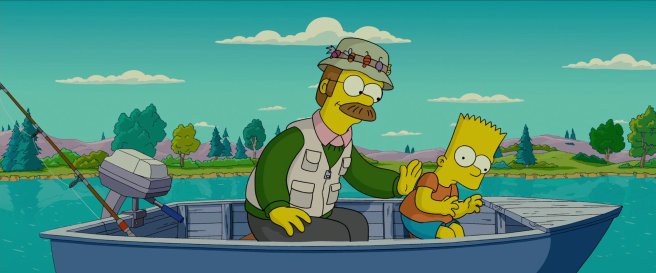
The other Simpsons are there too, I guess. Marge doesn’t have much to do outside of take Homer’s abuse (“Isn’t it great being married to someone who’s so recklessly impulsive?” “Actually, it’s aged me horribly.”) She gets her big scene where she once and for all “leaves” Homer, and between pairing it with the revisionist history wedding video and the producers forcing Julie Kavner to perform it five thousand times, it’s doing all it can to try and pack an emotional wallop… but it just comes off as empty since we’ve seen these two on the rocks dozens of times before, and on top of that, I don’t even care if they get back together considering how huge a prick Homer’s been through the whole movie. Lisa spearheads the environmentalist efforts in the first act, and has what I can’t even call a subplot in her romance with Tress MacNeille doing an Irish accent. Like Russ Cargill, Colin is a completely disposable movie-only character. They originally wanted to make Lisa falling for Milhouse, which I wouldn’t have wanted to see either, but maybe we can give the eight-year-old girl a storyline that isn’t about what boy they like? Bart gets the meatiest material of all, being reduced to a sniveling mess wanting Ned Flanders to be his Daddy, a man who won’t physically assault him or force him to go around in public with his genitals exposed. It’s very strange, borderline uncomfortable stuff (Bart instinctively preparing to be choked and his confused, euphoric reaction to being patted on the back.) But this story kind of conveniently removes Marge from the equation, who mothers Bart to death every chance she gets. Where is she in all this? As far as the Simpson family goes, Bart is easily the character the writing staff has struggled with the most as the series has gone on (and on and on and on…), and the movie is a pretty clear example of that. Bart nearly in tears begging to be a part of the Flanders family? Come on.
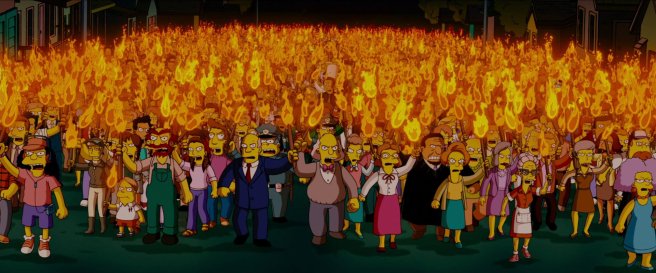
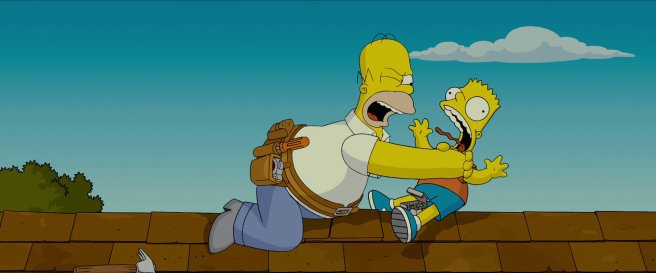
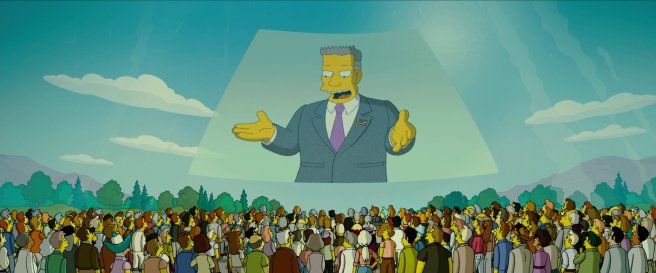
Presented in marvelous anamorphic widescreen, the movie is trying its damndest to feel worthy of its format. There are most definitely some fun visual moments and pretty nice looking shots and cinematography throughout the film, but its overall look is kind of bothersome to me. The more pristine and polished the show became as it got on in years felt more and more off-putting, and this is basically the ultimate version of that. The squeaky-clean varnish makes all the characters feel flatter than their early 90s counterparts. I also don’t care for the fact that literally every single character, object and background has a shadow layer on it in every single scene. I guess it’s supposed to make things pop more off the screen, but they just feel extraneous, and at worst distracting in more benign scenes that don’t necessitate any dramatic shadows. Another visual issue for me is the CG integration in the movie, which is pretty shaky on the whole. Cel-shaded 3D objects will stick out from the 2D elements, and the instances where 2D characters are placed into 3D environments for certain shots feel incredibly awkward (the family driving home from church in a 3D car, Bart almost falling off a 3D roof.) Some shots fare better than others (Homer smashing through the blockades at the lake before dumping the pig crap silo looks pretty damn smooth), but most of these more ambitious shots don’t quite hit the mark, like the above scene of the gigantic mob; as the camera passes through the 3D environment, all of the characters end up looking like paper cutouts. It’s a bit befuddling to me how within the same decade, Futurama managed to integrate 2D and 3D so well, but a big part of that is they would render entire shots in 3D, characters included, and would shoot and cut them in such a way that drew attention away from any unconvincing elements. Here, the mixture of 2D and 3D isn’t quite up to snuff yet, which ends up becoming distracting. Since 2007, there’s been incredible technical advancements utilized in wonderful films that toe the line between the two dimensions (Klaus, The Peanuts Movie, Spider-Man: Into the Spider-verse), but here, it’s in that iffy in-between stage where the effects kind of work, but also kind of don’t at the same time.

A big portion of my original review was about the behind-the-scenes stories on the commentary, how Al Jean and the writers were wholly reliant on test screenings to decide whether to keep, change or remove scenes, jokes and entire characters. Give it a listen if you want to feel depressed. The writing staff once famous for having a James L. Brooks-signed golden ticket protecting them from network notes, completely unheard of in the world of television, is now, completely voluntarily, at the beck and call of some schmo in Portland who didn’t laugh at Homer getting hit in the nuts or whatever. There’s just so many things about the mindset in the creation of this movie that are so incredibly disappointing. The biggest, of course, is the complete lack of creative confidence, which I feel I don’t have to belabor too much. This is a series that thrived solely because of its writing staff who created stories and characters that they enjoyed, and as a result, we the audience enjoyed too. Almost twenty years later, this slavish dependence on audience approval makes the staff feel like scared and tired old men who can’t stand by their own convictions. All of this constant rewriting and rethinking based on focus group response resulted in a movie that not only feels completely watered down, but with a confused plot with things that don’t quite connect. The “thousand eyes” in the prophecy used to refer to an entire forest full of mutated creatures, but since that was reduced to one multi-eyed squirrel in the final cut, it doesn’t make sense. Despite being incredibly important to kicking off the plot, Plopper just disappears from the movie after the first act. The Simpsons are in hiding at the motel from a wide sweeping manhunt, then go to a carnival in broad daylight with no issue. In Alaska, Bart and Lisa’s clapping avalanches Homer back into the house during the day, then it’s immediately nighttime for he and Marge’s Disney sex scene. When you rip your script to pieces so many times so close to the film’s release date, you’re gonna end up with some scattershot elements left in your finished film.
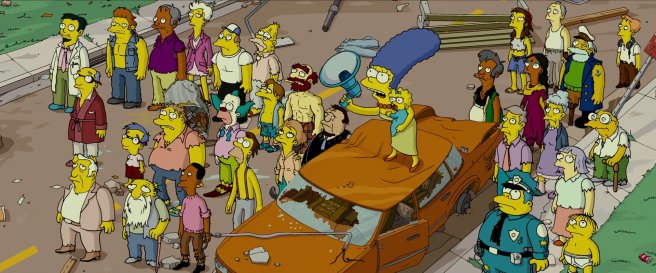
What’s most baffling to me is why the writers felt they had to do any of this. With eighteen years of public awareness and good will toward The Simpsons, they basically had carte blanche to do whatever the hell they wanted. FOX knew that they could open The Simpsons Movie and it would be a huge box office success by its name alone, so I’m sure they gave fuck all about what the movie was actually about. You would think this would be incredibly freeing creatively, lending you the ability to do whatever you wanted, so it’s very odd how the writers seem to have hobbled themselves in kowtowing to public response in such an extreme manner. I get that writing a film is a whole other ballpark than a TV script, and you want to make sure everything is working for an audience, but the endless amount of scenes pointed out on the commentary that were completely reworked after test screenings really speaks to a bizarre lack of confidence on their part, and that unsure attitude works its way into the movie itself. It’s impossible for me to separate the film from the behind-the-scenes stuff, but I can say this is one of those movies I remember liking less each time I saw it, for reasons I can’t entirely articulate (despite me being at like three thousand words at this point). But there’s definitely an overall malaise I get from it, a film made with good intentions and a lot of effort, but still a conflicted mess in what it wants to be. Is it social/political satire, or emotional character piece? PG-13 edgy, or genuine, saccharine emotional? For super fans of the show, or people who never watched it? In trying to be everything, and cater to as many people as possible, you end up with a movie for basically nobody, and that’s a sad fact.

I remember hearing Mike Judge talk about Beavis and Butt-head Do America, how he wanted to make the movie as best a representative of the best qualities of the series as he could, figuring the film would be more readily available than the series itself, sitting on video store shelves. And at the time, he was right. In the 1990s and 2000s when Blockbuster was king, movies were the big dogs, and TV was secondary. A TV show getting a movie was a huge coup, being viewed as a step-up in mediums. But over time, things changed. With the rise of premium cable channels, and later, streaming services, TV series became more prestige and valued. At the same time, video stores shuttered as streaming TV started to become more and more peoples’ first choice for home entertainment. As different streaming services continue to emerge, beloved TV series have become hugely hot commodities, as these services have to promote how they’re just exploding with large amounts of content for people to binge, much more than individual movies. A sizable piece of Disney+’s launch marketing was the inclusion of thirty seasons of The Simpsons, and I would think that was a pretty huge selling point for a lot of people that they could watch the entire series. The Simpsons Movie was also available, but just as a minor addendum to the series itself. And that’s basically what the movie is: a disposable vestigial limb to a once-great series. It had its brief moment in the sun when it came out, everybody was singing the Spider-Pig song for like a couple weeks, but now, fourteen years later, there really isn’t much of a reason to go back to it at all.