719. Boyz N the Highlands


Original airdate: March 6, 2022

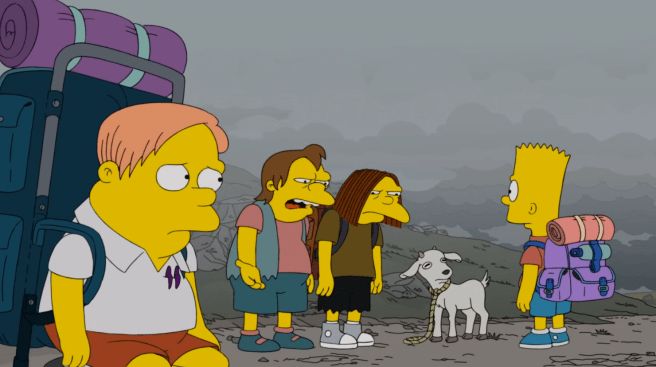
The premise: Bart, Nelson, Dolph, and Martin are forced to take part in the “Highland Trek for Trouble Truants” as part of community service. Martin is quickly made an easy target for the bullies, which Bart participates in to fit in, but ultimately he’s forced to see things from Martin’s perspective and has a change of heart.

The reaction: Martin Prince is a character who’s definitely fallen into the background in the last twenty-odd years of the series, only popping up every now and again with one or two lines during a school scene. In terms of the last time he had a major role in a plot, I can’t think of anything besides “Dial N for Nerder,” where Bart and Lisa witness his supposed death, but that episode featured Martin as a plot device more than a story built around him. The last major Martin moment I can recall is his crazed sacrifice to the alien cranberry sauce in “Thanksgiving of Horror,” an episode I shockingly actually liked, as well as being the final performance of Russi Taylor as the character before her death. Accomplished VO artist Grey DeLisle has taken over the role in the last few years, with this episode seemingly written to give her time to shine. When Bart and the town bullies are forced to go on this grueling wilderness hike that feels more like the Irish countryside than anywhere in Springfield, Martin is immediately the odd man out, claiming he signed up voluntarily. Eventually Bart has a crisis of conscious in actually sticking up for Martin against the bullies’ relentless taunting, which to me felt like the ending of act two of “This Little Wiggy” expanded to three times the length. When Bart and Martin are left alone, Martin has his breaking point, confessing he’s actually part of the group thanks to his overbearing parents. Forced to engage in extracurriculars to beef up his future prospects, he snapped under pressure and stole a bunch of drugs from a pharmacy to help him focus more. In the end, Martin debuffs his parents when they arrive and tell him to step away from those “bad kids” (“You’re late for your violin lesson. By the way, you play that now,”) and embraces his newfound chums. This characterization is fair enough, but I didn’t find it all that interesting. The overachieving student put under incredible pressure by their demanding parents is a trope I’ve seen play out in so many movies and TV shows, and nothing said or joked about here is anything that new. Plus, Martin always felt like a kid who enjoyed all of his quirky weird hobbies like playing the lute or model U.N., but does this episode imply that all of these things were thrust onto him and he was “forced” to like them? Like his dad telling him he plays violin now? I guess it could be implying he does actually like things like Greek chorus and waltzing, but it’s just way too many things to handle on top of academics? I dunno. All of this is combined with a weird runner featuring seemingly dangerous cultists and a sacrificial goat the boys save and protect, which has a twist ending that feels mostly overwhelming. This being a Matt Selman show, this is another episode focused more on the dramatic plot more than actual jokes, which I’ll again say is fine as long as you’re telling a story I can get invested in, but I wasn’t really. Martin saving the day thanks to his waltzing is sort of a satisfying payoff, as with him getting the respect of the bullies, but it all ultimately felt like a soft landing to me. Nothing before it felt particularly engaging or funny, so it made the ending feel not as impactful to me. I was pleased to see Martin in the spotlight, and with a pretty solid performance by Grey DeLisle, but the storytelling felt like it didn’t live up to the challenge.

Three items of note:
– The B-plot involves Lisa hijacking Homer and Marge’s weekend alone (how long is this death hike Bart’s been forced onto unsupervised?) by having them indulge in her fantasies of what it would be like as an only child, even adapting a new name “Jules.” Playing Suffragette-opoly, eating all the ice cream Bart always eats first, beat poetry, Lisa is determined to cram as many of these activities in as she can before her time is up. I understand the germ of this idea, but the forcefulness that Lisa thrusts this onto her parents is a little off-putting, arranging for Maggie to stay at Patty and Selma’s herself and presenting a pie chart of the sliver of time Homer and Marge actually spend on Lisa (“If you’ll just humor a middle child’s most frivolous whimsy, I’d like you to spend the entire weekend focusing only on me.”) Like goddamn, kid, could you be any more passive aggressive? People were bitching last week about Lisa’s childlike image of a romantic marriage inadvertently getting her parents almost killed out in the woods, but I felt her characterization was sympathetic in showing a child’s view of adult relationships. Here, it almost feels like she’s holding her parents hostage, frantically hurrying them through tasks and growling angrily when one of them fails to call her her new name. She ends up vomits up a bunch of ice cream on screen, which weirdly felt more uncomfortable than Homer bashing a poor animal’s brains in last episode, and things end on a semi-sweet note as Homer and Marge care for her, and the next morning Lisa pushes back at Homer’s suggestions off her list (“That’s kind of a Jules thing. Right now, I’d rather just stay in bed and be a Lisa.”) I feel like this could have been a kind of sweet subplot, but things just felt off overall. Maybe a lighter touch from Lisa would have helped.
– Grey DeLisle really is the best replacement for Martin we’re gonna get. From the very little we heard from the character previously, it felt like she was getting more comfortable with the voice, and now, in this prominent role, there were numerous lines that felt incredibly close to Russi Taylor’s range. Like if you just heard some of the scenes by themselves, you’d think it was her. There are certain sections where it starts to waver, particularly during Martin’s impassioned freakout toward Bart, but I think that’s partially due to DeLisle being so recognizable as many other major characters in animation. In some line readings, I’d be hearing faint reminders of Fairly OddParents‘ Vicky, one of the Loud House sisters, even Adventure Time‘s Ice Queen when Martin was really shouting. But overall, this is easily the strongest of all the recasting.
– Last week’s “Pixelated and Afraid” had a pretty warm reception by fans, and though it’s a bit early to tell, this episode seems to be getting similar accolade. There’s definitely been a noticeable shift this season, possibly due to Matt Selman becoming co-showrunner, giving us episodes that focus more on raw storytelling and dramatic elements over comedy, as we’ve seen with this, “Pixelated and Afraid,” and the “Serious Flanders” two-parter. I’ve reached the point that I can at least appreciate this move conceptually, trying to do new things with a 33-year-old show is more novel than hitting the same few buttons you’ve been mashing for decades. Plus, there’s a section of the fandom that seems to really love this new direction and want to see more episodes like this, and honestly, that’s perfectly fine. I feel I don’t have many specific criticisms of this episode or “Pixelated and Afraid” other than they’re not funny enough and the stories they’re telling aren’t interesting to me, which are two very subjective opinions, and things that the fans might not agree with. But even if they mean less for me to bitch about on this blog, I’d definitely prefer more episodes like this than “The Wayz We Were” or “Mothers and Other Strangers.”
718. Pixelated and Afraid


Original airdate: February 27, 2022

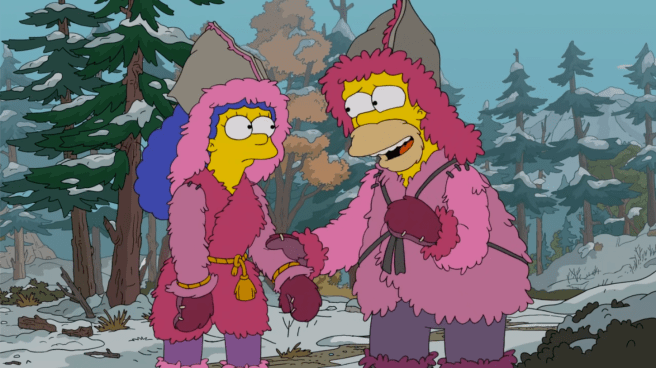
The premise: Homer and Marge end up driving off a mountain road on their way to a secluded wellness retreat, leaving them abandoned in the woods and needing to figure out a way to survive.

The reaction: Homer and Marge’s relationship has always been an interesting one, since as opposite as they may seem, there must be something between the two that keeps them together and loving each other. Despite her normally acting above it all, we’ve seen Marge be quite charmed by some of her husband’s more boorish qualities, and those little touches make their union seem all the sweeter. This episode opens with a similar sight, with the two completely comfortable with eating snacks while watching TV in a massive pile of blankets. While this sounds like paradise to me, Lisa is disturbed by this image, conflicting with her childlike view of marriage as a never-ending romance movie, urging her parents to take a week trip to “The Saffron Togetherness Center,” a phone-free relaxation retreat. All of this set-up feels promising enough, as I like to see Homer and Marge function as a loving team, grumbling about how the keto-diet and yoga-happy retreat schedule is of no interest to either of them. Then they crash their car and end up stranded with their wet clothes accidentally burned up, leaving them buck naked, apart from some helpful digital pixelation (hence the title. Originally I thought this was going to be a video games episode.) Homer and Marge eventually forge a “love nest” out of the remnants of an abandoned honeymoon villa, and even manage to catch a fish for food. The problem for me is that we don’t really get much of a progression of Homer and Marge’s characters through this story. If anything, it would have been better to start with them having some kind of petty argument, and them slowly softening to each other as the episode progressed and their love rekindling in such a dire situation. Or, they could be learning new things about each other in this brand new environment divorced from their suburban rut, realizing there’s still more to discover in each other even after ten-plus years of marriage. Instead, we see how they love each other in the beginning in their comfort with each other in mundanity (just not visible to Lisa’s immature eyes), and we end with them loving each other in a time of crisis. Homer ends up bashing in the skull of a feral wolverine about to attack Marge (which felt very uncomfortably real), sparking up their romantic flames once more. The two eventually follow snowmobile tracks back to a ranger station, enjoying a beautiful serene walk back to civilization, ending in one last cry of an embrace between the two of them, and a final view of the sunset while eating chips, mirroring their similar activity at the start of the episode. This is a Matt Selman show, so there’s your required dose of schmaltz, which doesn’t feel as egregiously manipulative as other episodes, but it doesn’t really feel potent to me since nothing really happened in to make it feel really earned. Like I said, we saw how close and in love the two of them were at the start of the episode, and by the end, they just realized how much they really love each other? I guess? The episode just felt very inert, and pretty laugh-less throughout. It once again brought up my “What even is this show now” question when it came to the last five minutes between the grisly manner of Homer killing that animal and their blissful walk back to the real world. I felt like the episode really needed to build up to that ending to really make it hit home, but it just didn’t to me. It reminded me a bit of the Futurama series finale “Meanwhile” (well, former series finale), where it ends with time frozen and Fry and Leela spend their lives walking across the entire planet, but that ending felt like a satisfying pay-off to the build-up of the episode, along with actually funny moments leading up to it. Like, okay, Homer and Marge love each other. We’ve seen them together for 33 years now. I’m totally onboard for an episode about them rediscovering that, but you’re going to have to give me more than the old “lost-in-the-woods” trope. It just felt very predictable and old hat.

Three One semi-unrelated item of note:
– I don’t really have any other tidbits to say about this episode, given how focused it was in its one premise with just Homer and Marge, but being reminded about Futurama made me think I should briefly cover the Hulu revival. I can’t tell you how weird it was to read the “Hulu Reboots Futurama” headline in my Twitter feed and feel absolutely nothing. I flashed back to when fifteen years prior when I heard that Futurama was coming back for new direct-to-DVD movies, and myself, a teenager who was enraged at FOX for “mistreating” and canceling the show, I was absolutely beaming with excitement. But then the show came back again, and again, and then finally ended. I actually just so happened to finish rewatching the show a few months back. The Comedy Central era was definitely spotty in places, with its share of mediocre-to-bad episodes, but there was also a lot of good in it, and I’d say at least a dozen shows were on par with some of the best seen in its FOX run. Futurama had four series finales over its lifetime, and for the seemingly unkillable run that it had, I’d say it finally “ended” on a solid note and I was perfectly fine with it finally coming to a permanent end. But now, in this era of studios reviving every corpse with a fan base to get new subscribers to their streaming services, Futurama is the latest in an endless line of revivals, coming back with new episodes after a decade in 2023 (yes, 2013 was that long ago, let that sink in.) Could these new Hulu Futurama episodes be good? Quite possibly. But do I want them? No. Yes, the types of futuristic sci-fi-based premises they could do are seemingly endless, but I feel like you can only do so much with these characters, and they were already starting to feel played out in the Comedy Central run. Sometimes things can just end. It’s okay. There’s plenty of other things to watch, even, dare I say, new shows by the same creators of the stuff you love. I didn’t care for the first season of Disenchantment, and never went back to watch further, but that felt like the true successor to Futurama, with a lot of the same cast and crew working on it. I respect the artistic integrity and merit of that far more than a Futurama reboot. Things seem even more dire with the news that John DiMaggio, as of now, is not returning to voice Bender, as he was unable to reach a contract agreement with Disney/Hulu. I was pretty blown away to see more than a few people online bitch about DiMaggio for being greedy or insulting his fellow cast members by asking for more money, in defense of Disney, the all powerful media monopoly. Voice actors are famously underpaid, and John DiMaggio has always been a champion for the art form, so I don’t blame him for wanting to get a higher salary, given this is now the fourth revival of this very popular show, doing the voice of its most famous character. The entire cast had a similar contentious negotiation at the start of the Comedy Central run, with all of them being threatened with being replaced, so there’s clear precedent of studios trying to fuck over talent with this series alone. The first table read for the reboot was a couple weeks ago, and apparently someone is subbing in for Bender for now, so who knows if Disney and DiMaggio will actually reach an agreement by the time they actually start recording. But it really feels like an absolute bonehead move by Disney. I have to imagine a large majority of fans would disown a season of Futurama with someone else voicing Bender, but will they watch it anyway, and is that all that matters to Disney? I feel like eventually Disney will buckle and give DiMaggio what ultimately must be a meager pay bump, but there is definitely a chance that they’ll stick to their guns and we’ll get a weird-sounding Bender in the new episodes, in which case, I will watch the first episode out of morbid curiosity and then turn it off.

EDIT: Well, not even 24 hours later, DiMaggio is back, so never mind about all that! Even if Hulu Futurama sucks, at least Bender will still sound like Bender.

717. The Longest Marge


Original airdate: January 2, 2022

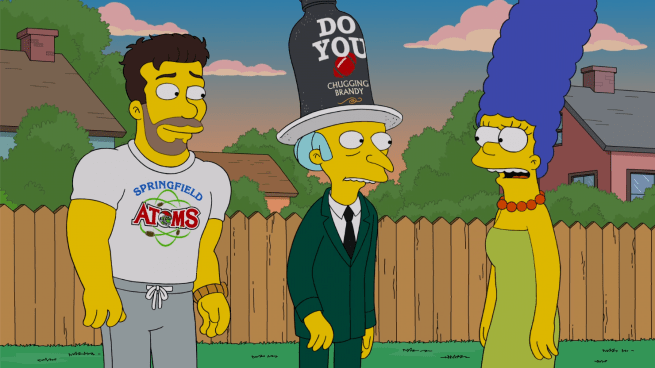
The premise: Springfield’s football team bags an all-star athlete, arrogant 22-year-old Grayson Mathers, who is quickly scooped up by Mr. Burns to be the sponsor of his failing brandy business. When a hungover Grayson stumbles through his first game, Marge takes him under her wing and cares for him, softening the footballer, much to Burns’ chagrin.

The reaction: This is another episode in recent years that seems to be focused on a brand-new guest character, in this case Grayson Mathers, played by Beck Bennett, who we’re introduced as a cocky, brash young athlete who has no filter, spouting off self-obsessed quips like “I do me” and “Truth bomb!” Mr. Burns chooses the pro-baller to lift up his struggling booze enterprise, and all-too-quickly warms up to Grayson’s charms (“To friendship hugs!” he toasts, in what may be the least-Burns quote ever spoken). A disastrous first game causes everyone in Springfield to turn on him, all but Marge, whose motherly instincts kick in as she invites Grayson into her home. There, Grayson’s backstory is revealed: when he displayed talent from a young age, his parents shipped him off to Football Academy, where his entire life has been entirely devoted to the game (“It helped me avoid the distractions that come with being a kid: friends, laughing, that junk.”) This man who was practically bred in a laboratory to be a perfectly marketable all-star athlete, with no concept of a loving family or social norms, is an intriguing comic concept, which the show kind of scratches the surface of, as Grayson finds himself more and more comforted by being a part of the Simpson family. But it’s not nearly enough, as the back half of the episode is devoted to the “hilarious” schtick of Marge and Burns butting head as Grayson’s “parents,” warring over who knows best for him. Even though Burns’ heart had softened to his new surrogate son, he’s aghast at Grayson’s newly proclaimed “momma’s boy” status (“Where’s my bad boy? Marge Simpson, what have you done?” Harry Shearer croaks out.) You can guess what the dialogue is from there, with the two bickering as if they’re actually co-parents, and Grayson is their real son. They both get invitations from Grayson to a sports awards show, and resolve their differences after getting blasted with brandy. Then Grayson announces he’s got a fiancee, and the episode is over. A pretty boring episode, all in all. There was the finest germ of an idea within the Grayson character, but it’s surrounded by a bunch of uninspired sports jokes and the tepid Marge-Burns dynamic. Bleh.

Three items of note:
– I had forgotten whether it was established that Springfield has a football team, then I looked it up and kicked myself for forgetting the amazing “Homer Loves Flanders.” The name Stan “The Boy” Taylor is funnier than anything in this episode, that’s for sure. The Springfield Atoms made a few other appearances within the last decade or so, most notably in the Boston episode, but who cares about those.
– John Mulaney makes his second appearance as fan-favorite character Warburton Parker. Remember him? He helped Homer and Bart go viral with their family fights? It was a season premiere a few years back? Remember what a funny and memorable character he was? He helps Burns with his brandy re-branding (how could they have not used that joke? It was right there), showing a slideshow on the benefits of celebrity sponsorship, with some surprisingly terrible caricatures of George Clooney and Ryan Reynolds. They look like those terrible gifts you can buy where a shoddy Simpson-ized portrait of your family.
– When Burns confronts Marge and they argue back and forth, the image starts to wobble as if they’re being “shot” with an actual camera, but it ends up looking like either you’re a little bit drunk or the Simpson house is out at sea. Then Burns slams his fist against the wall and collapses to the ground, and I realized this is their Marriage Story “parody.” Both he and Adam Driver yell “You’re winning!” as well. I’ve seen Marriage Story, but like all movies pre-COVID, it’s basically been completely memory holed, with the scene only being recognized by me thanks to it being immortalized in meme form. I guess that’s why they figured they could do the reference, since I’m sure a lot more people have seen the Adam-Driver-punches-wall memes than even saw Marriage Story. That’s kind of interesting, between this and the show referencing its own meme culture (steamed hams, Homer sliding into the bushes), it’s like the series going from referencing pop culture to referencing memes about pop culture.

716. A Made Maggie


Original airdate: December 19, 2021

The premise: Fearing for her youngest child’s unbaptized soul, Marge demands Homer find Maggie a godfather, and he does, in the form of Fat Tony. Marge is incredibly hesitant, but it seems like Tony has turned over a new leaf thanks to caring for the baby, leading to his associates planning on rubbing him off for going soft.

The reaction: In regards to our secondary cast, Fat Tony is a character that has been completely tapped. Back in his 1991 debut, it was novel to have an animated sitcom do an extended mafia parody, with Goodfellas being a new rich vein to tap into for comedy, as well as paying tribute to classics like The Godfather. But here we are thirty years later. As with everybody on this show, nobody has grown or evolved, so Fat Tony and his crew are stuck cycling through the same tired jokes we’ve seen them, and other mafia parodies, do for years, decades even. I especially noticed this in season 31’s “The Fat Blue Line,” the last major Fat Tony episode, and it was just as clear to me now. Fat Tony takes Maggie to a “Guido and Me” class. Offended by his subordinates’ language, Tony reacts, “Do you give the kiss of death with that mouth?” He orders Legs and Louie to “take care” of a dirty diaper, so they bury it near the coast after chaining it to a cement block. All of this is such stale shit. One joke involves Fat Tony never having seen The Godfather, but has seen Shark Tale and Analyze This, two mafia parody movies that are twenty years old at this point. The earth has been salted with this softball stuff. If you want to do mob schtick, you need to up your game and come up with a new way to do it. But, par for the course with this show, the old standards are good enough. Marge isn’t pleased with Tony assuming the role as godfather, but she decides to stick with it until she can wiggle out of it later. She, and later Homer, are in a nebulous state of terror through the episode, fearing for their lives being inside Fat Tony’s world, but these characters have been so defanged over the years, and as we see them in this episode, that it really doesn’t sell it. Again, Tony and company read as threats twenty years ago, but at this point, they’re basically old friends of the Simpson family with how many times they’ve crossed paths. Tony seems to genuinely want to go straight after bonding with Maggie, opening up a maternity store, but none of this is ever talked about with either Homer or Marge, so whatever. In the end, Tony subdues Johnny Tightlips after trying to usurp him, and he exposits out loud that being a mob boss is who he is and he can’t change that so he can’t be the godfather, so whatever. It’s all a completely pointless exercise. We get one small character moment of Tony talking about his mother giving him a “First Communion” book and ten dollars as a gift as a kid, but beyond that, nothing new is learned or felt at all about Fat Tony. It’s the same old gags just played on repeat, with nothing for me to feel but apathy.

Three items of note:
– Right off the bat, the episode contradicts “Home Sweet Homediddly-Dum-Doodily,” with Marge saying they haven’t baptized Maggie yet, and later having a nightmare that her baby will be damned forever unless she rectifies it. The Simpsons being “cafeteria Christians,” as we see in contrast to the militantly religious Flanderses in “Doodily,” seems to make more sense to me, but whatever. What’s more bothersome is another instance of a giant story hole in one of these episodes that never gets addressed. Maggie needs a godfather. Marge briskly mentions that either Patty or Selma can be the godmother, and we see Selma at the baptism and lunch afterwards and she’s completely silent (hey, wasn’t she married to Fat Tony? Oh wait, I guess that character’s technically dead, and Fat Tony is actually Fit Tony… shit, get back on topic, back on topic…) But who are Bart and Lisa’s godparents? Never addressed. How the fuck is that never brought up? The whole impetus of the episode is Marge worrying about what happens to her kids if they die, and that focus is only honed on one of three kids. Bart and Lisa must have godparents, so Marge could have asked them to take on Maggie too. It’s one of those things where I’m just boggled at how this never came up when they were writing this script. Like, how?
– The episode opens with the family going to visit “The Overpriced World of Angelica Button,” and you can probably guess what this is supposed to be referencing. You can buy expensive wands, drink some “Batterbeer,” and have the “Categorizing Cap” decide which wizarding house you belong to. Goddamn. The Angelica Button books were first introduced in season 18, which I guess is good, because this MAD Magazine bullshit “just change a few letters and it’s a parody” stuff really started to hit hard during the 2010s. A few years later, and it would have been called “Barry Trotter.”
– Speaking of tired references, Fat Tony saves Homer and Maggie from a falling piano, accidentally dropped by two workmen who look like Laurel & Hardy. It’s the year 2021, right? This episode was written by Elisabeth Kiernan Averick, and while I can’t find an official age for her, she appears to be in her 30s. While it’s possible that she’s a big fan of classic mob movies and turn-of-the-century silent comedy, these feel more like the contributions of the much older veteran writing staff ripping these scripts apart in the writer’s room. Like I said, this all feels like regurgitations of existing parodies rather than anything even remotely new.

715. Mothers and Other Strangers


Original airdate: November 28, 2021

The premise: When Homer is triggered by traumatic memories of his mother on Mother’s Day, an impromptu therapy session causes him to recall a lost memory: a postcard he received as a teenager confirming his mother was alive, leading to a road trip with his father to Utah to track her down.

The reaction: This episode marks Glenn Close’s eleventh guest appearance as Mona Simpson, and while most of those have been one or two line cameos, a couple of them featured Mona in a significant role via flashback after her death. Of course, all of these episodes sit in the enormous shadow that is “Mother Simpson,” one of the most emotionally impacting episodes of the entire series, one that established who Mona was and why she was absent for most of Homer’s life. This episode attempts to stay true to this continuity, all while wedging a new story in the middle of it that kind of breaks apart the established history. Now, I try not to be a purist of Simpsons continuity, because even as big a fan as I am, it’s pretty stupid to get hung up on what is or isn’t “canon.” But it’s a little different when an episode is attempting to piggyback off such a landmark episode and rewrite its history. If you’re going to do that, you better have something really important to say, or some interesting or entertaining twist to it. And wouldn’t you know it, it doesn’t! Here, we find out that as a teenager, Homer received a postcard from his mother, telling him she’s in Utah. As he and Abe drive out to find her, they’re being tracked by the FBI, hoping it will lead them to Mona. First off, the one FBI agent comments, “Letting that postcard go through was the smartest thing we ever did.” So they’re able to track all sent mail in the country, and rather than intercept the postcard, go to its point of origin and investigate, they just trusted that this dumb fuck kid could find Mona for them? And pretty easily, it turns out, as all they did was ask a waitress at a truck stop if they’d seen her and she led them right to her. And why would they be actively tracking her after all these years? The agents make a joke about it at the very end, but it still feels incredibly stupid. But never mind all that, this episode is now saying that Homer knew his mother was alive from age sixteen to the “present” where he was reunited with her in “Mother Simpson.” He didn’t think she was dead, he knew that she was hiding out from the law all this time. Their Utah reunion gets botched, only being able to see each other from afar before the agents close in, resulting in Mona hopping into the VW van we saw at the end of “Mother Simpson.” If that’s not bad enough, Homer reveals another memory near the ending: the night after Bart is born, Mona snuck into the hospital dressed as a doctor to hold her grandchild, tell Homer she’s always with him, before leaving him once more. That feels even more traumatizing than just being gone from his life for twenty-five years. “When I heard about the baby, I just had to come and see him,” Mona tells him. How did she hear about it? Does the Springfield Shopper have birth announcements? And does she pay to have it delivered to her to God knows where? Has she kept special tabs on Homer for all these years? In the deleted scene from “Mother Simpson,” Mona told Homer she knew he went into outer space, a national news item she could have seen from afar and be filled with pride about. Here, I guess Mona has followed Homer’s life achievements his whole life and could just pop into his life at will, but chose not to. It’s just really fucking bad. Nothing has been added to Homer’s story whatsoever, just some lame reconciliation with Abe, as flashback episodes continue to depict his younger self as nicer and nicer, where Homer sacrifices catching up to his mother for saving his now-loving and caring father. Again, I’m not a continuity stickler, but Homer growing up without a mother and his father being an uncaring asshole are pivotal backstory elements to who he is as a character, a source of a lot of his insecurities and character quirks. If you want to make an episode that negates those elements, you’re basically tearing apart his entire character. Al Jean himself wrote this one, who has written some pretty awful scripts over the recent years, but this has got to be his worst one yet. That such an incredible mishandling of a story from one of the most important episodes of the series comes from a man who’s been with the show from the very beginning is pretty stunning to me. Despite some fans calling for Al Jean to leave the show in favor of Matt Selman fully taking over as show runner, I’m pretty sure Jean is going to be with this show until the very end, ready to go down with this decrepit sinking ship that he helped to crash and decimate. I guess there’s some kind of honor in that, somewhere…

Four items of note:
– The episode barely started and it was befuddling me. While channel surfing, Bart stumbles upon “Muttflix,” a cable channel made for dogs. Then we see there’s a streaming service UI on the screen, which seems obvious given the sub-MAD Magazine-level riff off Netflix. So is it a channel or a streaming service? This may seem like nitpicking, but when what I’m hearing is immediately contradicted by what I’m seeing, it just feels like the writers just don’t care. Then we get our triumphant return of She Biscuit, Santa’s Little Helper’s mother, last seen in the nauseatingly treacly season 31 finale “The Way of the Dog,” where she sits next to her son and does nothing. In that episode, we saw She Biscuit living with the Simpsons, but now Bart says Santa’s Little Helper “invited her over.” What? From where? I honestly couldn’t give a shit if she ever reappeared again, but they couldn’t even be bothered to write any kind of explanation of where she’s been. And why did she even need to be there anyway? The Muttflix sequence would have played exactly the same if it were just Santa’s Little Helper. Just dumb, lazy shit.
– “Oh my God! Dad’s reliving the great tragedy of his life!” “Let it out, Dad. Studies show losing a parent is the most traumatic thing that could happen to a child.” These are lines said by Lisa in immediate response to her father suffering an emotional breakdown. I literally said, “SHUT THE FUCK UP” at my computer screen. I remember Lisa had some similarly awful dialogue in the last Mona episode “Forgive and Regret,” clinically summarizing the situation rather than react like a child concerned for her parent, but this felt even worse than that.
– The wraparound story involves Homer telling his story to an online therapist over the app Nutz, where we get in plenty of jokes that I assume are taking shots at similar therapy apps like BetterHelp. They’re all pretty lame and boring: Homer attempting to use emojis during his session, alerts about in-app purchases and ads… Also, the family is just there while Homer is having his one-on-one session, something that could have been made into a good joke but was ignored. There was some attempt to scratch at the topic of quick-service psychotherapy in a satirical way, but it all felt very easy and surface-level, as always with this show in its attempts at satire.
– The ending features Homer dreaming a black-and-white sequence of a bunch of characters dancing in a circle, including multiple different variants of himself, bookended by some kids and his younger self playing instruments on a stage? I have absolutely no idea what that was a reference to, does anybody know? Regardless, it was confusing and I couldn’t make sense of it not knowing the reference, and it wasn’t funny, so chalk that up a a big failure in my book.