
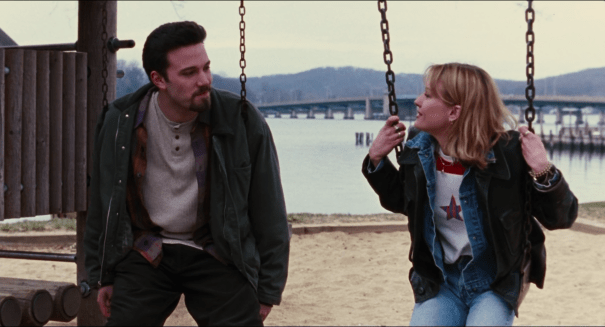
 Things weren’t going so hot for Kevin Smith after Mallrats, considering it made no money and everyone hated it. But there was one silver lining for Smith on his sophomore film: Joey Lauren Adams. The two met on the Mallrats set, and ended up dating for a while. It was only a few years before they split on amicable terms, but their romantic tryst ended up being the direct inspiration for Smith’s next film, a more dramatic turn taking a naked and honest look at relationships, specifically on how one’s insecurities can cloud and warp them. Made on an incredibly small budget, Chasing Amy turned out to be Smith’s second wind, with many critics being pleasantly surprised by his headier, more serious film. It showed that there was a little more that Smith had to offer than his usual crude fare, and although that’s pretty much the pond he continued to wade in for most of his ensuing career, Chasing Amy definitely displayed a new side of him.
As I mentioned before, Mallrats and Chasing Amy are the only two Kevin Smith movies in this series I haven’t watched since high school. And while I felt reasonably confident my thoughts on Mallrats wouldn’t change much from my memories of it (and they didn’t), I was curious to how I’d react to Chasing Amy. I could certainly see why a slow-moving romantic drama wouldn’t be that appealing to my teenage self, but I’m definitely more susceptible to this sort of film as an adult. I was also curious how much of a potentially cringe-worthy time capsule this would be in regards to its gay subject matter; the premise alone of a lesbian falling for a man seemed like it might not hold up super well. So after finally seeing it again, I’m definitely a little conflicted. I wouldn’t consider it a good movie, but there’s definitely quite a bit here that I think works well. It certainly feels like Smith’s voice is back in it after Mallrats, undoubtedly because of how personal the subject matter is to him, but the execution of the film is a bit of a mixed bag. Continue reading “ReView Askew: Chasing Amy (1997)”


 Me Blog Write Good