26. Homer vs. Lisa and the 8th Commandment

(originally aired February 7, 1991)
NOTE: During the past week,  I was visiting my hometown in New Jersey. However, that did not hinder my Simpsons obligations. I managed to burn through six episodes with two very good friends of mine, and together we recorded brief, five-minute commentaries for them. They’re quite rambling, misguided, and mostly disposable, but hey, they’re only five minutes, and if you’re reading this, chances are your time isn’t that valuable to begin with.

These audio reviews will also be an excuse for me to write less. A bit of a cop out, but hey, I got four hundred episodes more, so cut me a break.

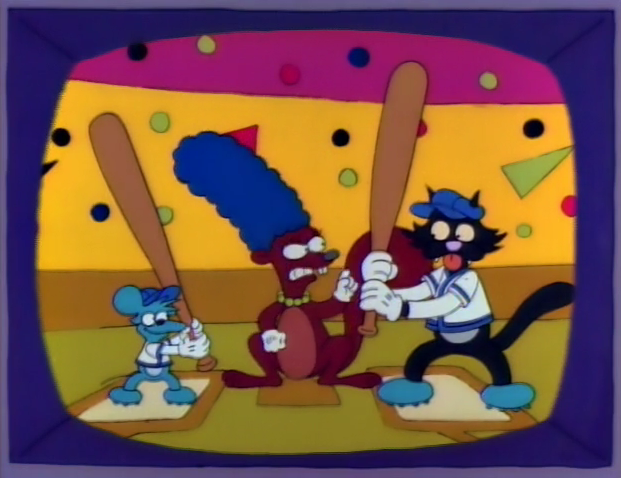
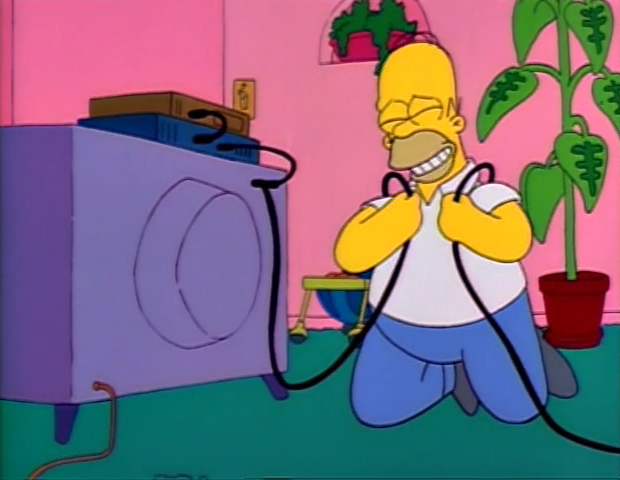
Homer/Lisa episodes have always been amongst my favorites, where the impulsive and hedonistic Homer must combat the moral compass that is his daughter. The plot-on-paper here is pretty cut-and-dry: Homer manages to get an illegal cable hook-up, and Lisa deals with the dilemma of scruples involved. From the opening at Mt. Sienna, we get right away this is a morality tale, with Moses laying down God’s commandments, with “Thou shalt not steal” befuddling the Homer expy of the time. In modern day, Homer is most ecstatic about his widened television options. The rest of the family is mixed: Bart is just as pleased as his father (especially upon discovering late-night nudie films), while Marge is mildly concerned about the legality, but is the quieter, less affirmative voice of reason. It’s up to Lisa to put her father back on the right path, but how?

First, a day at Sunday School strikes fear into Lisa over the possibility of her family being Hell-bound, which leads to a great sequence in which the living room morphs into the fiery pits below. Lisa then seeks help from Reverend Lovejoy, who suggests she perform a bit of a silent protest. The tension continues to build to the climax, a big house party Homer is throwing for an ultimate boxing match. Little items build up: concerns from his wife, a shifty return from the crooked cable guy, and catching Bart disobeying his orders not to watch X-rated TV (Bart bemoans, “I wish I was an adult so I could break the rules.”) Homer becomes even more frantic the night of the fight, hurriedly hiding other stolen items from guests and nearly breaking down before the police. His world is crumbling, but good wins out as he joins Lisa on the lawn during the fight, and cuts the cable.

It’s such a solid, sweet story, but this episode is also ripe with TV parodies given the subject matter. The first thing Homer sees on cable is a home shopping network pitch of a hideous clown figurine that no one has bought, and it brings a tear to his eye. Later, he watches a Seinfeld-esque comedian, who he’s much amused by (with the immortal line, and the most succinct summary of that type of comedy, “It’s funny because it’s true!”) There’s also the fight promotion and pre-show that’s great, with our first look at Drederick Tatum, the Simpsons universe’s Mike Tyson. We also see the introduction of Troy McClure, famous B-movie star who will do anything for a paycheck, including hawking a bogus teeth-whitening candy on a cheap infomercial. Phil Hartman is abound in this show, voicing McClure, the cable guy, and Moses in the opening. Like he was on SNL, he’s a valuable asset, and any character he voices is going to get a laugh. So yeah, this is a real good one.

Tidbits and Quotes
– Hartman scores immediately as Moses, who announces in a commanding, completely serious tone, “The Lord has handed down to us ten commandments by which to live! I will now read them in no particular order!” Then again, in the present, when Ned chews out the cable guy (“I should box your ears, you… you sneaky Pete!”), Hartman gives him a pandering, “Easy, tiger.”
– The “So You’ve Decided to Steal Cable” pamphlet is genius (“Myth: Cable piracy is wrong. Fact: Cable companies are big faceless corporations, which makes it okay.”) It’s also very fitting to Internet piracy today, which I of course never, ever, ever do. Ever. Maybe.
– I’d love to see entire versions of some of the stuff the family watches on TV: the Hear Me Roar network, for one. I want to see how to make your own band-aid with five yards of sterilized cotton.
– Odd that the Sunday School teacher claims that if anyone ever saw Hell, they would die, when Bart had been and left there a few episodes back.
– Bart in the car ride back endlessly repeating “Hell” is such a great kid moment, capped off by the great Marge line, “Bart, you’re no longer in Sunday School! Don’t swear!”
– I love the grocery clerk; he’s almost like the Charles Bronsan type, but even surlier. “I need a price check on two grapes!” kills me every time.
– Homer’s logic loophole for excusing his theft is bulletproof (“Look, Marge, I can’t afford it. when I can afford to pay for it, I will, but I can’t, so I’m not going to.”)
– They’ve played with Burns always forgetting who Homer is up to this point, but here’s where I first felt it to be extremely comical. His dinner at the Simpson house cost him the election, he was involved in a legal battle with them, but upon arriving for the fight, he mistakes Homer for Barney, not realizing a thing. Also, “Smithers, the Cheet-O’s” is such a great line, I always pronounce it like that, with both syllables emphasized.
– Homer’s moment of redemption is as begrudging as it gets, though we know he’s acknowledged what he’s doing is right… like it or not (“I hate to interrupt your judging me, but I wanted you to know that I’ve made a couple of really important decisions. Number 1: I’m cutting the cable as soon as the fight’s over, and Number 2: I’m not very fond of any of you.”)
25. The Way We Was

(originally aired January 31, 1991)
NOTE: During the past week, I was visiting my hometown in New Jersey. However, that did not hinder my Simpsons obligations. I managed to burn through six episodes with two very good friends of mine, and together we recorded brief, five-minute commentaries for them. They’re quite rambling, misguided, and mostly disposable, but hey, they’re only five minutes, and if you’re reading this, chances are your time isn’t that valuable to begin with.

These audio reviews will also be an excuse for me to write less. A bit of a cop out, but hey, I got four hundred episodes more, so cut me a break.

Here we have our first flashback episode, giving us a look at how our favorite couple met and fell in love, told in an absolutely perfect and heartwarming fashion. We open innocuously enough with the family watching TV, with not only a great Siskel & Ebert parody (Homer chuckles and comments, “I love watching the bald guy argue with the fat tub of lard!”) but the first look at McBain, the action-packed film series starring Schwarzenegger double Rainier Wolfcastle. As much as I know that the schtick would grow stale if extended, I would love to see a whole McBain film. We’ve seen enough snippets over the years that one could probably be cobbled together, but I think it would be fantastic. Anyway, the TV burns out, and the family are stuck having to talk amongst themselves, and topic eventually turns to how Homer and Marge first met.

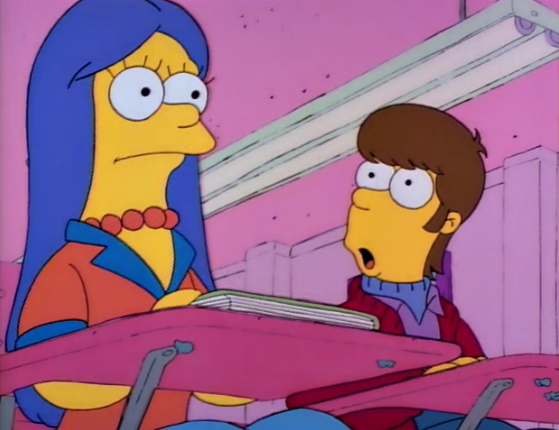
It’s now the bygone groovy time of 1974 where we meet our youthful heroes: Homer is a shaggy-haired slacker who skips class with fellow loafer Barney to smoke in the bathroom, and Marge is a headstrong go-getter with a knack for debate and foreign languages. These are two characters who would never have anything to do with each other if not for Marge being sent to detention for a radical bra-burning stunt on school grounds. Homer is immediately smitten, and seeks advice where he can: the guidance counselor suggests to find common interests and to “spend, spend spend!” while his father gives him a terribly reverse pep talk about aiming low (“Go for the dented car! The dead-end job! The less attractive girl!”) We get a real glimpse at how these characters matured and became who they are today, but in a very subtle way. We see Abe’s horribly dilapidated apartment and the rough way he treats his son and get a glimmer of where Homer got his questionable parenting from, and Marge’s discouraged political stunt dims the fire of her activism, sort of sadly paving the way for her future as a domesticated housewife. Both of these scenarios are kind of depressing now that I ponder them…

Homer fakes needing tutoring in French to get closer to Marge, which works, until she discovers it has all been a ruse. She instead goes with her pompous nerdlinger acquaintance Artie Ziff, voiced by the great Jon Lovitz. Lovitz is near the top of fantastic guest voices; his comic delivery and voice is almost tailor made for animation (which we would later get in spades on The Critic), and Ziff is a great character from Lovitz, a seemingly nice guy, but completely engulfed by his self-elevation from his peon classmates. He says it all in his acceptance speech as prom king (“Instead of voting for some athletic hero or a pretty boy, you have elected me, your intellectual superior, as your king. Good for you!”) True love wins out in the end as Artie gets grabby and Marge gives ol’ Homie one more shot, and the rest is history. It’s a really sweet episode, probably one of the series’s most so, full of lots of great character moments and sly nods to the future, the first at building the framework of the Simpsons past of how they became who the dysfunctional family we know and love today.

Tidbits and Quotes
– I always loved Homer imitating McBain’s cool quip, “That makes two of us”; he’s so like those dopes who do that, trying to sound cool. Also great is he and the kids desperation when the TV goes out, culminating with them staring intently at a single pixel. Marge shouts, “I think this is sick. You’re staring at a dot!!”
– We find out here that Bart was born out of wedlock, and that Marge’s pregnancy sparked Homer’s proposal. It was kind of ballsy for them to implicate this back in the early 90s, and I’m glad they did, as it inspired the wonderful followup flashback show “I Married Marge.”
– For some reason, I really like Marge’s activist friend. I think it’s because I wish a future episode would have further explored Marge’s high school days, showing more of the origins of her bottled-up indifference. Marge’s friend seems like the kind of person who pushes things onto people, thinking it’s of their best interest. Women should be given equal pay for equal work, but Marge contends, “Not if I have to do heavy lifting, or math.”
– Shakespeare’s Fried Chicken (a bucket of it sits in the Simpson apartment) is a chain I’d really like to see more of. Not related at all, I love Dan Castelleneta’s performance as middle-aged Abe, sounding younger and feistier. Actually related, his teenage Homer is wonderful too, having a higher, squeakier quality to it.
– Young Homer is brash, but oh-so-lovable. His query to his counselor (“I just met this girl Marge Bouvier and I want to force her to like me”) sounds so boorish on paper, but said and meant with such sincerity. Also great is his response when the counselor inquires about Homer’s post-graduate plans (“I’m gonna drink a lot of beer and stay out aaaaaaaaallll night!!”)
– Jon Lovitz also appears as the shop teacher, who has a more nasally tint to his voice. And one missing finger.
– The second act break is so golden, maybe one of my favorites ever. Homer may deal with rage and depression, but he’s the eternal optimist: even after Marge leaves in a devastated huff, he still knows it’s going to work out.
– I also wish we knew more of the Bouvier household. Marge’s mother appears briefly with some matronly advice (“If you pinch your cheeks, they’ll glow. Ladies pinch. Whores use rouge.”) We also see a rare glimpse at Marge’s father, long gone from this world (allegedly).
– We also see the first appearance of the “Wiseguy,” the sarcastic Charles Bronsan-sounding guy who fills a variety of jobs over the series. He’s Homer’s limo driver, and has some great lines, the best being his last as a dejected (and broke) Homer decides to walk home after the worst night of his life, to which Wiseguy responds, “Why spoil a perfect evening?”
– I’d talk about the perfect, sweet ending, but it’s hard to come up with stuff to say. It’s immortal, it’s classic, it couldn’t have been done any other way.

24. One Fish, Two Fish, Blowfish, Blue Fish

(originally aired January 24, 1991)
NOTE: During the past week, I was visiting my hometown in New Jersey. However, that did not hinder my Simpsons obligations. I managed to burn through six episodes with two very good friends of mine, and together we recorded brief, five-minute commentaries for them. They’re quite rambling, misguided, and mostly disposable, but hey, they’re only five minutes, and if you’re reading this, chances are your time isn’t that valuable to begin with.

These audio reviews will also be an excuse for me to write less. A bit of a cop out, but hey, I got four hundred episodes more, so cut me a break.

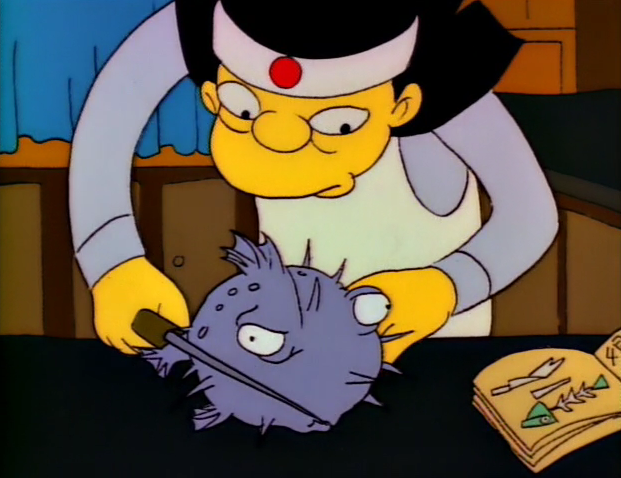
“Blowfish” is truly a tragic comedy, an episode that deals with the most serious of issues, a main character’s mortality, and not only does it never shy away from the premise, but still manages to get some laughs out of it. We begin with the Simpson family’s visit to a new sushi restaurant in a time when eating raw fish was a new and scary thing for the American populous. It is there that Homer ingests, amongst most everything else, fugu blowfish, which contains a poisonous toxin, giving him 24 hours to live. The show manages to keep tension not with foolishly messing with the audience about Homer’s imminent death, but in the worriment of Homer and Marge over the situation.

Comedy continues to shine through the dour plot, as Homer runs through his last wishes during his last day. He teaches Bart some valuable life lessons and phrases (“Cover for me,” “It was like that when I got here”), sits in on Lisa playing the sax, and records a postmortem video for little Maggie. With the latter, he borrows a camcorder from Ned, and devilishly agrees to attend his barbecue the following day; not even death will stop Homer from being an asshole to his neighbor-eeno. The show has its cake and eats it too best when Homer makes a tearful amends with his father, but grows weary of him taking up too much time during his final day. And of course, the best farewell words he can muster to his sleeping son is “I like your sheets.” As the episode ends, Homer, of course, is not dead, and continues to live exactly as he did before: eating salty snacks and watching mind-numbing bowling on TV. Homer is a simple man who appears to have learned nothing from his near-death experience, but we love him all the same for it.

Tidbits and Quotes
– I love Homer’s rampant stubbornness toward Lisa at the beginning; when she mentions how she’s always been told to be open-minded and try new things, Homer shoots back, “What are you talking about? Nobody’s trying to teach you that!”
– Great work by George Takei as the waiter Akira. Hank Azaria would later take over the role, doing a mighty fine Takei impression.
– First instance of depicting Mrs. Krabappel’s… sensual exploits. Ironic as I was talking with my friend Brad about the silly “Nedna” stunt from last season, and how it didn’t seem like those two were compatible.
– Despite Homer’s insistence against, he ends up loving sushi and eats everything. Then he’s going to die. The lesson here is never try new things. (“‘Try something new, Homer! What’ll it hurt you, Homer?’ I never heard of a poison pork chop!”)
– So many sweet bits in the show, but I love when Homer innocently asks Marge what she refers to their lovemaking as. That bedroom scene may be one of the most heartfelt moments in the entire series, but of course, it is immediately followed to Homer being shocked and furious that Marge let him sleep in (“You looked so peaceful lying there.” “There’ll be plenty of time for that!!”)
– Also first look at Burns’s antiquated form of ogling (“That’s it, baby. Work those ankles!”) I love Smithers’ follow-up “Ring-a-ding-ding, sir.”
– I like the inane chatter of the bowling announcers during the credits. It takes real skill to make something sound that boring, but still be funny.

23. Bart Gets Hit By A Car

(originally aired January 10, 1991)
Sometimes I wonder what the show would be like had Phil Hartman not died. His last appearance was in “Bart the Mother,” an early season 10 episode, about the time the series started to turn sour. Coincidence? Yes. But can you really imagine Troy McClure showing up in a season 14 episode? I dunno, his characters are just such a staple of high quality the show once had, it would feel weird. But anyway, I mention this because this is the first episode where Phil Hartman guest starred, here voicing one of his two regular characters, and one of the best supporting players ever, Lionel Hutz, questionably accredited (if at all) lawyer. Everything about the character is sleazy, smarmy and undercutting, but he does his darnedest to appear on the level, almost to the point where he’s deluded himself to that effect. With his welcoming powder-blue suit, he tries to propagate a just and caring air for himself, and son-of-a-bitch, it almost works. Hartman gives such a phenomenal performance as Hutz, creating a shockingly lovable character out of such a sleazeball.

Lionel Hutz appears, almost from thin air, into the Simpson family’s lives to represent them when Bart is knocked off his skateboard at a crosswalk by Mr. Burns’s limousine. Before we get here though, Bart has an out-of-body experience, takes a gilded escalator to heaven (with an angelic announcer voice, done by Hartman), but then is sent straight to Hell for a quick meeting with the Devil, before finally being sent back to Earth. This all happens in less than three minutes, by the way. It’s an epic example of Simpsons pacing, nothing feels rushed, all organic, and completely within the show’s rights. I’ve always loved the show’s depiction of the Devil, an impish, almost nerdy creature (with an appropriate voice by Harry Shearer), pulling up mortal’s timelines on computerized spreadsheets. When he finds he’s taken Bart prematurely, he chuckles, admonishing himself, “Boy, is my face red!” Almost seems like kind of a nice guy.

Anyway, back to Earth. When Homer is offered a pathetic, no-hard-feelings compensation by his boss, he decides to seek consultation from Hutz, in his office conveniently located in the middle of the mall. No punches are pulled on the credibility of his character; right as he and Homer sit down, his eyes light up as he hears an ambulance siren in the distance, but figures he’ll have to pass on that one. He then addresses his potential client (“Mr. Simpson, the state bar forbids me from promising you a big cash settlement. But just between you and me, I promise you a big cash settlement”) The settlement in question is a cool million, which Homer immediately responds to. This leads to a follow-up examination of Bart by another first appearance of a character with similar questionable morals, Dr. Nick Riviera. Like Hutz, Dr. Nick tries to put forth a smile on his line of work, but not much to disguise his run-down, filth-ridden office. Homer, however, is a-OK with the good doctor’s workplace also located in the mall and framed plaque denoting Dr. Nick as a female body inspector.

With phony bandages and phony testimony, Hutz and Homer are ready to go to court. This looks to be an absolute open-and-shut case, with all sympathy in the room immediately landing on a crippled-looking Bart, and Mr. Burns’s constant outbursts don’t much help his case (“I should be able to run over as many kids as I want!”) An episode highlight are the sequences of the two accounts of the accident from Bart and Mr. Burns. Bart’s recollection is of an insane maniac Burns sadistically mowing Bart down in “his luxury car of death.” Burns’s version, which he is clearly reading from cue cards, is a bright, wonderful tale of his selflessness and good will: off to deliver toys to orphans, a rambunctious Bart runs into his car, and Burns is quick to comfort the child, screaming to the heavens, “Take me! I’m old!!” The jury is not moved, much to Burns’s shock (“You believed his cock-and-bull story!”)

Marge ends up being Hutz and Homer’s undoing, as she is not as quick to tarnish her moral code. Called to the stand, she reveals her feelings on the legitimacy of Dr. Nick’s medical opinions, and of Bart’s exaggerated mental anguish. Homer is absolutely devastated at this. With the fantastical opening of Heaven and Hell and courtroom shenanigans, the back half of the third act seems a bit out of place, but feels like something that was built toward. Homer is concerned that he’ll never be able to look at his wife the same way again, that to him, she’ll be “the dame that blew [his] one big chance.” The denouement of this story is pretty silly and over-the-top, playing against the gasps in unison by Moe and the barflies, but it still manages to be sweet, even though we know the inevitability of Homer realizing his love for Marge will never fade. All in all, it’s a pretty wacky episode, a big part thanks to Hartman’s wonderful work with Hutz, with a sweet, grounded end.

Tidbits and Quotes
– I don’t know why, but I love that the title appears on screen (timed brilliantly to come up just seconds before the promise of the title is realized). This happened in “The Telltale Head” as well, as if it denotes this is a very special episode or something. I also liked that it said “Episode 23,” so I knew I haven’t been miscounting.
– I love the nod to Hieronymus Bosch in the depiction of Hell. It was later repeated in a much much later Treehouse of Horror, which was ruined by some dumb jokes to go with it.
– It’s so hard to pick a great Hutz line since every word he says is so great. It’s just the performance Hartman gives, so loud and commanding, killing with questionable kindness, and even more questionable scruples, not above chasing down a gurney rolling down a hospital hallway (“What’s that, a broken neck? Great!”)
– Great early bit of Burns’s lack of strength (“Tangle with me, and I’ll crush you like a paper cup!”) He strains and strains but eventually does it, and seems oh so satisfied of his achievement.
– Oh God, I LOVE the sequence of Burns imagining the “fallout” of him firing Homer after having mowed down his son: the newspapers reading “Burns Fires Ungrateful Employee” and “Hooray For Burns!” For some reason, the voice-over of Burns making positive murmuring noises makes it even funnier.
– We also get the first appearance of Mr. Burns’s lawyer, still unnamed to this day. When he was released in action figure form (unbelievable), he was just dubbed “Blue-Haired Lawyer.” He’s mostly Burns’s lawyer, but he’s always on the side against the Simpsons, a very skilled, methodological man who can crack and twist testimony out of anyone. He’s such a wonderful character, and a great foil to bumbling types like Hutz, and later Gil.
– I’ve always liked Burns screaming at his legal team after the session (“Hang your heads in shame, you overpriced, under-brained glorified notary publics!”) He’s usually such a reserved and calculated man, always in total control due to his affluence, but when things aren’t going his way, it makes sense for him to just lose it like that.
– My favorite line in the show is probably after Marge hesitates about her swearing to tell the truth in court, Hutz worriedly comments, “She sounded like she was taking that awful seriously.” I also love Blue-Haired Lawyer’s examination, starting antagonistically to get Marge to talk, then mellowing out, almost being glib toward the end, since he knows he’s got it in the bag. The scene where Marge is talking about the very minute negatives as a result of Bart’s mild injuries and Lawyer makes small commentshere and there is great; definitely another instance where Dan Castallaneta and Julie Kavner were in the same session just going off on each other’s reads.

22. Itchy & Scratchy & Marge

(originally aired December 20, 1990)
The Simpsons
is always up to tackle any subject, but never approaches things in a cut-and-dry manner. Characters with viewpoints from both sides are questioned and held under equal scrutiny, as the show examines both sides of a particular coin. This episode is a key example of this, as the show takes aim at the media in general and censorship, what is acceptable for general audiences, in almost a veiled commentary on the show itself. I was a mere infant when these episodes aired, but I’m aware that FOX was a nothing network until controversy from Married with Children caused a public interest (any publicity is good publicity). Not long after, our favorite family caught some flack for its off-beat content, and this show almost acts as a response to all of that, a brilliant look at what one screwball can accomplish.

The in-universe target is the grossly violent antics of cartoon cat and mouse Itchy & Scratchy. We’ve seen them a few times previously, but this is the first episode to really highlight them. The idea of a cartoon within a cartoon is interesting enough, let alone the content, like Tom & Jerry but taken to an overly graphic extreme. We get our fair share of I&S clips here, all of them extremely gratuitous in their carnage, but so funny for that very reason, just different bombastic variations for that mouse to brutally murder that poor cat. After a highly impressionable baby Maggie whacks Homer on the head with a mallet, Marge discovers it was television where she witnessed it and emulated the act. Stepping to her soapbox, she starts a campaign against cartoon violence, picketing the animation studio behind I&S. Her efforts build momentum, leading to an appearance on late-night panel discussion show Smartline where she faces against I&S studio head Roger Meyers, Jr. and Dr. Marvin Monroe. She urges the viewers to write in their complaints, leads to a flood of letters at the studio’s doorstep, creating a rift in the cartoon world.

The final act is filled with so much stuff on different topics, but is always true and on-point with the story. It begins with Marge getting a call from Meyers Jr. and the distressed I&S writers who are trying to figure out how to retool their show. I’m sure the Simpsons writers have had to deal with many a corporate executive with no creative experience giving them notes on what to change about the show, so the frustration of the scene feels so organic. In the end, the show is reduced to the most bland, offensively inoffensive material imaginable: a doe-eyed and stoic Itchy & Scratchy sitting on a porch drinking lemonade, with actual voices (like Tom & Jerry were given in later years, to horrifying effect). The kids of Springfield find the cat & mouse’s domesticated activities boring, and must find something else to fill their time (Lisa comments, “Maybe there’s something else to do on this planet.”) Following this, we get an absolutely beautiful montage where the children discover that beyond mind-rotting, violent television is a great big beautiful world to explore, where one can fly kites, play baseball, jump rope, or dance around a maypole. Life sure becomes grand and fulfilling.

None of this is to last, of course. Marge’s fellow censor-happy harpies approach her over banning a planned Springfield tour of Michelangelo’s David, but she considers that particular freedom of expression to be high art. In a follow-up edition of Smartline, Marge muses, “I guess one person can make a difference, but most of the time, they probably shouldn’t.” Perhaps our lives would be better without us being glued to the yammering idiot box, but if we must live with new forms of technology and creative output, we have to learn that the bad and the good, as we perceive them, are of equal value and validity, be it the works of Michelangelo, the symphonies of Beethoven, or The Simpsons. At this concession, the playgrounds are empty once more as an ever-violent Itchy & Scratchy returns to the airwaves, as it should be. This is an episode that tackles so much, but still retains a sense of itself, staying with Marge and her crusade the whole way through as these various big topics happen around her. If this episode has any failing, it’s that it makes Marge a minor antagonist, but her journey is a just one, having only best interests at heart, and all is well in the end… sort of. She is pleased to hear that Michelangelo’s David will be seen by the kids of Springfield on a class field trip, and despite her rabble-rousing, we’re happy for her too.

Tidbits and Quotes
– I could write a whole other article just about Itchy & Scratchy. The opening of the show is perfect, with the xylophone melody, high-pitched theme singers, and the two character’s clueless expressions as they bash each other repeatedly. Could you think of any better way to start a cartoon like that? I also love the effort made to make Itchy & Scratchy look and feel more like a cartoon within the cartoon universe of The Simpsons. With a needle drop-esque score, less detailed backgrounds, and an overall zanier feel, it really does feel more like a “cartoon” than the one you’re already watching.
–
The Psycho shot-for-shot riff with Homer getting “attacked” is fantastic; remaking such an infamous dramatic scene in a ridiculous fashion like this is such a wonderful parody.
– I love Marge wondering where Maggie got the idea to wield a mallet to her father right as she places the baby directly in front of the television, which then airs an I&S short that opens with the two inexplicably placed in a kitchen whacking each other repeatedly with cooking mallets.
– The cartoon clips seem to get more and more gratuitously violent as the episode goes. We have a short where Scratchy opens his front door only to get a ballistic missile to his face by Itchy, then one that consists of Itchy blowing up Scratchy’s grave with TNT, and finally, a cartoon that is just the two pulling out bigger and bigger handguns until they are larger than the Earth itself, followed by an explosion and Scratchy being shot into the sun screaming. What a treasure trove of hilariously violent cartoons.
– I love Marge’s list of offensive material from I&S, particularly “dogs tricked,” “gophers buried alive,” and one check mark of “brains slammed in car door.” I want to see that episode very much.
– First appearance of Sideshow Mel, and to a lesser extent, another of Krusty’s co-stars Corporal Punishment. I feel we don’t see enough of Krusty’s show, we’ve never seen the Corporeal, or Tina Ballerina, or even much of Mr. Teeny the monkey in action on his show.
– Great line from a self-immobilized Homer on the couch (“You know, some of these stories are pretty good. I never knew mice lived such interesting lives.”)
– Roger Meyers, Jr. on Smartline is so brilliant, with his constant interrupting and undermining of Marge, and his defense of his work with a shocking revelation (“I did a little research and I discovered a startling thing… There was violence in the past, long before cartoons were invented. The Crusades, for instance. Tremendous violence, many people killed, the darned thing went on for thirty years!”)
– Oh my, I LOVE the new Itchy & Scratchy theme (“They love, they share, they share they love they share…”) And the David statue covered up with blue jeans on the Smartline segment.