22. Itchy & Scratchy & Marge

(originally aired December 20, 1990)
The Simpsons
is always up to tackle any subject, but never approaches things in a cut-and-dry manner. Characters with viewpoints from both sides are questioned and held under equal scrutiny, as the show examines both sides of a particular coin. This episode is a key example of this, as the show takes aim at the media in general and censorship, what is acceptable for general audiences, in almost a veiled commentary on the show itself. I was a mere infant when these episodes aired, but I’m aware that FOX was a nothing network until controversy from Married with Children caused a public interest (any publicity is good publicity). Not long after, our favorite family caught some flack for its off-beat content, and this show almost acts as a response to all of that, a brilliant look at what one screwball can accomplish.

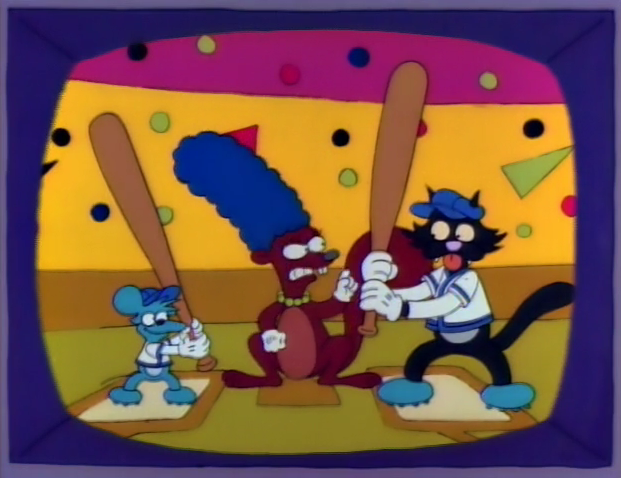
The in-universe target is the grossly violent antics of cartoon cat and mouse Itchy & Scratchy. We’ve seen them a few times previously, but this is the first episode to really highlight them. The idea of a cartoon within a cartoon is interesting enough, let alone the content, like Tom & Jerry but taken to an overly graphic extreme. We get our fair share of I&S clips here, all of them extremely gratuitous in their carnage, but so funny for that very reason, just different bombastic variations for that mouse to brutally murder that poor cat. After a highly impressionable baby Maggie whacks Homer on the head with a mallet, Marge discovers it was television where she witnessed it and emulated the act. Stepping to her soapbox, she starts a campaign against cartoon violence, picketing the animation studio behind I&S. Her efforts build momentum, leading to an appearance on late-night panel discussion show Smartline where she faces against I&S studio head Roger Meyers, Jr. and Dr. Marvin Monroe. She urges the viewers to write in their complaints, leads to a flood of letters at the studio’s doorstep, creating a rift in the cartoon world.

The final act is filled with so much stuff on different topics, but is always true and on-point with the story. It begins with Marge getting a call from Meyers Jr. and the distressed I&S writers who are trying to figure out how to retool their show. I’m sure the Simpsons writers have had to deal with many a corporate executive with no creative experience giving them notes on what to change about the show, so the frustration of the scene feels so organic. In the end, the show is reduced to the most bland, offensively inoffensive material imaginable: a doe-eyed and stoic Itchy & Scratchy sitting on a porch drinking lemonade, with actual voices (like Tom & Jerry were given in later years, to horrifying effect). The kids of Springfield find the cat & mouse’s domesticated activities boring, and must find something else to fill their time (Lisa comments, “Maybe there’s something else to do on this planet.”) Following this, we get an absolutely beautiful montage where the children discover that beyond mind-rotting, violent television is a great big beautiful world to explore, where one can fly kites, play baseball, jump rope, or dance around a maypole. Life sure becomes grand and fulfilling.

None of this is to last, of course. Marge’s fellow censor-happy harpies approach her over banning a planned Springfield tour of Michelangelo’s David, but she considers that particular freedom of expression to be high art. In a follow-up edition of Smartline, Marge muses, “I guess one person can make a difference, but most of the time, they probably shouldn’t.” Perhaps our lives would be better without us being glued to the yammering idiot box, but if we must live with new forms of technology and creative output, we have to learn that the bad and the good, as we perceive them, are of equal value and validity, be it the works of Michelangelo, the symphonies of Beethoven, or The Simpsons. At this concession, the playgrounds are empty once more as an ever-violent Itchy & Scratchy returns to the airwaves, as it should be. This is an episode that tackles so much, but still retains a sense of itself, staying with Marge and her crusade the whole way through as these various big topics happen around her. If this episode has any failing, it’s that it makes Marge a minor antagonist, but her journey is a just one, having only best interests at heart, and all is well in the end… sort of. She is pleased to hear that Michelangelo’s David will be seen by the kids of Springfield on a class field trip, and despite her rabble-rousing, we’re happy for her too.

Tidbits and Quotes
– I could write a whole other article just about Itchy & Scratchy. The opening of the show is perfect, with the xylophone melody, high-pitched theme singers, and the two character’s clueless expressions as they bash each other repeatedly. Could you think of any better way to start a cartoon like that? I also love the effort made to make Itchy & Scratchy look and feel more like a cartoon within the cartoon universe of The Simpsons. With a needle drop-esque score, less detailed backgrounds, and an overall zanier feel, it really does feel more like a “cartoon” than the one you’re already watching.
The Psycho shot-for-shot riff with Homer getting “attacked” is fantastic; remaking such an infamous dramatic scene in a ridiculous fashion like this is such a wonderful parody.
– I love Marge wondering where Maggie got the idea to wield a mallet to her father right as she places the baby directly in front of the television, which then airs an I&S short that opens with the two inexplicably placed in a kitchen whacking each other repeatedly with cooking mallets.
– The cartoon clips seem to get more and more gratuitously violent as the episode goes. We have a short where Scratchy opens his front door only to get a ballistic missile to his face by Itchy, then one that consists of Itchy blowing up Scratchy’s grave with TNT, and finally, a cartoon that is just the two pulling out bigger and bigger handguns until they are larger than the Earth itself, followed by an explosion and Scratchy being shot into the sun screaming. What a treasure trove of hilariously violent cartoons.
– I love Marge’s list of offensive material from I&S, particularly “dogs tricked,” “gophers buried alive,” and one check mark of “brains slammed in car door.” I want to see that episode very much.
– First appearance of Sideshow Mel, and to a lesser extent, another of Krusty’s co-stars Corporal Punishment. I feel we don’t see enough of Krusty’s show, we’ve never seen the Corporeal, or Tina Ballerina, or even much of Mr. Teeny the monkey in action on his show.
– Great line from a self-immobilized Homer on the couch (“You know, some of these stories are pretty good. I never knew mice lived such interesting lives.”)
– Roger Meyers, Jr. on Smartline is so brilliant, with his constant interrupting and undermining of Marge, and his defense of his work with a shocking revelation (“I did a little research and I discovered a startling thing… There was violence in the past, long before cartoons were invented. The Crusades, for instance. Tremendous violence, many people killed, the darned thing went on for thirty years!”)
– Oh my, I LOVE the new Itchy & Scratchy theme (“They love, they share, they share they love they share…”) And the David statue covered up with blue jeans on the Smartline segment.
21. Bart the Daredevil

(originally aired December 6, 1990)
Tonight, we have an episode about hero worship, impressionable youth, and the great lengths a father will go to to teach his son a lesson. We start innocently enough cutting back and forth between Bart at home and Homer at the bar watching a wrestling match. Despite their constant butting of heads, we see they’re not so different, most evidenced by their equally ecstatic reaction to an over-the-top advert for a monster truck rally, featuring the mighty Truckasaurus, a gigantic car-crushing mechanical dinosaur. Their plans to attend encounter a slight speed bump in the form of Lisa’s band recital, but before long, the family arrives at the rally, where they unwittingly drive into the arena and are attacked by the mechanized creature. Seeing the family car trapped within the jaws of a humongous robot dinosaur is quite a way to end an act. I’ve always wanted to know more about the operations of the machine. Why would they pick up the Simpson car? Regardless, the incident is brushed off by the team and the Simpsons are comped for the extensive car damage and given a half bottle of domestic champagne for being such good sports.

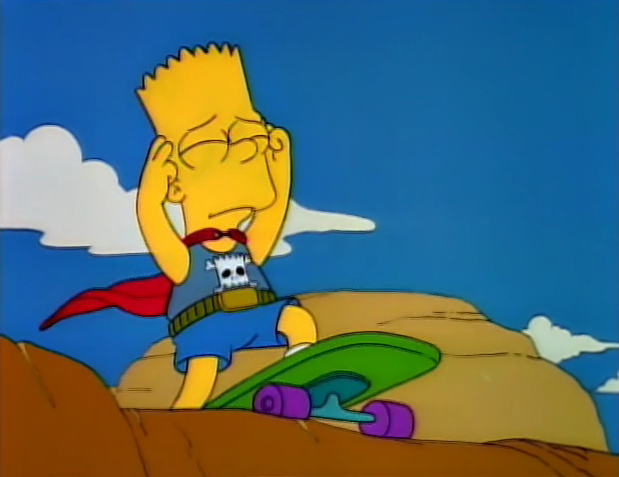
At the rally itself, Bart bears witness to Captain Lance Murdoch, world-class daredevil and Evel Knievel parody, who sets up a death-defying motorcycle stunt involving great white sharks, electric eels, piranha, alligators, a mountain lion, and one drop of human blood to get ’em all riled up. Bart is in complete awe, and despite Murdoch getting horribly injured, he decides to start cheating death himself with his skateboard. All it takes is one attempt to leap over the family car (the non-destroyed one) to knock him unconscious. At the hospital, Dr. Hibbert (first appearance) attempts to educate Bart on the dangers of emulating media stunts (though he opts not to subject him to the horrors of their Three Stooges ward), but Bart is a boy on a mission. He performs one successful jump, then another, and another, but soon feels he needs a greater challenge. He finds one in the form of Springfield Gorge, and announces to his fellow classmates his intentions to jump it.

I feel this review has been more synopsis-heavy than normal… I enjoy the subversion that witnessing people’s horrible accidents and disfigurements only encourages Bart more in his death-defying feats, as well as a visit to a hospitalized Murdoch, who applauds his efforts (“Bones heal, chicks dig scars, and the United States of America has the best doctor-to-daredevil ratio in the world!”) There’s a lot of great jokes in this show, but what I love most about it is at its core, it’s a sweet Homer and Bart episode. We begin with the two sharing a bond in their enthusiasm over the truck rally, and we end with Homer genuinely concerned about his son’s safety. The show manages to have very real sincere moments, which are still funny in Homer’s fumbling at trying to get through to his son. In an effort to get Bart to not go through with his jump, Homer has a heart-to-heart with him, pleading him to promise that he won’t do it (“This isn’t one of those phony-baloney promises I don’t expect you to keep! If you make this promise, you have to keep it.”) Bart promises, but is out the door a minute later. Later, Homer catches Bart at the gorge at the nick of time and can think of no other option than to jump the gorge himself to show his son “how much it hurts when a loved one risks his own life for no good reason.” There’s a real sadistic undertone to this if you think about it, but it’s pure misguided Homer logic. These scenes feature some funny lines (an exhausted Homer muses, “I tried ordering you, I tried punishing you, and God help me, I even tried reasoning with you”), but nothing really jokey. There are a lot of sincere moments in this episode that are allowed to just play out, whereas now, I feel there would be a frantic effort to not let any thirty seconds play out without a jokey joke.

The episode ends with one of the series’s most classic moments in Homer jumping the gorge and almost making it. Strange that we can find so much pleasure out of watching this poor man fall down the gorge (twice), horribly injuring himself, but perhaps it was because of his heightened enthusiasm and joy at his disbelief that he was going to make the jump. One must not get too cocky over their station in life, or they’re due for a fall, I suppose. This is another pure classic episode, full of iconic elements in Truckasaurus and Lance Murdoch, great jokes and commentary, and a truly epic ending.

Tidbits and Quotes
– The truck rally commercial is absolutely perfect, with a great finale (“If you miss this, you’d better be dead or in jail! And if you’re in jail, break out! BE THERE!”)
– The recital is like the calm before the crazy stuff in the meat of the episode, but it has a lot of great bits, like Ned weeping with joy over Todd’s solo, and Homer “consoling” him (“Come on Flanders, he’s not that bad.”) I also love Homer, super antsy to leave, lifting Lisa out of her chair at the end of the last number, and the sweet moment where he leaves, then returns so she can take a bow. The great coda to this opening is when Homer is recklessly driving down the highway humming the 1812 overture, and Lisa quietly, proudly tells her mother, “I reached him.”
– My favorite moment in the whole show is when Murdoch appears in a blast of flame inside the arena and addresses the audience whilst still in flames and two guys blast him with extinguishers and put him out. It’s one of those moments where it’s hard to place why it’s so funny; the action itself, but also he’s small in the frame and the animation is so fluid in that Murdoch is completely nonplussed by his condition. Also, his stunt was basically a success, but it was his showboating going back toward the ramp that did him in.
– We see a slightly more serious Dr. Hibbert here, but he has a great line after his serious lecturing (“As tragic as all this is, it’s a small price to pay for countless hours of top-notch entertainment,”) to which Homer gives an “Amen!”
– The first act break was one of the most ridiculous, but the second has a great bit when Bart tells Otto he’s going to jump the gorge (“You know, Bart, as the only adult here, I feel I should say something.” “What?” “Cool!!”)
– The whole scene of Murdoch in the hospital is wonderful. I love when he’s signing a photo with his teeth and reads aloud what he’s writing through gritted teeth, then in the end we see it’s all one big random scribble.
– Something that struck me… Homer’s airlifted up and put in the ambulance, then it drives off not even five tire rotations and slams right into the tree. The timing is so quick, which I love, but it’s weird how it’s so quick, like how could the front of the vehicle have been completely smashed up if it had literally just gotten into motion?

20. Bart vs. Thanksgiving

(originally aired November 22, 1990)
I was really surprised watching this episode by how leisurely the pace is. These first few seasons feel a bit slower than more recent shows, but this one in particular seemed like it was really taking its time. There’s an absolutely lovely scene where Maggie is sitting alone on the couch with the TV on, and Marge walks through the room into the kitchen, that lasts a good twenty seconds. That might not seem like long, but that’s a lot of time in a twenty-three minute show. Nowadays, episodes run for barely twenty minutes, so they could never save that much time to do something like this now. Anyway, the real “plot” of this episode doesn’t kick in until halfway through, with the first ten minutes being just the family getting ready for Thanksgiving, and it’s fascinating how amazing and funny the show can be. There’s no complex plot or real tension at the start; just the characters interacting and discussing this holiday. There’s a real beauty in that, and also a great sign that once the conflict arrives in the second half that it doesn’t lose its luster.

So yeah, the first act (maybe the longest ever at 10 minutes) is all the Simpsons preparing for Thanksgiving dinner. More accurately, it’s just Marge, as we open with a gorgeous shot of slimy turkey innards being scooped out. Homer is couch-bound watching the parade to start, later football, and then picks up his father from the retirement home (our first real look at the depressing residence). Marge’s focus is on the dinner, and is much chagrined when her sisters bring over food of their own (“Some people find your turkey a little dry, and if they want an option, they’ll have it.”) Lisa is busy preparing an elaborate centerpiece for the dinner table, a highly decorated cornucopia with figurines of trailblazing women. Also amidst this is the arrival of Marge’s incredibly hoarse mother (“I have laryngitis. It hurts to talk. So I’ll just say one thing… You never do anything right”), Bart’s lazy attempt to assist his mother, and the radio and television broadcast of the halftime show featuring those peppy youngsters of “Hooray for Everything.” There’s a lot of small stuff happening, but it all flows and feels like a real family on Thanksgiving Day. It takes a good nine minutes for the “plot” to begin, but I could have watched a lot more of this build-up.

As Lisa brings in her centerpiece, Bart butts in with the turkey. The two fight over center stage, resulting in the centerpiece being flung into the fireplace, which instantly sets aflame. Lisa is devastated, and Bart is sent to his room. Completely appalled at his treatment, Bart escapes through the window and, along with Santa’s Little Helper, hits the town in search of food. Winding up donating plasma for twelve dollars (and a cookie) and passing out, Bart is assisted by two homeless people, who take him to the soup kitchen. Kind of like the Christmas episode, this holiday special injects a bit of sentimentality into the mix, but never sinks into overt sappiness. The two hobos are kind and helpful to this ten-year-old, but aren’t above quickly accepting money from him. We also get the first appearance of Kent Brockman, who is doing a fluff piece at the mission. He’s clearly a seasoned professional, delivering an extremely pandering speech about the grimy, unloved patrons of the soup kitchen (“So every year, on one conscious-salving day, we toss these people a bone. A turkey bone. And that’s supposed to make it all better.”)

Finally able to express her heavy emotions through a poem, Lisa is once again interrupted by Bart as the family sees him on Brockman’s report on TV. While the family is in a panic, Bart realizes how fortunate he is to have those who care for him and decides to return home. He has second thoughts about how they’ll react to his absence however, in another fantastic dream sequence that starts out normally, but turns into a psychotic nightmare. Heavy red lighting shadows over a deformed Simpson family, insanely laughing at a repeatedly apologetic Bart, blaming him for every problem in their lives. It’s a great sequence, with fantastic direction and drawings from David Silverman. Bart opts to climb the roof and chill for a bit, but is taken aback hearing Lisa crying in her room, and calls her up. Here, we get a beautiful sequence between the two siblings, as Lisa somberly seeks answers for Bart’s actions (“Was it because you hate me? Or because you’re bad?”) while Bart remains adamantly defensive for reasons even unbeknownst to him (“I don’t know why I did it! I don’t know why I enjoyed it! And I don’t know why I’ll do it again!”) With Lisa’s urgings, Bart uncovers a nugget of remorse within him and gives a sincere apology, much to the delight of an on-looking Homer (“You know, Marge? We’re great parents!”)

That’s two-for-two with great holiday episodes. We recognize the Simpsons as a real family, one we can both laugh at because of their exaggerated personas, but also feel for because they’re so rooted in reality. We also can relate to crappy Thanksgiving Day balloons, enduring holiday visits from extended family members, and everyone wanting to bite each other’s heads off in lieu of a peaceful holiday meal. We also briefly see the family at a vulnerable standstill as the search for Bart seems futile, they’re genuinely worried about him. In the end, though, as the family sits at the kitchen table at night, dressed in their pajamas, Homer gives his second shot at a prayer before they chow down in turkey sandwiches (“Oh Lord, on this blessed day, we thank Thee for giving our family one more crack at togetherness.”) The Simpsons are an irrefutable family unit; we love to see them squabble, and we love to see them reunited just as much.

Tidbits and Quotes
– Following the great opening with Marge gutting the turkey, Maggie enters the living room, which pans to a silent Homer… then to Bart smothering his sister with a couch cushion over a glue bottle. Homer takes charge (“Stop it, you two! This is Thanksgiving, so glue friendly or I’ll take your glue away and then no one will have any glue to glue with!”)
I love the rapid-fire, but ultimately incoherent commentary on the parade by KBBL’s Bill & Marty (their first appearance?) It captures those types perfectly, always quick to get a witty retort or comment in, but not thinking it through to see if it made any lick of sense before saying it. Also, Homer’s observation (“If they start building a balloon for every flash-in-the-pan cartoon character, you’ll turn the parade into a farce!”) followed by a shot of a Bart Simpson balloon on the TV is a nice reference to the Bart balloon that flew in the Macy’s Thanksgiving Day Parade in 1990.
– I like Maggie crawling up the stairs past all many, many dangerous objects. It’s almost like a throwback to that one Tracy Ullman short where Maggie was off on her own (and put a fork into the electrical socket).
– My favorite line in the whole show, maybe one of my favorites ever, is during that scene with Maggie alone at the TV, the announcer at the football game (“In the Silverdome, now ablaze with flashbulbs, as ‘Hooray for Everything’ leaves the field! Of course, a stadium is much too big for flash pictures to work, but nobody seems to care!”)
I don’t know if Homer’s ever gotten through a mealtime prayer without either gossiping with the Lord or moaning and crying about his station in life.
– Great stuff at Burns’s mansion, with Burns eating barely a slice of turkey and asking Smithers to dispose of the insanely bountiful feast prepared. I also love the winged angel statue in the garden with a security camera where the head should be.
– I loved the line, “Operator! Give me the number for 911!” as a kid, and you know what, I still laughed at it now.

19. Dead Putting Society

(originally aired November 15, 1990)
Homer’s undying disdain for his neighbor Ned Flanders is one of the show’s long-standing hallmarks. Hell, “Shut up, Flanders” is basically one of his catchphrases. The two have a great dynamic; it’s almost playing off of the lovable neighbor character who stops by the core sitcom family’s house, except here, the patriarch can’t stand them. But here in the first episode to examine their relationship do we see what’s really going on. Homer’s antagonism stems from a deep-seeded jealousy. The Flanders are an affluent, caring family to which no wrong seems to befall them. As lazy and uncaring Homer seems in many aspects, he is truly envious of that. He and Ned could actually be good friends (which they would be in one fantastic episode to come), or at least somewhat amiable, but Homer’s sense of pride won’t let him. This episode is a real showcase of Homer’s blind emotions, starting off angry and getting progressively more irrational as the show goes on, and it is ever so hilarious.

We start with Homer being invited to Ned’s house for the first time, where he is blown away with his lavish rumpus room, his doting wife and loving son, and the newly installed beer tap with imported brews. With the small exception of his penchant for alcohol here (though maybe he has it exclusively for his guests), Ned is pretty much the man we know and love him as today: selfless, cheerful, and always willing to help out a neighbor-eeno. All these things slowly eat away at Homer, until he finally explodes in an angry rant. Ned responds in the crossest way he can think of: politely but firmly asking him to leave. Following this, we get the two men talking the spat over with their wives. Homer is unable to articulate how Ned was rude to him (because he wasn’t), while Ned feels awful at “erupting” and calls up Reverend Lovejoy for guidance. We also get a better glimpse at their relationship, with the Lovejoys clearly exasperated by Ned’s constant pestering of him over every little thing (“Probably stepped on a worm…”) But as I mentioned before, Lovejoy isn’t a cynical character, as he manages to give Ned some good Biblical advice, at least how he takes it. And Ned isn’t the insane Bible-thumper caricature he would later lean towards: he’s just an honest man who holds religion very dear to him and his family.

The two families later cross paths at the miniature golf course, where Homer invariably creates a rivalry of skill between Bart and Ned’s youngest son Todd. When the two boys express interest in a mini golf contest, Homer is quick to sign Bart up, hoping he can vicariously best his goody two-shoes neighbor. Bart is a fine golfer in his own right, but not so much when Homer is loudly coaching/berating him in the background. Lisa takes pity on a despondent Bart (“It’s times like these that I’m thankful Dad has little to no interest in almost everything I do”) and helps train him, enhancing his mind with age-old proverbs and examining each of the 18 holes to find the perfect angles to hit the ball (“I can’t believe it. You’ve actually found a practical use for geometry!”) Meanwhile, Homer’s unabashed goading has raised the stakes of the event: a bet is forged, where the father of the loser has to mow the winner’s front lawn in their wife’s Sunday-best dress. I always found this plot point hilarious: it’s introduced toward the end of the second act, followed by a short bit of Homer’s berating Bart at the course causing him to widely miss his shot, then the act ends with Homer mournfully looking at his options in Marge’s closet. This wildly ridiculous addition to the bet that he insisted on has backfired on him within minutes.

Civility wins out in the end as a deadlocked Bart and Todd realize this manufactured competition is stupid and call it a draw at the last hole. However, Homer is still unmoved that the father of the boy who doesn’t win has to suffer the embarrassment, so he and Ned both end up going through with the ridiculous bet. This is Homer at his most psychotic: completely blinded by anything except his petty grudge. Some of the best scenes here are Homer attempting to motivate and encourage (in a loud, obnoxious way) a completely indifferent Bart. This episode sets up the Homer-Flanders dynamic absolutely perfectly, something we’d come to love from the show years to come.

Tidbits and Quotes
– The scene where the Simpson family are laughing over Ned’s note is beautiful. Not only is it one of those few times all the actors are clearly in the same session, but it’s always so great whenever the family can get together and have fun in unison. Even Marge gets in a giggle, albeit out of the rest of the family’s sight.
– I love Sir Putts-a-Lot. I remember wishing that I had a mini-golf course as lavish and fun as this one, but alas, I was stuck with mere rock obstacles and water traps. I also like the bit where a frustrated Homer is jumping about similarly to the giant mechanical ape.
– Homer gives Bart some very gentle words of encouragement (“Son, this is the only time I’m going to say this: it is not okay to lose!”)
– I love Todd happily waving to Bart’s window, his pose mirroring the photo Homer gave Bart to glare at angrily. By itself, it’s funny, but as the finale to a fantastic scene where Homer is giving Bart an angry pep talk, it’s hilarious.
– Always good to see the ol’ card catalog. I’m just old enough to have remembered using it as a kid before they put computers in the libraries.
– I’m all for Bart in his technique for one-hand clapping. And if a tree falls in the woods, it does make a sound. Come at me, fools.
– There’s two great bits where Homer misunderstands Lisa. First, in act one (“I’m studying for the math fair. If I win, I’ll bring home a brand new protractor.” “Too bad we don’t live on a farm.”) And then later as Lisa begins to train Bart, starting with his breakfast (“Oats are what a champion thoroughbred eats before he or she wins the Kentucky Derby.” “Newsflash, Lisa! Bart is not a horse!”)
– The final hole with a stone-faced Abraham Lincoln mechanically swinging his legs back and forth revealing the hole… there are no words. How amazing that is.
– The announcer for the competition is fantastic. I have no idea why he’s taking a kid’s event so seriously, but I’m glad he is. Upon Bart and Todd’s decision for a tie, he fights back tears and reports, “This is the most stirring display of gallantry and sportsmanship since Mountbatten gave India back to the Punjabs.”

18. Dancin’ Homer

(originally aired November 8, 1990)
Perhaps “Dancin’ Homer” suffers from following an episode that tackled so much and felt so epic in scale. Here we have a decidedly smaller, more low-key and leisurely saga featuring Homer’s trials and tribulations at a brand new job, the first of many many MANY occupations he would briefly hold over the next twenty years. There’s something about this story that doesn’t quite ring true with me, though. There are elements that are spot-on, a lot of funny bits, but it doesn’t pack the punch that it feels it does.

We start at Moe’s Tavern, where a despondent Homer spins his tale of woe, a wrap-around that I never thought was too effective. The story begins at the ballpark during the “Nuclear Plant Employees, Spouses, and No More Than Three Children Night.” In a bit of a reprisal from “There’s No Disgrace Like Home,” we get Mr. Burns’s contractually obligation to warm up to the lower, less financially well-off life forms that are his employees. Homer fears that being seated next to his boss will ruin his good time, but shockingly, Burns proves to be good company, buying them beers, heckling players and doing a two-man wave. Even though last episode showed Burns straining to smile and his vow to destroy Homer’s life, we can still believe these characters can get along in some degree. Their banter back and forth is charming, it’s like the oddest of odd couples. Attempting to rouse up the crowd to aid the failing Springfield Isotopes, Homer cavorts and dances about like a fool in the dugout, sparking a rise out of the crowd, including the batter, who hits a home run, winning the game.

Homer is hired by the team to be their official mascot. Dubbed “Dancin’ Homer,” his crowd-pleasing buffoonery carries on the Isotopes winning streak, and he gains greater and greater popularity. Perhaps part of why I’m not so into this episode is I don’t understand the in-universe Dancin’ Homer phenomenon. I get that that’s part of the joke, and the character is partially based off of overenthusiastic fans’ chants and rituals becoming fan favorites and stadium institutions, but really, Homer’s act is not all that rousing. The big finale where the Capital City folks don’t “get” him is not so much a letdown as it was a logical conclusion for me. Sure, I felt bad for Homer, but at least my feelings were vindicated. But I’m skipping ahead here…

It isn’t long until Homer is called into the big leagues: Capitol City. The true savior of the episode is the Capitol City montage. First off, it establishes the Simpsons as small-town rubes in the face of the big city, full of mystery and wonder. Accompanying their drive in is an ode to the city in song, sung by the great Tony Bennett, kind of a riff on “New York, New York.” It’s the first instance of a celebrity playing themselves as Marge points him out singing the song, and he gives a quick aside, “Hey, good to see you!” It’s a sweet little moment, and the song is so brilliant. It really sets the mood, of a city that makes a bum feel like a king, and makes a king feel like some sort of nutty coo-coo super king. Also brilliant is the Capitol City Goofball, the mascot Homer is filling in for, an bizarre, mismatched whatchamacallit mascot design, a weird Muppet-type creature with deely boppers, a baseball torso, a giant horn nose, and a smooth, mellow voice performed by Tom Poston. Part of the fun is the two sitting and talking about their acts very seriously. It’s where I most buy the premise: as preposterous and stupid as this game is, Homer is taking it to heart and trying as hard as he can. However, his best efforts don’t cut it for the Capitol City crowd, and he and the family are sent back from whence they came.

I like the basic premise of chronicling the story like it’s of a pro athlete’s rise and fall, but it’s just of the goofy mascot. We even get a great play off of Pride of the Yankees, wherein Homer considers himself the luckiest mascot on the face of the Earth, is comforted by a Babe Ruth lookalike, and stumbles into the dugout on his way out. There’s plenty of parts that work in it, but all-in-all, it doesn’t resonate with me as a whole story. The wraparound device and Homer’s interruptions about the seriousness of the story feel so out of place. Perhaps if they had stuck with the story playing out on its own, it wouldn’t have had that odd story bit over its head. But with “Capitol City,” Bleeding Gums Murphy’s 26-minute national anthem, and “little baby batter can’t control his bladder,” this episode is still deserving of classic distinction.

Tidbits and Quotes
– A true classic Homer line: “Marge, this ticket doesn’t just give me a seat, it also gives me the right, no, the duty to make a complete ass of myself.”
– Another call-back to “Disgrace” with Smithers giving Burns cards with his employee’s family’s names. Homer seems to have grown a bit more backbone in correcting his boss’s erroneously referring to them as “The Simps.”
– All the bits at the ballpark are really funny: washed out played Flash Baylor’s baseball coming onto Marge (and Homer’s immense pride about it), the Jumbo-tron, and, as mentioned, Bleeding Gums. I like how sweet it is that Lisa remains standing and attentive to her hero’s whole performance.
– Here we get the first real great “Burns talk,” where he speaks of shaming and taunting Satchel Paige and Connie Mack, players who were in the leagues, back in 1990, over eighty-some-odd years ago.
– Marge’s line upon seeing a Dancin’ Homer shirt (“A Simpson on a T-shirt? I never thought I’d see the day.”) is a great remark about the rampant Simpsons merchandising at the time.
– Kind of shocking to see Homer concerned about seeing if he can get time off from work, when in recent years he mostly doesn’t even show up. We get a great quick scene where his supervisor is more than happy to give Homer as much time away from the plant as possible (“Sure, what would you like? Four years? Five years.”)
– Homer and The Goof talking shop is a very lovely scene (“What exactly do you have planned for us?” “Well, I get up, I dance, I spell out the name of the city, all to the tune of ‘Baby Elephant Walk.'” “Ah, Mancini. The mascot’s best friend.”)
– For some reason, I always love Homer’s assertion that the Dancin’ Homer costume is buried. Like he felt so ashamed, he couldn’t even bear disgracing his trash cans with it.