36. Stark Raving Dad

(originally aired September 19, 1991)
The Simpsons
was basically a smash hit right out of the box, and after two seasons, it was a total phenomenon. Fans loved it, critics loved it, people couldn’t get enough. Celebrities like Tony Bennett and Albert Brooks lended their credibility by having guest roles. But none would be bigger than the focus of this episode, Michael Jackson. Now for me, I grew up right during the turning point of his career from international pop superstar to ghost-faced weirdo who sleeps in hyperbaric chambers and dangles infants out windows. In the late 80s/early 90s, as I’m told, Jackson was the biggest star in existence. Ever. His fame could not be topped. As it turned out, he was a big fan of the show and called up the producers, telling them he wanted to give Bart a number-one song. And damn if he didn’t mean it: “Do the Bartman” was a #1 hit single (in the UK and other countries, but still). Anything Jackson was involved in turned to gold, so why wouldn’t The Simpsons say “yes” when he also asked if he could do a voice on the show?

If there’s one thing this show does best, it’s having its cake and eating it too, where they treat their guest stars with respect, but present them in biting, subversive ways. But let’s back up a bit. The festivities begin in typical fashion: a questioning of Homer’s sanity. This is a result of him wearing a pink shirt to work, thanks to Bart throwing his red cap in with the white laundry. He fails a psychological exam (which Bart fills out for him) and he’s hauled off to the nut house. There, he meets Michael Jackson. Sort of. He’s actually a hulking three-hundred-pound mental patient who thinks he’s the pop star. It’s a truly brilliant solution on how to deal with fitting Jackson into the show without making it seem like a 22-minute ass kissing session. You get your laughs with the context of it all, but “Jackson” is also presented as a nice guy, helping Homer through this new and strange situation. Homer is also the only man on the planet who has never heard of the King of Pop, which is a bit of a stretch, but if anyone is going to be that oblivious, I think it’d be Homer.

The emotional through-line in the episode involves Lisa’s urgings to her brother to not forget her birthday, which of course he does. Instead, Bart inadvertently sparks a media circus who expect Michael Jackson to arrive at the Simpson house, who are then infuriated by what they ultimately get. Lisa is devastated, so Jackson offers to help Bart write a song to make it up to her, in a story beat mirroring real life. Their happy birthday song, which Jackson himself wrote, is a very sweet song, and performed quite well by Nancy Cartwright and Jackson (or his sound-alike Kipp Lennon. Either or). The Jackson role becomes even more complicated when he reveals himself to be Leon Kompowski, speaking in a gruffer voice (done by Hank Azaria), explaining how he adopted the Jackson persona because he found it made people happy. Perhaps Michael Jackson in this episode is not so much about himself but about the idea of himself; similar to the real Jackson, he was larger than life, something that fans could adopt for themselves for their own purposes to make them happy, a sentiment that seems even truer now after his passing. While its Jackson content gives it a little age, this is still a wonderful episode. An epic collision of two pop cultural juggernauts? I can’t think of a better way to start a season.

Tidbits and Quotes
– The Krusty hotline is fantastic. It’s not only another example of the clown’s shameless merchandise hawking and half-assery of said products, but an examination of his “comedy.” Sometimes we see shots of the show in the background of just Krusty laughing at a camera. And here we get him laughing over the phone. But hey, the kids love it! “Thanks for calling, kids! A new message every day!”
– Great early line from Homer, aghast at his discolored attire (“Marge, I can’t wear a pink shirt to work. Everybody wears white shirts. I’m not popular enough to be different.”)
– I do like the running theme of non-conformity: wearing a pink shirt gets Homer labeled a wild, free thinking anarchist, while Kompowski decided to adopt his Jackson guise and ended up helping a lot of people.
– The America’s Funniest Home Videos parody is absolutely spot-on, complete with Bob Sagat’s dumb little voice-overs he does over the videos. Also interesting is that one of the finalists is “Baby with a Nailgun,” a situation that would occur a good nine seasons down the road between Homer and Maggie.
– We get our first “inappropriate hold music” joke, where Marge calls the mental institution and has to listen to “Crazy” by Patsy Cline.
– I love the obligatory One Flew Over the Cuckoo’s Nest parodies in the hospital, from the Chief (“It’s about time someone reached out to me!”) to the agoraphobic guy who Homer mocks (“Pfft. Baby.”)
– The “Not Insane” certificate is fantastic. I wish it would have become one of the staple items you’d always see hanging up in the Simpson house, like something Homer would be proud of and display, but I guess not.
– The Michael Jackson media storm is so indisputable, it’s great enough for Apu to close the Kwik-E-Mart (turning his “We never close” sign over to read “Closed for the first time ever.”) We also get Mayor Quimby declaring they’ll be renaming the Dalai Lama Expressway to the Michael Jackson Expressway, implying that the Dalai Lama has visited Springfield. Now that would be a good episode.
– I love Lisa’s angry letter (“Dear Bart, I am using the stationery Mom and Dad gave me for my birthday to inform you that we are now brother and sister in name only. Perhaps if a professional so advises, I will give you a hug at some far-distant family reunion. But rest assured, it will be purely for show.”)
–
At least Homer shows off his cool sanity certificate at the end. After Kompowski’s touching speech about how his Jackson voiced helped himself and others, he asks, “To make a tired point, which one of us is truly crazy.” Homer, holding up the certificate, gleefully responds, “Not me! I got this!” Brilliant.
35. Blood Feud

(originally aired July 11, 1991)
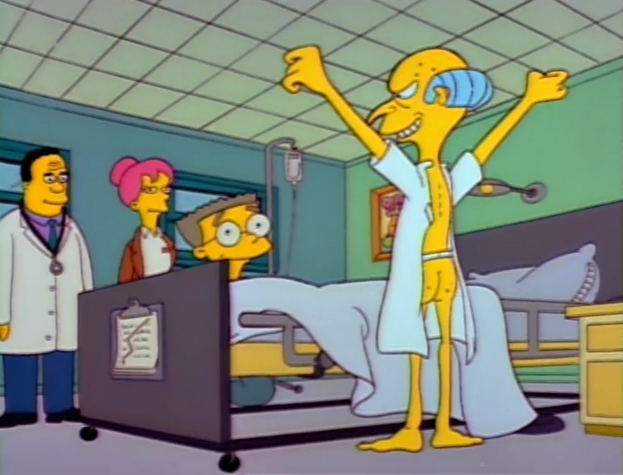
We end this glorious second season with a real treat, a spectacular finale that dances around issues of morality, human nature and goodwill, but ultimately is a story of our bone-headed hero’s impulsive actions and their repercussions. We open to find Mr. Burns in need of a blood transfusion, and Homer is ecstatic to find that Bart shares his boss’s rare blood type. Homer is by no means a heartless monster; in his words, “There’s a human being out there with millions of dollars who needs our help!” He’s more than ready to accept the waves of riches he is sure are coming his way, but instead receives a piddling thank-you card from the old man. Beyond his wholly selfish expectations, you can’t help but feel for Homer, but in an impassioned rage, he sends off a scathing letter to his boss, which despite his reconsidered efforts to retrieve it, ends up in the fuming hands of Burns.

If I’ve learned anything over this season, it’s how much I truly love Mr. Burns as a character. He, like many others, has been cheapened and watered down a bit in later episodes, but he’s in true impassioned form here. A man of raw power and vast, somewhat antiquated vocabulary, whose only hindrance is his withered mortal vessel holding his greedy evil soul. My favorite moment in the whole show occurs when Burns feels better than ever after the blood transfusion, telling Smithers, “I tried every tincture and poultice and tonic and patent medicine there is, and all I really needed was the blood of a young boy.” During that last bit, there’s a cut to a close-up on Burns’s face, a slight push-in and he says it with particular emphasis. It’s a wonderfully bizarre moment; you almost expect it to be a tipping point from the episode, like the second half is going to consist of Burns harvesting young children for their blood like a vampire. But no, that would have to wait another three seasons.

This show skirts around a few issues, on one’s obligation to help one’s fellow man and acts of compensation for one’s actions depending on their magnitude, but ultimately everybody’s actions fall in a mysterious gray area. Smithers calls off Burns’s ruthless tirade against Homer, mollifying him to the point that Burns decides the Simpsons deserve reciprocation after all. And boy do they get it, in the form of a gargantuan ancient Olmec head of Xtapolapocetl (the god of war). Later, the family debate the fact that they would have gotten nothing had Homer not written the angry letter, and Marge’s efforts to dispense a moral to the story are met with disapproval. Homer dismissively puts it, “It’s just a bunch of stuff that happened.” And while there’s a bit more going on here, it’s a brilliant summary of why this episode succeeds: it’s all focused on the character’s expectations and reactions, with some wonderful comedic bits and true-to-character moments, and an absolutely splendid way to close out the season.

Tidbits and Quotes
– We get a great bit at the start with the unveiling of the power plant warning sign, instructing motorists of any possible dangers, each increasingly serious message met with less and less applause from the crowd (“Relax. Everything is fine,” “Minor leak. Roll up window,” “Meltdown. Flee city,” “Core explosion. Repent sins.”) From the peanut gallery, Homer is quite amused (“Joke’s on them. If the core explodes, there won’t be any power to light that sign!”)
– A very sweet moment when Marge says that a mother knows everything about her family, and answers every small question Homer and the kids can throw at her. And now I always remember Bart’s allergies: butterscotch, imitation butterscotch, and glow-in-the-dark monster make-up.
– I love Homer’s over-enthusiasm over Bart’s procedure (“You’ve got a date with a needle!”) as well as his damage-control explaining to him the situation (“It’s not like I’m asking you to give blood for free. That would be crazy!”) Then he regales his son with the story of Hercules and the rich lion, which of course, is a classic moment.
– This episode contains one of my most quoted lines of all time, when a rejuvenated Burns approaches an employee, quipping, “How about that local sports team?” I say that all the time when I run into someone and don’t have anything particularly interesting to talk to them about.
– The first part of this episode is all about build. From the moment Homer hears about Burns’s ailment, he immediately has it in his mind that the donor will be given mounds of diamonds and rubies as reward. By the time he receives an envelope from Burns, he’s absolutely overwhelmed and can barely contain himself. Even sensing the envelope is light, he is still optimistic, all of this makes the let-down (and inevitable “D’oh!”) even more fantastic.
– Homer’s letter is so epic that it bears to be reprinted here in full (“Dear Mr. Burns, I’m so glad you enjoyed my son’s blood. And your card was just great. In case you can’t tell, I’m being sarcastic. You stink! You are a senile, buck-toothed old mummy, with bony girl-arms, and you smell like an elephant’s butt.”) It’s even more dramatic when Burns angrily reads it out loud later.
– Homer’s attempts to retrieve the letter with Bart standing by as the voice of logic is almost like something out of a Yogi Bear and Boo-Boo cartoon. But we do get the classic bit where Homer attempts to get the letter from the post office, using a disguised voice. He knows exactly what Burns sounds like, but uses the most phony, bizarre, and of course hilarious, voice possible, and, the kicker, doesn’t know Burns’s first name.
– I feel I also have a greater appreciation for Smithers during this season; later he would just be the show’s not-so-subtly gay avatar, but here he exists not only as Burns’s long-suffering toady yes man, but as his one and only trustee and voice of reason. The scene where he must begrudgingly hire a hit man to beat up Homer is fantastic, where he’s in a moral qualm about whether he should go through with it. And of course, when he doesn’t, Burns cries “Judas!” complete with a dramatic lightning striking behind them. Phenomenal.
– I’ve always love Burns’s inexplicable Seuss-ian monologue towards the end (“We’ll get the Simpsons a present. An extravagant present. A mad, unthinkable, utterly impossible present! A frabulous, grabulous, zip-zoop-zabulous present!”)
– Lastly, let’s talk about the head. First, how did they ever get it through the front door? Doesn’t matter. It remains a permanent fixture in the Simpsons house for seasons to come, appearing in the basement, and sometimes even the attic. How it got around the house is also a mystery.
– Oh yes! And Burns’s memoirs! The scenes of him writing by stormy night with a quill are perfect, and the immortal title, Will There Ever Be a Rainbow?

Season 2 Final Thoughts
I feel oh so ashamed that whenever I’d cite the classic years, I’d instinctively leave out season 2 and just go for 3 through 8. Season 2 is where the show truly came into its own, fleshing out its characters, the rules, and the entire Simpsons universe. Leaps and bounds were made from the first season; we saw episodes of tremendous scale, plot-wise (“Two Cars”) and emotionally (“The Way We Was”). We got a better sense of the world the Simpsons live in; their neighbors, their friends, their extended family all get their moments to shine, and they’re so entertaining, we heartily await their return. We start picking our favorite characters, favorite moments, favorite episodes, and each moment is so great that’s it’s so very hard to choose. And as shocking as it may sound, it only gets better from here. I can hardly believe it! Season 3 must be some insane, crazy super awesome collection of episodes! Well, I guess we’ll see, now won’t we?

The Best
I’m going to be dreading these season wrap-ups… I’m going to limit myself to five favorites, but goddamn is this gonna be hard…
“Two Cars in Every Garage and Three Eyes on Every Fish,” “Oh Brother, Where Art Thou?,” “Brush With Greatness,” “Three Men and a Comic Book,” “Blood Feud”

The Worst
Again, not the “worst,” just the not-as-good, which in classic years means merely fantastic, but not legendary. This season, three episodes fit that bill.
“Dancin’ Homer,” “Bart’s Dog Gets An F,” “The War of the Simpsons”

34. Three Men and a Comic Book

(originally aired May 9, 1991)
This is one of the first shows that really embraced geek culture. It wasn’t really until the digital age, when crater-faced nerds could find each other and communicate with greater ease, did comic books and the like become more mainstream. This is a show written by a bunch of dweebs, and as such, the show reflects it. We start off with Bart and Lisa attending the local comic convention, where we get a flurry of jokes and set-pieces, from the eerie similarities between Richie Rich and Casper the Friendly Ghost to watching old 50s superhero serials sponsored by cigarette companies. It is there that Bart sets his eyes upon Radioactive Man issue #1 in the hands of the uber-dork that we would come to know and love as Comic Book Guy. Comic Book Guy is probably my favorite character of the entire series, a delightfully accurate portrayal of surly, unimpressed nerds who view themselves on higher pillars than other nerds. He would later mirror Internet geeks, and detractors of the series itself with the immortal catchphrase, “Worst episode ever!” Now, he seems a bit more open, offering Bart the comic for $100 “because you remind me of me.”

After unsuccessfully bugging his father for money and desperately scavenging for mere pennies, Bart is running low on money-making options. He is set up to do chores for the neighborhood old biddy Mrs. Glick, voiced by Cloris Leachman, but his tiresome toils and iodine scars only reward him fifty cents. In the end, Bart discovers that if he pools his money together with fellow chums Milhouse and Martin, they’ll have enough to get the comic. But joint ownership is a devilish mistress. The third act turns into a bizarre psychodrama, with the three holed up in Bart’s treehouse debating over who gets primary ownership. It’s incredibly interesting to watch: all the action takes place in a small area, with these three characters repeatedly butting heads. Bart takes on a particularly paranoid angle, and ultimately his greed and lack of trust in his friends becomes his downfall. He manages to save his friendships, but their prized possession is lost in its place.

This is a fascinating episode: all three acts feel so different, from the very jokey comic convention in the first, Bart’s quest for cash and servitude to the elderly in the second, and the over-the-top thriller drama action in the third, yet it all flows with ease, and of course is thoroughly entertaining throughout. The jokes at the expense of hardcore nerds is biting, but not without acknowledging its appreciation for the material itself. We’ve all known a Mrs. Glick-type in our lives, old ladies with even older candy dishes and unaware of how little two quarters can go nowadays. And we’ve all squabbled with our friends over trivial collector’s items, preferably in a dark treehouse during a thunderstorm. This is an episode that comes out of life experience and pure honesty, and it’s truly one of the greats.

Tidbits and Quotes
– The Richie Rich/Casper comparison really is striking. I think Lisa’s theory on Rich’s death holds a lot of weight (“Perhaps he realized how hollow the pursuit of money really is and took his own life.”)
– Bart’s becoming of Bartman feels like a real kid thing, but I always connect it to the Bartman comics they put out, along with the rest of the Bongo Comics line-up. I also remember the Radioactive Man comics, which are a lot more brilliant looking back on them. They printed them as if they were in period, like #4 would reflect the 50s, and #476 would be the 70s, and the comic style would change based upon the era. There were a lot of parodies that I never got then, like of Watchmen, Batman Year One, and just general comic book stuff.
– The old Radioactive Man clip is absolutely brilliant. Reminds me a lot of the old Flintstones commercial. That and the very effeminate Buddy “Fallout Boy” Hodges, attempting to use his childhood success to springboard his current stage career. We also get a subtle reference to George Reeves’s death (Superman from the original TV series) in Dirk Richter, the actor who played Radioactive Man, having met a similar fate (Bart asks about it in an inquisitive, child-like manner, to which Hodges breaks down, “Dirk Richter was a beautiful man… Can’t you little vultures leave him alone?!”)
– First, I’m surprised they let Homer say “T.S.” I’d never heard anyone say that before, but I can figure out what it means. Next, I love the reversal of “Please, Dad?” “No.” thrown back at Bart by Homer, and him actually winning and rubbing it in (complete with a jovial punch to the arm to his son, which clearly hurts him). And, of course, a great Wonder Years homage in Bart’s internal dialogue, voiced by Daniel Stern.
– The first “Haw haw!” was in the last show, but this is the first time it really works as a joke, as Nelson rides by on his bike, mocking Bart’s pitiful lemonade stand.
– I do love the flashback to Mrs. Glick’s brother from the war, who had a bit too many people to avenge and name out loud after pulling the pin on his grenade.
– Another look at the steamy soap opera. Mrs. Glick’s critique is great (“Filthy. But genuinely arousing.”) [shudder]
– I like the ever logical Martin’s scheduling and tie-breaking decision-making involving ownership of the comic, and Bart parroting every complaint Milhouse makes. To this day, anytime someone asks, “What about [blank]?” I always pile on, “Yeah, what about [blank]?”
– There’s some great acting on Bart as his motions get more quick and wiry the madder he gets. I also love the wrap-around pan of the three of them glaring at each other while eating, as the music swells and the thunder roars outside. The climax is really dramatic and tense, as it should be.
– I also love how the very ending teases a lesson being learned, then drops it completely (“We worked so hard, and now it’s all gone. We ended up with nothing because the three of us can’t share.” “What’s your point?” “Nothing. Just kind of ticks me off.”)
–
Lastly, I love Harry Shearer’s performance as the narrated Radioactive Man. I don’t know why, but I just felt like saying it. He delivers a wonderful outro as the last panel of the now-destroyed comic, currently resting in a bird’s nest (“The world is safe again… but for how long?”)

33. The War of the Simpsons

(originally aired May 2, 1991)
Character traits and compulsions that seem commonplace nowadays seemed to have more gravity back in these early days. In a later episode, Homer getting drunk at a party would work as an amusing flashback, but here, it’s treated much more seriously, as the catalyst to this Marge-Homer marriage trouble episode is Marge’s mortification over Homer getting wasted during their house party. His drunken antics are also varied, going from loud rants to chewing out strangers to lustfully staring down Madame Flanders’s neckline. Particularly jarring is his brief interaction with Bart; it’s an uncomfortable moment where he tries to get his son to “perform” for his buddies. It’s definitely a bit unsettling, but that’s what we need to get at. This is just far too much for Marge, as she puts it, “you didn’t just cross that line, you threw up on it!”

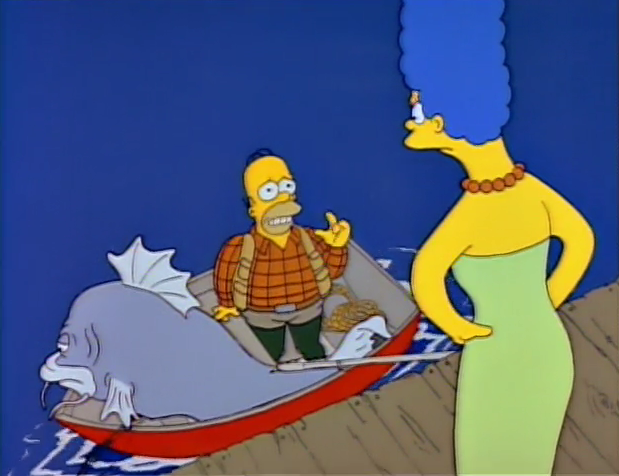
As a result, Homer is stuck having to go to a weekend marriage retreat hosted by Reverend Lovejoy. His attitude then turns when he finds out it’s being held lake-side so he can get in some fishing, and he’s enticed further upon hearing rumors of the famed giant elusive catfish General Sherman that dwells there. Meanwhile, Abe is left in charge of the kids, who quickly proceed to take complete advantage of him, letting them buy gallons and gallons of ice cream, drink coffee and smoke cigars. It’s a B-story I don’t much care for. Lisa does protest a bit and feel some remorse, but it doesn’t make much sense that she would go along with any of Bart’s schemes to this capacity. The ending bit with Abe tricking the kids into straightening up their act is a nice finale, but besides that, it’s mostly filler. Though we do get the first appearance of Snake, and our first “Haw haw!” out of Nelson.

The rest of the episode almost suffers from the fantastic first act; Marge and Homer at the retreat isn’t quite as interesting. By completely ridiculous happenstance, Homer winds up in a boat desperately trying to reel in the General, and when Marge catches him, he angrily tosses it back, showing his true devotion to his wife. It works, I guess, but his gallant gesture doesn’t seem to equal his general assholery at the party. This is another one of those episodes that gets buried amidst more stronger, classic shows, and while sometimes they may be hidden gems, this one’s just alright to me.

Tidbits and Quotes
– Odd that Ned of all people gets the ball rolling on Homer’s inebriation by serving him up drinks. A far cry from two years later when he’s still devastated by a raspberry schnapps he had ten years prior.
– Dr. Hibbert’s very dry manner of speaking is a source of great comedy: first in his commentary about how with all its chemicals, a gag ice cube is much more dangerous than a cube with an actual fly in it, then later upon leaving, he suggests that Marge turn a passed out Homer on his stomach, if she wanted him to live through the night.
– Homer’s recollection of the night before is spectacular, a wonderfully designed sequence with a great New Yorker cartoon-style featuring a dapper Homer as head of an Algonquin group type gathering. The rapid pan across the group morphing into their normal selves is spell-binding, it’s a really great piece of animation.
– One thing this episode has going for it is there’s a lot of great acting in it, from the subtle movements of drunk Homer to the not-so-happy couple during their fight at the retreat. There’s also a smaller bit when Homer is forced to explain his bawdy behavior to his son. Bart just sits there with a flat smile on his face. It’s like he’s humoring his dad, he’s well aware what being drunk means. When his father says he’s hoped he hasn’t lost any respect, Bart responds, “Dad, I have as much respect for you as I ever did or ever will.” Slick.
– I don’t know why, but I love the first couple at the retreat. “Queen of the harpies!” has stuck in my mind for years.
– I like how Homer talks aloud about his foolproof plan to catch and eat General Sherman before the morning, and he barely gets one foot out the door before Marge wakes up and catches him.
– We get a great line from the Reverend, who knows a lost cause when he sees one (“Marge, as a trained marriage counselor, this is the first instance where I’ve ever told one partner that they were 100% right. It’s all his fault. I’m willing to put that on a certificate you can frame.”)

32. Lisa’s Substitute

(originally aired April 25, 1991)
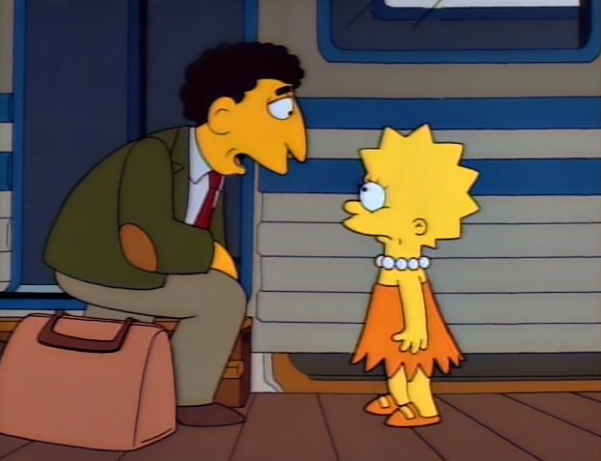
I guess it’s only appropriate we go from last episode that explored Marge’s lost potential amidst a boorish society to this one featuring Lisa in the same boat. Equally, if not more tragic a story than her mother’s, Lisa is an incredibly gifted and thoughtful young girl stuck in a school that undermines her and a family that is hard-pressed to acknowledge her. Plenty of episodes will give her some small amount of recognition or a kindred spirit, only for the cruel rug of life to be pulled out from under her in the end. Here is the first of many said spirits, perhaps the more famous, the soft-spoken intellectual Mr. Bergstrom. Miss Hoover’s absence brings him into Lisa’s life, and she is immediately smitten with this thoughtful, somewhat geeky substitute teacher.

Lisa’s infatuation is more than just a schoolgirl crush. Mr. Bergstrom represents the kind of father she wishes she had, a man who would enrich her, make her think and feel new things, and foster a love of learning. However, fate is a cruel mistress, and Lisa is stuck with a shaven ape who largely pays no mind to her daughter’s existence. It almost seems Lisa realizes this herself, which makes her tearful goodbye to Bergstrom all the more heartbreaking (as Mr. B succinctly puts it, “That’s the problem with being middle-class. Anybody who really cares will abandon you for those who need it more.”) And of course there’s the classic scene where Bergstrom gives Lisa all she needs whenever she feels alone in the world and needs reassurance of herself and the universe: a simple note, “You Are Lisa Simpson.” Just beautiful.

It’s unfortunate that due to the deep, poignant A-story, the goofy B-story of Bart running a mock platform for class president is all but buried from most people’s recollection of this episode. I guess there’s not all that much to examine about it, it’s just got a lot of fun stuff in it, and also lays groundwork for the very ending. Lisa explodes at Homer’s uncaring attitude, leaving him to have to pick up the pieces. He does the best he can with who he is, and in the end, his reconciliation scene works perfectly. Homer may not be the father Lisa truly deserves, but he still loves her and supports her. Plus I don’t think Mr. Bergstrom would hoot like a monkey and make Lisa laugh like Homer does. He’s the goofy dad, leaving Lisa to acknowledge she’s got to appreciate people for who they are, not who she wishes they could be. Following this, Homer calms Bart’s anger over losing the election by rightly speaking to his level, that being class president would mean having to do more work and he would hate it. Between these two and quelling a fussy sleeping Maggie with her pacifier, it’s probably Homer’s finest hour, and a sweet way to end the show.

Tidbits and Quotes
– We don’t see a lot of Miss Hoover on the show, but she’s still a very strong character: a passionless teacher waiting out the clock every day. She also is quite disturbed, as we see with her psychosomatic belief of having Lyme disease. We get a great line as Principal Skinner explains the unsettling details of the disease to the children, much to Miss Hoover’s abject horror (“The brain!? Oh, dear God!”)
– Now I can tell you, if a newly arrived substitute burst into a classroom firing fake guns in the air today, he would be arrested on the spot, no questions asked. Things were different twenty years ago…
– The challenge of naming the discrepancies on Bergstrom’s cowboy get-up is a cute and effective way of introducing his character, and Lisa’s instant connection with him. However, I always think about what Mr. B was thinking, that second graders would be able to figure out stuff about Texas’s annexation and when revolvers were invented. It’s a stretch enough that Lisa is an insanely smart wunderkind. But now I’m just nitpicking. Without it, we wouldn’t get the great line about Bergstrom pushing back against stereotypes about Jewish cowboys, who were actually, according to him, “big guys who were great shots and spent money freely.”
– Oh man… my favorite line of the show isn’t even from the A-story: during Martin’s first speech about creating a science-fiction library when he’s class president, featuring the ABCs of the genre: Asimov, Bester, and Clarke. When Wendell asks, “What about Ray Bradbury?” Martin replies, “I’m aware of his work” in the most dismissive, condescending manner possible, like it’s a pain for him to even acknowledge Bradbury’s name at all.
– I enjoy Mr. Bergstrom’s performance of “Home on the Range” with running commentary about the accuracy of the song. I guess at this point I should praise Dustin Hoffman (aka Sam Etic) for his great, great performance, giving Bergstrom that right mellow, powerful tone he needs, selling him as a truly engaging substitute teacher and someone Lisa could really admire and look up to.
– Lisa is very quick to begrudge her father and brother in front of Bergstrom, almost trying to distance herself from them for him. However, there’s a great moment when the two of them are witnessing one of Bart’s bombastic campaign stunts where Mr. B astutely points out that she’s going to miss Bart’s antics when she grows up and leaves this all behind. It almost sets the stage for the ending, about accepting and loving people for who they are. Reminds me of “Lisa’s Wedding” when she defends her oafish family to her future fiance, attesting she loves them regardless. Oh, and you gotta love Bart’s chant for more asbestos.
– We also get the first time that Homer has an internal argument with his brain, something that would happen much more as time goes on.
– I don’t feel like dissecting the ending much further; it’s one of those really great sequences that really speak for themselves. I will say it’s odd that Homer talks about having never lost anybody in his life, when his mother abandoned him as a child. Seems like something that would stick with a guy…