42. Treehouse of Horror II

(originally aired October 31, 1991)
This second installment of Treehouse of Horror confirmed these specials to be yearly, an outlet for the show to be as absurd, preposterous, and violent as they could not be in the series proper. But even when the segments would be wrapped in parody or a bunch of spooky stuff, it never lost sight of the characters. I feel later Halloween shows would do parodies just because they seemed relevant or could get some recognition laughs, like seeing a Transformer, Harry Potter or the Twilight vampires. But recognition of a pop culture item is not a joke (Family Guy fans might beg to differ). We get no better example than these early Halloween shows, which are filled with references and entire story lifts from old scary stories, Twlight Zone episodes and other sources, but feel entirely original and their own, taking their unique spins on these tales.

Our first segment is a classic example, based upon the age-old spooky story The Monkey’s Paw. Again, the joke isn’t that the Simpsons are in this story, it’s just the story. There’s even a psychic awareness of the story itself within the story, with the mysterious merchant stating right of the bat the paw could cause grave misfortune (upon experiencing it himself, Homer later muses, “I thought he was just trying to be colorful.”) Of course, the family’s wishes backfire in spectacular ways, perhaps the most ingenious being Bart’s wish for the Simpsons to be rich and famous. This leads to an amazing meta commentary where the family’s fame and fortune in-show mirror the real-life merchandising giant the show had become at that time. The citizens of Springfield go from amusement to boredom to just plain irritation. The products shown are also great send-ups, like the classic Bart Simpson T-shirts, and as strange as The Simpsons Sing Calypso seems, it’s every bit as bizarre as The Simpsons Sing the Blues. Lisa’s wish for world peace brings back Kang and Kodos, cementing them as Halloween regulars. We also get the first instance of their endless laugh, perhaps their greatest trait, confirming the comedy rule that extending something for just the right length makes it even funnier.

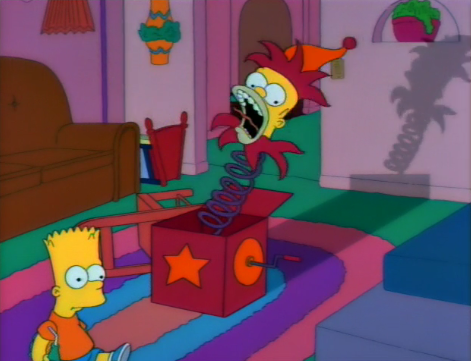
Segment two is an alteration of a Twilight Zone segment “It’s a Good Life,” where a child with psychic powers and the ability to read minds bends a town to his every whim. As Bart was larger than life at this point, it only made sense for him to fill the role. Childhood is painted as cruel and self-serving as Bart terrorizes his family, his school and just about everything else to tend to his desires, from changing national history in accordance to his test answers (making America now ‘Bonerland’) to morphing the family cat into a garish nightmare creature. There’s even a particularly grim sequence showing that Bart has forced his idol Krusty to stay on the air for days straight, pushing him to insane levels of exhaustion (hilarious for us, though, thanks to some great character animation and Dan Castellaneta’s crazed performance). As in the original Twilight Zone segment, Homer is turned into a jack-in-the-box by thinking negative thoughts toward the boy, but here, our wrap-up is more jovial, but still sarcastic as Bart’s hostility toward his father is defused by a super sappy father-son montage, made even more funny by Homer’s altered state. Bart waking up screaming after Homer kisses him goodnight is the icing on the cake, the exact moment his wonderful dream turned into a nightmare.

The third segment may be the weakest, a sort-of riff on Frankenstein where Burns believes he can create the ultimate worker by transferring the undying spirit of the working man into an impenetrable robot. All he needs is a brain, any will do, so of course, Homer is chosen. There’s some great bits of animation in Burns’s lab, with some portions mimicking closely to shots and visuals from the original film. There’s some great Burns-isms of course (though a pull from Wizard of Oz, calling the robot a “clinking, clattering cacophany of colligenous cog and camshifts” feels so very Burns), but I haven’t much to say on this one. I will say that this segment probably has the first genuinely disturbing moments in a Halloween segment, slicing Homer’s head open and Burns violently ripping the brain from his skull. I always felt these specials should be somewhat jarring and disturbing, but not in the way of senseless and gratuitous violence as some later specials (and even regular episodes) would be. Here, it fits the story and the tension of the scene, but of course, it’s played off immediately with Burns plopping the organ on his head, exclaiming, “Look at me! I’m Davy Crockett!” Brilliant example of the show having it both ways.

Tidbits and Quotes
– Marge returns at the opening for another warning about the special’s content, this time expressing exasperation over no one having listened last year, then conceding that no one will probably listen this time too. I wonder if people did complain about the content in the first special… Probably got some letters, I suppose.
– The wrap-around of the stories being bad dreams Lisa, Bart and Homer get after a suger-induced high is fair enough, which all builds to the final bit just fine.
– Brilliant bait and switch with Homer pointing the mysterious vendor out to Marge, only to find he has disappeared… We’ve seen this so many times that we accept that that might be the case, but then Homer points over to the left to show the vendor waving at him happily (“You’ll be sorry!”)
– On top of the, of all things, Midnight Express reference, it’s funny in hindsight to see an American being held up by airport security in the Middle East.
– I love Homer’s annoyance after Lisa wishes for world peace (“Lisa! That was very selfish of you!”) as well as the sequence of tranquility after it, and the human peace sign signaling the alien invasion.
– I guess here we introduced Kang and Kodos as an actual menace (sort of) as opposed to their generous nature in the first special. They’re great out of the box here (“Your superior intellect is no match for our puny weapons!”) Kang’s final monologue is so great and delivered with such seriousness, it’s been stuck in my head for years (“That board with a nail in it may have defeated us. But the humans won’t stop there. They’ll make bigger boards and bigger nails, and soon, they will make a board with a nail so big, it will destroy them all!”) Followed, of course, by extended laughter.
– I’m saddened I can’t come up with anything else for the second segment. I do like the very quick shot of the bus smashed up in front of the school, the bridge between Bart driving the bus and in the classroom. Classic example of telling a lot with a little, and keeping the story going.
– I love the design of the giant robot, which looks a lot like Homer, with wires extending on the sides of his head like Homer’s hair, and a muzzle-like metal mouth. Even without Homer’s brain, you expect him to laze about eating donuts upon activation.
– I’ve always love Burns’ pronunciation of “Bogeyman” as “Boogerman.” Also, a very disturbing moment of Burns viciously bashing a still-alive Homer in the sack with a shovel. Mollified in that he thinks Homer is dead, and the great delivery (“Bad corpse! [hit] Stop [hit] scaring [hit] Smithers!”)
– Upon finding Homer is still alive after reinstalling his brain, Burns tells Smithers he owes him a Coke. In a later installment, The Shining parody, Burns promises Smithers the same if they return to his vacation home to find Homer has massacred his family. Didn’t think that small thing would be a running gag, albeit a small one.
– I do love Burns’s inability to run out of the way of the slooooowwlly falling robot, and his dying breaths of describing his major aches and pains.

41. Like Father, Like Clown

(originally aired October 24, 1991)
Krusty represents the quintessential entertainer: a man who’s got the whole world in his hand in exchange for his morals, ethical qualms, and his humble roots. Behind his stage persona is an angry, bitter man, but going deeper than that, he is filled with guilt and remorse over his botched familial ties. With so much inner emotional turmoil based upon parental scorn, I guess it was only natural that Krusty would be revealed to be Jewish. We begin with the clown (yet again) cancelling a thank-you dinner to Bart for his actions in “Krusty Gets Busted” (I think our first big call-back of the series). When Bart is informed of this, he’s crushed. The boy’s faith in the lecherous clown is astonishing, considering Krusty can’t even remember his name, but there are limits to any rampant fandom, and this is Bart’s, who sends him a scathing letter (“I always suspected that nothing in life mattered. Now I know for sure. Get bent!”)

Krusty does eventually show up, and in an emotional state, regales the Simpson family with his sorted past, how his rabbi father (of course), played by Jackie Mason (of course), disowned him for his clownish ways. After finally getting all this off his chest, Krusty becomes an emotional basket case, thumbing through every photo album in the Simpson house, keeping them up to all hours. He yearns for what he felt he had to give up for his fame and fortune: domestic bliss, which he, of all people, admires the Simpsons for (Lisa puts it best, “A man who envies our family is a man who needs help.”) Beyond his grizzled off-stage presence is really the biggest softie: the man can’t even sit through a father-and-son themed “Itchy & Scratchy” without breaking down to tears on camera.

In a sort of reprisal of “Busted,” Bart and Lisa again set out to sort out Krusty’s personal affairs by tracking down the good rabbi. Rabbi Krustofski ultimately proves receptive not to childish pleas but to enlightened phrases and arguments from scripture. What finally breaks him is a quote about the treatment and perseverance of the Jews by Sammy Davis, Jr., an entertainer, creating the bridge for Krusty and his father, from secular to sacred. An on-air reconciliation seals the deal, and it’s a very sweet moment. Krusty’s Judaism is so ingrained in his character now, but I still laugh every time he makes the reveal that his real name isn’t Krusty, it’s Hersehl Krustofski. I can’t imagine him having any other name; it’s the perfect example of a performer re-adapting his name to distance himself from his humble roots. This is a great character-building show, very sweet and very funny.

Tidbits and Quotes
– Ms. Pennycandy, Krusty’s assistant, is a character we barely see anymore. I do like the idea that this woman would be alternately furious and admiring of the TV hero. Also, for some reason, I really like her performance; in the modern era of this series, it seems like every single woman character is voiced by Tress MacNeille, but Pennycandy is voiced by Pamela Hayden. I also love that Krusty passed over his dinner with Bart for the most insignificant of reasons: to scrub mildew off of his shower, a job he could easily hire someone to do for him.
– We are once again shown Krusty’s cripping illiteracy. I’m just waiting for the episode that they first said, “Fuck it,” and just made Krusty able to read. It worked for the story in “Busted,” but it’s kind of a hassle to keep going.
– I always laugh at the festive knock, horn honk, and Krusty’s laugh as he arrives at the Simpsons; Homer dumbly asks, “You think it’s him?” I also love his shock about Mel Brooks being Jewish. Unrelated, but there’s a similar runner in an Aqua Teen Hunger Force episode where Frylock lists Jewish entertainers for a Hitler balloon (don’t ask) and Shake reads, “Jackie Mason?! Come on!”
– Krusty’s father is introduced in the perfect way, as a wise rabbi full of answers. After answering two meaningful questions, someone asks him if he should by a Chrysler. The rabbi asks if he can ask him in the form of an ethical question, so he asks if it’s right to buy a Chrysler. The good rabbi responds jovially, “Yes! For great is the car with power steering and dyna-flow suspension!” Also great is his discouraging of his young son’s dreams (“Seltzer is for drinking, not for spraying! Pie is for noshing, not for throwing!”) And also great is later on in the flashback, his praising of his son being top in his class, being voted “Most Likely to Hear God.” When the rabbi he’s talking to says he’s exaggerating, he responds, “A rabbi would never exaggerate! A rabbi composes. He creates thoughts. He tells stories that may never have happened. But he does not exaggerate!”
– I guess I should just give straight praise for Jackie Mason’s performance. He’s the only guest star to win an Emmy for his work on the show. After that long string of great quotes, my favorite stuff here is his ramblings on the phone when a forlorn Krusty calls and can’t bring himself to say anything (“Anybody there? What’s this, I hear the phone ring, and suddenly there’s nothing. I’m listening and there’s no talking!”)
– Great stuff with Reverend Lovejoy, his recurring spot on the “Gabbin’ ‘Bout God” radio program, and finding the rabbi’s address in his “non-Christian rolodex.”
– I do love the running bit of Bart popping up into Rabbi Krustofski’s business, be it at a sauna, in the park, and even during a bris (“My friend, I’m still not convinced, and this is hardly the time or place to discuss it!”)
– I always love at the end that Krusty introduces the rabbi to his audience of children as his “estranged father,” followed by joyous cheering.

Also, note, I will be away until this coming Friday, so hang tight, more classic Simpsons goodness coming soon!

40. Homer Defined

(originally aired October 17, 1991)
As dysfunctional a group as they may be, the Simpson family are well aware of who they are and their station in life, and are just fine as is. A later episode would put it best (featuring Shary Bobbins) with the song “Happy Just the Way We Are.” Homer gleefully sings that he’d rather drink a beer than win father of the year because he knows who he is. He’s a lazy, selfish, thick-headed boob, but at least he’s comfortable with it. First season Homer would try to better himself, but the Homer we know and love is feelin’ fine. It’s when one is recognized as someone they’re not is when things turn sour. In this episode, Homer saves the plant from nuclear disaster by pure dumb luck and is acknowledged a hero by his employer and his family, much to his chagrin. I feel a modern-day Homer would soak up this misplaced fame with a pompous and arrogant air, but classic Homer knows he’s a fraud, and would love nothing more than to be exposed and go back to being his drunken slovenly self.

I feel I’ve just glossed over the entire first half of the episode, so let’s back up. We open with some wonderful stuff at the plant with Burns and Smithers small talk, discussing their weekend and Burns’s scathing critique over modern day raunchiness in film (“Just give the great unwashed a pair of oversized breasts and a happy ending, and they’ll oink for more every time!”) There’s a fair deal of quiet time of them talking, the calm before the atomic storm, and I really could have kept listening to Burns rattle on for even longer. The would-be armageddon is filled with great moments, from Burns’s phoned-in damage control to Kent Brockman, the flurry of rats fleeing the plant and Marge’s plea to God that in exchange for sparing the town, she’ll be sure to donate quality canned goods to food drives from now on. But Homer saves the day in spite of himself, and wins a bounty of riches, or more accurately, a plaque, a ham, Burns’s strained thumbs up and a congratulatory call from Magic Johnson. This initially feels like the kind of brief irrelevant cameo that we’d see in later years, but it’s not at all, because it’s funny, and works into the story, as he builds up Homer’s guilt. When Homer poses Johnson a hypothetical about people who succeed by accident, Magic replies, “Don’t worry. Sooner or later, people like that are exposed as the frauds they are.” And he makes a great reappearance at the end. Not a crucial role, but a substantial one nonetheless.

Apart from all this is a nice B-story, featuring Bart’s status quo being shattered as Milhouse informs him that his mom won’t let him play with him anymore, thinking that he’s a bad influence. Of course Mrs. Van Houten’s claims are completely justified, but you feel bad for them anyway. Bart has always been quite bossy and abusive to Milhouse, who takes any and all abuse without question, but all the two really have are each other, fantastically displayed by showing a pathetic, despondent Milhouse hopping up and down on one end of a see saw. He and Bart’s relationship seems one-sided, but they really do need each other. Marge acknowledges this and gets into Mrs. VanHouten’s good graces to dissolve the conflict. It’s a real true-to-life plot that gives us breaks from the averted nuclear holocaust A-story, and has a sweet ending with Bart thanking his mother for helping him. Which is then topped off with him unpacking a BB gun, cocking it ominously, and running off to reunite with his best chum.

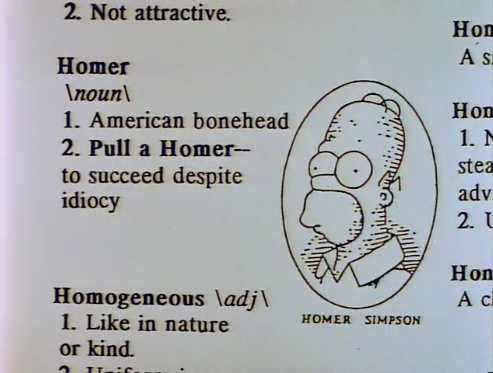
Homer is exposed in the end, of course. He is invited to the power plant in Shelbyville by its owner Aristotle Amadopolis (another great Jon Lovitz voice) to give a motivational speech which is interrupted by a meltdown warning of its own, one that Homer averts once more with his tried-and-true eeney-meeney-miney-moe method. Throughout the show is a running gag depicting a search through the dictionary, finding pictures of Homer by certain words, such as “stupid” and “fraud.” We close with a new terminology being added to the English language, “pulling a Homer,” or to succeed despite idiocy. I’m surprised it’s not really used that often, it works perfectly. At least we got “D’oh” in the dictionary. Anyway, awesome show.

Tidbits and Quotes
– A few episodes back it was Reader’s Digest, this time, the show targets USA Today, another publication filled with easy-to-digest factoids and quips. Homer again defends his reading choices (“This is the only paper in America that’s not afraid to tell the truth, that everything is just fine!”)
– Bart’s birthday card is fantastic; it’s a Krusty product for children, but for no reason other than the clown’s rampant libido, it features a very well-endowed woman in a bikini.
– The build-up to Bart realizing that Milhouse had a birthday party he wasn’t invited to is so great, from Martin’s awed praise of the event (“Jelly bean basket, personalized noisemakers. But the little touches are what made it enduring!”) to Milhouse’s ingenius ability to change the subject to throw Bart off the scent (“Hey! Look at that dog! Isn’t that something!”) which surprisingly works (“Wow, brown!”)
– Great swipe at Gerald Ford with Smithers informing Burns that Homer was hired under “Project Bootstrap.”
– Burns on with Kent Brockman is wonderful right off the bat with the ridiculous file photo of him with a toupee, to his referral to the meltdown as an “unrequested fission surplus.” Also great is Kent’s apology when the crisis is averted (“This reporter promises to be more trusting and less vigilant in the future.”)
– I love the risqué bit after the crisis of the aftermath of an end-of-the-world hook-up (“Will I ever see you again?” “Sure, baby. Next meltdown.”)
– Bart, still depressed about Milhouse, can’t bring himself to laugh at Itchy & Scratchy. Lisa asks, “Too subtle?”
– I do love when Milhouse calls Bart to tell him he can come over, Bart immediately asks, “Did your mom die?” Milhouse answers, “I don’t think so.”

39. Bart the Murderer

(originally aired October 10, 1991)
Well, I was originally going to write about how brilliant this show is able to integrate parodies into its universe, in this case seamlessly borrowing plot elements from Goodfellas, but then I read this story was in development right before the movie came out. So now I can instead praise the genius visionary writers who were able to think quicker than a Scorsese picture. This is a very sharp, clever episode that is both over-the-top and relatively grounded, paying homage to classic mafia films, and of course giving us the great Fat Tony and his associates. Our episode opens with Bart looking forward to a great new day, and then every conceivable thing that could go wrong, does, culminating to him missing out a school trip to the chocolate factory because he forgot his permission slip. It cuts even deeper because of how absurdly fun the trip looks, with kids going wild in the factory, some even swimming in the vats of chocolate, while Bart is stuck licking envelopes for hours for Principal Skinner. Just when things couldn’t get any worse, a skateboard accident lands Bart right into Fat Tony’s clutches.

Fat Tony, voiced by Joe Mantegna, is such a wonderful character, the golden archetype for a mafia boss, confident, in-control, and an expert at playing dumb (“What’s a murder?”) He and his goons take a liking to Bart at their headquarters, the Legitimate Businessman’s Social Club (an absolutely brilliant name, by the way), and they decide to give him a part-time job. There’s some great scenes involving Homer and Marge’s reactions to their son’s new dubious employment, from Homer’s obliviousness to Marge’s concern for Bart, and for the odd pizza van parked outside their house (her questioning blows their sting operation, only to be replaced with a truck ‘Flowers By Irene.’) There’s also Chief Wiggum breathing down Fat Tony’s neck, in the first episode that fleshes out his character a bit; he’s somewhat competent… but also quite dim (“Fat Tony is a cancer on this fair city. He is the cancer, and I am the… um… What cures cancer?”) Upon hearing Bart complain about his problems with Principal Skinner, Fat Tony decides to pay him a little visit. The next day, Skinner is reported missing. Bart is more than a little concerned, all culminating to a wonderful black-and-white macabre dream sequence imagining his principal’s death. Right when Bart confronts his employers, they are all arrested.

The third act turns into a bizarre legal drama as everyone throws the blame onto Bart, making it seem like he’s the junior-sized kingpin. The plot turns again where right before sentencing, a disheveled Skinner arrives, alive and well, prepared to divulge the truth. The incredibly ridiculous and stupid scenario of Skinner trapped under piles of newspapers, and his equally ridiculous, MacGyver-esque escape, is something only this show could pull off, thanks to the great writing and Harry Shearer’s completely genuine and serious read. His testimony gets Bart off the hook, and Bart breaks ties with the mob, realizing that “crime doesn’t pay,” as Fat Tony gets into his cushy limo with two cars trailing behind him. This episode keeps building as it goes, from Bart’s bad day to the mafia, then to a potential murder; at this point, the show has learned that if it’s going to tackle a large story, it’s go big or go home, and they certainly went big. And funny.

Tidbits and Quotes
– Gotta love Bart and Lisa’s cereals: Lisa is eating Jackie-O’s (with free stretch pants inside), and Bart is having Chocolate Frosted Frosty Krusty Flakes (“Only sugar has more sugar!”)
– I like Bart’s genuine surprise that Santa’s Little Helper actually ate his homework (“I didn’t know dogs really did that.”)
– Troy McClure narrates the video at the chocolate factory, and we get out first “you might remember me from…” line; in this case, McClure cites his great work like “The Revenge of Abe Lincoln” and “The Wackiest Covered Wagon in the West.”
– I love the horse race featuring horses named after classic cartoon catchphrases like “Yabba Dabba Doo” and “I Yam What I Yam.” “Don’t Have A Cow” wins, much to Bart’s benefit.
– I’m surprised they were able to get away with Bart not only working for the mafia, but serving alcohol. The cheat was to not show Bart actually mixing any drinks (with the great shot of him making the Manhattan, but he’s so short you only see his spiky hair over the bar), but I still can’t believe they got away with it.
– Homer walks past Bart’s room, which is literally filled floor-to-ceiling with boxes of cigarettes. Homer walks in, “Bart! Have you started smoking?!” He then picks up a box, takes out a pack, and concludes, “Aha! Just as I thought!”
– The press conference regarding the hijacked cigarette truck (and the jittery smokers itching for a fix) is hilarious, with the great press statement by the head of Laramie (“Folks, I’m pleased to announce that a new truckload of Laramie’s, with their smooth good taste of fresh tobacco flavor is already heading towards Springfield. The driver has been instructed to ignore all stop signs and crosswalks.”) The audience cheers wildly.
– Skinner’s reactions to the mob are priceless: when his secretary informs him there are “some large men” here to see him, he retorts, “I don’t have any appointment with any large men.” When Fat Tony and crew enter, he defiantly inquires, “How, may I ask, did you get past the hall monitors?”
– An early Wiggum dumb line: “I can assure you that we’re using the most advanced scientific techniques in the field of… body-finding.”
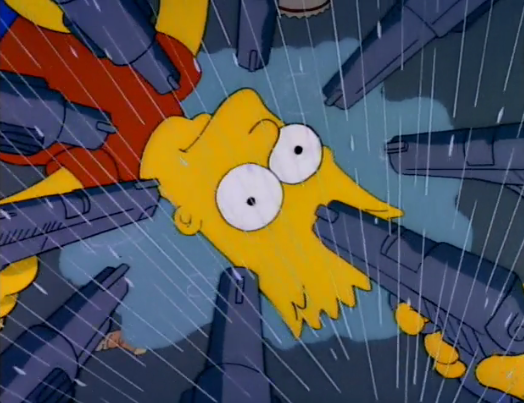
– Bart’s nightmare is such a great sequence, with Lovejoy’s pathetic comforting of Bart (“There, there. There, there”) and Homer’s “Kill My Boy” sign.
– If your episode features a courtroom scene, you know we’ll get some great Lionel Hutz material (“I’ll be defending you on the charge of… Murder One?! Wow! Even if I lose, I’ll be famous!”)
– I do like the very brief commentary by Burns observing news of Bart’s trial (“Thank God we live in a country so hysterical over crime that a ten-year-old child can be tried as an adult!”)
– I love the newspaper the day of the sentencing, “Sentencing Today for Dinky Don,” featuring a caricatured Bart octopus engulfing Springfield in its tentacles.
– I’d reprint Skinner’s laborious explanation of his whereabouts, but it’s too long, and does no justice to print it with no audio. Just watch the episode, it’s well worth it.

38. When Flanders Failed

(originally aired October 3, 1991)
If Homer is meant to be our hero, a character we hope will succeed beyond all odds and obstacles, then why do we accept, even love, his irrational hatred of his friendly neighbor-eeno? There’s a couple ideas about this, but there are two main ones I think explain it best. First, Ned is never, ever bothered by Homer’s back-handed, or overtly antagonizing, comments. Whether he even registers them as insults or not, Ned always leaves frame with a smile on his face. Second, it’s been established that Homer has a deep jealousy toward his cheery neighbor. Ned has a well-paying job, a family that openly loves him, and things always just seem to go his way, which is basically the exact opposite of what Homer has going for him. So in this episode, when things start to go sour for Ned, Homer’s behavior seems a bit more relentless and cruel, almost going too far, until his heel face turn at the end when he saves the day.

We start with an invitation to the Flanders backyard for a barbecue, which promises to have “incredibly Ned-ibles” and “Maude-acious vittles.” Homer adamantly refuses to go, but in the end, his stomach wins over his mind and he scurries next door, grabs a plate of burgers and sits by himself under a tree. So Homer’s pretty rude right from the get-go here. With his guests gathered, Ned announces that this event is in celebration for his new business venture: a new store at the mall that caters to left-handed folks like himself, dubbed “The Leftorium.” Later, upon breaking a wishbone with Ned, Homer gets the larger piece, and wishes that Ned and his store go belly-up.

Homer’s dreams become a reality ever so slowly: every time he checks in with Ned, his situation seems more and more dire, despite Ned’s attempts to put a happy face on things. It’s at the most desperate points for Ned that it becomes the hardest to not see Homer as a complete and total asshole, the worst being at an impromptu yard sale where Homer gets Ned to sell him his entire living room set, furniture and all, for seventy-five bucks. He also finds a handful of left-handed citizens who would be in need of wares catered to their needs, but ultimately says nothing. It takes Ned’s home to be foreclosed and for him to be nearly bankrupt for Homer to finally garner enough sympathy to do something for his neighbor, nearly calling up the entire town to frequent Ned’s store, saving the day. It’s probably the most cloying ending to date; the It’s a Wonderful Life send-up is kind of nice, but the sing-a-long to “Put On A Happy Face” is really a bit much. The producers of the show always used to joke that their old formula was to have 21 minutes of nasty cynicism and then 30 seconds of a sappy happy ending, and it couldn’t be more true here. Homer does save Ned at the end, but the road there felt kind of unpleasant.

Oh yeah, there’s also a B-story about Bart skipping out on karate class, but it’s mostly glossed over, and I really don’t have much to comment about it. Yep.

Tidbits and Quotes
– The Leftorium is really a wild financial venture. Sure, the store itself is a joke (“Left-handed pinking shears!”) but this show has always tried to be somewhat realistic. Even with Springfield appearing to have a larger population of left-handers than usual, and with Burns buying his car with the left-handed gear shift (one of three ever made), I really don’t see how Ned could keep this place in business on a regular basis. That’s kind of why the ending feels a bit empty, since I know a store like this would never survive. Today, this would be perfect as an Internet store, but paying out space at the mall and having all those products on hand seems like way too much for these specialty products.
– I like Homer’s amusement over schoolyard insulting epithets (“You lie like a fly with a booger in its eye!” “The fly was funny, and the booger was the icing on the cake!”)
– I totally forgot Ned was in pharmaceuticals prior to his new business. Probably because this is the only time it’s mentioned ever. This would make a great question for an insanely hard trivia contest.
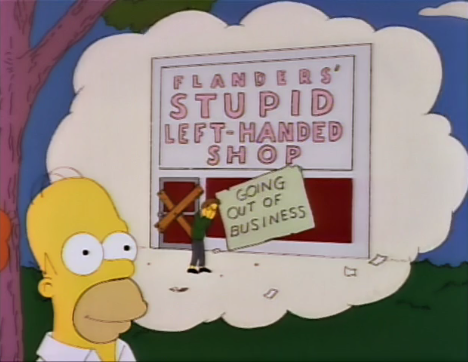
– We get Homer’s threshold of his Flanders hatred early as he imagines what he could wish for, first a poor, penniless Ned, then him next to his failed store, next his gravestone. Even Homer thinks this is going too far, so he back-pedals to just his failed store.
– I guess I’ll talk briefly on the B-story: Bart is enrolled in karate class, but when he quickly sees that it’s not all about learning video game moves like ‘The Touch of Death,’ he skips out to play video games and screw around at the mall. We get a second appearance by Akira, here voiced by Hank Azaria, doing a dead-on George Takei impression. The commercial is funny off the bat; Akira introduces himself and smashes a board with his face, commenting, “That didn’t hurt very much, because I know the ancient art of karate.” Later on the first day, an impatient Bart asks when they’ll be breaking blocks of ice with their heads. Akira replies, “First, you must fill you head with wisdom, then you can hit ice with it.”
– The Itchy & Scratchy cartoon is pretty standard fare: Itchy serves Scratchy a bomb wrapped in spaghetti at a restaurant, Scratchy freaks out and runs out the door, decapitating himself and his body explodes in the street. Only a little funny. Then a dog waiter walks in and trips over Scratchy’s head. Now that’s funny.
– I love the scene with Homer in Burns’s office with the complaint box, which only has two slips of paper inside: one a kiss-ass note from Smithers (“Keep that handsome owner out of sight, he’s distracting the female employees,”) and the other Homer’s. I love the incredibly wide shot of the whole office as Burns reads it (“‘No more apples in the vending machine please.’ Well that’s almost a sentence!”) Then there’s some wonderful acting as Burns patronizes him (“Tell my secretary that you could have a free apple!”)
– I like that the Leftorium will be closed and replaced by Libertarian Party Headquarters.
– As questionable I find the ending, I do enjoy Ned’s final line (“Homer, affordable tract housing made us neighbors, but you made us friends.”)