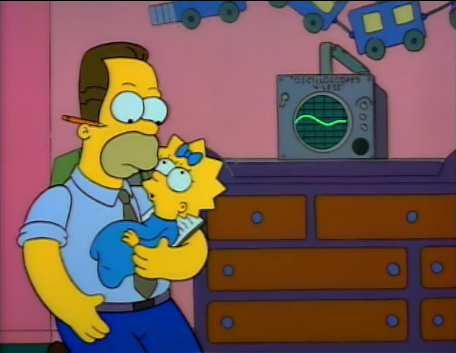
62. Homer the Heretic

(originally aired October 8, 1992)
The writers have talked about a good source for ideas is looking at the Ten Commandments and seeing which one of them Homer can break. They did it previous with the 8th, and here we have the 4th: observing the Sabbath day. The ideals of hard work and altruism of an ideal religious man, say Ned Flanders, are far from the mind of Homer, who would prefer a life of sloth and ignorance. This is a great character study episode, featuring Homer at his unabashed happiest, being a complete slob free of any responsibility, before his seemingly perfect life goes up in smoke (literally). Being the first of the fourth season production run, it also boasts some incredible animation, ranging from some great character acting during Homer’s best day ever, to the amazing sequence of the Simpson house on fire.

One fateful Sunday, Homer decides to skip church… and it ends up being the best decision he’s ever made. Just seeing him home alone, left to his own devices, is funny enough: he takes great joy cursing in the shower, cavorting around in his undies, making the most unhealthy snack imaginable, watching football, and to top it off, finding a lucky penny. In stark contrast, Marge and the kids end up stuck in the unheated icebox that is the First Church of Springfield. The choice is obvious for Homer: he becomes a hedonist. Most of the episode is quite leisurely, but only that the story is very introspective. Marge is very vocal of her concerns of her husband’s soul, but there’s only so much she can do. Same with Lovejoy and Ned Flanders, though the latter does engage in an insane car chase with Homer, in the sole over-the-top crazy scene of the show. While on the path of his new life style, Homer observes other denizens of Springfield’s religions and scoffs at them: Krusty goes door-to-door raising money for the Brotherhood of Jewish Clowns, and Apu points out his statue of Ganesh he keeps at his post (“Please do not offer my God a peanut.”)

All it takes to shake Homer’s beliefs is a mere raging fire that nearly turns his home to a pile of ash. Luckily for him, Ned and a motley crew of volunteer firefighters, Apu and Krusty included, manage to rescue him and his house. As mentioned before, the sequence of Ned saving Homer is gorgeous, from him nearly falling through the floorboards into a fiery inferno, to the animation of he and Homer falling onto the mattress outside and smashing through the bottom window. One of the best things about the episode is the handling of its themes of religion, divine retribution, relations with others beliefs… it doesn’t go anywhere near being preachy or moralistic, but allows the characters, and the audience, to make what they will of the situations that occurred. For Homer, he believes God Himself saved his life, so he owes it to Him to go to church, and next week, he’s there front and center… snoring loudly. But that’s Homer, and this episode is perhaps his greatest characterization.

Tidbits and Quotes
– The first scene is so great, featuring a peaceful prenatal Homer desperately attempting to prolong his stay in his comfy womb, just as a post-natal Homer attempts to stay in his comfy bed.
– I’ve always been tempted to try Homer’s Moon Waffles: caramel, waffle batter, liquid smoke, all wrapped around a stick of butter. Then I realize I’d probably go into cardiac arrest immediately upon eating it.
– I love how Lovejoy’s vivid depictions of the fires of Hell manage to warm up his freezing audience (Bart contently sighs, “I’m there…”)
– Homer calls into Bill & Marty’s radio contest and manages to fumble his answer (but still wins) even though he’s looking right at the record jacket (“This Things I Believe.” “Can we accept that?”) Also, a wonderful Homer observation upon watching the Three Stooges (“Moe is their leader!”)
– “I… found… a penny!!” Such incredible enthusiasm; I always quote it when I find a cent-piece. I also like his thinking back of previous best days ever: marrying Marge and running joyfully under a sprinkling of beer from a ruptured tanker truck.
– Homer’s logic for not going to church is worded poorly, but still contains nuggets of truth (“And what if we picked the wrong religion? Every week, we’re just making God madder and madder!”)
– The showcase of this episode is Homer’s dream of meeting God, who has five fingers, as if He transcends the crude four-fingered animated characters beneath Him. I love His disappointment with Lovejoy, apparently not knowing whether St. Louis has a football team or not, and His parting words to Homer (“Now, if you’ll excuse me, I have to appear in a tortilla in Mexico.”) Also immensely quotable is Homer’s description of the Almighty (“Perfect teeth. Nice smell. A class act, all the way.”)
– Homer tells Lovejoy of his dream of meeting God (“He appeared before me in a dream, and I knew that was special because I usually dream about naked… Marge.”) I also like his attempts to swap Bible verses with the Reverend, which fails immediately.
– The car chase is so ridiculous, but hilarious for that very reason. The ending cracks me up: “Where’s this thing headed?” “Garbage Island.” [ship horn]
– We haven’t seen an Itchy and Scratchy in a while, but this is one of the best ones. I love how nonchalantly Scratchy looks out the window, and how he thinks hiding in the closet will protect him from the moon falling to crush him.
– Classic Homer quote talking to the kids (“Let me tell you about another so-called ‘wicked’ guy. He had long hair and some wild ideas. He didn’t always do what other people thought was right. And that man’s name was… I forget. But the point is… I forget that, too. Marge, you know what I’m talking about. He used to drive that blue car?”)
– I love how Marge’s last plea to Homer to go to church is instantly dismissed by a special on TV on how to make your own ladder.
– The fire spreads to the basement, right to two boxes, conveniently labeled “Oily Rags” and “Blasting Caps.” Maybe should’ve kept them in a safer place.
– I love fire chief Apu racing down the street, only to be stopped by a long line of ducks crossing (“You ducks are really trying my patience! …but you’re so cute.”)
– It’s still funny, but a little horrible that after Ned has just risked his life to save him, Homer has a delightful vision of himself on a hammock laughing while Ned burns alive in his house.
– If I can make one complaint about the show, the run of gags following Homer’s rescue seem to go on a while. Barney chopping the mailbox, the insurance agent, Kent Brockman; they’re funny bits, but I feel that they should have kept it moving to the emotional climax after all that. The only thing that is crucial is the great bit of God seemingly having a hand in instantaneously saving Ned’s house, complete with a nice rainbow.
61. A Streetcar Named Marge

(originally aired October 1, 1992)
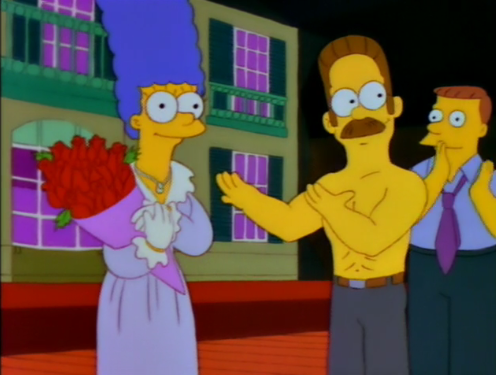
This show is as multi-layered as they come, not just in its story and characters, but in its jokes. I’m referring to how intelligent some of the gags in the series can be, referencing classic literature, old films, anything that the writers think would be funny to some percentage of the audience. I don’t remember when I first saw this episode, but it must have been some time in middle school, and I had never read, or really even heard of, A Streetcar Named Desire. I still enjoyed the episode regardless; the play was funny on its surface. A song bitching about New Orleans, Apu’s solo, Flanders’ passionate “Stella!”, they were all funny instances by themselves. In high school, when we all were assigned to read the play in English class, I knew I had to rewatch this episode, and when I did, it was a completely different experience. The episode reached a new level for me having known the source material, but the jokes and story were so solid it still worked without me. Then even later, learning a bit more about Ayn Rand gave it another layer. It’s the show that keeps on giving.

In a feeble attempt to escape her marital servitude, Marge goes out to audition for a community play, a musical version of A Streetcar Named Desire. Homer is less than responsive, and his boorish, insensitive treatment of his wife is what ends up not only getting her the lead role, but riling her up with the rage needed to play a convincing Blanche. The key here is that Homer is never intentionally mean to anyone. The first act features him and the kids watching TV, where Marge tells them about the play and then leaves, with none of them being any the wiser. This seems to be TV’s function in a lot of these shows, to just drown out other members of the family, usually at the start of an episode. But the telling scene is later in bed when Homer admits he doesn’t care about Marge’s play and he can’t fake an interest like he had in other activities of her past. When Marge asks him why he never told her any of this, he responds, ever-so sincerely, “You know I would never do anything to hurt your feelings” and promptly goes to sleep. Homer is completely oblivious in how his behavior is hurting his wife, and that’s the important thing: he doesn’t realize he’s an asshole. When called out on such a thing, like being a bad father or an overall jerk, he goes into overdrive to fix things. Watching Marge’s play strangely touches Homer, and Marge is equally touched when her husband feebly attempts to explain it to her.

The musical itself… is genius. Firstly, we have Jon Lovitz as the acerbic director Llewellyn Sinclair, which is probably my favorite of his characters (maybe tied with Artie Ziff). He’s loud and demanding, a true nightmarish artiste (his best line is in response to Marge’s weak read for Blanche: “If you set out to push the bile to the tip of my throat, mission accomplished!”) He also voices Sinclair’s sister (who is nearly identical to him), who runs the Ayn Rand Daycare Center (“where A is A”) where Maggie is left at. We get a great subplot involving her attempts to relinquish her fellow toddler’s pacifiers in a Great Escape-esque sequence, culminating in a great Birds reference as Homer tactfully tiptoes through a sea of suckling babies to retrieve Maggie and slowly back out. Again, these references are funny due to their context within a story, not because we recognize them as references. The same goes for the play, which already is a joke; the idea of making an upbeat musical of the dramatic play is funny already. The opening number, riffing off of the opening number of Sweeney Todd, is hilarious, as is Apu’s ballad as the paperboy, and the ridiculous over-theatrical laser light show depicting Blanche losing her mind. But the crown jewel is the finale: “You Can Always Depend on the Kindness of Strangers” is the best song ever written on the show. That’s a bold statement that I may take back (the Planet of the Apes musical may rival it); it’s just so, so, so wrong in terms of what happens in the play, and ultimately the point of the story, but it’s absolutely hilarious turning the depressing ending into a showstopping final production number (randomly ending with “Streetcar!”) There had been songs in the show previously, but this I felt was really the first musical episode, one that prepared us for the bevy of wonderful, memorable songs soon to come.

Tidbits and Quotes
– On TV, Troy McClure hosts the Miss American Girl Pageant, which opens with the contestants singing “At Seventeen” (unironically). Again, only Phil could have hosted this event (“If you ask me, they’re all winners! We’ll be cutting our first 40 contestants right after this.”) There’s also a Mr. Blackwell expy commenting on wardrobe, who amuses Bart (“He’s such a bitch!”)
– Ned is a great addition to the cast; first in his admission that he played Blanche back when he attended an all-boys school (later he comments, “not to be an armchair Blanche” in teaching Marge how to properly break a bottle). Him playing Stanley is a wonderful contrast, and one Ned doesn’t shy away from. I feel Ned in the later seasons would be taking notes on all the offensive material in the play like a media watchdog, but here, he’s a normal guy playing a role. He takes direction, responds, “Rodger dodger!” and proceeds to throw Marge onto the bed… and his heart melts when Maggie takes his glasses. It’s completely in character, and makes Ned more like a real person than the Christian extremist he would later become.
– Lovitz goes big as Llewellyn, and he’s hilarious from his first scene (“While directing ‘Hats off to Chanukah,’ I reduced more than one cast member to tears. Did I expect too much from fourth-graders? The review ‘Play Enjoyed By All’ speaks for itself.”) Also great that his first order is for the potential Stanleys to immediately take off their shirts, and that we see Apu’s various bullet wounds from the back.
– Marge’s reservations about her character gives us a classic, telling line (“I just don’t see why Blanche should shove a broken bottle in Stanley’s face. Couldn’t she just take his abuse with gentle good humor?”) The build-up of Homer’s obnoxiousness in the background, ramming into a vending machine and honking the horn outside, is a great sequence in building Marge’s anger. This is turned humorous later when Marge rehearses at Ned’s, and Homer’s wailing winds her up further: “Let’s rehearse the bottle scene!” as she smashes another one. Ned, already with a bloody mark on his chest, worriedly suggests, “Let’s not and say we did?”
– The family talking in different accents at the dinner table gives us a Homer line I still quote today: “I’m living in a cuckoo clock!”
– Homer’s summary of the play is perfect, poorly worded, but still understanding (“The poor thing gets hauled to the nuthouse when all she needed was for that big slob to show her some respect.”) The ending as Homer realizes he’s similar to Stanley and Marge’s mollifying of him is very sweet.

60. Kamp Krusty

(originally aired September 24, 1992)
So we begin our fourth season with the final episode of the third production run. The writers and producers have talked about how in the early days, they ran themselves ragged making the show, and by the end of a season, they felt incredibly burnt out. How they managed to keep the quality of the show so high despite their tiredness is astounding; “Kamp Krusty” is of the same ilk of “Dog of Death,” where it’s not focused on a solid, emotionally driven story, but how many gags they can cram into twenty-odd minutes, and by God does every single one get laughs. Making this the season premiere is sort of a sign of the show’s entering into goofier territory, which some may not have liked at the time, but I’m all for it. The series is certainly richer and more meaningful due to its realistic characters and ideas, but above all, The Simpsons needs to make me laugh, and some of the best episodes are the most insane ones.

Our September premiere begins on the last day of school, where Bart is, for once, nervous about his impending failing grades, knowing without a C-average, his parents won’t let him go to Kamp Krusty, a summer camp run by his beloved idol. Bart’s nervousness leads to a classic conclusion where Homer lets his son go to the camp anyway regardless of grades (“I didn’t want you hangin’ around all summer anyway,”) making our first act seem all for naught. Anyway, the excitement for camp dissolves immediately when they find Kamp Krusty is truly Hell on Earth: run by the school bullies, the kids sleep in rundown, snake-riddled cabins, live on Krusty Brand Imitation Gruel (9 out of 10 orphans can’t tell the difference), and are forced to stitch fake Gucci wallets for Hong Kong scalpers. It’s a little disconcerting to see the kids in this much despair, but the exaggeration is so high that it remains funny. The best joke in the show depicts the bullies and their boss, Mr. Black, in their luxurious cabin, with celebratory brandy and cigars all around. Black toasts, “Gentlemen, to evil.”

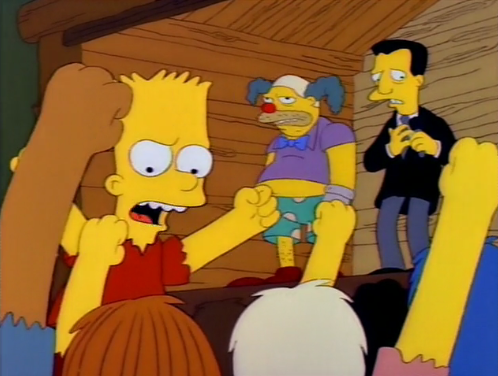
Hovering throughout the show is Bart’s unwavering faith that Krusty will show up and save them, almost like the coming of the Messiah. When Mr. Black tries to pass off a drunken Barney in a cheap costume as the clown himself, that’s the last straw for Bart, and the kids proceed to take over the camp. There’s great side stories running alongside the main plot, featuring Homer and Marge’s love life being better than ever without the kids, and Krusty being obnoxious at Wimbledon, as well as being knighted (even though he’s an American). It’s strange how it still works that Krusty is so horrified by the conditions of the camp, but we’ve seen him approve plenty of clearly malfunctioning and dangerous products with his face on it (regarding the camp, he wails, “They drove a dump truck full of money up to my house! I’m not made of stone!”) Lastly, I will say that these sillier episodes are normally less memorable than ones with more of a emotional punch; I didn’t remember this episode being this funny. But it’s still a classic episode with an enormous bevy of laughs. Welcome, season 4. I’m gonna like you.

Tidbits and Quotes
– Bart’s dream of destroying the school is a classic sequence, with “School’s Out for Summer” playing as Skinner runs about trying to find someone to torch the permanent records.
– Great Homer bits at the breakfast table: his promise to the children (“When you’re 18, you’re out the door!”) and his fatherly advice to Bart (“Son, if you really want something in this life, you have to work for it. Now quiet! They’re about to announce the lottery numbers.”) The first three missed numbers elicits a three “D’oh!”s. He actually gets the fourth number, prompting a “Woo-hoo!” Like it matters at that point he gets one. Last number, no match, and of course, another “D’oh!”
– A bit shocking to say, but Miss Hoover may be less enthusiastic a teacher and sadder a person than Mrs. Krabappel (“I have nothing left to say to any of you, so if nobody minds, let’s just quietly run out the clock.”) I also like that she seems to have given Lisa a B+ in conduct out of sheer spite (“Everyone has a blotch on their permanent record.”) A wigged out Lisa then proceeds to crush her hand for it.
– I love Bart’s attempts to sweeten Mrs. K by telling her all of his textbooks are being returned mint, some in their original wrapping. Edna is not swayed, of course (“Have a D-lightful summer.”)
– Great Kamp Krusty ad, especially with the fat kid turning skinny, and Krusty slapping his cheek. I don’t know if this show invented this gag, the completely shocked and speechless cheek slap, but it does it better than anyone.
– I like even someone as dull as Homer can figure out Bart forged his grades, probably since he probably pulled the same trick with his dad (“You know a D turns into a B so easily. You just got greedy.”) Also his continued good fathering of asking Bart to reach inside the lawnmower blades to recover a roller skate, only to have them fire back up right before his hand is under them.
– Bart and Homer’s mini-war with the pickle at dinner is a great sequence, with a rare moment of pure reverence from Bart to his father (“Always thinking two steps ahead.”)
– I love Homer’s follow-up advice off of Marge’s “Leaves of three, leave them be”: “Leaves of four, eat some more!” Not sure what it means, but I love that Homer amused himself so much with such a stupid expression.
– The Kamp Krusty song is classic, of course, blending its funny lyrics with funny sight gags (particularly the kids running from Mount Avalanche).
– I like this exchange between Bart and Lisa, shivering in their cabins (“I feel like I’m gonna die, Bart.” “We’re all gonna die, Lis.” “I meant soon.” “So did I.”)
– Gotta love the Ben Hur reference where Kearney beats the drums as the kids stitch wallets.
– Barney posing as Krusty is great of course (“I am so Crunchy the Clown!”) as is a panicked Mr. Black yelling at the bullies for not breaking the kids’s spirits (“You broke nothing!”) They worked really hard to abuse these grade schoolers, for reasons that escape me, but dammit, they did their best.
– I want to see more of “Sadrodin Muraradad’s Yoga Party.” That’s it.
– I love Kent Brockman’s opening to his “Krisis at Kamp Krusty” segment (“Ladies and gentleman, I’ve been to Vietnam, Afghanistan, and Iraq, and I can say without hyperbole that this is a million times worse than all of them put together.”)
– We get a glimpse at Krusty’s three identifying body marks: his pacemaker scar, his cattle skull birthmark, and his superfluous third nipple. Of course they’re never seen again when he’s shirtless, except for “Bart the Fink,” where Krusty’s identity needs to be proven once more.

59. Brother, Can You Spare Two Dimes?

(originally aired August 27, 1992)
Herb Powell dug his own grave in “Oh Brother, Where Art Thou?,” but it still felt bad seeing such a great character destroyed like that. The writers apparently thought so too, thus we have a sequel where Herb returns, this time entering the Simpson family’s home turf a disheveled bum. Before we get that far, we have a typical sitcom set-up: discovering our protagonist is sterile, thanks to years of working at the power plant (visualized by seeing his flailing, uncoordinated Homer sperm). Burns’s damage control is to offer Homer a pithy two-thousand dollars in exchange for signing away any right to sue. Homer, for once, isn’t so easy to trick (“I’m not signing anything until I read it, or someone gives me the gist of it.”) Burns explains the form is for him being awarded the First Annual Montgomery Burns Award for Outstanding Achievement in the Field of Excellence, a title he pulls out of his ass on the spot. This snowballs into a giant awards ceremony, an absurd affair with theme music by the Bonita DeWolf and the Nuclear Plant Soft Shoe Society. It’s a ridiculous set piece, but in the most wonderful way possible, complete with Smokin’ Joe Frazier presenting the award (“Webster’s Dictionary defines excellence as ‘the state or condition of being excellent.'”)

News of Homer’s big cash prize brings Herb to Springfield. The Simpson family are thrilled to see him, but Herb still has reservations toward the half-brother that ruined him. The dynamic between the two brothers is an interesting runner through the episode which I felt could have been explored a little more. In its place is Herb’s new big idea to reinstate his fortune: a baby translator that will interpret baby garbling into coherent English. Somehow, he manages to create an astoundingly sophisticated prototype with only two thousand dollars, doing all the programming and engineering all by himself. The man’s an automobile magnate, but I don’t know how much of a genius the man is in regards to a machine this sophisticated. Plus, this is a landmark invention; you’d think that it would be talked about more later in the series, or at least Marge would have one. There’s lots of questions and concerns connected to this idea, but all of them dissolve thanks to Danny DeVito’s hilarious reading on the baby translations (Lisa covers Maggie’s eyes: “Where did you go?” Lisa exclaims, “Peek-a-boo!” “Oh there you are. Very amusing.”)

Also throughout the episode is Homer’s lament after his beloved couch is destroyed. His fond memories of landmark programs he’s watched lends to a great brief montage, ending with Homer switching off footage of the Berlin Wall collapse to watch Gomer Pyle instead. He toys with using the money to buy a lavish vibrating chair, which at its full power setting puts him into a 2001: A Space Odyssey-style stupor with flashing lights and colors. Herb gets the money instead, with Homer further bemoaning the bitter treatment he receives from him. The end of the episode is sweet with Herb giving each family member a personal gift, with Homer’s gift being his forgiveness for the troubles he’s caused… and getting him the vibrating chair. It’s a great moment where Homer is unsure about hugging his brother (“I’ve never really hugged a man before,”) followed by him wildly kissing him after finding out about the chair. Though not quite as solid as the first Herb episode, this is a fine farewell to the character, with plenty of funny bits and memorable moments.

Tidbits and Quotes
– The plant physical is a great way to start, from Lenny’s nonchalant attitude to being stark naked to Homer eating chicken in the tank (which does… what exactly?)
– Smithers is so efficient that even his sperm swim in lock-step alignment.
– Burns’s tirade against his lawyers seems a bit out of character for him, but I still enjoy the sequence, with him continuously having to restrain himself.
– Burns’s greeting when Homer walks in prior to the settlement is great (“Ah, Simpson, you big virile son of a gun!”)
– Bart and Lisa’s swipe against the Emmys seems very bitter, as this was the season the show first lost the Emmy for “Radio Bart” against a Claymation Easter special. Having watched it later, their anger was pretty justified.
– Herb running aside the train to Springfield and the hazardous railcars is a classic Simpsons gag: toxic waste, no, lion cage, no, Krusty Brand sulfuric acid, no, Emil’s Famous Pillows (“That’s the one!”)
– Having Herb stop at the Flanders house and get cleaned up seems to work to soften the blow to the Simpsons that Herb is really in desperate need of help. It’s also a great sequence, with Todd visibly upset that he is not allowed to anoint the sores on this poor soul’s feet.
– Herb’s advice on being homeless to Bart is probably my favorite quote of the show, and one I try to quote whenever I get the chance (“Discarded pizza boxes are an inexpensive source of cheese.”)
– I love Homer’s one-track mind in his obsession over Herb’s drinking bird. He’s in such awe of it, like it’s the greatest thing he’s ever seen. The bird would make a comeback in a big, bad way later on in “King-Size Homer.”
– Homer’s initial reaction to the baby translator is… not so cordial (“I can’t believe we spent $2,000 on this when right now rollers could be kneading my buttocks!”) Herb retorts, “Homer, would you stop thinking about your ass?!” Homer sadly replies, “I’ll try, but I can’t.”
– First, and only (?), appearance of Professor Frink’s child, and mention of his wife, who I assume divorced him after seemingly killing their baby boy in that plane accident.
– All of Herb’s gifts are great, from Lisa’s Greater Books of Western Civilization (“At last, a copy of Ethan Frome to call my own!”), Bart’s NRA membership (when asked if he can get cyanide-tipped bullets, Herb replies, “It’s in the Constitution, son!”), Maggie, who isn’t picky (“I want what the dog’s eating!”) and Marge, a new washer and dryer, with the old ones sold to do races at Moe’s Tavern (“Stupid dryer!”)

Season 3 Final Thoughts
If season 3 suffers in any regard, it’s that I underestimated the greatness of season 2. It’s astounding watching these again just how perfect those early episodes were, and how they hold up so damn well. That being the case, season 3 felt like more of the same greatness. The one thing I can say is that we saw more of the wackier, crazier elements of the series start to emerge here; from “Homer at the Bat” and stuff like Spinal Tap’s bus exploding, the show began to become more exaggerated and silly, drifting a bit from the more serious, realistic tone it had in the first two seasons. It’s a delicate balance the show would end up servicing: going big and brash for its outlandish gags, but still maintaining a true-to-life tone and emotional core with the Simpson family. I have no worries that season 4 will do just that.

The Best
“Lisa’s Pony,” “Saturdays of Thunder,” “Flaming Moe’s,” “I Married Marge,” “Dog of Death”

The Worst
Not one episode fell short. Some were better than others, of course, but none deserve to be mentioned here.

58. Bart’s Friend Falls In Love

(originally aired May 7, 1992)
As much as a rambunctious rapscallion as Bart is, he’s still very much as vulnerable as the next kid. This episode is able to show him at his lowest point without feeling cloying or sappy, mainly because it mines from a pure realistic source with its story. Here, we see a girl getting in between Bart and Milhouse’s friendship, a young romance story that we can all connect to. The title is not only a very early burn on Milhouse, but refers to the main meat of the story involving Bart’s desperate attempts to hold onto his best friend before he “loses” him, and his eventual extreme measures to getting him back. The girl in question is Samantha Stanky, a timid transfer student with a shy voice and braces. She doesn’t have too much of a personality, but it fits the story, and also how ten-year-old romances aren’t really too deep to begin with. The material she is given is great though, and is still infinitely better than the parade of girlfriends voiced by celebrities Bart would get once a season down the road. Here, Stanky is voiced by Kimmy Robertson, whose biggest credit is being the receptionist on Twin Peaks, and she does a great job in her role here.

Before this prepubescent drama begins, we have a fantastic opening parodying Raiders of the Lost Ark as Bart nabs Homer’s penny jar just as Indy stole the idol. The reference works, and is funny here, as Homer proceeds to take a dual role as the ball rolling after Bart down the stairs and the angry natives as he runs out onto the lawn in his undies (a hilarious, grotesque sight) and screams after his son in gibberish. The cultural reference is given context and meaning within the show’s universe, and is elevated, and thus, is very funny. Later in class, we meet Samantha, and Milhouse is taken with her almost immediately. The two’s affection grows further after watching an educational video, perhaps the best ever shown in the entire series, “Fuzzy Bunny’s Guide to You-Know-What.” Hosted by Troy McClure (of course), it’s a child’s guide to abstinence and true romance and marriage, with an apparently grotesque sex scene (complete with porno music) spliced in. The shot of kids watching this in a darkened classroom, audibly disgusted, with their teacher standing in the back, smoking, commenting, “She’s faking it” is alternately hilarious and disturbing.

As shown in “Homer Defined,” Bart and Milhouse have a co-dependent friendship, since they really only have each other as friends. But this episode is kind of a window to a future that shows that eventually, they will part ways, perhaps due to one falling in love, and Bart is visibly hurt by it. He ends up breaking the two up by exposing the torrid romance to Samantha’s prudish father, who enrolls her in an all-girls school run by Canadian nuns. Bart and Milhouse eventually make up, but not before a brief intense scuffle when Bart reveals the truth. The fight ends when Bart whacks Milhouse in the noggin with a magic 8-ball, which breaks, which is kind of cool since it’s what predicted the dooming of their friendship at the beginning of the episode. This episode has classic film reference bookends as we close Casablanca-style with Bart claiming this is the start of a beautiful friendship. Well, not quite, but it’s basically like that.

Tidbits and Quotes
– Great sequence of Skinner looking over Samantha’s records, only to go in and out of grim Vietnam war recollections, complete with excellent lighting through the blinds and Skinner gripping tightly against his chair arms.
– Samantha’s introduction to the class is really sweet, tinged with nervousness and a general lack of confidence that a kid would have in that situation. Excellent explanation of her move to Springfield: her father owns a home security company, and moved to the town because of its high crime rate and lackluster police force.
– No one but Phil Hartman could have voiced the educational film. The emphasis he gives on certain parts, like “they never ruined their fun by giving into their throbbing biological urges” is just hysterical. Also the line, “Nine months later, Fluffy gave birth to fourteen beautiful bunnies. Eight survived.” Additionally great is the randomness of Fuzzy Bunny being Jewish, crushing a glass at his wedding (with no shoes, I might add. That had to have been painful.)
– A small moment I like is where Bart asks about creating a half-man half-monkey creature. Mrs. K claims would be playing God, which is retorted with the well-delivered line, “God schmod! I want my monkey-man!”
– The B-story involves Lisa’s attempts to have her father lose weight with subliminal message tapes played for him at night, but the company accidentally sends vocabulary building tapes instead. Similar to the swear jar plot in “Bart the Lover,” it’s its own little story divorced from the A-plot that has a lot of great moments, starting with Kent Brockman’s report on obesity (“Did you know that 34 million American adults are obese? Putting together that excess blubber would fill the Grand Canyon two fifths of the way up. That may not sound impressive, but keep in mind it is a very big canyon.”) Lisa imagines her father’s funeral, dead at over 400 pounds and having to be lifted down into his grave in a piano crate. Hearing Homer speak exclusively in college-level vocab is pretty funny, ending with him throwing out the tapes “A pox on thee!”
I like Bart’s answer when Mr. Stanky on the phone asks for his identity (“Let’s just say I’m a concerned prude with a lot of time on his hands.”)
– Of course, the best line of the show comes from a broken Milhouse (“How could this happen? We started out like Romeo and Juliet, but ended up in tragedy.”)