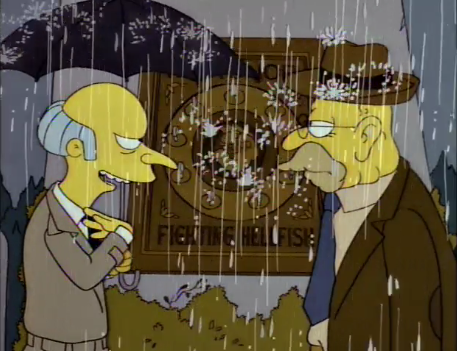
150. Raging Abe Simpson and his Grumbling Grandson in “The Curse of the Flying Hellfish”

(originally aired April 28, 1996)
Grampa is one of the show’s more interesting characters. His senile outbursts are his main gimmick, which, like with much of the cast, would usurp his entire character in later years, but his life story is very rich, with fascinating tidbits that may or may not be completely true. He’s a man very much the product of his era: an agile young man sent off to war, who then came back home to settle down with a family. We’ve seen a younger Abe before, full of vigor in his constant berating and denigrating of his only son. Here we see him at full physical form, leading a rough-tough battalion in the Ardennes during the war. We gain a newfound respect for him, as does Bart, who at first is embarrassed by his grandfather’s constant outbursts, but then starts to believe his war stories aren’t complete nonsense. This is a pretty crazy ambitious episode, and some of the stuff is maybe too fantastical for the normally grounded series, but it’s incredibly entertaining and one of my favorites.

We start by re-establishing that everyone thinks Grampa is a delusional old coot, especially Bart. But he soon learns of his grandfather’s wartime past, of how he entered a pact with his fellow soldiers in the Hellfish battalion regarding a treasure trove of paintings stolen by the Nazis. The last surviving member will gain access to these priceless items, and the only two left are Abe and Mr. Burns. Burns, being the greedy old miser that he is, wants to speed up the process, hiring an assassin to try to kill Abe. The attempted murders are pretty damn absurd, but they kind of keep the episode balanced from getting too dark. The flashbacks during Grampa’s story are fantastic. We get to see Abe at his most active and courageous, and that even back then, Burns was just as selfish and with as great a sense of entitlement as ever. We also see that familiar ancestors like Wiggum and Barney’s fathers were part of the platoon, which is a bit silly, but it makes sense given that Springfield is the typical American town that most townsfolk would have enlisted. We’ve seen Abe’s wartime experiences in a few flashbacks, mostly as gags (him posing as a cabaret singer comes to mind), but it’s great to see it here played in a serious light. A particularly nice moment is the air of respect he gives when he addresses the gravestones of his men, which feels so genuine, even if it is capped off with a joke (“I want you to know that when I die, you’re all welcome to visit me in rich men’s heaven.”)

Bart manages to swipe Burns’s Hellfish key, and together with Grampa’s, trigger the Hellfish grave marker to shine a light on the location of the treasure… out at sea. They manage to retrieve the sunken crate, but are ambushed by Burns, who buys time escaping by kicking Bart into the empty crate to sink to a watery grave. Now, this is hands down the most evil, unforgivable thing Burns has ever done, and it would seem to be going too far, but for some reason it doesn’t feel that way. You’re wrapped up in the story, and we get to see Grampa be heroic in saving his grandson, and then regaining his past physical feisty nature in getting onto Burns’s boat and taking him down. It’s a proud moment for him, and we’re glad to see it. The resolution is pitch perfect, with the U.S. government arriving to retrieve the paintings, and to avoid unwanted tension overseas, they return the items to their closest living inheritor: some snooty Eurotrash douchebag (hilariously performed by Hank Azaria). It’s a real adventurous episode overall. Later seasons would be known for having big action sequences and ramping up some crazier elements, which are present in this episode, but the difference is this one earned its finale. The plot is very interesting and works with our characters, and we even get a nice bonding moment between Bart and Grampa at the very end, which is then wonderfully undercut by the best line in the show: “Hey, fun boys! Get a room!”

Tidbits and Quotes
– We get a look at some of the other kids’s grandparents: Grandpa Van Houten has an RV and a new wife, and Grandpa Muntz, a judge, is proud to announce he’s just sentenced his forty-seventh man to death, a factoid Nelson is quite proud of.
– I love everything about Grampa addressing Bart’s class. Where the other men just stood in front of the blackboard, Abe makes himself comfortable, demanding attention as he takes a load off, putting his legs up on the desk as he tells his rambling story (“My story begins in nineteen-dickety-two. We had to say “dickety” ’cause that Kaiser had stolen our word “twenty”. I chased that rascal to get it back, but gave up after dickety-six miles…”) Martin scoffs, “‘Dickety’? Highly dubious!” Abe quickly retorts (“What’re you cackling at, fatty? Too much pie, that’s your problem!”)
– Abe’s mail gives us some good gags (“Consider burial… at Sea World!”) He’s none too thrilled (“This junk was hardly worth getting up for. Maybe if I go back to sleep for a few days, some good mail will build up.”)
–
I love the atmosphere at the funeral in the rain. The music is very foreboding as Burns and Abe, the only two in attendance, give each other knowing stares while holding their respective keys. Reverend Lovejoy gives a lifeless eulogy of Asa Phelps’s life in the background, which is pretty funny if you actually listen to it (“Asa Phelps spent his entire life in Springfield, except for four years of service in World War II and one high school day-trip. He worked at the United Strut and Bracing Works as a molder’s boy, until he was replaced by a Molder-Matic, and died.”)
– The Hellfish symbol and the grave marker are fabulous designs. They really give the episode a historical, mysterious feel to it.
– Nice swipe at Marion Barry as Burns calls the assassin, identifying himself as M.B., to which the assassin asks “Barry” if it’s time for another shipment. Barry was mayor of the District of Columbia, infamous for falling victim to a sting operation in 1990 where he did coke. And then afterwards was re-elected. Funny world we live in.
– I like how the assassin’s plans just get worse and worse, from the Simpson family disguises (I love Smithers’s Bart disguise. Like, why would they think this would work? “I’ll be in the car, dudes”) and then later of him just going for broke and shooting up the retirement home. Unfortunately for him, the nurses are packing heat themselves (“Our residents [shot] are trying [shot] to nap!! [shot]”)
– A small moment I love when Grampa is on the Simpson couch recalling the assassination attempts. Thinking her grandfather is out of it, Lisa suggests she moisten the washcloth on his forehead. Grampa shoots up, irate (“It’s plenty moist!”) I love that line.
– I love the explanation of why Burns was just a private. Abe explains that he was busted for obstructing a probe from J. Edgar Hoover, and they got stuck with him in the battalion.
– A very exciting moment when Abe saves Burns from a grenade blast quickly gets turned into a wild dirty joke (“They took a photo of my keister for Stars and Stripes! …at least they told me it was for Stars and Stripes.”) So, yeah, some dirty men’s erotic magazine used a photo of Abe’s ass. Or something to that effect.
– Ox, the stereotypical dim tough guy, is great for when we see him, the only man who can explain what a tontine is in unusually eloquent terms. Abe also explains he was the first to die, getting a hernia carrying the crate of paintings out of the castle.
– I like Bart’s urgings to go with Burns to get the treasure (“I won’t eat much and I don’t know the difference between right and wrong!”) and Burns’s response (“Oh, you’re a good boy, but the child labor people have been watching me like a hawk.”) This was all an elaborate ruse of course so Bart could get the keys.
– Nice back-and-forth to start the final act as Bart and Grampa walk through the cemetery (“Hey, Grampa, do you think that dead bodies get up and walk around at night?” “If they’re anything like me, they have to get up twice.”)
– Bart needs to dive down into the water to retrieve the crate. Grampa sets up a signal system: tug the rope sixty-three times if he’s out of air, and sixty-four if he’s found the treasure. Why so many times? So dumb, but so great. Dan Castellaneta gives a great performance when the rope tugs sixty-three times and Abe bemoans his grandson’s death, but when the rope tugs one more time, he becomes joyful without skipping a beat.
– As over-the-top as it is, I do love the climax. It’s a real exciting and satisfying conclusion with these two old men returning to their past selves: heroic Abe and underhanded Burns.


149. Twenty-Two Short Films About Springfield

(originally aired April 14, 1996)
I can’t think of a better way to start things off than how Bart did in this episode, wondering whether anything of interest ever happens to the citizens of Springfield. By this point, the series had amassed a large collection of characters all just begging to be explored further. In this episode, we get just that, an array of short subjects focusing on a large number of some of our favorite secondary (and tertiary) characters. It’s a very inventive concept, and makes this a really special show, feeling unlike any we’ve seen before. While part of me wishes episodes like this had become a reoccurring thing, having this be a one-off makes it feel very unique. But the idea of the show is something I’d hoped had been delved into more. We get to spend more time with all of these previously established characters and witness their everyday lives, and it’s fantastic. Like “A Fish Called Selma” was centered on two secondary characters, this had the potential to open the floodgates on stories about the rest of the cast. A few characters would get moments in the limelight in future seasons, but not as many as I would have hoped.

This episode is just so odd… some characters even have their own theme music and title cards, like this is a snippet of another series. Apu stars in “The Jolly Bengali” where he takes full advantage of a four minute break from work, Cletus attempts to do a kindness to his dearly beloved Brandine, and that wacky Principal Skinner gets himself in hot water as he attempts to schmooze Superintendent Chalmers with an unforgettable luncheon. “Skinner & the Superintendent” is an all-timer Simpsons segment; the repartee between Hank Azaria and Harry Shearer is so goddamn funny. A lot of these snippets consist of character behavior we’ve seen before, but it feels fresh to see it extended and on its own, and completely divorced from any Simpson-related matters. Others have a totally different feel: Dr. Nick’s potential disbarment until he “saves” Abe felt really entertaining, I’d totally watch a Dr. Nick show. Then we have the Pulp Fiction segments involving Chief Wiggum, Snake and the severely twisted Herman. It treads the line between parody and just plain reference, but it takes the material and pushes it just enough to be memorable on its own (“Do they have Krusty partially gelatinated non-dairy gum-based beverages?” “Mm-hm. They call ’em, ‘shakes.’ “Huh, shakes. You don’t know what you’re gettin’.”)

Besides the wraparound with Bart and Milhouse, one plot line runs through the episode involving getting gum out of Lisa’s hair, which eventually results in a whole slew of random characters showing up one after another, even as obscure as Corporal Punishment and the Capitol City Goofball. At the end of the second act, it’s like they had to cram in all the characters they couldn’t write stories for, or ran out of time, and also sort of capsulized the episode’s mission to showcase as many characters as possible. Matt Groening has talked about various spin-offs the show was rumored to have, one being inspired by this episode, to have a full series focusing on the other citizens of Springfield. But why can’t they do it in the show proper? This episode makes me want to see more of Moe or Wiggum or Cletus or even Bumblebee Man. Why not write episodes around them? A Simpson can pop their head in a few times but if you’ve created this elaborate world and great cast, why not take full advantage of it? I love this episode, but I feel it left so many doors open that not many people took the time to walk through.

Tidbits and Quotes
– I guess this section will just go by segment: first, Apu’s. We get the classic line, “I’m going to party like it’s on sale for 19.99!” and his rushing to party hearty is really great, well timed, great animation, and excellent hurried performance by Azaria. Also Apu can seemingly make love to a woman in two seconds. Not sure how much of a good thing that is though (“Don’t worry, I’ll tell everybody you were untouchable!”)
– The animation on the swarm of bees flocking to Lisa’s condiment-covered head is pretty great.
– Burns motivating a deathly-ill Smithers is a potpourri of old-timey Burns-isms (“Stick your left hoof on that flange, now! Now, if you can get it through your bug-addled brain, jam that second mephitic clodhopper of yours on the right doodad! Now pump those scrawny chicken legs, you stuporous funker!”) The finale is great too when the hospital attendants takes a collapsed Burns inside instead of Smithers.
– That leads us to Dr. Nick, who finds the passed out Smithers and tosses change at him (“Holy smokes! You need booze!”) We learn more of his horrendous medical gaffs, such as operating with a fast food knife and fork and using cadavers to utilize the car pool lane.
– The Moe’s bit is great, with Moe enlisting NASA to properly calculate Barney’s bar tab, and Moe saving himself from armed robber Snake behind a trap compartment protected by bullet proof glass… allowing Snake to rob him freely (“Goodbye, student loan payments!”)
– Can’t say enough good things about the Skinner/Chalmers section, with Skinner desperately attempting to smooth over his increasingly disastrous lunch date with Chalmers with “steamed hams” straight from Krusty Burger. The best part is when Chalmers reacts in shock at catching a glimpse of Skinner’s kitchen on fire. He asks what the hell it is, to which Skinner, without skipping a beat, responds, “Aurora Borealis.” Quick on his feet. Chalmers is incensed (“Aurora Borealis? At this time of year? A this time of day? In this part of the country? Localized entirely within your kitchen?”) Skinner says yes. Chalmers asks to see it. Skinner says no. Brilliant.
– Even in an episode all about secondary characters, Homer gets a little time to shine in a well-done segment trying to get Maggie out of a newspaper kiosk. Great bits involve his apparent ability to write legibly using Cheese-Whiz and the newspaper headline “Deadbeat Dad Beat Dead.” The ending with him playing peek-a-boo with Maggie, having ripped the newspaper dispenser out of the sidewalk and brought it home, is really cute too.
– The Bumblebee Man bit is great, with the absurd Spanish dialogue, and how this poor guy’s personal life is just as disastrous as his TV persona’s.
– I like how Flanders suggests to freeze the ice in Lisa’s hair, then whack it with a hammer, but then he ultimately observers that that may have just mash more hair into it. Then we get the flurry of random guest appearances.
– The Cletus segment is brilliant. Best part? “Hey, what’s going on on this side?”
– One minor beef: Milhouse is seen within the episode, but is also at the very beginning and the end with Bart. So did Kirk and Luann pick him up, and then drop him back off with Bart at the overpass? Doesn’t seem right to me. But who cares? If logic had been put into consideration, we wouldn’t have seen Kirk’s awkward predicament standing next to two hogtied men, one being a cop, or Comic Book Guy’s seventy-five cent offer to Milhouse of a Hamburgler comic book (the jumble inside has already been completed: the answer is fries.)
– Okay, they saved the best for last: Nelson meets his match. He laughs at Lisa, he laughs at Mrs. Glick, and he laughs at an extremely tall man cramped into a small VW Beetle. That last bit… big mistake. The man finds him and confronts Nelson… in the voice of Cecil Turtle from the old Looney Tunes cartoons. Very Tall Man is my favorite tertiary character. I love the voice, the design, and his manner of speaking (“Everyone needs to drive a vehicle, even the very tall. This was the largest auto that I could afford. Am I therefore to be made the subject of fun?”) I don’t know why, I just have a humungous grin every time I watch this last part. I was very surprised watching the season 9 DVD for “The City of New York vs. Homer Simpson” that he has a second minor appearance, that I never saw as it was a syndication cut. He didn’t speak though. I couldn’t help but be slightly disappointed. I love you, Very Tall Man.

148. Bart on the Road

(originally aired March 31, 1996)
It’s amazing how much story some of these episodes can fit in twenty minutes. The emotional core of “A Fish Called Selma” could span an entire film, while the plot of “Bart on the Road” could easily fill an hour and a half. Even so, the compact running time makes every scene feel integral, keeping the plot focused. It’s amazing how fast the show went from “Bart deals with the school bully” to “Bart gets a fake ID and road trips with his friends and gets stranded having to courier shipments to Hong Kong.” But the characters still feel true, and the situations, ridiculous as they may be, still seem within the realm of believability, at least in this universe. Anyway, the story: on the eve of spring break, Skinner enacts “Go to Work with your Parents Day” and Bart ends up stuck with Patty and Selma. Printing a fake ID and utilizing Martin’s newly earned cash, they, Milhouse and Nelson go on a road trip, under the guise to their parents of attending a “grammar rodeo.” Meanwhile, Lisa spends the day at work with Homer, which continues through their break as the two form a stronger bond.

Man, I haven’t even touched a third of the story yet. As I said, I can handle most of the unbelievable things in this episode. Everyone being dim enough to think Bart is of age? Okay. (“You sure don’t look 25, but your unlaminated, out-of-state driver’s license is proof enough for me.”) Parents allowing their kids to attend a school event in Canada with no permission slips or any investigation at all? Fine. I didn’t even have a problem with Bart apparently knowing exactly how to drive (how does he even reach the pedals?) All is excused thanks to the rule of funny. There’s only one thing I have a slight issue with: the sun sphere collapsing and crushing their car. No one notices this and comes to see what’s up? Even if Nelson threw the rock, they should still be entitled to some restitution. But they’re kids, so they don’t know. So this is where I draw the line, apparently. Everyone had their own threshold. But ultimately, a minor quibble, and it is touched in the last scene when Marge gets continuous phone calls about all the crazy shit the boys were up to, an acknowledgement from the writers of all the silly loose ends.

Running alongside the crazy A-plot is the sweet B-plot of Homer and Lisa. Lisa admitting her secret crush to her father is such an adorable scene. Dan Castellaneta and Yeardley Smith give absolutely genuine performances, and it’s always great when those two actually spend some time together. The two stories collide when Bart is left with no option but to call Lisa for help, who then tells Homer so the two can come up with a plan to get the boys home. As crazy as the episode is, all of its pieces fit perfectly. For some reason I hadn’t put together that Martin’s wad of cash came from him working the stock market with his dad. We start with talking about Skinner’s trip to Hong Kong, then we see him there at the end when a sleep deprived Bart must make a delivery. And the touching resolution where Homer has the kids shipped home care of Langdon Alger, the boy Lisa has (or had) a crush on. For an episode that goes all out, it’s very tight knit, making for an extremely satisfying watching experience.

Tidbits and Quotes
– I like that despite his dedication to his school, Skinner can be just as self-serving as anyone, instating “Go to Work with your Parents Day” because he couldn’t change his flight (“Tomorrow you will learn by doing and applying your knowledge of fractions and gym to real-world situations.”)
– As much as I’d like to try eating cereal and milk out of the box, I know that in ten seconds it would soak right through the bottom. I also like how Bart dug his own grave with his snark about wanting to see women in the workplace (ie: staying home and doing nothing with Marge), and then he must go to the DMV with Patty and Selma (“Some days we don’t let the line move at all.” “We call those weekdays.”)
– I love the exciting world of Kirk Van Houten’s cracker factory, with a salt tundra and sled dogs.
– An incredibly sweet scene with Homer and Lisa playing wearing radiation suits (“This is way more fun with a second person!”) I love that Homer clearly doesn’t know what the suits are when Lisa first asks about them.
– What’s the first thing you do as a kid with a fake ID? Go see an R-rated movie. Unfortunately for Bart and the others, that movie is David Cronnenberg’s Naked Lunch (“I can think of at least two things wrong with that title.”) They then go to score beers at Moe’s, which turns into a mini PSA against underage drinking. Seeing Barney and the other miserable barflies is more effective against drinking than any of the anti-alcohol ads I’ve ever seen.
– I love Milhouse’s brief little geeky freakout (“Spring breeeaaak! Yeah!”)
– Excellent bit showing the kids reading off Bart’s bullshit letter about the grammar rodeo to their parents, ending with Nelson just walking out (“I’m goin’ away for a week. See yah!”) He hasn’t even looked at the note, he just crumples it up.
– Amazing animated moment where we first see the road trip, an aerial view of the car going into a complete wrap around the vehicle. The show now can easily do this with CG rendering, but this? All hand drawn, baby. Also great how the awesome bit turns immediately to Milhouse spastically turning the volume knobs like the huge dork he is.
– I love the mini story of how Marge is home all by herself, and with no kids or husband to look after, she’s got nothing. The best bit is when she forcibly nudges Maggie awake to upset her, just so she can comfort her and fulfill her natural motherly instincts.
– Very true moment that Bart enacts a big road trip without actually thinking of where to, and that Milhouse puts so much faith in the AAA guidebook. Later at the long ended World’s Fair, we see that the year edition is in big bold letters on the cover. How did Milhouse miss that? The answer is that he’s Milhouse.
– Great bit where Smithers confronts Homer and Lisa, who are knocking loose snacks from the vending machine, and is quickly subdued thanks to his penchant toward Jolly Ranchers. (“Nice work, Simpson. …Simpsons.”)
– Hilarious performance by Castellaneta as an extremely irate father on the road, absolutely sick of his kids and their noisy backseat bullshit. I love how cavalier Nelson slaps the back of his head from the other car, and the dad’s explosive reaction (“That’s it! Back to Winnipeg!”)
– Great montage of the various road trip stops, including one to pick up an escaped mental patient straight out of The Texas Chainsaw Massacre. Then they get ice cream, and the madman seems quite cordial overall (“I don’t think I was rehabilitated, but I guess they needed the extra bed.”)
– Great trip through Branson, Missouri. A much later episode would have its climax there, but Homer seems to have nailed it down here: it’s like Vegas if it were run by Ned Flanders. We also learn Nelson’s great affinity toward Andy Williams, the shot of him awestruck in his seat is hysterical (“I didn’t think he’d do ‘Moon River,’ then bam! Second encore!”)
– Nice inversion of the prank phone calls where Homer doles out the angry outbursts to Moe.
– Langdon Alger is not only the perfect name for a boy Lisa would like, but his brief description fits perfectly too (“a quiet boy who enjoys puzzles.”) It’s also great seeing her fickle childish nature later when she tells her dad she doesn’t like him anymore. What did poor Langdon do that was so bad? Poor guy.
– It’s stupid enough that there was originally an information desk inside the sun sphere, but that they would store mountains of wigs up there may be even dumber. Great smash cut showing the four despondent kids sitting on the curb with various wigs on.
– Special mention must be made of the Al Gore doll (“You are hearing me talk.”)
– I like how when the kids try to catch a train that’s too fast for them, Nelson is a bit more persistent and runs a bit farther than the others before stopping.
– An especially dumb moment where Bart mistakes ‘courier’ for ‘terrier.’ Lisa’s flat reaction to her brother’s stupid mixup is great.
– A truly wonderful bit when after hearing where Bart is, Homer’s face goes beet red and he must vent his unintelligible anger, screaming so much into the radiation helmet that it fogs up the visor. He then attempts to calm himself and address Lisa (“I will send Bart the money to get home, and then I will murder him.”)
– The animation of Homer casually pouring soda on his work console is great. I love how he runs his finger on the brim of the soda can and flicks the last few drops on for good measure.
– Great bit at the end at the dinner table where Bart is quite pleased how he got away with it all. Lisa is pissed, Homer is pissed, but Marge is none the wiser.

147. A Fish Called Selma

(originally aired March 24, 1996)
Troy McClure is pretty much a gag character, a washed-up actor from another era trying to keep himself relevant (and get paid) doing crummy infomercials and instructional videos. This episode is extremely fascinating as we see a more human side to the character, or at least whatever humanity he has left in him. Reported to pass an eye test at the DMV, he crosses paths with Selma, whom he sweet talks into getting his license OK’d in exchange for a date. Right off we establish Troy as a man desperately clinging to his past fame: his slight disappointment that Chief Wiggum doesn’t recognize him almost comes through his phony smiling facade. He clearly has no interest in Selma during their date, at least until paparazzi take notice, when Troy quickly finds that having a healthy relationship is just the thing to kick start his career. It isn’t long before he pushes the train forward into marriage, and a starstruck, man-crazy Selma gleefully accepts.

This episode is just so surprising, it’s one of the more serious the series has ever done. The pacing is pretty leisurely, with a lot of scenes of characters talking through situations that are really emotional. A drunken Troy confides with Homer about the phony marriage, which quickly gets to Marge, leading to her confronting Selma about it. Troy is quick to admit to his new wife that their marriage is a sham, but doesn’t see the harm in it: his career is on an upswing, and she’s living the glamorous life she’s always wished for. Seeing how their situation is mutually beneficial, Selma decides to just go along for the ride. It’s just very interesting watching these two opposite characters interact: for all her gruffness, Selma’s actually quiet gentle and genuine, while every word out of Troy’s mouth are empty, self-congratulatory pleasantries. It’s not an episode with the biggest laughs, aside from the Planet of the Apes musical, of course (one of the best bits of the entire series,) It’s an odd breed of episode where you’re not really laughing that much but you’re still extremely engaged in this adult story.

Troy finds that he can boost his image even further by having a baby, an idea Selma is lukewarm about, but, having always wanted a child, she agrees to. The scene where the two attempt to get in the mood is so very bizarre. Selma attempts to be beguiling, and Troy… I have no idea what the hell he’s doing. There’s the ongoing gag about his bizarre fish fetish (what that is exactly, I’m not even going to think about), but really, what is his sexuality? He doesn’t even seem to fathom how sex operates. He exists in this vacuum of fame where anything coming close to an actual emotion doesn’t even permeate. Coming off this energy, Selma concludes that while she and Troy’s loveless marriage may be fine for them, but she can’t bring a child into this world in this situation, and with that, she bids Troy adieu. Even in its climax and conclusion, this episode is so low-key and subdued, but very powerful, ending with two adults coming to a realization and going their separate ways. It’s an episode we haven’t seen much of, and probably won’t ever again. This show doesn’t always have to be a laugh riot. Sometimes we can have more intimate shows with our minor characters, with the Simpsons peeking in every once and a while. The series features a rich universe, full of different characters and emotions, waiting to be explored. Or we can have Homer take up another job. That’ll be funny.

Tidbits and Quotes
– Watching this episode makes me all the more sad that Phil Hartman is dead. There were talks that he was interested in starring in a live-action Troy McClure movie, and honestly, doesn’t that sound like the most amazing idea ever? It would have been great.
– Though it seems to be displaying the contrary, we open with seeing Troy in his prime starring in “The Muppets Go Medieval.” Big stars were scrambling to be on The Muppet Show in the height of its popularity, so this is McClure at his finest. As a Muppet fan, it’s fun to see. I love whoever’s doing Piggy’s voice’s (Dan Castellaneta?) take on her low serious voice, and Homer’s explanation to the kids on what a Muppet is (“Well, it’s not quite a mop, and it’s not quite a puppet, but man… so to answer your question I don’t know.”)
– Great naive Marge line in response to Homer mentioning McClure’s alleged fetish, where she asserts that he’s a perfect gentleman “like Bing Crosby or JFK.”
– I don’t know why, but it’s somewhat fitting that Troy drives a DeLorean. It’s also great that Wiggum gets knocked in the face by its gull wing doors.
– The constant references to the fish fetish thing are so discomforting (“Hot damn! I’m going to Sea World!”) We see his house has a giant aquarium too. It’s so strange… like what is it? Then I think back to a horrifying, horrifying drawing I saw online and I stop thinking of it. I’m not going to say what it is, and certainly not going to try and find it and post it, but it involves Troy doing unnatural things to poor three-eyed Blinky.
– The Pimento Grove is freeze frame central with all the celebrity portraits on the wall, both real and Springfield-adjacent celebrities we’ve seen on the show before. Troy’s portrait is on the doggie door.
– Troy kissing Selma ends up on Page Ten above a column “Look Who’s Drunk” with a very inebriated Rainier Wolfcastle.
– It’s perfect how the upscale restaurant crowd turns on Selma like a rabid animal when she attempts to light a cigarette (“Excuse me, I ordered a Zima, not emphysema.” “Please, don’t smoke in our restaurant; we don’t serve contemporary Californian cuisine in your lungs.”) Also great how it turns into a romantic moment when Troy puffs up with Selma outside.
– “Stop the Planet of the Apes, I Want to Get Off!” is brilliant. And I think it should be turned into an actual musical. And why not? They made Spider-Man a musical, why not this? I could totally see it, and I would love it. And if no one else is gonna do it, then I’ll write it. One of these days. “You’ve Finally Made a Monkey Out Of Me” rivals “A Stranger’s Just a Friend You Haven’t Met” for best song of the series .It’s the perfect finale for a musical version of the film. The “I love you, Dr. Zaius!” at the end seals the deal.
– I love Selma’s fashionable outfits throughout the show, a non-verbal indicator of how she’s enjoying the good life.
– Classic bit when Lovejoy asks those to speak now or forever hold their peace at Troy and Selma’s wedding. Close-in on Homer… “Na na na na na, hey!” I only know the song by that, but it’s actually “Rock ‘N’ Roll Part Two” by Gary Glitter.
– I love how non-plussed Troy is at his own wedding, with their nuptial photo just him mugging for the camera, and when Selma says it’s the best day of her life, he proclaims, “It’s a good day for me too, baby!”
– I haven’t mentioned Jeff Goldblum as Troy’s agent MacArthur Parker, but he does a swell job. He’s almost more cold and disconnected than Troy (“You and your, er, wife have gotta have a baby.”) When Troy asks how, he says he’ll send him a pamphlet. I’m still confused about this, is it like Troy’s so disconnected from reality in being a big star in his mind he literally cannot function without being told what to do? I’ve never pondered this much about a cartoon character’s sex life before… He starred in “The Erotic Adventures of Hercules” for God’s sakes, he must know something!
– I guess I’ll end with this: The Contrabulous Fabtraption of Professor Horatio Hufnagel. I’d watch it right after the live-action Troy McClure movie. The perfect double bill.

146. The Day the Violence Died

(originally aired March 17, 1996)
Itchy & Scratchy has always been the show’s outlet to animation parodies, and this episode is absolutely no exception. For a cartoon nut like me, this show is a treat, with so many different kinds of animation and allusions to toon history. Some of the most iconic characters of the medium have shaky histories as to who created what. Felix the Cat was conceived by Otto Messmer, but heavily marketed by Pat Sullivan. Ub Iwerks animated most of Walt Disney’s “Steamboat Willie.” And here, we have our own cartoon controversy: Bart comes upon penniless bum Chester Lampwick (voiced by Kirk Douglas), who claims he created the character of Itchy, having the original 1919 film to prove it. Sadly, upon one screening to prove it to Bart, the film burns up in the projector, but that’s enough to make Bart vow to get Lampwick the rightful credit (and cash) he deserves. Hope appears lost during an ensuing trial until Bart uncovers a message written to Roger Myers, Sr. from Lampwick on an old production drawing, vindicating him. However, the huge cash settlement results in the immediate shutdown of Itchy & Scratchy Studios.

The animation references in this episode are amazing, from the original Itchy cartoon filled with the anarchic spirit of old 30s cartoons, to the R. Crumb-styled “Fritz the Cat” crossover. Most astounding is “Amendment to Be,” the Schoolhouse Rock-inspired segment. It’s absolutely flawless, it couldn’t have captured the source material better. If not for the Simpsons-esque overbites, you could easily place that into rotation with other Schoolhouse segments and no one probably would notice. Getting Jack Sheldon, who voiced the Bill in the parodied segment, is genius, and he does such a phenomenal job. On top of everything else, it even has a great political slant in its ending, as the ratified anti-flag burning amendment opens precedent, allowing all of the crazy and nutty bills to storm Congress. Also fantastic is Roger Meyers, Jr.’s outburst in court, claiming that all animation was built on plagiarism, referencing The Honeymooners predating The Flintstones, Huckleberry Hound aping Andy Griffith, and our very own Chief Wiggum being just a riff on Edward G. Robison (in the court room, Wiggum acknowledges this reference with an odd look.) He finishes his rant with a spectacular line (“Your honor, you take away our right to steal ideas, where are they gonna come from?”)

The third act is pretty great, in a bizarre sort of way. After getting his millions, Lampwick becomes of absolutely no help to Bart. He’s a man who once may have had artistic integrity and a desire to make cartoons, but now, after decades of sitting in the gutter, his only ambition was to get the money he had coming to him, and now that he’s got it, his life is complete (“I’m not greedy. As long as I’ve got my health, and my millions of dollars and my gold house and my rocket car, I don’t need anything else.”) He couldn’t be less interested in Bart and Lisa’s pleas to reopen I&S Studios, despite owing everything to them. At this point, we get another edition of Bart and Lisa Detective Agency as the two study up on copyright law and statutes of limitations to see if they can overthrow the ruling. This conceit of pint-sized problem solvers has become so ridiculous by now that the writers acknowledge it, giving us a ridiculous meta ending where the day is saved… by two other crime solving kids Lester and Eliza, modeled after the primitive Tracey Ullman-era designs of Bart and Lisa. Who are these two? Where did they come from? Are they from some bizarre parallel universe? Who knows, but as Bart attests so well, there’s something very… unsettling about them.

Tidbits and Quotes
– We get Itchy & Scratchy cartoons as bookends in this show. The one at the start is pretty standard fare (I love Scratchy’s angry eyes as Itchy stirs them in his glass), but the one at the end is really amazing. It starts with a chase through the desert a la Road Runner cartoons. Itchy spots a church and immediately stops to pray. Scratchy is then crushed by the foot of God, who is later revealed to be a mouse, and He and Itchy wink at the camera. What a strange conceit. God created Itchy in His image, so are mice His chosen ones, and cats are scourges of the earth to be killed in horrible, horrible ways? It’s a real thinker.
– This really is the season of Comic Book Guy, he’s been in almost every episode. Not that I’m complaining of course. I love his contemptuous reading of “toodle-oo.”
– The commentary of the Itchy & Scratchy parade is great, with the wooden, stoic male announcer reading his teleprompted lines as unenthusiastically as possible, played against the peppy Suzanne Sommers.
– Right when the parade enters Bumtown, you’re thinking why exactly did they have the parade go through there… then it’s commented on (“This certainly seems to be a poorly planned parade route.”) I love the quick animation and sped up music as the parade guns it out of the sketchy neighborhood.
– All Lampwick needs is a ninety-year-old projector to play his old reel. Where can Bart get such an ancient piece of technology? Springfield Elementary, of course.
– “Manhattan Madness,” the first Itchy cartoon, is absolutely fabulous. Its look and feel is so authentic, as well as the title cards (I love the bit where Milhouse slowly reads it, but gives a small groan when he doesn’t finish in time for the next scene.) Itchy’s mischievous nature is so spot-on too, mirroring the early days of Mickey Mouse. People may only know of “Steamboat Willie” from Mickey gleefully whistling at the helm, but go and watch it and you’ll see Mickey was kind of a dick, abusing animals to get them to play music, totally different from the innocuous corporate logo he would become in later years.
– Bart vouches for the good nature of Roger Meyers, Jr. (“Every Christmas, he goes down to the pound and rescues one cat and one mouse and gives them to a hungry family.”)
– Bart hides Lampwick in the basement to, at first, no suspicion. Homer walks by the basement door and tosses down some change when asked with no reaction, but Lisa is more observant (“Mom, there’s a weird smell and a lot of cursing coming from the basement and Dad’s upstairs.”)
–
Lionel Hutz is fabulous as always (“No, money down!”), as are his catalog of surprise witnesses, consisting of a Santa in crutches, John Swartzwelder, and the McCrary twins on their motorbikes.
– I love Grampa and Chester’s furious feud over an unpaid debt about a painted fence. The animation of Grampa leaping over the table and the brawl that ensues is pretty great. And there’s a great callback later when Krusty and Chester have a similar altercation in court, this time over blintzes.
– The Blue Haired Lawyer is at his most contemptuous here, which does make sense given that Hutz literally has no evidence at all to support his client’s claims (“Your famous film, the one you destroyed before the trial and haven’t been able to find another copy of! Oh yes, that film.” “Yes. You don’t have a copy, do you?”)
– I love how recklessly Bart opens up the frame on the drawing Lampwick gives him, busting the frame and the glass, ripping the paper, then callously flinging it up for the judge to catch. Also great that Lampwick calls him “Brad,” showing that he really has no regard for this kid who’s helping him before or after the trial.
– Another Disney reference in showing that Meyers, Sr. has to keep his father’s head in an icebox (now thawing and melting), obviously alluding to the rumor that Uncle Walt is cryogenically frozen somewhere. Alex Rocco’s reading of “You comfortable in there, daddy?” is perplexing to me. I’s like half sincere, half sarcastic, all disturbing.
– I l
ove the resolution to Meyers, Jr.’s plight: finding that his father’s pathetic stick figure creation Manic Mailman was “ripped off” by the postal service’s similarly simply designed Mr. Zip. Also great is how in the middle of the press conference, he draws in extra details on Manic Mailman to make it appear more similar to the other one, eliciting no suspicion at all from the crowd.