713. A Serious Flanders (Part Two)


Original airdate: November 14, 2021

The premise: Ned must grapple with having to sin in order to save Homer’s life from the bad guy, as things barrel onto their climactic conclusion.

The reaction: Of all the format-bending episodes this show has experimented with in recent years, this certainly feels like their most ambitious, and the one I have the most amount of respect for. In this second half, we get an extended flashback sequence, and a third act taking place after a three-year time jump, both segments expanding the world of their time periods and the characters within it, all within a short period of time. More thought went into these episodes than most of the typical Simpsons fare, I can at least lend it that. Whether it’s entertaining or not is more subjective, of course. This second half feels like it leans even stronger on peak TV tropes, as the aforementioned first and third act at times are attempts to write in that style and not differentiate much from it. Like I talked about in act one, this feels like an earnest effort to try a different style of TV writing, but what’s missing to me is any kind of Simpsons stamp on it, or an attempt to buck these conventions in a way that’s unique to the Simpsons world. The only emotional carry-over from last week was Ned’s wrestling with his own sense of pride, not wanting to accept credit for his donation to the orphanage. He idolized his lawman grandfather as a virtuous man, but the flashback in act one reveals that he was as crooked as they come, shooting a man in cold blood in order to take off with the ill-gotten sack of money, only to get killed himself by the Bad Guy. At the very end, Ned tearfully admits to Homer that deep down he wanted to take credit and he feels shame for it, and when the Bad Guy reveals to him his beloved grandfather was a murdering sinner, Ned flips out and fights back. As much of this two-parter seems to be about Ned’s crisis of faith on whether he should sin to do good, it never really hits home for me as anything really interesting character-wise. Probably because there’s so much other shit going on in this story that feels like flashy padding. The two assassins have an all-out brawl as the house burns down around a captured Homer. The first act flashback, which really could have been done in half the time if you shaved off all the needless drama. This two-parter was split up into six self-titled “chapters,” and it felt like each chapter was treated as if it would be a full-length 42-minute episode of the “A Serious Flanders” mini-series, but in the end, I just didn’t find the story being told all that compelling. Or funny, as was my complaint last week. At least this episode acknowledges that, with the “Serious Flanders” streaming page listing it as containing “Brief Comedy.” By the time we got to the final act, I found myself thinking back to my “What even is The Simpsons now?” question. I’m all for experimenting and trying new things, but I feel like a fundamental bedrock of the series is the subversion and re-contextualization of media stories and tropes. “A Serious Flanders” is a card-carrying riff on “peak TV,” but there’s nothing in it that I would say is a true parody. Even the lame on-the-nose dialogue ripping on tropes from part one is absent in this one, save one gag at the very end when the unseen streamer fast-forwards through the Bad Guy’s super long monologue before he goes to kill Ned. Unlike the godawful “Warrin’ Priests,” I have some degree of admiration for “A Serious Flanders,” but I can’t in my heart of hearts say I enjoyed it. But I was intrigued by it, and that’s more I can say for the bulk of the series these days.

Three items of note:
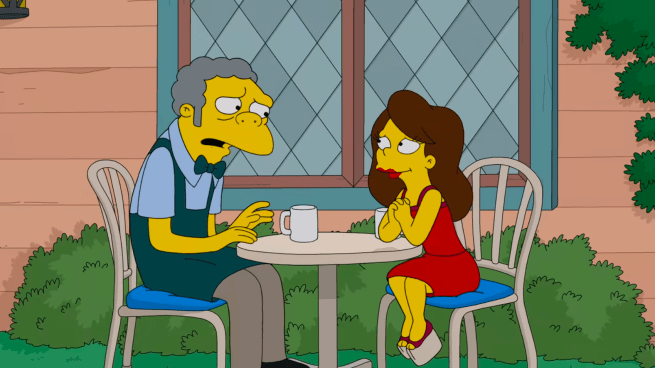
– I honestly kind of liked the Szylak brothers in the act one flashback. It felt like a believable expansion of Springfield lore that Moe’s family would be small town reprobates like him. I guess they were added so there would be at least something recognizably Simpsons-y going on in the flashback, but it worked well enough. Also I think the barber was a young Crazy Old Man. Or Old Jewish Man, as they’ve re-dubbed him.
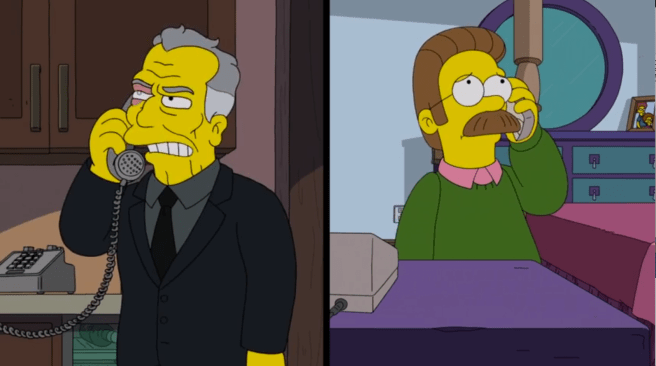
– There’s moments in this second part that definitely stuck out to be as direct lifts from other series. The motel where the shootout occurs in act one is based on the motel featured from season three of Fargo. The motel sign reads “Free Peak TV in Every Room,” which doesn’t make much sense given it’s set in the 1970s. Ned’s abandoned and desecrated house and his off-the-grid cabin are clearly based on the final episodes of Breaking Bad. And the ending showdown on the ice was reminiscent to the ending of the first season of Fargo. Again, though, these are all references, and there’s no real jokes associated with them. There’s also the moment where Ned and Homer drive past each other and we get shots of the two turning their heads to acknowledge each other in the cars, which I’m sure is a direct reference to something, but I don’t remember what. Also, Homer’s various disguises to throw off his trail on his way to Ned’s cabins must also be references. Him in the biker getup at the diner might be Sons of Anarchy? I dunno. Again, par for the course with this series, it’s not actually funny, but it’s like a homework assignment to the viewer to find the source of all the references.
– The flash forward seeing a 13-year-old Bart and 11-year-old Lisa for one scene almost made me want to see more of them, but this series has had a pretty shit track record recently with future episodes. Honestly though, I think an episode about Bart and Lisa in high school has potential in the right hands, but I’m not gonna be holding my breath about that.
712. A Serious Flanders (Part One)


Original airdate: November 7, 2021

The premise: In a parody of prestige crime thrillers, Ned Flanders finds an incredible amount of money and donates it to the local orphanage, which ultimately puts him in the sights of a ruthless debt collector who will do anything to reclaim his cash.

The reaction: It’s difficult to judge a two-part episode on just its first half, but this episode is definitely a much different animal than “Warrin’ Priests.” Right from the start, opening with a streaming service menu selecting “A Serious Flanders,” to the grisly cold opening depicting the Rich Texan’s death (and later graphic dismemberment), this show is a genre parody of modern day serialized thrillers, most specifically the Fargo TV series, as made clearest in the opening title parody of the “This is a true story” bit. The attempt at riffing on this source material is admirable as a change of pace, I suppose, but I felt like the attempts at parody were similar to past examples where they’re mostly just playing tropes of the source material straight with characters commenting on it. Cutting from the Rich Texan’s bloody post-mortem to the main bad guy breaking apart his pomegranate (“Its juices remind me of the bloody profession I’ve chosen. No, I agree, it’s not subtle.”) The assassins commenting on the eclectic soundtrack underscoring a dramatic moment (“How come every song you play has to be so kooky and obscure?”) All of these bits feature the writers holding giant arrows to the common trappings of these types of shows, but they don’t do much to actually play with those ideas or subvert them or make them overly comical in any way. The premise of the episode itself is played just as straight. Ned Flanders donates to the orphanage, but does it in his grandfather’s name, which is also his own (Ned Flanders the First), as we see he clearly has a big problem with pride or accepting any kind of accolade that might elevate himself. This mostly likely will culminate in something in part two, but as for now, it’s really all there is to hold onto that could be somewhat interesting. The bad guy and his henchmen are legitimate threats, killing multiple characters in a horrific, almost beyond-Treehouse of Horror-level of violence, but that threat doesn’t amount to much when not only do you know no harm will come upon our main characters, and this episode clearly isn’t canonical to begin with. They clearly worked very hard emulating the dramatic tone of these types of shows, but ultimately I don’t care about any of that if there isn’t an interesting story to go along with it. Also, no jokes, which the episode put by the wayside for the most part. This certainly isn’t the disaster that “Warrin’ Priests”s first part was for many reasons, but I’d still chalk this one up as an ambitious fumble. However, we’ll see how next week’s part two might change my perspective.

Three items of note:
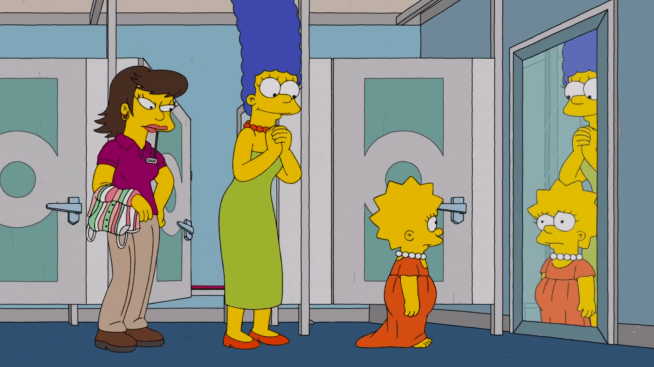
– Also in this episode is Ned pursuing a romance with Barb, the director of the orphanage, voiced by Cristin Milioti, who played Betsy Solverson in the second season of Fargo, with the character clearly modeled on Molly Solverson, that character’s daughter, from the first season. This semi-plotline ends with the twist that Barb is married to Sideshow Mel, who are in an open relationship, which turns real weird real fast. Again, I don’t know if anything will come of this in part two, but I kind of doubt it. I think it was just supposed to be a gag ending representing this good thing for Ned blowing up because of his guilt over the other events of the episode, but it just felt weird seeing Mel walk out with that Xbox controller totally cool with another guy about to bang his wife in front of him. Also, we’d seen Mel’s wife, also named Barb, in a few episodes in the past, and she looks nothing like who we see here. I don’t really care about the continuity of it, but it’s a strange coincidence they gave Mel an all-new wife and gave her the same name. Or maybe they actually did look up and see her name was Barb, but wanted to redesign the character to resemble the kindly Midwestern Molly character, and just said fuck it.
– This episode actually pulled off a pretty clever plot turn: the assassins are given Ned Flanders’ address, but accidentally lose it. They know it’s 74-something Evergreen Terrace, and immediately train their eyes on the Simpson yard, which is littered with items with “Property of Ned Flanders” labels on them. Even on Homer’s person later, they find credit cards and IDs on him, all with Ned’s name. Taking a long-running joke and utilizing it in a new setting with an entirely different tone, in that Homer’s rampant “borrowing” could have resulted in his own death… I have to give the writers credit for that, I actually enjoyed that bit. I wish the rest of the episode was able to blend Simpsons staples with a dramatic twist like that.
– The episode ends with the bad guy taking out Fat Tony and the rest of the mafia, as well as Disco Stu, in an absolute bloodbath. I was unsure of this episode being non-canon based on the Rich Texan’s death early on, but this ending certainly cinched it. Especially when Mr. Burns randomly walked in with a “Free Donut on your Birthday” sign and got his head blown up. I really don’t know why Burns would be at a Lard Lad Donuts in the first place (“Dough-nuts? I told you I don’t like ethnic foods!”), or why he would care about getting something for free… I guess both of those could just be the joke? It just felt bizarre, even more so that his head bursts open like it was made in pottery class with no blood, which stood out even more considering we just saw the bad guy use Disco Stu as a human shield, getting riddled with bloody bullet holes. What a hilariously violent ending! I guess the bad guy turning Fat Tony’s head into a donut (off-screen) is meant to be funny, but it all just came off as very uncomfortable. It was just straight-up violence, not exaggerated Treehouse of Horror-style violence. Again, it’s trying to replicate the sensationalized violent scenes from these types of shows, but it ultimately comes off as jarring when it’s done on the goddamn Simpsons with no winking twist to soften it. Snake appearing to rob the place afterwards and being horrified at what he sees I guess is an attempt to do that, but it felt like too little, too late.

711. Lisa’s Belly


Original airdate: October 24, 2021

The premise: Bart and Lisa gain some extra pounds due to taking medicinal steroids. While Bart finds newfound kinship with the bullies and their secret basement gym at the school, Lisa becomes incredibly self-conscious of her new appearance thanks to Marge offhandedly calling her “chunky.”

The reaction: After last week’s episode, I found myself pondering a question that’s puzzled me for a while: what exactly is The Simpsons now? Like, what is the intended goal of this series? For a show that’s lasted over three decades, I’m certainly not looking for it to be exactly the same as it once was, but there have been certain times over the years writing this blog where I find myself kind of stumped as to how to disseminate what I’m watching in terms of it being a Simpsons episode. Reading the byline of this episode beforehand, I figured it would be an story about body positivity, which it kind of is, but also kind of isn’t. A newly slightly overweight Lisa finds herself traumatized by her mother playfully (from Marge’s perspective at least) calling her “chunky.” The word manifests itself in Lisa’s self-conscious, burrowing down, and she hears the word everywhere she goes, in the first of many, many incredibly overbearing and hamfisted scenes, driving the message down as much as possible. Lisa flips out on Marge, who eventually understands why she was so upset, and the two briefly make amends, before Marge tells her that now that Lisa is done with her medication, soon she’ll be back to “normal” as her “perfect” little girl, leaving Lisa with more loaded words in her head. Ultimately, mother and daughter find themselves at a hypnotherapist, who sends them both into each other’s inner thoughts, which felt like a hybrid of “Make Room For Lisa” and that awful Inception parody the show did way back when. Marge sees how her seemingly innocuous words have created great strife for Lisa, while Lisa sees into Marge’s girlhood memories and her own mother’s harmful words that have plagued her. In the end, they make amends, and talk about how these words can only have power if you let them, or something to that effect. Now, all of this is well and good as a story, though obviously spelled out in a drawn out way as per usual for this show, but I just didn’t know what to make of it in the end. Given Lisa’s weight gain was temporary within the episode itself, as well as in the series in general, since we know she’s going to go back to her usual look next week, it made sense for them to pivot from just being about Lisa’s weight to a larger, related point, but that ultimately made the episode feel more weightless. But more than anything else, the story just wasn’t funny. A social satire like I assume this show still is should be able to tell stories like this in a manner that is enlightening and humorous at the same time, but there just wasn’t any kind of amusing bent to this episode to me. Matt Selman shows of this ilk emphasize the sentimental elements of their stories, sacrificing a lot of the humorous potential in the process. That’s why I find myself confused as to the modus operandi of this series now. Last week’s episode, though an Al Jean-run affair, gave me a similar feeling in its grand conclusion with Moe’s personal demons plaguing him and him proposing to Maya, two premises played almost completely straight. I’ve talked about how this show became more and more a conventional sitcom as time went on, and I guess this is kind of more of that taking effect. I just don’t see what this show has to offer that is unique unto itself anymore. Apologies if this post feels more rambly and inconclusive than normal, but I’m still trying to completely formulate my thoughts on the matter. Some people may like the more emotional direction this show delves into sometimes, but it just doesn’t feel right to me the way it’s handled now.

Three items of note:
– The episode opened with the traditional Simpsons clouds, then going right to the TV with the executive producer credits, which seemed weird, since there’s been plenty of times they’ve gone right into the episode with those credits as lower thirds. Actually, all the episodes this season have done that so far, so it’s kind of strange they didn’t just do that here and gain themselves a couple more seconds of show.
– The B-plot involves a heavier Bar getting in with the bully crowd and their secret gym, which they more or less pretend to actually use in-between fucking around and eating Hot Pockets. Once Bart found himself embraced by his former tormentors, I thought there was going to be a parallel created between him and Lisa, highlighting the different standards boys and girls are held to in regards to their looks. Instead, the two stories were completely separated, with Bart’s just kind of sputtering out in the end. It felt like a potentially rich vein, story and humor-wise, that just went ignored.
– The hypnotherapist Dr. Sage is voiced by Renee Ridgeley, wife of Matt Selman, with the character partially based on her, being a breast cancer survivor with a single mastectomy. I stumbled upon a Twitter post about this new character last week, and at first scoffed about Ridgeley’s casting, but quickly pulled back after reading more about it. I mean, as someone with multiple family members affected by cancer, what kind of monster would I have to be to pissed about this? I found it a bit odd that there was never any mention from Dr. Sage about her medical history, but I guess the point is that there didn’t need to be. She’s just a regular character like anybody else, she’s not defined by her history of cancer. Before the episode aired, I figured it would fit with the body positivity theme, but since that had largely been morphed into the broader “words hurt” theme by the time she appeared, there wasn’t much need for that anymore. I guess the worst I can say about her character, as with the episode itself, is that she wasn’t funny, acting as the amazing therapist who was able to solve Lisa and Marge’s problems. I’m not expecting her to do a stand-up routine, or to be incompetent, or be a greedy shyster, but some kind of humorous quirk to remind me that I’m watching a comedy program would be nice.

710. The Wayz We Were


Original airdate: October 17, 2021

The premise: When Evergreen Terrace becomes a never-ending traffic jam, the Simpsons must confront Wayz, a navigational app that redirects traffic to residential areas. Meanwhile, Moe is reunited with his old girlfriend Maya, but is plagued with insecurity about her possibly leaving him again.

The reaction: Season 20’s “Eeny Teeny Maya Moe” is a pretty fondly remembered episode by a lot of fans, which isn’t easy to say about any episode from the last fifteen years. The writing staff has noticed this, and as a result, we get the Maya sequel episode that fans have been clamoring for thirteen years after her introduction. I don’t remember caring much for “Eeny Teeny,” as it felt an overly saccharine affair with a boring, schmaltzy Moe and a rushed ending. Moe was all set to propose to Maya, as well as get height adjustment surgery for her, but Maya broke it off with him because she felt that he didn’t see her for her, only her as a little person. Except that wasn’t actually true, and she only got mad when he started making short jokes about her, but only after she made them herself, and she also did weird shit like pretend to be a doll for some reason. I don’t really remember much about Maya as a character, nor do I think there probably was much to her in the first place, but here, she is a complete blank slate. She and Moe reunite in a traffic jam, and she is still head-over-heels in love with Moe with absolutely no reservations, or explanation, as to why she wants to get back together. She off-handedly mentions she got her PhD, but we never find out in what, what she’s been doing for x amount of years, or anything like that. We get a few short clips of “Eeny Teeny” showing her and Moe together, but besides that, we’re given no re-introduction to this character who appeared in one episode over a decade ago. I feel like there are pretty dedicated fans who might not remember her episode well enough after all this time to discern who she is. So Moe and Maya are back together, and since we’re not going to develop her character or their relationship whatsoever, the bulk of the episode is about Moe dealing with his crippling anxiety that Maya might leave him again. We never go into why she left him in the first place, of course, which makes this even weirder. Why bring this character back if you’re not going to bring up anything from the previous episode? But none of that matters, because it’s all building to Moe proposing to Maya to lock that shit down (when Homer suggests “the big M,” Moe thinks he means, “murder-suicide,” again completely forgetting that he proposed to Maya in the last episode.) So Moe pops the question, Maya says yes, and then the episode ends. So, I guess they’re a permanent couple then? Just like Comic Book Guy and Kumiko, I assume this means it will take many, many years to do another episode actually examining their relationship, or giving Maya any sort of characteristics or personality traits. I get the impulse of wanting to bring back this character from an episode people like, but they did absolutely nothing with her. I guess there’s people who will just feel good that Moe got a happy ending, but why? Moe being a miserable loser leeching off of his regular customers, as well as his disgusting, perverted lowlife, are fundamental bedrocks of his character. If he’s now going to be a happily married man, they have to completely reconstruct his character, and I know they’re not going to do that. We’ll get plenty more of the same kinds of jokes with Moe, and every now and again, Maya will show up and the audience will be baffled that she still exists. I mean, I’m more than willing to be proven wrong, but once again, CBG and Kumiko is a perfect example of a “big” change in the series that ultimately led to nothing. Let’s see what happens!

Three items of note:
– We get another guest couch gag done by Stoopid Buddy Studios, where Maggie imagines her little wooden kingdom playset comes to life. It’s all done in a similar style to their Hulu series Crossing Swords, a show that I’ve never heard anybody talk about ever, but apparently is still premiering its second season later this year. Does anybody watch that? Anyway, it’s not terrible, but nothing really memorable either.
– It’s weird that the Moe/Maya story is kind of the B-plot in this episode, with the A-plot being the Evergreen Terrace traffic jam thing, taking up the bulk of the first two-thirds of the show, and gives us the episode title (they’re really stretching how many times they can naming episodes after The Way We Were ). The traffic never, ever stops, so a neighborhood meeting is called, but everyone just uses it to bitch about how much they hate the Simpsons. We also get a look at who apparently lives on the block: the Hibberts (I thought they’d live in a much nicer, more expensive area), Sideshow Mel (same comment), and Pamela Reed returns as Ruth Powers to give a meta joke about how it’s been two decades since Marge said hi to her. Later, Professor Frink saves the day by hacking into the navigation app’s code to remove Evergreen Terrace from the map completely, and Homer is annoyed at how everybody loves him now for fixing the problem. But he didn’t do anything, Frink did. Oh, who gives a shit. It’s surprising enough that the Moe/Maya thing, something a good pocket of fans wanted to return, is not only the B-plot here, but to such a really boring “main” story such as this.
– Racked with anxiety, Moe spends the night in Bart’s treehouse, and when he returns to the bar the next day, Maya is already packing to leave (“You’d better speak fast, or for the second time, you’re going to lose the first good thing that ever happened to you!”) In “Eeny Teeny,” Moe’s crackpot plan to reduce his height is kind of stupid, but he gave a heartfelt speech about what Maya actually meant to her as a person, but she just left him anyway because the episode was ending. Here, rather than actually talk to Moe, Maya is just going to leave him again, despite completely dropping her entire life (whatever that is) because she just had to be with him again after all this time. WHO is this character? In both these episodes, thanks to poor writing, she almost comes off fickle and slightly manipulative, and I know that’s completely unintentional. I look forward to an episode in season 39 where we can finally learn that Maya used to be a gymnast in college or whatever bullshit crumb of backstory they decide to give us.

709. Treehouse of Horror XXXII


Original airdate: October 10, 2021

The premise: “This Side of Parasite” is a Parasite “parody.” In “Nightmare on Elm Tree,” Bart’s treehouse comes to life and gathers an army of trees to wage war against their human oppressors. “Dead Ringer” is a “parody” of The Ring, except with TikTok instead of a videotape. Yes, you read that right.

The reaction: Here we are at another Halloween special, where I struggle in vain to try and come up with something new to say about them. No real scares or tension, unremarkable tone, parodies that don’t actually parody anything…  I’ve said all this stuff before. The first segment just retells the plot of Parasite up until the very end where they attempt to build atop the rich social commentary of the film by having all the “parasites” hiding under the house fight and kill themselves. I really didn’t get it. It reminded me of the Stranger Things segment where they tried to condense so much source material plotting down to a few minutes that it loses all meaning as a story. I can’t imagine this would make much sense to anyone who hasn’t seen Parasite (if you haven’t, feel free to chime in. And then go watch Parasite, it’s fantastic), and to those who have seen it, it’s just a series of scenes you recognize from that movie you saw. The third segment is not as slavish to the source material, but it’s equally as dull with Lisa uncovering the mystery of the ghost girl killing all her classmates, with the “twist” being that when the girl comes to get her, Lisa bests her by smothering her with her friendship, resulting in the ghost girl banishing herself because everybody hates Lisa. Really uninspired stuff. Along that vein, the second segment felt incredibly bare bones. While I like the impulse of writing a story about an actual treehouse of horror, it’s basically nothing but the trees going on a rampage, and then they kill all the humans. It reminded me of “Night of the Dolphin,” but without the Snorky character, so there’s no story other than a bunch of pop culture jokes to fill time (Little Shop of Horrors! The Wizard of Oz! A Tree Rollins cameo!) Modern Treehouse of Horrors are normally pretty forgettable, but this one felt like the weakest I’ve seen in a while, without much of anything I could even charitably call out as a highlight.

Three items of note:
– This year’s special was advertised as having five stories instead of three. The opening is a riff on Disney with Bambi (Bart) fearing his mother (Marge) has been shot and killed just like the original film, but a Homer buck ends up goring the hunter (Mr. Burns) to death. I’d hesitate to call this a parody. I honestly don’t even know what to call it. Between segments two and three is a brief visual poem read by not-Vincent Price, “The Telltale Bart,” depicted in a twisted storybook style of Bart getting up to all sorts of mischief. This segment is actually an expansion of a bit from a season 18 episode “Yokel Chords,” where Bart terrifies his classmates with the legend of “Dark Stanley,” where we see his nightmarish tale come to life in the same sort of Edward Gorey-inspired art style. However, watching that clip again, the art direction is pretty striking and unique, and by itself, it’s a pretty fun and inspired sequence. “The Telltale Bart,” on the other hand, has the Gorey-style designs, but none of the interesting visual direction. It’s just animated straight ahead like it were a normal section of the episode, only in a different style. It also abruptly ends with Maggie killing the Vincent Price storyteller for the story taking too long, which was just random. In the end, it ultimately came off as kind of boring, especially given how they executed a similarly stylized sequence so much better thirteen years earlier.
– It’s so strange how we get “parodies” of Parasite and The Ring in the same episode; the former being an example of the writers desperately trying to take on current pop culture, but being far too late to the party (although of no fault of theirs, the pandemic has kind of wiped all pre-2020 pop culture from any kind of relevancy anyway), and the latter just feels like such an uninspired pull, given Ringu is almost twenty years old. But the bulk of the original Treehouse of Horrors were based upon older movies or Twilight Zone segments, so what made them so different? Well, on top of the show being produced in the 90s when those other works felt more timeless in an age when there were only so many media outlets, those episodes actually crafted real stories with these characters, and many times with some kind of unique twist or hook that was unique to the Simpsons universe. Homer goes mad in the “Shinning” house because of no beer or TV. The Talking Tina doll from The Twilight Zone is re-imagined as a Talking Krusty. I never saw the source material of any of these segments  until much later, but these stories made sense to me, made logical sense, and most importantly, were incredibly funny, completely on their own. Meanwhile, the Parasite segment featured no real Simpsons spin on the film whatsoever, and like I said before, must not make a whole lot of sense to someone who hadn’t seen the movie.
– Yes, it’s true, the Ring segment features all your favorite Springfield Elementary students saying the word “TikTok.” It’s as awkward as it sounds., I guess it’s no different than Dolph writing on his Apple Newton way back in the day? But at least that had a joke to go with it. Whatever. Grey DeLisle gets in a few more lines as Sherri and Terri, and I think she’s starting to sound a bit better. It’s not perfect, but it felt close enough that it didn’t sound jarringly off as it did a bit in her first couple of appearances.