
Original airdate: April 10, 2022
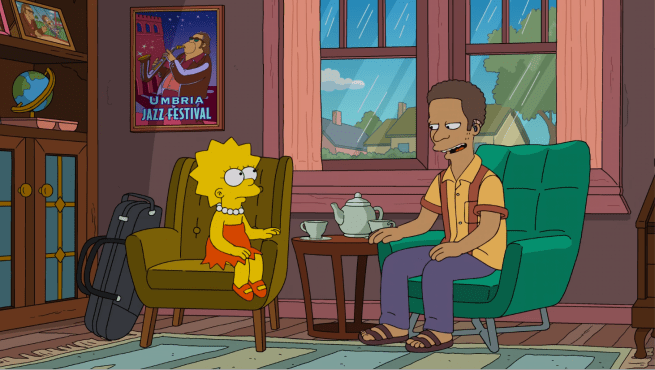
The premise: Lisa is outraged that one of Bleeding Gums Murphy’s songs is being used in a lottery commercial. She is later shocked to find out that Murphy has a deaf son, and goes on a crusade to get the rights to his father’s music back in his hands.
The reaction: Bleeding Gums Murphy is a curious character. He feels like such a timeless fixture of the show (especially since he used to appear every week in the opening theme), an integral figure in the first episode to really explore Lisa’s character, but he only really featured in season 1’s “Moaning Lisa,” and season 6’s “‘Round Springfield,” where he was killed off. We actually learned a lot about Murphy in his second outing, almost purposefully to give more weight to his upcoming death: his mentor, Blind Willie Witherspoon, his possible relation to Dr. Hibbert, his fledgling mainstream success appearing on The Steve Allen Show and The Cosby Show, and his crippling Fabergé egg habit. All of these bits, in addition to being funny, further served to flesh Murphy out and make him feel more like a real person. So here, posthumously, we have another chance to learn more about him, so what’s up? Well, despite Lisa priding herself to be the biggest Bleeding Gums expert around, she’s stunned to discover he had a son. And a wife, apparently, who we see only in pictures in his house. Where were these two when he was on his death bed? What’s the story there? We’re never told, with our only flashback involving Murphy taking his son to the doctor to find out he’s deaf. Who was his wife? Is she still alive? In the last episode, we had an extended flashback sequence of Cletus and Brandine’s courtship, but we can’t delve into this material? Whatever. Monk Murphy is a deaf man with a healthy relationship with his deceased father, and Lisa pries her way into his life to try to get the rights to his father’s music back. Lisa is in 100% insufferable idealist mode here (“I was destined to find you. My new mission in life is to make you happy! You’re my new cause!”) The point of the episode is that Lisa’s childlike optimism hits hard against a harsh reality, but she’s written less like an innocent child and more like the 30-something grad student the writers have spent the better part of two decades writing her as. Lisa’s search for answers of who owns Murphy’s music is just so boring. They go to the Jazz Hole to talk to his old colleagues, we have to endure an unfunny scat session, then Lisa happens to look at one of Murphy’s album covers on the wall and they decide to go to the record label’s office. She didn’t think to go there first? It’s not like it was hidden information. For a huge Bleeding Gums expert, she doesn’t seem to know about this obvious stuff. The record label is a humungous scam created to steal shit from artists (as made obvious by endless sign gags), where Monk eventually calls it quits and tells Lisa to just stop bothering her and it’s not her business. Lisa learns a lesson not to pry, I guess, and makes up with Monk, who later gets a cochlear implant, then Lisa plays his father’s record and he cries. Hooray. The thing is that this structure could have actually worked. In her apology, Lisa tells Monk that her father helped her when she was sad, and he wanted to return the favor by helping him. We even see a recreation of “Moaning Lisa” at the beginning of the episode, but it doesn’t feel like it translates to Lisa actively recalling how much Murphy’s kindness meant to her, outside of being a music snob who’s pissed off that Big Lotto is appropriating the music of her people. It’s just a big wasted opportunity, given how strong the Lisa/Murphy connection is, despite their screen time being so brief.
Three items of note:
– This episode got some minor buzz for featuring deaf actors playing Monk Murphy and the characters at his non-profit, as well as featuring sign language (which must have been a challenge adapting to the four-fingered characters). In principle, I’m all for the inclusion of different types of people on any kind of show. It’s also fortuitous that this episode is coming off of CODA winning Best Picture at the Oscars. As we saw in that film, as well as Troy Kotsur’s speech after his Best Supporting Actor win, there’s plenty of ways to be humorous with deaf characters, and the subject matter itself. But Monk Murphy, much like almost all one-off characters this show creates now, is pretty uninteresting. It’s not entirely his fault, as he basically functions as the silent tagalong as Lisa drags him around to fight a cause he doesn’t even care about until he puts his foot down. But finding out more about him and his father would have been interesting, and he could have had some funny moments along the way, but he just doesn’t. The closest we get is when he tells Lisa he can tune her out at will by closing his eyes, as he won’t be able to read her lips, which he demonstrates. It’s not a bad joke, but it reminds me too much of a much, much funnier real life story from my wife about one of her students, who happens to be deaf. In class, the girl was getting annoyed by some other students who were being loud and obnoxious, who insulted her when she asked them to be quiet. She then shot back herself, saying, “I don’t have to listen to this,” then turned her cochlear implant off. What an absolute badass moment. It’s pretty much the same as the joke done here, but not as cool. Anyway, the writer of this episode, Loni Steele Sosthand, pulled this story out of her real life: she has mixed race parents, a father who loved jazz music, and a deaf brother, all of which were made part of this story. The golden years of this series were built on the writers remembering elements of their childhood and amplifying them to comedic purposes. A stable of younger writers could definitely harness this power again to create new and different stories like this one to breathe life into this decayed husk of a show, but for whatever reason, it’s just not coming to life for me.
– I think Kevin Michael Richardson did a pretty solid job voicing Bleeding Gums here, especially with the “Moaning Lisa” recreation (in 4:3, no less), and even with Richardson repeating some of Murphy’s other previous lines (“You’ve made an old jazz man happy, Lisa!”) It’s not a perfect match, but like Grey DeLisle’s Martin Prince, it captures the essence of the character enough to work. Also, this is the first time that I haven’t been bothered by his Dr. Hibbert. It still doesn’t sound like Harry Shearer at all, but my brain has just stopped hitting the brakes whenever I hear it at this point, so that’s progress, I guess?
– There’s a bit late in this episode that feels like the most damning example that this show should just never, ever do pop culture references ever again. The spirit of Bleeding Gums tells Lisa that he’s always magically here for her, citing The Legend of Bagger Vance and Driving Miss Daisy as examples, basically labeling himself as Lisa’s Magical Negro. Before we get into the actual scene, this set-up feels wrong to me. Lisa is a little girl who loves jazz, so it’s appropriate she would look up to and idolize an old jazz man. In his two appearances, it never felt like Bleeding Gums filled the Magical Negro role at all, other than just being a black man who “helps” a white person. He acted as a sympathetic ear in “Moaning Lisa,” and gave Lisa his saxophone on his death bed. That’s all. But whatever, from there, we cut to a recreation of Miss Daisy featuring Bleeding Gums and Lisa, where they do a really annoying joke where Lisa just says what happens in the movie (“Teach me about equality and civil rights in a way that doesn’t make me feel too guilty. In return, in thirty years, I will ask you your last name.”) Wow, way to take down a prime target for ridicule, Driving Miss Daisy, a film over thirty years old that nobody cares about anymore. Would you believe that it’s outdated in its racial politics? Just as I mentally griped about the show carting out such an old reference, Murphy’s car slams into that of Frank Vallelonga from 2018’s Green Book, helpfully holding up a copy of said book as he’s driving. Even being a four year old movie, this feels super outdated too. Everybody already had their fill ragging on Green Book when it was out, many of which were parallels to films like Miss Daisy. Even outside the age range of the references, the pop culture jabs are always just so surface-level, stuff that has been observed and ridiculed millions of times over already. Then we get stuff like the scene over the credits, where a black-and-white Lisa, Bleeding Gums, his son and the whole band of jazz musicians and deaf kids sing at a jazz club. The other Simpsons are in attendance, Bart complains to Lisa, and Lisa makes him disappear by nodding her head in an I Dream of Jeannie reference. I Dream of Jeannie! A show that went off the air over fifty years ago. Who is this joke for? Despite featuring more and more scripts by writers in their twenties and thirties, this show still manages to make time for jokes that only appeal to people in old age homes.
 Me Blog Write Good