691. Three Dreams Denied

Original airdate: November 22, 2020

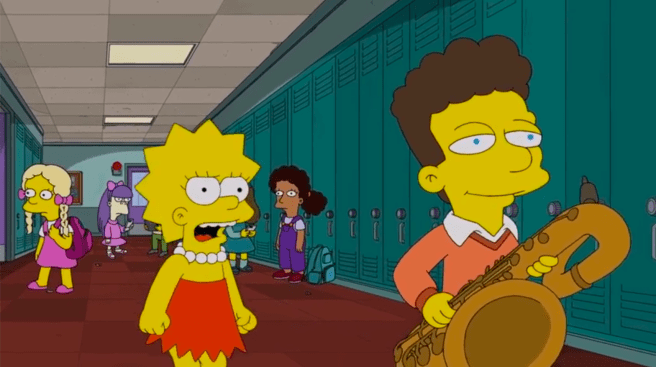
The premise: Three tales of minor misfortune: Comic Book Guy fulfills his dream of coming to San Diego Comicalooza, but blows his chance to get a job at Marvel, Lisa’s newest crush ends up screwing her out of first chair saxophone, and Bart gets a voice acting gig, but is shocked to find out he’s voicing a princess character.

The reaction: This isn’t one of those my most dreaded anthology episodes, but merely three different stories that don’t intersect or mirror each other thematically in any meaningful way. It’s like someone took a bunch of undeveloped story scraps and crammed them into one episode. The title “Three Dreams Deferred” implies the episode involves three characters having their most desired dreams dashed, but that’s not really the case. Story one has Comic Book Guy get the cash he needs to finally go to San Diego Comic-Con… errr, I mean, Comicpalooza, but his actual  dream is getting the chance to work at Marvel. He believes if he asks the perfect question at a Hall H panel, he’ll get the job, but sadly, he loses the card he wrote it down on and ends up humiliating himself. This is definitely the most promising of the three stories; Comic Book Guy at Comic-Con feels like a no-brainer of an idea that you could tell a multitude of different stories out of, but what little we have here, having to share screen time with two other dull plot lines, it’s not enough to develop into anything interesting. Story two features Lisa crushing on a new boy who plays the saxophone, who later turns out to be a double crosser who sabotages her out of her first chair. Blake is a non-character, so his dramatic reveal as a backstabber (he literally takes out his bright blue contacts to show his evil red eyes) means nothing. But what was Lisa’s denied dream? I guess being first chair forever? Story three has Bart becoming friends with the man running the Android’s Dungeon in Comic Book Guy’s absence, a voice actor who invites Bart to the studio and ends up getting a part. Remember Bart’s series-long dream to do voice acting? It’s hard to get any investment of a goal we never knew a character had. Bart is teased when it’s revealed the character he voices is a princess, then Lisa gives him a pep talk that he should be proud for being woke, then he’s publicly vindicated when the princess character becomes a violent badass who gores people with her unicorn. Whatever. An episode with three independent stories might work if they were some significant connection between them, but this was just a bunch of fractured nonsense.

Three items of note:
– Blake is voiced by Broadway performer Ben Platt. This show has had many guest stars who voice new classmates of Bart and Lisa’s, and many of them sound pretty jarring since they’re basically doing their adult voices as children. Of all of the worst examples of this, Blake may be the worst of all. His voice is so deep, he’s a literal adult man that Lisa is just fawning over, and it’s kind of uncomfortable.
– Comic Book Guy spends two seconds lamenting that his beloved wife Kumiko won’t be able to go to Comicpalooza with him, as we see a letter saying she’s visiting her sick father. But of course she’s not in the episode. Just like Selma’s daughter Ling, the writers have shown they have absolutely no interest in further developing these seemingly “important” characters after they’ve been introduced. Why did they bother giving Comic Book Guy a wife and then proceed to do nothing with her? Her only other moment of note I can recall is in the “Sad Girl” episode where she finds Lisa’s discarded graphic novel and decides to publish it in her husband’s store. And regarding CBG going to a convention, there was an episode a few seasons back, “101 Mitigations” that ended with CBG taking Homer to Comic-Con. Like the actual Comic-Con. So he’s already been to the biggest convention ever, and just like this time, he didn’t take his beloved wife.
– Bart’s subplot gets so little screen  time that I don’t even feel like complaining about how little sense it makes. Bart gets the voice over job on the spot, and the cartoon instantly goes on the air? (they make a joke about it, but come on.) The opening credits show it’s a cast full of A-list actors, but a nobody child like Bart gets a solo billing card. Bart gets a check from Warner Bros. Animation, but why are they recording in Springfield? Who gives a shit, who gives a fuck.
690. Podcast News

Original airdate: November 15, 2020

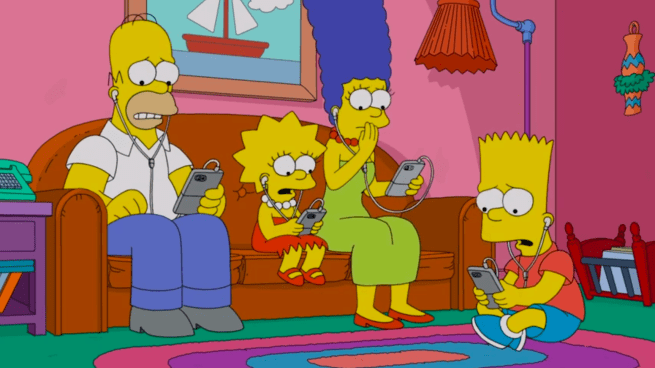
The premise: Lisa and Marge are swept up in the true crime podcast craze. Wanting to get in on the lucrative new news market, Kent Brockman starts his own podcast series based on a recent unsolved crime: the disappearance of a retired TV actress who fell off a cruise ship. The number one suspect? Her new boyfriend, Abe Simpson.

The reaction: This show has had a handful of mystery episodes, but for the most part, the mystery itself isn’t so much the focus as the characters around it and how they’re dealing with things. By act two, this entire episode becomes about whether Abe actually killed his new girlfriend, which of course there’s no chance that he did, but the episode isn’t really about that, it’s how sensationalist journalism can sway public opinion, and even affect the case itself, this time via true crime podcasts. We start off with showing Lisa obsessively addicted to listening to them, which leads to Marge getting swept up in it herself, which was pretty sweet seeing them share a common interest. Meanwhile, Kent Brockman is shocked to find how popular this new medium is, and decides to get in on the craze, chronicling the latest hot story: the cruise ship disappearance of an old soap opera actress, with her new beau Abe Simpson being the chief suspect. It’s logical that a large part of this episode is either listening to podcasts, or hearing people talk about podcasts, but I didn’t find any of that material that interesting or funny. Besides., the basic jokes about podcast ad breaks and tropes about sound design, it’s just Kent talking about the case, and it just wasn’t that engaging. This seems like it should be a Kent-centric episode, but it doesn’t really feel like it. In the end, when he discovers the truth that the actress isn’t dead, he eventually exposes the truth, rejecting the siren call of flashy faux journalism, but it really felt like a limp climax without much build-up. In act one, we see him returning home to find his four (!) kids listening to podcasts, further fueling his desire to switch careers. Maybe he could’ve had a conversation with one of them? What about their mom? Is she Stephanie the weather lady? Something new for us to learn about Kent, maybe? Instead, we don’t really get anything to grab onto since Kent has to share so much screen time with Marge and Lisa, who just keep fretting about whether they believe Abe is innocent or not after listening to the latest podcast. Their crisis of faith after having their minds warped by true crime podcasts is kind of the slow burn through the episode, but I feel like if they were suspicious of Abe from the start, and Homer and Bart were the clear-headed ones for once and had to try to exonerate Abe, that could have been something. Instead, Dr. Hibbert just shows up at the end with the evidence that solves the case, and that’s that. There were a couple of smirk-worthy moments, but I found the episode mostly pretty boring, and a squandering of a potentially interesting Kent Brockman story. In other words, it’s easily the best of the season so far.

Three items of note:
– This episode was written by David X. Cohen, writer from seasons 6-9 and co-creator of Futurama. Seeing his name definitely perked my interest, but as I say over and over, it doesn’t matter who the credited writer is, it all comes out of the same homogenized tube in the end. There’ve been other Futurama writers who have been credited to lousy Simpsons episodes: Jeff Westbrook, Bill Odenkirk, J. Stewart Burns…
– Yeardley Smith guest stars as herself, hoping to get Kent to pull back from stoking the flames of an active investigation, appealing to him as one true crime podcaster to another. I actually had no idea she did a podcast, “Small Town Dicks,” and would have to guess that most viewers probably didn’t know either. It’s a short scene that comes off as a cute inside joke between the staff and Smith., but I could be wrong, do any of you listen to her show? Anyway, it’s notable that this is the first time a voice actor has “officially” played themselves. Harry Shearer played “himself” as Spinal Tap’s Derek Smalls in “The Otto Show,” and Dan Castellaneta effectively played himself as the voice actor for Angry Dad in “I Am Furious Yellow,” but I don’t believe he was ever named. Am I forgetting something else?
– Judge Snyder and Dr. Hibbert make appearances in this episode, but they both still sound like Harry Shearer. Alex Désert is credited at the end, and this episode is after “Undercover Burns” in production order, so I’m not quite sure what happened. Maybe they recorded this episode earlier?

689. The 7 Beer Itch

Original airdate: November 8, 2020

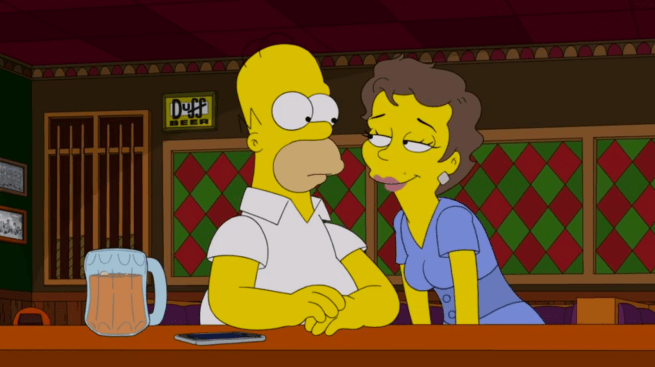
The premise: After Marge and the kids travel to Martha’s Vineyard without him, Homer meets Lilly, a fun-loving girl from England who falls head over heels for him.

The reaction: It’s uncommon nowadays that a guest star playing a character gets a huge role in an episode. Last season Michael Rappaport played Mike, baseball enthusiast, anger management candidate, and Homer’s biggest fan, a character that absolutely baffled me as to what his motivations were. Here, we have the exact same problem. From the beginning, this is ostensibly Lilly’s story, as we meet her in England and see that all of the men are just obsessed with her, with her having a natural ability to make anything fun. In fact, she’s literally excised to America specifically because she’s too great of a person. So from the start, she’s really not so much a character than a representation of an exciting, carefree life partner, a literal manic pixie dream girl for the men of the world. Traveling to Springfield, she arrives at Moe’s Tavern, and with just one look at Homer, she’s absolutely captivated. Homer, meanwhile, is despondent from Marge and the kids leaving him home alone. Lilly is ostensibly supposed to be lifting Homer out of his funk, but she doesn’t really do anything for him. She sings him a song, they have a picnic at the plant with Lenny and Carl, there’s a pointless diversion where Homer chaperones a date with her and Mr. Burns, but Lilly doesn’t connect with Homer in any way, nor does she represent anything specific for him to connect with. For the first half of the episode, Homer is just completely oblivious to Lilly’s advances, but in the second half, he’s clearly aware of his growing attraction to her. He’s shocked to find Marge has returned home early, and finds himself captivated by Lilly’s literal siren song over  the phone beckoning him to come over, basically just telling him she’ll make him food. Moments from reaching Lilly’s door, we see fantasy muses appear around Homer’s head beckoning him to her, holding scrolls reading different words. “Kindness” and “Boobies” are clear enough: she’s definitely a very nice, attractive woman, that would be appealing to most men. Then there’s “Humor,” which I don’t recall her making anybody laugh, especially Homer, despite Olivia Coleman doing her best in performing such a dull, empty character. But the killer is “Common Interests,” which we never, ever see. She likes to drink… and that’s really it. This feels especially damning to me as I just recently watched “The Last Temptation of Homer,” an episode all about Homer grappling with his feelings for a woman who shares his greatest vices. But forget about the classic era, season 28’s “Friends and Family” introduced Homer’s neighbor Julia. Although they were never romantically involved, it was a similar story of Homer forming a kinship with another woman, and it was all over their mutual love of overeating, drinking and hating Ned Flanders. It was a terrible show, but even that episode put in the necessary ingredients to attempt to have the story make sense. By the climax of this episode, we’re expected to believe Homer is seconds away from cheating on his wife for this absolute blank slate of a woman, and it absolutely does not work for that very reason.

Three items of note:
– I honestly don’t know what they were going for with the Lilly character. As I mentioned, she seems like just a manic pixie dream girl type, but since she doesn’t really affect Homer’s life in any real way, that doesn’t really check out. We see Lilly musing to herself, longing for Homer from afar, so are we supposed to relate to her in some way? That being said, we never know why she is specifically so turned on by Homer, outside of joke lines that give little insight (“Please let me win him, even briefly. It would be like having a lover and a child at the same time!”) (Wow that line is real creepy.) But Lilly isn’t a real character. We see she’s literally sought after by every single man who sees her, even being with and turning down Hollywood’s finest like Leonardo DiCaprio. Surely this could be an easy set-up for a story. She meets Homer, who is the only man who isn’t immediately smitten by her. She could take this one of two ways: either she’s relieved that a man could actually be interested as her as a person rather than just her looks, or she’s aghast that he’s not taken by her charms immediately, making him all that much more desirable. Homer’s a big lunkhead with not much of a wandering eye, so either of these scenarios would work with him, and both premises would communicate something different about Lilly as a person. Instead, we get nothing. Sometimes it really feels like these stories are half finished and they just throw in a bunch of jokes on top and call it a day.
– As Homer is seconds from grasping Lilly’s doorknob, she’s singing “la, la, la” into the phone, which then is replaced by Marge singing “la,  la, la” as Homer’s mind switches back to the love of his life. It’s quite the contrast from Coleman’s sweet siren song to the elderly Julie Kavner’s aggressively grating voice. I know I literally just talked about it on the season premiere, but this may be the worst Kavner has ever sounded throughout the entire episode. All of the characters definitely sound different as their actors have gotten older over thirty years, but the perpetually 36-year-old Marge very much sounds like an old crone at this point. And again, I feel so awful saying this, as I’m sure Julie Kavner is still giving it her absolute all, but this is just what happens when you get older. As many times as I’ve pointed this out, I feel like this is the first time Kavner’s aging voice actually negatively affected an episode, considering what we’re supposed to be hearing is the saintly voice of Homer’s dear wife pulling him back from the edge of infidelity, but it sounds just like the angry floor buffer at the Capital City Hotel. Unless that was supposed to be the joke? It definitely feels extra-exaggerated, but it was still hilariously off-putting either way.
– The ending features a crestfallen Lilly returning to London, sure she’ll never find love again,  until she meets Homer’s British doppelgänger (“Are you married, and would you shave off your mustache?” “Yes, and immediately.”) This reminded me of the ending of “Papa Don’t Leech,” the episode featuring Lurleen Lumpkin’s reappearance. Before Lurleen leaves the Simpson house, we see she’s now with a roadie Homer doppelgänger herself, an absolute lout who mooches beer money off her. In “Colonel Homer,” Lurleen was so taken by Homer because he was genuine to her, helping her with her career with no strings attached. In “Leech,” her realistic attraction is reduced to her just being super horny about men who look like Homer. In this episode, Lilly was attracted to Homer for absolutely no reason, so it makes perfect sense that she would find happiness with a Homer clone at the end, a pointless ending to a pointless episode.

688. Treehouse of Horror XXXI

Original airdate: November 1, 2020

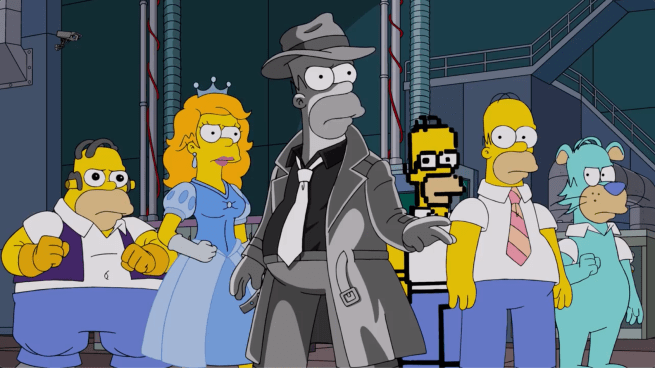
The premise: In “Toy Gory,” Bart’s toys enact their revenge after being abused for too long. In “Into the Homer-verse,” an incident at the power plant results in a gathering of Homers from different dimensions. In “Be Nine, Rewind,” Lisa and Nelson find themselves reliving the same day over and over, trying to avoid death in the process.

The reaction: These are always the hardest write-ups to do, because my general criticisms of Treehouse of Horrors have been the same for years, and I don’t want to just repeat them over and over. Hell, I’m pretty sure I’ve used that sentence as my opener for the last four years at least. At least “Toy Gory” has pretty-looking CG on its side, similar to the Coraline “parody” they did a few years ago, but sadly used in service of a pretty dull story. The toys attack Bart and make him a living pull string toy, and then that’s the end. It feels like that should have been the midway point of the story. Bart basically acts like Sid from the first Toy Story, an absolute terror, ripping toys apart, but the climactic reveal of the toys being alive and confronting Sid in the movie is way more dramatic and eerie than this entire segment, so that feels like a bit of a failure. “Homer-verse” is yet another “parody” of a non-horror movie, and a pretty uninspired one. When I saw low-bit video game Homer, why couldn’t that have been Homer from The Simpsons arcade game? Have the other Homers be from other Simpsons media, or from other fantasy sequences over the course of 30 seasons? Especially since this is the 30th anniversary of Treehouse of Horrors, this felt like an appropriate opportunity to be totally meta, like all the different TOH universes are colliding (King Homer! Donuthead Homer! Grim Reaper Homer!) Instead, we get Hanna-Barbara Homer (jokes about Snagglepuss in 2020. Timely!) and Film Noir Homer, because it’s just like that movie they watched and ripped off… er, paid homage to. “Be Nine, Rewind” apes off of time loop movies, specifically the Happy Death Day films and the Netflix series Russian Doll (the segment opens with the same Harry Nilsson song that plays when time resets on Russian Doll.) Lisa and Nelson are stuck repeating Lisa’s birthday, and repeatedly kill themselves over and over trying to break the cycle. They even do the same wood chipper death from Happy Death Day 2U, except not as gleefully macabre as the protagonist in that film who threw herself in willingly, as part of a montage of her glibly accepting her death time and time again. More than half of the segment feels like them explaining the rules of their predicament and coming up with plans, and then later going to Comic Book Guy to list off a bunch of time loop movies, and the loop is broken by Nelson just randomly killing Gil? Whatever. These Halloween shows used to bum me out, but now I’ve just grown numb to how uninteresting they are.

Three items of note:
– This episode was written by writer/comedian Julia Prescott, who co-hosts the ‘Round Springfield podcast. She also co-hosts Stonecutters LA, a live monthly Simpsons trivia show in Los Angeles that I’ve gone to many, many times. Having seen her on-stage over the years, Julia is a very likable personality and clearly a super fan of the show, so I tried to go into this episode positively, hoping there would be some fresh voice to it, but alas, it felt exactly like all the recent Treehouse of Horrors to me. Just like when the show has had guest writers like Seth Rogan or Judd Apatow, something happens in the rewriting process that just homogenizes everything into a colorless slop, and I don’t know what that is. In fact, the season premiere “Undercover Burns” was also written by an outsider, David Cryan, a 29-year-old Canadian who reached out to Al Jean on Twitter to pitch ideas to him, which eventually led to him writing a freelance script. Between Prescott, Cryan, and recent staff hire Megan Amram, the hiring of younger writers who grew up creatively inspired by the show certainly feels like it would breathe new life into this old dinosaur, but as we’ve seen time and again, their episodes feel just as lame and tired as the ones written by the regular old stable of writers.
– The opening was exactly what I’d feared it would be: a ham-fisted anti-Trump election segment. Who is this appealing to? Trump is a moronic ghoul, but all the liberal comedic institutions just harp on the same “orange man bad” tropes, and now at this point, the “joke” is just literally scrolling a gigantic list on the screen of all of Trump’s transgressions and blunders over his presidency. Thinking about how they’ve done these terrible election cold opens the last decade or so, I thought even further back to “Citizen Kang,” an entire segment specifically featuring the 1996 presidential candidates Bill Clinton and Bob Dole. How was that different? Besides the humorous, subversive story (the classic “take me to your leader” demand being hung up because of the election, causing aliens to replace the candidates), the humor was derived from our political system and the election race itself, with only a few minor touches specific to that year’s candidates (Bob Dole’s unique speaking patterns, Ross Perot’s cameo.) Kang and Kodos’ perfect emulation of empty political jargon (“And always twirling, twirling, twirling towards freedom!”), appealing to the broadest possible electorate (“Abortions for some, miniature American flags for all!”) and the travesty that is our two-party system (“I’m going to vote third party!” “Go ahead! Throw your vote away!”) are all things that are still painfully relevant six election cycles later, while this Trump-Biden opening will be dated immediately.
– Dr. Hibbert appears at the end of “Toy Gory,” still voiced by Harry Shearer. It seems like “Undercover Burns” is the switch-over point for the new voice actors, and this episode, “I, Carumbus,” and the upcoming “The 7 Beer Itch” were produced before it, so everything after that I assume will have the new voices. Later in “Be Nine, Rewind,” we get our first extended listen at Grey DeLisle’s Sherri and Terri (I think one of them had a quick line last season.) I think DeLisle’s Martin is pretty good, but Sherri and Terri… not so much. It’s a very distinct voice to try to match, and DeLisle is an incredibly talented performer, but it ends up sounding like a character from The Loud House or something. It’s as good as we’re gonna get though, so I guess it’s fine. No sense creating new characters in your thirty-second season when your actors die off, what’s the point?

687. Now Museum, Now You Don’t

Original airdate: October 11, 2020

The premise: Lisa stays home from school sick and tells some stories about famous artists: herself as Leonardo da Vinci, Bart as a generic French impressionist, and Marge and Homer as Frida Kahlo and Diego Rivera.

The reaction: Oh jeez, two of these in a row? Seriously, these fantasy episodes are so boring to watch, I barely have anything else to say about them. Treehouse of Horrors, at least in the classic era, felt like exceptions because the stories mostly took place in the “real world” of the show as horrific elements befell the characters. I asked last week, but seriously, does anybody like these episodes? Even looking at No Homers this morning, most of those diehard fans are giving it low scores. Hell, I don’t like it when any show does this fantasy episode shit. Futurama‘s “Naturama.” It’s Always Sunny in Philadelphia‘s “The Gang Cracks the Liberty Bell.” I watch the show I’m watching because I like these characters in this setting, so when you change that, I don’t care as much. If they were to tell these stories about famous historical or fictional people, maybe it could be engaging, but that’s never the case. Act one has Lisa-nardo being very talented and sad. In act two, Bart leads an impressionist movement, and then the king likes his paintings. Act three has Homer/Diego and Marge/Frida more or less just straight retelling the story behind Rivera’s “Man at the Crossroads” commissioned mural at Rockefeller Plaza. Being an art major, this all should be appealing to me, but it just isn’t at all. It’s not taking these historical events and retelling them in unique or satirical ways, it just feels like an excuse to draw the characters in different costumes and give the other artists more work to do. Futurama‘s “The Duh-Vinci Code” featured a twist explaining da Vinci’s genius: he was actually a refugee from an alien world, but upon returning there, we see that he was actually one of the dumbest of his extremely advanced species. It was a unique episode, and also felt natural in-universe, as the premise is driven by Professor Farnsworth idolizing da Vinci as a great inventor. These episodes just suck. S’all I can say about it.

Two items of note:
– This episode features our next re-casted POC character: one line from Eric Lopez as the new Bumblebee Man. He doesn’t really sound much like Hank Azaria, but it really doesn’t matter. When was the last time Bumblebee Man had a line? On the Simpsons wiki, he’s made relatively sporadic appearances over the last decade, but I don’t know if they list appearances based on if the character actually speaks, or if they just make a silent cameo in a crowd or something. The only actually notable characters left to be dealt with are Apu, Dr. Hibbert, Lou the cop, and maybe Drederick Tatum, all of the others barely show up anymore and don’t really matter. Also, specifically about Bumblebee Man, why does he even still exist in 2020? The character was born out of one of the writers randomly coming upon a Mexican comedy show featuring a man in a red grasshopper suit, so they replicated it with Homer doing the same. Back in the early 90s, if you flipped your TV up to like channel 79, you could just watch Spanish television and be fascinated by “weird” shows like that. But in 2020, when nobody channel surfs and just watches streaming services, and with El Chapulín Colorado long removed from the air waves, what is Bumblebee Man supposed to represent on the show anymore?
– Marge/Frida mentions that a young man named Bernie Sanders has recently been born who will champion socialism, which is followed by a scene of baby Bernie vouching for free cootie shots on the playground, under the threat of his “Bernie Babies” bullies, who beat up another kid for no reason (“I disavow that, and welcome it!”) Now, a couple things with this. First, Diego Rivera’s Rockefeller Plaza commission was in the early 1930s, and Bernie Sanders was born in 1941, so the timeline doesn’t even come close to lining up. Second, this gag clearly feels like it was written a year ago when Bernie was the frontrunner leading up the primaries, so seeing this joke three weeks before the Trump/Biden election feels like another example of the show being woefully too late in making cultural references. And finally, it’s just a shitty gag. There’s plenty you can poke fun at Bernie about, but a Bernie Bros joke? Seriously? It also feels especially tone-deaf now to joke about someone demanding free healthcare when we’re still living in a pandemic with 200k Americans dead. But don’t worry, the majority of the show’s writers and producers have been working this cushy job for over a decade, and I’m sure they’ve never had any serious worries about their healthcare.