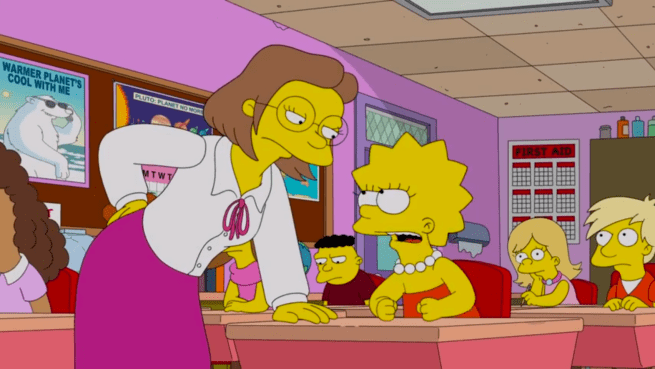
696. Diary Queen

Original airdate: February 21, 2021

The premise: Bart gets a hold of Edna Krabappel’s diary, and upon finding her writing about her belief in his untapped potential, he turns over a new leaf to be a better student. Lisa discovers Edna was actually writing about her cat, and struggles to keep the secret to herself.

The reaction: Almost eight years following Marcia Wallace’s death, Edna Krabappel’s departure from the series has always felt like this weirdly unresolved issue. I absolutely understand the apprehension given Wallace’s untimely passing, but considering Edna was a pivotal character as not only Bart’s teacher but also Ned Flanders’ wife, it felt all the stranger as years and years went by with no in-series acknowledgement apart from a short tribute shortly after Wallace’s death. Eventually, Ned ended up the new fourth grade teacher, but I can count on one hand the number of episodes where we’ve actually seen him in that role. But now, finally, we have what feels like our Farewell to Edna episode, and while the intentions were obviously pure, it’s a big schmaltzy mess. Bart ends up with Mrs. K’s diary, and is surprised to find a passage about Edna’s “spiky-haired after school buddy” he assumes is about him (“Sometimes I have to be tough on him so his behavior gets better, but he’s smart as a whip.”) Invigorated by his former teacher’s faith, Bart resolves to do better of himself, eventually leading to an actual A on a test. Lisa, however, finds that Edna was writing about her cat, and drives herself into an anxiety spiral to keep the secret. The back half of the episode is Bart giving long speeches about how he actually likes being good now while Lisa literally drives herself sick with guilt. It’s all so strange. I guess Bart just stopped reading the diary over however many days pass after reading that previous passage. Meanwhile, Lisa’s motivations are muddy: she starts off suspicious and weirdly jealous about Bart’s A, and that’s before the school carries Bart off like a hero for getting the “Most Improved Student” award or whatever. Is this still based off of just one test? Bart’s resolve is shown that he’s more kind and helpful, not that he’s working harder academically. At the start of act three, Bart feels confident enough to enter the spelling contest, and now Lisa is motivated to stop Bart before he fucks up and humiliates himself. Would he be a school-wide laughing stock for misspelling a word? Why would anyone care?

When Lisa finally exposes the truth, Bart starts crying and runs away. It’s pretty pathetic. In the end, Ned Flanders comes to the rescue, telling Bart a story about when he was planning to leave Springfield (for what reason, we’re never told why), but Edna was the sole “no” vote, believing she needed to stay because students like Bart needed her help. And… I’m not buying it. Sorry. I can kind of understand why some people might find this touching, but it just stinks of manipulative re-characterization. Like most Springfieldians, Edna may have entered her profession with hope and optimism, but for the course of the entire series, she was completely apathetic about her job, desperate for any opportunity to cut corners and get the hell out by the final bell every school day. Again, we’re never told why Ned wanted to leave, but it’s an opportunity that I think Edna would have leaped at if given the chance. The ending also attempts to put a sweet bow on Nedna (you know, that relationship nobody cared about?) by having Ned thumb to a page in Edna’s diary (“Now that I’ve been with Ned a year, he’s made my life a living… dream come true.”) Following this we get a sweet photo montage of Edna moments, ending with the “We’ll Really Miss You, Mrs. K” chalkboard that was used shortly after Wallace’s death. There’s so much irony-free sentimental bullshit here that I was surprised this wasn’t a Matt Selman show. Now, I don’t want to come off like a heartless asshole. Wanting to give Mrs. Krabappel a send-off show is a nice idea, and hoping to give it a level of earnestness is a good thing. This show used to be a master at balancing genuine emotional moments within its own crapsack world perfectly. We’ve seen more caring and vulnerable sides of Edna in the past (“Bart the Lover,” “Grade School Confidential”), so it’s possible to create some kind of narrative that gives her a farewell that feels within character. Even having to rely on using archive audio of Wallace, it could have been done. Instead, they went the easy route of retroactively framing Edna as an incredibly caring teacher who really loved her new husband and what a wonderful woman she was and it’s so sad she’s gone. Marcia Wallace was an incredibly talented performer, and most likely a wonderful woman beloved by the whole crew, but translating that great affection onto her character creates too big of a disconnect to me. For as pure the impulse seemed to be, this episode just came off way too forced and disingenuous.

Three items of note:
– More recasting shit: flamboyant gay stereotype Julio is now voiced by singer Mario Jose. Honestly, I don’t think anyone would have been upset if they just quietly retired this character. Also, Dr. Hibbert is still being voiced by Harry Shearer, having already made two other appearances (I think) this season. Did they just forget to recast him at this point?
– The episode opens with a musical number of everybody in Springfield waking up excited to head on down to Ned’s garage sale, since he’s such a pushover, they can get really good deals on all his stuff. Within the song, it’s implied that Ned “always” does this, so I guess he’s held multiple garage sales over a long period of time? The sale barely starts before Ned blows up at the bullies for smashing the Norman Rockwell commemorative plates they just bought. He vows to not sell one more item unless it’s going to actually be respected. So we spend two whole minutes on an opening musical about Ned being too nice, and then immediately undercut it. And it’s not like any of it has any point. Bart sweet-talks Ned into buying a box of books, one of which is Edna’s diary, unbeknownst to either of them, but he could have done that with Ned being his normal too-nice self. Pointless. Also, the song just sucks. The jokes aren’t funny, all our favorite characters do an elaborate choreographed dance number… just boring, transparent padding.
– Ned shows up at the very end to save the day, but it’s funny how we don’t see him at all in the middle chunk of the episode as Bart excels and impresses at school. He gets an A on a test in art, I guess presumably because they wanted to save Ned’s appearance until the end, but why not have it be in Ned’s class? Bart could be indirect when questioned about his new change-of-heart, which would make Ned curious, setting up the ending more. Later, when Bart discovers the truth and runs off crying, Lisa could go to Ned’s classroom and explain everything, leading right into him finding Bart to comfort him. But no, instead, Ned is nowhere to be found in Springfield Elementary. He’s not in the teacher’s lounge where we see the rest of the staff working telemarketer jobs, he’s not at the big assembly to award Bart… why make this change if you’re not going to do anything with it? Ned is literally Bart’s new teacher, the classroom being a huge series set piece for one of the main characters, and in three years after christening him the new fourth grade teacher, I can only remember one time we’ve seen Ned at school (“Crystal Blue-Haired Persuasion.”) It’s yet another “big” change in the series that actually doesn’t change anything, unless the writers randomly remember it sometime later. We literally just saw this in the last episode, where years and years after giving Comic Book Guy a wife, they finally decide to make an episode about it. By that standard, I guess in season 37, we’ll finally get an episode featuring Ned actually being a teacher. Can’t wait!

695. The Dad-Feelings Limited

Original airdate: January 3, 2021

The premise: Comic Book Guy’s wife Kumiko gets baby fever, but he isn’t crazy on the idea of having kids. When the pressure gets to be too much for him, he retreats to his childhood home, forcing Homer and Marge to convince him to come back.

The reaction: Season 25’s “Married to the Blob” introduced Kumiko, the love of Comic Book Guy’s life, whom he married by the end of the episode. In the seven years since then, we’ve only seen her a small handful of times. Much like Selma’s daughter Ling or Ned Flanders becoming the new fourth grade teacher, this “big change” ended up barely being addressed in the years following, in this case, a new character to easily be discarded if need be (as we just saw this season in “Three Dreams Denied.”) Kumiko is a manga artist whose biggest turn-on is American sarcasm, but we basically know nothing else about her, so reading the synopsis to this episode was kind of laughable. How can I give a shit about whether CBG and Kumiko have a kid when I barely even understand them as a couple? That being said, I was willing to push all of that aside. If this episode wanted to retroactively develop Kumiko’s character and her relationship with CBG, I’m fine with that. But of course, that didn’t really happen. Kumiko is basically an otaku’s dream girl, as she and CBG spend their Sunday having tea service and attending a Miyazaki film marathon. This changes once she gets to hold Maggie for the first time, awakening her desire to have a child of her own. This change of heart doesn’t reveal any new info about Kumiko and her hopes for a family, never extending any further than her just being baby crazy, like all women get, amirite, guys?! CBG is blindsided by this, as they had bonded in their mutual disinterest in having children. This scene contains a nugget of actual character work, as CBG explains that his years of minding the comic book store have given him a natural disdain toward children, never imagining he could ever be a father. Marge (and begrudgingly, Homer) stick their noses in their affairs by trying to push CBG in the right direction, pawning Bart and Lisa on them during an outdoor film screening of a Back to the Future “parody.” Having never seen it before, Bart and Lisa are enchanted by the film, getting CBG incredibly emotional, watching this favorite film of his through new eyes, regaling the kids with trivia and factoids. Although over-explained through the dialogue, this feels like the perfect inspiration for why CBG would ever consider procreating, so kudos to the writers on that. When Bart and Lisa get frightened as their parents have seemingly gone missing (they’ve run off to have sex, obviously), Kumiko continues to try and get CBG to emotionally open up and comfort the kids, but it proves to be too much as he flees the scene. Despite Kumiko still not being a real character, things seemed to be going in a promising direction with seeing the couple actually acting and reacting back and forth with each other, but it was over far too soon.

Kumiko knows where CBG has run off to, but she demands Homer and Marge go after him, because God forbid she actually take agency in her own story, lest we actually learn something about her. CBG’s childhood home is an old, pretty lavish mansion, and from this point, we’re regaled with CBG’s origin story of his youth via a quirky, narrated flashback with picture book-esque visuals. These sections are clearly referencing the style of Wes Anderson, and even though I’ve only seen a couple of his movies, I still got what they were going for. CBG grew up in a house full of childless relatives, each with their own obsessive collections, too busy to pay attention to him. When his father missed his big baseball game, he retreated to the world of comic books. All of this is not very funny and pretty underdeveloped, and it all feels like it would hold a lot more weight if CBG had actually narrated his own story, or if it unfolded over time as CBG and his father talked about it. Instead, it feels like Tell, Not Show again, almost intentionally, as the book closes on the flashback and we see the title, “Great Expositions.” But what specifically about comics was CBG drawn to? The escape into fantasy? How there’s always a status quo in long-running comics, so there’s no permanent emotional pain? Also, it’s unclear what CBG’s relationship with his father is. His father lets him back into the house, no problem, but then CBG just goes to his room and it seems the two don’t even speak to each other. Ultimately it’s revealed that CBG’s father missed his son’s big game in order to buy a baseball signed by his favorite player, but ended up not going (“I was afraid if you lost, I wouldn’t know how to comfort you.”) I guess they’re showing how CBG got his stunted emotional growth from his father, but there’s way too much open-endedness to this story. What happened after the game? Did CBG and his dad just never speak again? His father says he expressed his affection with collectibles, so did he buy CBG his comics when he was younger? Their story is so underdeveloped I just don’t know what to make of this ending. Despite my initial grumblings, a story about CBG and Kumiko planning a family could work, and a few pivotal moments here do, but it’s mostly just severely undercooked and rushed to actually feel like a meaningful story.

Three items of note:
– Continuing this season’s recasting, Jenny Yokobori is the new voice of Kumiko, replacing Tress MacNeille. I actually enjoyed her performance, though it’s hard to directly compare to MacNeille, since the material here is more emotional and substantial than any of Kumiko’s other appearances, where MacNeille just did a generic Japanese girl voice. Hopefully they don’t rope Yokobori into voicing Cookie Kwan. Best to just let that horrible character stay dead.
– CBG, Kumiko and the Simpsons all attend the movie screening at Springfield Forever Cemetery, inspired by similar events hosted at Hollywood Forever Cemetery (yet another example of Springfield basically being Los Angeles, Jr. now.) There, they watch the classic sci-fi film “Forward to the Past.” Sigh. We see scenes of the movie featuring not-Marty and not-Doc and their time traveling steamboat. I honestly don’t get why they do these almost-but-not-really parodies. Am I supposed to think it’s funny that you took a famous movie and just changed some words around? Why couldn’t they have just been watching Back to the Future? Earlier, Kumiko cosplays as a character from Gremlins 2, which CBG mentions by name, so what the hell’s the difference? The fake movie scenes aren’t commenting on Back to the Future in a funny or interesting way, it just feels pointless.
– In our last scene, CBG returns home and tells Kumiko he’s a changed man. Kumiko is thrilled (“You are ready to make a baby!”), the two don their cosplay and share a romantic dance as the Faces song “Ooh La La” plays. Curtains close as the credits start to roll (this song was also used in the Wes Anderson film Rushmore, most likely why they used it here.) It’s all just so sickeningly sweet. This is another Matt Selman-produced episode, and all of his episodes seem to have these incredibly saccharine conclusions, emotional endings that are 100% played straight. They always feel like shit the show would have made fun of in its prime. During my Revisited series, rewatching seasons 6 and 7, there are plenty of examples of genuine, heartwarming moments, but they’re always surrounded by absurdity, or have some kind of undercutting joke or weird element to them that make them simultaneously funny. Here, I guess we’re supposed to laugh that CBG is in a beaver costume, but it’s just not enough. It’s just a schmaltzy final shot that feels absolutely unearned.

694. A Springfield Summer Christmas for Christmas

Original airdate: December 13, 2020

The premise: A “Heartmark” film producer is called to Springfield to assist in the filming of their new Christmas movie, where she instantly clashes with their small town ways, particularly with Skinner, but the two slowly start to fall for each other.

The reaction: So, I have to watch a lot of different shows and movies for my job, and one of our recurring clients is Hallmark. As such, I have seen a lot of Hallmark movies, including their never-ending supply of Christmas movies. One might think that doing a parody of a Hallmark movie is way too easy a target, but in all honesty, having seen them, it’s an impossible task. I don’t know if there’s a way you could parody them. They are so vacuous and paint-by-numbers, they’re basically already parodies of themselves. But despite that, this episode is basically trying to be one big Hallmark movie parody, but it basically ends up becoming just another Hallmark movie story, albeit with a meta twist. Big city, no-nonsense film producer Mary Tannenbaum (get it?), played by Ellie Kemper, is our focal character for most of the running time. To secure her promotion to head of the network, she must supervise the shoot of a new Christmas movie in Springfield. She’s dreading this, having a clear aversion to Christmas movies, something that predictably will be revealed as to why later in the episode. Mary is written like the one of two basic types of protagonists in Hallmark movies: the working woman from the big city who needs to learn to slow down and appreciate the simple things, preferably from a small town she’s stuck in and with a handsome country boy who can bring her down to Earth. In this episode, that role is filled by Skinner of all people, who butts heads with Mary instantly, as her filming is standing to interfere with Springfield’s annual Lettuce and Tomato festival. The story beats predictably go from here: the two agree to help each other out, grow more fond of each other, they have a brief falling out, Mary’s fiance gets into the picture, yadda yadda yadda… The entire town turns on Mary when her negative view on small towns is exposed, but she later admits a change of heart. After that, the whole town comes together to decorate the town square for their big shoot, including Skinner. It’s just like something out of a Hallmark movie! Because it is. Yes, there’s the meta aspect of them actually shooting a Hallmark movie, complete with the director talking about how pointless and disposable they are, and Mary has her share of self-conscious lines (“Christmas movies are the best movies, because everything always works out, no matter how contrived,”) but everything about the episode itself is playing out all the tropes of these movies completely straight. Like I said, it’s basically just like watching a terrible facsimile of a Hallmark movie, with no significant twist or subversion to it to make it interesting or entertaining. Parodying such a softball target in a unique or significant way is possible, even with the meta movie-within-a-movie angle, but per usual, the show chooses to go with the easiest, blandest route possible. What a shocker.

Three items of note:
– I know I already mentioned it at the start of the season, but man oh man does Julie Kavner sound bad. Her screaming at Homer to take Mary’s bags at the start made me incredibly sad. I have to assume that Kavner is in no pain while recording, and that the producers make sure their talent isn’t being pushed too hard, but this poor woman sounds like her voice is going to give out at any moment. They certainly aren’t going to recast Marge, but it’s getting to the point that it doesn’t even sound remotely like Marge anymore.
– Through the whole episode, we’ve been waiting for the explanation as to why Mary hates Christmas movies (both act one and two end with her grumbling, “It just had to be a Christmas movie…”) She finally spills the beans to Marge: her father was killed on set as an extra for Jingle All the Way. Yawn. Maybe this feels especially lame since I just watched Gremlins, where Phoebe Cates’ story about her dead father feels much more shocking and impactful. Also, if Mary’s father died while filming a movie, why on Earth would she want to be in the entertainment business? She calls it her dream job, but wouldn’t she want nothing to do with a company whose crown jewel are their Christmas movies? This aspect could have been highlighted as ironic, but instead, they do nothing with it. Again, what a shocker.
– So this episode is basically just a condensed Hallmark movie, but there are some details they get wrong. First, Hallmark movies are 100% sexless. Everything is building up to the completely chaste kiss at the very end, and leading up to that, there is absolutely nothing sensual or titillating at all, no intimacy, no discussion of attraction, nothing. The episode mentions this, with the director enforcing a closed-mouth kiss between the leads, but between Skinner and Mary, there’s a bizarre cheesecake shot where Skinner pours water on himself, revealing his muscular physique and Mary gets turned on a bit, and that would NEVER happen in a Hallmark production. Later, Mary mentions how she can’t wait to get back to the big city, her surgeon fiancé and her gay best friend. The gay best friend is a common trope of romantic comedies, but in Hallmark World, homosexuality does not exist. I think they might have broken the mold this year by having one gay minor character, but normally their movies feel completely lost in time (which I guess is part of their appeal). They actually use the black best friend trope a lot, which felt played out in most media by the end of the 90s. I wish I didn’t know so much about this shit, but if this show is gonna take on Hallmark, they should do it right. Maybe the reality of a grungy Springfield could have clashed with the saccharine, whitewashed world of a Hallmark story. Instead, all the Springfielders are cast in the small townie roles of the story, congenial faceless nobodies who all joke around at the local diner and obediently save the day at the end. Absolute yawn.

693. Sorry Not Sorry

Original airdate: December 6, 2020

The premise: When Miss Hoover gives Lisa a B-minus on her report, Lisa calls her a hack, landing her in detention. Miss Hoover proceeds to continue giving her detention unless she apologizes, but Lisa won’t budge.

The reaction: Of all the side characters I’d be interested in seeing a whole episode about, Miss Hoover would probably be towards the bottom of my list. Unlike Mrs. Krabappel, Miss Hoover functions perfectly as the perfect foil to Lisa. What cruel misfortune that a gifted and impassioned young student would get stuck with a teacher who couldn’t care less about her job. Could a Miss Hoover episode be interesting? Sure, I guess so. But unlike “The Road to Cincinnati,” this isn’t even that, it’s another boring as hell Lisa storyline. Lisa creates an elaborate model for her report, dreaming that it’ll be the lynch pin that gets her into Yale, but she is aghast that Miss Hoover gives the entire class B-minuses across the board because it’s easier. She also has a back injury so she’s laid up on a mat in the classroom, a detail that doesn’t really matter at all to the episode. Enraged, Lisa lays into her (“I come here every day eager to learn, and you just put me down!”) This presents an issue to me, as Miss Hoover has always been consistently shown as incredibly apathetic toward all of her students, but this episode paints her as weirdly antagonistic, goading Lisa into her apology lest she get more detention and her Yale dreams go up in smoke. She’s an adult woman who presumably knows how silly it is that a second grader thinks any of her individual grades matter to any colleges, so maybe she’s just messing with her? But anyway, the idea could be that getting called a hack cuts deep into Miss Hoover and this is her lashing out, but like I said, this episode isn’t about Miss Hoover or her story. The best we get is when Lisa follows her home to her shitty apartment where she lies on the floor with her cat who hates her (“I’m so alone,” she narrates, in case you didn’t pick up on that.) Real exciting stuff. Lisa believes she shouldn’t have to apologize, but after seeing how awful Miss Hoover’s life is, she decides to make amends by spending her Yale piggy bank money on a down payment for a vibrating chair for Miss Hoover’s bad back. Upon getting the chair, Hoover still doesn’t accept Lisa’s apology, still upset about the “hack” comment. But why does she give a shit? Miss Hoover is a non-character, and we’ve learned nothing about her this episode, so why is she still holding this over Lisa? Just to be a cruel bitch? I guess so. But everything’s cool when she finds the massage function on the chair and ups Lisa’s grade to a B-plus. Nothing was learned, nothing was felt, what an absolutely pointless exercise.

Three items of note:
– This episode was written by Nell Scovell, who has written for a bunch of different series, but most notably wrote the season 2 episode “One Fish, Two Fish, Blowfish, Blue Fish.” Surely this must be the longest break in TV history, thirty years between scripts. Wikipedia also reports she’s a strong advocate for gender equality in the TV workplace, writing of her experiences of the toxic environment at Late Night with David Letterman. I guess this explains the bit in this episode where Lisa goes on a rant about how women are expected to say sorry all the time “because men make us feel like we have to apologize for existing,” a point that feels weird in context since she’s refusing to apologize to Miss Hoover, a woman. Anyway, as usual, this episode by-and-large feels no different than anything else this season, which just makes me wonder if there’s anything that can shake up this series at all at this point. Bringing back the classic writers yields nothing different, be it David X. Cohen recently with “Podcast News,” or the great Jeff Martin, returning to write absolutely awful episodes like “Moho House” and “I’m Just a Girl Who Can’t Say D’oh.” I thought bringing in young blood would give the series a shot in the arm, but as we saw with “Undercover Burns” and “Three Dreams Deferred,” that didn’t seem to do the trick either. I say it over and over, but I just don’t know what happens in that writer’s room when they’re ripping these scripts apart that just sucks the life out of them
– Lisa’s super awesome presentation is on Gladys West, a mathematician whose work on satellite models of the Earth were incorporated into the development of GPS systems. She creates a little model Earth with satellites, then she hits a button that activates a recorded rap about Gladys West set to the theme of “Wild Wild West.” It’s Kevin Michael Richardson singing, but who recorded this song in-universe? Is this a real song? Or did Lisa get a random adult musician to perform a song she wrote? And the class is dancing and going apeshit about it for some reason. What is this? Lisa is normally the one who values studying and hard academic work over flashy gimmicks. It would make more sense if she got upset at her thoroughly researched and informed oral report got her a lower grade, not some dumb rap song. Same with her thinking this project will actually matter to the Yale admissions board. Does she think they’re gonna be movin’ and groovin’ to her cool rap song? I just don’t get it.
– The episode is told in media res by Lisa sitting on the roof as she’s joined by the rest of the  family in the end. In a tag at the end of the episode, Homer’s lying on the roof a la Snoopy on his doghouse, where he dreams of being a World War I flying ace, just like Snoopy used to do in the comics and TV specials. I’ll admit, it was kind of cute seeing the dream sequence where Homer is sitting on a doghouse-sized Simpson house. But do people still get this reference? I don’t know how many people 20 and under have seen the Peanuts specials, and I’m sure a lot have, but if you didn’t know the reference, I don’t know what the hell you’d make of this. Then the sequence ends with him crash landing near two British soldier, referencing a major scene from 1917. As usual, too late with a movie that’s exited public consciousness, even more so with this fucking year. Jesus, I saw that movie in January, this year, it feels like an eternity ago. But none of that is the show’s fault, to be fair.

692. The Road to Cincinnati

Original airdate: November 29, 2020

The premise: Superintendent Chalmers is scheduled to speak at an administrator’s conference in Cincinnati and is dispirited when he ends up having to take Skinner with him. Their road trip proves to be calamitous, but the two end up growing fonder of each other along the way.

The reaction: One of my biggest wants over the past fifteen or so years for this show is for them to explore their enormous roster of secondary characters. I think we’ve had enough Homer and Lisa episodes for one lifetime, why not give us some variety and feature Ned Flanders, or Mayor Quimby, or in this case, Skinner and the Superintendent? Just like Comic Book Guy going to Comic-Con, a story with Skinner and Chalmers being stuck together feels like a promising idea, one I was genuinely curious as to how they would execute it. While it definitely felt novel to have an episode that barely featured the Simpsons at all, I was ultimately disappointed as to how bland and unambitious the episode ended up being. If you’ve seen any road trip comedy featuring two mismatched protagonists, you can basically predict the story beats here: the two bicker, meet up with odd characters and get into wacky shenanigans, one or two token acts bring them closer, a secret is revealed leading to a falling out, then a tearful reconciliation and everything is a-OK by the end. That’s not to say a traditional story can’t be engaging or fun to watch, but there’s not enough unique here that really kept my attention. Skinner resolves to have more backbone and be proactive in getting on Chalmers’ good side, and his kindness and quick thinking gets the two out of a few jams, which helps to make Chalmers grow more fond of him. Unfortunately it doesn’t seem like we learn a lot about these two during their trip. We see Chalmers freaking out about air travel, getting them kicked off the plane, but that never really develops into anything. Skinner finally standing up for himself to Chalmers was a little cathartic, but feels a little empty since there’s no real stakes for him in the episode. He tags along with Chalmers not for a promotion or a pay raise, he just wants to be his friend, I guess. This show has actually had some success in the past few years in showcasing new and different shades of our familiar characters (Mr. Largo and his partner’s domestic life, Krusty’s dream of filming an “unfilmable” adaptation of a sci-fi story), it’s just a bummer that this episode entirely focused on the secondary cast feels so rote and formulaic. 

Three items of note:
– In an episode where the Simpsons barely appear, it was interesting seeing how the rest of the cast were given some rare token roles. Dan Castellaneta plays the Missouri sheriff, though he typically plays a lot of non-Homer roles per episode. Yeardley Smith gets a lot of lines as one of the improv Shakespeare performers Skinner and Chalmers pick up. And, something I didn’t notice before the credits revealed it, Julie Kavner performed the turkey on the airplane that freaks Chalmers out, and pretty well, I might add. She also gets a decent sized bit as Marge in the tag of the episode, so don’t worry, all of our regular performers definitely earned their large paychecks for this episode.
– Attached to the episode description I read somewhere, it mentioned that there would be a steamed hams reference, which instantly made me cringe. I feel like the genesis of this episode was inspired by the explosion of the Steamed Hams meme, so I was preparing for the worst, most on-the-nose callback ever. However, the reference ended up simply being a Steamed Hams restaurant they drive by, a blink-and-you’ll-miss-it background sign. I was pleasantly surprised by the restraint.
– If it’s one thing this show is unable to do anymore, it’s balancing genuine sentimentality with a snarky twist, something that really made this series shine in its heyday. Now, happy endings are played 100% straight, and even if they’re somewhat earned, they feel like they belong in a completely different show. Here, Skinner races back to Cincinnati to get Chalmers his cue cards for his speech while Chalmers riffs on stage about how lame Skinner is, before slowly realizing he actually cares for him (“God help me, I respect Seymour Skinner! In fact, I like him!”) The two have a tearful hug and Chalmers gives his speech uninterrupted. It literally feels like something out of a bad movie, with no attempt at adding anything new on top of it. Maybe Chalmers’ speech goes terribly? The two get kicked out? Some other crazy thing happens? You can still have your sweet moment and have it land meaningfully, but there’s got to be more to it.