
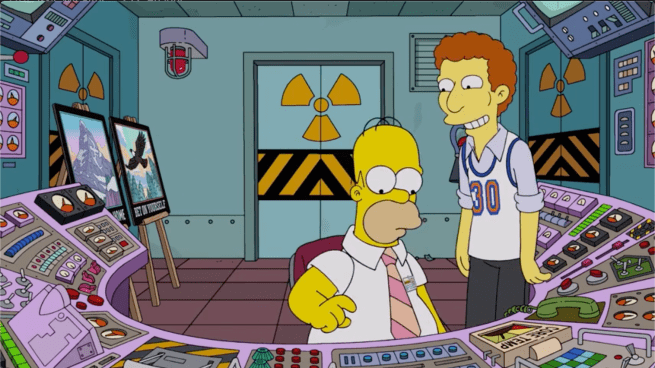
 Original airdate: October 6, 2019
The premise: Stuck supervising the new crop of power plant interns, Homer is introduced to Mike, an excitable elder millennial who considers him his idol. He begs Homer to be his mentor, which he happily accepts, feeling unappreciated at home and by the town at large.
The reaction: Boy, the writers must have been laughing their tits off at this Mike guy. It feels like 70% of all the dialogue in this episode is just his motor mouth saying… jokes? I think? For an episode that focuses so heavily on this character, I am completely lost as to who he’s supposed to be and what I’m to get out of his “character progression,” whatever it even was. Mike is a 35-year-old voiced by the 49-year-old Michael Rapaport, who I’m not at all familiar with, so any kind of inside joke connecting Mike’s personality with his voice actor is completely lost on me. John from “Homer’s Phobia” was effectively a yellow John Waters, but his personality was wholly realized within the episode on its own. Anyway, Mike is one of a dozen new interns at the power plant, who immediately sticks up for Homer when he gets stymied by the others asking him actual questions about the plant. Mike looks up to Homer thanks to countless news stories about the plant’s numerous near-meltdowns over the years always featuring Homer at the epicenter of the crisis (despite Homer being a town pariah at this point, I guess none of these articles Mike presumably has obsessively read over and over again at this point implicate he was responsible for these disasters.) The first half of the episode is just him going on and on about what an honor it is for him to worship at Homer’s feet and how fucking amazing he is. But why? Mike is not a scientist or an engineer (“Why not follow my hero into the world’s greatest calling: nuclear whatever!”) He never asks Homer any questions about his job or any specific interest in what he does. It’s not even anything broad like he admires Homer’s “courage” for taking charge and averting all those meltdowns, like it’s just a general heroism he looks up to him for. It’s just… nothing. Absolutely nothing. Mike looks up to Homer because that’s what we wrote in the script. He wears a basketball jersey throughout and is obsessed with the sport, namedropping numerous players. Why isn’t one of them his hero? That doesn’t come into play in the story, so I guess it’s just another hilarious quirk from this great new character.
Meanwhile, Homer doesn’t look a gift horse in the mouth, thrilled that someone is giving him the respect he thinks he deserves. But Mike also has an incredible anger issue. Multiple times in the episode, when someone is rude to Homer, his face goes red and he goes off on an insult comic tirade against the ignorant swine who would dare defame his beloved mentor. One of his victims happens to be Bart, during a family dinner with Mike and his pregnant wife as invited guests. Despite witnessing Mike verbally abusing his son to the point of tears firsthand, Homer doesn’t say a damn word when Marge throws him out of the house, and never apologizes to her or Bart about it (“How many times do I have to say I’m sorry?” “Once would be nice!”) The conversation immediately pivots off of Marge attesting that this grown man that screamed at her young child is a dangerous lunatic, to Homer whining that she and the kids don’t respect him like Mike does. So, Mike actually appears to be mentally unstable, and it was getting more and more overt that I thought the episode would eventually have to deal with it. Instead, Homer decides to actually attempt to be a mentor, in his sole action of expressing interest in Mike’s dumb-ass idea: a business that sells pizza by the slice instead of entire pies. Mike gets a food truck thanks to a legitimate loan from the mob, leading to he and Homer to get chased to a junk yard by Fat Tony, who then lay down their arms because they like Mike’s dumb-ass idea and can also use it for money laundering and man, who gives a flying shit. In the end, Mike’s business with Fat Tony is a big success, Fat Tony makes Homer tear up when he calls him a great mentor, and shots over the credits show Mike thriving with his work and his family and living a wonderful life all thanks to Homer believing in him! Ohhhhhhh boy! He isn’t delusional or has serious anger issues to work on, he’s just a goofy character that we all love! Mike the adult intern! This one was a real head scratcher. Again, I honestly have no idea what they were going for with the Mike character, and as the episode is solely centered around him, that’s a serious problem. His insane actions and serious character flaws clash dramatically with the clean, safe happy ending we’re given, and none of the random pieces thrown at us fit together whatsoever. A very dumb, strange, dumb, dumb, dumb episode.
Three items of note:
– Homer begins his talk to the new plant interns blending a bunch of millennial stereotypes together, but thanks to this show’s floating timeline, the 38-year-old Homer would now have been born in 1981, making him a millennial! What a scary world we live in. When we get to the point the show is still airing and Homer is as old as I am, I think I’ll just instantly turn into a fossil.
– Mike blows up at Mr. Burns to stand up for Homer, and as thanks, he ends up getting shot in the face point blank with an old musket by Burns (filled with hundred-year-old pellets that lightly embed themselves in his face.) Certainly an unexpected ending to the scene, but one that is ultimately pointless, as there are no repercussions from this event, and Mike’s food truck is shown thriving in the power plant parking lot at the end, so everything’s all good!
– There really isn’t a whole lot of other specific stuff to comment on, since this episode is so absolutely heavily focused on this one-off character we will never see again (God willing). I guess members of the staff just really love Michael Rapaport, or are like good friends with him. Doing some quick Internet research, it appears he’s a pretty big sports guy, so I guess that explains Mike’s sports obsession. He’s also responsible for this, which I guarantee is ten thousand times funnier than anything in this abysmal episode.
One good line/moment: Mike giving Bart a vicious verbal beat down leaves the Simpson dining room speechless, except for Lisa, who is adorably laughing her ass off at her brother being made the fool for once. Yeardley Smith’s performance is just lovely, and it got a big genuine smile out of me for once, as it effectively added a joke to the truly horrific and shocking moment, using expert comedic timing I haven’t seen from this show in years. Ignoring the fact that the episode did absolutely fucking nothing to address or deal with Mike’s transgressions following this scene, it was an honestly great moment.
 Me Blog Write Good