
 Original airdate: October 14, 2018
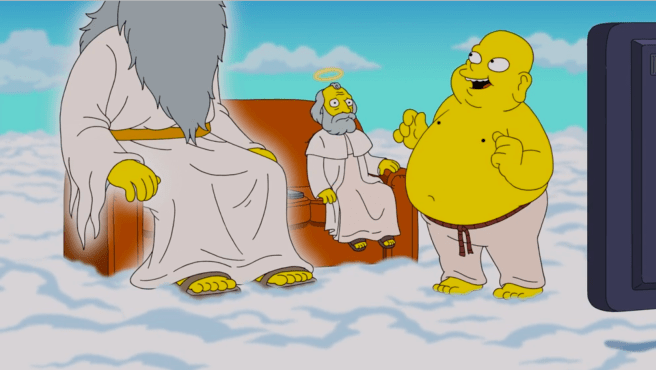
The premise: Seeing a shortage in the population in Heaven, God and St. Peter decide to lower the bar for entry a bit, observing three tangential stories of non-traditionally virtuous Springfielders.
The reaction: I’ve never been fond of these anthology episodes. While the Halloween specials are (well, were) finely crafted horror parodies with a distinctly darker tone from the series itself, these episodes just felt like plug-and-play re-tellings of other stories with a few paltry jokes sprinkled throughout (Lisa as Joan of Arc, Bart as Batman, Homer as Paul Bunyan, etc.) We actually haven’t had a proper one in almost a decade (season 20’s “Four Great Women and a Manicure,”) and I can’t say I’ve missed them. These three tales aren’t exactly copying public domain or documenting historical figures like in episodes past, but the inane, pointless feel of the segments are present all the same. The wraparounds feature God and St. Peter debating what sinless non-Christians they should allow into Heaven. First up is Ned Flanders, who talks of his prior debaucherous days as a door-to-door salesmen of kids trampolines which turned out to be incredibly dangerous. After saving a young Homer from getting struck by lightning, he has a vision of seeing Jesus and vows to turn his life around. He talks about his godless life performing depraved jobs like painting dots on dice and putting bikinis on mannequins, but he’s clearly uncomfortable about doing all of it in the flashbacks. He acts like the exact same Flanders, so what’s the purpose of the story? Next up is something about Marge’s French grandmother hiding American troops from the Nazis, which feels exactly like a “Simpsonized history” segment from the old anthology shows (a younger Abe and the barflies as the Americans, Rainier Wolfcastle as the head Nazi.) Grandma Bouvier is an atheist, and she lets you know it (“Because I don’t believe there is a God above, we must make our own Heaven.”) Then they stop the Nazis. Part three is Lisa telling a fantasy story about a princess who rejects her gross materialistic life to make peace with herself through Buddhist teachings. And in the end, she does. These last two stories are so, so boring. There’s no investment, no stakes, it’s just so bland and meaningless. I always want to give this show a little bit of credit when they try to do something different, but it really only counts if they actually, y’know, try something once they decide on a non-traditional format.
Three items of note:
– We get to see Flanders’ hippie parents at the start of his story, indoctrinating him with their carefree, rule-breaking, color-outside-the-lines rhetoric. From “Hurricane Neddy,” we saw young Ned was a little hell raiser, why not lean into that in this story? You could make a whole episode about a young, amoral Flanders and how he eventually came to be one of God’s favorite apple polishers. But like I mentioned, he acts really no different in the segment than he normally does. In his near-death experience, Jesus proclaims him a sinner who, in his selfless act of saving Homer, took his “first step” on the road to redemption. Wouldn’t this line hold more weight if he was a complete dick before this? It’s also revealed that Ned got a hideous scar above his lip from this event, which I guess gives us the answer to the question that fans have been feverishly asking for decades: why does Ned have a mustache? Boy oh boy, what a treat!. Wouldn’t he want to keep his lip bare if he viewed the scar as such an important marker of this divine intervention?
– I was really checked out of this one by the halfway point. The WWII segment was so uninteresting. It ends with the Nazis getting beaten up in a big fight set to “Non, je ne regrette rien,” which I’m sure the show has used multiple times before in a French setting. And not even in any funny ways, unless you consider Abe shooting a photo of Hitler or Lenny opening up the Ark of the Covenant in the middle of the tavern to be hilarious jokes. Lisa’s segment features a grand song about her desire for less, but none of it seems like it’s trying to be funny. It’s sort of parodying Disney princess “I Want” songs (Lisa cutely titles her story, “The Princess-Not-Affiliated-With-Disney, unless we’re now owned by Disney.”) But it just doesn’t go anywhere or do anything interesting with this set up. She sets off to find enlightenment, and then she does. That’s all.
– As much as I try not to think back to the classic era, an episode like this immediately makes me recall the likes of “Homer vs. Lisa and the 8th Commandment” or “Homer the Heretic.” Episodes like these were like morality plays, with characters discussing and debating serious questions about faith, humanity, and the difference between right and wrong. Homer stealing cable for the family made him grapple with real moral dilemmas, whittling away at his excuse making until he descended further and further into a paranoid panic before finally doing the right thing, saving his soul in his daughter’s eyes. What are the stakes in these stories? What are they trying to say? Two of them aren’t even technically about our characters, so why should I care what happens to these fantasy people? It’s not like the episode has given me any reason to.
One good line/moment: Wherein the show once again gloms onto the success of a more contemporary cartoon (Rick & Morty, Adventure Time), Homer is flung into the Bob’s Burgers dimension for the couch gag, viewing their opening titles from inside the restaurant, then attempting to hide when the Belchers turn around to observe him through the glass. This seems to have been animated by the Burgers crew as Homer looks and moves a little differently, and we get an amusing back-and-forth between the Belchers as they watch this crazed jaundiced man flounce about their restaurant (“If he’s robbing us, I feel sorry for him.” “No, don’t say that! We’re fun to rob!”) It’s just sad to go from this segment to the episode itself. The Belchers feel even more authentic, humorous and full of life when immediately followed by a sterile, shambling corpse. Even entering its 9th season, Bob’s Burgers is still a joy to watch, the closest to a spiritual successor to The Simpsons as we’re ever going to get, in my opinion.

 Me Blog Write Good