

Original airdate: February 10, 2013
The premise: Mary Spuckler returns to Springfield only to find that Bart couldn’t care less about spending any quality time with her. When she breaks up with him, Bart, along with his newly martially estranged father, must figure out how to win their women back.
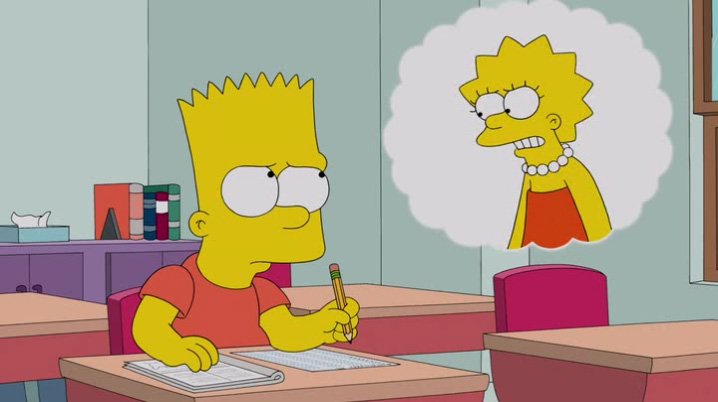
The reaction: Ah, corporate synergy. Thanks to New Girl, Zooey Deschanel’s Mary is back for the second time this season. Everybody’s favorite character, right? Right? This episode serves as almost a mirror image of “Moonshine River;” instead of Bart pining away at his lost love and traveling across the country to get her back, here we see Bart actively ignore and disregard Mary, driving her away. It’s pretty bizarre, but ultimately it doesn’t matter, since there’s still been no indication of who Mary is and why this relationship matters. Like I mentioned before, Mary’s introductory episode “Apocalypse Cow” was not romantic; she and Bart were friends that ended up being roped into a hillbilly marriage by Cletus. In these two episodes, their relationship is being treated like this long-standing important thing that doesn’t exist. Lisa pulls Bart aside, chastising him, “You will not do better than Mary Spuckler!” Does Lisa know something we don’t? The entire first half of the episode features Bart failing to pass incredibly low bars in relationships such as giving a shit about the other person and basic human empathy. Again, the opposite of “Moonshine,” Bart acts like a normal, attention-deficient kid, not really knowing or caring how a relationship works. He seems to not give any less of a shit, but when Mary leaves him, he’s depressed and wants her back. Why? Why? Whhhyyyyy? The back half of the episode involves Homer being thrown out of the house after an argument with Marge, and he and Bart staying at a motel with other troubled husbands. How will they solve their collective predicaments? Homer has a solution: get inspired by movies! They watch a Love, Actually “parody” involving the mending of a relationship via a grand romantic gesture, and then that’s what they do. The wives are invited to the motel to a grand symphony orchestra playing as the men stand there in tuxedos with sad puppy dog eyes, and the women fall for it, hook, line and sinker. This show used to actively subvert typical sitcom and film tropes, exposing them for the hollow, unrealistic depictions of reality they were. But nowadays, they will openly uses said tropes, but try to get a pass by acknowledging the trope itself. It’s the same as when they attempt to excuse bad jokes or bad writing by making a joke that it’s bad. But that doesn’t make it good. It just reinforces to the audience that it sucks.
Three items of note:
– This episode features two instances of characters blatantly appearing in a scene to tell their joke and leave. They’re like drive-by appearances where they walk through the scene, spouting their joke as they go. First with Skinner joking that a caterpillar would actually give their Sloppy Joes some actual meat, and then later with Homer and Abe walking through a scene, saying they represent Bart’s best possible future. It’s so damn lazy. Why bother animating a walk, why not just have a character appear in a bubble on the screen to say their joke quickly and move on?
– There’s a wraparound device of Bart dressed as Woody Allen semi-narrating the entire story, moaning on and on about how he just doesn’t understand women and he’s out of his depth, and how he screwed up, blah blah blah. A caricatured Allen shows up at certain points through the episode as well to give him pointers. This all feels very strange and uncomfortable given Allen’s romantic history in real life. It gets odder at the end where we see Woody-Bart checking adult Mary’s Facebook and seeing it’s been changed to single (after her husband just died, no less). But, it still looks and sounds like kid Bart. What is this? Is this entire thing a reference to a specific Allen film?
– The show makes a joke about how Homer is basically a regular at the local motel and that Marge throws him out of the house on a regular basis. The undercurrent of this bit is incredibly sad. The only two instances of this happening in the classic years that I can recall is “Homer’s Night Out” and “Secrets to a Successful Marriage,” and in both instances, it’s treated fairly seriously, with both parties being devastated by their alienation, and actively working toward mending fences. Here, it’s just a big goof. Oh, that crazy wacky Homer and his nagging bitch wife! A marriage as thin as tissue paper!
One good line/moment: Mary’s Bossa nova-style break-up song to Bart is actually pretty darn catchy, and partially cathartic considering Bart’s constant negligence.



 Me Blog Write Good