
Original airdate: October 2, 2011
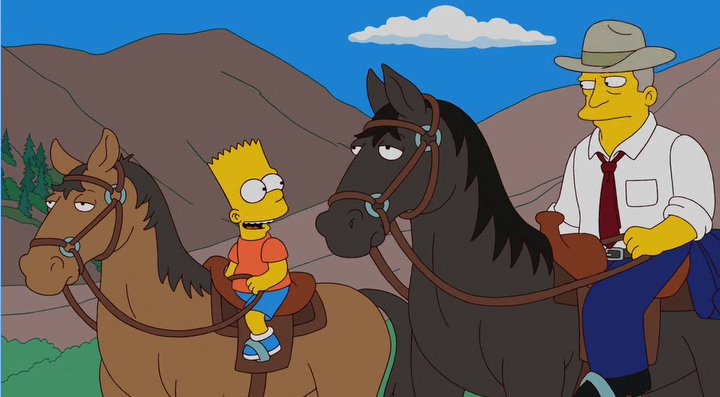
The premise: Skinner passes the buck of reigning in an out-of-control Bart to Superintendent Chalmers, who proceeds to inflame the boy’s imagination with the great outdoors. After an incident at an impromptu field trip gets Chalmers fired, Bart and the other kids initiate a school lock down to save his job.
The reaction: I always felt that this show could never run out of fresh ideas because of the enormous cast. Who’s to say Smithers or Willie or even Sideshow Mel can’t carry a story all on their own? But every time the show would try to do this, it would always stubbornly hone the focus on a Simpson and the “star” became essentially an afterthought. A few seasons back I remember they tried to do a Krabappel show in “Bart Gets a Z,” which featured Bart convincing her to follow her dream of opening a muffin shop or something? It was a disaster. So, this episode actually tries to create a character out of Superintendent Chalmers, and while it adds in some potentially interesting ingredients, it never actually goes anywhere or does anything with them. Chalmers is tasked with actually getting Bart to give a shit about his education, which gives him hesitation. His first solo scene is him in the bathroom psyching himself up, having not been an educator in a long time, which actually was a successful scene, until they ruin it with a Family Guy-style cutaway of Chalmers in The Breakfast Club. He reaches Bart by teaching him about the rough-and-tumble life and times of Theodore Roosevelt (I remember Al Jean was puffing his chest out in interviews about how they finally had a president on the show, via archival audio of Roosevelt). We see a lot of Chalmers in this episode: he’s drinking scotch, he talks about missing his wife (whose urn we see in his home), but most of all, he believes in tough love, that boys shouldn’t be coddled, that they need to get some real life experience in the great outdoors to be “real” men, so he takes Bart, Milhouse and the bullies out to Springfield Forest. These are all really great touches, but unfortunately we never really get to see Chalmers in action with these beliefs. We see them arrive at the forest, then it’s the next day where we get a quick scene with Bart and Chalmers before Nelson falls down a cliff in a very awkwardly animated sequence. Even though he’s the superintendent, Chalmers didn’t bother to get permission slips and just took five kids to the woods, so he gets canned. This leads Bart to be invigorated and round up the other boys to stage a coup at the school to get Chalmers back. Jimbo, Nelson and the other bullies are reduced to props as Bart becomes their ringleader in the final act. Then the conflict just ends when during a police stand-off, Wiggum accidentally shoots the comptroller in the kneecap and he gives Chalmers his job back. I can give the show a little credit for attempting to inch forward with the characterization of a secondary character, but it didn’t go far enough to make this episode feel like it really showed a new side of him. It was close, but no cigar.
Three items of note:
– This episode features another guest star couch gag, this one courtesy of Ren & Stimpy creator and animation creep John K. While he’s clearly an incredibly talented artist, I’ve never been a fan of anything he’s produced post-Ren & Stimpy, and this couch gag is a clear example of his solo style. The designs of the family in a static image are kind of appealing, but in motion, they’re nearly indecipherable. Every part of a character’s body will react and gyrate so randomly and at such a quick speed that I can’t even tell what’s going on.
– There are two bits with Skinner in the first act I take issue with. The episode opens with a school auction, where Skinner is taken for a ride by an anonymous phone call, a wealthy British dowager who buys every single item tallying up to over a hundred grand. Whoever could this mysterious voice belong to? He and everyone else falls for this, and I’m not quite sure why. Isn’t Skinner in MENSA? He was never a dumb character. Later on, we see Skinner finally break with Chalmers, biting back from one of his insults that he’s lop-shouldered from being a POW in Vietnam. Again, I like the idea of Skinner finally reaching his tipping point, but it ultimately feels a little awkward. It also reminds me of previous instances of him reminiscing about ‘Nam. Finding his POW helmet at a swap meet for Skinner is like reuniting with an old friend. In one of the funniest monologues in the entire series, Skinner recalls his three years in a POW camp and the stew he survived on… and his torture of being unable to recreate it when he came home to the States. He had always been unusually upbeat recalling the horrors of war and that was always the subversive joke, so seeing him act so defensively about it like a real traumatized veteran feels weird and awkward. Also, given the floating timeline of the show, I guess Skinner fought in the war when he was a baby? Either that or Skinner is in his 60s now. Meh.
– The scene with Chalmers at his house with the boys is probably the best of the entire episode. With his glass of scotch, he armchair philosophizes his feelings about the infantilization of boys, trying to save these poor wimps and mold them into future manly men. Again, the episode really feels like it could be going somewhere with Chalmers’s behavior, but it just doesn’t stick with it. Their forest trip results in Nelson getting a bum arm, and his mother threatening to sue Chalmers, who, as mentioned before, did not get any permission slips. The scene in Skinner’s office is the antithesis of Chalmers’s philosophy on teaching, and they could have had him standing up for himself and remaining brazen in his viewpoints, but it looks like they just missed the opportunity. In absence of this, it just looks like Chalmers was a big dummy for not covering his ass. Also, Nelson’s mom’s lawyer looks and sounds exactly like Victor the hovercar dealer from Futurama.
One good line/moment: Like last episode, there actually was some good stuff in this one. The middle chunk of the show with Chalmers working with Bart and the other kids mostly works (“I thought teachers only went outdoors to smoke and cry.” “Son, have you ever seen a horse your father wasn’t betting on?”)
 Me Blog Write Good