281. The Lastest Gun in the West

(originally aired February 24, 2002)
It’s important when you’re writing a TV show, a movie, a song, anything creative, really, that you should… care about it. Or at the very least come across like you do. This has been a problem of recent years, but there are a few parts in this episode in particular that are really jarring to me. This show is so aimless and lackadaisical, and when the writers point out how stuff makes no sense, it just illuminates the laziness even more. This episode is kind of a first in that it literally has no story. There have been thin premises in the past, but this is the first one where I really couldn’t tell you what this episode is about. We open with an angry dog chasing Bart across town, who seems to only have an out for him. And that’s not just the first scene, that’s the entire first act. It’s almost like the Bart digging a hole thing at the beginning of “Homer the Moe,” except that was half the length, and was weirdly intriguing in its own way. This is just empty time-killing, a clear indication that the episode has nowhere to go.

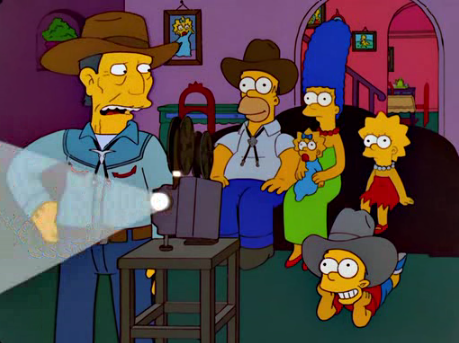
Bart ends up meeting veteran Western actor Buck McCoy, voiced by Dennis Weaver, and develops a shining for him and cowboys in general. That’s basically act two. This episode feels really strange, they centered the whole show around Buck, as if he were a big star they had to cater to, and while Weaver is a known celebrity, it’s not like he was that big at the time. The writers seem to find Buck a lot more interesting and entertaining than we do. Some of the bits are amusing, but a lot of it is very dry and boring. And again, there is no story to be had. There’s an odd running bit of Homer feeling betrayed that Bart idolizes Buck instead of him, which feels kind of bizarre. It’s like a throwback to the very early seasons where Homer wanted his son’s respect more than anything, but after the complete desecration and tarnishing of his character up to this point, it doesn’t really make any sense. It’s just to grasp at anything to try and trick the audience into thinking something is happening.

The closest I can grasp at a story happens at the end of the second fucking act when Buck goes on Krusty’s show drunk and reveals he’s an alcoholic. Then Homer and Marge try to get him to sober up… for some reason. It kind of makes sense for Homer to step up to rehabilitate his son’s hero, but through this whole episode, Marge has sat on the sidelines spouting hollow, expository lines (“I think Westerns are due for a comeback!”) The scene that really sticks out to me is when Buck leaves the rehab center, and says this to Marge: “Look, I worked long and hard, got rich and now I’m retired. Why shouldn’t I be able to drink all I want?” An excellent point. Buck’s not some sad sack old man desperate to reclaim his fame, he’s just an older actor who had his time in the limelight and now is living a comfortable retirement. Marge responds, “Well, I don’t know. I just naturally assumed it was some of my business.” So, to translate, when asked what the point of this story is, the writers say, “We don’t know.” At that point what does any of this matter? I don’t even hate this episode. It’s like being mad at a kid who didn’t even bother writing answers on his test paper. I’m just disappointed.

Tidbits and Quotes
– The dog opening is astounding. Like, that’s really what you’re going to draw six minutes of material out of? And then they bring it back at the very end for absolutely no reason? It’s hands down the worst first act of the series.
– “Little Grampa Simpson” on Abe’s childhood badge bothers me. It’s just a gag, but it always bugs me in the show when characters outside the family call Abe “Grampa.”
– There are some Buck bits I actually chuckled at: riding his horse the short distance to the laundry room, calling his films as good wholesome family entertainment (“No drugs, no nudity, no cussin’, just drinkin’, fightin’, and trippin’ horses with wires,”) getting excited about refried whiskey, and his in-show endorsement of Drunken Cowboy Whiskey (“I’m not sure I approve of selling whiskey to children.” “Well that was aimed at children who were already heavy drinkers.”)
– When we get to Brockman’s newscast and Apu’s singalong, I’m just exhausted. I can’t stress enough how this episode literally has no story. It’s twenty two minutes of filler, and no amount of them referencing their flaws excuses them of that.
– Krusty and Buck have some brief small talk before the show. Buck comments how much things in show business have changed since his day, to which Krusty gruffly responds, “I don’t care…” My sentiments exactly.
– So Buck gets drunk and shoots Krusty in the stomach on stage. Does he get put up on charges? Arrested? Nope! (“This is horrible! All my spit takes have blood in them!”)
– Homer’s Farrah Fawcett poster… my God. Any attempt at making this emotional through-line of Homer wanting to be his son’s hero feel genuine in any way plummets to the earth.
– The ending with the robbery makes absolutely no sense and is stupid in every way, but it gives us the only two great lines in the show. First when the criminals attempt to thwart Buck (“I’m shooting at the lasso, but the bullets just go right through the middle!!” “It’s the ultimate weapon!”) Dan Castalleneta’s read on the first guy is so panicked and shocked, it’s great. Then we get Buck’s outtro (“Goodbye, Bart! Never bother me again!”) It gets the idea across that Buck’s this old guy who never wanted to be bugged by this stupid kid, and makes him, and Homer and Marge, seem more like irritants to intruded on his life and tried to change him. If the episode commented on this at all or made that more of the point of the show, it would kind of work, but instead we get this uninspired schlock. Way to go, writers.

280. The Bart Wants What It Wants

(originally aired February 17, 2002)
If you’re going to do an episode featuring a one-off romance, you need two important things: your love interest should be a distinct and interesting character, and the relationship needs to have some kind of deeper purpose. Jessica Lovejoy was the devious daughter of the minister, the bad girl Bart was head over heels over, until he realized she was maybe too hardcore even for him. A prototypical Ralph Wiggum was this dim, naive kid who attached himself to Lisa, while she had to figure out how to let him down gently. These stories not only featured entertaining characters and situations, but they also felt like believable stories involving grade school-aged children. This episode is the first of many f”Bart-gets-a-celebrity-voiced-girlfriend” episodes, and, like the others, it features none of those three things. At least I can say this episode isn’t as bad as the others this season, as nothing here genuinely annoyed me. I was more bored than anything.

The new girl here is Greta, voiced by Reese Witherspoon, daughter of Rainier Wolfcastle. Right there you’d think there would be some interesting connection between father and daughter, or that aspect would play into the story, but no. Greta has no real discernible characteristics other than she’s sweet. That’s it. She’s just a sweet girl who’s head over heels with Bart. The plot, I guess, is that Bart is too naive to notice that this girl is falling for him, and when Lisa alerts him to this fact, he decides he has to break up with her. Then he’s shocked to find she’s now dating Milhouse, and realizes he may have made a huge mistake. Now moving on to my next point, the writers seem to have forgotten that Bart is ten years old. When he talks about letting Greta go and that he may have lost “the one,” it’s so very strange. When you’re a kid, you don’t think of relationships like that. I guess the joke is supposed to be they’re treating it more seriously, but it doesn’t feel right at all. Later iterations of this type of episode would involve Bart and a pregnant girl, an arranged marriage, and other stories better suited for a teenager than a kid.

When Bart finds out Greta is going with Milhouse to Canada for her father’s new film shoot, he is destined to go after her to win her back. So, the Simpsons are going to Canada! Here’s what drives me nuts, when the show covers a stupid bullshit plot turn with a stupid bullshit joke. The family has no reason to drop everything and rush to Canada so Bart can get his stupid girlfriend back. Maybe Bart could have conned Homer into driving him there, that I would buy. But not Marge and Lisa, there’s no way that this could work. So here’s the dialogue with Bart and Marge: (“This is for love, Dad. Someday, you’ll feel what I feel.” “It’s only fair. We went to Europe when Lisa lost her balloon.”) Brilliant. That’s how they hand-wave it. Again, if the writers could care less if this shit makes sense, then why should I? So we get a quick Canada montage, Bart and Milhouse fight, Greta breaks up with both of them, then the boys join the Canadian basketball team. Another crappy episode in the can. This episode’s greatest sin is being the predecessor to the aforementioned future Bart-girlfriend episodes, but on the whole, it’s just very bland and inoffensive. Which is exactly what I want to think of what I think of this show.

Tidbits and Quotes
– More lazy, lazy writing. We start off with Homer being chased by a helicopter. He’s stolen the Olympic torch because he’s sick of his favorite shows getting pre-empted. Not a terrible concept, but it still makes no sense. So after killing time for a minute and a half, we get this from Homer: “I’m bored. ……hey, a fair!” It’s as if he’s the writers, jumping from set piece to set piece, never focusing on one thing.
– At the Springfield prep school, we get more of characters just appearing in places they don’t belong. What’s Lenny and Carl doing there? And Flanders? And with him, we get another motherfucking joke where Homer moans loudly at the idea of the less fortunate getting money. Why do the writers think this is so goddamn funny?
– Rather than listen to Lisa’s request that the school apply for a bond issue (which makes total sense for an eight-year-old to know), Skinner opts to just take off with as much stuff as he can swipe from the prep school (“Principal Skinner, you’re just stealing.” “Welcome to Dick Cheney’s America.”) OHHHH!! SICK BURN!
– Wolfgang Puck is at the prep school too. That’s it. Another worthless celebrity cameo.
– I like Homer’s adivce Bart gives about women (“Don’t give them nicknames like ‘Jumbo’ or ‘Boxcar,’ and always get receipts. Makes you look like a business guy.”)
– Though I feel they didn’t do nearly enough with him, Rainier’s got some great lines here (“Bart, your little tie makes me smile.” “Laughing time is over.” “Remember when I said I’d eat you last? I lied.”) Instead of developing his relationship with Greta and the boy she likes, we get a scene where Homer carts him to the bar with his new “best friend,” which has nothing to do with the main story and does nothing but kill time.
– Skinner tries out stand-up comedy at Floppy’s. This whole scene is awful. First, Krusty is the emcee. Why is Krusty, a world-renown celebrity, hosting open-mike night at a shitty club? It’s not like he does any jokes, he just plays off Captain McAllister and introduces Skinner. It could have been anyone. But it’s just more cramming in familiar faces for the audience. Second, Skinner is doing bad comedy, except it’s not funny to us. It’s not like Krusty bombing in “Last Temptation of Krust,” it’s just Skinner being pathetic and sad. But I guess the writers though it was a hoot, because we cut back to him on stage again at the very end. I guess they were trying to do a Seinfeld thing. Whatever.
– I kind of like the montage of Bart stalking Greta and Milhouse. The two lovebirds get caricatured on the boardwalk, and Bart gets caricatured creepily staring at them from behind a trash can.
– This is a really small moment, but it just really bugged me. On set of Rainier’s movie, he picks up an actor and impales him through another actor. This is all on set, it’s not like we’re seeing this done with dummy actors or visual effects. This is just him shoving one person right through another guy’s guts. It’s almost like they forgot they were in the context of a movie shoot, and just wrote a scene from an actual McBain movie, and figured fuck it.

279. Half-Decent Proposal

(originally aired February 10, 2002)
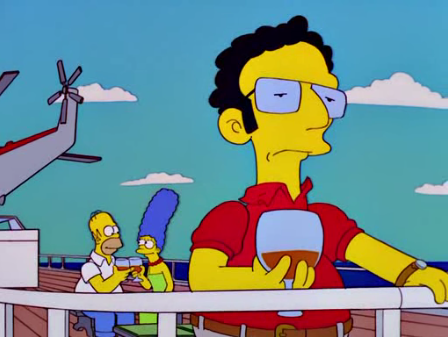
Well hands down, this is the best episode of the season so far, in that I didn’t want to claw my eyes out while watching it. Apart from a sloppy ending, it’s actually pretty decent, thanks in no small part to the great Jon Lovitz. They bring back an old character in a somewhat interesting way, and although they didn’t explore him as much as I’d hoped, I welcome this modern day Artie Ziff with open arms. Following the post-prom incident involving his busy hands, Artie became the fifth richest man in America, running a company that manufactures a plethora of various doo-dads. But through it all, he still harbors a deep, somewhat insanely obsessive yearning for the one that got away: Marge. Sparked by an email sent by a tipsy Marge (and punched up by her devious sisters), Artie pays Marge a visit, only to find she’s buckled down with a husband and kids. He offers she and Homer an unorthodox proposition: a million dollars to spend a weekend with Marge. Marge is initially resistant, but in dire need of cash to get a surgery to eliminate Homer’s snoring, she accepts.

I’d be surprised if Lovitz did it consciously, but I can feel a difference between this Ziff and his high school self from “The Way We Was.” Strangely it’s like an inverse of what you’d expect of a nerd: in high school, he felt more cool and collected, but here he seems more awkward and desperate. This makes sense for each story point though: “The Way We Was” has Artie be the steady pining best friend to Marge that’s in Homer’s way, but now in the present, he’s a man who seems to have it all, but is still unsatisfied. His twenty-year-old obsession with Marge seems a bit over-the-top, but I still buy it. It’s sort of like people who spends years dwelling over mistakes they made in the past and can never get over them. He may be successful financially, but it will never make him truly happy if he doesn’t move on. And in the end, he doesn’t (“Now, Homer, if there’s one thing that you should’ve learned from all this… it’s that I’m rich, rich, rich!“) But that’s okay. He’s a small man with a big ego, and I love him for it.

Artie recreates their high school prom for Marge, but she of course is not won over. So he reverts to his old standard: trying to stick his tongue down her throat. Unfortunately Homer spies on this from afar, misconstrues it, and by the time Marge returns home, he’s gone. It’s here that the episode starts to get wacky. He vows to leave Springfield and never return, along with Lenny for some reason, and the two end up on a dangerous oil rig in West Springfield. I’m all for the ending where Marge enlists Artie to save Homer, who assures him that he will never be able to buy his wife away from him, but it’s just way too silly and random that they’re on an oil rig up in flames. Lenny could care less where Homer drags him or even that he’s about to die. In the inferno he’s just standing there with a glazed look in his eyes. It’s just bizarre. But for the large part, I found myself enjoying this one. Jon Lovitz is amazing as always, and it ties in with a classic episode while still standing on its own. For an episode this late into the series, that’s quite a feat.

Tidbits and Quotes
– All the snoring bits at the beginning are okay, nothing exceptional though. The only great thing is the paper Marge gets hit with when she resorts to sleeping out on the stoop (“Sleep Important, Study Says.”)
– Nice Sex and the City parody, “Nookie in New York” (“It’s a cable show about four single women who act like gay men,”) and how Patty and Selma, like many women in America, so clearly identify with them (“This is so like our lives.” “It’s like they hid a camera in our apartment.”)
– No Jon Lovitz episode is complete without him singing, which we get twice here. First as part of his latest invention, a machine that changes the dial-up modem noise into easy-listening music (“Hey, com-puter geek, you will be connected in no time.”) Then at the end as a wonderful conclusion to the snoring problem, with Marge getting a similar device that converts Homer’s snoring to music, as well as an unwelcome live feed from Artie (“I traveled the worlds and the seven seas, I am watching you through a camera!”)
– Marge dictates her email to Artie, and Patty and Selma modify it accordingly (“Dear Artie…” “Dear Hottie…” “Congratulations on your recent TV appearance.” “I want to sex you up. Your love slave, Marge.”)
– Homer immediately becomes insecure about the illicit weekend at the bar, thinking Marge will definitely leave him for Artie (“I can’t get Artie out of my head. He’s like a spy in the House of Moe!”)
– I buy that the people of Springfield would pretend it’s the 70s for a thousand bucks. I mean, I would. And of course, Disco Stu is working pro bono. Also great is that Artie also hired Principal Dondelinger (“You’re not on the guest list, Simpson. Orders of Prom King Ziff. And have you been drinking?” “Just for twenty-five years!”)
– The Baron VonKissalot cut-away is so, so weird. It feels like a Family Guy joke, I have no idea what it’s doing here.
– Another weird third act bullet point is the further “development” of Lenny and Carl’s relationship, where basically they’re one step away from being gay lovers. Or maybe they have consummated, I don’t know. You don’t throw in stuff like Mount Carlmore without raising some questions (“I carved that one wonderful summer.” “What did Carl think?” “You know, we’ve never discussed it.”)
– The only bit I like on the oil rig is Homer’s shock when the fire starts (“Oh no! This is how Faceless Joe lost his legs!”)

278. Jaws Wired Shut

(originally aired January 27, 2002)
These reviews are getting harder and harder to start off. At some point I might just forgo trying to come up with an opening statement and just jump into the episode. It’s not like there are any overarching themes or interesting character stuff to talk about, these episodes are mostly just a bunch of stuff that happens. Here’s how this one starts: the Simpsons attend a gay pride parade. Then they go to a movie. That’s it. There’s literally no connection between the two, they leave the parade and show up at the theater without even mentioning it. It may not seem like a big deal, but it just makes me feel like the first two minutes I just watched was worthless since they couldn’t have been bothered to connect it to anything. It’s like it was lifted from another episode. Also the parade stuff itself is so unfunny and makes no sense. First, I don’t know any parades that go down a residential street. Second, Homer’s behavior. At first he’s very enthused by the parade, even giving a “Woo-hoo!” but then we see that he’s kind of nervous and uncomfortable by the floats. Characters have changed drastically from scene to scene before, but I can’t remember them changing mid-scene. It’s like they’re not even paying attention, or caring. And look, I blew this whole paragraph on the first fucking two minutes of the episode.

Let’s skip to the main plot. Homer makes a ruckus at the theater and is chased out by ushers. For some reason they continue chasing him even when they’ve gotten him out of the building, and Homer runs face-first into the fist of the newly christened statue of Drederick Tatum. His jaw busted, Homer must have it wired shut in order for it to heal, keeping him completely mute, and worst of all, unable to eat solid foods. Now, at this point I’m glad, because this looks to be an episode where Homer won’t be screaming. Unable to speak, Homer ends up becoming a pretty good listener, much to the delight of the family. Marge even feels confident enough that they can go to the formal ball at the country club. Which they do, with people like Mr. Burns and the wealthy dowager there. What is this event? How did they get tickets? A prior episode showed that the Simpsons were complete outsiders, financially and socially, from the high and mighty social elite at the country club, now all of a sudden they can get in with ease and rub elbows with the elite. It’s like stuff like this doesn’t matter anymore, just do whatever the story calls for, do it, regardless if it makes sense.

When Homer gets his wires removed, Marge fears he will revert back to his normal self, but the changes actually stick. They even end up on a The View-style show somehow to talk about Homer’s transformation. Marge complains that the old Homer was a complete glutton, and it’s not exactly addressed or explained why Homer doesn’t go back to eating a lot. But anyway, the weeks drag on and Marge finds herself completely bored without Homer causing some wacky, dangerous schemes for her to clean up. This whole conceit is very disturbing as it further clinches Homer’s new “character,” the reckless impulsive maniac as revealed in “Lost Our Lisa.” Here, we see he’s even forgone entering the demolition derby. Why would Homer want to participate in the derby? Real Homer would be sitting on his ass, drinking beer, and whooping it up in the stands, or watching on TV at home, not risking his life in the pit itself. So Marge enters the derby, wanting some excitement in her life, something she immediately regrets, and Homer has to save her by going back to his old reckless self. We end with Marge saying the family needs its live wire. Of all the fucking things I’d call Homer, “live wire” is not one of them. Homer is a lazy, lazy, lazy man, not Captain Daredevil as the writers apparently think he is now.

Tidbits and Quotes
– The only good thing at the gay pride parade was this bit between the marchers and Lisa (“We’re here! We’re queer! Get used to it!” “You do this every year! We are used to it.” “Spoilsport!”) Then we have the bit with Smithers and Patty on a float hidden “in the closet.” The subtly for Smithers’s sexuality is basically gone at this point, but I guess Patty’s been officially outed. But what a lame way to do it. Go back to “Treehouse of Horror III,” where Homer runs naked through the kitchen, and Patty comments, “There goes the last lingering thread of my heterosexuality.” Classic.
– The movie theater pre-roll jumble at the theater is pretty good (“Otm Shank. He is India’s answer to Brian Dennehy.”)
– I don’t know what to think about the Soccer Mummy trailer and the bit with him getting a boner. The joke is that this is a terrible gag from a bad movie, but the movie they’re presenting looks like a family film, since it’s about a downtrodden little kid (with an adult voice, for some reason) and this supernatural being who’s helping him achieve his dreams. So what’s a sex joke doing in there? Again, no thought put into this.
– Why do the ushers keep chasing Homer outside? I worked at a movie theater, believe me, no one gave that much of a shit. No fucking way a staff of unqualified teens is going to go above and beyond the call of duty like that.
– The “So Your Life Is Ruined” pamphlet is basically reused from “I Married Marge,” except it was much funnier in regards to a pregnancy than having ones jaw wired shut for a few weeks. And then there’s a conveniently labeled suicide machine in Hibbert’s office for some reason. Okay.
– The scene at the bar with Duffman is alright (“Newsweek said you died of liver failure.” “Duffman can never die, only the actors who play him!”) The quiz is so unbelievably stupid, but that’s kind of the point, so I don’t mind.
– Here’s a scene that bothers me: Homer listens to Lisa’s complaints. She talks about a tiff she had with Ralph playing four-square, and how he basically ignored the rules because he’s a dumb kid. Considering how adult the writers make Lisa, you’d think she’d know that he’s special needs and not get so upset, but whatever. What bothers me most is what Homer thinks when he hugs his daughter: “Maybe a hug will cork her cry-hole.” What an awful thing to say. Or think, in this case. It made me think of one of the greatest Homer lines, “Just because I don’t care doesn’t mean I don’t understand,” which shows how he can be unintentionally offensive and misguided. “Maybe a hug will shut my daughter the fuck up” is different, it’s just mean.
– The only really funny line in the show comes from Grampa, following one of his long-winded stories (“Anyway, ‘long story short,’ is a phrase whose origins are complicated and rambling.”)
– We have Homer trying to tell Marge he’s horny, Moe on the phone with an escort wanting to be taken to “Orgasm-ville,” and Homer at the derby yelling, “Quit banging my wife!” I dunno, am I being too sensitive? I just don’t think this kind of humor fits with this show. I get they’re trying to chase after the current comedy trends of the early 2000s of being more risqué, but these jokes feel so uncomfortable.
– Homer and Marge go on “Afternoon Yak” to talk about Homer’s transformation. And they bring a clip with them of Homer making ostrich burgers, meaning he’s got ostriches in his backyard and he’s going to beat them to death to make burgers out of them. This bit kind of broke my brain. As if this show wasn’t further removed from reality, this shot it even more so. I can’t even be bothered to comment, who out there can tell me this bit, hell this episode, made any sense at all or was funny?
– Homer saves Marge by becoming Popeye, but at that point I don’t really care. Though there’s one exchange at the end that is so incredibly indicative of the outlook of the writers (“Isn’t it great to have the old Dad back?” “I thought you liked the new Dad.” “Whatever.”) There it is. If the writers can’t even be bothered to care about whether their show is good or makes sense, why should we?

277. Sweets and Sour Marge

(originally aired January 20, 2002)
I think I need some medication or something, every episode this season so far has infuriated me in some way. I’ve got to calm down if I’m going to make it through eight (!) more of these. These few Al Jean episodes are just as bad as Scully’s, if not worse in some respects, but I can’t entirely place why. Maybe because it feels like they’re trying harder to be meaningful episodes with a point, but couldn’t fail harder at it. Despite having a consistent plot, this episode felt like an endless string of sketches that happened to have a story around it. By the end, I felt like I had watched nothing at all. We start at a library book sale where Homer comes upon the Duff Book of World Records. After exhausting everyone with reading off different records, he decides he want to make his own, but finds out the World Records council will only accept those done as a group. So Homer gets the entire town of Springfield together, somehow, to participate in the world’s largest human pyramid. Okay, sure, it’s a bit of a stretch, but Springfield is filled with a bunch of rubes like Homer that would love to have a record to their name, so I get it. Then the pyramid collapses, and the entire town forms a gigantic rolling ball that careens down the street. Honestly, how can I comment about this? I already had my aneurysm for the day, I’m not going to trigger it again.

The human ball lands on a truck weigh station scale, where the people of Springfield earn their record after all, as the World’s Fattest Town. Everyone is pretty psyched about this, save Marge, who is upset about the state of the townspeople’s health. She pays a visit to Garth Motherloving, owner of the local sugar manufacturer, to plead with him to rethink his business, but he’ll have none of it. Garth is voiced by Ben Stiller, and I’m glad they gave him an interesting comic character to play. Oh wait, never mind, he’s just a generic evil corporate head who does things because he’s evil. Another celebrity wasted. So Marge gathers signatures in order to file a class action suit against the company. Things appear to maybe get interesting when Professor Frink gives Marge a tip-off, and then testifies in court about the addictiveness of his top-secret sugar plan for Motherloving… but then that’s it. No interesting twist. I would’ve even gone for something stupid at this point. In the end, Judge Snyder rules in favor of Marge, and has all sugar products banned from the town.

It doesn’t take long before the entire town goes through sugar withdrawal, one of the worst being Homer. Eventually he falls into a secret group consisting of Mr. Burns, Motherloving, Apu and Count Fudgula, scheming to get sugar back to Springfield. Even though they could easily smuggle it from across the town borders, instead they have to go off shore to the island of San Glucose. Maybe it’s because they got it free of charge (“Okay, man, here’s the sugar. Now you give us the money.” “That wasn’t part of the deal!” “…he’s right. Who wrote this thing?”) Then it becomes wacky Homer antics as he goes with them on the boat, falling back off the boat and completing the deal. Why did they need him for this? Couldn’t Apu have done this? Or maybe Count Fudgula could have bitten them, because apparently he’s a real vampire. Or at least a deranged man who thinks he is. I want to see an episode about him. But, not really. Anyway, this whole third act is essentially Homer going behind Marge’s back and breaking the law to pull this con, but it’s never addressed. He ends up dumping the sugar to appease her, but the fact that he betrayed her in the first place is never brought up. He just reassures her with a paltry line, they kiss, Snyder shows up to revert things back to the status quo, and that’s the end. It just all felt so empty and meaningless, traits that would carry through the Jean years for many seasons. At least the Scully episodes evoked some kind of response.

Tidbits and Quotes
– Some of the library stuff is alright: Comic Book Guy buys Leonard Nimoy’s books, Dr. Nick’s complete shock at a real medical journal, and Cletus feeding his pigs torn up, unsold books. Then Marge shows Homer the Duff record book. When Bart asks why Duff would put out a book at all, Lisa pipes in, “It was originally published to settle arguments in taverns.” Now, why would she know that? How could she know that? It’s a small line, but feels telling to me, that now Lisa is just the know-it-all, and any time we need something explained or narrated, they’ll have her say it, regardless if it makes sense.
– Seeing Homer do a wacky dance before the Duff judges is absolutely painful. Then he grabs a banjo and cobra that he’s seemingly brought with him. He couldn’t be more removed from reality at this point. He is Captain Wacky now.
– I like Homer’s blueprints for the human pyramid: just a big triangle.
– The various products at the Kwik-E-Mart are great: Sugar, Free Donuts, Honey-Glazed Cauliflower, and Choco-Blasted Baby Aspirin.
– “Why don’t you file a class-action suit?” “Oh, yeah, like Erin Brockovich.” “The prostitute with a heart of gold.” Similar to the Lisa thing earlier, how would Bart know who Erin Brockovich is? I don’t buy it.
– There’s some nice bits of Marge going door-to-door, best of all being Disco Stu, who proceeds to do lines of sugar before boogie-ing down to “More More More” on a sugar high. It would have been funnier if he actually inhaled the stuff, but no way they could get away with that.
– Garth snapping in court and claiming he’ll kill everybody feels like such a hollow imitation of Freddy Quimby doing the same in “The Boy Who Knew Too Much.”
– After the sugar ban, the police burn all the sweets in town. They try to throw in some Butterfingers, but they’re not even singed (“Even the fire doesn’t want them.”) Butterfinger ended their contract with the show in 2001, so I guess this was their shot back at them. This show has always bit the hand that feeds, but this kind of felt really petty. Plus Butterfingers are delicious, fuck all y’all.
– Act three really is just a tour-de-force of stupid Homer shit: consciously licking a puddle of blood and Vapo-Rub, landing backwards on the lower deck, then on a whale, trying to use reverse-psychology on a bird, and “marking” his share of the sugar. Then he has a high-speed boat chase with the police, which is not tense at all or funny. Oh yeah, and Bart’s there too for some reason. Not really sure why.
– “Now that I think of it, I wildly exceeded my authority, and I declare the sugar ban over.” That’s how we resolve the story. That little thought was put into it. It’s the writers basically saying, “Oops,” and throwing that line in to fix the problem.