
 (originally aired November 17, 1996)
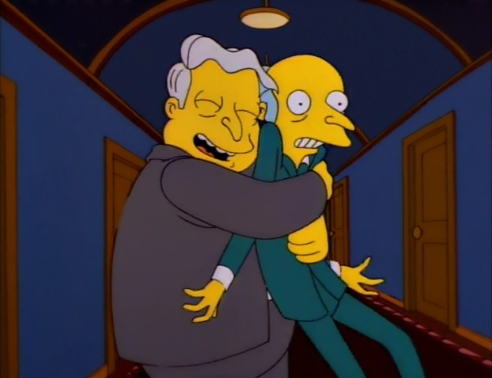
There’s been plenty of guest stars come in to play different characters. There’s also plenty of guests stars who have played themselves. Then there’s the rare occasion where it’s one and the same. Here we have Rodney Dangerfield voicing Mr. Burns’s long lost bastard child Larry, who essentially is the same character that we know from the many movies he’s been in. It seems so odd and out of place, but it’s mollified by two points: one, I love Rodney Dangerfield, and two, the character actually works for the purposes of the story. Who could be more opposite and act as a greater foil to the joyless, no-nonsense Burns than Dangerfield? Given this opportunity, the writers managed to cram this show with a ton of Rodney-style one-liners, which may not entirely fit with the comedic rhythm of the series, but dammit do I still love that guy that I didn’t mind (one in particular I use quite often, “If it gets any livelier, a funeral’s gonna break out.”) I also love his character design, a sore of bizarre mish-mash of the actual comedian with Burns-like features. He even exhibits the same extended preying arms walk at one point.
I really enjoyed basically everything in the first two acts. Having previously picked him up as a hitchhiker, Homer builds a kinship with Larry due to their mutual laziness, which makes sense. Meanwhile, Burns desperately attempts to integrate his son into high society at a fancy gala, which is a scene that basically feels ripped from one of Rodney’s movies. I can actually picture it; he’s at the finger sandwich station, but he scoops the bread out of each piece and makes this elaborate super sandwich, much to the crowd’s shock. If anyone can remember the movie, feel free to post. Again, I don’t mind this content shift because I was still amused and it worked within the story. Burns can’t even pawn his son off to Yale without a rather sizable donation (“Yale could use an international airport, Mr. Burns.”) Burns’s annoyance continually builds until he outright disowns his son, leaving Larry with no one to rely on but tag along Homer, who comes up with a brilliant scheme: a phony kidnapping.
Now the last act is a bit strange. The fake kidnapping didn’t seem too inspired, but I did find myself going along with for the most part, as it wasn’t that out of left field and there were plenty of great gags thrown in. It’s the very ending that doesn’t entirely sit with me. Larry admits that they faked the kidnapping, leading Homer to come to his defense, giving some rigamarole schmaltzy speech about how much he values the love of his children or something. Nothing really built to this epiphany on Homer’s end, so it didn’t really make much sense coming from him with no set-up. This leads to Burns and Larry’s not-so-reconciliation, which is at least better than them making up when we know we’ll never see Larry again (and I do like the dumb revelation that he has a wife and kids, “Oh, that reminds me. They’re probably wondering where I went! I told ’em I’m going for coffee, that was a week ago!”) And then we have the dancing party ending, aping 80s movie conventions, many from movies Rodney’s been in like Caddyshack. While I at least appreciate that they pointed out how dumb it was, it just didn’t sit right. After all the Rodney-isms and silly third act twist, I feel like it needed something of a grounded ending that sort of made sense, but instead they just went for broke in all out craziness. But on the whole, I enjoyed it. I feel if you don’t like Rodney Dangerfield, you’d hate this one, but luckily for me, that’s not the case. If that is the case for you, then I don’t want to know you.
Tidbits and Quotes
– I love Flanders’s spiel at the cider mill, proudly flashing his annual pass (of which he’s the first, and possibly only, member). He instills Homer with great wisdom regarding the difference between juice and cider (“If it’s clear and yella’, you’ve got juice there, fella! If it’s tangy and brown, you’re in cider town!”) Homer’s brain can’t take much more, literally abandoning the rest of his body, leaving his mortal self to nod a few times, then collapse in a heap. The animation of him falling is hysterical, he just sort of crumples to the floor. Compare this with that shitty pulled frames cycle of people falling down that Family Guy does all the time. What garbage. But I don’t want to open this Pandora’s Box…
– I like Marge’s apple souvenir hat atop her hair, and the little running gag of her mispronouncing words and Lisa correcting her, much to her chagrin (“It doesn’t take a nucular scientist to pronounce foilage.”)
– Great animation when the train screeches to a halt, thrusting Burns and Smithers forward and all the pool balls spill into one pocket.
– I like all of Larry’s horrible tchotchkes, like the googly eyed walnut and rocks, and the stretched out Pepsi bottle (“If this stuff is too nice for ya, I’ve got some crap!”)
– Homer’s initial reaction to Larry on the side of the road with a “Springfield” sign is hilarious (“Can’t they get a pole for that sign?”) Also great is his bickering with Marge whether they should pick him up, culminating in Homer declaring they are picking him up. At that point they’d already pulled into the driveway at home, so he backs out and drives the other way.
– I like the rhythm of the bit of Grampa sitting on the pie. It’s a wholly contained joke with Marge almost narrating it, “Don’t sit on the pie,” “Are you sitting on the pie?” And Grampa’s “I suuuuure hope so…” is hilarious.
– Nice winking nod to Rodney’s constant riffing, as he rattles off a few one-liners walking up Burns’s estate (“Hey, who am I talking to?”)
– The history of Larry’s conception is truly a great one: at his 25th Yale reunion, Burns ran across his unrequited love, and managed to see past her slight wrinkles and gray hair… to her 21-year-old daughter. Their arousal was heightened by seeing Gone With the Wind and Clark Gable’s reckless use of the word “damn,” then they snuck into the Peabody museum, and expressed their love physically, “as was the style at the time.” Larry is impressed (“Well, how do ya like that? I have been in a museum!”)
– Cheap joke with Burns’s “play room” actually hosting a play, but I love the one actor’s intensity in an unknown production (“You can’t just eat the orange and throw the peel away! A man’s not a piece of fruit!”)
– I like all of the Rodney-isms, but my favorite is probably his reaction to the rather homely, recently outed debutante (“Woah! Put her back in! She’s not done yet!”)
– We get a joke where Moe talks about what happened to the last guy foolish enough to charge a beer to Mr. Burns… who of course is Barney. Pan over to show him covered in garbage, saying it was worth it. I’d comment how silly it was that he still would be covered in filth from what we assume is a past event… but it’s Barney, so it still works.
– I think it’s sweet when the Simpson kids make their own Rodney-style jabs at their mom, but it’s all in good fun. Marge’s slight annoyance is overtaken by a shyness as she thanks their applause.
– I like Burns on the phone with Homer using a disguised voice, who is trying to get Burns to admit he misses Larry, but to no avail (“Do you miss your son?” “Yes, I am missing one son! Return it immediately!”)
– Homer and Larry are on the run from the cops. They first try and hide out at the old abandoned warehouse, only to find it’s up and running (“D’oh! Stupid economic recovery!”) Then they go to a costume shop, and we later see two men dressed as an organ grinder and monkey leaving the store. The shopkeep then goes to the bathroom and tells Homer and Larry they need to beat it. The two then find the perfect empty hiding place: a movie theater playing “Too Many Grandmas,” starring Olympia Dukakis and Bo Dereck. Based on the brief bit we hear, I want to see that movie (“Drive faster, Grandma! Grandma’s gaining on us!”) The two are basically safe until they make the mistake of heckling Hans Moleman. I love the timing of him slowly walking up the aisle with Homer and Larry laughing, cut to the cops surrounding the building.
– God, I love the simulation of Homer getting shot to death. Why would they waste money on doing that? And producing it so quickly? Jokes like these don’t make much sense, but that’s why I love them (“A bloody end for Homer Simpson… is just one of several possible outcomes according to our computer simulation.”)
– I like the end where Larry asks if his father can accept him for who he is and pops a cocky smirk, followed by Burns’s uneasy noises under building music. It’s not an easy decision, and he eventually goes against it (“Oh, I can’t do it, it’s just not me!”)


 Me Blog Write Good